
John Caron Unidata October 2012 And what are
John Caron Unidata October 2012 And what are its plans for world domination?
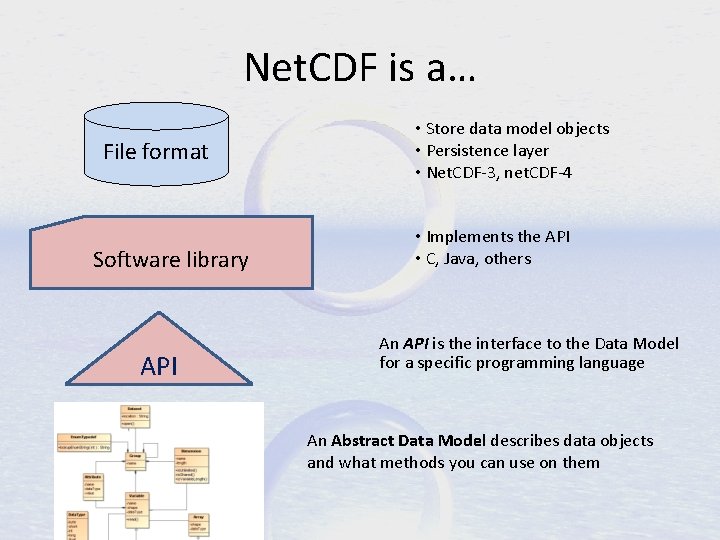
Net. CDF is a… File format Software library API • Store data model objects • Persistence layer • Net. CDF-3, net. CDF-4 • Implements the API • C, Java, others An API is the interface to the Data Model for a specific programming language An Abstract Data Model describes data objects and what methods you can use on them
Net. CDF is a… File format • Stores scientific data • Persistence layer • Net. CDF-3, net. CDF-4 • Portable Format: Machine, OS, application independent • Random Access: fast subsetting • Simple: self-describing, user accessible“flat file” • Documented: NASA ESE standard, 1 page BNF grammer (netcdf-3)
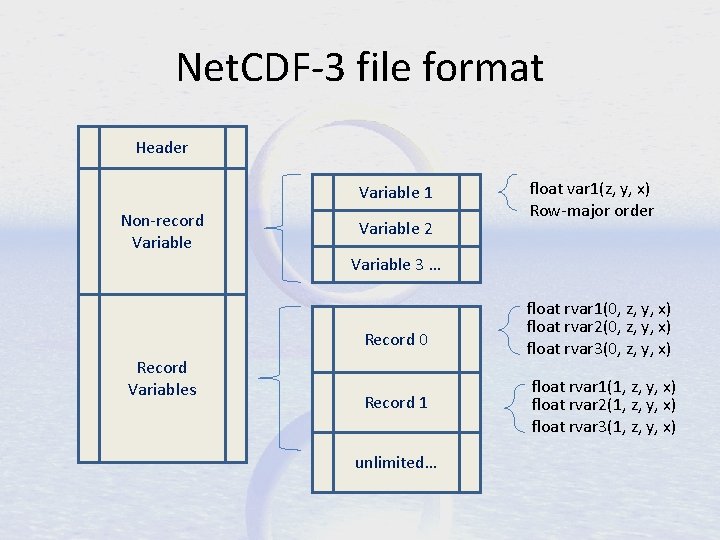
Net. CDF-3 file format Header Variable 1 Non-record Variable 2 float var 1(z, y, x) Row-major order Variable 3 … Record 0 Record Variables Record 1 unlimited… float rvar 1(0, z, y, x) float rvar 2(0, z, y, x) float rvar 3(0, z, y, x) float rvar 1(1, z, y, x) float rvar 2(1, z, y, x) float rvar 3(1, z, y, x)
Net. CDF-4 file format • Built on HDF-5 • Much more complicated than net. CDF-3 • Storage efficiency – Compression – Chunking (can optimize for common I/O pattern) – Multiple unlimited dimensions – Variable length data
Row vs Column storage • Traditional RDBMS is a row store – All fields for one row in a table are stored together • Netcdf-3 is a column store – All data for one variable is stored together • Netcdf-4 allows both row and column store – Row: compound type – Column: regular variable • Recent commercial RDBMS with column oriented storage, better pergormance in some cases • Net. CDF-3 record variables are like a compound type
Net. CDF is a… Software library • Reference library in C Ø Fortran, C++, Perl, Python, Matlab, … • Independent implementation in Java • others? • Open Source • Active community • Supported • No reference library, no user group for GRIB, BUFR Ø fragmented, not interoperable, difficult to use
Net. CDF is a… API The Application Programming Interface (API) is the interface to the Data Model for a specific programming language. • Clean separation of concerns • Information hiding – user never does a seek() • Stable, backwards compatible • Easily understood – no surprises • Interface has small “surface area”
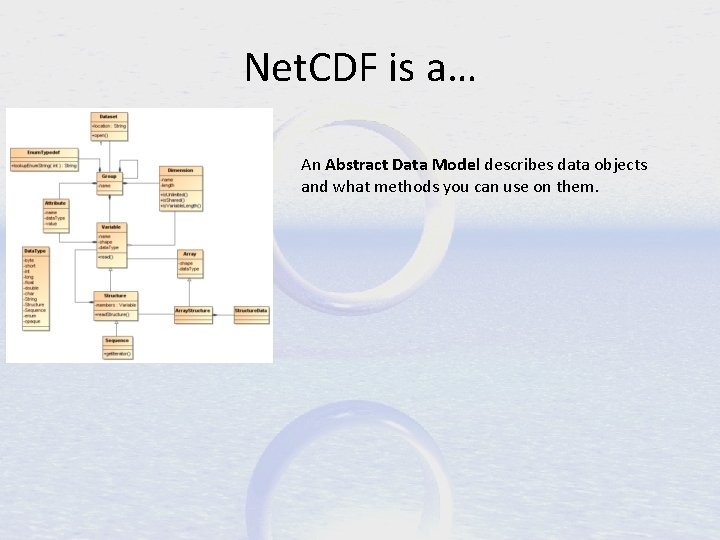
Net. CDF is a… An Abstract Data Model describes data objects and what methods you can use on them.
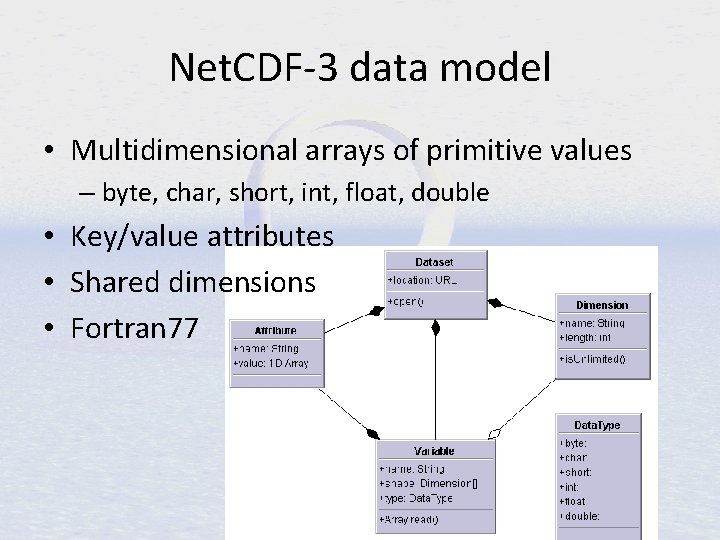
Net. CDF-3 data model • Multidimensional arrays of primitive values – byte, char, short, int, float, double • Key/value attributes • Shared dimensions • Fortran 77
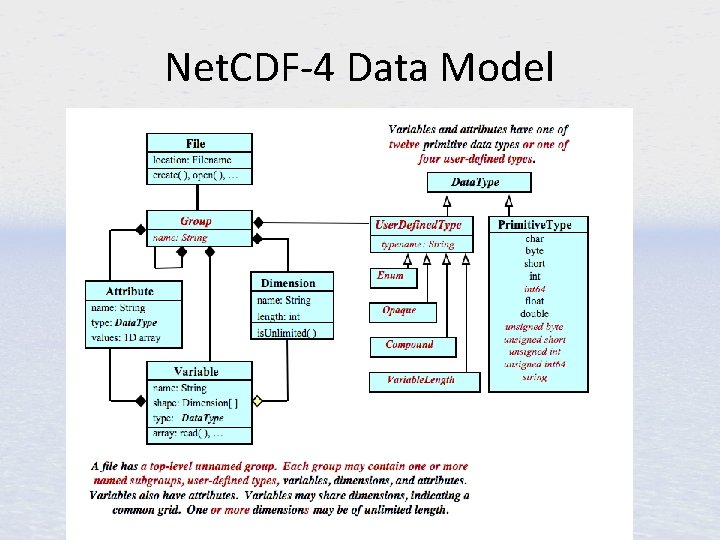
Net. CDF-4 Data Model
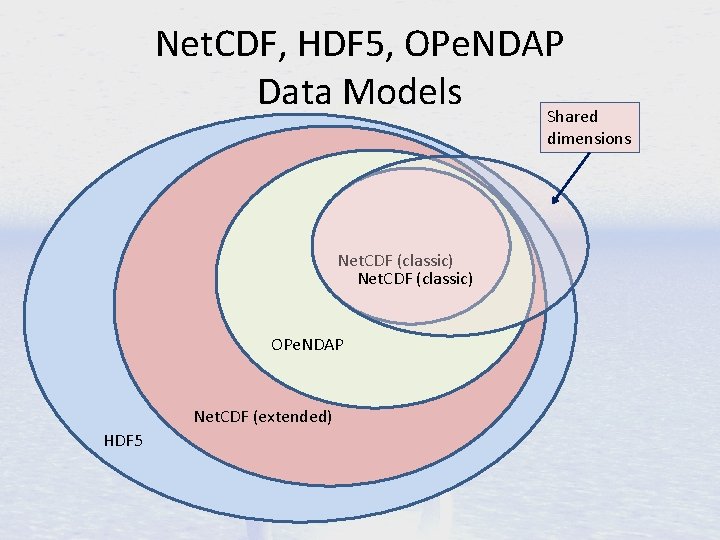
Net. CDF, HDF 5, OPe. NDAP Data Models Shared dimensions Net. CDF (classic) OPe. NDAP Net. CDF (extended) HDF 5
Net. CDF-Java Library (aka) Common Data Model Status Update
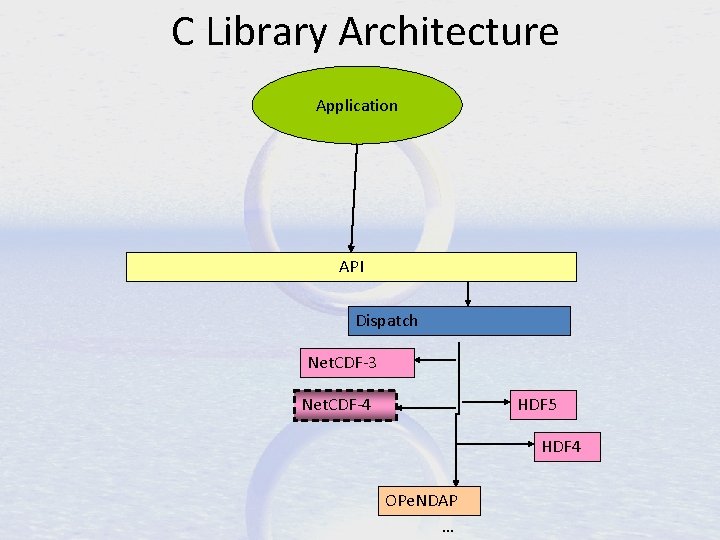
C Library Architecture Application API Dispatch Net. CDF-3 Net. CDF-4 HDF 5 HDF 4 OPe. NDAP …
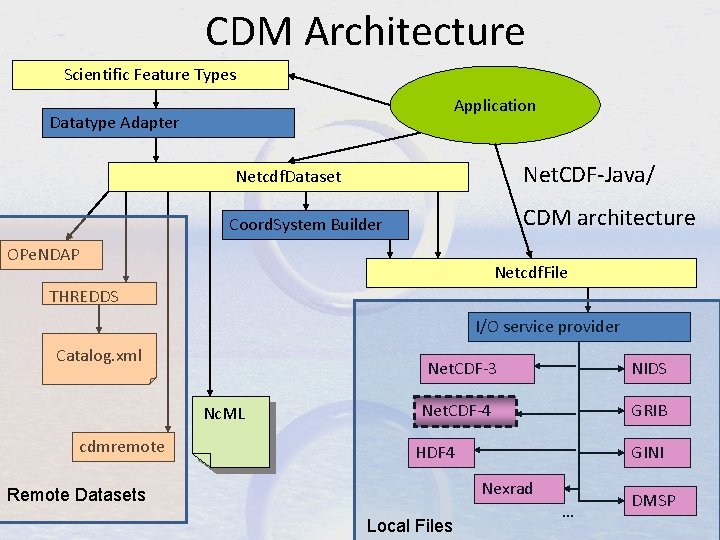
CDM Architecture Scientific Feature Types Application Datatype Adapter Net. CDF-Java/ Netcdf. Dataset CDM architecture Coord. System Builder OPe. NDAP Netcdf. File THREDDS I/O service provider Catalog. xml Net. CDF-3 Nc. ML cdmremote NIDS Net. CDF-4 GRIB HDF 4 GINI Nexrad Remote Datasets Local Files … DMSP

CDM file formats
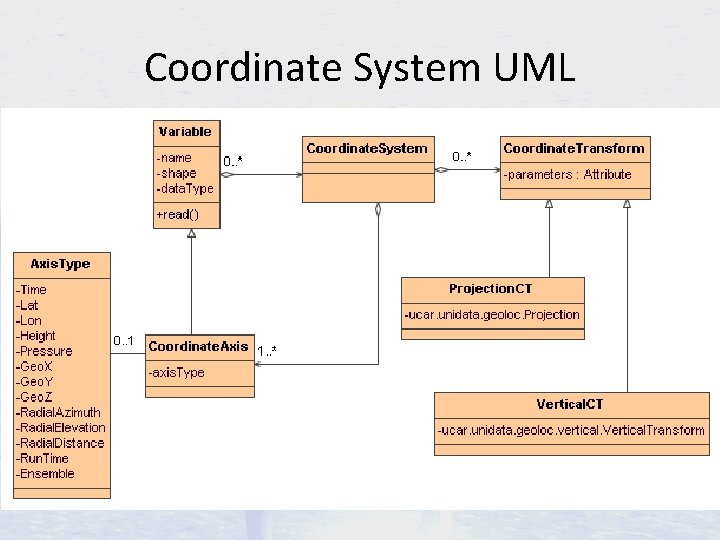
Coordinate System UML
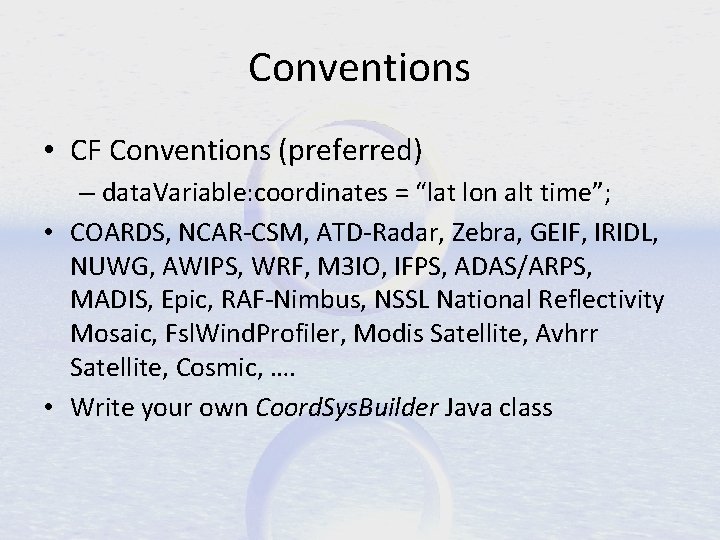
Conventions • CF Conventions (preferred) – data. Variable: coordinates = “lat lon alt time”; • COARDS, NCAR-CSM, ATD-Radar, Zebra, GEIF, IRIDL, NUWG, AWIPS, WRF, M 3 IO, IFPS, ADAS/ARPS, MADIS, Epic, RAF-Nimbus, NSSL National Reflectivity Mosaic, Fsl. Wind. Profiler, Modis Satellite, Avhrr Satellite, Cosmic, …. • Write your own Coord. Sys. Builder Java class
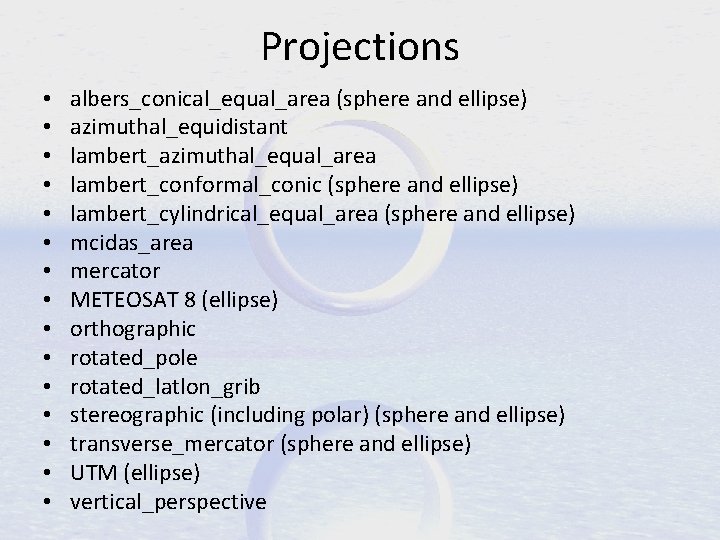
Projections • • • • albers_conical_equal_area (sphere and ellipse) azimuthal_equidistant lambert_azimuthal_equal_area lambert_conformal_conic (sphere and ellipse) lambert_cylindrical_equal_area (sphere and ellipse) mcidas_area mercator METEOSAT 8 (ellipse) orthographic rotated_pole rotated_latlon_grib stereographic (including polar) (sphere and ellipse) transverse_mercator (sphere and ellipse) UTM (ellipse) vertical_perspective
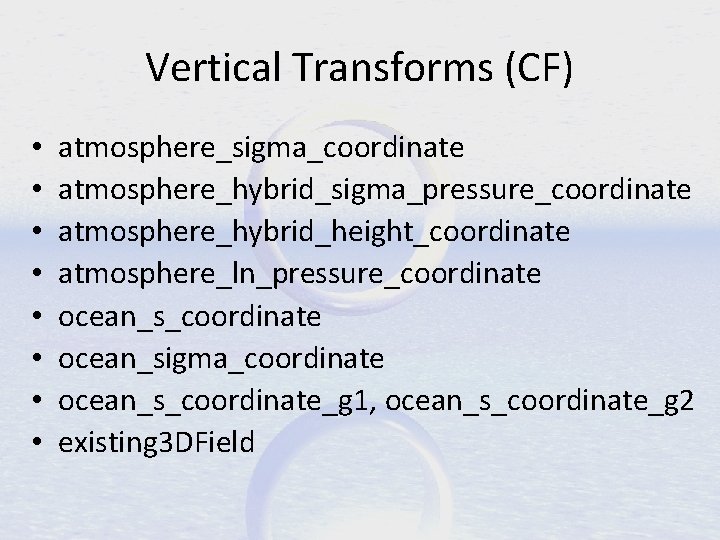
Vertical Transforms (CF) • • atmosphere_sigma_coordinate atmosphere_hybrid_sigma_pressure_coordinate atmosphere_hybrid_height_coordinate atmosphere_ln_pressure_coordinate ocean_sigma_coordinate ocean_s_coordinate_g 1, ocean_s_coordinate_g 2 existing 3 DField
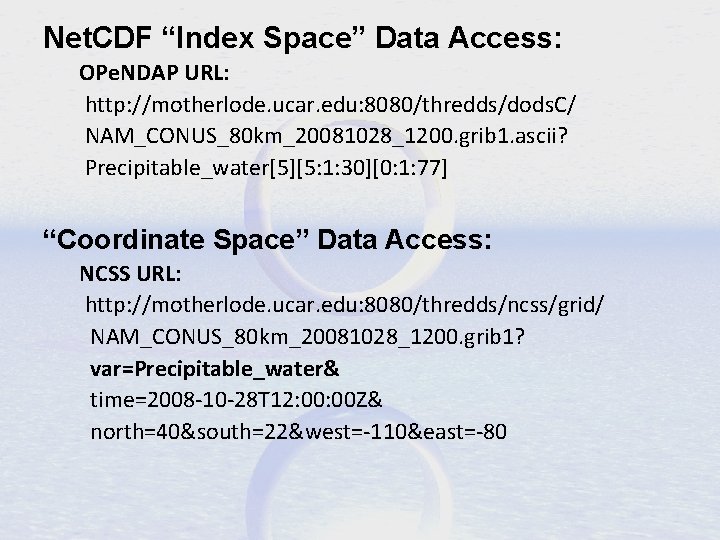
Net. CDF “Index Space” Data Access: OPe. NDAP URL: http: //motherlode. ucar. edu: 8080/thredds/dods. C/ NAM_CONUS_80 km_20081028_1200. grib 1. ascii? Precipitable_water[5][5: 1: 30][0: 1: 77] “Coordinate Space” Data Access: NCSS URL: http: //motherlode. ucar. edu: 8080/thredds/ncss/grid/ NAM_CONUS_80 km_20081028_1200. grib 1? var=Precipitable_water& time=2008 -10 -28 T 12: 00 Z& north=40&south=22&west=-110&east=-80
Scientific Feature Types • Classification of earth science data into broad categories. • Take advantage of the regularities that are found in the data for performance • Scale to large, multifile collections • Support subsetting in Space and Time
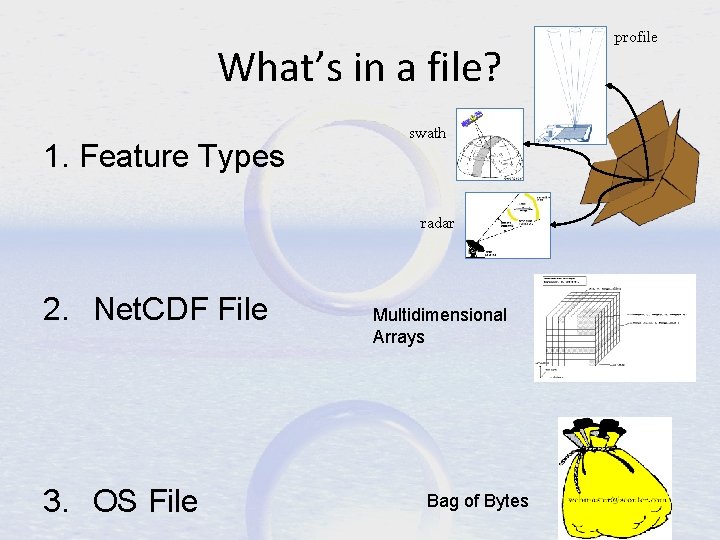
What’s in a file? 1. Feature Types swath radar 2. Net. CDF File 3. OS File Multidimensional Arrays Bag of Bytes profile
Gridded Data • Grid: multidimensional grid, separable coordinates • Radial: a connected set of radials using polar coordinates collected into sweeps • Swath: a two dimensional grid, track and cross -track coordinates • Unstructured Grids: finite element models, coastal modeling (under development)
Point Data • point: a single data point (having no implied coordinate relationship to other points) • time. Series: a series of data points at the same spatial location with monotonically increasing times • trajectory: a series of data points along a path through space with monotonically increasing times • profile: an ordered set of data points along a vertical line at a fixed horizontal position and fixed time • time. Series. Profile: a series of profile features at the same horizontal position with monotonically increasing times • trajectory. Profile: a series of profile features located at points ordered along a trajectory
Discrete Sampling Convention CF 1. 6 • Encoding standard for net. CDF classic files – Challenge: represent ragged arrays efficiently • Classifies data according to connectedness of time/space coordinates • Defines net. CDF data structures that represent features • Make it easy / efficient to – Store collections of features in one file – Read a Feature from a file – Subset the collection by space and time
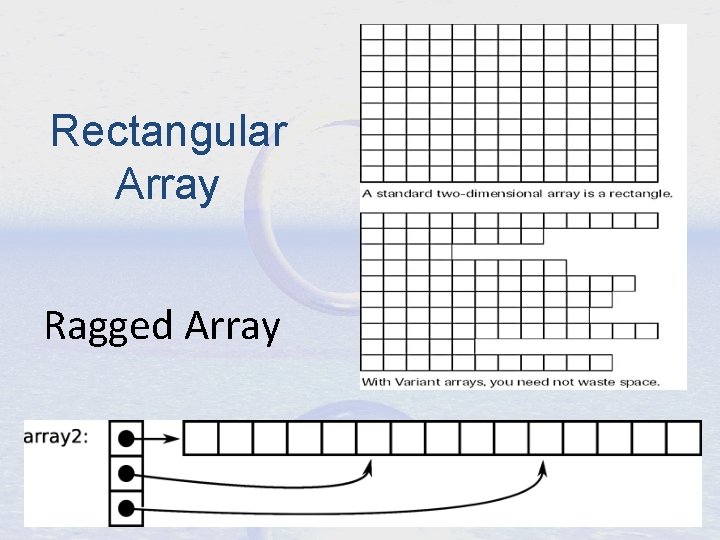
Rectangular Array Ragged Array
Net. CDF Markup Language (Nc. ML) • XML representation of net. CDF metadata (like ncdump -h) • Create new net. CDF files (like ncgen) • Modify (“fix”) existing datasets without rewriting them • Create virtual datasets as aggregations of multiple existing files. • Integrated with the TDS
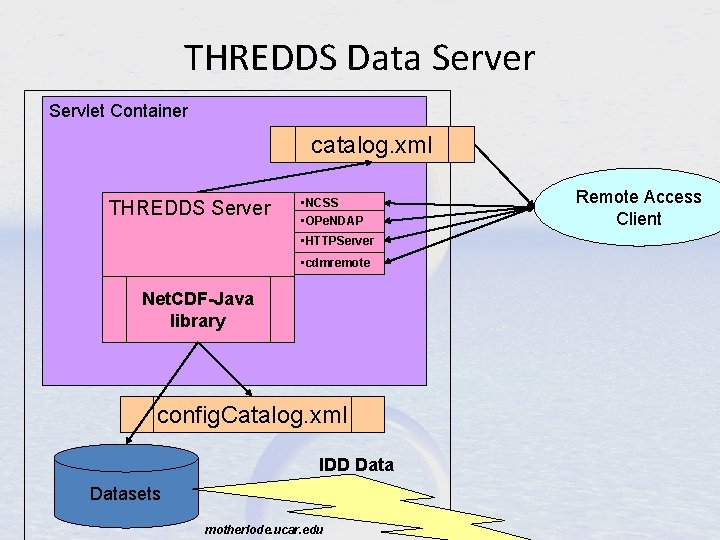
THREDDS Data Server Servlet Container catalog. xml THREDDS Server • NCSS • OPe. NDAP • HTTPServer • cdmremote Net. CDF-Java library config. Catalog. xml IDD Datasets motherlode. ucar. edu Remote Access Client
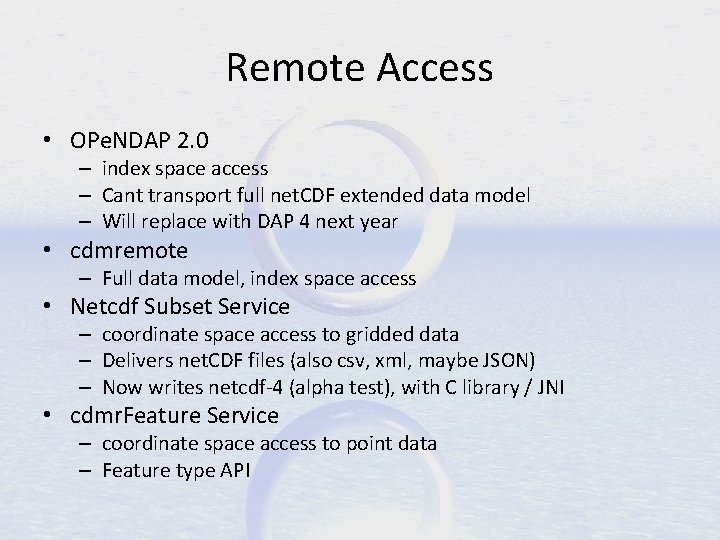
Remote Access • OPe. NDAP 2. 0 – index space access – Cant transport full net. CDF extended data model – Will replace with DAP 4 next year • cdmremote – Full data model, index space access • Netcdf Subset Service – coordinate space access to gridded data – Delivers net. CDF files (also csv, xml, maybe JSON) – Now writes netcdf-4 (alpha test), with C library / JNI • cdmr. Feature Service – coordinate space access to point data – Feature type API
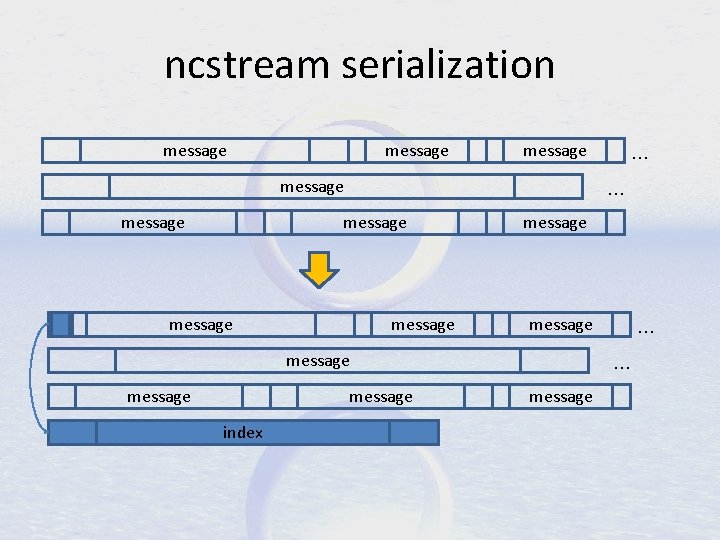
ncstream serialization message message … message message index … … … message
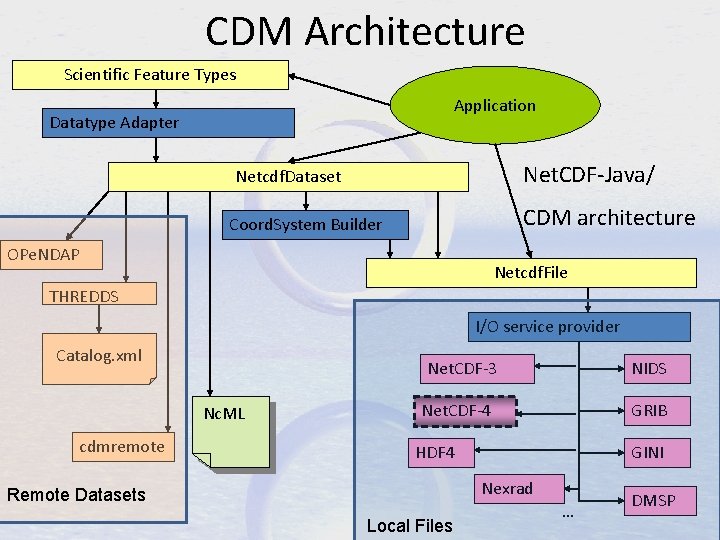
CDM Architecture Scientific Feature Types Application Datatype Adapter Net. CDF-Java/ Netcdf. Dataset CDM architecture Coord. System Builder OPe. NDAP Netcdf. File THREDDS I/O service provider Catalog. xml Net. CDF-3 Nc. ML cdmremote NIDS Net. CDF-4 GRIB HDF 4 GINI Nexrad Remote Datasets Local Files … DMSP
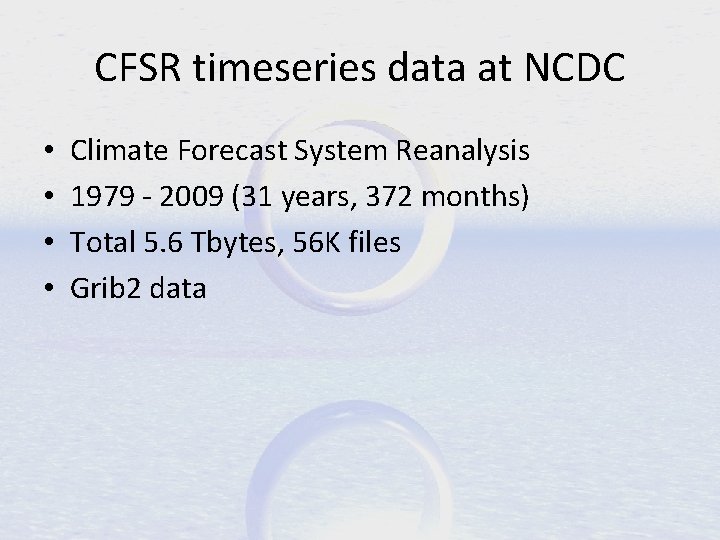
CFSR timeseries data at NCDC • • Climate Forecast System Reanalysis 1979 - 2009 (31 years, 372 months) Total 5. 6 Tbytes, 56 K files Grib 2 data
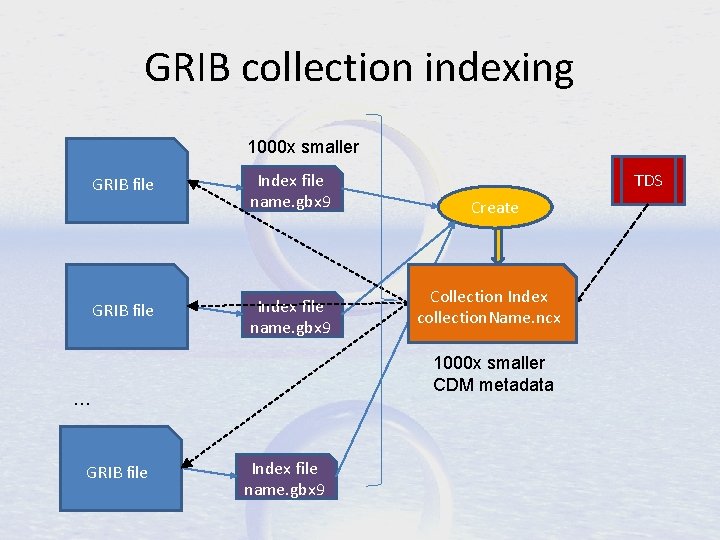
GRIB collection indexing 1000 x smaller GRIB file Index file name. gbx 9 Create Collection Index collection. Name. ncx 1000 x smaller CDM metadata … GRIB file TDS Index file name. gbx 9
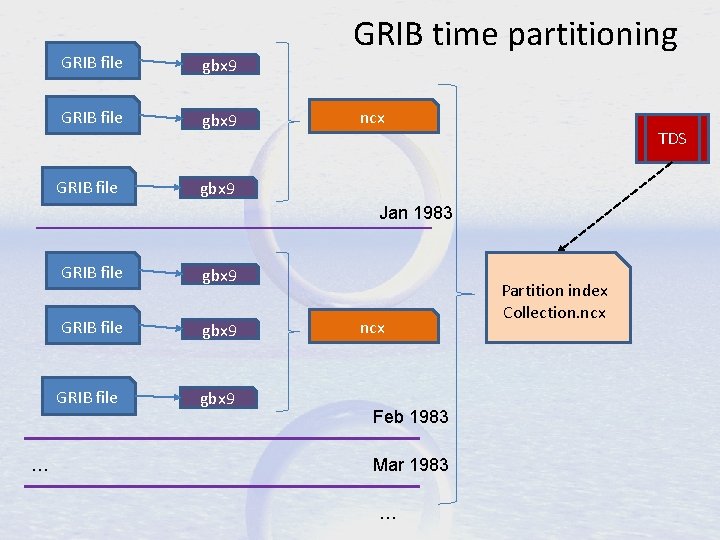
GRIB file gbx 9 … GRIB file gbx 9 GRIB time partitioning ncx TDS Jan 1983 … GRIB file gbx 9 ncx Feb 1983 Mar 1983 … Partition index Collection. ncx
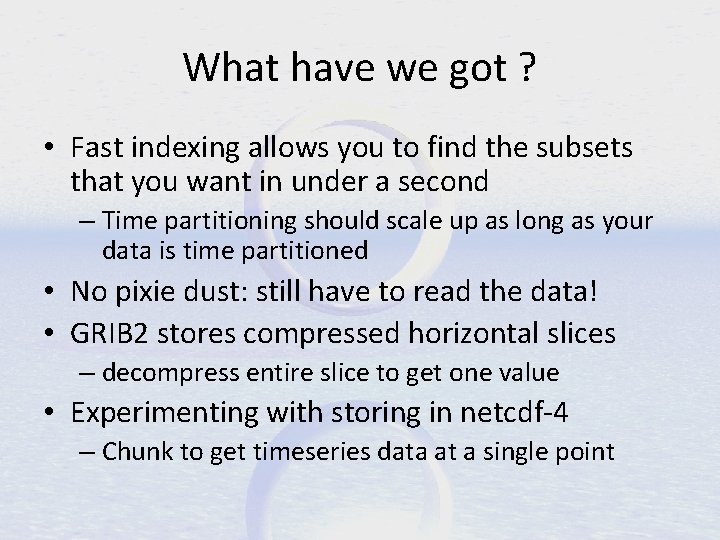
What have we got ? • Fast indexing allows you to find the subsets that you want in under a second – Time partitioning should scale up as long as your data is time partitioned • No pixie dust: still have to read the data! • GRIB 2 stores compressed horizontal slices – decompress entire slice to get one value • Experimenting with storing in netcdf-4 – Chunk to get timeseries data at a single point
Big Data
Bigger Data • CMIP 5 at IPSL Climate Modelling Centre – 300 K net. CDF files, 300 Tb. • Sequential read of 300 Tb @ 100 Mb/sec – 3 x 10^6 sec = 833 hours = 35 days • How to get that down to 8 hours ? ØDivide into 100 jobs, run in parallel
Required: Parallel I/O Systems • Shared nothing, commodity disks • Fault tolerant, replicated data (3 x) • Google File System using map/reduce – Hadoop is open source implementation • Wide industry use • Cost – – $3000 per node TCO per year $300 K per year for 100 node cluster Cost will continue to fall Not sure if you should rent or buy
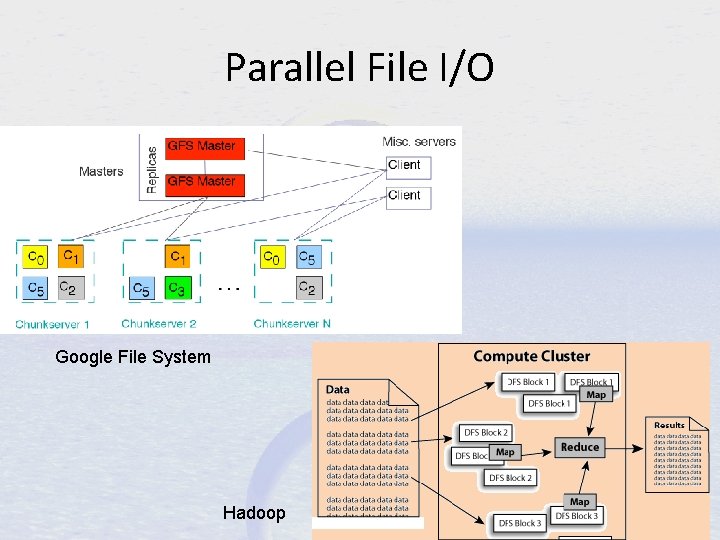
Parallel File I/O Google File System Hadoop
Required: Send User programs to server • Need a query / computation language – easily parallelized – scientists can/will use – Powerful enough to accomplish hard tasks • What language? – Not going to retrofit existing Fortran code • Remember, this is post-processing, not model runs – Not Fortran, C, Java (too low level) – Some subset of Python ?
Send User programs to server • Probably a Domain Specific Language (DSL) – Make it up for this specific purpose – But make it familiar! – So it could look like some subset of existing language
Existing Candidates • Sci. DB just proposed Array. QL: “Array. QL currently comprises two parts: an array algebra, meant to provide a precise semantics of operations on arrays; and a user-level language, for defining and querying arrays. The user-level language is modeled on SQL, but with extensions to support array dimensions. ” • Google Earth Engine is developing a DSL
Required: Parallelizable High Level Language • Scientific Data Management in the Coming Decade, Jim Gray (2005) • Now: File-at-a-time processing in Fortran • Need: Set-at-a-time processing in HLQL • Declarative language like SQL (vs. procedural): • Define dataset subset to work against • Define computation • Let the system figure out how to do it
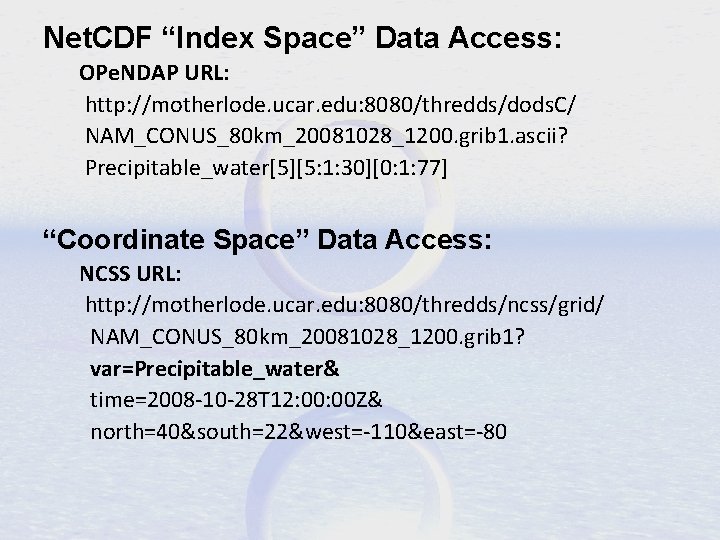
Net. CDF “Index Space” Data Access: OPe. NDAP URL: http: //motherlode. ucar. edu: 8080/thredds/dods. C/ NAM_CONUS_80 km_20081028_1200. grib 1. ascii? Precipitable_water[5][5: 1: 30][0: 1: 77] “Coordinate Space” Data Access: NCSS URL: http: //motherlode. ucar. edu: 8080/thredds/ncss/grid/ NAM_CONUS_80 km_20081028_1200. grib 1? var=Precipitable_water& time=2008 -10 -28 T 12: 00 Z& north=40&south=22&west=-110&east=-80
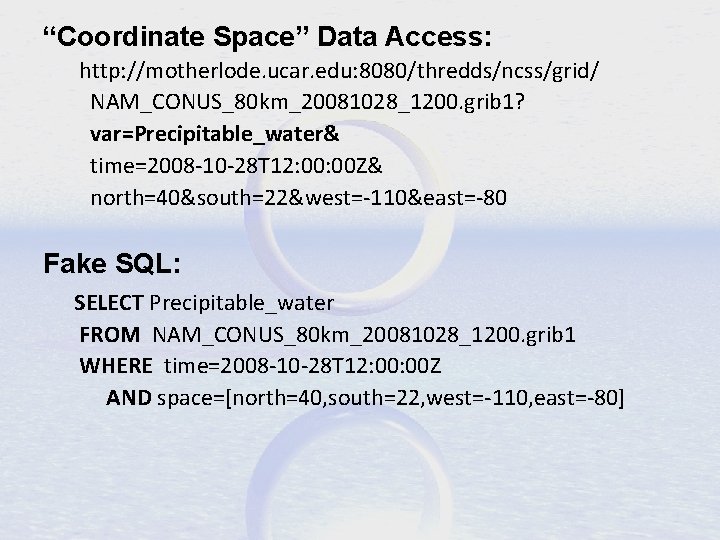
“Coordinate Space” Data Access: http: //motherlode. ucar. edu: 8080/thredds/ncss/grid/ NAM_CONUS_80 km_20081028_1200. grib 1? var=Precipitable_water& time=2008 -10 -28 T 12: 00 Z& north=40&south=22&west=-110&east=-80 Fake SQL: SELECT Precipitable_water FROM NAM_CONUS_80 km_20081028_1200. grib 1 WHERE time=2008 -10 -28 T 12: 00 Z AND space=[north=40, south=22, west=-110, east=-80]
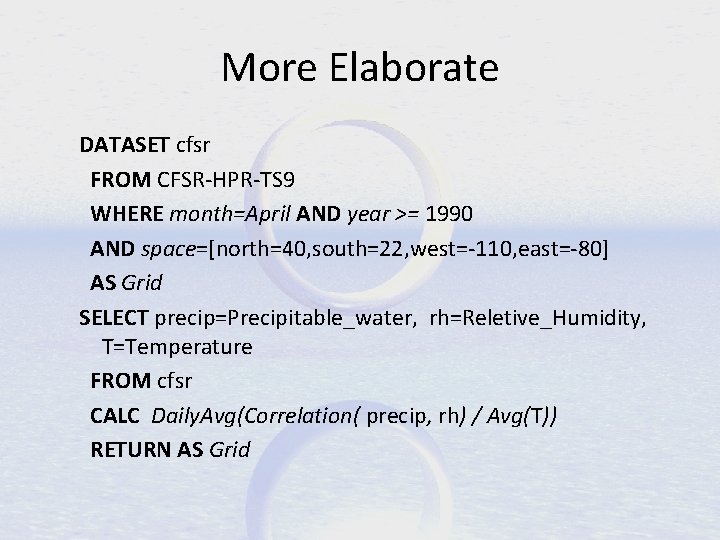
More Elaborate DATASET cfsr FROM CFSR-HPR-TS 9 WHERE month=April AND year >= 1990 AND space=[north=40, south=22, west=-110, east=-80] AS Grid SELECT precip=Precipitable_water, rh=Reletive_Humidity, T=Temperature FROM cfsr CALC Daily. Avg(Correlation( precip, rh) / Avg(T)) RETURN AS Grid
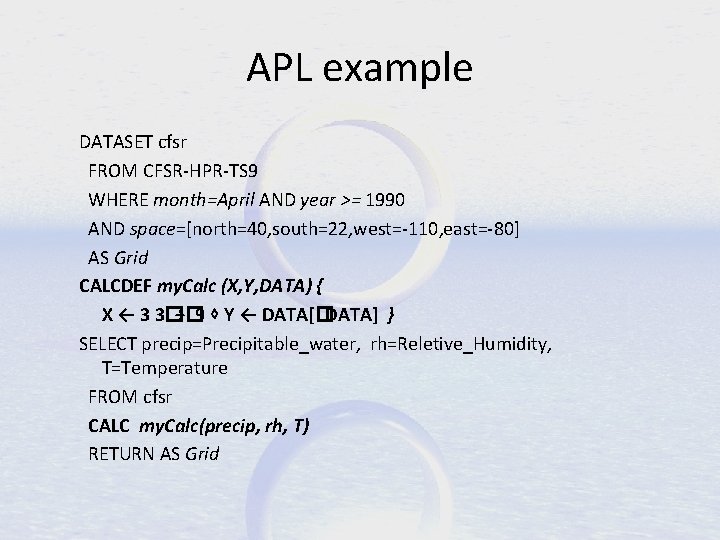
APL example DATASET cfsr FROM CFSR-HPR-TS 9 WHERE month=April AND year >= 1990 AND space=[north=40, south=22, west=-110, east=-80] AS Grid CALCDEF my. Calc (X, Y, DATA) { X ← 3 3�÷� 9 ⋄ Y ← DATA[�DATA] } SELECT precip=Precipitable_water, rh=Reletive_Humidity, T=Temperature FROM cfsr CALC my. Calc(precip, rh, T) RETURN AS Grid
Summary: Big Data Post-Processing • Need parallel I/O System – Shared nothing, commodity disks, replicated data • Need parallel processing system – Hadoop based on GFS (Map/reduce) • Need to send computation to the server • Need a parallelizable query / computation language – Possibly declarative – Must be expressive and powerful – Probably a new “domain specific” language – Need to capture common queries
- Slides: 50