
JobOrder Costing Cost Flows and External Reporting Learning

Job-Order Costing: Cost Flows and External Reporting
Learning Objectives • Understand the flow of costs in a job-order costing system [and prepare appropriate journal entries to record costs]. • Use T-accounts to show the flow of costs in a joborder costing system. • Prepare schedules of cost of goods manufactured and cost of goods sold an income statement. • Compute underapplied or overapplied overhead cost and prepare the journal entry to close the balance in the overhead account.
Flow of Manufacturing Costs • Traditionally, costs follow the physical flow of goods, i. e. , they move as goods move through the manufacturing process and sale. – e. g. , cost of materials are transferred to work-in -process as materials are released to production floor.
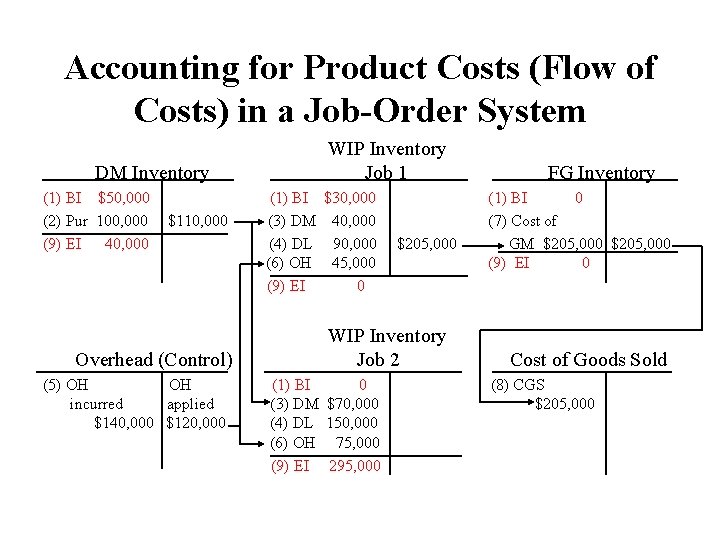
Accounting for Product Costs (Flow of Costs) in a Job-Order System DM Inventory (1) BI $50, 000 (2) Pur 100, 000 (9) EI 40, 000 $110, 000 Overhead (Control) (5) OH OH incurred applied $140, 000 $120, 000 WIP Inventory Job 1 (1) BI $30, 000 (3) DM 40, 000 (4) DL 90, 000 (6) OH 45, 000 (9) EI 0 $205, 000 WIP Inventory Job 2 (1) BI 0 (3) DM $70, 000 (4) DL 150, 000 (6) OH 75, 000 (9) EI 295, 000 FG Inventory (1) BI 0 (7) Cost of GM $205, 000 (9) EI 0 Cost of Goods Sold (8) CGS $205, 000
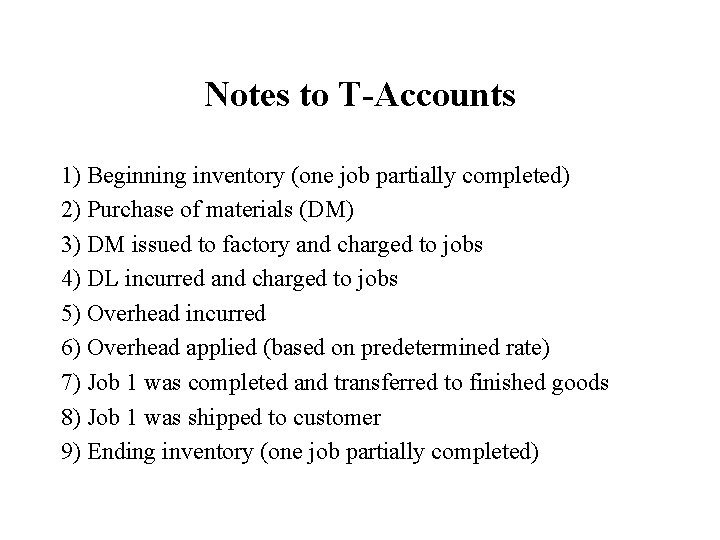
Notes to T-Accounts 1) Beginning inventory (one job partially completed) 2) Purchase of materials (DM) 3) DM issued to factory and charged to jobs 4) DL incurred and charged to jobs 5) Overhead incurred 6) Overhead applied (based on predetermined rate) 7) Job 1 was completed and transferred to finished goods 8) Job 1 was shipped to customer 9) Ending inventory (one job partially completed)
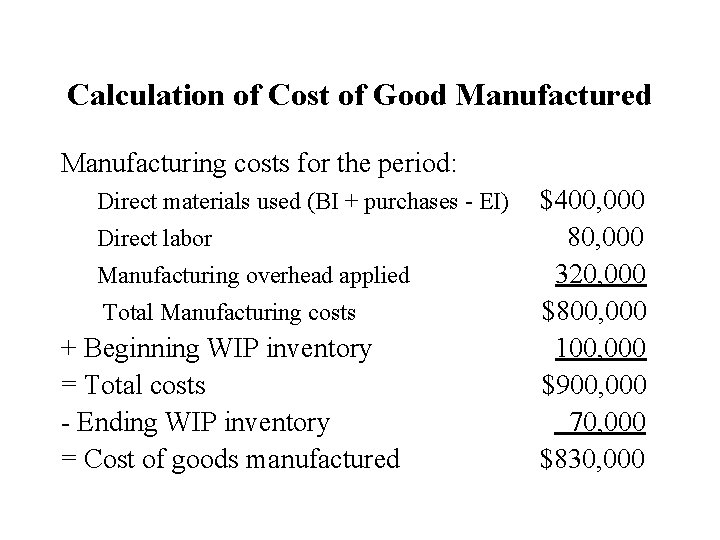
Calculation of Cost of Good Manufactured Manufacturing costs for the period: Direct materials used (BI + purchases - EI) Direct labor Manufacturing overhead applied Total Manufacturing costs + Beginning WIP inventory = Total costs - Ending WIP inventory = Cost of goods manufactured $400, 000 80, 000 320, 000 $800, 000 100, 000 $900, 000 70, 000 $830, 000
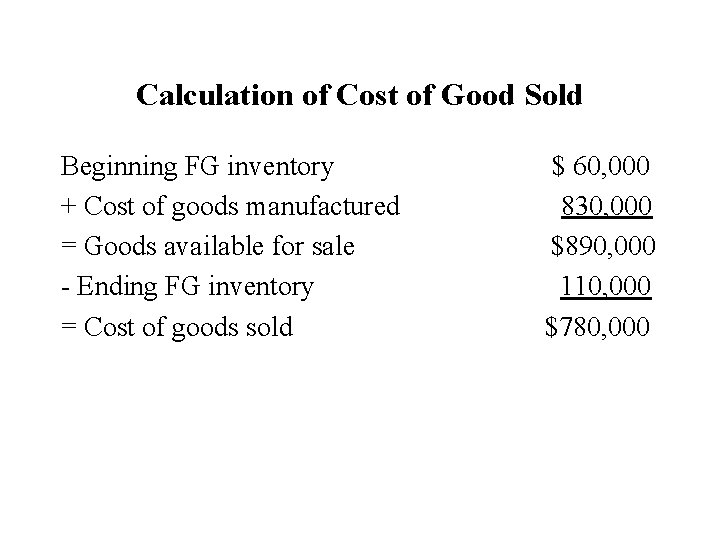
Calculation of Cost of Good Sold Beginning FG inventory + Cost of goods manufactured = Goods available for sale - Ending FG inventory = Cost of goods sold $ 60, 000 830, 000 $890, 000 110, 000 $780, 000
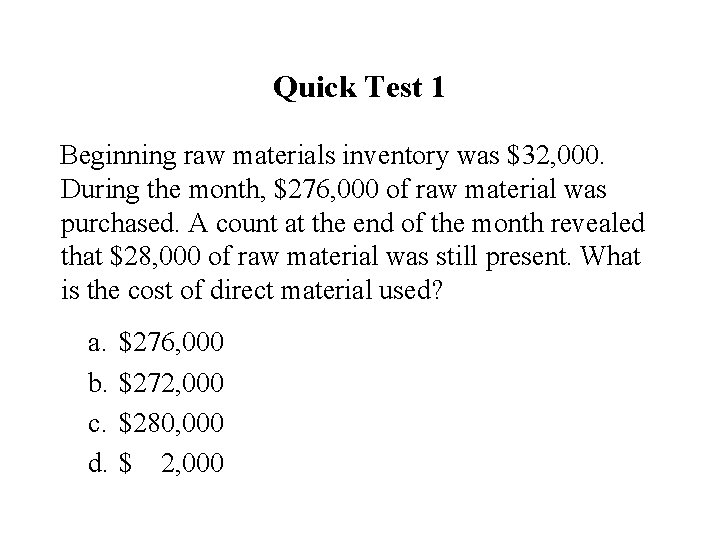
Quick Test 1 Beginning raw materials inventory was $32, 000. During the month, $276, 000 of raw material was purchased. A count at the end of the month revealed that $28, 000 of raw material was still present. What is the cost of direct material used? a. b. c. d. $276, 000 $272, 000 $280, 000 $ 2, 000
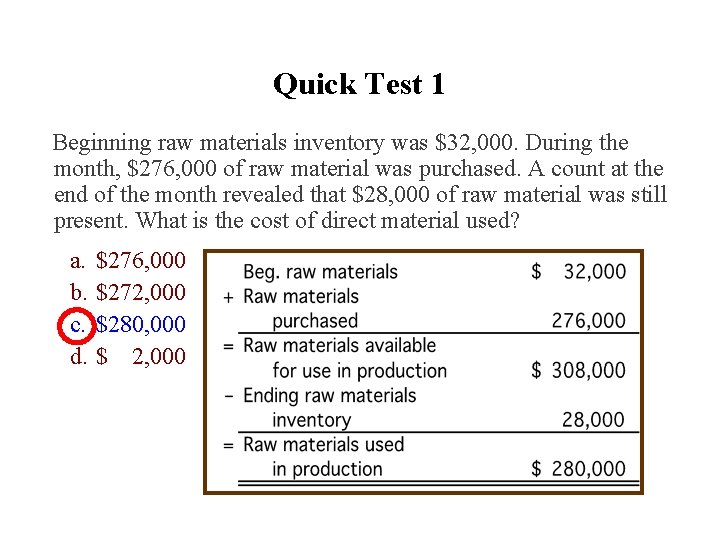
Quick Test 1 Beginning raw materials inventory was $32, 000. During the month, $276, 000 of raw material was purchased. A count at the end of the month revealed that $28, 000 of raw material was still present. What is the cost of direct material used? a. b. c. d. $276, 000 $272, 000 $280, 000 $ 2, 000
Quick Test 2 Direct materials used in production totaled $280, 000. Direct labor was $375, 000, and $180, 000 of manufacturing overhead was applied to production for the month. What were total manufacturing costs for the month? a. $555, 000 b. $835, 000 c. $655, 000 d. Cannot be determined.
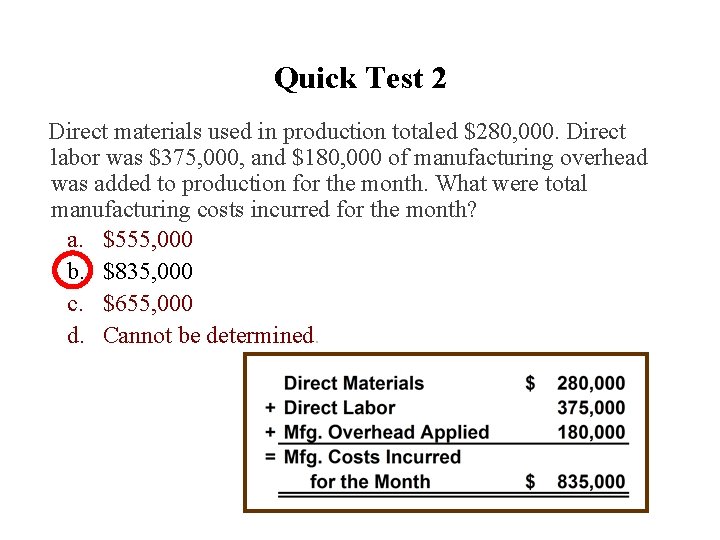
Quick Test 2 Direct materials used in production totaled $280, 000. Direct labor was $375, 000, and $180, 000 of manufacturing overhead was added to production for the month. What were total manufacturing costs incurred for the month? a. $555, 000 b. $835, 000 c. $655, 000 d. Cannot be determined.
Quick Test 3 Beginning work in process was $125, 000. Manufacturing costs added to production for the month were $835, 000. There were $200, 000 of partially finished goods remaining in work in process inventory at the end of the month. What was the cost of goods manufactured during the month? a. b. c. d. $1, 160, 000 $ 910, 000 $ 760, 000 Cannot be determined.
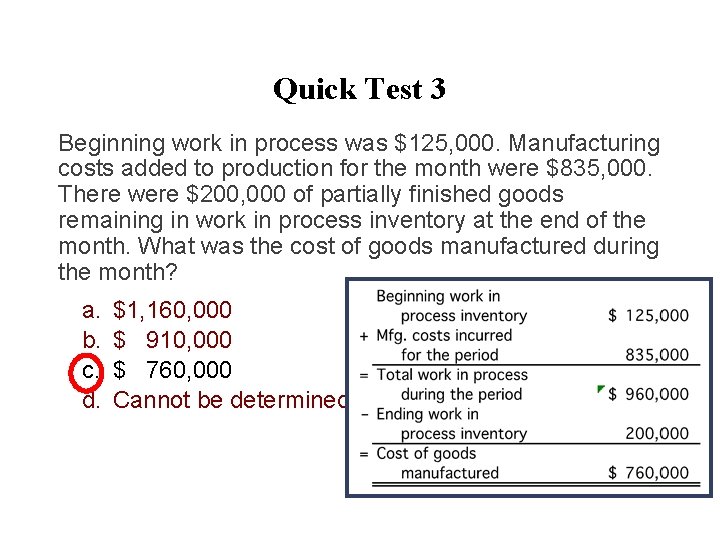
Quick Test 3 Beginning work in process was $125, 000. Manufacturing costs added to production for the month were $835, 000. There were $200, 000 of partially finished goods remaining in work in process inventory at the end of the month. What was the cost of goods manufactured during the month? a. b. c. d. $1, 160, 000 $ 910, 000 $ 760, 000 Cannot be determined.
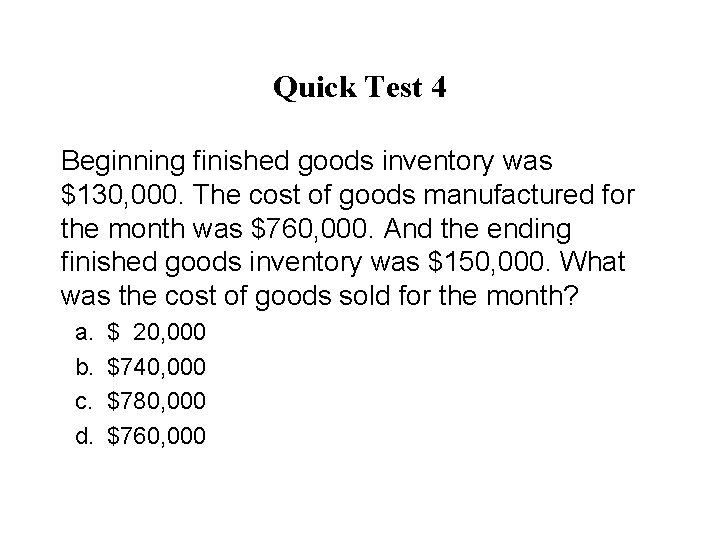
Quick Test 4 Beginning finished goods inventory was $130, 000. The cost of goods manufactured for the month was $760, 000. And the ending finished goods inventory was $150, 000. What was the cost of goods sold for the month? a. b. c. d. $ 20, 000 $740, 000 $780, 000 $760, 000
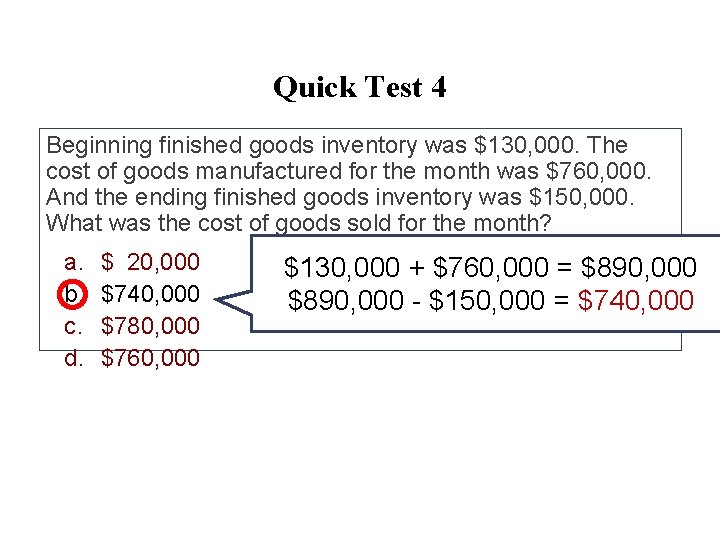
Quick Test 4 Beginning finished goods inventory was $130, 000. The cost of goods manufactured for the month was $760, 000. And the ending finished goods inventory was $150, 000. What was the cost of goods sold for the month? a. b. c. d. $ 20, 000 $740, 000 $780, 000 $760, 000 $130, 000 + $760, 000 = $890, 000 - $150, 000 = $740, 000
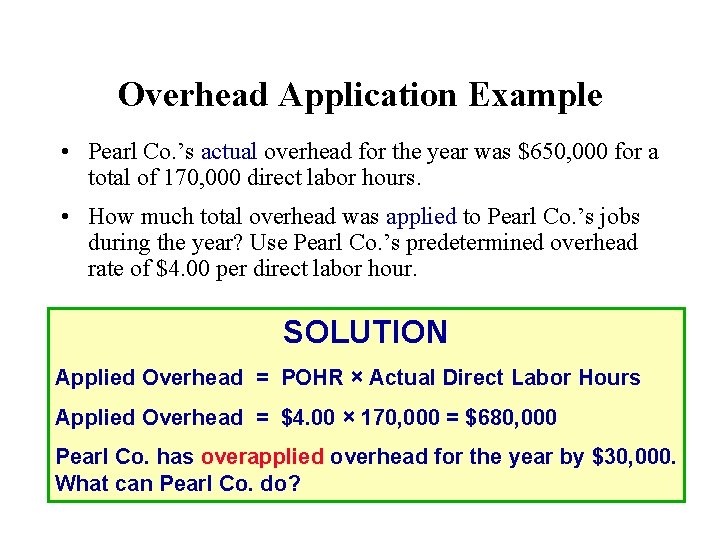
Overhead Application Example • Pearl Co. ’s actual overhead for the year was $650, 000 for a total of 170, 000 direct labor hours. • How much total overhead was applied to Pearl Co. ’s jobs during the year? Use Pearl Co. ’s predetermined overhead rate of $4. 00 per direct labor hour. SOLUTION Applied Overhead = POHR × Actual Direct Labor Hours Applied Overhead = $4. 00 × 170, 000 = $680, 000 Pearl Co. has overapplied overhead for the year by $30, 000. What can Pearl Co. do?
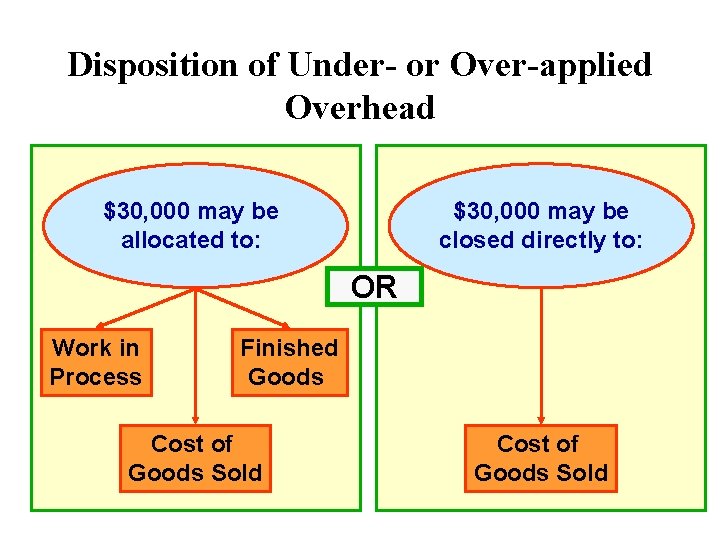
Disposition of Under- or Over-applied Overhead $30, 000 may be allocated to: $30, 000 may be closed directly to: OR Work in Process Finished Goods Cost of Goods Sold
- Slides: 17