
JobOrder Costing Calculating Unit Product Costs CHAPTER 2
Job-Order Costing: Calculating Unit Product Costs CHAPTER 2 Power. Point Authors: Susan Coomer Galbreath, Ph. D. , CPA Jon A. Booker, Ph. D. , CPA, CIA Cynthia J. Rooney, Ph. D. , CPA ©Mc. Graw-Hill Education. All rights reserved. Authorized only for instructor use in the classroom. No reproduction or fur distribution permitted without the prior written consent of Mc. Graw-Hill Education.
2 -2 Job-Order Costing: An Overview Job-order costing systems are used when: 1. Many different products are produced each period. 2. Products are manufactured to order. 3. The unique nature of each order requires tracing or allocating costs to each job, and maintaining cost records for each job. ©Mc. Graw-Hill Education. All rights reserved. Authorized only for instructor use in the classroom. No reproduction or fur distribution permitted without the prior written consent of Mc. Graw-Hill Education.
2 -3 Job-Order Costing: Examples of companies that would use job-order costing include: 1. Boeing (aircraft manufacturing) 2. Bechtel International (large scale construction) 3. Walt Disney Studios (movie production) ©Mc. Graw-Hill Education. All rights reserved. Authorized only for instructor use in the classroom. No reproduction or fur distribution permitted without the prior written consent of Mc. Graw-Hill Education.
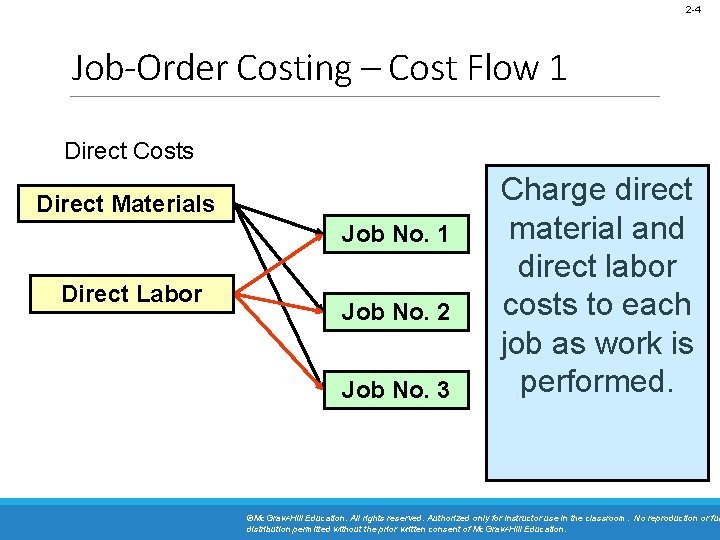
2 -4 Job-Order Costing – Cost Flow 1 Direct Costs Direct Materials Job No. 1 Direct Labor Job No. 2 Job No. 3 Charge direct material and direct labor costs to each job as work is performed. ©Mc. Graw-Hill Education. All rights reserved. Authorized only for instructor use in the classroom. No reproduction or fur distribution permitted without the prior written consent of Mc. Graw-Hill Education.
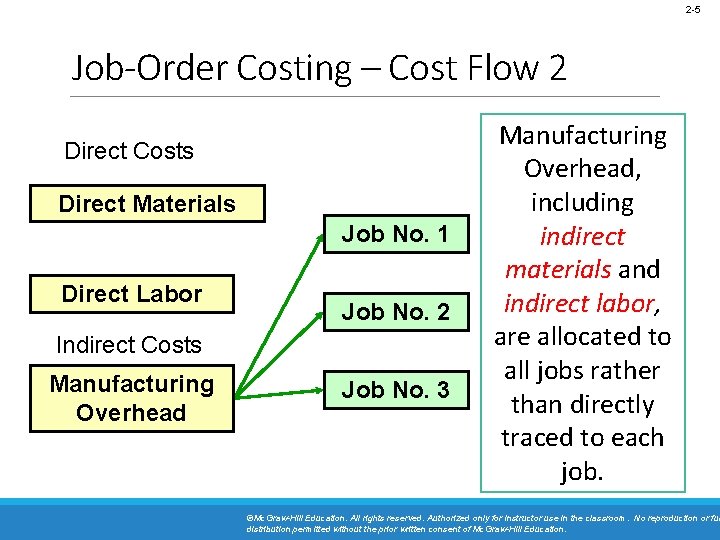
2 -5 Job-Order Costing – Cost Flow 2 Direct Costs Direct Materials Job No. 1 Direct Labor Job No. 2 Indirect Costs Manufacturing Overhead Job No. 3 Manufacturing Overhead, including indirect materials and indirect labor, are allocated to all jobs rather than directly traced to each job. ©Mc. Graw-Hill Education. All rights reserved. Authorized only for instructor use in the classroom. No reproduction or fur distribution permitted without the prior written consent of Mc. Graw-Hill Education.
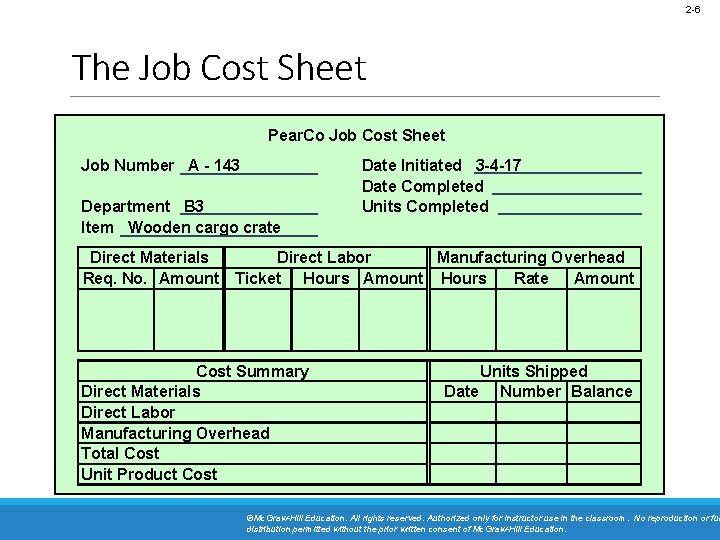
2 -6 The Job Cost Sheet Pear. Co Job Cost Sheet Job Number A - 143 Department B 3 Item Wooden cargo crate Date Initiated 3 -4 -17 Date Completed Units Completed Direct Materials Direct Labor Manufacturing Overhead Req. No. Amount Ticket Hours Amount Hours Rate Amount Cost Summary Direct Materials Direct Labor Manufacturing Overhead Total Cost Unit Product Cost Units Shipped Date Number Balance ©Mc. Graw-Hill Education. All rights reserved. Authorized only for instructor use in the classroom. No reproduction or fur distribution permitted without the prior written consent of Mc. Graw-Hill Education.
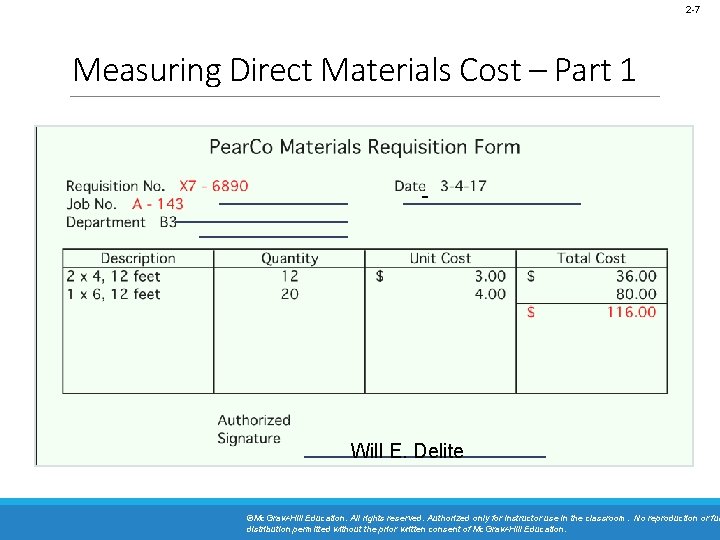
2 -7 Measuring Direct Materials Cost – Part 1 Will E. Delite ©Mc. Graw-Hill Education. All rights reserved. Authorized only for instructor use in the classroom. No reproduction or fur distribution permitted without the prior written consent of Mc. Graw-Hill Education.
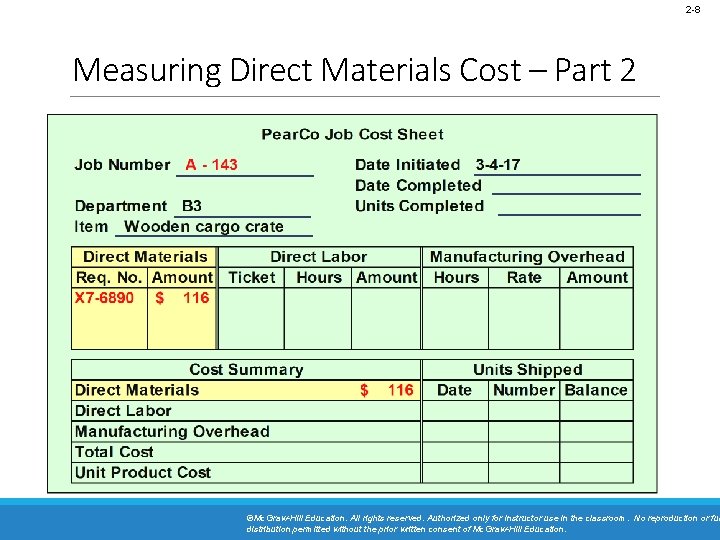
2 -8 Measuring Direct Materials Cost – Part 2 ©Mc. Graw-Hill Education. All rights reserved. Authorized only for instructor use in the classroom. No reproduction or fur distribution permitted without the prior written consent of Mc. Graw-Hill Education.
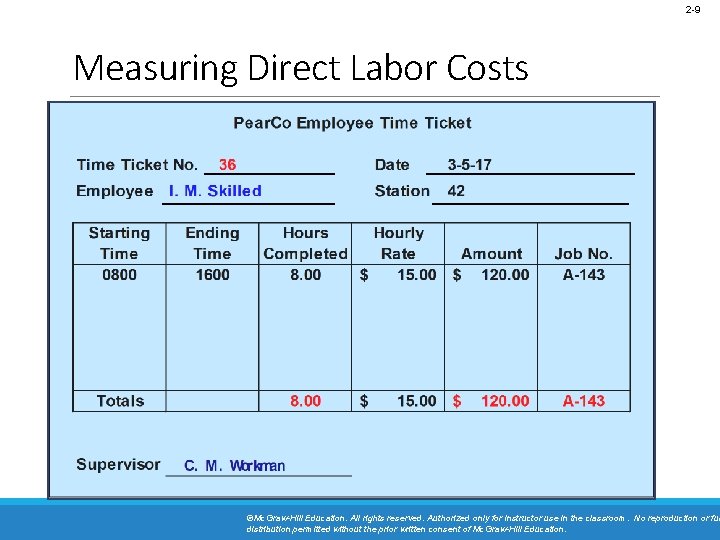
2 -9 Measuring Direct Labor Costs ©Mc. Graw-Hill Education. All rights reserved. Authorized only for instructor use in the classroom. No reproduction or fur distribution permitted without the prior written consent of Mc. Graw-Hill Education.
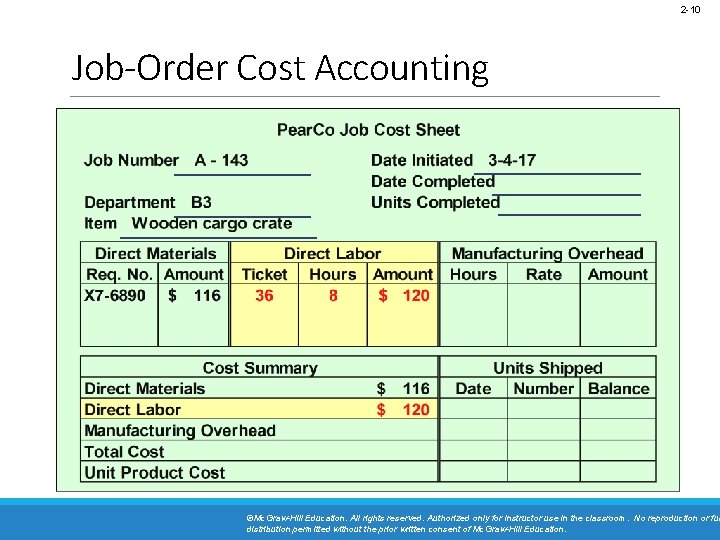
2 -10 Job-Order Cost Accounting ©Mc. Graw-Hill Education. All rights reserved. Authorized only for instructor use in the classroom. No reproduction or fur distribution permitted without the prior written consent of Mc. Graw-Hill Education.
2 -11 Learning Objective 1 Compute a predetermined overhead rate. ©Mc. Graw-Hill Education. All rights reserved. Authorized only for instructor use in the classroom. No reproduction or fur distribution permitted without the prior written consent of Mc. Graw-Hill Education.
2 -12 Why Use an Allocation Base? An allocation base, such as direct labor hours, direct labor dollars, or machine hours, is used to assign manufacturing overhead to individual jobs. We use an allocation base because: a. It is impossible or difficult to trace overhead costs to particular jobs. b. Manufacturing overhead consists of many different items ranging from the grease used in machines to the production manager’s salary. c. Many types of manufacturing overhead costs are fixed even though output fluctuates during the period. ©Mc. Graw-Hill Education. All rights reserved. Authorized only for instructor use in the classroom. No reproduction or fur distribution permitted without the prior written consent of Mc. Graw-Hill Education.
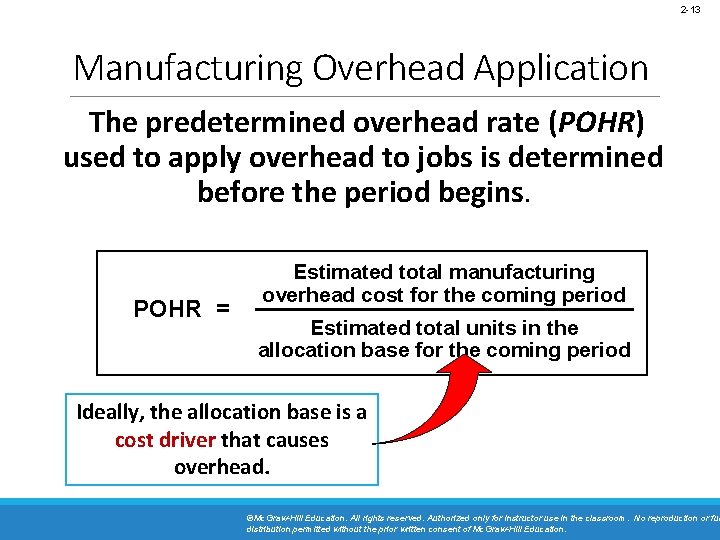
2 -13 Manufacturing Overhead Application The predetermined overhead rate (POHR) used to apply overhead to jobs is determined before the period begins. POHR = Estimated total manufacturing overhead cost for the coming period Estimated total units in the allocation base for the coming period Ideally, the allocation base is a cost driver that causes overhead. ©Mc. Graw-Hill Education. All rights reserved. Authorized only for instructor use in the classroom. No reproduction or fur distribution permitted without the prior written consent of Mc. Graw-Hill Education.
2 -14 The Need for a POHR Predetermined overhead rates that rely upon estimated data are often used because: 1. Actual overhead for the period is not known until the end of the period, thus inhibiting the ability to estimate job costs during the period. 2. Actual overhead costs can fluctuate seasonally, thus misleading decision makers. ©Mc. Graw-Hill Education. All rights reserved. Authorized only for instructor use in the classroom. No reproduction or fur distribution permitted without the prior written consent of Mc. Graw-Hill Education.
Computing Predetermined Overhead Rates 2 -15 The predetermined overhead rate is computed before the period begins using a four-step process. 1. Estimate the total amount of the allocation base (the denominator) that will be required for next period’s estimated level of production. 2. Estimate the total fixed manufacturing overhead cost for the coming period and the variable manufacturing overhead cost per unit of the allocation base. 3. Use the following equation to estimate the total amount of manufacturing overhead: Y = a + b. X Where, Y = The estimated total manufacturing overhead cost a = The estimated total fixed manufacturing overhead cost b = The estimated variable manufacturing overhead cost per unit of the allocation base X = The estimated total amount of the allocation base 4. Compute the predetermined overhead rate. ©Mc. Graw-Hill Education. All rights reserved. Authorized only for instructor use in the classroom. No reproduction or fur distribution permitted without the prior written consent of Mc. Graw-Hill Education.
2 -16 Learning Objective 2 Apply overhead cost to jobs using a predetermined overhead rate. ©Mc. Graw-Hill Education. All rights reserved. Authorized only for instructor use in the classroom. No reproduction or fur distribution permitted without the prior written consent of Mc. Graw-Hill Education.
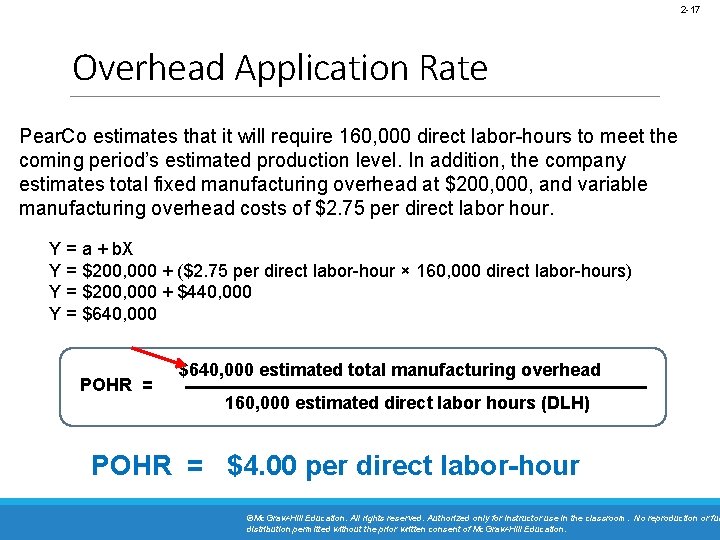
2 -17 Overhead Application Rate Pear. Co estimates that it will require 160, 000 direct labor-hours to meet the coming period’s estimated production level. In addition, the company estimates total fixed manufacturing overhead at $200, 000, and variable manufacturing overhead costs of $2. 75 per direct labor hour. Y = a + b. X Y = $200, 000 + ($2. 75 per direct labor-hour × 160, 000 direct labor-hours) Y = $200, 000 + $440, 000 Y = $640, 000 POHR = $640, 000 estimated total manufacturing overhead 160, 000 estimated direct labor hours (DLH) POHR = $4. 00 per direct labor-hour ©Mc. Graw-Hill Education. All rights reserved. Authorized only for instructor use in the classroom. No reproduction or fur distribution permitted without the prior written consent of Mc. Graw-Hill Education.
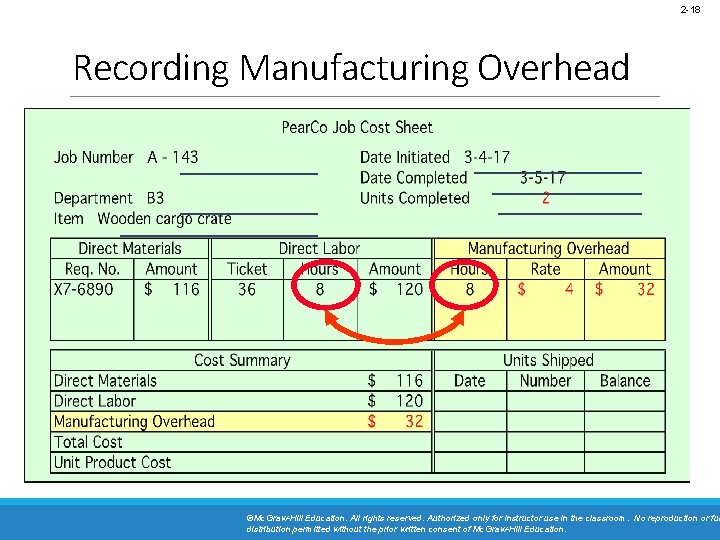
2 -18 Recording Manufacturing Overhead ©Mc. Graw-Hill Education. All rights reserved. Authorized only for instructor use in the classroom. No reproduction or fur distribution permitted without the prior written consent of Mc. Graw-Hill Education.
2 -19 Learning Objective 3 Compute the total cost and the unit product cost of a job using a plantwide predetermined overhead rate. ©Mc. Graw-Hill Education. All rights reserved. Authorized only for instructor use in the classroom. No reproduction or fur distribution permitted without the prior written consent of Mc. Graw-Hill Education.
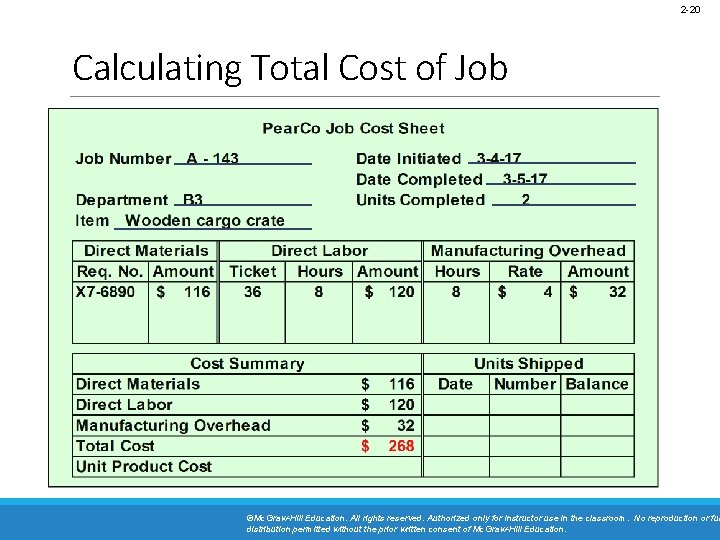
2 -20 Calculating Total Cost of Job ©Mc. Graw-Hill Education. All rights reserved. Authorized only for instructor use in the classroom. No reproduction or fur distribution permitted without the prior written consent of Mc. Graw-Hill Education.
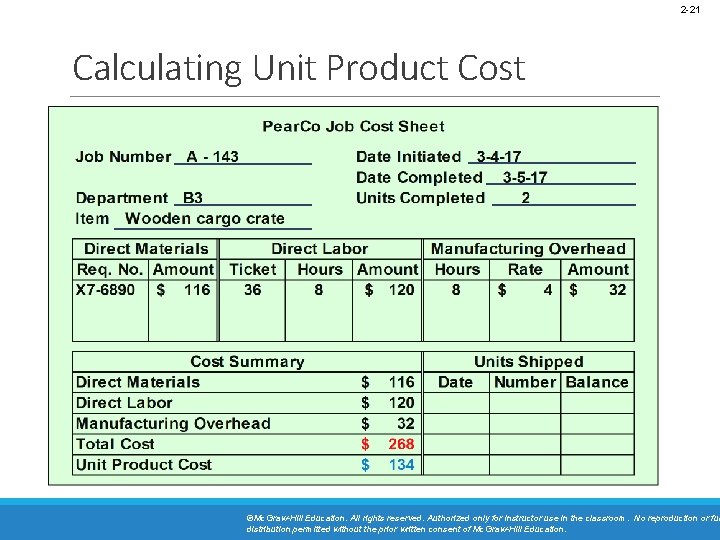
2 -21 Calculating Unit Product Cost ©Mc. Graw-Hill Education. All rights reserved. Authorized only for instructor use in the classroom. No reproduction or fur distribution permitted without the prior written consent of Mc. Graw-Hill Education.
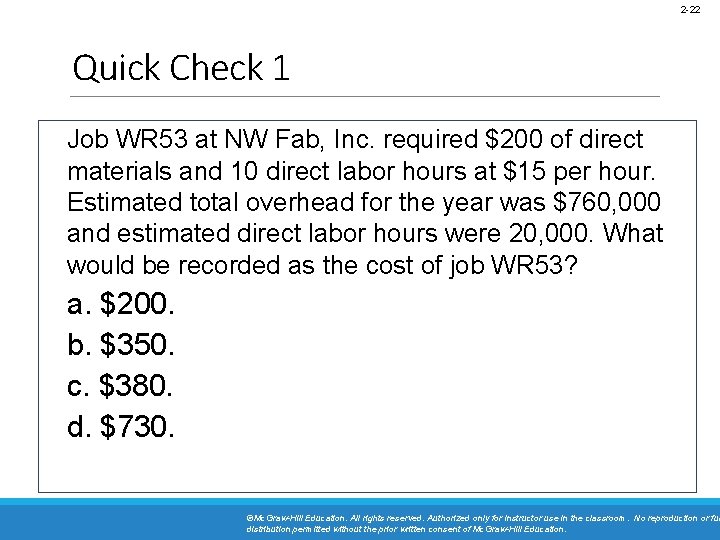
2 -22 Quick Check 1 Job WR 53 at NW Fab, Inc. required $200 of direct materials and 10 direct labor hours at $15 per hour. Estimated total overhead for the year was $760, 000 and estimated direct labor hours were 20, 000. What would be recorded as the cost of job WR 53? a. $200. b. $350. c. $380. d. $730. ©Mc. Graw-Hill Education. All rights reserved. Authorized only for instructor use in the classroom. No reproduction or fur distribution permitted without the prior written consent of Mc. Graw-Hill Education.
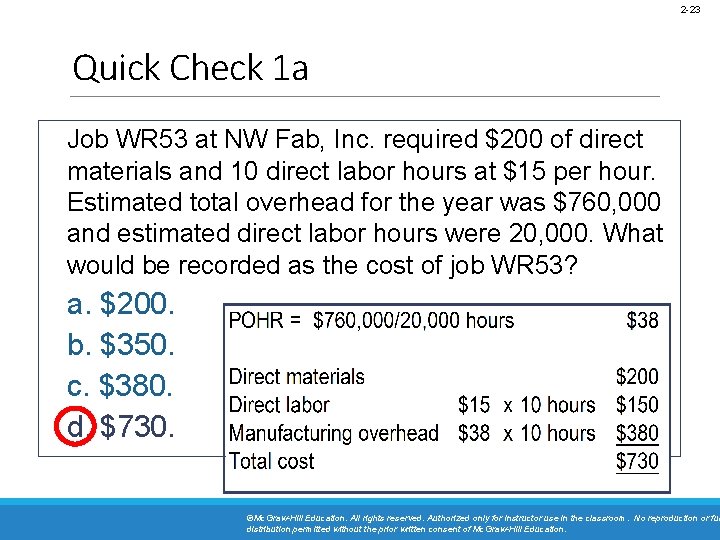
2 -23 Quick Check 1 a Job WR 53 at NW Fab, Inc. required $200 of direct materials and 10 direct labor hours at $15 per hour. Estimated total overhead for the year was $760, 000 and estimated direct labor hours were 20, 000. What would be recorded as the cost of job WR 53? a. $200. b. $350. c. $380. d. $730. ©Mc. Graw-Hill Education. All rights reserved. Authorized only for instructor use in the classroom. No reproduction or fur distribution permitted without the prior written consent of Mc. Graw-Hill Education.
Job-Order Costing – A Managerial Perspective – Part 1 2 -24 Inaccurately assigning manufacturing costs to jobs adversely influences planning and decisions made by managers. 1. Job-order costing systems can accurately trace direct materials and direct labor costs to jobs. 2. Job-order costing systems often fail to accurately allocate the manufacturing overhead costs used during the production process to their respective jobs. ©Mc. Graw-Hill Education. All rights reserved. Authorized only for instructor use in the classroom. No reproduction or fur distribution permitted without the prior written consent of Mc. Graw-Hill Education.
Job-Order Costing – A Managerial Perspective – Part 2 2 -25 Choosing an Allocation Base Job-order costing systems often use allocation bases that do not reflect how jobs actually use overhead resources. The allocation base in the predetermined overhead rate must drive the overhead cost to improve job cost accuracy. A cost driver is a factor that causes overhead costs. Many companies use a single predetermined plantwide overhead rate to allocate all manufacturing overhead costs to jobs based on their usage of direct-labor hours. 1. It is often overly-simplistic and incorrect to assume that direct-labor hours is a company’s only manufacturing overhead cost driver. 2. If more than one overhead cost driver can be identified, job cost accuracy is improved by using multiple predetermined overhead rates. ©Mc. Graw-Hill Education. All rights reserved. Authorized only for instructor use in the classroom. No reproduction or fur distribution permitted without the prior written consent of Mc. Graw-Hill Education.
2 -26 Learning Objective 4 Compute the total cost and the unit product cost of a job using multiple predetermined overhead rates. ©Mc. Graw-Hill Education. All rights reserved. Authorized only for instructor use in the classroom. No reproduction or fur distribution permitted without the prior written consent of Mc. Graw-Hill Education.
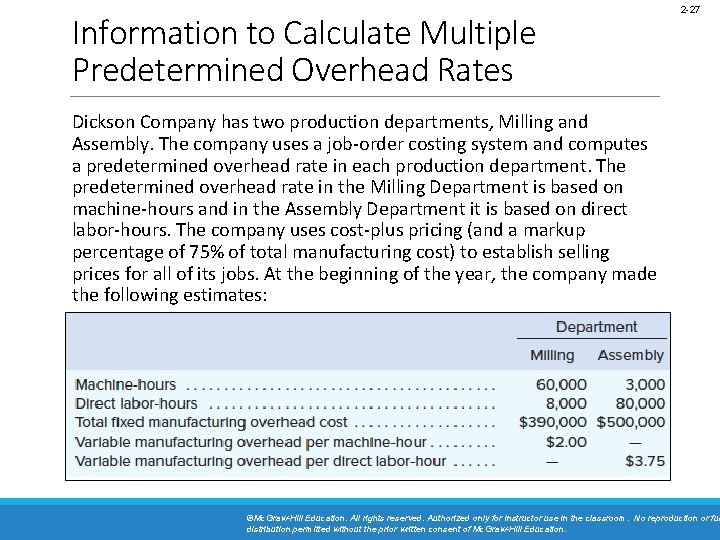
Information to Calculate Multiple Predetermined Overhead Rates 2 -27 Dickson Company has two production departments, Milling and Assembly. The company uses a job-order costing system and computes a predetermined overhead rate in each production department. The predetermined overhead rate in the Milling Department is based on machine-hours and in the Assembly Department it is based on direct labor-hours. The company uses cost-plus pricing (and a markup percentage of 75% of total manufacturing cost) to establish selling prices for all of its jobs. At the beginning of the year, the company made the following estimates: ©Mc. Graw-Hill Education. All rights reserved. Authorized only for instructor use in the classroom. No reproduction or fur distribution permitted without the prior written consent of Mc. Graw-Hill Education.
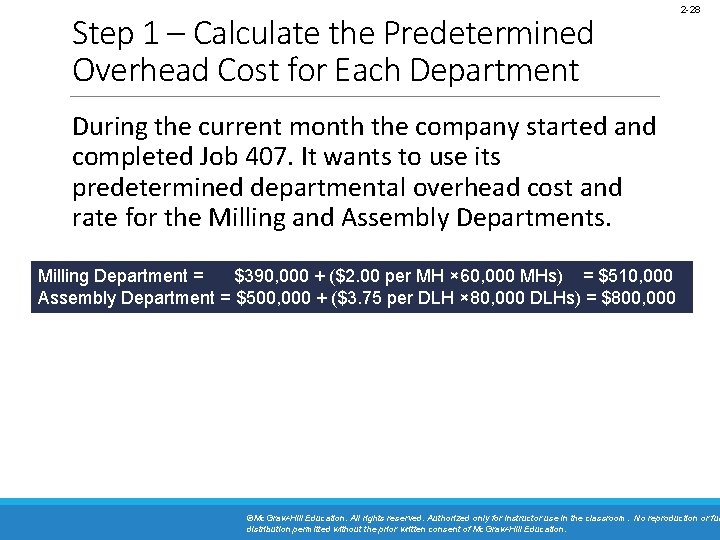
Step 1 – Calculate the Predetermined Overhead Cost for Each Department 2 -28 During the current month the company started and completed Job 407. It wants to use its predetermined departmental overhead cost and rate for the Milling and Assembly Departments. Milling Department = $390, 000 + ($2. 00 per MH × 60, 000 MHs) = $510, 000 Assembly Department = $500, 000 + ($3. 75 per DLH × 80, 000 DLHs) = $800, 000 ©Mc. Graw-Hill Education. All rights reserved. Authorized only for instructor use in the classroom. No reproduction or fur distribution permitted without the prior written consent of Mc. Graw-Hill Education.
Step 2 – Calculate the Predetermined Overhead Rate for Each Department 2 -29 Use the amounts determined on the previous slide to calculate the predetermined overhead rate (POHR) of each department. Milling Department = $510, 000 ÷ 60, 000 MHs = $ 8. 50 per MH Assembly Department = $800, 000 ÷ 80, 000 DLHs = $10. 00 per DLH ©Mc. Graw-Hill Education. All rights reserved. Authorized only for instructor use in the classroom. No reproduction or fur distribution permitted without the prior written consent of Mc. Graw-Hill Education.
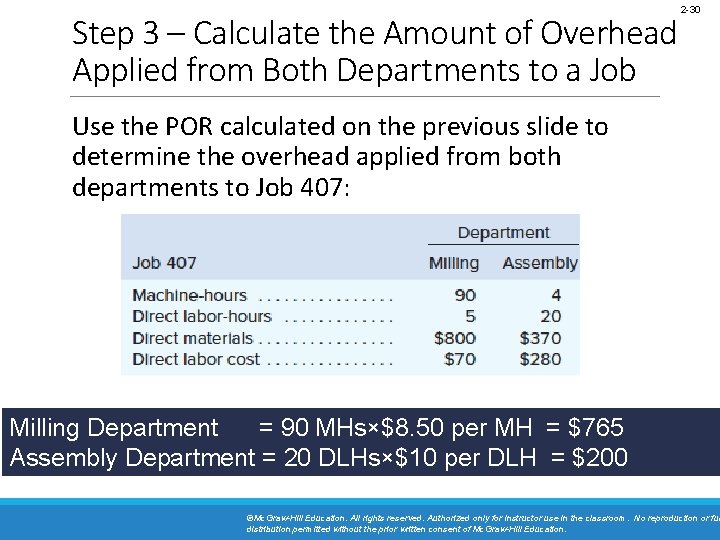
Step 3 – Calculate the Amount of Overhead Applied from Both Departments to a Job 2 -30 Use the POR calculated on the previous slide to determine the overhead applied from both departments to Job 407: Milling Department = 90 MHs×$8. 50 per MH = $765 Assembly Department = 20 DLHs×$10 per DLH = $200 ©Mc. Graw-Hill Education. All rights reserved. Authorized only for instructor use in the classroom. No reproduction or fur distribution permitted without the prior written consent of Mc. Graw-Hill Education.
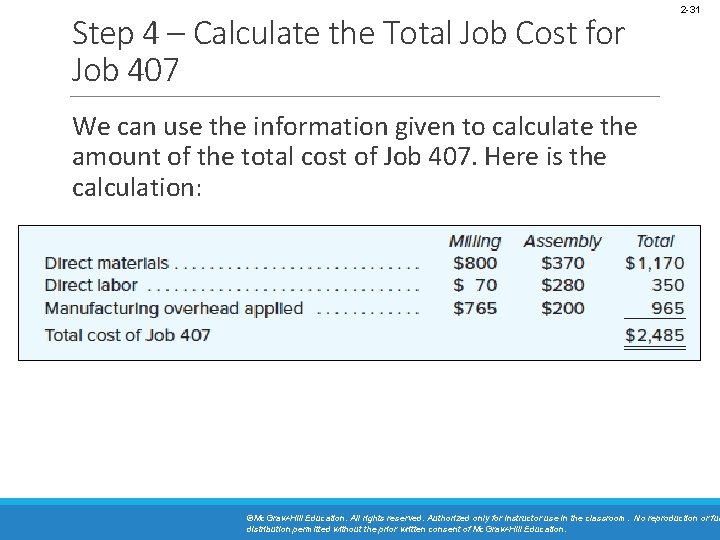
Step 4 – Calculate the Total Job Cost for Job 407 2 -31 We can use the information given to calculate the amount of the total cost of Job 407. Here is the calculation: ©Mc. Graw-Hill Education. All rights reserved. Authorized only for instructor use in the classroom. No reproduction or fur distribution permitted without the prior written consent of Mc. Graw-Hill Education.
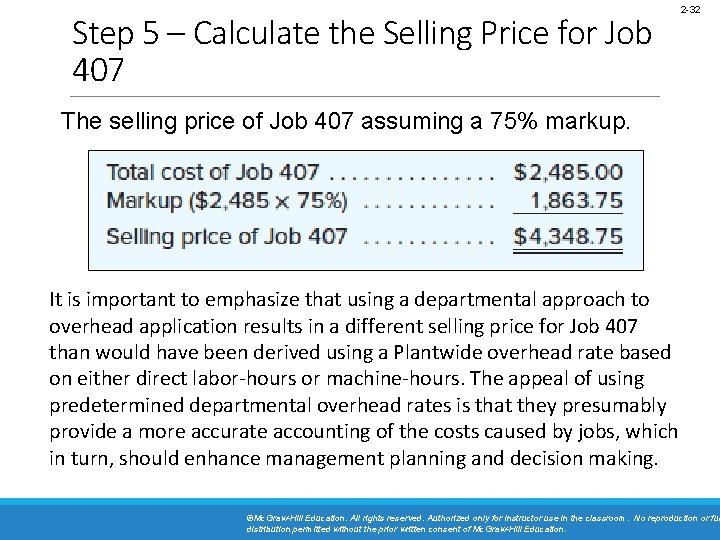
Step 5 – Calculate the Selling Price for Job 407 2 -32 The selling price of Job 407 assuming a 75% markup. It is important to emphasize that using a departmental approach to overhead application results in a different selling price for Job 407 than would have been derived using a Plantwide overhead rate based on either direct labor-hours or machine-hours. The appeal of using predetermined departmental overhead rates is that they presumably provide a more accurate accounting of the costs caused by jobs, which in turn, should enhance management planning and decision making. ©Mc. Graw-Hill Education. All rights reserved. Authorized only for instructor use in the classroom. No reproduction or fur distribution permitted without the prior written consent of Mc. Graw-Hill Education.
Multiple Predetermined Overhead Rates— An Activity-Based Approach 2 -33 When a company creates overhead rates based on the activities that it performs, it is employing an approach called activity-based costing. Activity-based costing is an alternative approach to developing multiple predetermined overhead rates. Managers use activity-based costing systems to more accurately measure the demands that jobs, products, customers, and other cost objects make on overhead resources. ©Mc. Graw-Hill Education. All rights reserved. Authorized only for instructor use in the classroom. No reproduction or fur distribution permitted without the prior written consent of Mc. Graw-Hill Education.
Job-Order Costing for Financial Statements to External Parties 2 -34 The amount of overhead applied to all jobs during a period will differ from the actual amount of overhead costs incurred during the period. 1. When a company applies less overhead to production than it actually incurs, it creates what is known as underapplied overhead. 2. When it applies more overhead to production than it actually incurs, it results in overapplied overhead. ©Mc. Graw-Hill Education. All rights reserved. Authorized only for instructor use in the classroom. No reproduction or fur distribution permitted without the prior written consent of Mc. Graw-Hill Education.
2 -35 Financial Adjust for Overhead Applied The cost of goods sold reported on a company’s income statement must be adjusted to reflect underapplied or overapplied overhead. 1. The adjustment for underapplied overhead increases cost of goods sold and decreases net operating income. 2. The adjustment for overapplied overhead decreases cost of goods sold and increases net operating income. ©Mc. Graw-Hill Education. All rights reserved. Authorized only for instructor use in the classroom. No reproduction or fur distribution permitted without the prior written consent of Mc. Graw-Hill Education.
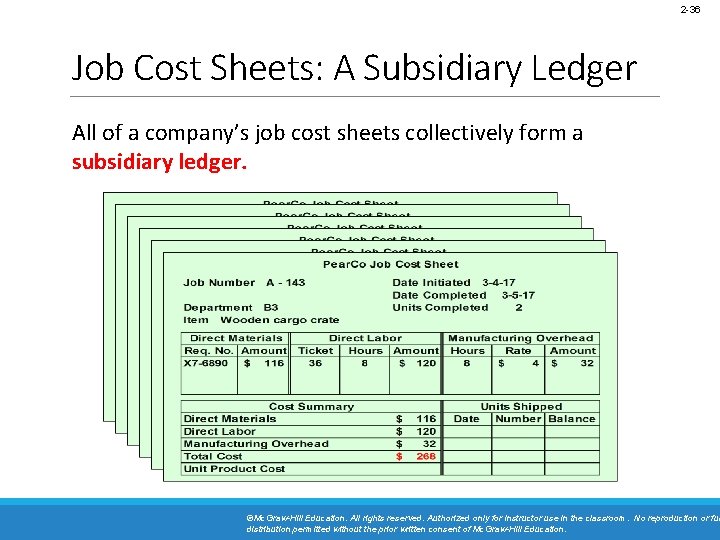
2 -36 Job Cost Sheets: A Subsidiary Ledger All of a company’s job cost sheets collectively form a subsidiary ledger. ©Mc. Graw-Hill Education. All rights reserved. Authorized only for instructor use in the classroom. No reproduction or fur distribution permitted without the prior written consent of Mc. Graw-Hill Education.
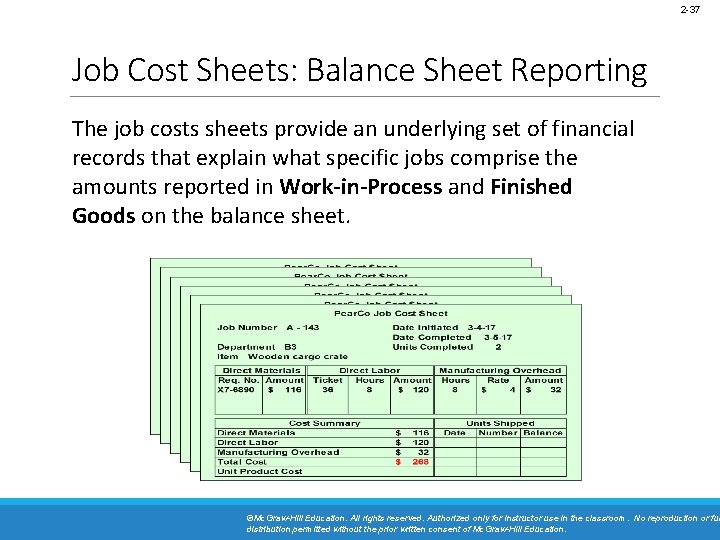
2 -37 Job Cost Sheets: Balance Sheet Reporting The job costs sheets provide an underlying set of financial records that explain what specific jobs comprise the amounts reported in Work-in-Process and Finished Goods on the balance sheet. ©Mc. Graw-Hill Education. All rights reserved. Authorized only for instructor use in the classroom. No reproduction or fur distribution permitted without the prior written consent of Mc. Graw-Hill Education.
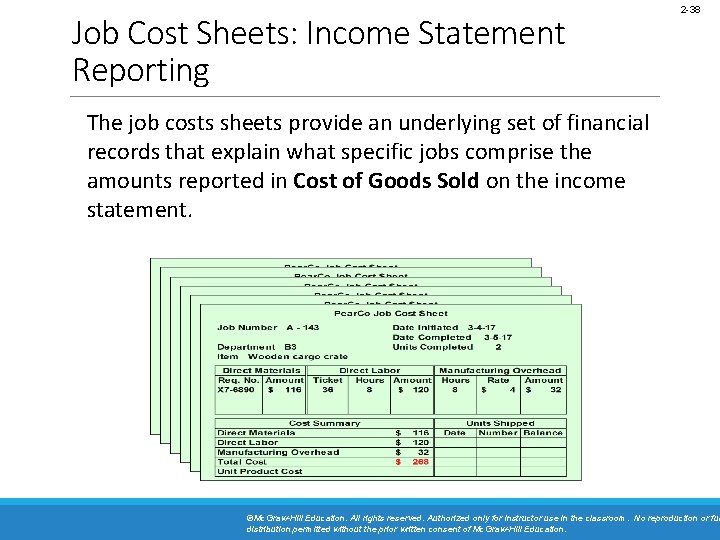
Job Cost Sheets: Income Statement Reporting 2 -38 The job costs sheets provide an underlying set of financial records that explain what specific jobs comprise the amounts reported in Cost of Goods Sold on the income statement. ©Mc. Graw-Hill Education. All rights reserved. Authorized only for instructor use in the classroom. No reproduction or fur distribution permitted without the prior written consent of Mc. Graw-Hill Education.
2 -39 Job-Order Costing in Service Companies Although our attention has focused upon manufacturing applications, it bears re-emphasizing that job-order costing is also used in service industries. Job-order costing is used in many different types of service companies. For example, law firms, accounting firms, and medical treatment. ©Mc. Graw-Hill Education. All rights reserved. Authorized only for instructor use in the classroom. No reproduction or fur distribution permitted without the prior written consent of Mc. Graw-Hill Education.
2 -40 End of Chapter 2 ©Mc. Graw-Hill Education. All rights reserved. Authorized only for instructor use in the classroom. No reproduction or fur distribution permitted without the prior written consent of Mc. Graw-Hill Education.
- Slides: 40