
Job Order Costing and Analysis Chapter 15 Wild
Job Order Costing and Analysis Chapter 15 Wild, Shaw, and Chiappetta Financial and Managerial Accounting 7 th Edition ©Mc. Graw-Hill Education. All rights reserved. Authorized only for instructor use in the classroom. No reproduction or further distribution permitted without the prior written consent of Mc. Graw-Hill Education.
11 - 2 Chapter 15 Learning Objectives CONCEPTUAL C 1 Describe important features of job order production. C 2 Explain job cost sheets and how they are used in job order costing. ANALYTICAL A 1 Apply job order costing in pricing services. PROCEDURAL P 1 Describe and record the flow of materials costs in job order costing. P 2 Describe and record the flow of labor costs in job order costing. P 3 Describe and record the flow of overhead costs in job order costing. P 4 Determine adjustments for overapplied and underapplied factory overhead. © Mc. Graw-Hill Education 2
Learning Objective C 1: Describe important features of job order production. © Mc. Graw-Hill Education 3
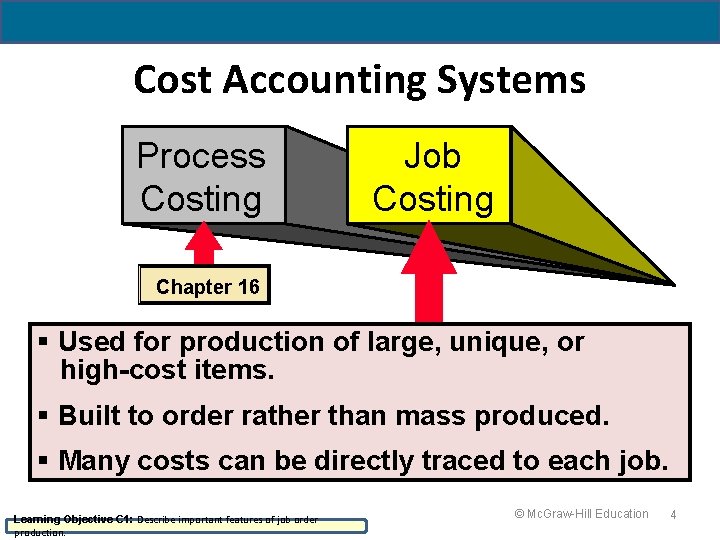
19 - 4 Cost Accounting Systems Process Costing Job Costing Chapter 16 § Used for production of large, unique, or high-cost items. § Built to order rather than mass produced. § Many costs can be directly traced to each job. Learning Objective C 1: Describe important features of job order production. © Mc. Graw-Hill Education 4
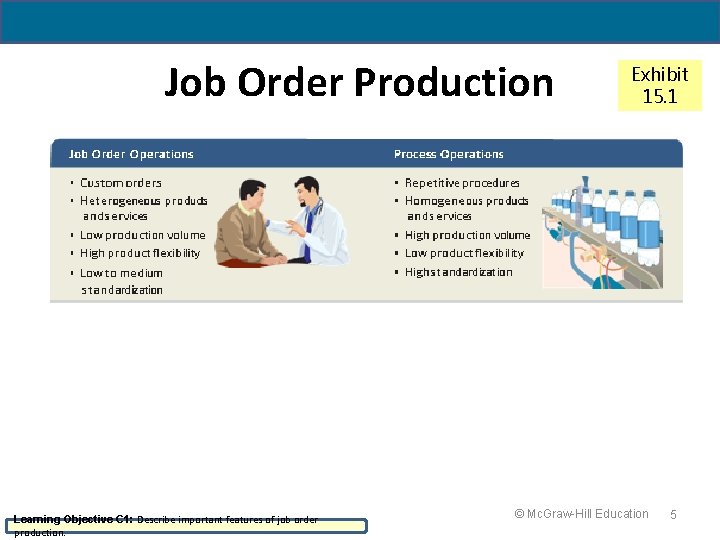
19 - 5 Job Order Production Learning Objective C 1: Describe important features of job order production. Exhibit 15. 1 © Mc. Graw-Hill Education 5
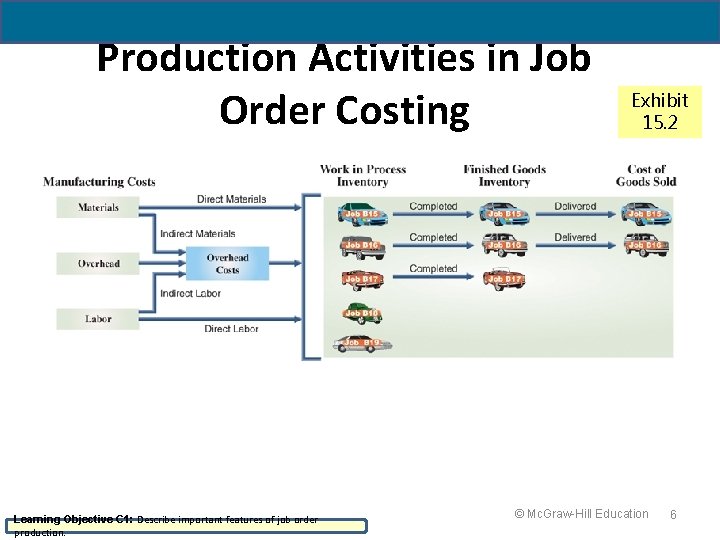
19 - 6 Production Activities in Job Order Costing Learning Objective C 1: Describe important features of job order production. Exhibit 15. 2 © Mc. Graw-Hill Education 6
Cost Flows Manufacturing costs flow: 1. Raw materials – direct and indirect materials 2. Work in process – job is being produced 3. Finished goods – completed goods 4. Cost of goods sold – goods which are sold Subsidiary records store information about the manufacturing costs for each individual job. Learning Objective C 1: Describe important features of job order production. © Mc. Graw-Hill Education 7
Learning Objective C 2: Explain job cost sheets and how they are used in job order costing. © Mc. Graw-Hill Education 8
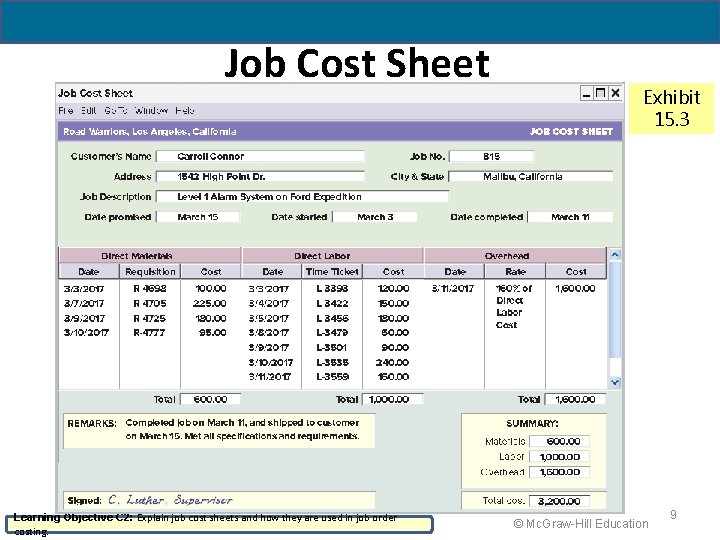
19 - 9 Job Cost Sheet Learning Objective C 2: Explain job cost sheets and how they are used in job order costing. Exhibit 15. 3 © Mc. Graw-Hill Education 9
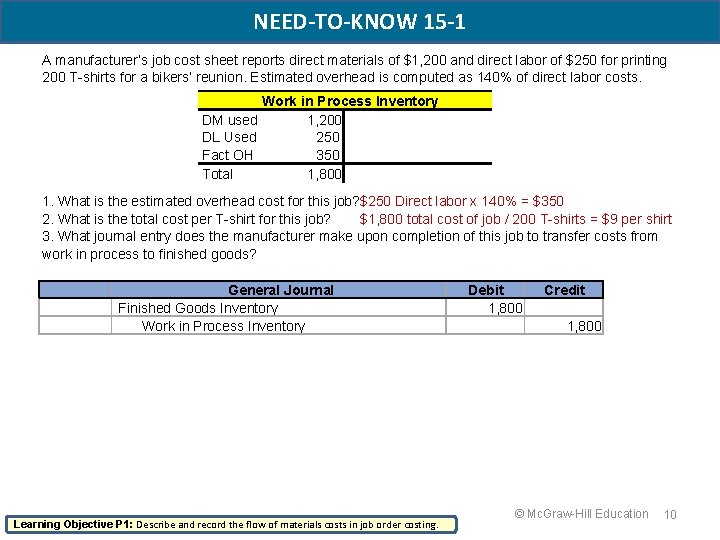
NEED-TO-KNOW 15 -1 A manufacturer’s job cost sheet reports direct materials of $1, 200 and direct labor of $250 for printing 200 T-shirts for a bikers’ reunion. Estimated overhead is computed as 140% of direct labor costs. Work in Process Inventory DM used 1, 200 DL Used 250 Fact OH 350 Total 1, 800 1. What is the estimated overhead cost for this job? $250 Direct labor x 140% = $350 2. What is the total cost per T-shirt for this job? $1, 800 total cost of job / 200 T-shirts = $9 per shirt 3. What journal entry does the manufacturer make upon completion of this job to transfer costs from work in process to finished goods? General Journal Finished Goods Inventory Work in Process Inventory Learning Objective P 1: Describe and record the flow of materials costs in job order costing. Debit 1, 800 Credit 1, 800 © Mc. Graw-Hill Education 10
Learning Objective P 1: Describe and record the flow of materials costs in job order costing. © Mc. Graw-Hill Education 11
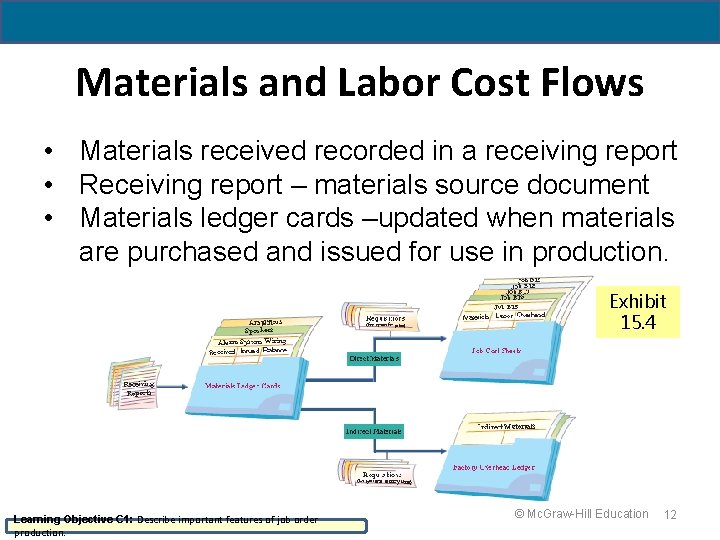
Materials and Labor Cost Flows • Materials received recorded in a receiving report • Receiving report – materials source document • Materials ledger cards –updated when materials are purchased and issued for use in production. Exhibit 15. 4 Learning Objective C 1: Describe important features of job order production. © Mc. Graw-Hill Education 12
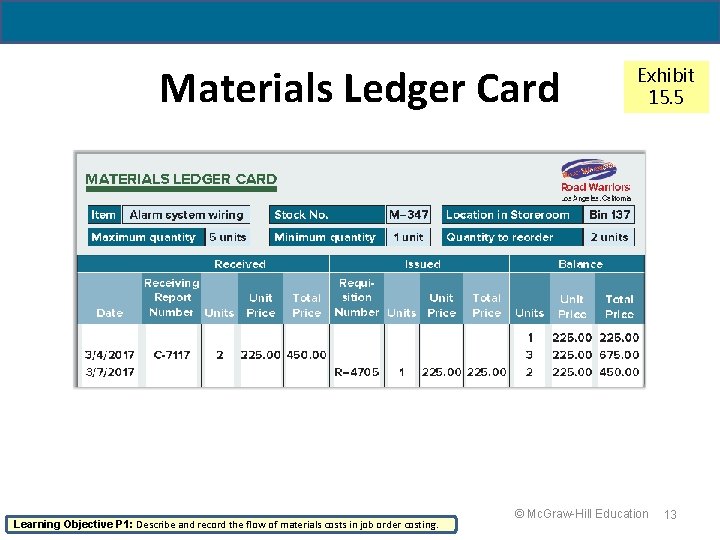
19 - 13 Materials Ledger Card Learning Objective P 1: Describe and record the flow of materials costs in job order costing. Exhibit 15. 5 © Mc. Graw-Hill Education 13
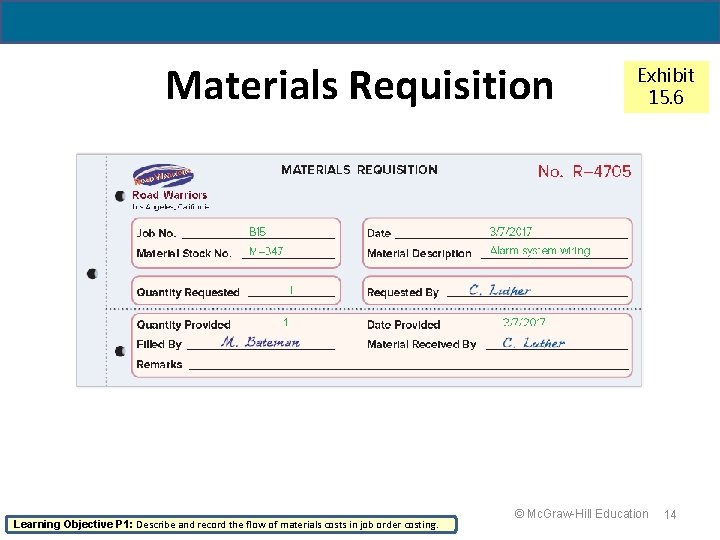
19 - 14 Materials Requisition Learning Objective P 1: Describe and record the flow of materials costs in job order costing. Exhibit 15. 6 © Mc. Graw-Hill Education 14
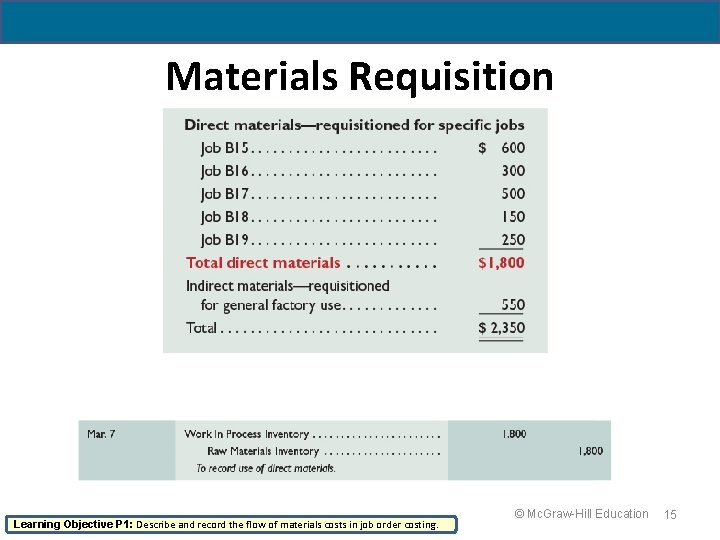
19 - 15 Materials Requisition Learning Objective P 1: Describe and record the flow of materials costs in job order costing. © Mc. Graw-Hill Education 15
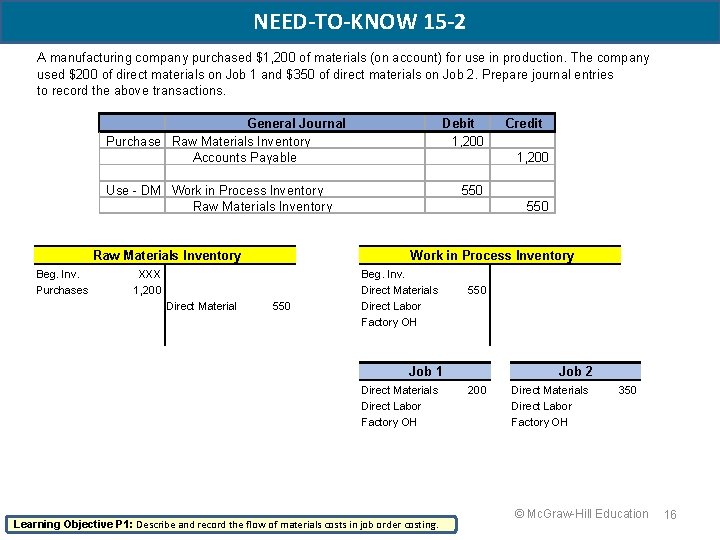
NEED-TO-KNOW 15 -2 A manufacturing company purchased $1, 200 of materials (on account) for use in production. The company used $200 of direct materials on Job 1 and $350 of direct materials on Job 2. Prepare journal entries to record the above transactions. General Journal Purchase Raw Materials Inventory Accounts Payable Debit 1, 200 Use - DM Work in Process Inventory Raw Materials Inventory Beg. Inv. Purchases 550 Work in Process Inventory XXX 1, 200 Direct Material Credit 550 Beg. Inv. Direct Materials Direct Labor Factory OH 550 Job 1 Direct Materials Direct Labor Factory OH Learning Objective P 1: Describe and record the flow of materials costs in job order costing. Job 2 200 Direct Materials Direct Labor Factory OH 350 © Mc. Graw-Hill Education 16
Learning Objective P 2: Describe and record the flow of labor costs in job order costing. © Mc. Graw-Hill Education 17
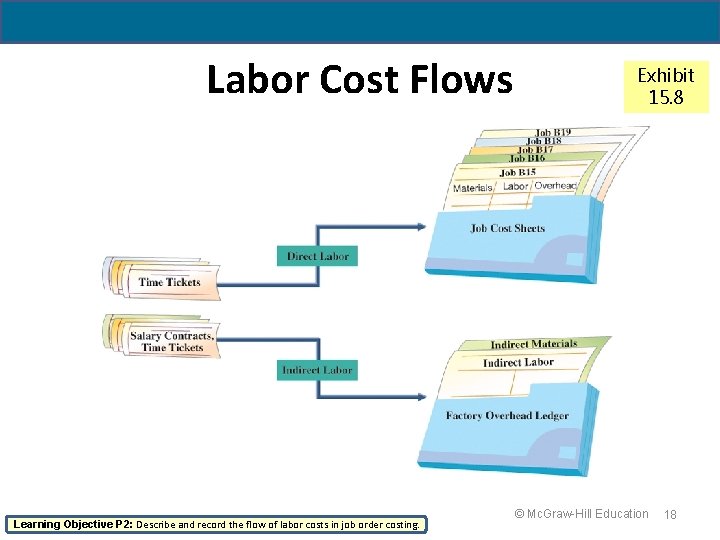
19 - 18 Labor Cost Flows Learning Objective P 2: Describe and record the flow of labor costs in job order costing. Exhibit 15. 8 © Mc. Graw-Hill Education 18
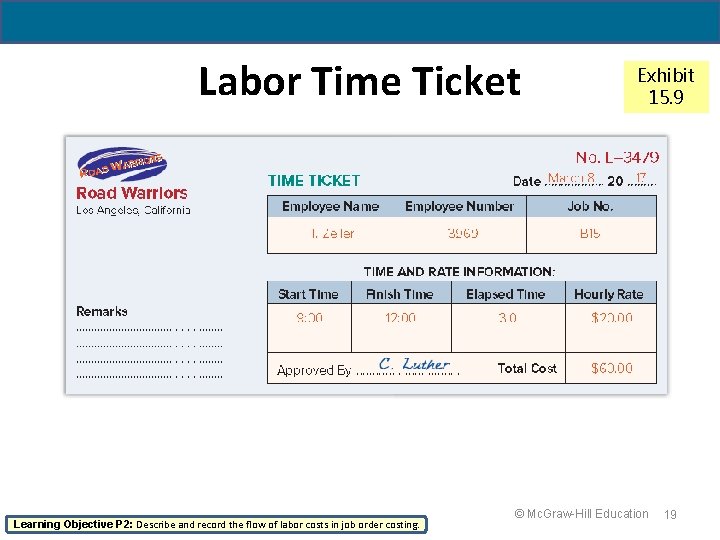
19 - 19 Labor Time Ticket Learning Objective P 2: Describe and record the flow of labor costs in job order costing. Exhibit 15. 9 © Mc. Graw-Hill Education 19
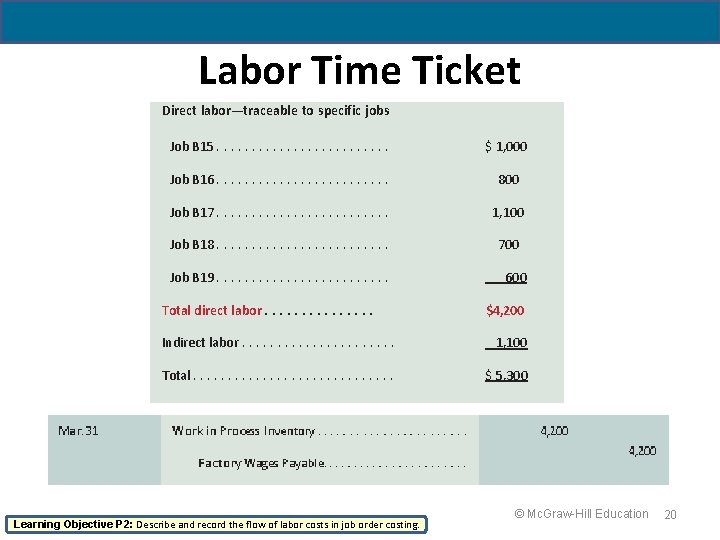
19 - 20 Labor Time Ticket Direct labor—traceable to specific jobs Job B 15. . . $ 1, 000 Job B 16. . . 800 Job B 17. . . 1, 100 Job B 18. . . 700 Job B 19. . . 600 Total direct labor. . . . $4, 200 Indirect labor. . . . . 1, 100 Total. . . . $ 5, 300 Learning Objective P 2: Describe and record the flow of labor costs in job order costing. © Mc. Graw-Hill Education 20
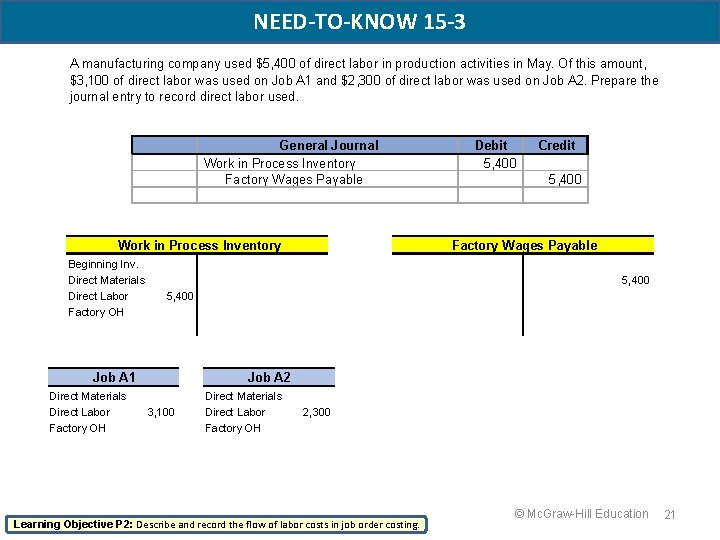
NEED-TO-KNOW 15 -3 A manufacturing company used $5, 400 of direct labor in production activities in May. Of this amount, $3, 100 of direct labor was used on Job A 1 and $2, 300 of direct labor was used on Job A 2. Prepare the journal entry to record direct labor used. General Journal Work in Process Inventory Factory Wages Payable Work in Process Inventory Beginning Inv. Direct Materials Direct Labor Factory OH Credit 5, 400 Factory Wages Payable 5, 400 Job A 1 Direct Materials Direct Labor Factory OH Debit 5, 400 Job A 2 3, 100 Direct Materials Direct Labor Factory OH 2, 300 Learning Objective P 2: Describe and record the flow of labor costs in job order costing. © Mc. Graw-Hill Education 21
Learning Objective P 3: Describe and record the flow of overhead costs in job order costing. © Mc. Graw-Hill Education 22
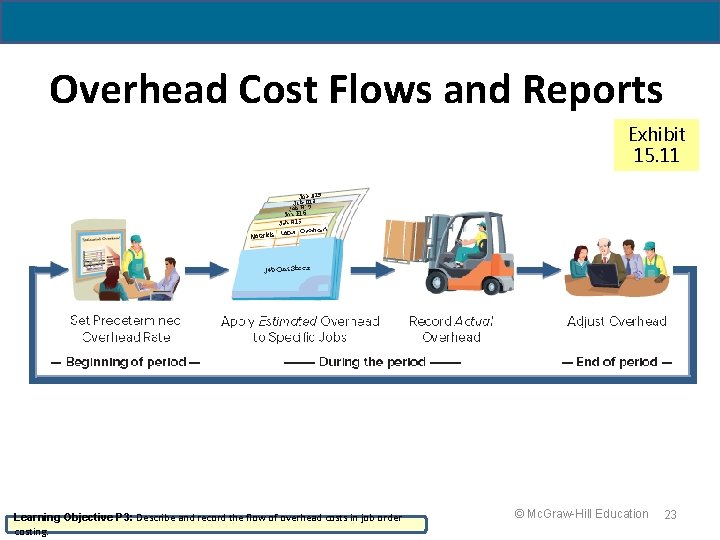
19 - 23 Overhead Cost Flows and Reports Exhibit 15. 11 Learning Objective P 3: Describe and record the flow of overhead costs in job order costing. © Mc. Graw-Hill Education 23
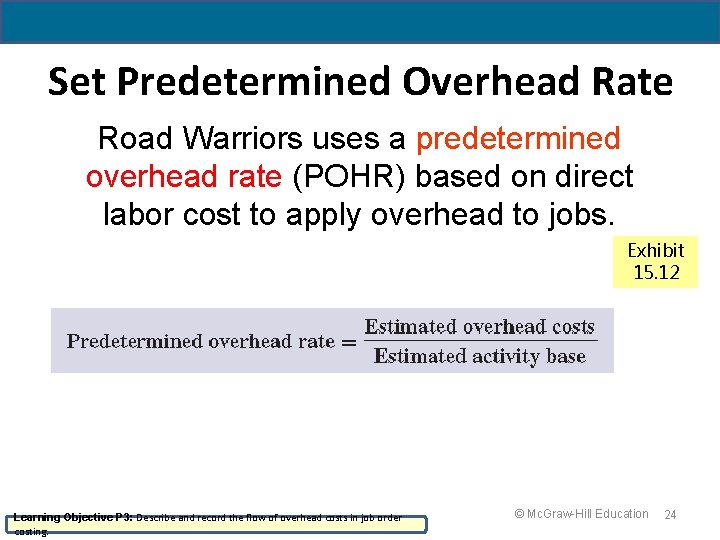
19 - 24 Set Predetermined Overhead Rate Road Warriors uses a predetermined overhead rate (POHR) based on direct labor cost to apply overhead to jobs. Exhibit 15. 12 Learning Objective P 3: Describe and record the flow of overhead costs in job order costing. © Mc. Graw-Hill Education 24
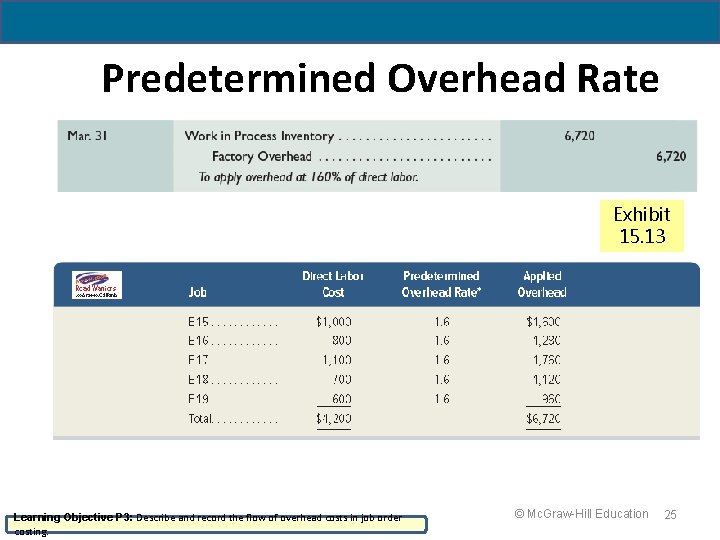
19 - 25 Predetermined Overhead Rate Exhibit 15. 13 Learning Objective P 3: Describe and record the flow of overhead costs in job order costing. © Mc. Graw-Hill Education 25
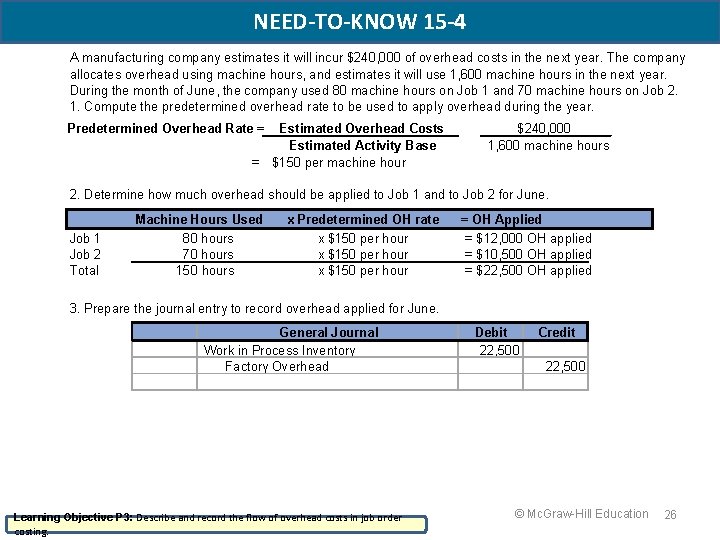
NEED-TO-KNOW 15 -4 A manufacturing company estimates it will incur $240, 000 of overhead costs in the next year. The company allocates overhead using machine hours, and estimates it will use 1, 600 machine hours in the next year. During the month of June, the company used 80 machine hours on Job 1 and 70 machine hours on Job 2. 1. Compute the predetermined overhead rate to be used to apply overhead during the year. Predetermined Overhead Rate = Estimated Overhead Costs Estimated Activity Base = $150 per machine hour $240, 000 1, 600 machine hours 2. Determine how much overhead should be applied to Job 1 and to Job 2 for June. Job 1 Job 2 Total Machine Hours Used 80 hours 70 hours 150 hours x Predetermined OH rate x $150 per hour = OH Applied = $12, 000 OH applied = $10, 500 OH applied = $22, 500 OH applied 3. Prepare the journal entry to record overhead applied for June. General Journal Work in Process Inventory Factory Overhead Learning Objective P 3: Describe and record the flow of overhead costs in job order costing. Debit 22, 500 Credit 22, 500 © Mc. Graw-Hill Education 26
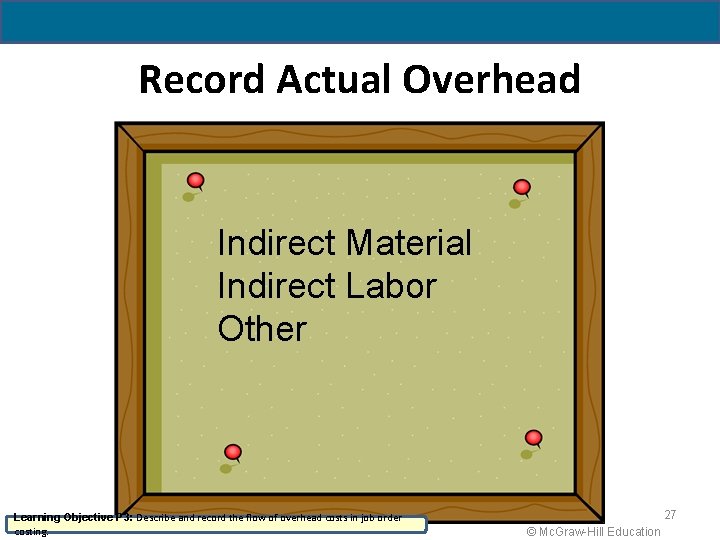
19 - 27 Record Actual Overhead Indirect Material Indirect Labor Other Learning Objective P 3: Describe and record the flow of overhead costs in job order costing. 27 © Mc. Graw-Hill Education
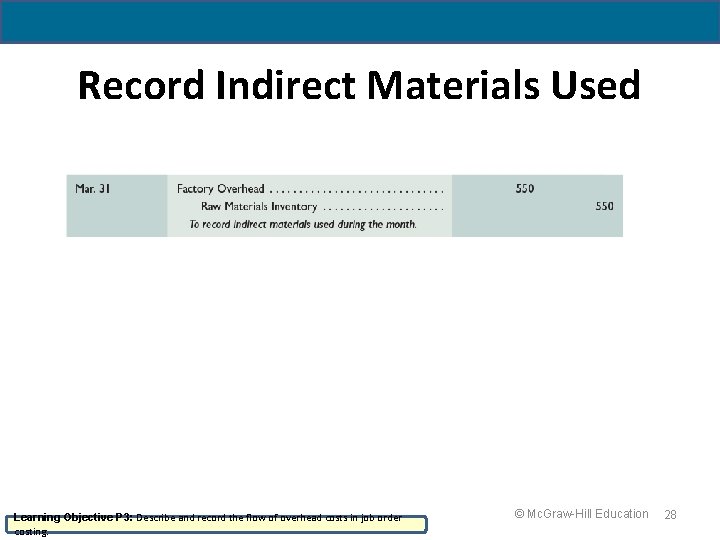
19 - 28 Record Indirect Materials Used Learning Objective P 3: Describe and record the flow of overhead costs in job order costing. © Mc. Graw-Hill Education 28
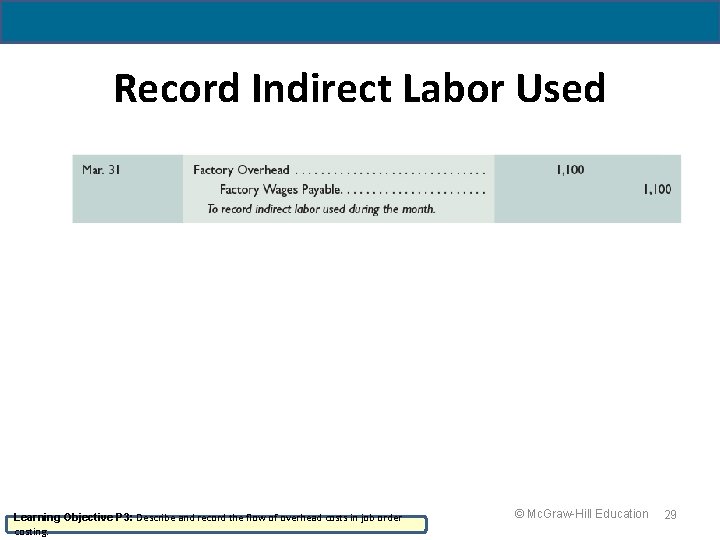
19 - 29 Record Indirect Labor Used Learning Objective P 3: Describe and record the flow of overhead costs in job order costing. © Mc. Graw-Hill Education 29
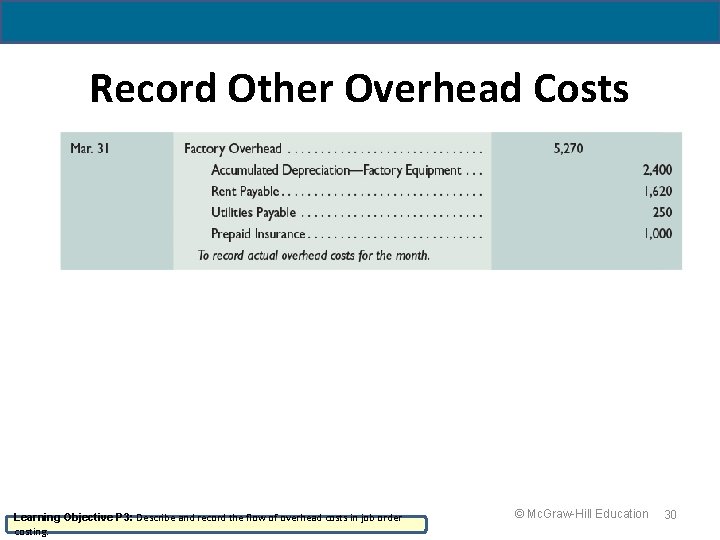
19 - 30 Record Other Overhead Costs Learning Objective P 3: Describe and record the flow of overhead costs in job order costing. © Mc. Graw-Hill Education 30
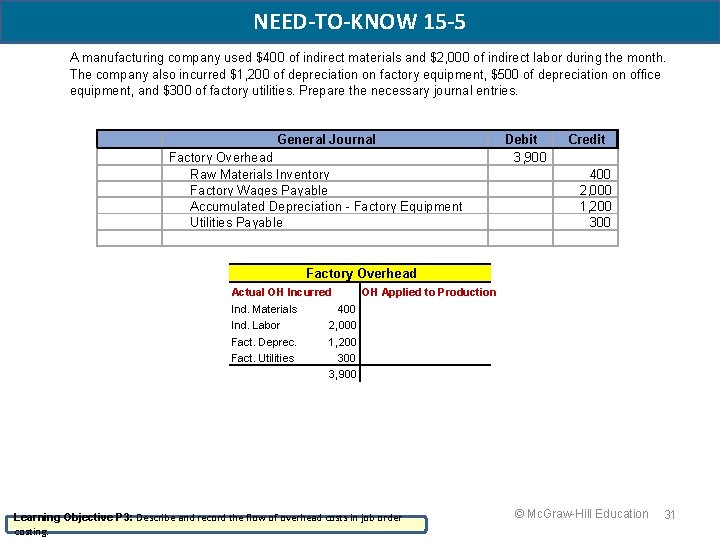
NEED-TO-KNOW 15 -5 A manufacturing company used $400 of indirect materials and $2, 000 of indirect labor during the month. The company also incurred $1, 200 of depreciation on factory equipment, $500 of depreciation on office equipment, and $300 of factory utilities. Prepare the necessary journal entries. General Journal Factory Overhead Raw Materials Inventory Factory Wages Payable Accumulated Depreciation - Factory Equipment Utilities Payable Debit 3, 900 Credit 400 2, 000 1, 200 300 Factory Overhead Actual OH Incurred Ind. Materials Ind. Labor Fact. Deprec. Fact. Utilities OH Applied to Production 400 2, 000 1, 200 3, 900 Learning Objective P 3: Describe and record the flow of overhead costs in job order costing. © Mc. Graw-Hill Education 31
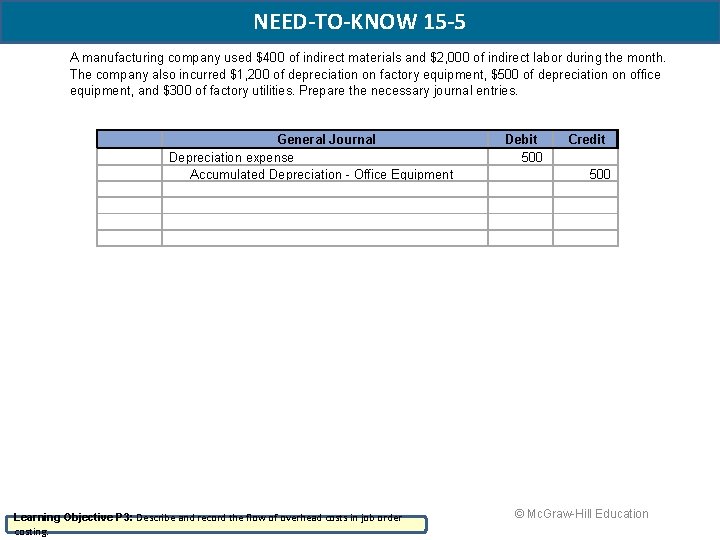
NEED-TO-KNOW 15 -5 A manufacturing company used $400 of indirect materials and $2, 000 of indirect labor during the month. The company also incurred $1, 200 of depreciation on factory equipment, $500 of depreciation on office equipment, and $300 of factory utilities. Prepare the necessary journal entries. General Journal Depreciation expense Accumulated Depreciation - Office Equipment Learning Objective P 3: Describe and record the flow of overhead costs in job order costing. Debit 500 Credit 500 © Mc. Graw-Hill Education
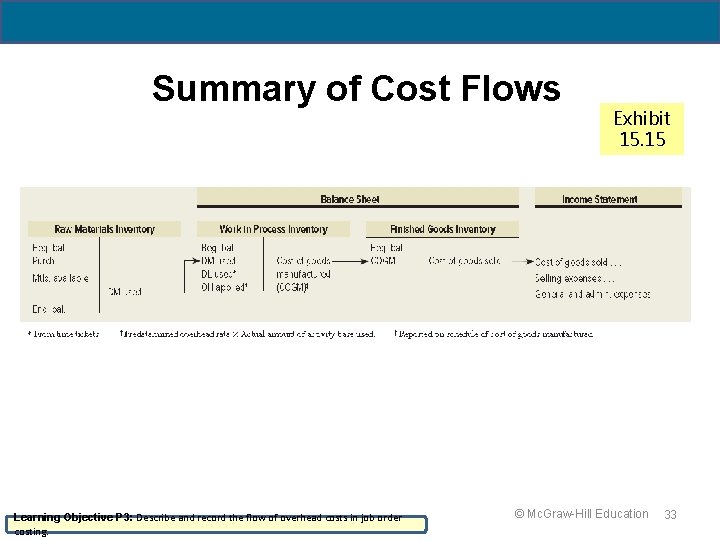
19 - 33 Summary of Cost Flows Learning Objective P 3: Describe and record the flow of overhead costs in job order costing. Exhibit 15. 15 © Mc. Graw-Hill Education 33
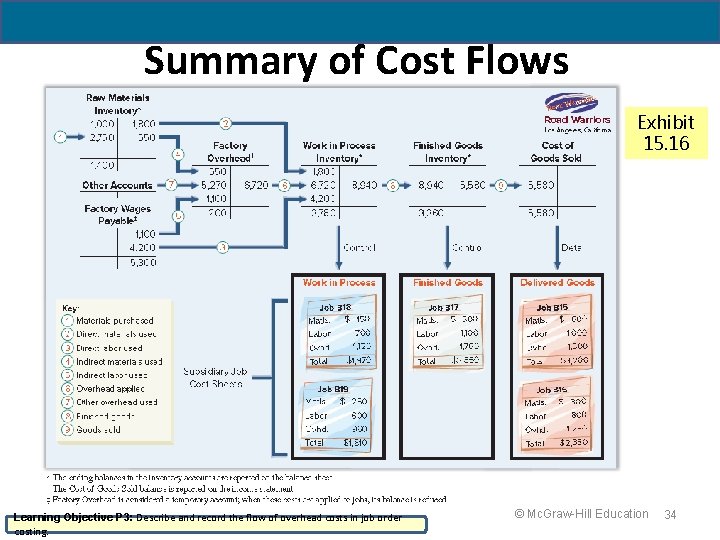
19 - 34 Summary of Cost Flows Exhibit 15. 16 Learning Objective P 3: Describe and record the flow of overhead costs in job order costing. © Mc. Graw-Hill Education 34
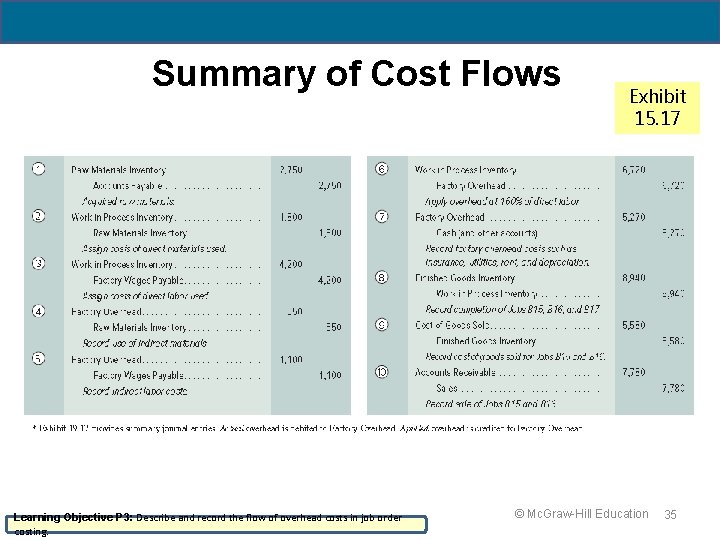
19 - 35 Summary of Cost Flows Learning Objective P 3: Describe and record the flow of overhead costs in job order costing. Exhibit 15. 17 © Mc. Graw-Hill Education 35
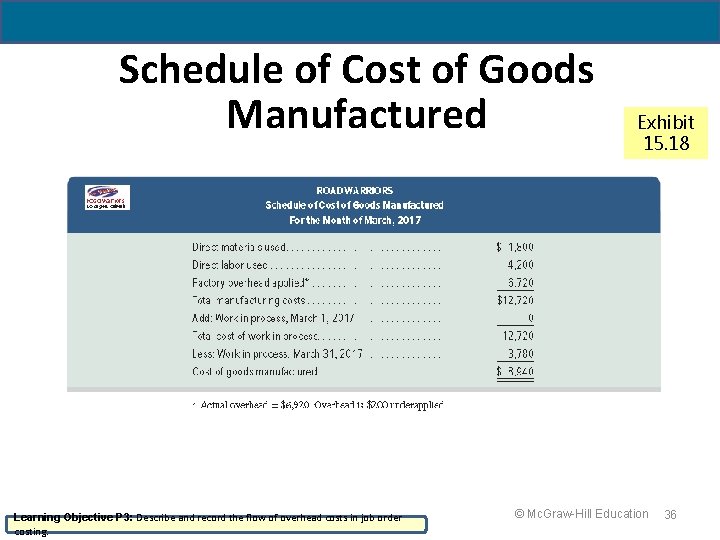
19 - 36 Schedule of Cost of Goods Manufactured Learning Objective P 3: Describe and record the flow of overhead costs in job order costing. Exhibit 15. 18 © Mc. Graw-Hill Education 36
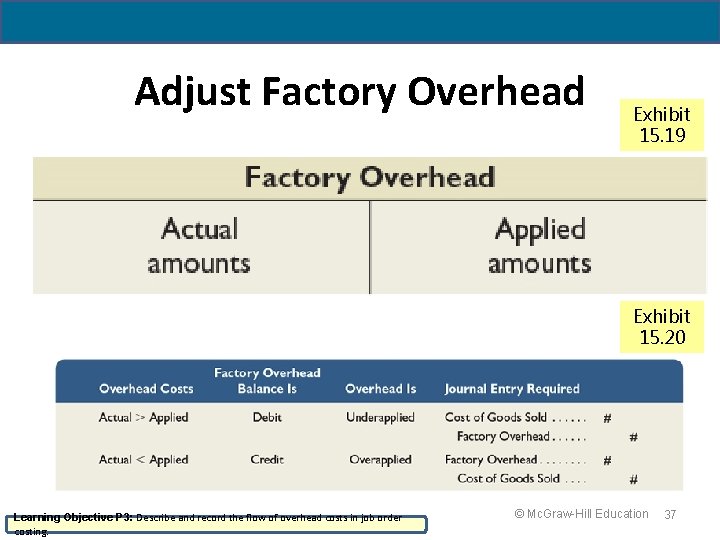
19 - 37 Adjust Factory Overhead Exhibit 15. 19 Exhibit 15. 20 Learning Objective P 3: Describe and record the flow of overhead costs in job order costing. © Mc. Graw-Hill Education 37
Learning Objective P 4: Determine adjustments for overapplied and underapplied factory overhead. © Mc. Graw-Hill Education 38
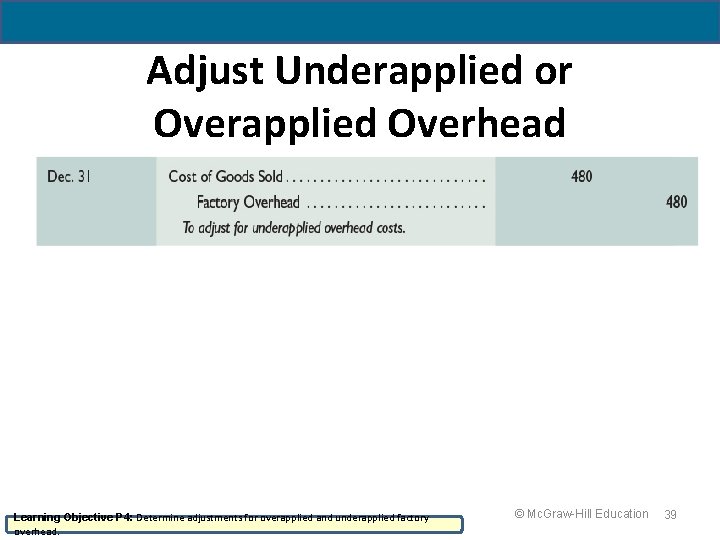
19 - 39 Adjust Underapplied or Overapplied Overhead Learning Objective P 4: Determine adjustments for overapplied and underapplied factory overhead. © Mc. Graw-Hill Education 39
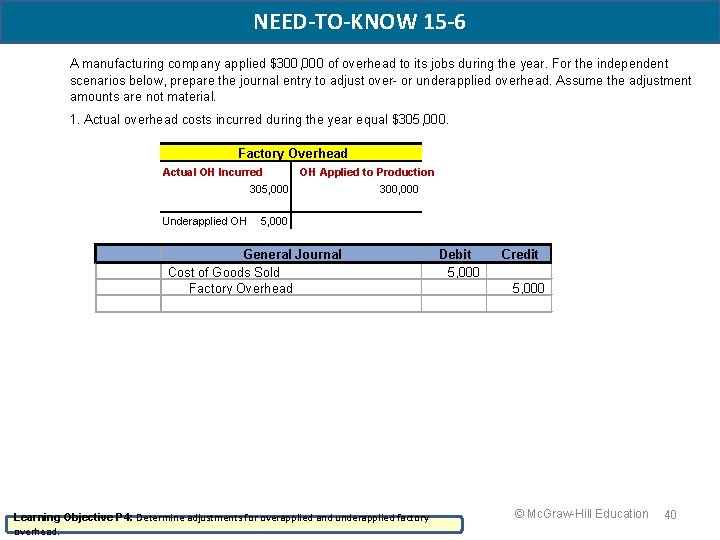
NEED-TO-KNOW 15 -6 A manufacturing company applied $300, 000 of overhead to its jobs during the year. For the independent scenarios below, prepare the journal entry to adjust over- or underapplied overhead. Assume the adjustment amounts are not material. 1. Actual overhead costs incurred during the year equal $305, 000. Factory Overhead Actual OH Incurred OH Applied to Production 305, 000 Underapplied OH 300, 000 5, 000 General Journal Cost of Goods Sold Factory Overhead Learning Objective P 4: Determine adjustments for overapplied and underapplied factory overhead. Debit 5, 000 Credit 5, 000 © Mc. Graw-Hill Education 40
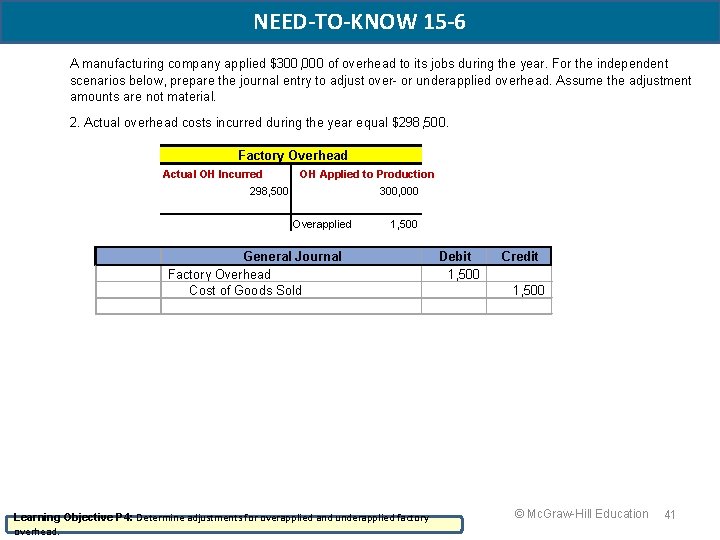
NEED-TO-KNOW 15 -6 A manufacturing company applied $300, 000 of overhead to its jobs during the year. For the independent scenarios below, prepare the journal entry to adjust over- or underapplied overhead. Assume the adjustment amounts are not material. 2. Actual overhead costs incurred during the year equal $298, 500. Factory Overhead Actual OH Incurred OH Applied to Production 298, 500 300, 000 Overapplied 1, 500 General Journal Factory Overhead Cost of Goods Sold Learning Objective P 4: Determine adjustments for overapplied and underapplied factory overhead. Debit 1, 500 Credit 1, 500 © Mc. Graw-Hill Education 41
Learning Objective A 1: Apply job order costing in pricing services. © Mc. Graw-Hill Education 42
Pricing for Services • Service providers also use job order costing. • Cost for each individual job are track separately. • Total costs include labor and overhead. Learning Objective P 3: Describe and record the flow of overhead costs in job order costing. © Mc. Graw-Hill Education 43
19 - 44 End of Chapter 15 © Mc. Graw-Hill Education 44
- Slides: 44