
Job Corps TEAP Specialist Orientation Diane Tennies Ph
Job Corps TEAP Specialist Orientation Diane Tennies, Ph. D, LADC Christy Hicks, MSW Regional TEAP Health Specialists
Job Corps’ Mission As a national, primarily residential training program, Job Corps' mission is to attract eligible young adults, teach them the skills they need to become employable and independent, and place them in meaningful jobs, higher education, or the military.
Regional Health Specialists (RHS) Tasks • Provide technical assistance by answering questions via email, text or phone calls • Conduct center assessments (now called Program Compliance Assessments or PCAs) • Provide training to regional and center staff • Assist with understanding and implementing policies • Provide up-to-date information to assist in meeting program requirements • Conduct monthly teleconferences
Program Compliance Assessments (PCAs) • Every 1 to 2 years, Health Specialists and Assessors visit each center as part of a review team. • Using the Program Assessment Guide (PAG), in conjunction with the Policy and Requirements Handbook (PRH), this team will conduct an overall assessment of your center’s health and wellness program.
Important Resources • PRH—The Policy and Requirements Handbook (now ephr. jobcorps. gov) • PAG—The Program Assessment Guide • COP/SOP—Center or Standard Operating Procedures • DRG—Desk Reference Guide
6 Health Directives • PRH Change Notices—Contain new or revised policy with instructions to delete, replace, or add pages to the PRH. (e. g. 16 -10 Clarification of Drug Infractions). • Program Instructions—Provide one-time instructions with a designated expiration date and usually require center response (e. g. 16 -21 MAT for Opioid Addiction). • Information Notices—Provide one-time announcements with information that is of interest to centers (e. g. 16 -29 regarding use of secondary alcohol detection method).
Job Corps Health & Wellness Website • Designed for Job Corps health and wellness staff – Use it to connect with your peers, get the latest information on new initiatives and training events, learn about the health and wellness program, and link to related resources. – https: //supportservices. jobcorps. gov/ Health/Pages/default. aspx
Job Corps Career Development Services System (CDSS) • Includes four CDSS periods within which health and wellness services and activities are conducted: – – Outreach and Admissions (OA) Period Career Preparation Period (CPP) Career Development Period (CDP) Career Transition Period (CTP)
Trainee Employee Assistance Program (TEAP)
What is Overall TEAP Goal? • Assist students in developing appropriate health and wellness practices that will enhance their ability to obtain/maintain employment 10

11
Other Skills Needed 12
Flexibility with Structure 13
Hours and Qualifications • TEAP Specialist: Six hours/100 students/week is the minimum required level of TEAP coverage by a qualified TEAP specialist (see Exhibit 6. 5) – Example: a center with 300 students must have a TEAP specialist working at least 18 hours per week. • Exhibit 5 -3 - to be qualified means: Active, unrestricted substance abuse license or credential that meets minimum state licensing or credentialing requirements to practice in the state where the center is located. • ALL TEAPs must meet minimum staffing qualifications listed in Exhibit 5 -3 within one year of employment • Waiver process allows for ONE year to complete requirements and must be approved by the National Office.
TEAP Responsibilities and Guidance • Located in PRH 6. 11, R 1 • Also: – Exhibit 6 -4: JC Basic Health Care Responsibilities – Desk Reference Guide (more about this later) – Exhibit 3 -1: Infraction Levels, Definitions and Appropriate Center Actions (this has been recently changed)
Before the PRH: TEAP Boils Down to Six Major Areas • • • Prevention/education Assessment Relapse prevention Overcoming barriers Documentation Training 17
TEAP/TUPP Components • Prevention/education (TEAP and TUPP) – – – Being visible Center wide activities CPP/CDP/CTP Coordination with other staff TUPP activities for all students • Assessment (This is in part why credentialed necessary) – – AFR SIF Use of Formalized Assessment Measures MSWR 18
Components (continued) • Relapse prevention – – Self-help groups (on/off center) Groups with RP focus Individualized RP planning RP interwoven • Overcoming barriers – – Oversee Drug testing program TEAP Intervention services Alcohol testing and intervention services TUPP intervention services 19
Finally • Documentation – Clinical notes (content and participation) for TEAP and TUPP – HCG’s/SMG’s • Training – On suspicion screening (drugs and alcohol) – Other AODA related trainings – topic de jour 20 – Community partners for training
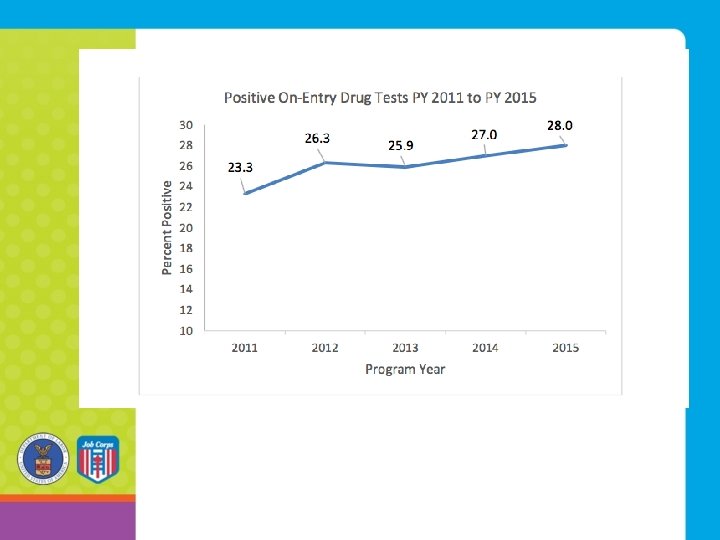
6. 11, R 1 (a) • The general emphasis of TEAP shall be on: – Prevention – Education – Identification of substance abuse problems – Relapse prevention – Helping students overcome barriers to employability • Why Prevention and Education emphasis?
Life would be easier if everyone would…
Prevention and Education Services (6. 11, R 1 (b)) • 1 -hour presentation on substance use prevention in CPP to include: – Description of the Center’s TEAP. – JC’s and the center’s drug and alcohol policies. – Consequences for testing positive (alcohol and/or drugs). • Career Development and Transition Period presentations. • Annual center-wide activities (3). • Consultation with staff around prevention and education efforts. • Coordination with other departments/programs.
Prevention and Education Services • Templates are available for all three transition phase presentations on the JC Community Website. • https: //supportservices. jobcorps. go v/health/Pages/default. aspx • Where are they located on the JC website?
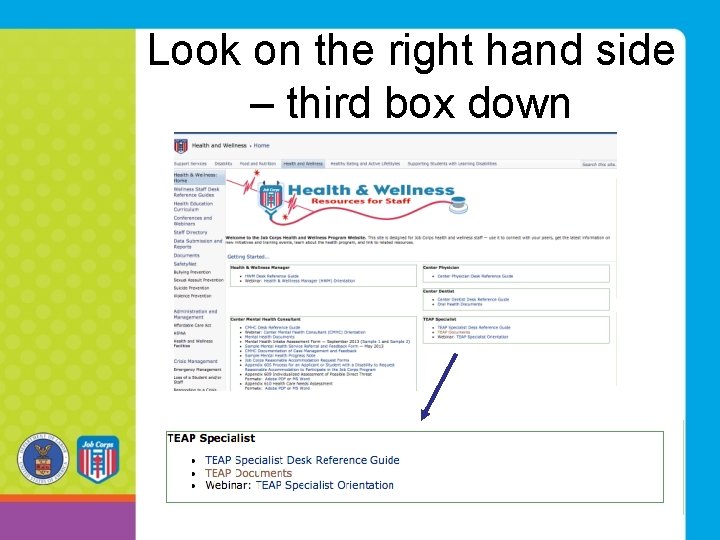
Look on the right hand side – third box down
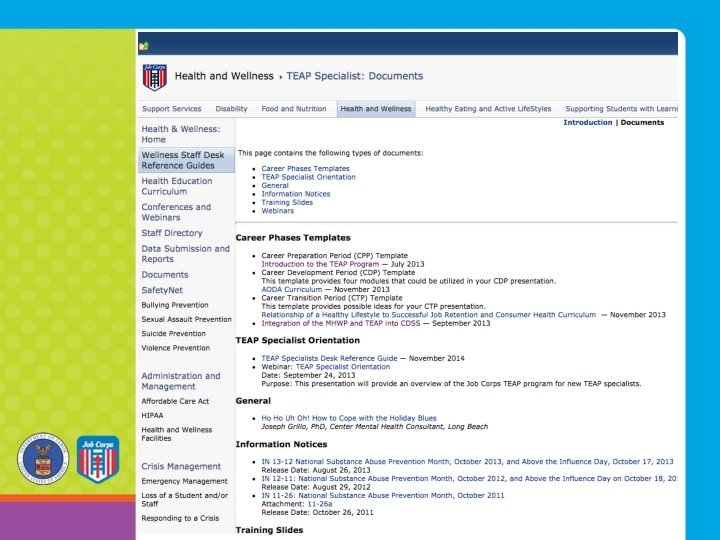
CPP Presentation • CPP presentation components: – TEAP Specialist Introduction Confidentiality (42 CFR Part 2 and HIPAA) – Zero Tolerance (ZT) Policy – Center-wide Prevention And Education Activities – Drug Screening – TEAP Mandatory Program – Alcohol Use Policies – Alternative Activities – Tobacco Use Prevention Program (TUPP) – Hazards Of Drug Use – Summary And Questions/Answers
Career Development (CDP) and Transition Periods (CTP) – see 6. 11; R 1, b(2) • More flexibility with format and time. • Focus on linking success in JC to a drug-free lifestyle which equals EMPLOYABILITY. • Templates on JC Community Website with many ideas for these meetings.
Another Prevention & Education Requirement (6. 11; R 1, b(3)) • Three center-wide activities annually (keep track of this information) – National TEAP Observances (see PIN 16 -25) such as: • • • – – – Kick Butt Day - March National Alcohol Awareness Month - April National Recovery Month – September Red Ribbon Week – October Substance Abuse Awareness Month – October Great American Smokeout - November Outside Speakers/Activities Tabling in cafeteria when students leave on break Various contests (e. g. poster, essay, poetry) Presentations at weekly assembly TEAP sponsored recreational activities
Prevention and Education (6. 11; R 1, b(4)) • Clinical consultation to get input and buy-in from: – – • • Center Director Management Staff CMHC Wellness Staff Take lead on prevention activities Develop support and alliances for assistance Keep it salient/relevant Delegate
Assessment (6. 11; R 1, c) • Identify high-risk students • Each JC Center to determine: – Specifics of assessment process. – Timeframe for assessment. – Process for documentation in SHR. • The general process is: – Review SIF (Social Intake Form) within one week. – Utilized Formalized assessment measures (e. g. , SASSI 3 or SASSIA 2) as well as clinical judgment to determine students’ level of risk for substance use and necessary next steps. – Other assessment measures acceptable as long empirically-derived. – CRAFFT is NOT considered FAM because it is given to everyone at entrance.
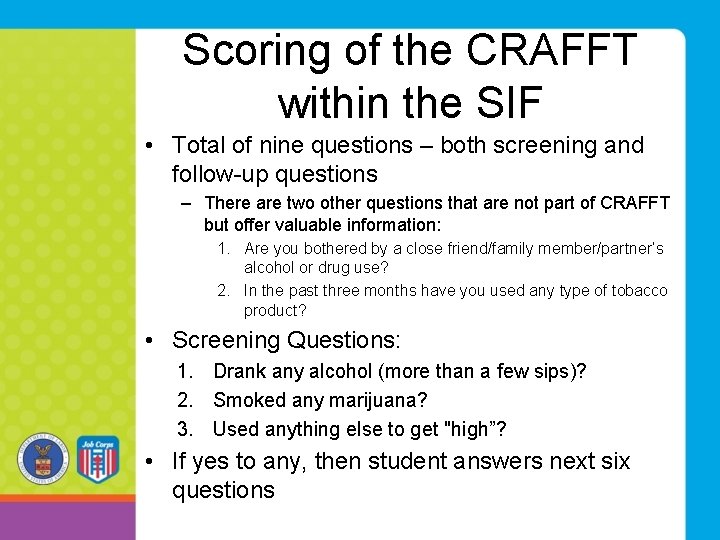
Scoring of the CRAFFT within the SIF • Total of nine questions – both screening and follow-up questions – There are two other questions that are not part of CRAFFT but offer valuable information: 1. Are you bothered by a close friend/family member/partner’s alcohol or drug use? 2. In the past three months have you used any type of tobacco product? • Screening Questions: 1. Drank any alcohol (more than a few sips)? 2. Smoked any marijuana? 3. Used anything else to get "high”? • If yes to any, then student answers next six questions
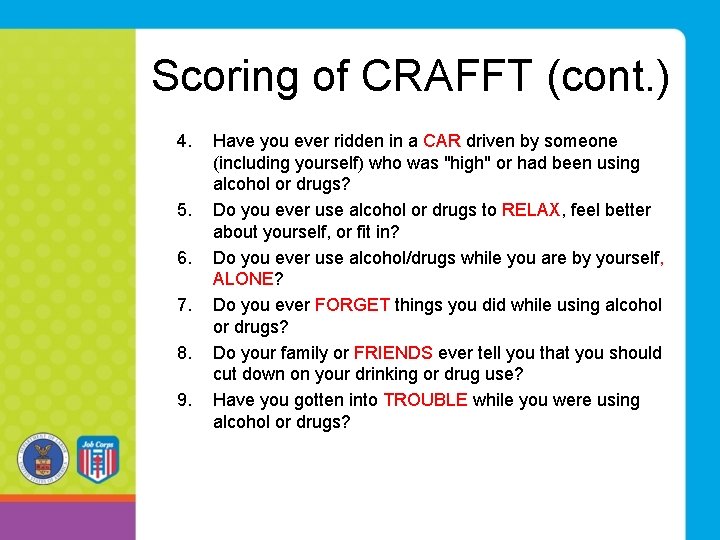
Scoring of CRAFFT (cont. ) 4. 5. 6. 7. 8. 9. Have you ever ridden in a CAR driven by someone (including yourself) who was "high" or had been using alcohol or drugs? Do you ever use alcohol or drugs to RELAX, feel better about yourself, or fit in? Do you ever use alcohol/drugs while you are by yourself, ALONE? Do you ever FORGET things you did while using alcohol or drugs? Do your family or FRIENDS ever tell you that you should cut down on your drinking or drug use? Have you gotten into TROUBLE while you were using alcohol or drugs?
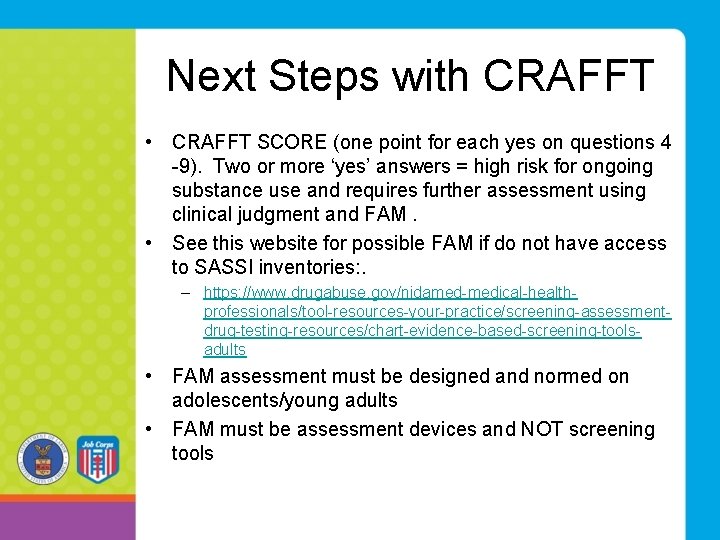
Next Steps with CRAFFT • CRAFFT SCORE (one point for each yes on questions 4 -9). Two or more ‘yes’ answers = high risk for ongoing substance use and requires further assessment using clinical judgment and FAM. • See this website for possible FAM if do not have access to SASSI inventories: . – https: //www. drugabuse. gov/nidamed-medical-healthprofessionals/tool-resources-your-practice/screening-assessmentdrug-testing-resources/chart-evidence-based-screening-toolsadults • FAM assessment must be designed and normed on adolescents/young adults • FAM must be assessment devices and NOT screening tools
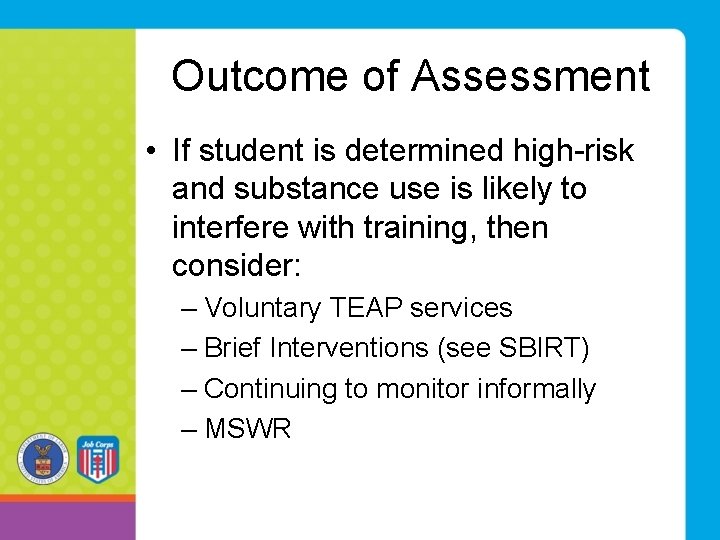
Outcome of Assessment • If student is determined high-risk and substance use is likely to interfere with training, then consider: – Voluntary TEAP services – Brief Interventions (see SBIRT) – Continuing to monitor informally – MSWR
Intervention Services 37
Intervention Services (6. 11, R 1(d)) • Primarily for those testing positive on entrance or those who volunteer. • Individual/group intervention services with a focus on behaviors that represent employability barriers. • Collaboration with the CMHC and consider consolidating services. • Referral to off-center substance abuse professionals or agencies as needed and available.
45 -Day Intervention Period: But what does it really look like? • No mandated components. • Remember goal = abstinence (and negative 45 -day screen). • Components: – – Treatment Contract delineating program. Individual/group meetings or check-ins. Self-help introduction for relapse prevention. Involvement of other departments: • Recreation • Residential
Relapse Prevention • Relapse Prevention – More than just self-help groups and should be integrated into all work instead of a separate program • Individual treatment plans to address RP • Self-Help groups: on- versus off-center access • Speakers at assemblies – example: prospective employers • • Ongoing RP groups CTP groups Emphasized in individual meetings Newsletters/electronic communication
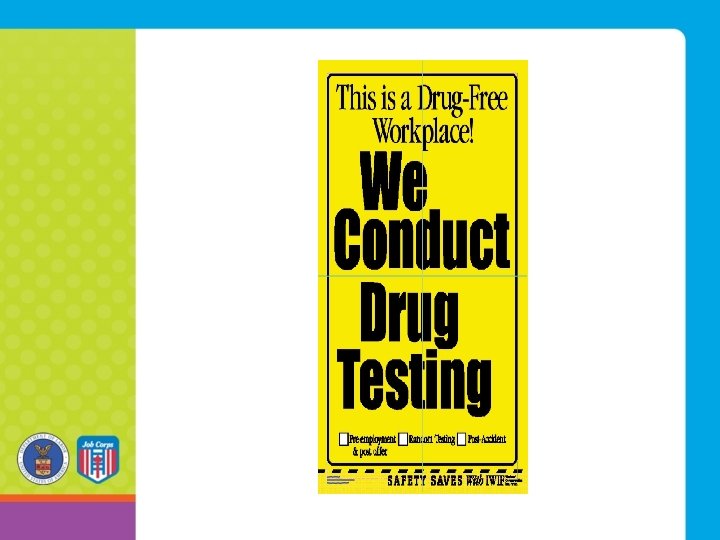
Drug and Alcohol Testing (6. 11; R 1, e) • Drug testing procedures – who gets tested: – New and readmitted students – Students who tested positive on entrance shall be retested between the 37 th and 40 th day after arrival on center. – Students who are suspected of using drugs at any point after arrival on center (if positive = ZT termination) • • • Biochemical testing is never permissible on a random basis If a student refuses to provide a specimen or has an unexcused absence from his or her follow-up (both 45 -day and suspicion) drug test this is now a ZT Termination Students who state they are unable to produce a specimen shall be referred to the center physician or designee for follow up.
Drug/Alcohol Testing • Collection of urine for drug testing shall be in accord with chain-of-custody principles and conducted by health and wellness staff or a staff member trained in urine collection procedures. • Use the CDD • Reinstated students shall not be subject to entry drug testing upon return to the center • Transfer students shall not be subject to drug testing upon arrival at receiving center. • Both reinstated and transfer students shall be subject to testing for drugs upon suspicion of use only
Decrease the Likelihood of Adulteration • Providing a private area for specimen collection • Remove all cleaning products from the collection room area • Perform visual and temperature checks. The sample temperature should fall between 90. 5 F and 99 F. • Visually should appear free of possible contaminants • Turn off additional water sources in the immediate collection area, if possible • Place a blue chemical in the toilet tank to color the water • Have the student wash (with water only) hands and clean under nails and give student a paper towel for hand drying before he/she provides the requested sample 45
More Basics for Supervised Collection • Have the student remove outer garments (e. g. , coats, sweaters, jackets) • Prohibit bags, packages, or purses in the collection area • Have the student provide the specimen while in an examination gown, if urine collection is part of a medical exam • Have collection personnel stand close to the door and be aware of unusual sounds when conducting a routine supervised collection • Make sure the student hands the specimen directly and immediately to collection personnel 46
Supervised Versus Observed • Observed ONLY recommended if concerns about adulteration • This means same sex staff is watching the urine stream leave the body and enter the specimen container 47
Alcohol Testing Procedures • As of 05/01/2016 – all centers will have a ‘three strikes and you are out’ alcohol policy. • PRH Change Notice No. 15 -09 emphasizes holding students accountable and having proportional consequences for infractions. – There are changes that impact TEAP: • A third alcohol-use infraction (now called “Abuse of Alcohol) will result in a Level I ZT termination. • Implications: • Educate students/staff. • Intervene more quickly when students have alcoholinfractions. • Assess for substance use disorders and possible MSWR.
Alcohol Testing Procedures • Students who are suspected of using alcohol at any point after arrival on center are immediately tested. • Tested using the “safety” breathalyzer (Alco. Blow unit). • If medical concerns – use the “medical” breathalyzer (or other method that gives quantitative reading) • Only administered by trained staff member (TEAP responsible for training). • All testing documented and filed in SHR.
Students testing positive for drug or alcohol use (6. 11; R 1, e(3, a) • If an intervention period takes place during a center vacation period (i. e. , winter break), the intervention period is suspended and resumes the day the student is scheduled to return to the center (e. g. , if a student is on day #30 of his or her intervention period at the time of the center vacation, the day count will be suspended at 30 days, and resume as day #31 the day he or she is due back on center) • Need to check CIS to determine how it was coded • Count also suspended for MSWR
Students testing positive for alcohol and drugs (cont. ) • Readmitted students previously separated for drug use who test positive on entry or any time during their second enrollment at Job Corps are separated. • During the 45 -day suspicion-intervention period, students in the driver’s education program and student drivers who fall under DOT regulations are not permitted to drive.
6. 11; R 1(e) • Students who test positive for drug use by an off-center facility are retested on center using the Job Corps nationally contracted laboratory as soon as possible, to include: – Work-based learning students who tested positive on a drug test administered by experience sites, union trades, or potential employers; – Students who tested positive on a drug test administered at a referral health facility (e. g. , hospital emergency department, urgent care facility). • • Student drivers who test positive for drug use under 49 CFR Part 391 DOT Federal Motor Carriers Safety Administration shall follow the same procedures outlined above for positive suspicion tests and cannot drive during this time. Students who test positive for alcohol use on suspicion shall be referred to the TEAP specialist for assistance and the center’s student conduct system for disciplinary action.
Notification of Drug and Alcohol Tests • Drug and alcohol test results shall be shared only with center personnel who have a need to know for purposes of discipline, counseling, administration, and delivery of services (in accordance with 42 CFR, Part 2). – Students are informed by the TEAP specialist, center physician, or designee. – Best practice would be to notify students of both positive and negative results. • • • The results of the retest drug test shall be provided to the student by the 45 th day after enrollment. Alcohol test results shall be provided to the student by the person administering the test. If a student questions the validity of a confirmed positive drug test, he or she shall be referred to the center physician or designee for counseling.
MSWR for Substance Use Conditions • • Students may be given a MSWR for a diagnosed substance use condition, allowing the student to return to Job Corps to complete his or her training within 180 days. To return to Job Corps, proof of treatment completion from a qualified provider must be received. A MSWR for substance use conditions can only be given if the following conditions are met: – The TEAP specialist and center director agree. – There is a documented assessment of the student’s diagnosed substance use condition by the TEAP specialist in collaboration with the center mental health consultant. • A MSWR cannot be granted in lieu of ZT separation when a positive 45 -day intervention period follow-up test is reported. – If a student is placed on a MSWR during the 45 -day intervention period, the intervention period is suspended and resumes the day the student is scheduled to return to the center.
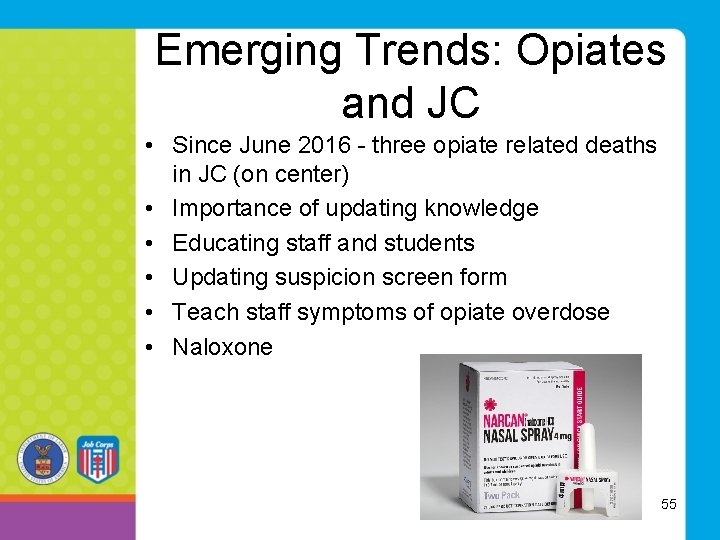
Emerging Trends: Opiates and JC • Since June 2016 - three opiate related deaths in JC (on center) • Importance of updating knowledge • Educating staff and students • Updating suspicion screen form • Teach staff symptoms of opiate overdose • Naloxone 55
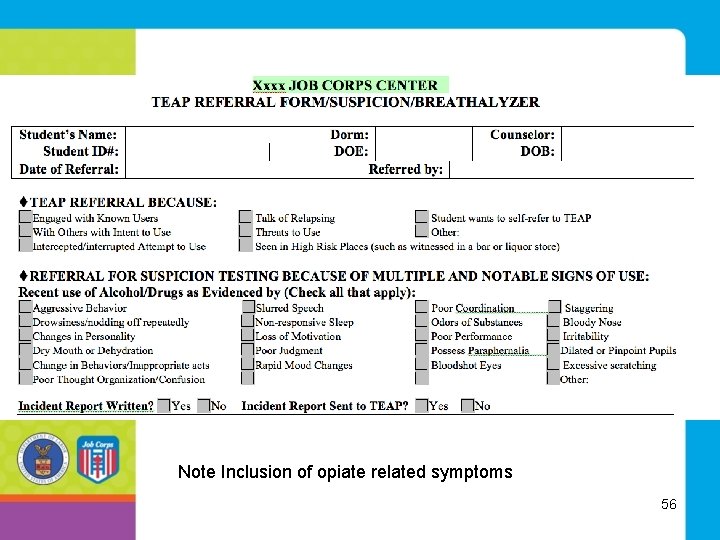
Note Inclusion of opiate related symptoms 56
TEAP Best Practices • Peer Mentoring • Full-time employee or at least full-time visibility on center • Relapse Prevention Groups • Separate mandatory versus voluntary TUPP groups • Ways to keep TEAP visible • Strong community partners • Strong center alliances • Strong management alliances 57
Tobacco Use and Prevention Program (TUPP) • Centers must implement a program to prevent the onset of tobacco use and to promote tobacco-free environments and individuals. • TUPP Coordinator may not be TEAP Specialist. • Centers must establish a smoke-free, tobacco-free environment for the majority of the center. • Centers are encouraged to maintain an entirely tobaccofree environment, especially during the training day.
TUPP Requirements • All buildings and center-operated vehicles must be tobacco-free. • Tobacco products must not be sold on center. • If center operators choose to allow use of tobacco products, they must designate specific areas for tobacco use. It is required that these areas be at least 25 feet, or as required by state law, away from all building entrances. • Minor students’ access to tobacco products should be restricted as required by state law (must check your state law). • Minors who use tobacco products shall be referred to the TUPP** (not voluntary). • All services provided should be documented in the SHR.
TUPP Tips • Case management for tobacco cessation should be offered to all students who use tobacco products. • Designated tobacco-use areas should be located away from central locations to discourage non-smokers from congregating with smokers, and have proper receptacles. • Staff should not use tobacco in the presence of students. • Criteria for good tobacco cessation product candidates: – NOT research clear minors. – Students on Nicotine Replacement Therapy (NRT) should participate in the TUPP on center. – Students who desire to use NRT should be smoking more than 10 cigarettes per day (a half pack per day), to be eligible for the NRT program. – The students should be willing to set a date by which s/he intends to quit smoking and use NRT for support of cessation. – Finally, the NRT students should be followed weekly in the HWC to check-in with the staff and receive their one week supply of NRT.
More TUPP Tips • Use evidence based practices for tobacco cessation groups – example: Not on Tobacco. • Have separate groups for minors and those wanting to cease tobacco use. • Have policy for tobacco products like e-cigarettes and vape pens.
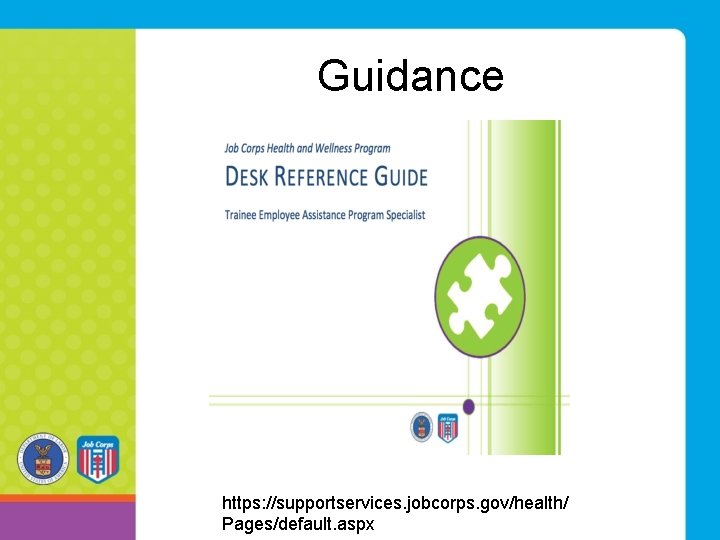
Guidance https: //supportservices. jobcorps. gov/health/ Pages/default. aspx

63
Comments, Questions and Concerns 64
- Slides: 64