
Job Analysis Job Analysis In a labour surplus
Job Analysis
Job Analysis �In a labour surplus and capital hungry country like India, jobs are very important to individuals. �They help determine standards of living, place of residence, status and even one’s sense of self- worth. �Jobs are important to organizations because they are accomplishing organizational objectives. �Traditionally, organizations used to define jobs in a rigid way. �In reality, however jobs are not static. They are subject to change.
Meaning of Job Analysis �Job analysis is a formal and detailed examination of jobs. �It is a systematic investigation of tasks, duties and responsibilities necessary to do a job. �Tasks- is an identifiable work activity carried out for a specific purpose e. g. typing a letter �Duties: large work segment consisting of several tasks e. g. pick up, sort out and deliver incoming mail. �Job analysis is an important personnel activity because it identifies what people do in their jobs and what they require in order to do the job satisfactorily.
Uses of Job Analysis �Good human resource management demands both the employee and the employer a clear understanding of the duties and responsibilities to be performed on a job. �Human resource planning �Recruitment �Selection �Placement and orientation �Training �Counselling
Uses of Job Analysis �Employee safety �Performance appraisal �Job design and redesign �Job evaluation
Process of Job Analysis �The major steps involved in job analysis are: �Organizational analysis- overall picture of various jobs obtained through organizational charts and workflow charts �Selection of representative positions to be analyzed- a representative sample of jobs to be analyzed keeping cost and time constraints in mind �Collection of job analysis data- collection of data on the characteristics of the job, the required behavior and personal qualifications needed �Preparation of job description- describing the contents of job in terms of functions, duties, responsibilities, operations etc. �Preparation of job specification- is a written statement of personal attributes in terms of traits, skills, training, experience needed to carry out the job
Methods of Job Analysis Data �A variety of methods are used to collect information about jobs �None of them, however is perfect �In actual practice, a combination of several methods is used for obtaining job analysis data. �Personal observation- observes the workers doing the job- the task performed, activities etc. �During observation, the analyst must observe average workers, observe without directly involved in the job, obtain proper sample etc. �It is appropriate for manual, short period job activities �The method failed to take the mental aspects of jobs.
Methods of Job Analysis Data �Critical incidents- CIT is a qualitative approach to job analysis used to obtain specific, behaviorally focused descriptions of work �The job holders are asked to describe several incidents based on their past experience. �The incidents collected are analyzed and classified �The job requirements will become clear once the analyst draws the line between effective and ineffective behavior of the workers on job. �E. g: if a shoe salesman comments on the size of a customers feet and the customer leaves the store in a huff, the behavior of the salesman may be judged as ineffective in terms of the result produced.
Methods of Job Analysis Data �Interview : consists of asking questions to both incumbents and supervisors in either individual or group setting. �The reasons behind the use of this method is that job holders are most familiar with the job and can supplement the information obtained through observation. �Panel of experts : utilizes senior job incumbents and superiors with extensive knowledge of the job �The analyst conducts an interview with the group.
Methods of Job Analysis Data �Diary Method: several job incumbents are asked to keep diaries or logs of their daily job activities and record the amount of time spent on each activity �By this, a job analyst is able to record the job’s essential characteristics- it is a time consuming and costly exercise �Questionnaire method: is a widely used method of analyzing jobs and work. �The job holders are given a designed questionnaire and after completion designed questionnaire are handed over to supervisors.
Methods of Job Analysis Data �Questionnaire method: the supervisors can seek further clarifications on various items by talking to the job holders directly. �After everything is finalized, the data is given to the job analyst. �The success of the method depends on various factors �The structured questionnaire must cover all job related tasks and behaviors. �The job holders should be asked to properly rate the various factors and communicate the same on paper.
Questionnaires �Position Analysis Questionnaire( PAQ)quantitative work oriented job elements- 19 items divided into six major divisions. �Management Position Description. Questionnaire( MPDQ) standardized instrument in analyzing managerial jobs. 274 item questionnaire contains 15 sections. The respondents are asked to state how important each item is to the position �Factors: staff service, supervision, complexity and stress, autonomy of actions, public and customer relations etc
Questionnaires �Functional Job Analysis( FJA)- is a worker oriented job analysis that attempts to describe the whole person on the job. �Five steps: Ø identification of organizational goals Ø identification and description of tasks Ø analysis of tasks Ø develops performance standards to assess the results of a worker’s tasks Ø development of training content needed by the job holder
Why Job Analysis v Over the past few years, the concept of job has been changing quite dramatically v Employees do not like standardized, routine operations v They do not like supervisors overseeing their work from close quarters. v They want the work to be more meaningful, challenging and interesting v They like to work on jobs with “ stretch, pull and challenge” v So the concept of a job having well defined, clearly delineated set of responsibilities is being increasingly questioned by present day employees who are more knowledgeable and demanding
India's top 10 best companies to work for 2013 - Google �Google’s stock climbed past $1, 000 in 2013 — a boon for Googlers, all of whom are stockholders. CEO Larry Page urged them to be “audacious, ” especially in philanthropy. Google donates $50 for every five hours an employee volunteers. Last year a new program sent employees to Ghana and India to work on community projects.
Intel Technology �Business: Microprocessors, chipsets, motherboards, adaptors for desktops, laptops Employees 3, 472 Location: Bangalore Rank 2012 2 Intel embeds its employees with reminiscences and does not change them into job-hopping Joes. Like any other firm, the company has its litmus test to ensure it has the best pick. However, a job interview with Intel is not about knowing a product but making sure if you are a right fit. At Intel, one of the tenets strictly followed is that a new hire does not feel isolated.
American Express Business: Charge and credit cards, corporate cards, prepaid cards and travelers Employees 6, 856 Location: Gurgaon Rank 2012 6 It is not work-life balance but integration that American Express is keen to adopt. It is no secret then that Amex has one of the strongest retention rates in the financial sector with an attrition rate in the low-teens.
NIIT �Business: Learning solutions Employees 2, 448 Location: Gurgaon Rank 2012 10 At NIIT, compatibility and competence go hand in hand to strike a unique balance. 'EMPLOYEE' is a taboo word at the Gurgaon-headquarterd learning solutions firm NIIT. All professionals working with the company are referred to as NIITians. Chief Executive Officer Vijay K Thadani feels the company has consciously stayed away from using the terms 'employee' and 'employer' as they create a divide.
Forbes Marshall �Business: Steam engineering and control instrumentation Employees 1, 260 Location: Pune Rank 2012 5 With second and even third generation employees, Forbes Marshall projects a home away from home. Almost 14% of the workforce at Forbes Marshall comprises second-generation employees, with some on the shopfloor even from the third generation. One thing that's obvious is that this is a company that takes its people seriously.
Job Description �It is a written statement of what the job holder does, how it is done, under what conditions it is done and why it is done. �It describes what the job is all about, throwing light on job content, environment and conditions of employment. �It is descriptive in nature and defines the purpose and scope of a job. �The main purpose of writing a job description is to differentiate the job from other jobs and state its outer limits.
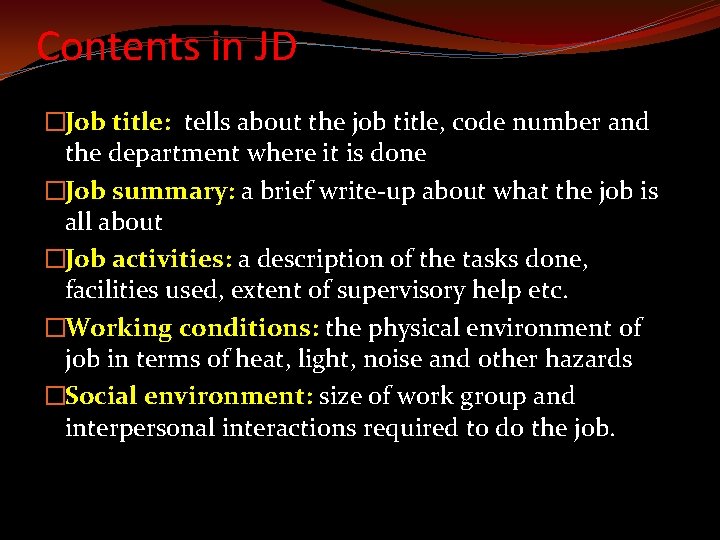
Contents in JD �Job title: tells about the job title, code number and the department where it is done �Job summary: a brief write-up about what the job is all about �Job activities: a description of the tasks done, facilities used, extent of supervisory help etc. �Working conditions: the physical environment of job in terms of heat, light, noise and other hazards �Social environment: size of work group and interpersonal interactions required to do the job.
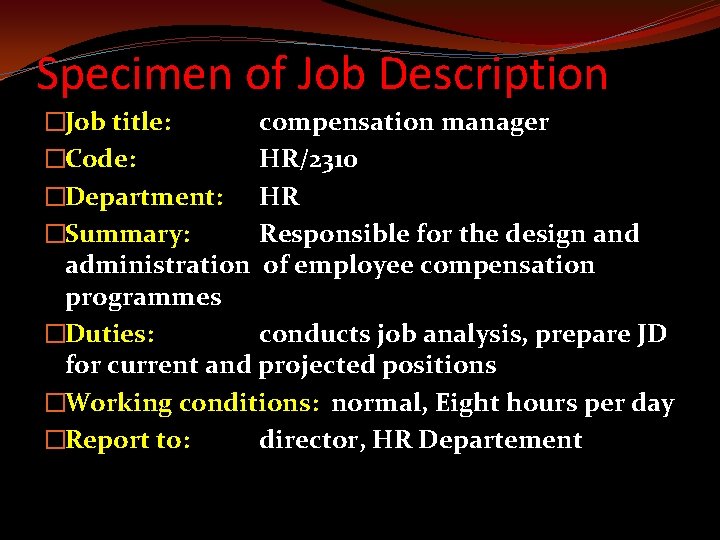
Specimen of Job Description �Job title: compensation manager �Code: HR/2310 �Department: HR �Summary: Responsible for the design and administration of employee compensation programmes �Duties: conducts job analysis, prepare JD for current and projected positions �Working conditions: normal, Eight hours per day �Report to: director, HR Departement
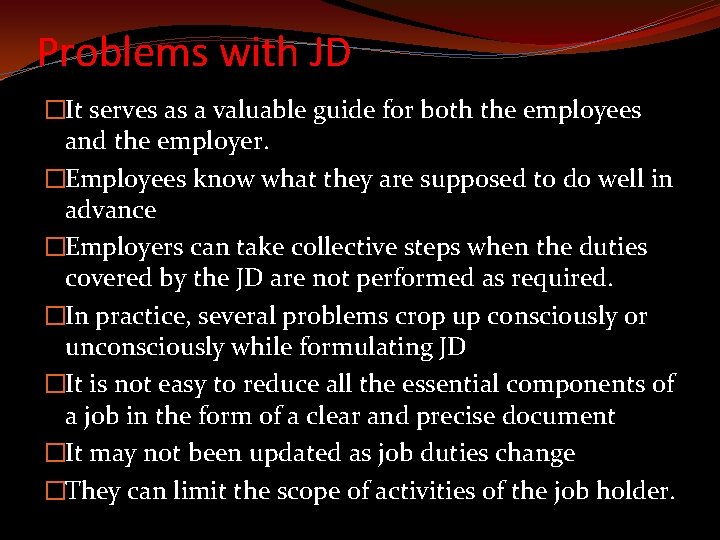
Problems with JD �It serves as a valuable guide for both the employees and the employer. �Employees know what they are supposed to do well in advance �Employers can take collective steps when the duties covered by the JD are not performed as required. �In practice, several problems crop up consciously or unconsciously while formulating JD �It is not easy to reduce all the essential components of a job in the form of a clear and precise document �It may not been updated as job duties change �They can limit the scope of activities of the job holder.
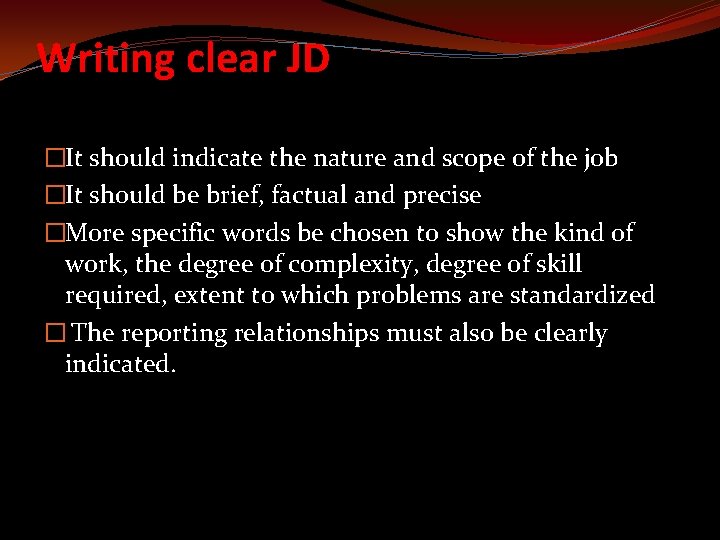
Writing clear JD �It should indicate the nature and scope of the job �It should be brief, factual and precise �More specific words be chosen to show the kind of work, the degree of complexity, degree of skill required, extent to which problems are standardized � The reporting relationships must also be clearly indicated.
Job Specification �It summarizes the human characteristics needed for satisfactory job completion �It tries to describe the key qualifications needs to perform the job successfully. �It spells out the important attributes of a person in terms of education, experience, skills, knowledge and abilities ( SKAs) to perform a particular job. �For each JD, it is desirable to have a job specification. �This helps the organization to determine what kind of person are needed to tae up specific jobs
Job Specification �The personal attributes that are described through a job specification may be classified into three categories �Essential attributes: skills, knowledge and abilities a person must possess �Desirable attributes: qualifications a person ought to possess �Contra-indicators: attribute that will become a handicap to successful job performance
Job Specification �JS can be developed by talking with the current job holders about the attributes required to do the job satisfactorily. �It is useful in selection process because it offers a clear set of qualifications for an individual to be hired for a specific job �A well written ob specification offers a clear picture to new recruits of what they will be doing in the organization.
Specimen of Job Specification of compensation manager �Education MBA with specialization in HRM �Experience: at least 3 years experience in similar position in a large manufacturing company �Skill, abilities, knowledge: knowledge of compensation practices, compensation analysis procedure, of compensation survey techniques etc �Age: preferably below 35 years
Selection �To select means to choose �It is the process of picking individuals who have relevant qualifications to fill jobs in an organization. �The basic purpose is to choose the individual who can most successfully perform the job from a pool of qualified candidates �To meet this goal, the company obtains and assesses information about the applicants age, qualification, skills, experience etc �The needs of the job are matched with the profile of candidates.
Selection �The most suitable person is picked after eliminating the unsuitable applicants through successive stages of selection process �How well an employee is matched to a job is very important because it directly affects the amount and quality of employees work. �Any mismatch in this regard can cost an organization a great deal of money, time and trouble �In course of time, the employee may find the job distasteful and leave in frustration and circulate ‘hot news’ and juicy bits of negative information about the company �Hence effective selection demands constant monitoring of the fit between person and the job
Process of Selection �It is usually a series of hurdles or steps �Each one must be successfully cleared before the applicant proceeds to the next �The important steps in the selection process of a typical organization are: �Reception – create favorable impression on the applicants by being tactful and in extending help �Screening Interview- preliminary interview is planned to cut the costs of selection by allowing eligible candidates to go through the further stages in selection. �If suitable candidate is found, a prescribed application form is given to the applicants to fill and submit
Process of Selection �Application blank- it is one of the most common methods used to collect information on various aspects of the applicants academic, social, demographic, work-related background and references- a history sheet of an employees background �Selection testing- a standardized, objective measure of a persons behavior , performance or attitudeintelligence tests( stanford-Binet test, Binet-simon test, The Wechsler Adult intelligence scale), aptitude test, personality test , simulation tests etc
Process of Selection �Selection interview: it is the oral examination of candidates for employment �Interview gives the recruiter an opportunity to size up the candidate personally, ask questions that are not covered in tests, make judgments on candidates enthusiasm and intelligence, give facts to candidate regarding the company, its policies, programmes etc. �Medical examination: Certain jobs require physical qualities like clear vision, perfect hearing , clear tone etc- it reveals whether or not a candidate processes these qualities.
Process of Selection �Reference checks : Candidates are required to give the names of two or more references in their application forms �These references may be individuals, applicants previous employer etc �Hiring decisions : the line manager has to make the final decision whether to select or reject a candidate after soliciting the required information through different techniques
Career Planning �It is the process by which one selects career goals and path to achieve these goals �It is not an event or end in itself but a continuous process of developing human resources for achieving optimum results �A person who is not able to translate his career plan into action within the organization may probably quit the job, if he has a choice �Organizations, should therefore help employees in career planning so that both can satisfy each other’s needs
Career Planning �Career planning assists in finding those employees who could be groomed for higher level positions, on the strength of their performance- is able to prepare a summary of skills and potentials �It only gives us a picture of who could succeed in case of retirement, death, resignation of existing employees. HRP �It is the process of analyzing and estimating the need for availability of employees �It gives valuable information on availability of hr for expansion, growth etc
Career Planning �There cannot be an effective manpower planning, if career planning is not carried out properly HRP �It is tied to the overall strategic planning efforts of the organization
Need for career planning �Every employee has a desire to grow and scale new heights in his workplace continuously �If there are enough opportunities, employees can pursue their career goals and exploit potential fully �They feel highly motivated when the organization shows them a clear path as to how he can meet his personal ambitions �Unfortunately, organization do not pay adequate attention to this aspect �When recognition does not come in time for meritorious performance , they look for another job
Need for career planning �Key executives leave in frustration and the organisation suffers badly when turnover figures rise. �So the absence of career plan is going to make a big difference to both the employees and the organisation �Organisations are not going to benefit from high employee turnover �New employees mean additional selection and training costs. �So organizations therefore try to put their career plans in place and educate employees about the opportunities that exist internally for talented people.
Objectives of career planning �Attract and retain talent by offering careers, not jobs �Use human resources effectively and achieve greater productivity �Reduce employee turnover �Improve employee morale and motivation �Meet the immediate and future human resource needs of the organization on a timely basis
Process in career planning �Identifying individual needs and aspirations �Analyzing career opportunities �Aligning needs and opportunities �Action plans and periodic review.
Career Development �It consists of the personal actions one undertakes to achieve a career plan �It looks at the long term career effectiveness of employees �The actions for career development may be intitated by the individual himself or by the organization
Individual career development �Career progress and development is largely the outcome of actions on the part of an individual. �Some of the important steps that could help an individual cross the hurdles on way may include: �Performance: career progress rests on performanceis sub standard, career goals cant be achieved �Exposure: attract the attention of those who matters most in an organization �Networking: professional and personal contactsprivate clubs, professional associations etc �Leveraging: take up new job- job hopping may not be a good career strategy in long run.
Individual career development �Loyalty to career: companies such as Infosys, NIIT, Wipro- all IT Companies where turn over ratio is generally high have come out with lucrative, innovative compensation packages. �Mentors : offers advice and guidance on how to survive and get ahead in the organization. �Key subordinates: qualified and knowledgeable subordinates often help their bosses and these bosses when they cross the bridge , they take the subordinates also �Expand ability: attending training programme, acquiring a degree, updating skills etc.
Organizational career development �The assistance from managers and HR department is equally important in achieving individual career goals and meeting organizational needs �A variety of tools and activities are employed for this purpose. 1. Self-assessment tools: employees identify career goals, develop suitable action plan and point out obstacles- two self- assessment tools are used a. Career planning workshop: after completion of self-assessment, they share their findings with others in career workshops- throw light on how to prepare individual career strategies
Organizational career development b. Career workbook: form of career guide in the question -answer format outlining steps for realizing career goals c. This guide throws light on organizations structure, career paths, qualifications for jobs and career ladders 2. Individual counselling: is a process whereby employees are guided in overcoming performance problems- offered by HR Department/experts 3. Information services: employment opportunities at various levels are made known to employees through information services of various kinds like job posting system, skills inventory, career ladders, career paths, career resource centre- is a sort of library in the organization to distribute reference books, career manuals, brochures, newsletters, learning guides etc.
Organizational career development �Employee assessment Programme: a new recruit is informed about career policies and procedures of the company �Mentors help new recruits through training, career programmes etc �Several assessment programmes are used to evaluate employees potential for growth and development in the organisation �They include assessment centers, psychological test, promotability forecasts- a process of identifying employees with high career potential and training and groom them for higher positions, succession planning
Organizational career development �Employee development programmes: seminars, workshops, job rotations, mentoring programmes etc are used to develop a broad base skills as a part of developmental activities.
- Slides: 48