
Joanne Blocker Director of Academics Gateway Regional School
Joanne Blocker, Director of Academics Gateway Regional School District Professional Development 2010 -2011
PROFESSIONAL DEVELOPMENT OCTOBER 2010 SURVEY RESULTS
Question 1. The in district professional development sessions I have attended since July have been beneficial. The majority of the responses were yes. Comments Summary: � � Staff likes it when the Professional Development impacts learning for students. Specialists and para’s would like more offerings geared towards their area of instruction. There were a lot of positive comments about the Smartboard and clicker sessions. The bullying Professional Development was beneficial because it is important to update staff on policy.
Question 2. I would like to have more sessions offered on: Comments Summary: � � Specialists would like time to work with their colleagues in their same content area. They would like times for sharing best practices. Some like the idea of providing several “choice” offerings for Professional Development and letting staff choose/sign up. Topic areas that were asked to be offered include writing, behavior management, special education ie: Autism, technology, retirement planning, math, reading, bullying, ie: redirecting behavior, classroom management, curriculum planning, restraint training, love & logic, MCAS, science, instructional strategies/classroom content.
Question 3. I like the new system of getting PDP’s right after the session. All responses were yes and all feedback was positive.
Question 4. I feel it would be important to have sessions/professional development about the implementation of the National Core Curriculum in ELA and Mathematics. Majority of feedback was yes. Comment Summary: � � � For the most part, the responses were geared toward the importance of being prepared to make the change. Some staff indicated they would like to work in grade level groups for this. Some staff want to work on other curriculum areas such as art, music, PE and health. Some staff wanted more information.
Common Core Standards

1. The National Common Core Standards have been adopted by 32 states including Massachusetts. It is expected that we will implement these standards by 2013. Each state is allowed to add 15% of their state’s standards to the National Common Core. Massachusetts is currently working on this addition.
2. The Common Core State Standards for English Language Arts & Literacy in History/Social Studies, Science and Technical Subjects (“the Standards”) are the culmination of an extended broad-based effort to fulfill the charge issued by the state to create the next generation of K-12 standards in order to ensure that all students are college and career ready in literacy no later than the end of high school.
3. The Common Core State Standards for Mathematics: The Standards for Mathematical Practice describe varieties of expertise that mathematics educators at all levels should seek to develop in their students. These practices rest on important “process and proficiencies” with longstanding importance in mathematics education. The first of these are the NCTM process standards of problem solving, reasoning and proof, communications representation, and connections. The second are the strands of mathematical proficiencies specified in the National Research Councils report adding it up: adaptive reasoning, strategic competence, conceptual understanding (comprehension of mathematical concepts, operations and relations), procedural fluency skill in carrying out procedures, flexibly, accurately, efficiently and appropriately) and productive disposition (habitual inclination to see mathematics as sensible, useful, and worthwhile), coupled with a belief in diligence and one’s own efficacy
4. College and career readiness standards have been incorporated into the K-12 standards. The criteria used to develop the college- and career- readiness standards, as well as these K-12 standards are: Aligned with college and work expectations; Include rigorous content and application of knowledge through high-order thinking skills; Build upon strengths and lessons of current state standards; Informed by top-performing countries so that all students are prepared to succeed in our global economy and society; and Evidence and/or research based
Summer Professional Development July 19, 20, 26 Elementary Leveled Readers August 24 Read Naturally Para’s August 25 Workboard K-2
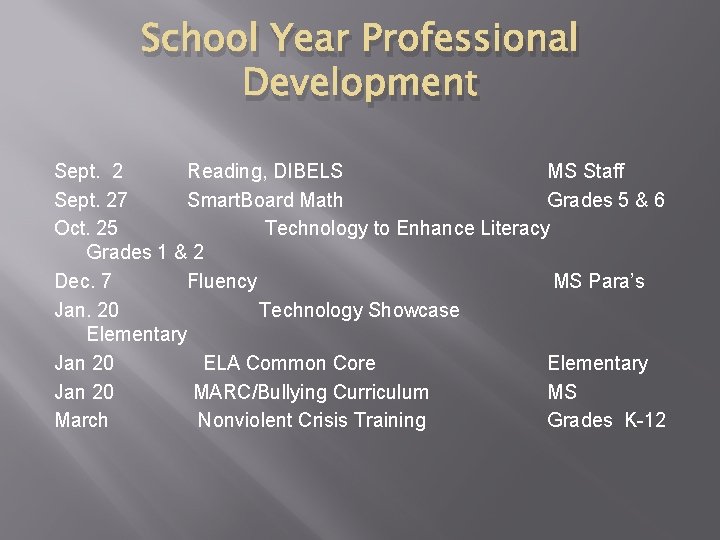
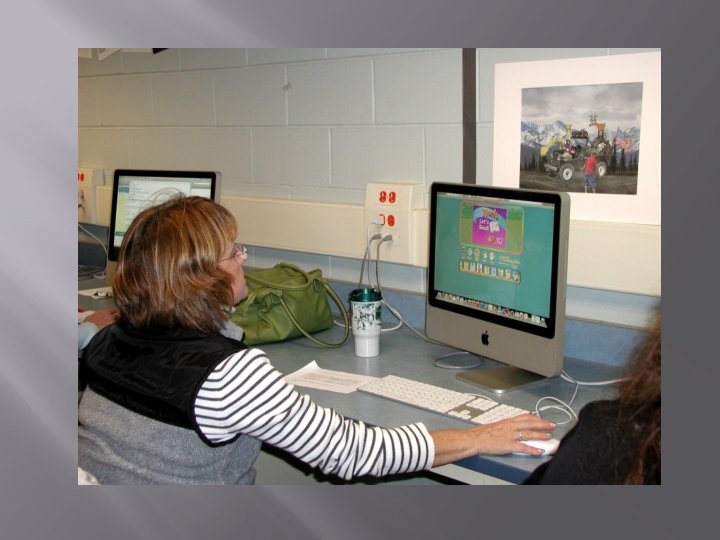
School Year Professional Development Sept. 2 Reading, DIBELS MS Staff Sept. 27 Smart. Board Math Grades 5 & 6 Oct. 25 Technology to Enhance Literacy Grades 1 & 2 Dec. 7 Fluency MS Para’s Jan. 20 Technology Showcase Elementary Jan 20 ELA Common Core Elementary Jan 20 MARC/Bullying Curriculum MS March Nonviolent Crisis Training Grades K-12
Professional Development Provided by DSAC (District and School Assistance Center) March Paraprofessional Workshop Overview of the five big ideas of reading (Phonemic Awareness, Alphabetic Principle, Fluency with Text, Vocabulary Comprehension). The second session will go more in depth with one of the five big ideas in reading. June Teacher and Paraprofessional Training How to utilize paraprofessional staff to enhance the classroom. Provided by Susan Kazeroid, Literacy Specialist
Early Release & Half Day Professional Development September: Elementary: Websites Middle School: Clicker training JH/HS: PLC’s October: Elementary: Smart. Board Middle School: Web Sites JH/HS: PLC’s December: Elementary: Technology Sessions Middle. School: Using Data to Inform Instruction JH/HS: PLC’s
Early Release & Half Day Professional Development January 20 Administration: Data Warehouse Elementary: Technology Showcase and ELA Common Core Middle School: MARC/Bullying Curriculum March: Elementary: TBA Middle School: ELA Common Core JH/HS: PLC, MCAS
Early Release & Half Day Professional Development April: Elementary: MARC/Bullying Curriculum Middle School: 21 st Century Skills JH/HS: Best Practices, Interdisciplinary lesson planning, PLC’s, and Class Management May: Elementary: Professional Development with Coaches Middle School: Data Analysis & Grade Level Groups JH/HS: PLC’s Final Reports, and Best Practices.
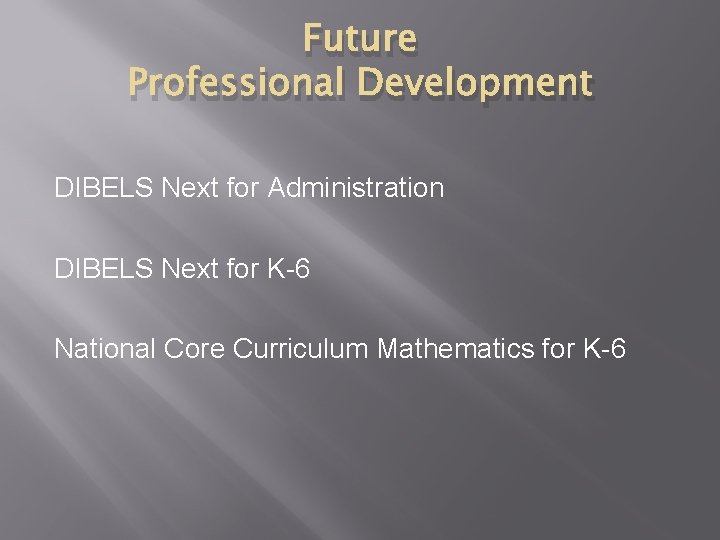
Future Professional Development DIBELS Next for Administration DIBELS Next for K-6 National Core Curriculum Mathematics for K-6
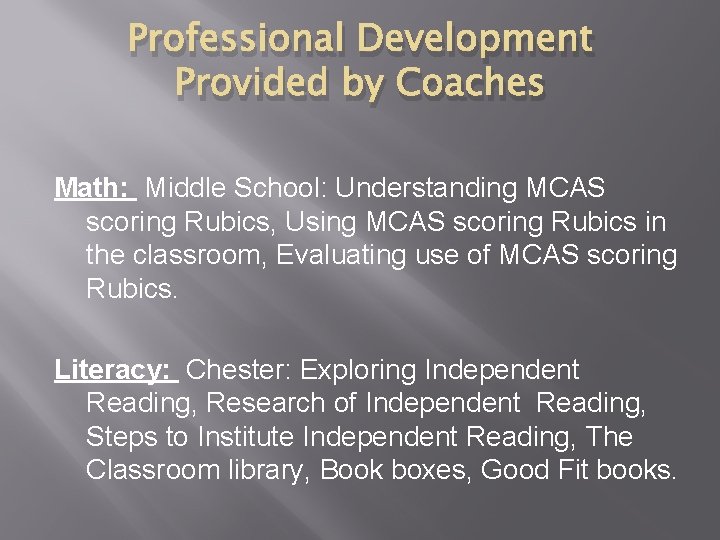
Professional Development Provided by Coaches Math: Middle School: Understanding MCAS scoring Rubics, Using MCAS scoring Rubics in the classroom, Evaluating use of MCAS scoring Rubics. Literacy: Chester: Exploring Independent Reading, Research of Independent Reading, Steps to Institute Independent Reading, The Classroom library, Book boxes, Good Fit books.
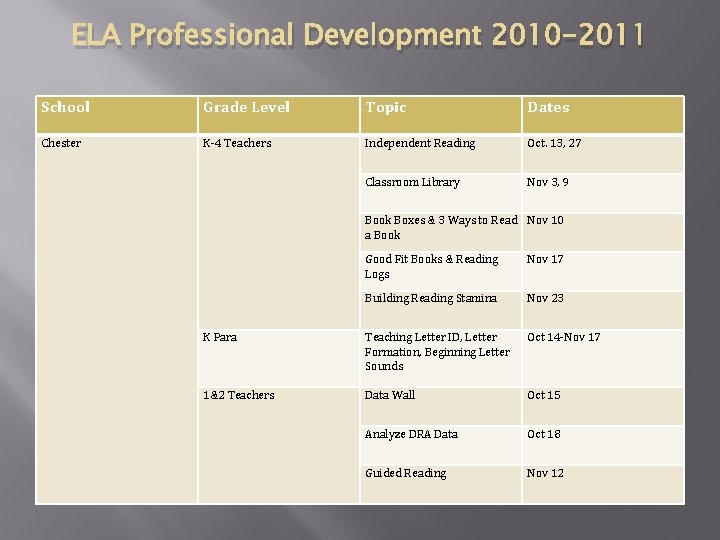
ELA Professional Development 2010 -2011 School Grade Level Topic Dates Chester K-4 Teachers Independent Reading Oct. 13, 27 Classroom Library Nov 3, 9 Book Boxes & 3 Ways to Read Nov 10 a Book Good Fit Books & Reading Logs Nov 17 Building Reading Stamina Nov 23 K Para Teaching Letter ID, Letter Formation, Beginning Letter Sounds Oct 14 -Nov 17 1&2 Teachers Data Wall Oct 15 Analyze DRA Data Oct 18 Guided Reading Nov 12
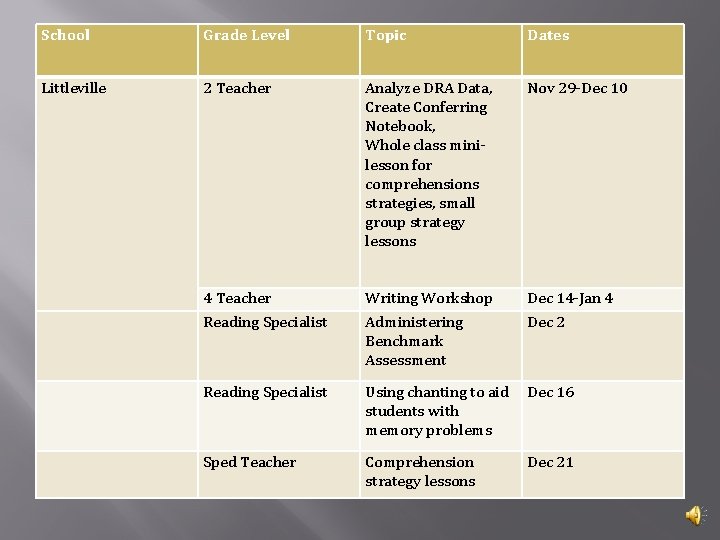
School Grade Level Topic Dates Littleville 2 Teacher Analyze DRA Data, Create Conferring Notebook, Whole class minilesson for comprehensions strategies, small group strategy lessons Nov 29 -Dec 10 4 Teacher Reading Specialist Writing Workshop Administering Benchmark Assessment Dec 14 -Jan 4 Dec 2 Reading Specialist Using chanting to aid students with memory problems Dec 16 Sped Teacher Comprehension strategy lessons Dec 21
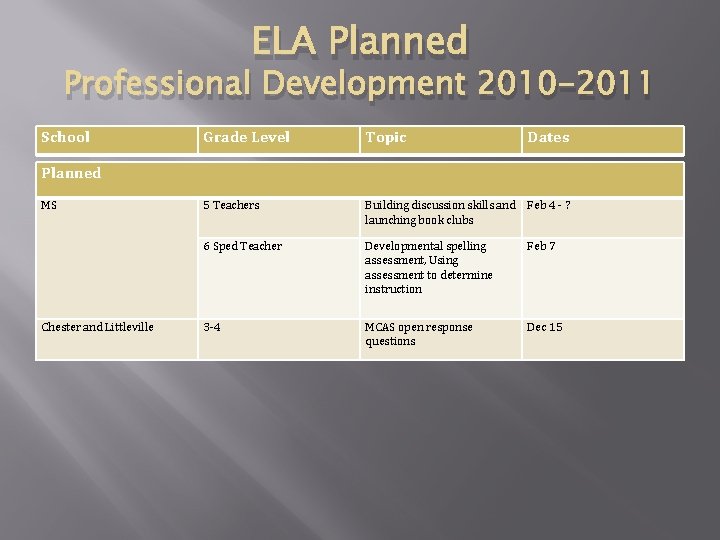
ELA Planned Professional Development 2010 -2011 School Grade Level Topic Dates 5 Teachers Building discussion skills and Feb 4 - ? launching book clubs 6 Sped Teacher Developmental spelling assessment, Using assessment to determine instruction Feb 7 3 -4 MCAS open response questions Dec 15 Planned MS Chester and Littleville




- Slides: 31