
JLEIC ELECTRON RING DYNAMIC APERTURE WITH NONLINEAR FIELD
- Slides: 1
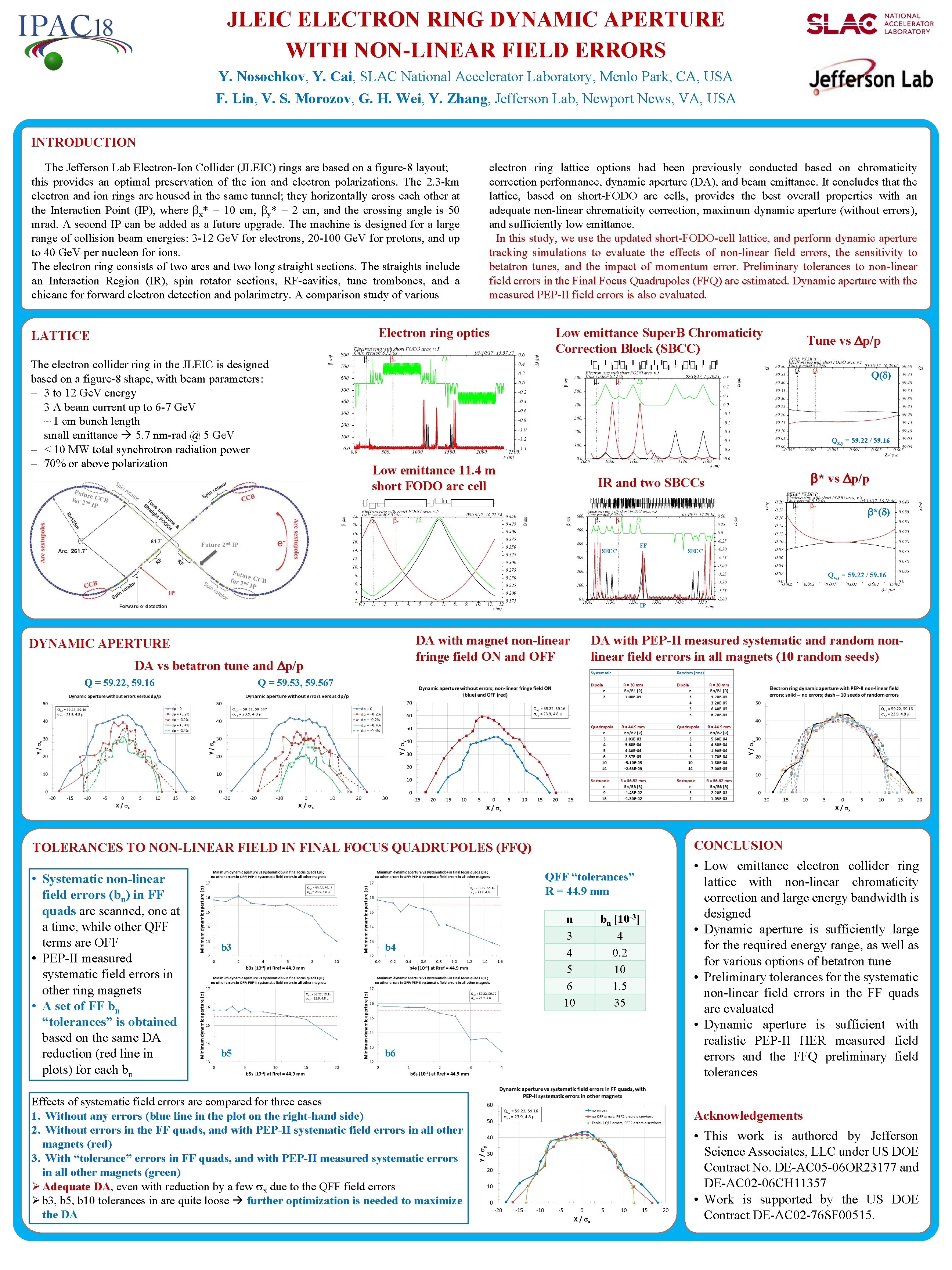
JLEIC ELECTRON RING DYNAMIC APERTURE WITH NON-LINEAR FIELD ERRORS Y. Nosochkov, Y. Cai, SLAC National Accelerator Laboratory, Menlo Park, CA, USA F. Lin, V. S. Morozov, G. H. Wei, Y. Zhang, Jefferson Lab, Newport News, VA, USA INTRODUCTION The Jefferson Lab Electron-Ion Collider (JLEIC) rings are based on a figure-8 layout; this provides an optimal preservation of the ion and electron polarizations. The 2. 3 -km electron and ion rings are housed in the same tunnel; they horizontally cross each other at the Interaction Point (IP), where bx* = 10 cm, by* = 2 cm, and the crossing angle is 50 mrad. A second IP can be added as a future upgrade. The machine is designed for a large range of collision beam energies: 3 -12 Ge. V for electrons, 20 -100 Ge. V for protons, and up to 40 Ge. V per nucleon for ions. The electron ring consists of two arcs and two long straight sections. The straights include an Interaction Region (IR), spin rotator sections, RF-cavities, tune trombones, and a chicane forward electron detection and polarimetry. A comparison study of various electron ring lattice options had been previously conducted based on chromaticity correction performance, dynamic aperture (DA), and beam emittance. It concludes that the lattice, based on short-FODO arc cells, provides the best overall properties with an adequate non-linear chromaticity correction, maximum dynamic aperture (without errors), and sufficiently low emittance. In this study, we use the updated short-FODO-cell lattice, and perform dynamic aperture tracking simulations to evaluate the effects of non-linear field errors, the sensitivity to betatron tunes, and the impact of momentum error. Preliminary tolerances to non-linear field errors in the Final Focus Quadrupoles (FFQ) are estimated. Dynamic aperture with the measured PEP-II field errors is also evaluated. Electron ring optics LATTICE The electron collider ring in the JLEIC is designed based on a figure-8 shape, with beam parameters: – 3 to 12 Ge. V energy – 3 A beam current up to 6 -7 Ge. V – ~ 1 cm bunch length – small emittance 5. 7 nm-rad @ 5 Ge. V – < 10 MW total synchrotron radiation power – 70% or above polarization Low emittance Super. B Chromaticity Correction Block (SBCC) Tune vs Dp/p Q(d) Qx, y = 59. 22 / 59. 16 Low emittance 11. 4 m short FODO arc cell IR and two SBCCs b* vs Dp/p b*(d) SBCC FF SBCC Qx, y = 59. 22 / 59. 16 IP DA with magnet non-linear fringe field ON and OFF DYNAMIC APERTURE DA vs betatron tune and Dp/p Q = 59. 22, 59. 16 DA with PEP-II measured systematic and random nonlinear field errors in all magnets (10 random seeds) Q = 59. 53, 59. 567 TOLERANCES TO NON-LINEAR FIELD IN FINAL FOCUS QUADRUPOLES (FFQ) CONCLUSION • Systematic non-linear field errors (bn) in FF quads are scanned, one at a time, while other QFF terms are OFF • PEP-II measured systematic field errors in other ring magnets • A set of FF bn “tolerances” is obtained based on the same DA reduction (red line in plots) for each bn • Low emittance electron collider ring lattice with non-linear chromaticity correction and large energy bandwidth is designed • Dynamic aperture is sufficiently large for the required energy range, as well as for various options of betatron tune • Preliminary tolerances for the systematic non-linear field errors in the FF quads are evaluated • Dynamic aperture is sufficient with realistic PEP-II HER measured field errors and the FFQ preliminary field tolerances QFF “tolerances” R = 44. 9 mm b 3 b 4 b 5 b 6 Effects of systematic field errors are compared for three cases 1. Without any errors (blue line in the plot on the right-hand side) 2. Without errors in the FF quads, and with PEP-II systematic field errors in all other magnets (red) 3. With “tolerance” errors in FF quads, and with PEP-II measured systematic errors in all other magnets (green) Ø Adequate DA, even with reduction by a few sx due to the QFF field errors Ø b 3, b 5, b 10 tolerances in are quite loose further optimization is needed to maximize the DA n 3 4 5 6 10 bn [10 -3] 4 0. 2 10 1. 5 35 Acknowledgements • This work is authored by Jefferson Science Associates, LLC under US DOE Contract No. DE-AC 05 -06 OR 23177 and DE-AC 02 -06 CH 11357 • Work is supported by the US DOE Contract DE-AC 02 -76 SF 00515.