
JLab SVT Concept to Implementation Brian Eng Detector
JLab SVT Concept to Implementation Brian Eng Detector Support Group 9/3/2020
Contents • • Design Assembly Operation Infrastructure • Just showing a few highlights 2/12/2022 Detector Support Group 2
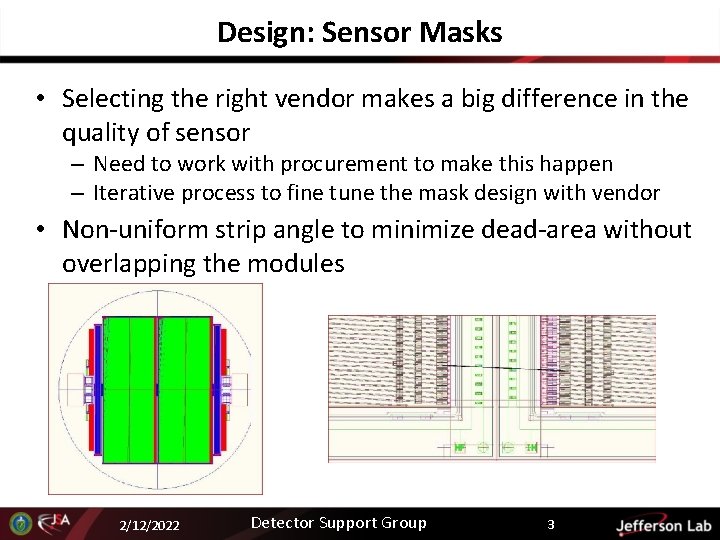
Design: Sensor Masks • Selecting the right vendor makes a big difference in the quality of sensor – Need to work with procurement to make this happen – Iterative process to fine tune the mask design with vendor • Non-uniform strip angle to minimize dead-area without overlapping the modules 2/12/2022 Detector Support Group 3
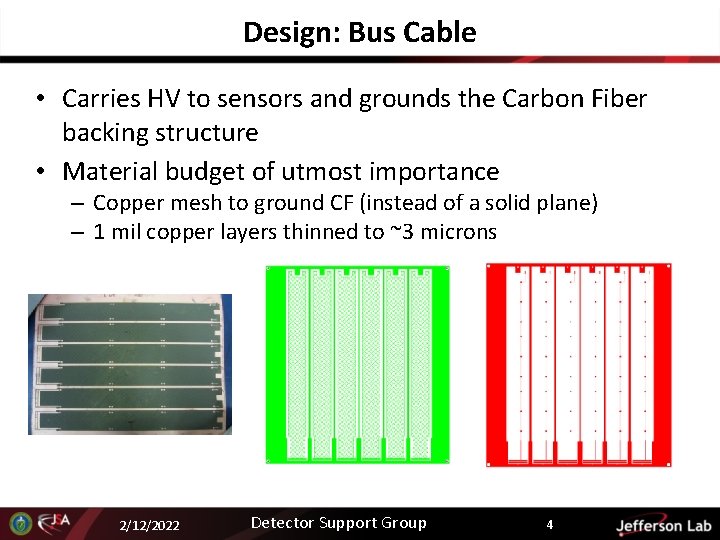
Design: Bus Cable • Carries HV to sensors and grounds the Carbon Fiber backing structure • Material budget of utmost importance – Copper mesh to ground CF (instead of a solid plane) – 1 mil copper layers thinned to ~3 microns 2/12/2022 Detector Support Group 4
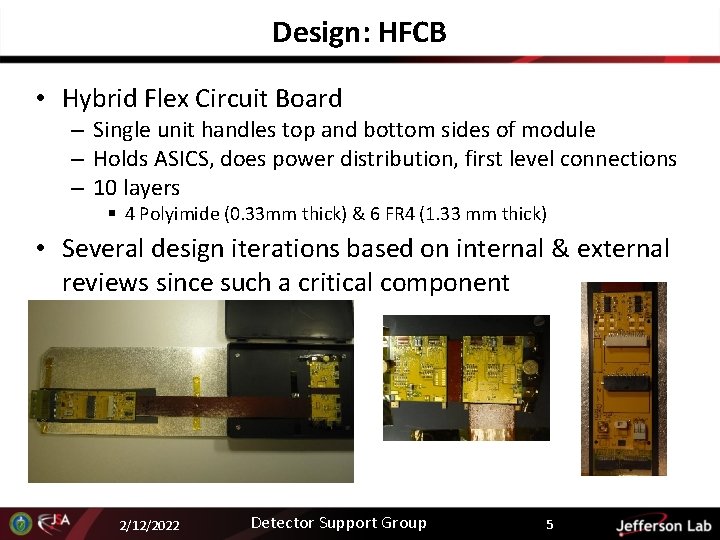
Design: HFCB • Hybrid Flex Circuit Board – Single unit handles top and bottom sides of module – Holds ASICS, does power distribution, first level connections – 10 layers § 4 Polyimide (0. 33 mm thick) & 6 FR 4 (1. 33 mm thick) • Several design iterations based on internal & external reviews since such a critical component 2/12/2022 Detector Support Group 5
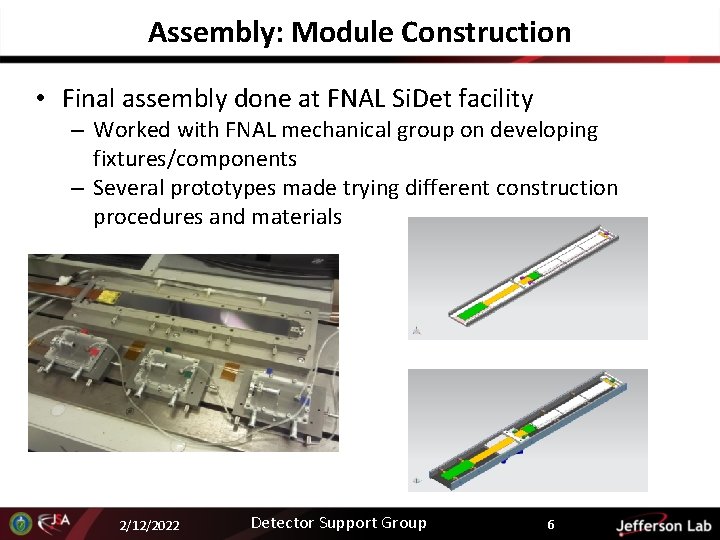
Assembly: Module Construction • Final assembly done at FNAL Si. Det facility – Worked with FNAL mechanical group on developing fixtures/components – Several prototypes made trying different construction procedures and materials 2/12/2022 Detector Support Group 6
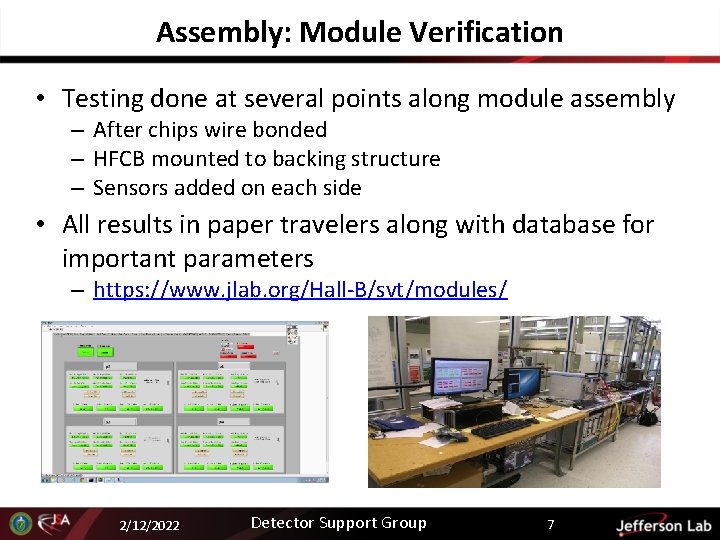
Assembly: Module Verification • Testing done at several points along module assembly – After chips wire bonded – HFCB mounted to backing structure – Sensors added on each side • All results in paper travelers along with database for important parameters – https: //www. jlab. org/Hall-B/svt/modules/ 2/12/2022 Detector Support Group 7

Assembly: Detector • Working with JLab mechanical and survey groups – Assembly procedures, where to put metrological features, survey data analysis, etc. • Connecting detector to outside services 2/12/2022 Detector Support Group 8
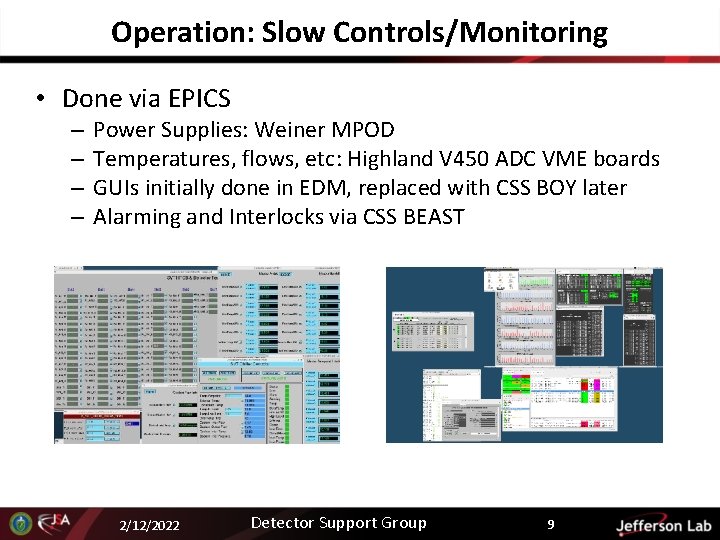
Operation: Slow Controls/Monitoring • Done via EPICS – – Power Supplies: Weiner MPOD Temperatures, flows, etc: Highland V 450 ADC VME boards GUIs initially done in EDM, replaced with CSS BOY later Alarming and Interlocks via CSS BEAST 2/12/2022 Detector Support Group 9

Operation: Interlocks • Independent hardware interlocks to insure safe detector operation – NI c. RIO controller: Lab. VIEW & CSS GUIs – Voltages, temperatures, flows, leaks 2/12/2022 Detector Support Group 10

Infrastructure: Cleanrooms • Two used for SVT construction and testing – Class 10, 000 but actual performance is closer to 1, 000 § ~825 sqft used for testing § ~2300 sqft (24’ walls) used for assembly 2/12/2022 Detector Support Group 11
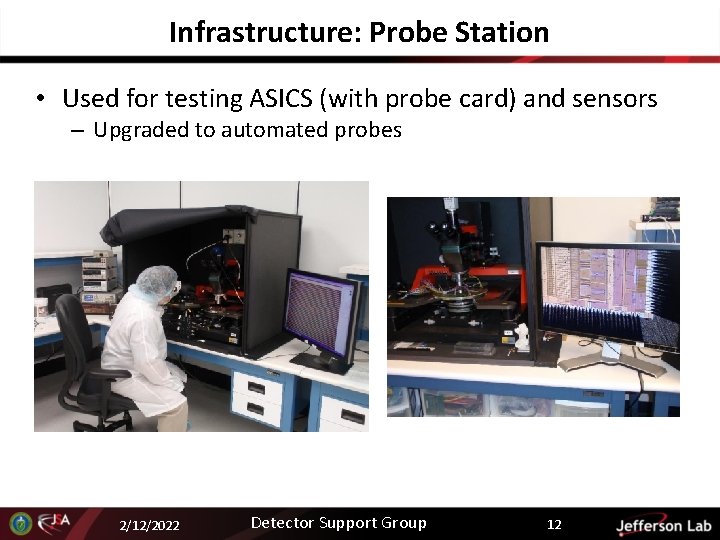
Infrastructure: Probe Station • Used for testing ASICS (with probe card) and sensors – Upgraded to automated probes 2/12/2022 Detector Support Group 12
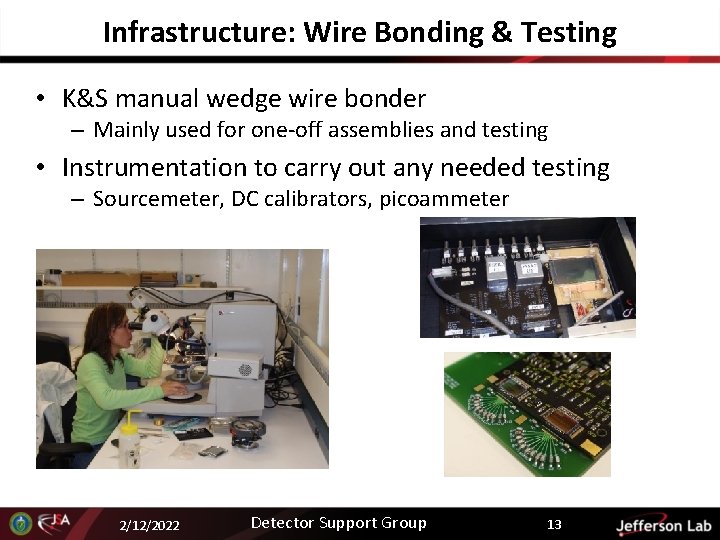
Infrastructure: Wire Bonding & Testing • K&S manual wedge wire bonder – Mainly used for one-off assemblies and testing • Instrumentation to carry out any needed testing – Sourcemeter, DC calibrators, picoammeter 2/12/2022 Detector Support Group 13
Conclusion • Involved in all aspects of detector from concept to implementation • Collaborate with other groups (both within JLab and external) when additional knowledge or equipment needed • End result: a high performance (low noise and very few bad strips) detector developed with unique circumstances of Hall B in mind 2/12/2022 Detector Support Group 14
- Slides: 14