
Jio Infrastructure Platform for Datacenters Tower Monitoring Using



- Slides: 14
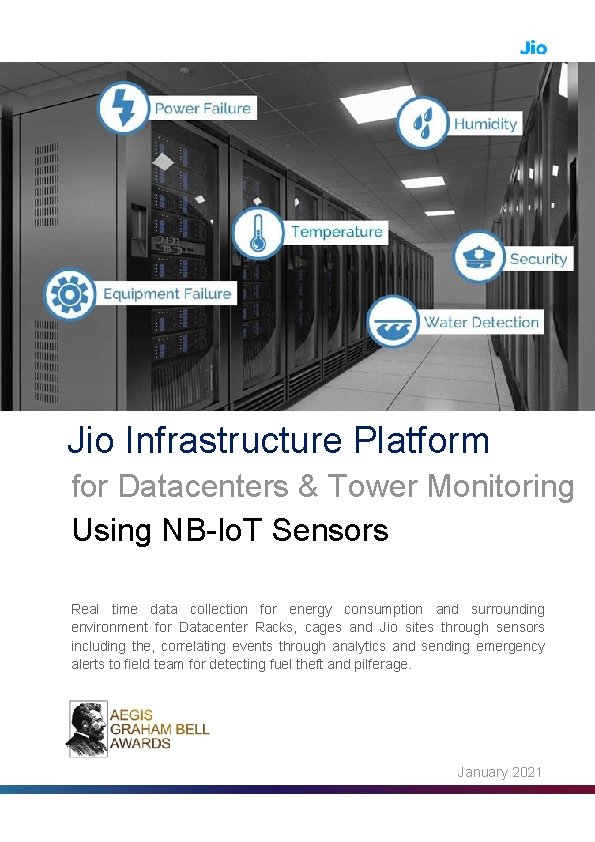
Jio Infrastructure Platform for Datacenters & Tower Monitoring Using NB-Io. T Sensors Real time data collection for energy consumption and surrounding environment for Datacenter Racks, cages and Jio sites through sensors including the, correlating events through analytics and sending emergency alerts to field team for detecting fuel theft and pilferage. January 2021
Jio Infrastructure Platform – with Io. T Sensors Overview Jio has rolled out its 4 G network with more than 300 K e. Node. B sites installed all over India. These sites are normally called as tower sites or small facility sites. Most of these sites operate through three power sources – grid power from electricity board (EB), battery, and diesel generator (DG). In ideal operation grid power is the primary power source; if grid is not available then site switchovers to battery power; if battery is discharged below a certain threshold and grid power doesn’t restore then DG starts to feed power to site equipment as well as to charge the battery. The starting of DG should be the last option and DG running time should be as minimum as possible since out of three power source cost of DG power is the maximum; the more DG running hours the more is OPEX because of high fuel consumption. The switchover of power among grid, battery and DG is automatic and managed by site power system, known as switch mode power supply (SMPS). The SMPS, DG and battery has their own controller module and SMPS controller is central entity, which controls the other two. There are rules set in the SMPS controller and as per rule it decides in the event of grid failure how long site will run with battery, when DG will start and when DG to stop in a step-by-step manner. However, in many cases this rule breaks; even if grid is available in the site DG remains on; in the event of grid failure, when battery voltage drops below a threshold and DG needs to start it doesn’t start, hence site abruptly goes down. The SMPS Controller is further connected with centralized network management system (NMS) and forwards all site events over SNMP (Simple Network Management Protocol) interface. But required alarm events are neither reflected in NMS nor in alarm archive to analyze real cause of problem through post processing analysis. As alarms are lost in NMS, critical alert events doesn’t reach to the field people to take immediate action. In Jio network the small facility sites are managed by third parties known as service providers (SP). A major challenge faced by Jio in these small facilities is to verify the fuel bill claimed by SP’s. To verify fuel bill, it is necessary to check the fuel consumption and DG run hours in a particular period through event records logged in the system. As there is no such data available, in many cases SPs submits inflated invoice and claim high amount of reimbursement. In addition, there also cases of fuel theft and manipulation of connections between SMPS and DG controller to generate false DG start alarm to show that site is running with DG power, although actually, site is running with EB power. This paper describes a noble method to overcome all the above issues by using NB -Io. T sensors and implementing an intelligent correlation logic, which is presented in this paper. Through this approach various site events like grid power availability status, battery voltage and DG status are captured by independent sensors and forwarded to a centralized platform. The centralized platform stores all events and correlate these events to verify the SP vendors claim. In addition, the huge event records received from sensor can be stored and used a historic reference for future network infrastructure planning and expansion. The Jio Infrastructure Platform (JIP) solution is aimed to bring visibility and transparency on usage of space and power in all Jio medium and large facilities - AG 2, AG 2+OTN, SAG 2, AG 3+IDC etc. In addition, it will also bring visibility to identify asset owners and unused assets in various facility in the network. The JIP solution comprises a number of sensor hardware, a platform and applications. The sensor hardware’s will put in each rack – connected with power source - of a facility to collect power and environment data. The platform will collect all information from sensors, analyze it in real time and provide a 3 D graphical view on various dashboard functions – floor space utilization, power utilization of a floor, thermal map on a floor, PUE of a facility, power connectivity tracing and many other features. The application tool empowers the user to receive real time site status on mobile. This tool also provides user to map each and every sensor with various facility parameters – Rack Id, Bay No, Floor No and Site ID. Copyright © 2020 “Jio Platforms Ltd. ” INFORMATION BRIEF
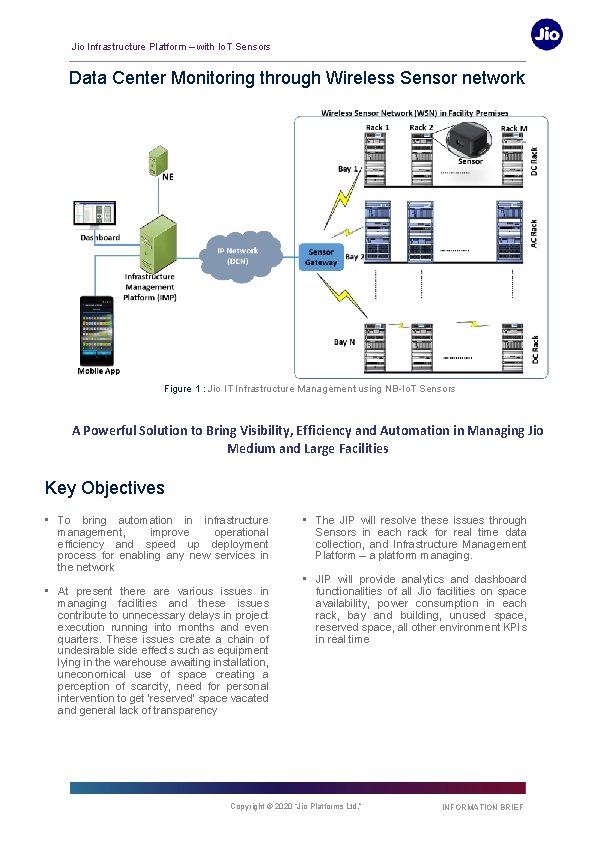
Jio Infrastructure Platform – with Io. T Sensors Data Center Monitoring through Wireless Sensor network Figure 1 : Jio IT Infrastructure Management using NB-Io. T Sensors A Powerful Solution to Bring Visibility, Efficiency and Automation in Managing Jio Medium and Large Facilities Key Objectives • To bring automation in infrastructure management, improve operational efficiency and speed up deployment process for enabling any new services in the network • At present there are various issues in managing facilities and these issues contribute to unnecessary delays in project execution running into months and even quarters. These issues create a chain of undesirable side effects such as equipment lying in the warehouse awaiting installation, uneconomical use of space creating a perception of scarcity, need for personal intervention to get ‘reserved’ space vacated and general lack of transparency • The JIP will resolve these issues through Sensors in each rack for real time data collection, and Infrastructure Management Platform – a platform managing. • JIP will provide analytics and dashboard functionalities of all Jio facilities on space availability, power consumption in each rack, bay and building, unused space, reserved space, all other environment KPIs in real time Copyright © 2020 “Jio Platforms Ltd. ” INFORMATION BRIEF
Jio Infrastructure Platform – with Io. T Sensors Managing physical infrastructure in large facility with greater efficiency is a challenge to the managers, so is the challenge to manage space, power, and environment at each rack level. The issue of power, space and environment unfolded when requirements arise for new service to be deployed over the existing infrastructure. The reasons of such issues are many; non-availability of efficient monitoring tools, unreliable data – captured through manual process; maintaining separate excel worksheet by different groups for data records; no transparency on who is owning what asset etc. These issues create a chain of undesirable side effects such as equipment lying in the warehouse awaiting installation, uneconomical use of space creating a perception of scarcity, need for personal intervention to get ‘reserved’ space vacated and general lack of transparency. Solution Jio Infrastructure Platform (JIP) aims to mitigate all such issues. It provides a robust data collection method through sensors on each rack and a strong analytic platform to analyse these data and provide correct information and clear visibility on the ground situation. . • Real Time monitoring for: I. Power II. Space III. Temperature IV. Humidity • Rack/Hall/Site level monitoring • Visual Dashboards • Transparency on Resource Owners • Visibility on Resource Usage • Identification of unused assets • Automatic Data Collection • Intelligent Analytics The WSN part in JIP has two modules namely sensor gateway and wireless adaptor. One sensor gateway manages hundreds of wireless adaptors installed in different racks at a site location. The gateway collects information from different wireless adaptors and forward to the IMP node. Typically, in a rack two input power connections are provisioned for redundancy purpose. For each input power one wireless adaptor is installed. The JIP ecosystem broadly comprises with three components – a wireless sensor network (WSN) to collect data, an analytic platform known as infrastructure management platform (IMP) to analyze data, and a mobile application named sensor mapping application (SMA) to create inventory. Figure 2 : Sensor Configuration in a Rack The unique design of wireless adaptor, environment sensor and rack space sensors ensure that no rack space unit is consumed in a rack while these devices are installed. The installation of these sensors also ensures no service disruption. The current sensor basically measures the current in a circuit (input). The wireless adaptor measures the voltage and calculate the energy consumption for the same circuit. The wireless adaptor has AC and DC input power, so it works in both AC power rack as well as DC power rack. Copyright © 2020 “Jio Platforms Ltd. ” INFORMATION BRIEF
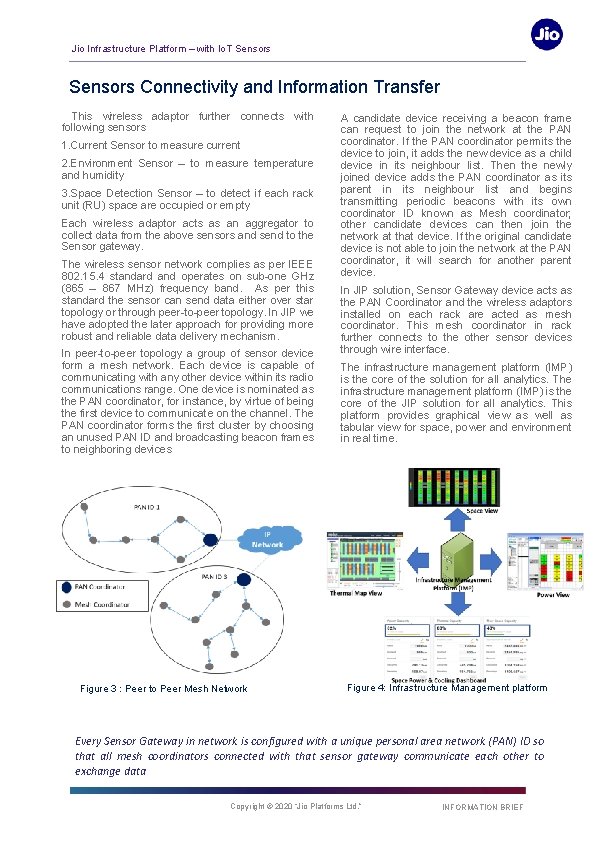
Jio Infrastructure Platform – with Io. T Sensors Connectivity and Information Transfer This wireless adaptor further connects with following sensors 1. Current Sensor to measure current 2. Environment Sensor – to measure temperature and humidity 3. Space Detection Sensor – to detect if each rack unit (RU) space are occupied or empty Each wireless adaptor acts as an aggregator to collect data from the above sensors and send to the Sensor gateway. The wireless sensor network complies as per IEEE 802. 15. 4 standard and operates on sub-one GHz (865 – 867 MHz) frequency band. As per this standard the sensor can send data either over star topology or through peer-to-peer topology. In JIP we have adopted the later approach for providing more robust and reliable data delivery mechanism. In peer-to-peer topology a group of sensor device form a mesh network. Each device is capable of communicating with any other device within its radio communications range. One device is nominated as the PAN coordinator, for instance, by virtue of being the first device to communicate on the channel. The PAN coordinator forms the first cluster by choosing an unused PAN ID and broadcasting beacon frames to neighboring devices Figure 3 : Peer to Peer Mesh Network A candidate device receiving a beacon frame can request to join the network at the PAN coordinator. If the PAN coordinator permits the device to join, it adds the new device as a child device in its neighbour list. Then the newly joined device adds the PAN coordinator as its parent in its neighbour list and begins transmitting periodic beacons with its own coordinator ID known as Mesh coordinator; other candidate devices can then join the network at that device. If the original candidate device is not able to join the network at the PAN coordinator, it will search for another parent device. In JIP solution, Sensor Gateway device acts as the PAN Coordinator and the wireless adaptors installed on each rack are acted as mesh coordinator. This mesh coordinator in rack further connects to the other sensor devices through wire interface. The infrastructure management platform (IMP) is the core of the solution for all analytics. The infrastructure management platform (IMP) is the core of the JIP solution for all analytics. This platform provides graphical view as well as tabular view for space, power and environment in real time. Figure 4: Infrastructure Management platform Every Sensor Gateway in network is configured with a unique personal area network (PAN) ID so that all mesh coordinators connected with that sensor gateway communicate each other to exchange data Copyright © 2020 “Jio Platforms Ltd. ” INFORMATION BRIEF
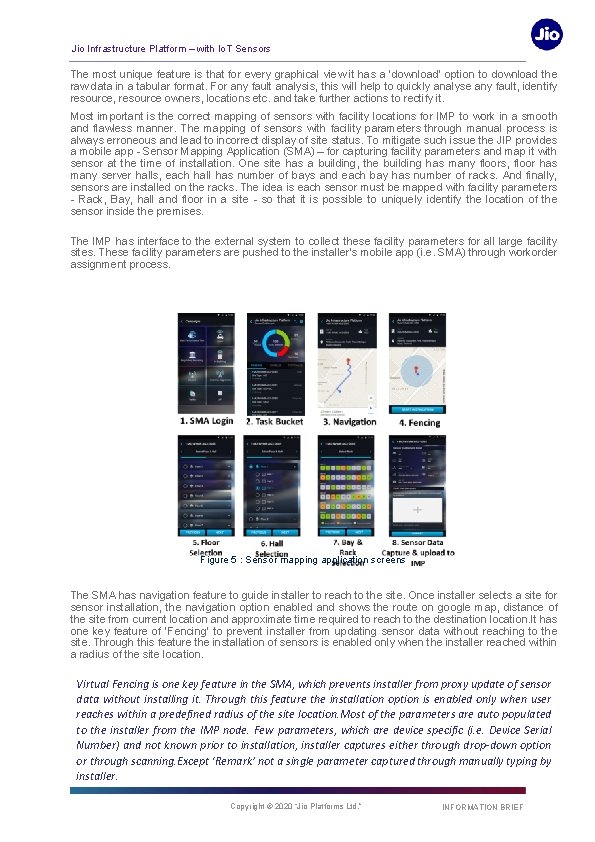
Jio Infrastructure Platform – with Io. T Sensors The most unique feature is that for every graphical view it has a ‘download’ option to download the raw data in a tabular format. For any fault analysis, this will help to quickly analyse any fault, identify resource, resource owners, locations etc. and take further actions to rectify it. Most important is the correct mapping of sensors with facility locations for IMP to work in a smooth and flawless manner. The mapping of sensors with facility parameters through manual process is always erroneous and lead to incorrect display of site status. To mitigate such issue the JIP provides a mobile app - Sensor Mapping Application (SMA) – for capturing facility parameters and map it with sensor at the time of installation. One site has a building, the building has many floors, floor has many server halls, each hall has number of bays and each bay has number of racks. And finally, sensors are installed on the racks. The idea is each sensor must be mapped with facility parameters - Rack, Bay, hall and floor in a site - so that it is possible to uniquely identify the location of the sensor inside the premises. The IMP has interface to the external system to collect these facility parameters for all large facility sites. These facility parameters are pushed to the installer’s mobile app (i. e. SMA) through workorder assignment process. Figure 5 : Sensor mapping application screens The SMA has navigation feature to guide installer to reach to the site. Once installer selects a site for sensor installation, the navigation option enabled and shows the route on google map, distance of the site from current location and approximate time required to reach to the destination location. It has one key feature of ‘Fencing’ to prevent installer from updating sensor data without reaching to the site. Through this feature the installation of sensors is enabled only when the installer reached within a radius of the site location. Virtual Fencing is one key feature in the SMA, which prevents installer from proxy update of sensor data without installing it. Through this feature the installation option is enabled only when user reaches within a predefined radius of the site location. Most of the parameters are auto populated to the installer from the IMP node. Few parameters, which are device specific (i. e. Device Serial Number) and not known prior to installation, installer captures either through drop-down option or through scanning. Except ‘Remark’ not a single parameter captured through manually typing by installer. Copyright © 2020 “Jio Platforms Ltd. ” INFORMATION BRIEF
Jio Infrastructure Platform – with Io. T Sensors Innovation Impact Summary JIP aims to bring efficiency, transparency and visibility in managing medium and large facility infrastructures in Jio Network. This is a powerful tool which enable managers to improve facility performance by monitoring critical parameters in real-time. It also brings automation by capturing information through sensors and helps micro-level monitoring of various assets and resources deployed in the facility. Copyright © 2020 “Jio Platforms Ltd. ” INFORMATION BRIEF
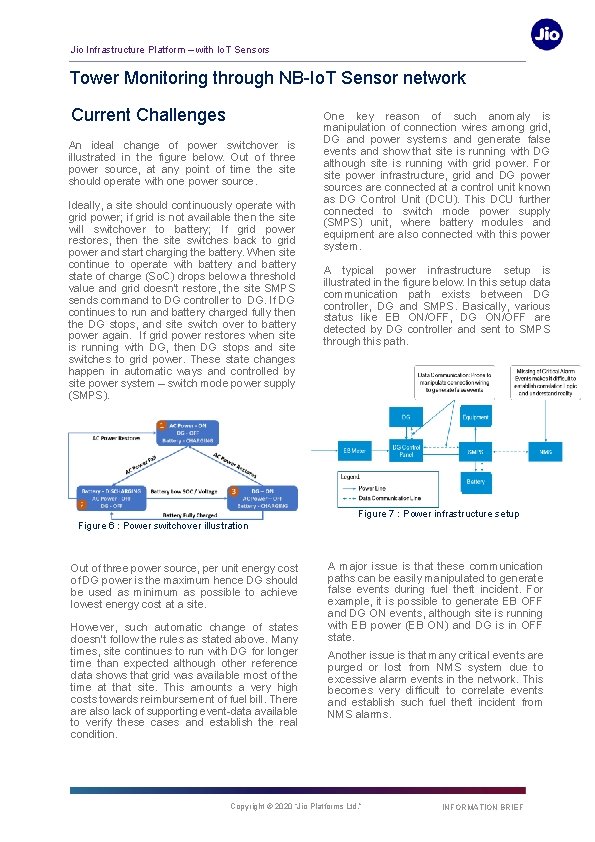
Jio Infrastructure Platform – with Io. T Sensors Tower Monitoring through NB-Io. T Sensor network Current Challenges An ideal change of power switchover is illustrated in the figure below. Out of three power source, at any point of time the site should operate with one power source. Ideally, a site should continuously operate with grid power; if grid is not available then the site will switchover to battery; If grid power restores, then the site switches back to grid power and start charging the battery. When site continue to operate with battery and battery state of charge (So. C) drops below a threshold value and grid doesn’t restore, the site SMPS sends command to DG controller to DG. If DG continues to run and battery charged fully then the DG stops, and site switch over to battery power again. If grid power restores when site is running with DG, then DG stops and site switches to grid power. These state changes happen in automatic ways and controlled by site power system – switch mode power supply (SMPS). One key reason of such anomaly is manipulation of connection wires among grid, DG and power systems and generate false events and show that site is running with DG although site is running with grid power. For site power infrastructure, grid and DG power sources are connected at a control unit known as DG Control Unit (DCU). This DCU further connected to switch mode power supply (SMPS) unit, where battery modules and equipment are also connected with this power system. A typical power infrastructure setup is illustrated in the figure below. In this setup data communication path exists between DG controller, DG and SMPS. Basically, various status like EB ON/OFF, DG ON/OFF are detected by DG controller and sent to SMPS through this path. Figure 7 : Power infrastructure setup Figure 6 : Power switchover illustration Out of three power source, per unit energy cost of DG power is the maximum hence DG should be used as minimum as possible to achieve lowest energy cost at a site. However, such automatic change of states doesn’t follow the rules as stated above. Many times, site continues to run with DG for longer time than expected although other reference data shows that grid was available most of the time at that site. This amounts a very high costs towards reimbursement of fuel bill. There also lack of supporting event-data available to verify these cases and establish the real condition. A major issue is that these communication paths can be easily manipulated to generate false events during fuel theft incident. For example, it is possible to generate EB OFF and DG ON events, although site is running with EB power (EB ON) and DG is in OFF state. Another issue is that many critical events are purged or lost from NMS system due to excessive alarm events in the network. This becomes very difficult to correlate events and establish such fuel theft incident from NMS alarms. Copyright © 2020 “Jio Platforms Ltd. ” INFORMATION BRIEF
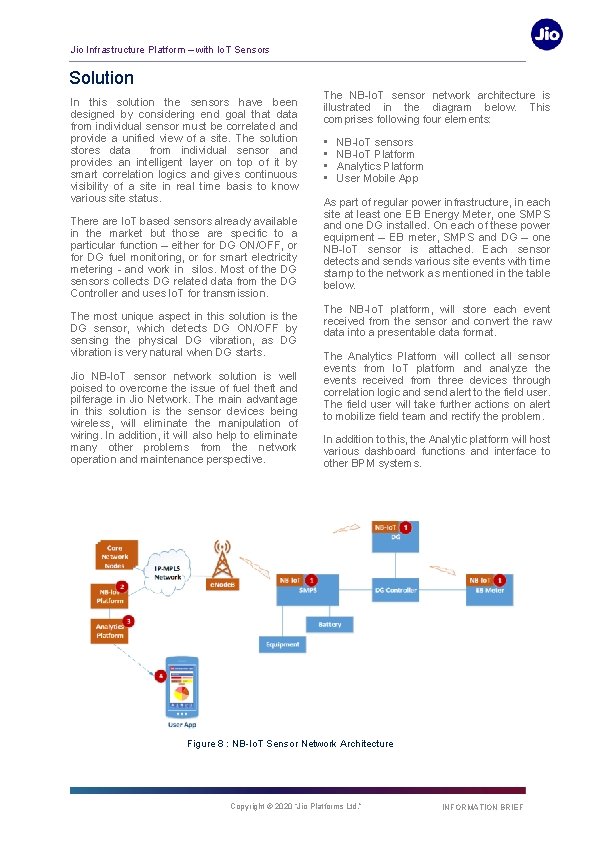
Jio Infrastructure Platform – with Io. T Sensors Solution In this solution the sensors have been designed by considering end goal that data from individual sensor must be correlated and provide a unified view of a site. The solution stores data from individual sensor and provides an intelligent layer on top of it by smart correlation logics and gives continuous visibility of a site in real time basis to know various site status. There are Io. T based sensors already available in the market but those are specific to a particular function – either for DG ON/OFF, or for DG fuel monitoring, or for smart electricity metering - and work in silos. Most of the DG sensors collects DG related data from the DG Controller and uses Io. T for transmission. The most unique aspect in this solution is the DG sensor, which detects DG ON/OFF by sensing the physical DG vibration, as DG vibration is very natural when DG starts. Jio NB-Io. T sensor network solution is well poised to overcome the issue of fuel theft and pilferage in Jio Network. The main advantage in this solution is the sensor devices being wireless, will eliminate the manipulation of wiring. In addition, it will also help to eliminate many other problems from the network operation and maintenance perspective. The NB-Io. T sensor network architecture is illustrated in the diagram below. This comprises following four elements: • • NB-Io. T sensors NB-Io. T Platform Analytics Platform User Mobile App As part of regular power infrastructure, in each site at least one EB Energy Meter, one SMPS and one DG installed. On each of these power equipment – EB meter, SMPS and DG – one NB-Io. T sensor is attached. Each sensor detects and sends various site events with time stamp to the network as mentioned in the table below. The NB-Io. T platform, will store each event received from the sensor and convert the raw data into a presentable data format. The Analytics Platform will collect all sensor events from Io. T platform and analyze the events received from three devices through correlation logic and send alert to the field user. The field user will take further actions on alert to mobilize field team and rectify the problem. In addition to this, the Analytic platform will host various dashboard functions and interface to other BPM systems. Figure 8 : NB-Io. T Sensor Network Architecture Copyright © 2020 “Jio Platforms Ltd. ” INFORMATION BRIEF
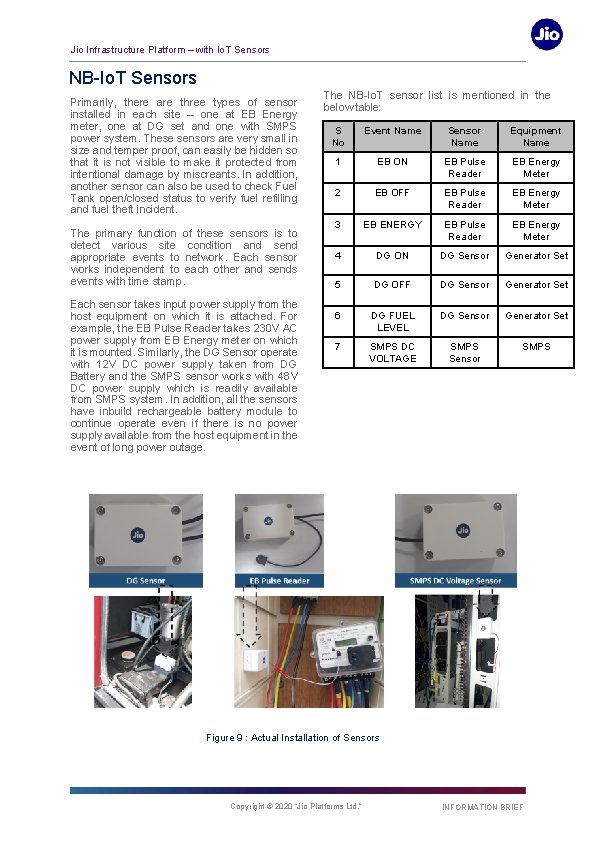
Jio Infrastructure Platform – with Io. T Sensors NB-Io. T Sensors Primarily, there are three types of sensor installed in each site – one at EB Energy meter, one at DG set and one with SMPS power system. These sensors are very small in size and temper proof, can easily be hidden so that it is not visible to make it protected from intentional damage by miscreants. In addition, another sensor can also be used to check Fuel Tank open/closed status to verify fuel refilling and fuel theft incident. The primary function of these sensors is to detect various site condition and send appropriate events to network. Each sensor works independent to each other and sends events with time stamp. Each sensor takes input power supply from the host equipment on which it is attached. For example, the EB Pulse Reader takes 230 V AC power supply from EB Energy meter on which it is mounted. Similarly, the DG Sensor operate with 12 V DC power supply taken from DG Battery and the SMPS sensor works with 48 V DC power supply which is readily available from SMPS system. In addition, all the sensors have inbuild rechargeable battery module to continue operate even if there is no power supply available from the host equipment in the event of long power outage. The NB-Io. T sensor list is mentioned in the below table: S No Event Name Sensor Name Equipment Name 1 EB ON EB Pulse Reader EB Energy Meter 2 EB OFF EB Pulse Reader EB Energy Meter 3 EB ENERGY EB Pulse Reader EB Energy Meter 4 DG ON DG Sensor Generator Set 5 DG OFF DG Sensor Generator Set 6 DG FUEL LEVEL DG Sensor Generator Set 7 SMPS DC VOLTAGE SMPS Sensor SMPS Figure 9 : Actual Installation of Sensors Copyright © 2020 “Jio Platforms Ltd. ” INFORMATION BRIEF
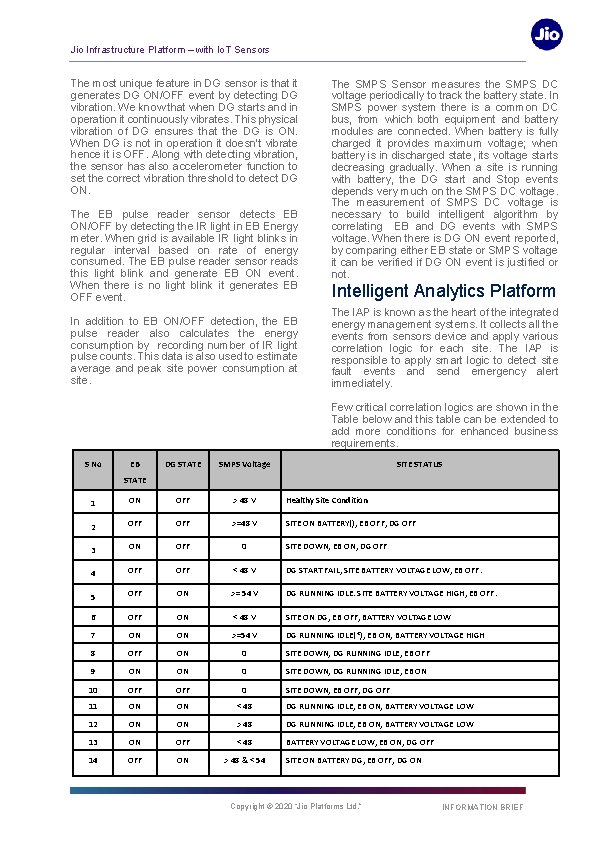
Jio Infrastructure Platform – with Io. T Sensors The most unique feature in DG sensor is that it generates DG ON/OFF event by detecting DG vibration. We know that when DG starts and in operation it continuously vibrates. This physical vibration of DG ensures that the DG is ON. When DG is not in operation it doesn’t vibrate hence it is OFF. Along with detecting vibration, the sensor has also accelerometer function to set the correct vibration threshold to detect DG ON. The EB pulse reader sensor detects EB ON/OFF by detecting the IR light in EB Energy meter. When grid is available IR light blinks in regular interval based on rate of energy consumed. The EB pulse reader sensor reads this light blink and generate EB ON event. When there is no light blink it generates EB OFF event. In addition to EB ON/OFF detection, the EB pulse reader also calculates the energy consumption by recording number of IR light pulse counts. This data is also used to estimate average and peak site power consumption at site. The SMPS Sensor measures the SMPS DC voltage periodically to track the battery state. In SMPS power system there is a common DC bus, from which both equipment and battery modules are connected. When battery is fully charged it provides maximum voltage; when battery is in discharged state, its voltage starts decreasing gradually. When a site is running with battery, the DG start and Stop events depends very much on the SMPS DC voltage. The measurement of SMPS DC voltage is necessary to build intelligent algorithm by correlating EB and DG events with SMPS voltage. When there is DG ON event reported, by comparing either EB state or SMPS voltage it can be verified if DG ON event is justified or not. Intelligent Analytics Platform The IAP is known as the heart of the integrated energy management systems. It collects all the events from sensors device and apply various correlation logic for each site. The IAP is responsible to apply smart logic to detect site fault events and send emergency alert immediately. Few critical correlation logics are shown in the Table below and this table can be extended to add more conditions for enhanced business requirements. S No EB DG STATE SMPS Voltage SITE STATUS STATE 1 ON OFF > 48 V Healthy Site Condition 2 OFF >=48 V SITE ON BATTERY(), EB OFF, DG OFF 3 ON OFF 0 4 OFF < 48 V DG START FAIL, SITE BATTERY VOLTAGE LOW, EB OFF. 5 OFF ON >= 54 V DG RUNNING IDLE. SITE BATTERY VOLTAGE HIGH, EB OFF. 6 OFF ON < 48 V SITE ON DG, EB OFF, BATTERY VOLTAGE LOW 7 ON ON >=54 V DG RUNNING IDLE(*), EB ON, BATTERY VOLTAGE HIGH 8 OFF ON 0 SITE DOWN, DG RUNNING IDLE, EB OFF 9 ON ON 0 SITE DOWN, DG RUNNING IDLE, EB ON 10 OFF 0 SITE DOWN, EB OFF, DG OFF 11 ON ON < 48 DG RUNNING IDLE, EB ON, BATTERY VOLTAGE LOW 12 ON ON > 48 DG RUNNING IDLE, EB ON, BATTERY VOLTAGE LOW 13 ON OFF < 48 BATTERY VOLTAGE LOW, EB ON, DG OFF 14 OFF ON > 48 & < 54 SITE DOWN, EB ON, DG OFF SITE ON BATTERY DG, EB OFF, DG ON Copyright © 2020 “Jio Platforms Ltd. ” INFORMATION BRIEF
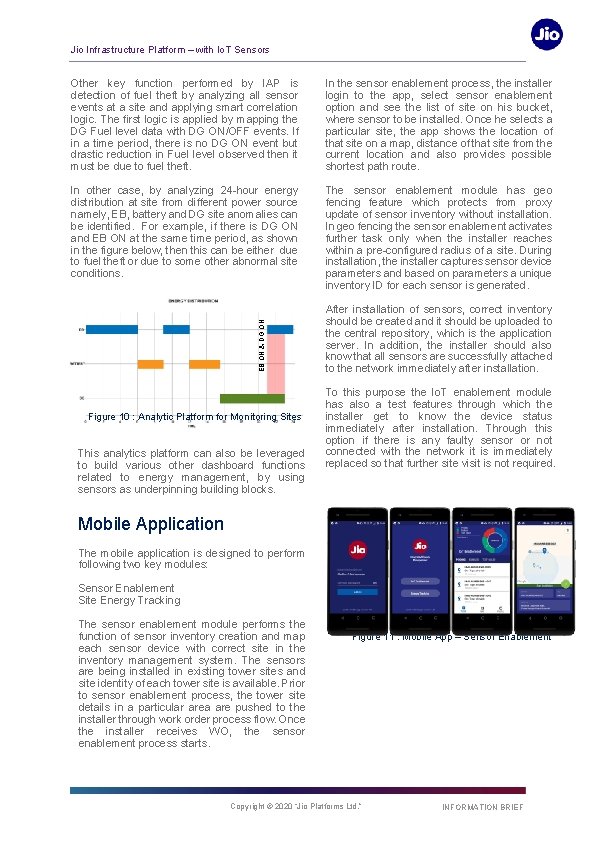
Jio Infrastructure Platform – with Io. T Sensors In the sensor enablement process, the installer login to the app, select sensor enablement option and see the list of site on his bucket, where sensor to be installed. Once he selects a particular site, the app shows the location of that site on a map, distance of that site from the current location and also provides possible shortest path route. In other case, by analyzing 24 -hour energy distribution at site from different power source namely, EB, battery and DG site anomalies can be identified. For example, if there is DG ON and EB ON at the same time period, as shown in the figure below, then this can be either due to fuel theft or due to some other abnormal site conditions. The sensor enablement module has geo fencing feature which protects from proxy update of sensor inventory without installation. In geo fencing the sensor enablement activates further task only when the installer reaches within a pre-configured radius of a site. During installation, the installer captures sensor device parameters and based on parameters a unique inventory ID for each sensor is generated. EB ON & DG ON Other key function performed by IAP is detection of fuel theft by analyzing all sensor events at a site and applying smart correlation logic. The first logic is applied by mapping the DG Fuel level data with DG ON/OFF events. If in a time period, there is no DG ON event but drastic reduction in Fuel level observed then it must be due to fuel theft. Figure 10 : Analytic Platform for Monitoring Sites This analytics platform can also be leveraged to build various other dashboard functions related to energy management, by using sensors as underpinning building blocks. After installation of sensors, correct inventory should be created and it should be uploaded to the central repository, which is the application server. In addition, the installer should also know that all sensors are successfully attached to the network immediately after installation. To this purpose the Io. T enablement module has also a test features through which the installer get to know the device status immediately after installation. Through this option if there is any faulty sensor or not connected with the network it is immediately replaced so that further site visit is not required. Mobile Application The mobile application is designed to perform following two key modules: Sensor Enablement Site Energy Tracking The sensor enablement module performs the function of sensor inventory creation and map each sensor device with correct site in the inventory management system. The sensors are being installed in existing tower sites and site identity of each tower site is available. Prior to sensor enablement process, the tower site details in a particular area are pushed to the installer through work order process flow. Once the installer receives WO, the sensor enablement process starts. Figure 11 : Mobile App – Sensor Enablement Copyright © 2020 “Jio Platforms Ltd. ” INFORMATION BRIEF
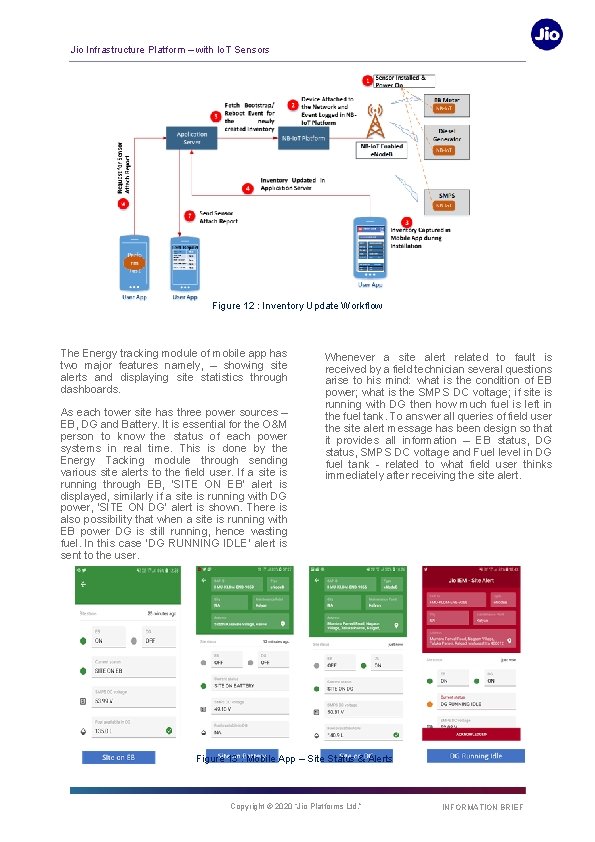
Jio Infrastructure Platform – with Io. T Sensors Figure 12 : Inventory Update Workflow The Energy tracking module of mobile app has two major features namely, – showing site alerts and displaying site statistics through dashboards. As each tower site has three power sources – EB, DG and Battery. It is essential for the O&M person to know the status of each power systems in real time. This is done by the Energy Tacking module through sending various site alerts to the field user. If a site is running through EB, ‘SITE ON EB’ alert is displayed, similarly if a site is running with DG power, ‘SITE ON DG’ alert is shown. There is also possibility that when a site is running with EB power DG is still running, hence wasting fuel. In this case ‘DG RUNNING IDLE’ alert is sent to the user. Whenever a site alert related to fault is received by a field technician several questions arise to his mind: what is the condition of EB power; what is the SMPS DC voltage; if site is running with DG then how much fuel is left in the fuel tank. To answer all queries of field user the site alert message has been design so that it provides all information – EB status, DG status, SMPS DC voltage and Fuel level in DG fuel tank - related to what field user thinks immediately after receiving the site alert. Figure 13 : Mobile App – Site Status & Alerts Copyright © 2020 “Jio Platforms Ltd. ” INFORMATION BRIEF
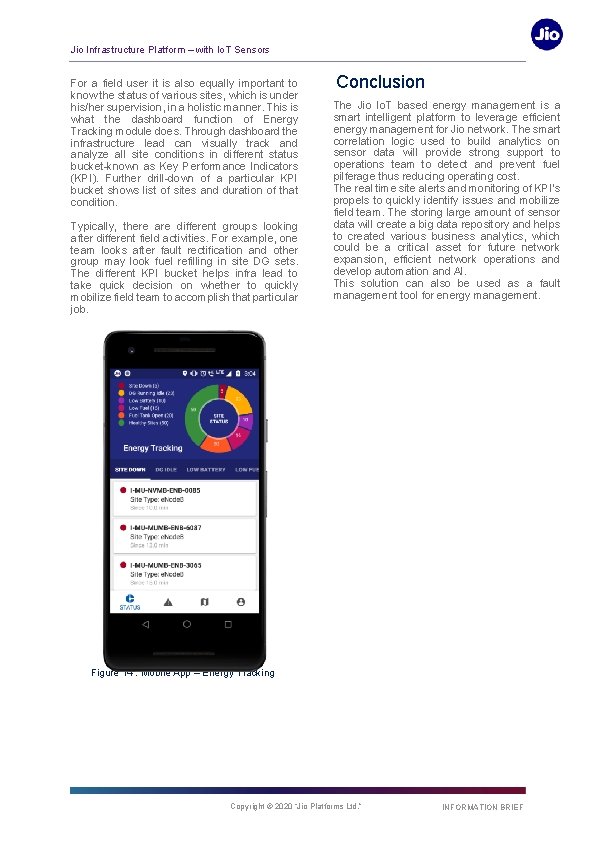
Jio Infrastructure Platform – with Io. T Sensors For a field user it is also equally important to know the status of various sites, which is under his/her supervision, in a holistic manner. This is what the dashboard function of Energy Tracking module does. Through dashboard the infrastructure lead can visually track and analyze all site conditions in different status bucket-known as Key Performance Indicators (KPI). Further drill-down of a particular KPI bucket shows list of sites and duration of that condition. Typically, there are different groups looking after different field activities. For example, one team looks after fault rectification and other group may look fuel refilling in site DG sets. The different KPI bucket helps infra lead to take quick decision on whether to quickly mobilize field team to accomplish that particular job. Conclusion The Jio Io. T based energy management is a smart intelligent platform to leverage efficient energy management for Jio network. The smart correlation logic used to build analytics on sensor data will provide strong support to operations team to detect and prevent fuel pilferage thus reducing operating cost. The real time site alerts and monitoring of KPI’s propels to quickly identify issues and mobilize field team. The storing large amount of sensor data will create a big data repository and helps to created various business analytics, which could be a critical asset for future network expansion, efficient network operations and develop automation and AI. This solution can also be used as a fault management tool for energy management. Figure 14 : Mobile App – Energy Tracking Copyright © 2020 “Jio Platforms Ltd. ” INFORMATION BRIEF