
Jin Kwan KWON We are the people We
- Slides: 24
Jin Kwan KWON
§ We are the people. We are human beings. Story makes who we are as humans. § It concerns who we are, who God is a story-teller. Jesus was also. § How can be become an active Subject in our life and history? Subjectification. § Active subject and passive subject are two sides of the same coin (the same subject) § Subject and self, or ego. Self and ego has constant essence that never changes. Subject is capable of change from conservative to progressive, reactionary to revolutionary. He/she is “subject” to language, culture and social system. § Subject is passive and active.
§ There are several types of doing liberation and minjung theology in our scene and in Korea. § 1) social analysis oriented. No hermeneutics involved. A sort of social science amateurism. § 2) hermeneutics oriented. Biblical interpretation and hermeneutics. Inspirational. No discussion about the situation of the poor people. § 3) post-modern philosophy oriented. philosophical, postmodern, deconstruction, metaphysical, etc. Philosophy, critical or non-critical, are more emphasized than theological inspiration (poetic, narrative, insightful) § 4) subject-oriented, political and language-story-oriented.
§ Suh Namdong’s argument: the poor is the key of the Gospel and the Revelation. § The poor is the infrastructure of theology and the Gospel (proclamation of the good news). § The poor is the subject of history not only as the agent as opposed to the object, but also as a subject who is determined by society at large. They are subject to different factors in the society. § Because they are subject to power-relations, to the powerful, they also aspire to be delivered. They compose poems, tell their own stories of suffering and hope. § We are subject to language and stories, on one hand; we speak and use language and stories, on the other. § As a mediator, theologian is to observe and watch in a critical way how stories are told and heard by those subjects.
§ a metaphysics of the self, i. e. the idea of a self-transparent I equal to itself (‘cogito ergo sum’) as the stable basis of a controlling scientific practice that keeps being under control by means of thinking. Laustsen, Carsten Bagge. The Subject of Politics: Slavoj Zizek’s Political Philosophy (Philosophy Insights) (Kindle Locations 540 -542). Humanities-Ebooks. Kindle Edition. § Cartesian subject does not consider that the self is subject to and affected by the unconscious, behind which all language and socio-economic-political structures are arrayed and effective. § Still, “There is no revolution without a revolutionary subject. ” Laustsen, Carsten Bagge. The Subject of Politics: Slavoj Zizek’s Political Philosophy (Philosophy Insights) (Kindle Locations 1817 -1818). Humanities-Ebooks. Kindle Edition.
§ The remaining in our subconscious and unconscious can be the capital for our new reality or prison that captivates us. § We need to see what is remaining in our mind and sub-mind (the soul). § Purpose: “the transformation from the analysed subject to the acting, analysing, creating subject. ” Laustsen, Carsten Bagge. The Subject of Politics: Slavoj Zizek’s Political Philosophy (Philosophy Insights) (Kindle Locations 225 -226). Humanities. Ebooks. Kindle Edition. § We treasure the remaining as our capital for our true subjectivity. § How can we transform the remainder in our mind to be the source of our subjectivity? § In the reservoir, stories, language, memory for future also treasured.
§ Yale Univ. divinity school: George Lindbeck, Hans Frei, Stanley Hauerwas § Robert Mc. Afee Brown § C. S. Song § Minjung theologians Suh Namdong (story, folktales) and Kim Yongbock (social biography of minjung).
§ Method: § 1) Confluence of two streams, two stories and traditions. § 2) Transposition: Reading Christian stories in the context of Asian stories in Asian situation, or reading Asian stories in the context of Bible stories. C. S. Song tries to Christianize Asian stories or tries to fit Asian stories into Christian (predominantly neoorthodox or liberal) theological framework. § 3) dialogue between two stories and traditions (Christian story and Asian story) as equal partners, influencing and enhancing each reading. § Finding and locating a hermeneutical point (usually in the form of a concrete word or a constructed idea) that overlaps the two stories as the starting point of a new understanding of an Asian story. § Finding corresponding stories, ideas, words, and languages in the Bible as crucial.
§ Critical analysis and ideological critique of both Asian and Christian stories. § Both stories constitute our conscious and subconscious, and, the unconscious. Determine our identities, who we are. § Both stories carry within themselves cultural and ideological legacies and inconspicuously implicate power relations. Stories are never neutral, and culture-free, value-free. § Ideology and power-relations are implicated not only in theoretical discourses and but in narratives and stories. § Stories carry culture, value, ideologies, and power-relations on one side. § Stories carry new visions, alternative values on the other. These alternative views and visions can be obtained when we read them in the context of other tradition and stories.
§ The unconscious mind, consisting of the primitive, instinctual wishes as well as the information that we cannot access. Although our behaviors might indicate the unconscious forces that drive them, we don’t have easy access to the information stored in the unconscious mind. During our childhood, we acquired countless memories and experiences that formed who we are today. However, we cannot recall most of those memories. They are unconscious forces (beliefs, patterns, subjective maps of reality) that drive our behaviors. § Our conscious acts are in fact affected and even controlled by the unconscious. § Legend and myths and folk tales are important elements that affect the unconscious.
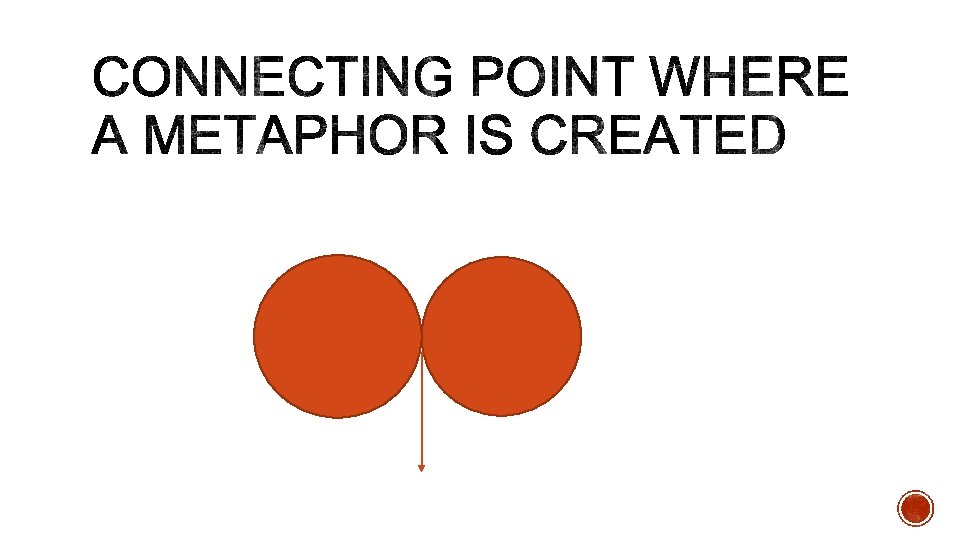
§ We take in stories with their essence into our mind and digest them. § The essence of stories can be in the form of signifier, images, and shades, and they are stored in the reservoir of our un- and sub- conscious. § Our mind always want to be creative. So sometimes, it needs different meanings, and alternative life experiences. § We look for fantastic ideas and images, and signifiers. We look for metaphor that opens a new horizon. § How can we attain to such metaphors? § Confluence, nodal points. Joint area. Metaphor. § One story can play the role of a metaphor for another.
§ Asian stories need to be told as they are, not in theological framework. Christian and theological imperialism over the integrity of different stories. § Hastening to obtain theological meanings from Asian stories are not relevant to our experience. Method is needed. § Can we go beyond a simple comparison and a finding the point of connection and similarity? My methodological suggestion is 1) finding the connecting point and common denominator or a metaphor that connects the two. 2) from their reinterpret the each text.
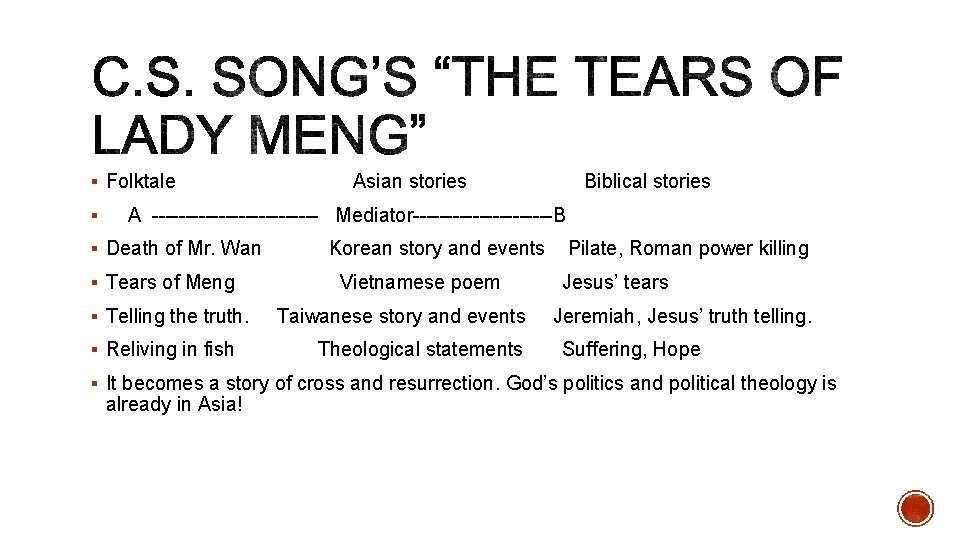
§ Folktale Asian stories Biblical stories § A ------------- Mediator-----------B § Death of Mr. Wan Korean story and events Pilate, Roman power killing § Tears of Meng Vietnamese poem Jesus’ tears § Telling the truth. Taiwanese story and events Jeremiah, Jesus’ truth telling. § Reliving in fish Theological statements Suffering, Hope § It becomes a story of cross and resurrection. God’s politics and political theology is already in Asia!
§ Story is expressed by language and fictional to a various extent, while event is historical and actual. E. g. , Jesus’ historical event vs. stories and plots of Jesus in the Gospels. Plot picks up significant facts and things from the event and from the story and organize them tightly and in a causal relation. (Story connects the series of events to make them meaningful). Thus, event (and story) is of more abundant and infinite elements in it than plot. § Then, what is story and discourse? Both are in narrative. Narrative has a story part and a discourse part (way of telling the story). § Story is one, while discourse is plural. § Story never exists until we tell it in discourse (narrative discourse). Story never exists without discourse.
§ As Joyce Carol Oates wrote, “Storytelling is shaped by two contrary, yet complementary, impulses—one toward brevity, compactness, artful omission; the other toward expansion, amplification, enrichment. ” § Make short at some area, and expand at other area of the historical event. § But, in general, a story is much shorter than a historical event that is told by storyteller.
§ Narrative is composed of story part and discourse. § Discourse is a manipulation of story. § Discourse omits and adds. Discourse is a manipulative way of telling a story. § Thus, story is more foundational, while discourse is derivative and intentional. § Critical theologians have the task to select and tell stories and events that bring about enhancement of humanity, and at the same time the task to critique and analyze the discourses that are told. § We are story people. Story is fundamental that makes who we are. § We make sense of the world through telling stories and narratives. Language is fundamental. We use language to make stories/narratives.
§ Story has beginning, middle, and end. § It is composed by words, signifiers. § We think we tell stories for others, to inform or entertain. But what if we are initially doing this for ourselves? Storytelling is such an essential tool to keep the human psyche in balance that it has become as important as food, air and sleep. § We are story tellers, and story listeners. Our life is meaningless if we cannot compose and tell to ourselves a story out of our experiences of the day. § We create stories out of our daily life because we want to maintain our mind with integrity and learn from it and answer something arising in my life, and provide consistent meanings or redirect our life. Story is necessary. § Story is necessary element for our life like air, water, sleep, and food.
§ We consume stories and digest them into our unconscious and conscious. § By consuming them, we grow. We become human and grow to be mature human by composing and telling stories. § Hearing, composing and telling stories creates our identity.
§ Telling stories and narratives is a power practice. Those who tell define the situation and the world. Those who hear them are defined by the story-tellers. § Minjung and the subaltern, or the oppressed must speak for themselves and tell their own stories in order to become equal partners and subjects in history.
§ Confluence of Christian and Asian stories is required.
§ We have different confluences: § I. Failed confluence § 1) stopping at comparative studies of two stories; § 2) just collecting and juxtaposing similar and connective stories and cases without finding a common figure or metaphor for a new understanding and vision. § 3) convergence instead of confluence which symbolizes dialogue between equal partners. Convergence lets and changes the two into a new one with both being left behind and disappearing from the scene. § II. Desirable confluence
§ Story theologians are also improvisers like poets. They are not a scientifically cold discursive scholars, but insight-seekers and truth-seekers learning from stories and discourses. § Christian stories become a foundational context to understand Asian stories: C. S. Song’s The Tears of Lady Meng. Asian story attains theological implications and attains a new meaning. § Lady Meng becomes a suffering Messianic figure. This figure is already implanted in the heart of Chinese people.