
JIMMA UNIVERSITY COLLEGE OF NATURAL SCIENCES DEPARTMENT OF
- Slides: 105
JIMMA UNIVERSITY COLLEGE OF NATURAL SCIENCES DEPARTMENT OF SPORT SCIENCE Introduction to Adapted Physical Exercises and sports(Sp. Sc 3103 ) Lecture note for regular program students. 1 By Merera Negassa (Lecturer) FEB, 2020 Jimma, Ethiopia
Adapted Physical Education DEFINITIONS AND HISTORY
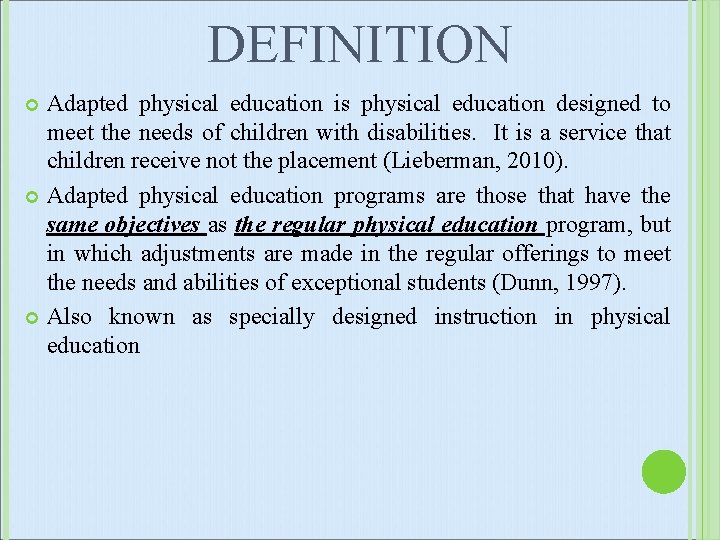
DEFINITION Adapted physical education is physical education designed to meet the needs of children with disabilities. It is a service that children receive not the placement (Lieberman, 2010). Adapted physical education programs are those that have the same objectives as the regular physical education program, but in which adjustments are made in the regular offerings to meet the needs and abilities of exceptional students (Dunn, 1997). Also known as specially designed instruction in physical education
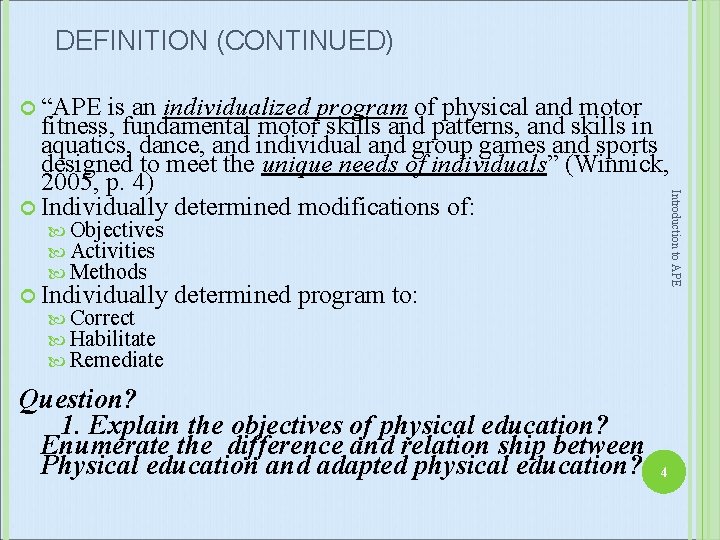
DEFINITION (CONTINUED) “APE Objectives Activities Methods Individually Correct Habilitate Remediate Introduction to APE is an individualized program of physical and motor fitness, fundamental motor skills and patterns, and skills in aquatics, dance, and individual and group games and sports designed to meet the unique needs of individuals” (Winnick, 2005, p. 4) Individually determined modifications of: determined program to: Question? 1. Explain the objectives of physical education? Enumerate the difference and relation ship between Physical education and adapted physical education? 4
OBJECTIVES OF PHYSICAL EDUCATION Physical Development- Foremost objective and related with physical development. . v Development in size , shape and efficiency of organic systems due to effects of physical activities which are performed. v Mental Development- Related to mental development of an individual. v Social Development- Related to development of social traits, essential for better adjustment in life. Neuron-Muscular Co-ordination- Concerned with better relationship between nervous system and muscular system. v
OBJECTIVES OF PHYSICAL EDUCATION (CTD ) Emotional Development- Emotions are vital for every individual but excess are always bad. One of the major objective responsible for developing /controlling various emotions like fear, pleasure, hope , wonder, anger etc. v Development of Health- Provide education about prevention of communicable diseases. v. Develops health related habits v
PHILOSOPHY IS FOUNDATIONAL Based on your beliefs and values: All individuals at all ages can benefit from physical activity. All individuals can learn when adaptations are incorporated into instruction. All individuals deserved access to high-quality instruction that enhances self esteem and contributes to a healthy lifestyle.
HISTORICAL PERSPECTIVE Physical o o Education followed the Medical Model (1900 – 1950) Students with disabilities did not participate in Physical Education or they were placed in corrective physical education, specifically students with physical disabilities. Many students with cognitive or behavioral disabilities were in institutions and participated in recreational activities if physically able.
MOVED FROM A MEDICAL MODEL TO A SOCIAL MODEL IN PHYSICAL EDUCATION Medical model sees deficits, activity is to fix what is wrong. The approach is low achievement expectations. (Not going to get better) Social model views acceptance of difference. Sees ability to learn and improve. Looks for possibilities of what can be.
LEGAL DEFINITION OF APE The Introduction to APE term physical education includes special physical education, adapted physical education, movement education, and motor development. Special physical education – if specially designed physical education is prescribed in a child’s IEP, the public agency responsible for the education of that child shall provide the services directly, or make arrangements for it to be provided through other public or private programs. 10
WHAT IS A DISABILITY? A disability is defined as a condition or function judged to be significantly impaired relative to the usual standard of an individual or group. The term is used to refer to individual functioning, including physical impairment, sensory impairment, cognitive impairment, intellectual impairmental illness, and various types of chronic disease. Disability is conceptualized as being a multidimensional experience for the person involved. There may be effects on organs or body parts, and there may be effects on a person's participation in areas of life. Correspondingly, three dimensions of disability are recognized in ICF: body structure and function (and impairment thereof), activity (and activity restrictions) and participation (and participation restrictions). The classification also recognizes the role of physical and social environmental 11 factors in affecting disability outcomes.
DISABILITY CTD Disabilities can affect people in different ways, even when one person has the same type of disability as another person. Some disabilities may be hidden, known as invisible disability. There are many types of disabilities, such as those that affect a person's: Vision Hearing Thinking Learning Movement Mental health Remembering Communicating Social relationships 12
WHY IS ADAPTED PE IMPORTANT? Movement is a pre-requisite for most of our educational activities. Individuals with inefficient movement patterns may encounter added difficulties in vocational, social, emotional and educational areas. It is essential to provide success- oriented activities to students who have interests, capabilities and limitations that are not met through the regular PE program. . Introduction to APE Adapted PE emphasizes: Ø Physical and motor fitness Ø Motor skills and patterns Ø Body mechanics Ø Individual games and sports for lifetime enjoyment and fitness Ø Leisure/recreation activities Ø Healthy Lifestyles 13
GENERAL CHARACTERISTICS OF DISABILITIES v Developmental Introduction to APE delays in chronologically ageappropriate motor skills; v Difficulty with equilibrium responses and balance activities; v Lack of strength, endurance, flexibility; v Poor body or spatial awareness; v Chronic medical conditions; v Lack of appropriate play and socialization behavior; v Poor auditory processing. 14
PSYCHOLOGICAL ASPECT OF DISABILITIES Self-Concept A crucial difference between congenital and acquired disability may be the extent to which people incorporate their disability into their self-concept ( Smart, 2008). Self-concept is a multidimensional structure of identity that includes self-esteem, group identity, and self-efficacy ( Bandura, 1977; Crocker & Major, 1989; Judge, Erez, Bono, & Thoresen, 2002; Rosenberg, 1965) A large part of our self-concept is based on our social group identity. Disability studies scholars argue that the negative aspects of disability are largely socially constructed through social stigma and a lack of accommodations ( Olkin, 1999). Members of stigmatized groups are at risk for poor self-concept because the dominant group in society holds the stigmatized group in low esteem ( Crocker & Major, 1989).
PSYCHOLOGICAL ASPECT OF DISABILITIES …CTD Self-Esteem Self-esteem can be defined as, “a generalized evaluative attitude toward the self that influences both moods and behavior and that exerts a powerful effect on a range of personal and social behaviors” (Gerrig, Zimbardo, & Psychology And Life, 2002). Self-esteem is the positive and negative evaluations of one’s personal identity ( Rosenberg, 1965). Dynamics such as whether the CID is congenital, acquired, or a disease process can all have an impact on individual self-appraisal of the disability, coping strategies that are employed, and the subsequent self-concept and self-esteem the person has. 16
PSYCHOLOGICAL ASPECT OF DISABILITIES …CTD Body image Introduction to APE Body image is the picture that a person forms of their body in their mind based on feelings and judgments and sometimes it is different than what we see in the mirror Men with Physical Disabilities Independence, dominance, strength, athleticism: these are just some of the traits associated with masculinity in our society. For men with physical disabilities, however, especially those who must rely upon devices such as wheelchairs, crutches, canes, and artificial limbs to obtain mobility, it is difficult to live up to such masculine ideals. This often damages the selfesteem of disabled men, leading them to question their masculinity, their desirability, and their very place in society. In many cases, “not only are men with physical disabilities…perceived as undesirable, they are also perceived to be asexual” (Zola 1982). Disabled men may internalize such widespread perceptions. In a society that places a premium on men’s ability to attract sexual partners, to exert control over others, and operate without assistance from others, men 17 with disabilities must struggle daily to be perceived as “real” men.
PSYCHOLOGICAL ASPECT OF DISABILITIES …CTD Introduction to APE Women with Disabilities Women who are disabled have to deal with not only that impairment but also the lower status that comes with being female in our society today. Disabled women often differ from narrow definitions of ideal feminine beauty displayed in the media, leading others to perceive them as unattractive, as not “real” women (Fine and Asch 1988). Disabled women themselves may come to internalize such views, which may create barriers to forming intimate relationships. Women with disabilities are more likely than other women to remain single and less likely to become mothers 18
BENEFITS OF PHYSICAL ACTIVITY FOR INDIVIDUALS WITH DISABILITY PA is essential for quality of life reasons and as a public health promoter. In people with disabilities PA has an amplified importance based on higher rates of chronic diseases which PA can influence. Above those metabolic advantages individuals with disability can further profit from PA: Health: Introduction to APE PA also has amplified importance for cognitive, emotional and social difficulties Psychological benefits such as enhanced self-perception through successful PA experiences PA can reduce stress, pain, and depression → ADLs are perceived to be easier 19
BENEFITS OF PHYSICAL ACTIVITY FOR INDIVIDUALS WITH DISABILITY…. . CTD Social contact: PA Introduction to APE can reduce the stigmatisation process and negative stereotypes PA can contribute to improve social status: non-disabled people see physically active individuals with disabilities more favourably than non-active people Social benefits as the nature of many sport activities leads to increased social integration, bonding and friendship Fun: PA leads to mood benefits Enjoyment through social interaction of both fitness staff and other participants 20
UNIT TWO: FUNDAMENTAL MOTOR SKILLS Moving our bodies throughout our day to day lives is something most of us do without giving it much thought — but it actually takes a considerable amount of skill. The central nervous system controls both fine and gross motor skills. Fundamental motor skills -It is the ability to perform basic physical skills correctly that are used in all sports. Motor coordination to complete a task a collaboration of three skills: Fine Motor Skills Require coordinated movement of small muscles (hands, face). Examples: include writing, drawing, buttoning a shirt, blowing bubbles Gross Motor Skills Require coordinated movement of large muscles or groups of muscles (trunk, extremities). Examples: include walking, running, lifting activities. Hand-eye Skills The ability of the visual system to coordinate visual information. Received and then control or direct the hands in the accomplishment of a task. Examples : include catching a ball, sewing, computer mouse 21
CAUSATIVE FACTORS OF LOW MOTOR SKILLS There are several factors that influence the development of gross and fine motor skills. These factors include growth of the child, environment, genetics, muscle tone, and gender. What are poor motor skills? A person with dyspraxia has problems with movement, coordination, judgment, processing, memory, and some other cognitive skills. . Dyspraxia is also known as motor learning difficulties, perceptuo-motor dysfunction, and developmental coordination disorder (DCD) Uncoordinated movement or coordination impairment is known medically known as ataxia. There a number of known causes for ataxia. Introduction to APE 22
CAUSATIVE FACTORS OF LOW MOTOR SKILLS. . CTD They range from chronic conditions to sudden onset. However, most conditions will relate to damage or degeneration of the cerebellum. Coordinated movement requires a functioning cerebellum, Spinal chord and Peripheral nervous system. Diseases and injuries that damage or destroy any of these structures can lead to ataxia. These include: Traumatic brain injury alcoholism infection Neuropathies Spinal chord injuries Multiple sclerosis Stroke Cerebral palsy brain tumors Introduction to APE 23
CAUSATIVE FACTORS OF LOW MOTOR SKILLS. . CTD Toxins can also cause ataxia. These include: alcohol (most common) seizure medications chemotherapy drugs lithium cocaine and heroin mercury, lead, and other heavy metals toluene and other types of solvents Introduction to APE 24
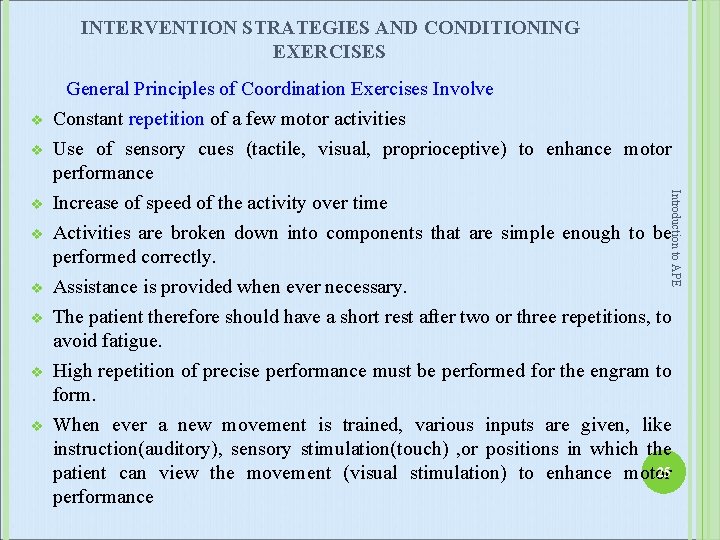
INTERVENTION STRATEGIES AND CONDITIONING EXERCISES v v v v Introduction to APE v General Principles of Coordination Exercises Involve Constant repetition of a few motor activities Use of sensory cues (tactile, visual, proprioceptive) to enhance motor performance Increase of speed of the activity over time Activities are broken down into components that are simple enough to be performed correctly. Assistance is provided when ever necessary. The patient therefore should have a short rest after two or three repetitions, to avoid fatigue. High repetition of precise performance must be performed for the engram to form. When ever a new movement is trained, various inputs are given, like instruction(auditory), sensory stimulation(touch) , or positions in which the 25 patient can view the movement (visual stimulation) to enhance motor performance
INTERVENTION STRATEGIES There are many interventions that can be utilized to improve coordination, such as: Tai chi Pilates Yoga Neuromuscular coordination exercises. Proprioceptive Neuromuscular Facilitation. Neurophysiological Basis of Developmental Techniques Sensory Integrative Therapy Introduction to APE 26
UNIT THREE: DIFFERENT TYPES OF DISABILITIES Learning Introduction to APE disabilities are problems that affect the brain's ability to receive, process, analyze, or store information. These problems can make it difficult for a student to learn as quickly as someone who isn't affected by learning disabilities. Therefore it is Having trouble in: Ø Processing information Ø Organizing information Ø Applying information 27
TYPES OF LEARNING DISABILITIES Ø Ø Dyslexia A language and reading disability Dyscalculia Problems with arithmetic and math concepts Dysgraphia A writing disorder resulting in illegibility Dyspraxia (Sensory Integration Disorder) Problems with motor coordination Ø Ø Central Auditory Processing Disorder Difficulty processing and remembering language-related tasks Non-Verbal Learning Disorders Trouble with nonverbal cues, e. g. , body language; poor coordination, clumsy Visual Perceptual/Visual Motor Deficit Reverses letters; cannot copy accurately; Language Disorders (Aphasia/Dysphasia) Trouble understanding spoken language; poor reading comprehension
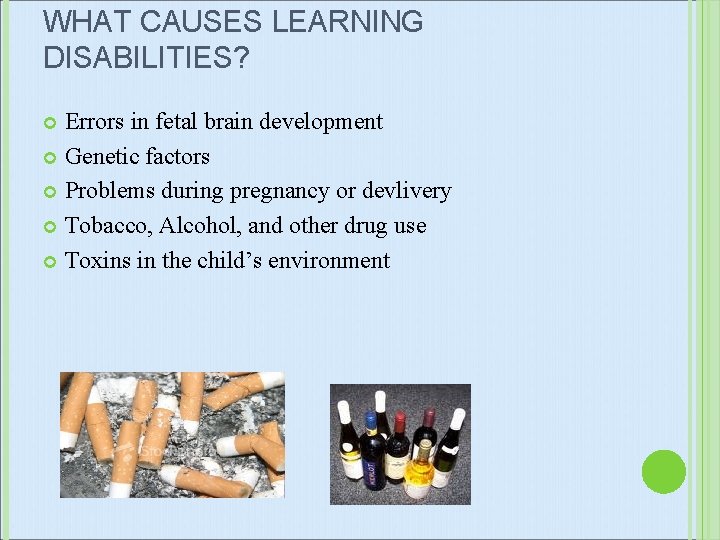
WHAT CAUSES LEARNING DISABILITIES? Errors in fetal brain development Genetic factors Problems during pregnancy or devlivery Tobacco, Alcohol, and other drug use Toxins in the child’s environment
HOW ARE LEARNING DISABILITIES DIAGNOSED? v Learning Response to intervention usually involves the following: v Monitoring Introduction to APE disabilities are often identified once a child is in school. The school may use a process called “response to intervention” to help identify children with learning disabilities. Special tests are required to make a diagnosis. all students’ progress closely to identify possible learning problems v Providing children who are having problems with help on different levels, or tiers v Moving children to tiers that provide increasing 30 support if they do not show sufficient progress
Students Introduction to APE who are struggling in school can also have individual evaluations. An evaluation can Identify whether a child has a learning disability Determine a child’s eligibility under federal law for special education services Help develop an individualized education plan (IEP) that outlines help for a child who qualifies for special education services Establish benchmarks to measure the child’s progress 31
Introduction to APE A full evaluation for a learning disability includes the following: A medical exam, including a neurological exam, to rule out other possible causes of the child’s difficulties. These might include emotional disorders, intellectual and developmental disabilities, and brain diseases. Reviewing the child’s developmental, social, and school performance A discussion of family history Academic and psychological testing Usually, several specialists work as a team to do the evaluation. The team may include a psychologist, a special education expert, and a speech-language pathologist. Many schools also have reading specialists who can help diagnose a reading disability. 32
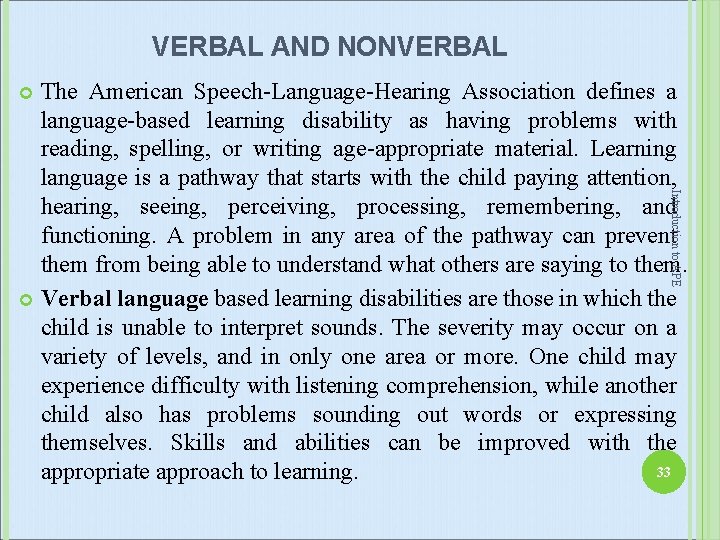
VERBAL AND NONVERBAL The American Speech-Language-Hearing Association defines a language-based learning disability as having problems with reading, spelling, or writing age-appropriate material. Learning language is a pathway that starts with the child paying attention, hearing, seeing, perceiving, processing, remembering, and functioning. A problem in any area of the pathway can prevent them from being able to understand what others are saying to them. Verbal language based learning disabilities are those in which the child is unable to interpret sounds. The severity may occur on a variety of levels, and in only one area or more. One child may experience difficulty with listening comprehension, while another child also has problems sounding out words or expressing themselves. Skills and abilities can be improved with the 33 appropriate approach to learning. Introduction to APE
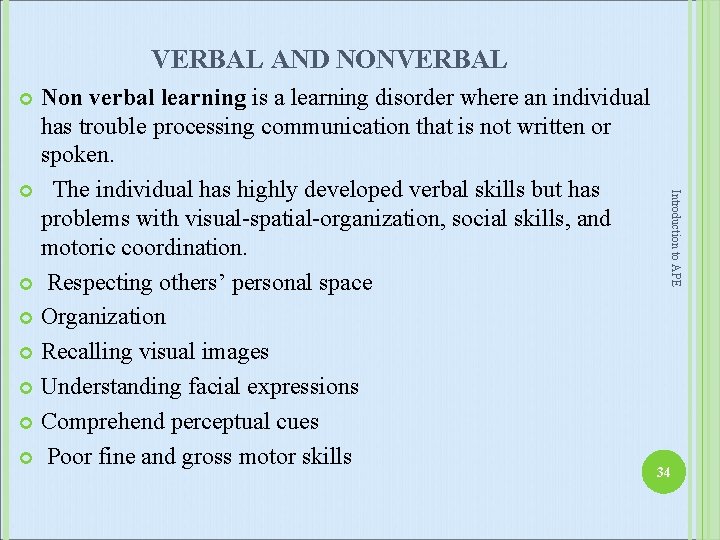
VERBAL AND NONVERBAL Non verbal learning is a learning disorder where an individual has trouble processing communication that is not written or spoken. The individual has highly developed verbal skills but has problems with visual-spatial-organization, social skills, and motoric coordination. Respecting others’ personal space Organization Recalling visual images Understanding facial expressions Comprehend perceptual cues Poor fine and gross motor skills Introduction to APE 34
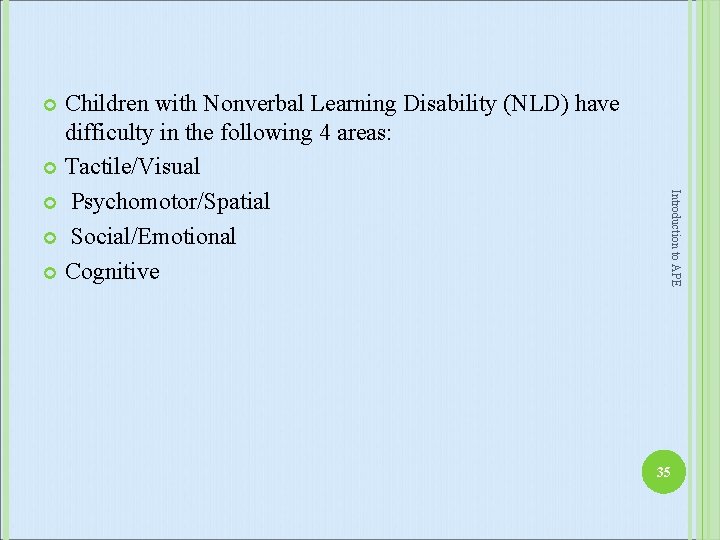
Children with Nonverbal Learning Disability (NLD) have difficulty in the following 4 areas: Tactile/Visual Psychomotor/Spatial Social/Emotional Cognitive Introduction to APE 35
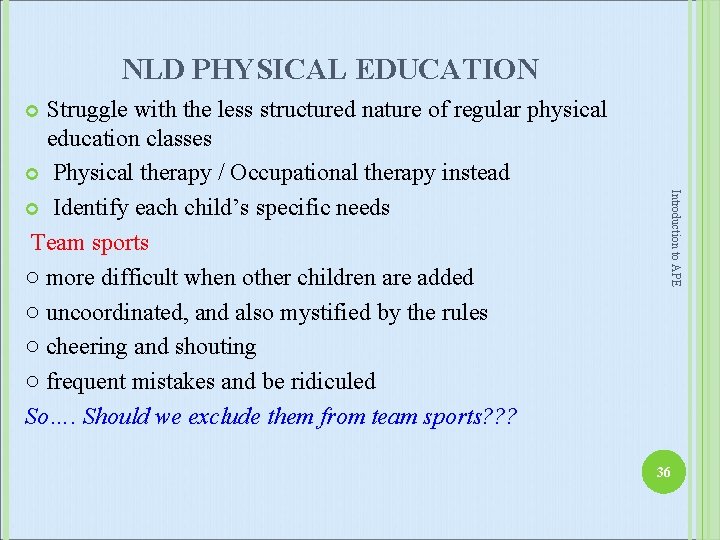
NLD PHYSICAL EDUCATION Struggle with the less structured nature of regular physical education classes Physical therapy / Occupational therapy instead Identify each child’s specific needs Team sports ○ more difficult when other children are added ○ uncoordinated, and also mystified by the rules ○ cheering and shouting ○ frequent mistakes and be ridiculed So…. Should we exclude them from team sports? ? ? Introduction to APE 36
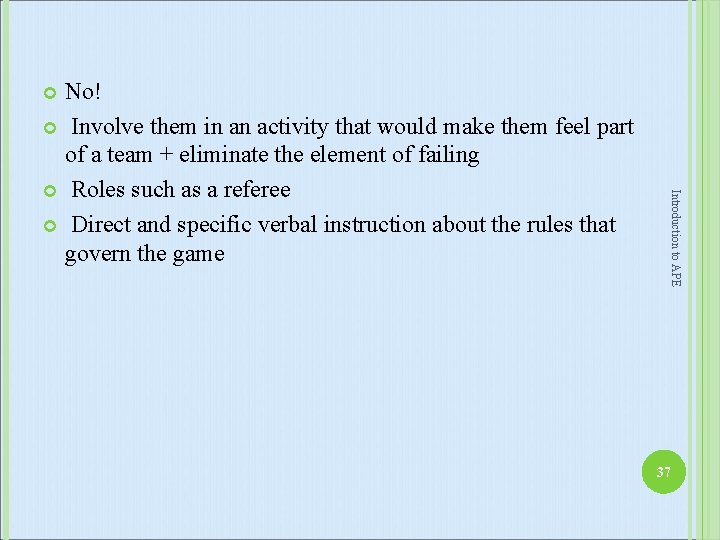
No! Involve them in an activity that would make them feel part of a team + eliminate the element of failing Roles such as a referee Direct and specific verbal instruction about the rules that govern the game Introduction to APE 37
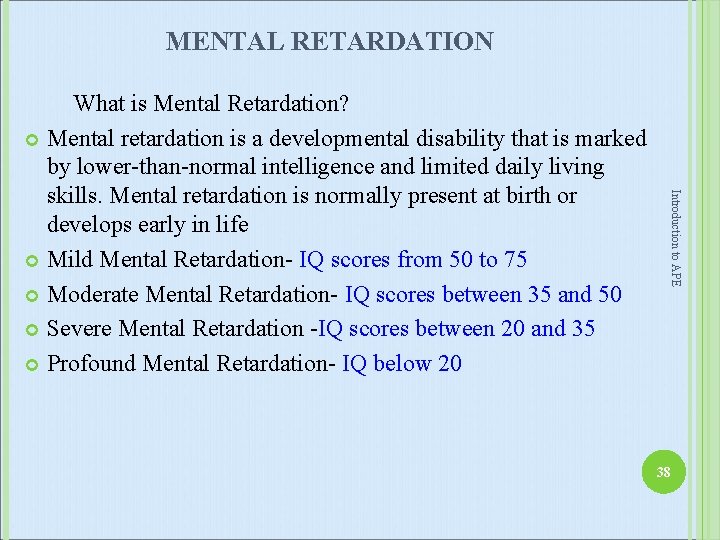
MENTAL RETARDATION Introduction to APE What is Mental Retardation? Mental retardation is a developmental disability that is marked by lower-than-normal intelligence and limited daily living skills. Mental retardation is normally present at birth or develops early in life Mild Mental Retardation- IQ scores from 50 to 75 Moderate Mental Retardation- IQ scores between 35 and 50 Severe Mental Retardation -IQ scores between 20 and 35 Profound Mental Retardation- IQ below 20 38
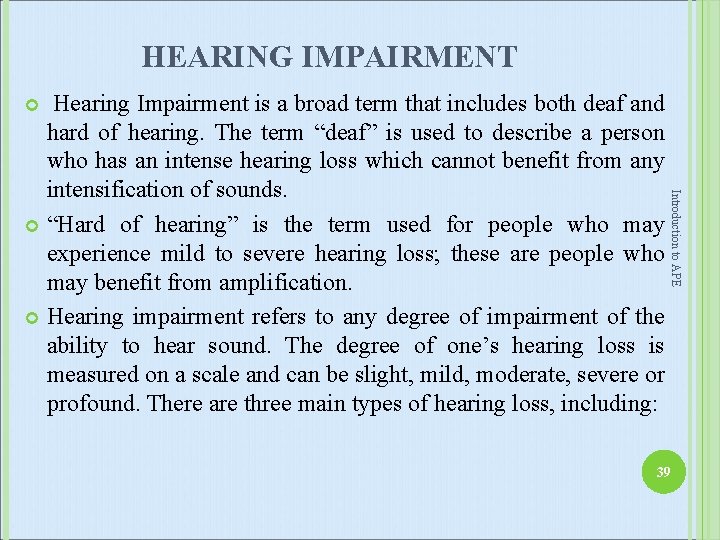
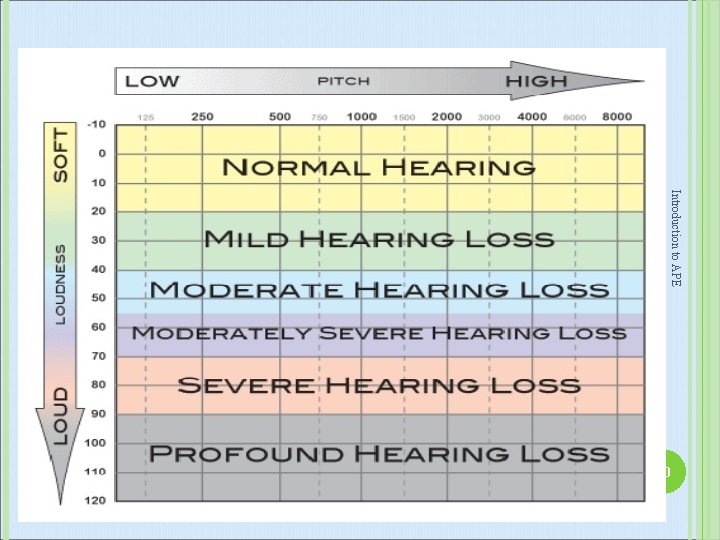
HEARING IMPAIRMENT Hearing Impairment is a broad term that includes both deaf and hard of hearing. The term “deaf” is used to describe a person who has an intense hearing loss which cannot benefit from any intensification of sounds. “Hard of hearing” is the term used for people who may experience mild to severe hearing loss; these are people who may benefit from amplification. Hearing impairment refers to any degree of impairment of the ability to hear sound. The degree of one’s hearing loss is measured on a scale and can be slight, mild, moderate, severe or profound. There are three main types of hearing loss, including: Introduction to APE 39
Introduction to APE 40
MAIN TYPES OF HEARING LOSS Conductive: caused by diseases or obstructions in the outer or middle ear that usually affect all frequencies of hearing. A hearing aid generally helps a person with a conductive hearing loss. Sensorineural : results from damage to the inner ear. This loss can range from mild to profound and often affects certain frequencies more than others. Sounds are often distorted, even with a hearing aid. Central which occurs as a result of damage in the central nervous system, not the ear, affecting the ability to interpret or understand language. The individual may be able to hear perfectly, but they cannot interpret or understand the language. Introduction to APE 41
CAUSES Introduction to APE Some known causes of Hearing Impairment are: v A family history of hearing loss. v Frequent and/or recurring ear infections as an infant or toddler. v Some antibiotics and chemotherapy treatments that may have hearing loss as one of the side effects. v Meningitis, Measles and CMV (Cytomegalovirus) Infection. v Some syndromes and disabilities have also been associated with causing hearing loss, such as Down Syndrome, Autism, 42
CHANGES IN TEACHING STRATEGIES ADAPTIVE PLAY MATERIALS “Adaptations help children to develop independence, Introduction to APE interact with their peers and manipulate materials” The 4 strategies used in making these adaptations are: Stabilize – secure materials onto a surface underneath Enlarge – add small pieces or materials to make a toy accessible Enhance – when parts of a toy are used differently to make it more accessible Simplify – reduce the number of steps, remove the number of pieces or replace the number of materials 43
VISUAL IMPAIRMENTS Visual impairment (VI) refers to a significant functional loss of vision that cannot be corrected by medication, surgical operation, or ordinary optical lenses such as spectacles. Types of Visual Impairments Crossed eye : It represents an inability of the individual to focus on the same object with both eyes simultaneously. Coloboma: a condition in which the central areas of the retina of a new born are found incomplete in their formation It may be serious impairment. Introduction to APE 44
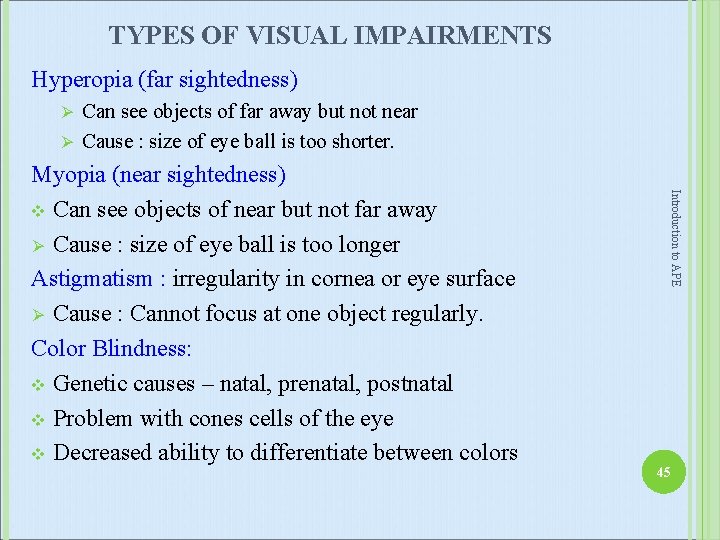
TYPES OF VISUAL IMPAIRMENTS Hyperopia (far sightedness) Can see objects of far away but not near Ø Cause : size of eye ball is too shorter. Ø Introduction to APE Myopia (near sightedness) v Can see objects of near but not far away Ø Cause : size of eye ball is too longer Astigmatism : irregularity in cornea or eye surface Ø Cause : Cannot focus at one object regularly. Color Blindness: v Genetic causes – natal, prenatal, postnatal v Problem with cones cells of the eye v Decreased ability to differentiate between colors 45
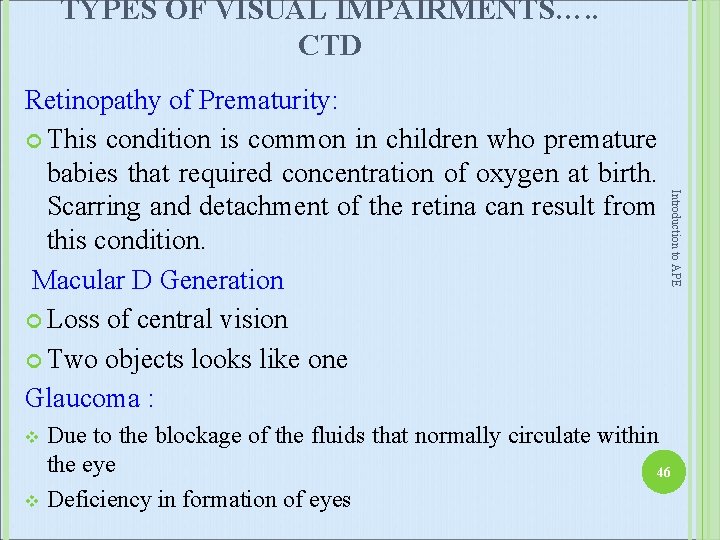
TYPES OF VISUAL IMPAIRMENTS…. . CTD Introduction to APE Retinopathy of Prematurity: This condition is common in children who premature babies that required concentration of oxygen at birth. Scarring and detachment of the retina can result from this condition. Macular D Generation Loss of central vision Two objects looks like one Glaucoma : Due to the blockage of the fluids that normally circulate within the eye 46 v Deficiency in formation of eyes v
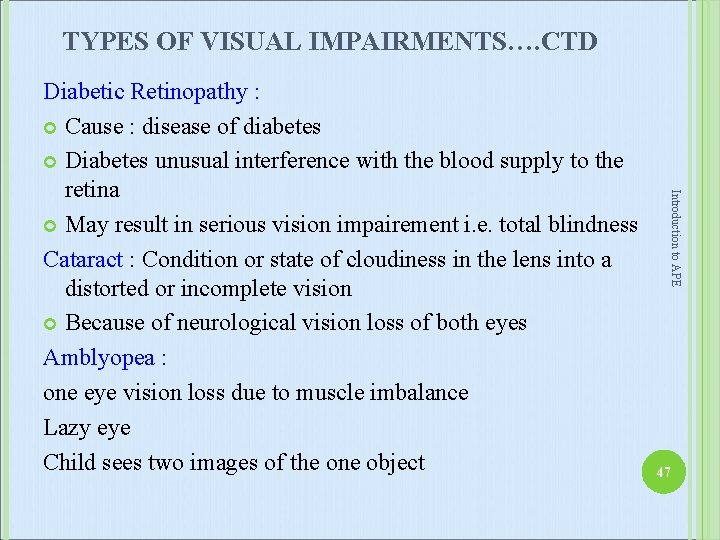
TYPES OF VISUAL IMPAIRMENTS…. CTD Introduction to APE Diabetic Retinopathy : Cause : disease of diabetes Diabetes unusual interference with the blood supply to the retina May result in serious vision impairement i. e. total blindness Cataract : Condition or state of cloudiness in the lens into a distorted or incomplete vision Because of neurological vision loss of both eyes Amblyopea : one eye vision loss due to muscle imbalance Lazy eye Child sees two images of the one object 47
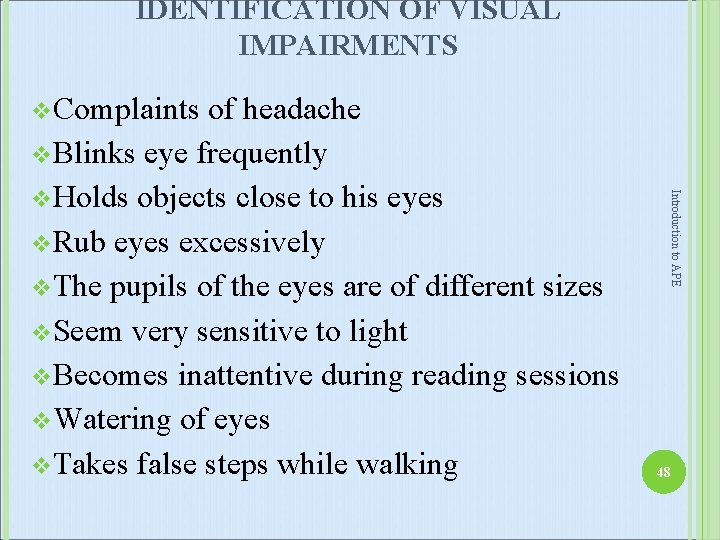
IDENTIFICATION OF VISUAL IMPAIRMENTS v Complaints Introduction to APE of headache v Blinks eye frequently v Holds objects close to his eyes v Rub eyes excessively v The pupils of the eyes are of different sizes v Seem very sensitive to light v Becomes inattentive during reading sessions v Watering of eyes v Takes false steps while walking 48
CEREBRAL PALSY (CP) Introduction to APE Definitions is a group of permanent disorder of the development of movement and posture, causing activity limitation. (Hockenberry & wilson) is a motor disorder, the condition involves disturbances of sensation, perception, communication, cognition and behavior, secondary musculoskeletal problems and epilepsy. (Hockenberry & wilson) 49
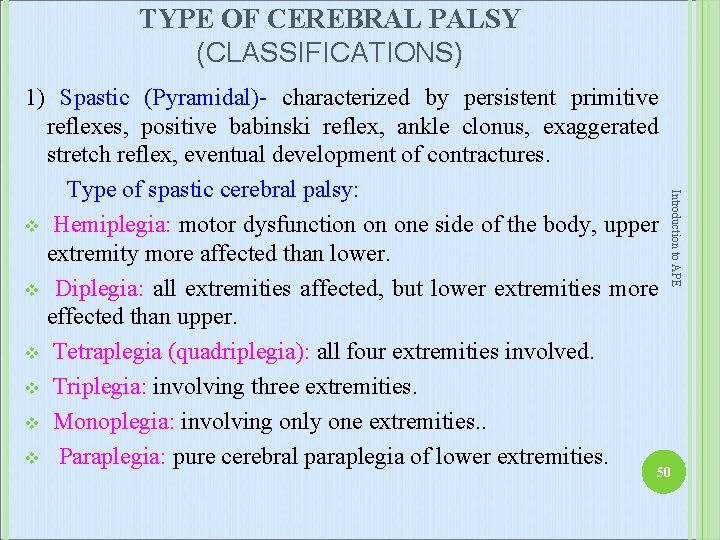
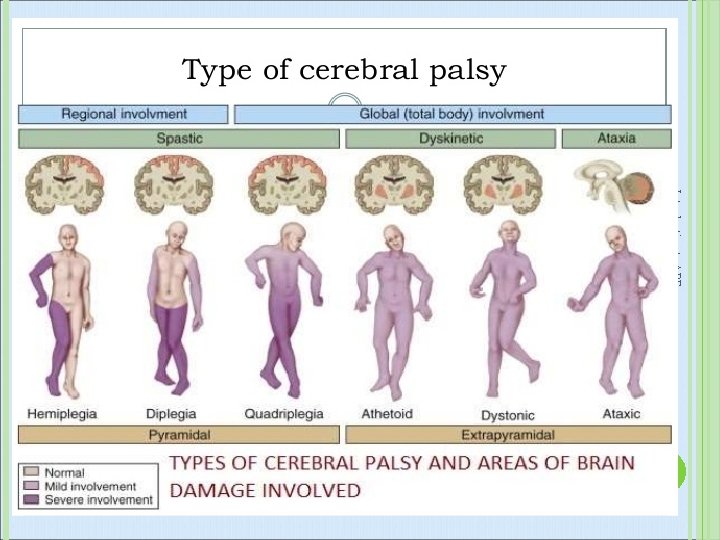
TYPE OF CEREBRAL PALSY (CLASSIFICATIONS) Introduction to APE 1) Spastic (Pyramidal)- characterized by persistent primitive reflexes, positive babinski reflex, ankle clonus, exaggerated stretch reflex, eventual development of contractures. Type of spastic cerebral palsy: v Hemiplegia: motor dysfunction on one side of the body, upper extremity more affected than lower. v Diplegia: all extremities affected, but lower extremities more effected than upper. v Tetraplegia (quadriplegia): all four extremities involved. v Triplegia: involving three extremities. v Monoplegia: involving only one extremities. . v Paraplegia: pure cerebral paraplegia of lower extremities. 50
Introduction to APE 51
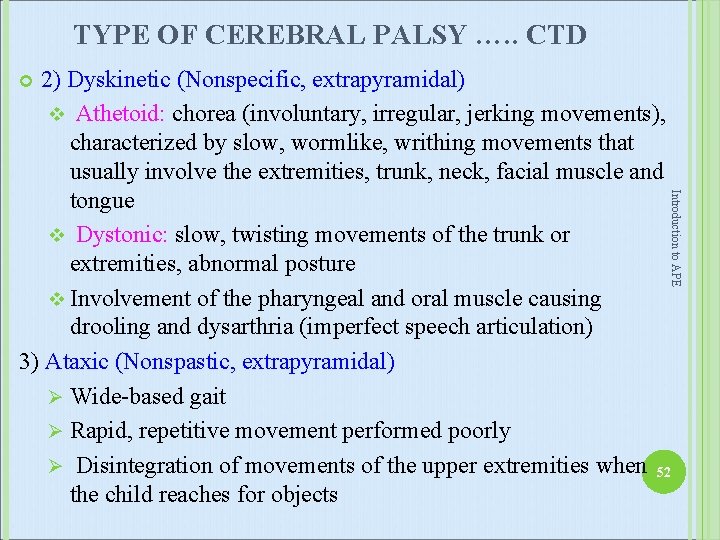
TYPE OF CEREBRAL PALSY …. . CTD 2) Dyskinetic (Nonspecific, extrapyramidal) v Athetoid: chorea (involuntary, irregular, jerking movements), characterized by slow, wormlike, writhing movements that usually involve the extremities, trunk, neck, facial muscle and tongue v Dystonic: slow, twisting movements of the trunk or extremities, abnormal posture v Involvement of the pharyngeal and oral muscle causing drooling and dysarthria (imperfect speech articulation) 3) Ataxic (Nonspastic, extrapyramidal) Ø Wide-based gait Ø Rapid, repetitive movement performed poorly Ø Disintegration of movements of the upper extremities when 52 the child reaches for objects Introduction to APE
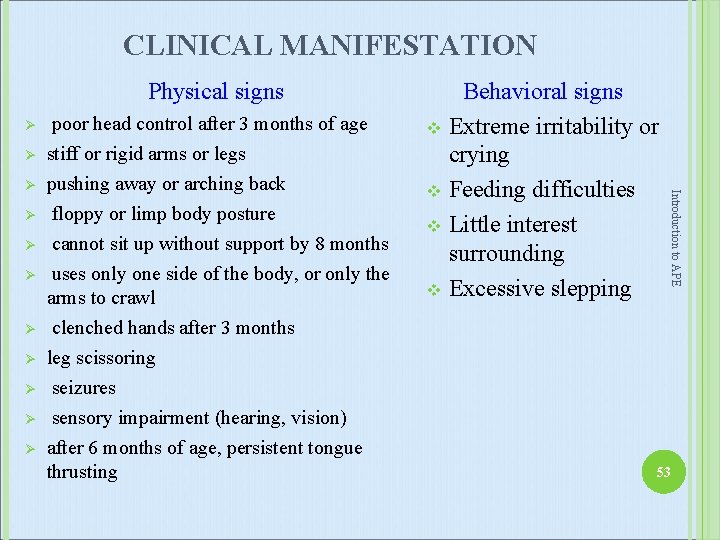
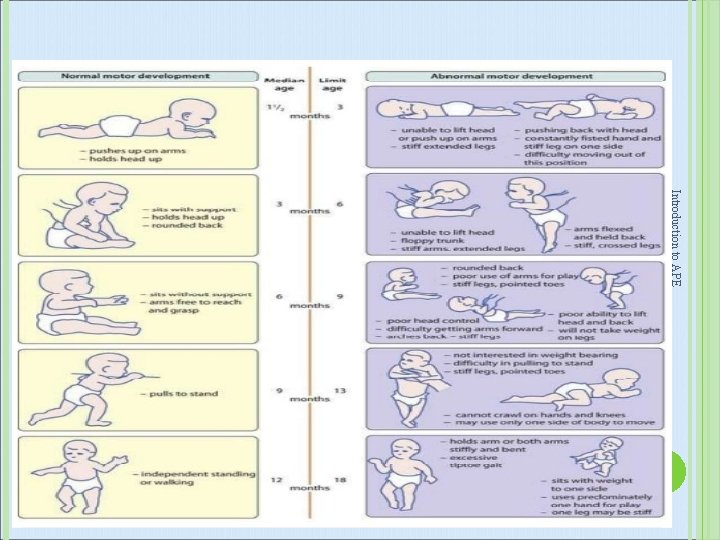
CLINICAL MANIFESTATION Physical signs Ø Ø Ø Ø Ø clenched hands after 3 months leg scissoring seizures sensory impairment (hearing, vision) after 6 months of age, persistent tongue thrusting Introduction to APE Ø poor head control after 3 months of age stiff or rigid arms or legs pushing away or arching back floppy or limp body posture cannot sit up without support by 8 months uses only one side of the body, or only the arms to crawl Behavioral signs v Extreme irritability or crying v Feeding difficulties v Little interest surrounding v Excessive slepping 53
Introduction to APE 54
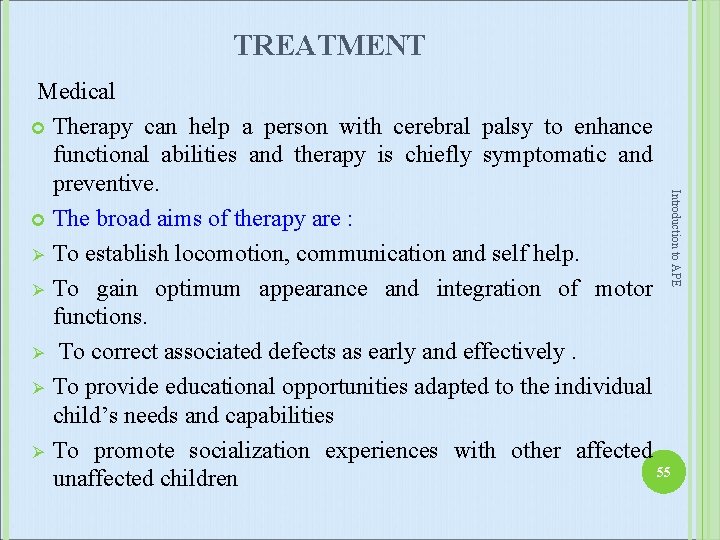
TREATMENT Introduction to APE Medical Therapy can help a person with cerebral palsy to enhance functional abilities and therapy is chiefly symptomatic and preventive. The broad aims of therapy are : Ø To establish locomotion, communication and self help. Ø To gain optimum appearance and integration of motor functions. Ø To correct associated defects as early and effectively. Ø To provide educational opportunities adapted to the individual child’s needs and capabilities Ø To promote socialization experiences with other affected 55 unaffected children
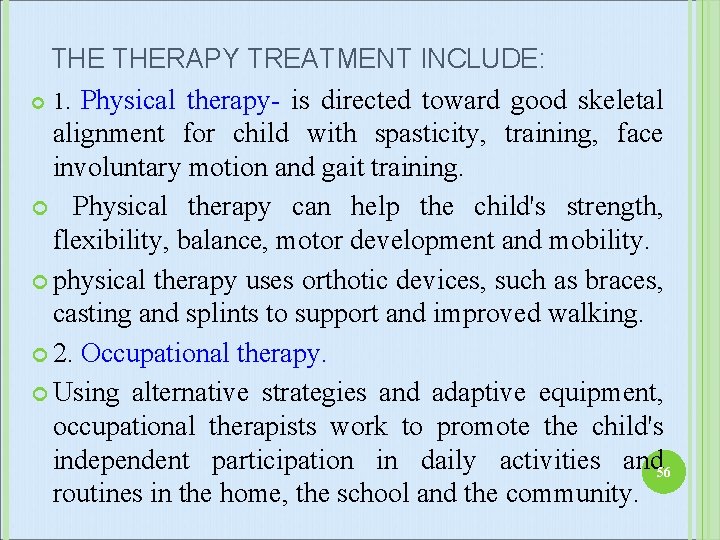
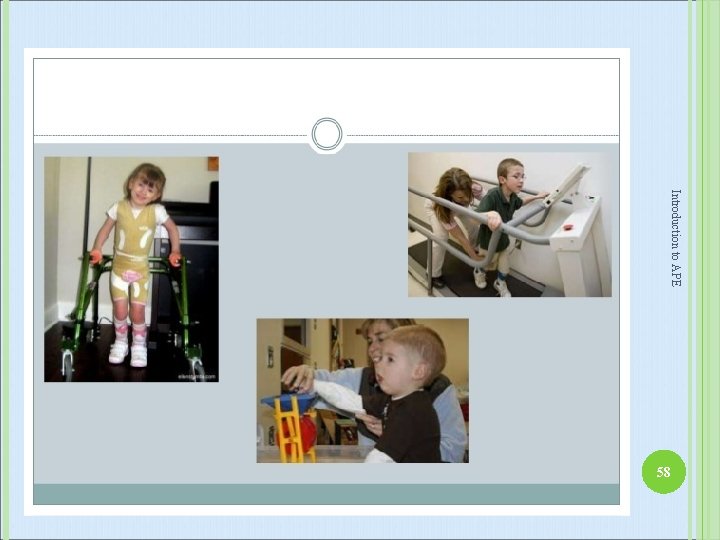
THE THERAPY TREATMENT INCLUDE: 1. Physical therapy- is directed toward good skeletal alignment for child with spasticity, training, face involuntary motion and gait training. Physical therapy can help the child's strength, flexibility, balance, motor development and mobility. physical therapy uses orthotic devices, such as braces, casting and splints to support and improved walking. 2. Occupational therapy. Using alternative strategies and adaptive equipment, occupational therapists work to promote the child's independent participation in daily activities and 56 routines in the home, the school and the community.
Adaptive equipment may include walkers, quadrupedal canes, seating systems or electric wheelchairs 3. Speech and language therapy- Speech-language pathologists can help improve the child's ability to speak clearly or to communicate using sign language. 4. Recreation therapy -This therapy can help improve your child's motor skills, speech and emotional well-being. Introduction to APE 57
Introduction to APE 58
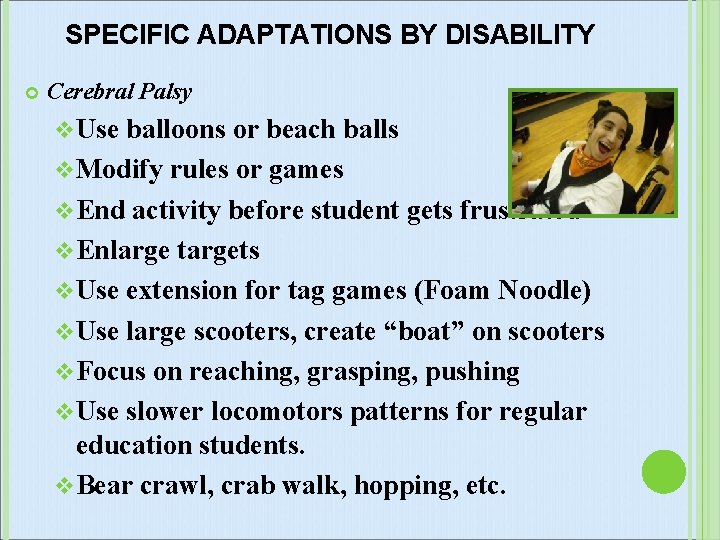
SPECIFIC ADAPTATIONS BY DISABILITY Cerebral Palsy v Use balloons or beach balls v Modify rules or games v End activity before student gets frustrated v Enlarge targets v Use extension for tag games (Foam Noodle) v Use large scooters, create “boat” on scooters v Focus on reaching, grasping, pushing v Use slower locomotors patterns for regular education students. v Bear crawl, crab walk, hopping, etc.
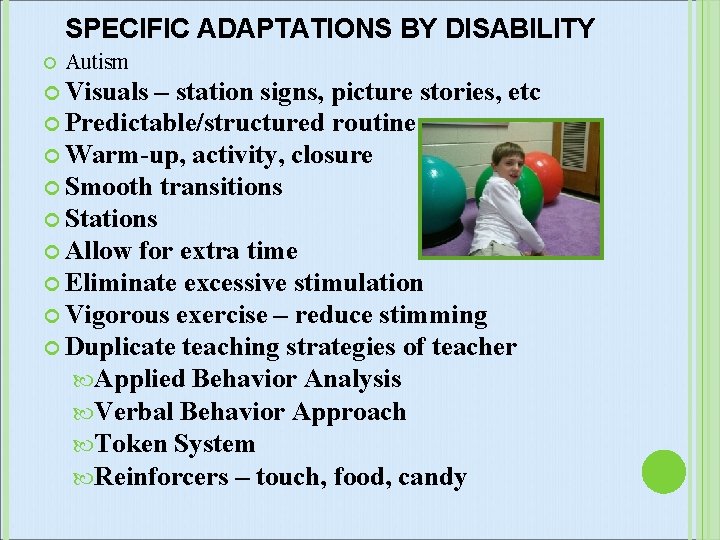
SPECIFIC ADAPTATIONS BY DISABILITY Autism Visuals – station signs, picture stories, etc Predictable/structured routine Warm-up, activity, closure Smooth transitions Stations Allow for extra time Eliminate excessive stimulation Vigorous exercise – reduce stimming Duplicate teaching strategies of teacher Applied Behavior Analysis Verbal Behavior Approach Token System Reinforcers – touch, food, candy
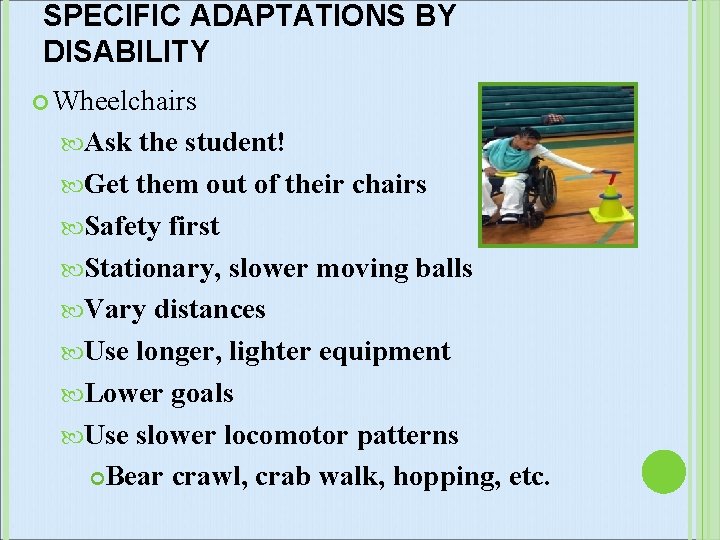
SPECIFIC ADAPTATIONS BY DISABILITY Wheelchairs Ask the student! Get them out of their chairs Safety first Stationary, slower moving balls Vary distances Use longer, lighter equipment Lower goals Use slower locomotor patterns Bear crawl, crab walk, hopping, etc.
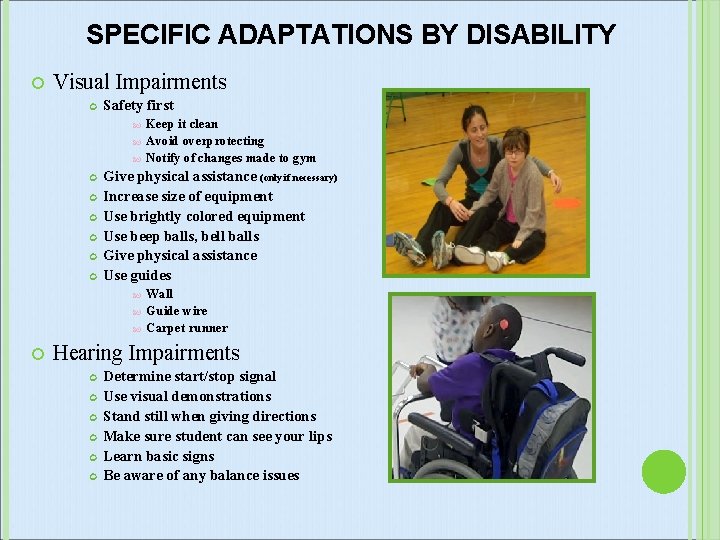
SPECIFIC ADAPTATIONS BY DISABILITY Visual Impairments Safety first Give physical assistance (only if necessary) Increase size of equipment Use brightly colored equipment Use beep balls, bell balls Give physical assistance Use guides Keep it clean Avoid overprotecting Notify of changes made to gym Wall Guide wire Carpet runner Hearing Impairments Determine start/stop signal Use visual demonstrations Stand still when giving directions Make sure student can see your lips Learn basic signs Be aware of any balance issues
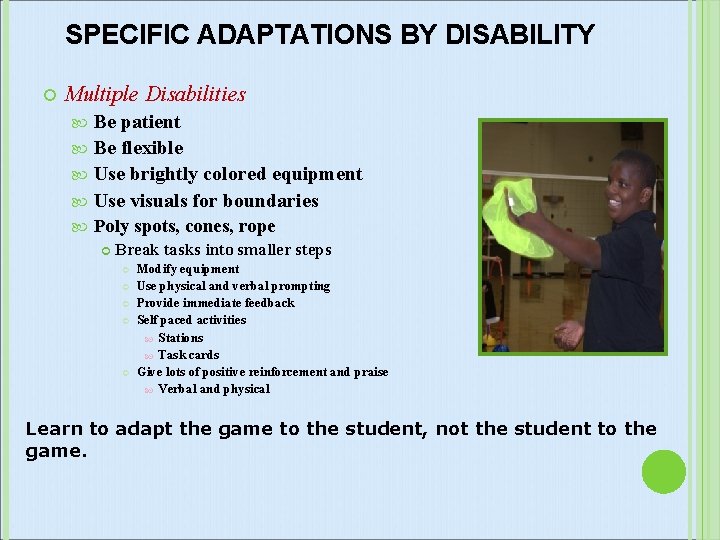
SPECIFIC ADAPTATIONS BY DISABILITY Multiple Disabilities Be patient Be flexible Use brightly colored equipment Use visuals for boundaries Poly spots, cones, rope Break tasks into smaller steps Modify equipment Use physical and verbal prompting Provide immediate feedback Self paced activities Stations Task cards Give lots of positive reinforcement and praise Verbal and physical Learn to adapt the game to the student, not the student to the game.
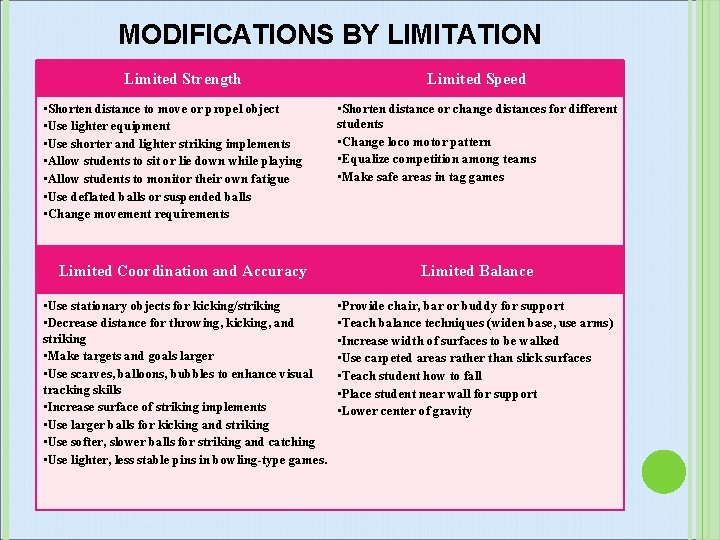
MODIFICATIONS BY LIMITATION Limited Strength • Shorten distance to move or propel object • Use lighter equipment • Use shorter and lighter striking implements • Allow students to sit or lie down while playing • Allow students to monitor their own fatigue • Use deflated balls or suspended balls • Change movement requirements Limited Speed • Shorten distance or change distances for different students • Change loco motor pattern • Equalize competition among teams • Make safe areas in tag games Limited Coordination and Accuracy Limited Balance • Use stationary objects for kicking/striking • Decrease distance for throwing, kicking, and striking • Make targets and goals larger • Use scarves, balloons, bubbles to enhance visual tracking skills • Increase surface of striking implements • Use larger balls for kicking and striking • Use softer, slower balls for striking and catching • Use lighter, less stable pins in bowling-type games. • Provide chair, bar or buddy for support • Teach balance techniques (widen base, use arms) • Increase width of surfaces to be walked • Use carpeted areas rather than slick surfaces • Teach student how to fall • Place student near wall for support • Lower center of gravity
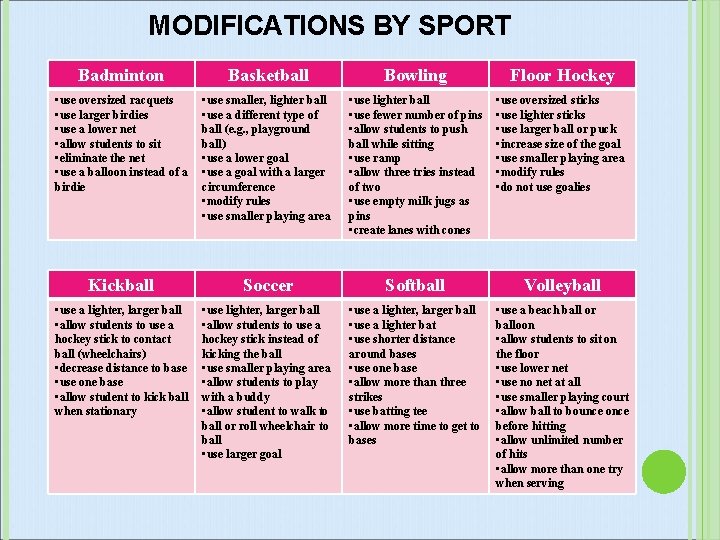
MODIFICATIONS BY SPORT Badminton Basketball Bowling Floor Hockey • use oversized racquets • use larger birdies • use a lower net • allow students to sit • eliminate the net • use a balloon instead of a birdie • use smaller, lighter ball • use a different type of ball (e. g. , playground ball) • use a lower goal • use a goal with a larger circumference • modify rules • use smaller playing area • use lighter ball • use fewer number of pins • allow students to push ball while sitting • use ramp • allow three tries instead of two • use empty milk jugs as pins • create lanes with cones • use oversized sticks • use lighter sticks • use larger ball or puck • increase size of the goal • use smaller playing area • modify rules • do not use goalies Kickball Soccer Softball Volleyball • use a lighter, larger ball • allow students to use a hockey stick to contact ball (wheelchairs) • decrease distance to base • use one base • allow student to kick ball when stationary • use lighter, larger ball • allow students to use a hockey stick instead of kicking the ball • use smaller playing area • allow students to play with a buddy • allow student to walk to ball or roll wheelchair to ball • use larger goal • use a lighter, larger ball • use a lighter bat • use shorter distance around bases • use one base • allow more than three strikes • use batting tee • allow more time to get to bases • use a beach ball or balloon • allow students to sit on the floor • use lower net • use no net at all • use smaller playing court • allow ball to bounce once before hitting • allow unlimited number of hits • allow more than one try when serving
UNIT FOUR: 66 Introduction to APE Components of perceptual motor efficiency
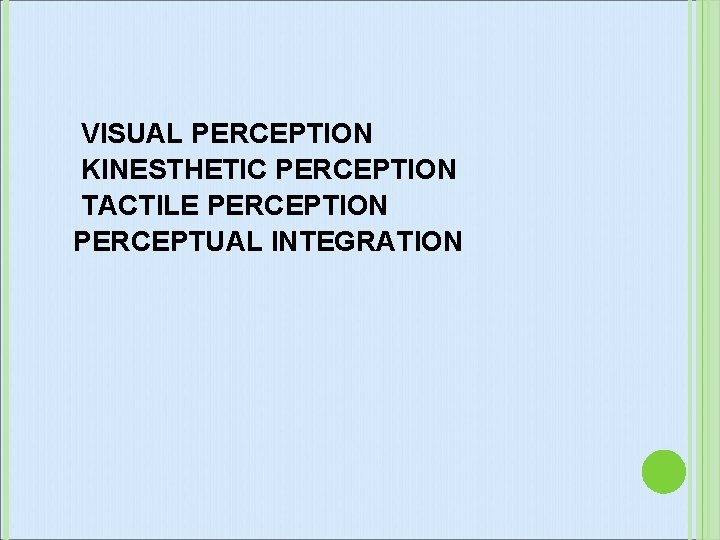
VISUAL PERCEPTION KINESTHETIC PERCEPTION TACTILE PERCEPTION PERCEPTUAL INTEGRATION
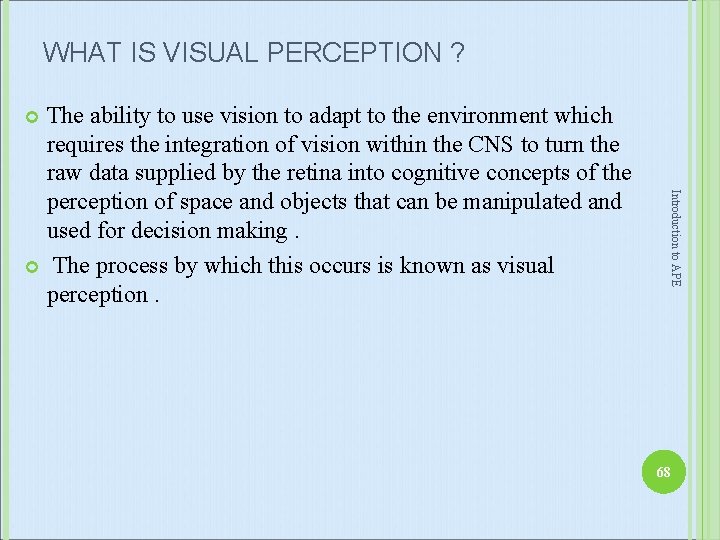
WHAT IS VISUAL PERCEPTION ? The ability to use vision to adapt to the environment which requires the integration of vision within the CNS to turn the raw data supplied by the retina into cognitive concepts of the perception of space and objects that can be manipulated and used for decision making. The process by which this occurs is known as visual perception. Introduction to APE 68
DEVELOPMENTAL CHANGE IN VISUAL STRUCTURES Although all of the visual structures are intact at birth, several are immature in terms of myelinization and synaptic potential. Development proceeds rapidly - by the end of the first year the major structures of the retina are like those of the adult. The part of the nervous system that relays visual impressions between the retina and the cortex of the brain also develops quickly and reaches a large part of its ultimate efficiency during the first year of postnatal life.
DEVELOPMENTAL CHANGE IN VISUAL FUNCTIONS Visual acuity refers to clearness of vision and the capacity to detect both small stimuli and small details of large visual patterns. From a motor behavior perspective visual acuity often is classified as static or dynamic. factors that affect visual acuity Ødevelopment of the fovea Ødegree of myelinization Ønumber of neural connections in the visual cortex shape Østructure of the eye Østrength of the ciliary muscles
Object The Permanence realization that objects continue to exist when they are no longer in view is object permanence. This ability is considered one of the more notable achievements in perceptual development. A-not-B error
Figure-Ground It Perception refers to the ability to distinguish an object from its surrounding background This ability requires the individual to concentrate on and give selective attention to a visual stimulus.
Depth Perception It is the ability to judge the distance of an object from the self. Consists of absolute distance and relative distance. Oculomotor cues and visual cues It is generally agreed that depth perception is absent at birth. Most sources indicate that by the age of 6 months, children are capable of judging depth with fair accuracy.
Field of Vision (peripheral vision ) Field of vision refers to the entire extent of the environment that can be seen without changing the fixation of the eye. vertical and lateral capabilities Only after age 5 are visual fields equivalent to those of adults.
PERCEPTION OF MOVEMENT AND VISUAL-MOTOR COORDINATION One Introduction to APE of the most important and complex perceptual abilities related to motor behavior is the detection, tracking, and interception of moving objects. The ability to coordinate visual abilities with movements of the body is visual-motor coordination. eye-hand or eye-foot integration proximodistal , midline to periphery, cephalocaudal, head to toes, and gross-to-finemotor order. 75
KINESTHETIC PERCEPTION Often referred to as the sixth sense, kinesthetic perception is a comprehensive term that encompasses the awareness of movement and body position. It based on information that derives from the individual’s internal environment. It receives sensory input from receptors located in muscles, tendons, joints, and the vestibular (balance) system Introduction to APE 76
DEVELOPMENT OF KINESTHETIC PERCEPTION kinesthetic acuity refers to the ability to detect differences or match qualities such allocation, distance, weight, force, speed, and acceleration. kinesthetic memory involve a reproduction of movements
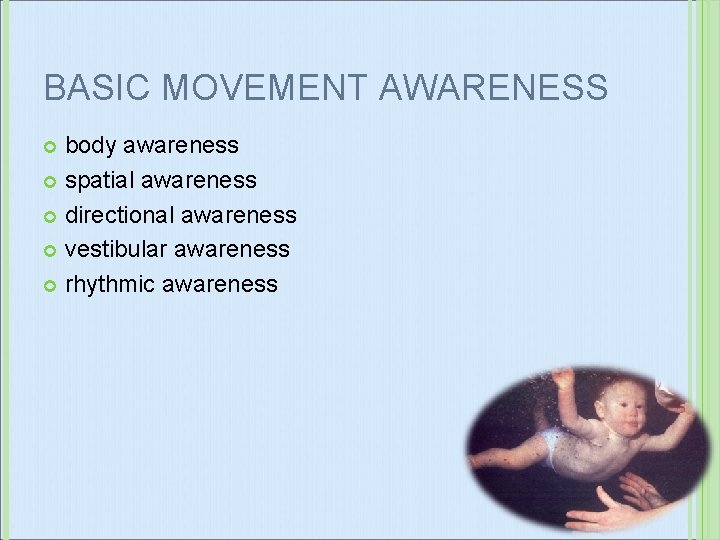
BASIC MOVEMENT AWARENESS body awareness spatial awareness directional awareness vestibular awareness rhythmic awareness
BODY AWARENESS Sometimes The knowledge of body parts and their functions is one of the most basic aspects of kinesthesis. The ability to identify various body parts depends heavily on both conceptual and language abilities, as well as other sensory perceptions. Introduction to APE referred to as body concept, body knowledge, or body schema It involves an awareness of body parts by name and location, their relationship to each other, and their capabilities and limitations 79
SPATIAL AWARENESS It Introduction to APE interplays with the visual perception of spatial orientation. The sense of the location of one’s body in space in relationship to the environment. Egocentric localization and Objective localization v. Spatial Awareness is the distance between you and the objects in your environment 80
DIRECTIONAL AWARENESS Directional awareness refers to the conscious internal awareness of two sides of the body (laterality) and the ability to identify various dimensions of external space and project the body within those dimensions (directionality). Laterality refers to motor awareness of the two sides of the body, while directionality refers to the ability to know right from left, up from down, forwards from backwards, etc v The child who has a laterality problem has not yet internalised the knowledge that the body has two sides. v A child with a directionality problem has difficulty dealing with directions of objects in relation to self, such as “to my right, ” “to my left, ” “above me, ” “below me, ” etc. Introduction to APE 81
In theoretical terms, directional awareness is that aspect of kinesthetic perception assumed to be an extension of body and spatial awareness. From a theoretical perspective, directionality is the motoric expression of laterality and the perception of spatial orientation.
Vestibular The Awareness successful performance of virtually all motor skills depends on the individual’s ability to establish and maintain equilibrium (balance). The general description for this component is vestibular awareness.
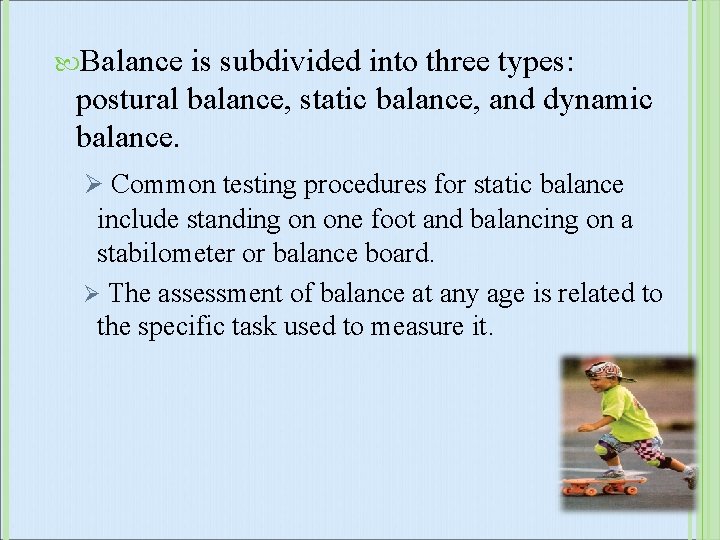
Balance is subdivided into three types: postural balance, static balance, and dynamic balance. Ø Common testing procedures for static balance include standing on one foot and balancing on a stabilometer or balance board. Ø The assessment of balance at any age is related to the specific task used to measure it.
Rhythmic It (Temporal) Awareness refers to creating or maintaining a temporal pattern within a set of movements. Even young infants seem to be born with the tendency to make rhythmic movements with parts of their bodies.
It suggest that children between 2 and 5 years of age improve considerably in their ability to keep time to a rhythmical stimulus and that periods of improvement continue to adulthood. Better accuracy scores were recorded at faster rather than slower tempos.
TACTILE PERCEPTION Tactile perception (touch) refers to the ability to detect and interpret sensory information cutaneously. In conjunction with kinesthetic perception, often referred to as the tactile-kinesthetic system. Provides information about our environment Provides feedback Difficulties if no feedback?
PERCEPTUAL INTEGRATION The description of developmental characteristics and improvements ‘within’ individual sensory systems is referred to as intrasensory development. The perceptual and perceptual-motor processes is known as perceptual integration. Intermodal perception Visual-Kinesthetic Integration Introduction to APE Visual-Auditory Integration Auditory-Kinesthetic Integration 88
UNIT FIVE –EMOTIONAL DISTURBANCE Introduction to APE What is Emotional Disturbance? IDEA defines emotional disturbance as “a condition exhibiting one or more of the following characteristics over a long period of time and to a marked degree” v An inability to learn which cannot be explained by intellectual, sensory, or health factors. v An inability to build or maintain satisfactory interpersonal relationships with peers and teachers. Inappropriate types of behavior or feelings under normal circumstances. v A general pervasive mood of unhappiness or depression. v A tendency to develop physical symptoms or fears associated with personal or school problems. 89
Introduction to APE The IDEA definition addresses: Chronicity (“over a long period of time”) Severity (“to a marked degree”) Difficulty in school (“adversely effects educational performance”) 90
CHARACTERISTICS Hyperactivity (short attention span, impulsiveness); Aggression /self-injurious behavior (acting out, fighting); Withdrawal (failure to initiate interaction with others; retreat from exchanges of social interaction, excessive fear or anxiety); Immaturity (inappropriate crying, temper tantrums, poor coping skills); and Learning difficulties (academically performing below grade level). Children with the most serious emotional disturbances may exhibit distorted thinking, excessive anxiety, and abnormal mood swings and are sometimes identified as children who have a severe psychosis or schizophrenia
CHARACTERISTICS…. . CTD Students with emotional disturbances often use inappropriate ways to get attention, such as talking back to adults, refusing to do work, or making jokes. Students with emotional disturbances may have low selfesteem and poor social skills. Students with emotional disturbances can benefit from classes that are highly structured and have clear rules that are consistently enforced.
CAUSES OF EMOTIONAL DISTURBANCES Biological Psychological, including the influence of home--quality and quantity of parental and sibling attention Influence of school. Quality of behavior management, especially. Introduction to APE 93
A TALE OF TWO TERMS Neurosis. The neurotic worries too much. This might describe a lot of lives in our contemporary world. Psychosis. The psychotic is past worry and is out of touch with reality at least part of the time. “The neurotic builds castles in the air; the psychotic goes to live in them. ” Introduction to APE 94
PHOBIAS AND THEIR TREATMENT Phobias are fears that go far beyond evidence. Sometimes fear is wise. Acrophobia is a fear of high places. Agoraphobia is a fear of open places Algophobia is a fear of pain. Anthrophobia is a fear of mankind Claustrophobia is a fear of closed places. Mysophobia is a fear of germs Introduction to APE 95
TREATMENTS FOR PHOBIAS Exhaustion or flooding method. Advantages: time, simplicity. Disadvantages: real risk to client; spread of phobia if procedure fails. Ethics can be a concern depending upon how things are handled. Best use of flooding: minor phobias, phobias that are not intense or deeply internalized. De-sensitization method. Advantages: natural method; less real risk to client; less likelihood of spread of effect if the procedure does not work; usually more comfortable for the client since he is partially in control. Disadvantages: time, possible lack of motivation of client. For more deep-seated phobias Introduction to APE 96
APPROACHES TO TEACHING EMOTIONALLY DISTURBED STUDENTS Psychodynamic strategy. Freudian approach that attempts to bring the id, ego, and superego into balance with each other. Sometimes referred to as the “five year couch” approach. One feature of this approach that is frequently used in schools is the “life space interview” following a crisis. Problem: need something more pro-active in a school situation. Biogenic approach. Appropriate when problems are more physical than mental. Schizophrenia, substance abuse, glucose, ADHD, and other medically related problems. Humanistic approach. Teacher acts as a non-authoritarian “resource and catalyst” rather than being directive. For most ED students this approach is not recommended Introduction to APE 97
APPROACHES TO TEACHING ED Introduction to APE Behavior modification Behavior is controlled by its consequences until the student gains self-control. BMOD has the strongest research base of any of the approaches for ED. Even with BMOD there are some situations that do not always work. ED is the last great frontier of special education teaching Ecological approaches. These try to re-arrange key elements in the child’s environment, including his home, to facilitate his adjustment to the world. The combination of behavioral and ecological approaches, 98 called Project RE-ED, has been the most effective thus far.
Introduction to APE Unit Six: Fitness games and activities for different physical qualities improvement (practical) 99
PARALYMPICS GAMES The Paralympic Games is a major international multi-sport event, involving athletes with a range of physical disabilities, including impaired muscle power (e. g. paraplegia and quadriplegia, muscular dystrophy, Post-polio syndrome, spina bifida), impaired passive range of movement, limb deficiency (e. g. amputation or dysmelia), leg length difference, short stature, hypertonia, ataxia, athetosis, vision impairment and intellectual impairment. The word “Paralympic” derives from the Greek preposition “para” (beside or alongside) and the word “Olympic”. Its meaning is that Paralympics are the parallel Games to the Olympics and illustrates how the two movements exist side-by 100 side. Introduction to APE
Introduction to APE German born Dr. Ludwig Guttmann of Stoke Mandeville Hospital, who had been helped to flee Nazi Germany by the Council for Assisting Refugee Academics (CARA) in 1939, hosted a sports competition for British World War II veteran patients with spinal cord injuries. The first games were called the 1948 International Wheelchair Games, and were intended to coincide with the 1948 Olympics. Dr. Guttman's aim was to create an elite sports competition for people with disabilities that would be equivalent to the Olympic Games. The games were held again at the same location in 1952, and Dutch veterans took part alongside the British, making it the first 101
The Paralympics have grown from a small gathering of British World War II veterans in 1948 to become one of the largest international sporting events by the early 21 st century. Paralympians strive for equal treatment with non -disabled Olympic athletes, but there is a large funding gap between Olympic and Paralympic There are Winter and Summer Paralympic Games, which since the 1988 Summer Games in Seoul, South Korea, are held almost immediately following the respective Olympic Games. All Paralympic Games are governed by the International Paralympic There are currently 28 Paralympic sports sanctioned by the IPC: 22 summer and six winter. Introduction to APE 102
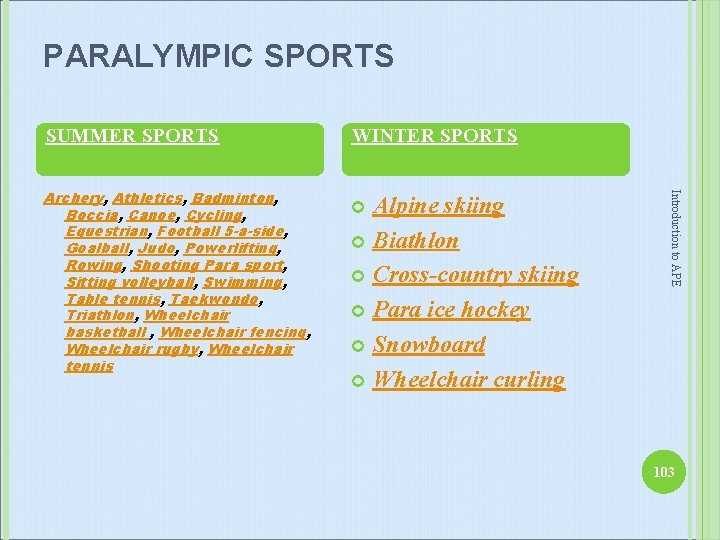
PARALYMPIC SPORTS SUMMER SPORTS Alpine skiing Biathlon Cross-country skiing Para ice hockey Snowboard Wheelchair curling Introduction to APE Archery, Athletics, Badminton, Boccia, Canoe, Cycling, Equestrian, Football 5 -a-side, Goalball, Judo, Powerlifting, Rowing, Shooting Para sport, Sitting volleyball, Swimming, Table tennis, Taekwondo, Triathlon, Wheelchair basketball , Wheelchair fencing, Wheelchair rugby, Wheelchair tennis WINTER SPORTS 103
REVIEW QUESTIONS Define the fallowing A. Adapted Physical education? Adapted Physical activity? Adapted sport? B. Explain Physical disability, Emotional/Behavioral disorders, Sensory disablities C. What are the exercises recommended for persons with disability D. What are the responsibilities s of adapted physical educator Introduction to APE 104
References Margaret Hollis. (1998), Massage for Therapists, 2 nd edition. Patricia J. Benjamin and Scott P. Lamp. (2005), Understanding Sport Massage, 2 ndedition. Ramella Mills and Shanon Parker. (2004), Sports Massage, 2 nd edition. Winnick, Joseph P. , (2017)Adapted Physical Education and Sport, Sixth Edition. Introduction to APE 105