
JIF CLAIMS COORDINATORS TRAINING SEMINAR Presented by Chris
JIF CLAIMS COORDINATORS TRAINING SEMINAR Presented by: Chris Roselli, Patty Davidson, Joe Lisciandri & Barbara Mac. Lean

JIFs Proved to be a Better Way! JIFs allowed municipalities to join together to take advantage of lower costs and additional services associated with self insurance and to achieve coverage and pricing STABILITY!
Why JIF? 1. Why have so many N. J. Municipalities, Counties, MUA’s, Housing Authorities and School Boards made the JIF their choice for coverage and risk management services? 2. Why have so many stayed with the JIF?
The JIF is Different • • • Public Entity Ownership Unparalleled Safety Programs Solid Claims Management Effective Risk Management Customized Services Financial Stability

JIF Concept Towns put their money together s e ns Cla e c an Be e p x E R r u s n i e im s ne fits
Qual-Lynx Staff • Claims – – Intake Investigation Claim Adjudication Payments • Managed Care – Intake – Nurse Case Management – Network
Claims Support • • • Claims Coordinator Claims Personnel Fund Administrator Expert Defense Panel Fund Attorney Risk Management Consultant
MULTIPLE LINES OF COVERAGE Qual-Lynx handles multiple lines of coverage: • Property: damage to municipal vehicles, equipment, or buildings. • General Liability: bodily injury or property damage to a third party. • Automobile Liability: bodily injury or property damage to a third party. • Workers’ Compensation: your employees’ work related injury claims.
Role of The Claims Coordinator
Role of the Claims Coordinator The Claims Coordinator has the following responsibilities: Coordinate prompt reporting of all claims within the municipality. Maintain supply of claim forms. Serve as a liaison between the municipality, TPA, and the MCO. Direct injured employees to Panel Physician for initial medical evaluation. Follow-up with employee/claims adjuster/supervisor/ nurse case manager, as needed to track the progress of the claim. • Direct supervisors to “Incident Reports” on the JIF website; encourage completion within reasonable timeframe and transmit all reports as indicated. • Maintain records on all claims submitted. • Early, accurate claim reporting is essential to controlling the costs associated with your Workers’ Compensation, Liability and Property Damage programs. • •
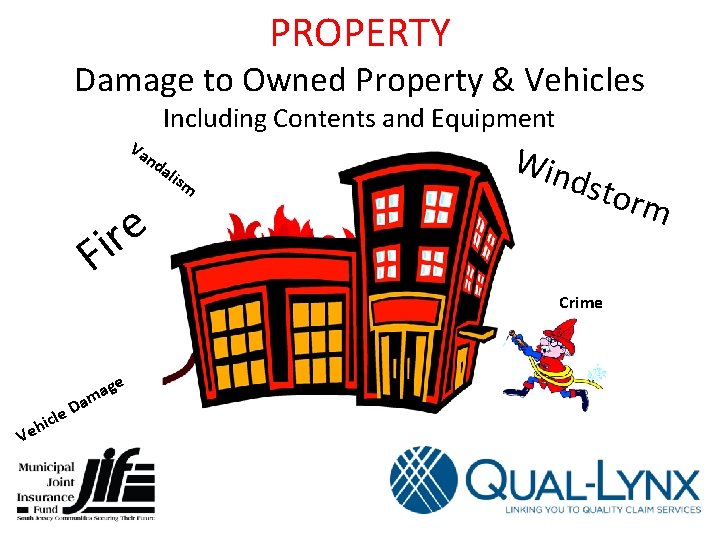
PROPERTY Damage to Owned Property & Vehicles Including Contents and Equipment Va nd e r i F ali sm Win dsto rm Crime V icle h e ge a m Da
First Party Property Claims • Fire, theft, vandalism, wind damage, lightning, flood • Automobile physical damage (your vehicles) • Any damage to insured property (i. e. , owned buildings, contents, lighting, bleachers, park equipment, clothing, communications devices, fire rescue equipment, etc. ) • Damage to backhoes or other off road equipment • Boiler and machinery losses • Damage to watercraft • Theft of funds
Property Pointers • Report the claim as soon as possible – Even non-emergency claims should be reported. – Enables the proper protection of the damaged and undamaged property involved in the loss. – Quick reporting can assist in preserving any evidence that may exist to determine causation and for subrogation. • Provide as much information at the outset of the claim as possible. – For example, knowing where a municipal vehicle is located and whether it is accruing storage can keep costs down.
Common Coverage Exclusions • Long term events (rust, rotted materials, mold, pollution/contamination) • Roadways, sidewalks, pavements • Trees, bushes and shrubs • General cleanup of streets, or extra costs related to increased curbside pick up of residents’ debris
What do you do? • Report the claim to Qual-Lynx at the earliest opportunity • The following is needed to start a claim: ₋ a description of the loss ₋ the location of the loss ₋ the date of loss ₋ contact person with contact information • Mitigate damages (start clean up, board up) • Timing is very important - delays can cost money and in some cases, coverage • Protect involved equipment. It may be evidence!
Please Remember • Keep all receipts - invoices, purchase orders and rental agreements • Evidence/spoliation • Take photos of anything about to be repaired/discarded • If uncertain about the next step, please contact our office
Vehicles and Salvage • Please take all damaged vehicles back to a secured yard owned by the municipality. • If the vehicle is driveable, it is not much of an issue. The vehicle can be driven to an auto body for an estimate and potentially still be in use. • If the vehicle is not driveable, it should not be taken to an auto body where it may accrue storage. Your choice of repairer should have no issues coming to you for an inspection. • If it is totaled, it is where it should be, and will remain there until the highest bidder for the salvage comes to pick it up. • If not totaled, the repairing shop will likely not charge for the tow(depending on vehicle size and condition).
What happens next? • Qual-Lynx will set up the claim. You will receive an acknowledgement letter from QL with the name of adjuster and claim number. • The adjuster will contact the insured for more details, address coverage, assign a vehicle appraiser, field adjuster, or expert. • If it appears that the claim will exceed the JIF limits, Qual-Lynx will place the MEL TPA on notice. • Once the claim has been settled and the insured has received payment, the adjuster may follow for subrogation proceeds if there is a negligent third party that contributed to or caused the loss to occur.
CATASTROPHIC CLAIMS IMMEDIATE REPORTING IS CRITICAL • Secure the property involved considering the safety of employees, residents, etc. • Contact an Emergency Service Provider to prevent further damages or secure a building. The MEL Website www. njmel. org. provides a list of qualified emergency service providers. However, the member is not obligated to select a vendor from the list. • Report the claim to Qual-Lynx who will then report the claim to the designated Property Adjuster on the MEL level. The MEL TPA will then handle the claim. • For a catastrophic event, such as Hurricanes Irene and Sandy, you should contact FEMA no matter how small the claim may be. FEMA website is www. FEMA. gov and phone number is 800 -621 -3362.
Things to think about • Do you have a plan in place? ₋ Please visit Ready. Gov/Business or Ready. Gov/Hurricanes • Remember, we are normally aware of hurricanes for weeks. Nor’easters do not have that kind of warning! • What important documents are you storing? Are they stored properly? • How about your computers/communication systems? − What can you do to protect them? − Lightning protection in place? − Back them up and take info home • Does your generator have the capability to run the portions of the building you will need it to run? ₋ Is it running properly? • Flood policy required for any of your buildings? • Regular maintenance can prevent large exposures
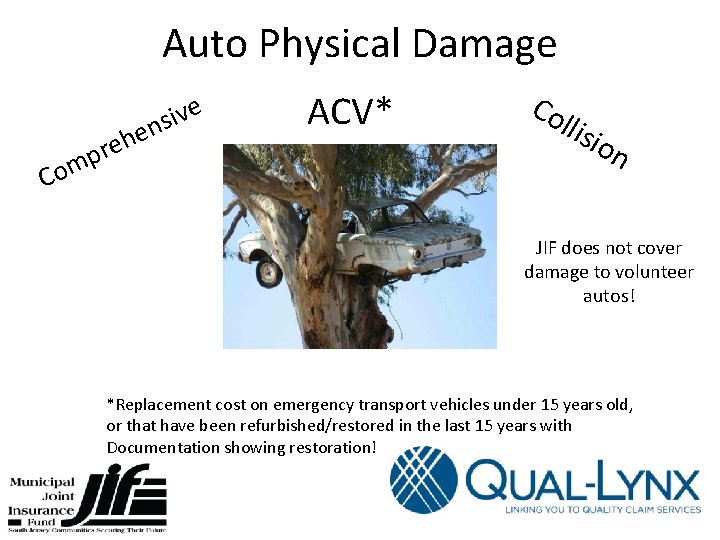
Auto Physical Damage e v i s n Com e h e pr ACV* Co llis io n JIF does not cover damage to volunteer autos! *Replacement cost on emergency transport vehicles under 15 years old, or that have been refurbished/restored in the last 15 years with Documentation showing restoration!
PROPERTY CONTACT INFORMATION Joe Lisciandri, Prop. Claims Supervisor Qual-Lynx 100 Decadon Drive Egg Harbor Township, NJ 08234 609 -653 -8400 x. 3237 Cell Phone 609 -402 -5218 Property Dedicated Fax 609 -6013192 • Eileen Stasuk, Senior Property Adjuster x 2023 estasuk@qual-lynx. com jlisciandri@qual-lynx. com • Jim Mercanto, Property Adjuster x 2102 jmercanto@qual -lynx. com
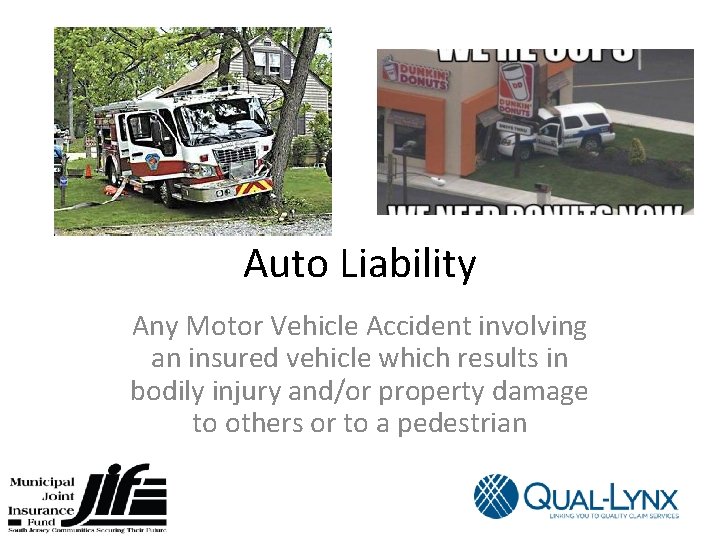
Auto Liability Any Motor Vehicle Accident involving an insured vehicle which results in bodily injury and/or property damage to others or to a pedestrian
Auto Liability • Municipal vehicle accident that causes: – Injury to others – Damage to another’s vehicle – Damage to property of others Damage to your own vehicle and employee injuries are reported separately. Refer to JIF Coverage Documents for complete description of coverage
At The Scene • NEVER admit liability • Advise will send claim into our insurance company • Gather information at the scene
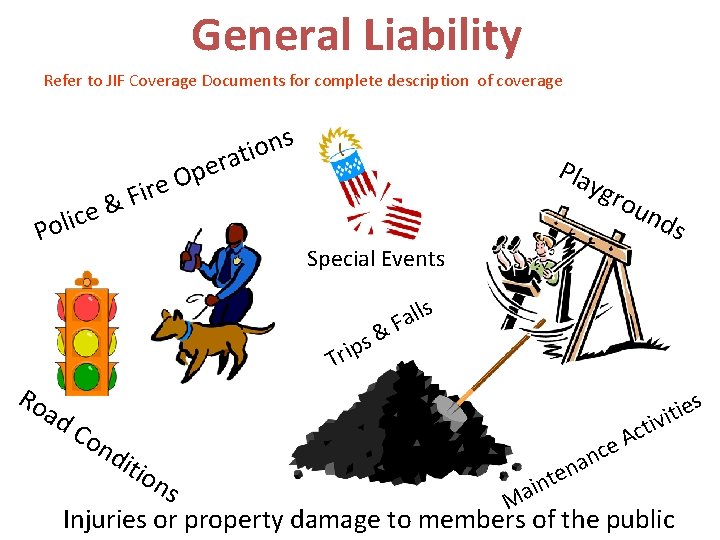
General Liability Refer to JIF Coverage Documents for complete description of coverage e c i l Po s n o i rat Pla r i F & e p O e Special Events T Ro ad Co nd s rip & ygr oun ds ls l a F s A e c an e i t i ctiv itio en t ns n i a M Injuries or property damage to members of the public
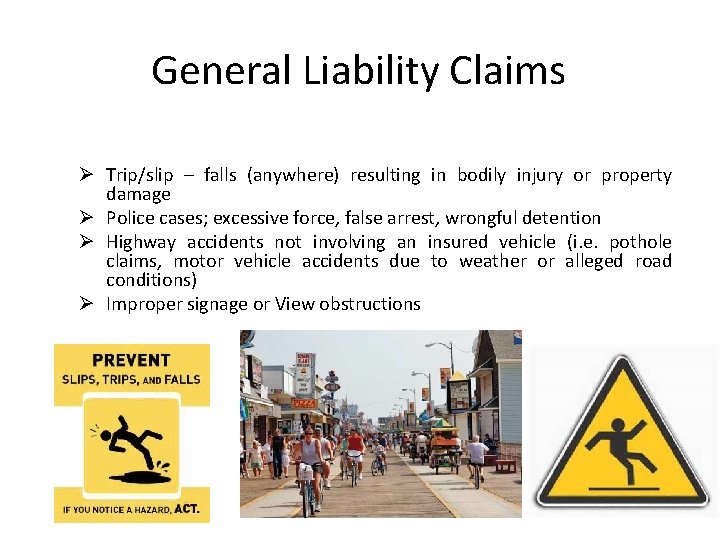
General Liability Claims Ø Trip/slip – falls (anywhere) resulting in bodily injury or property damage Ø Police cases; excessive force, false arrest, wrongful detention Ø Highway accidents not involving an insured vehicle (i. e. pothole claims, motor vehicle accidents due to weather or alleged road conditions) Ø Improper signage or View obstructions
NEW JERSEY TORT CLAIMS ACT • Also known as Title 59. • State statute that applies to all public entities in New Jersey. • The legislative response to the Supreme Court abrogating sovereign immunity in 1970. • The Act was effective July 1, 1972 and it re-establishes immunity as to negligence claims. • Sets forth the rules by which a person can pursue a municipality for civil damages.
TITLE 59 IMMUNITIES • • • Lack of prior notice (59: 4 -3) Allocation of resources (59: 2 -3) Dangerous conditions; whether “palpably unreasonable”; property must be used with due care and purpose for which it was intended (59: 4 -2) Weather; must be sole cause of loss to apply (59: 4 -7) Plan or Design (59: 4 -3) Discretionary immunity; high level policy-making and planning decisions (59: 2 -3) Inspection immunity (does not exonerate from failure to protect against a dangerous condition) (59: 2 -6) Lack of permanent injury; requires objective proof of permanent loss of a bodily function that is substantial, by objective medical evidence rather than subjective complaints by the plaintiff (59: 9 -2) Collateral source rule; all other insurance is primary (59: 9 -2) Cannot subrogate against a public entity (59: 9 -2) Unimproved land (59: 4 -8) Escape of prisoner or injuries between prisoners (59: 5 -2)
Qual-Lynx LIABILITY CONTACT Barbara Maclean, Liability Supervisor Qual-Lynx 100 Decadon Drive Egg Harbor Township, NJ 08234 bmaclean@qual-lynx 609 -653 -8400 x 2087
WORKERS’ COMPENSATION Work Related Injury/Illness JIF provides the maximum WC benefits allowed by law! 31
SOCIAL LEGISLATION • The New Jersey Workers’ Compensation Act was passed in 1911 and has been amended over the years. • Workers’ compensation is a system created by the New Jersey Legislature that provides benefits to workers’ who are injured or who contract an occupational disease while working. • Workers’ compensation is a “no fault” system. As a result, an injured worker is entitled to benefits under the Act regardless of his own negligence or that of a co-employee. 32
Workers Compensation Statutory Benefits • Any injury to one of your employees arising out of and in the course of their employment for which medical treatment is required. * • Any injury to a police, fire or rescue volunteer, or other qualified volunteer as defined in the New Jersey Workers Compensation Act that arises out of and in the course of their public duty for which medical treatment is required. * • Any alleged occupational exposure (injury occurring over a period of time as opposed to a traumatic injury). *If employee refuses medical treatment submit the claim as a “Report Only”.
WORKERS’ COMPENSATION BENEFITS There are only three remedies in the NJ system of compensation: medical benefits, temporary disability benefits and permanent disability benefits. • MEDICAL TREATMENT Ø Provide treatment with MCO panel physicians until employee is either discharged or reaches maximum medical improvement (MMI) • TEMPORARY TOTAL DISABILITY (TTD) – Wage Replacement TTD rates: Ø 2016 Maximum $871. 00 Minimum $232. 00 Ø 2017 Maximum $896. 00 Minimum $239. 00 • PERMANENT DISABILITY - EITHER PARTIAL (PPD) OR TOTAL (PTD) Ø Depending on nature of injury, extent of treatment, and residual loss of function, a percentage of disability will be negotiated between all involved parties (injured worker, TPA/JIF, attorneys, and/or the judge) Ø Settlements are paid (within JIF authority) with approval from Qual-Lynx 34
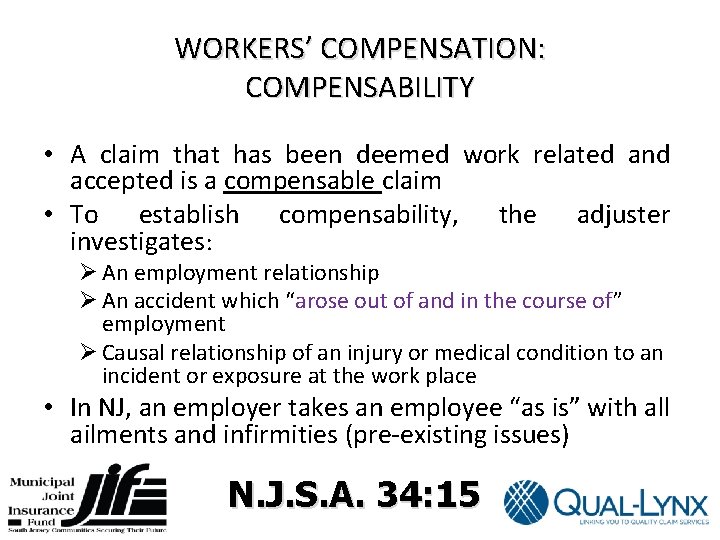
WORKERS’ COMPENSATION: COMPENSABILITY • A claim that has been deemed work related and accepted is a compensable claim • To establish compensability, the adjuster investigates: Ø An employment relationship Ø An accident which “arose out of and in the course of” employment Ø Causal relationship of an injury or medical condition to an incident or exposure at the work place • In NJ, an employer takes an employee “as is” with all ailments and infirmities (pre-existing issues) N. J. S. A. 34: 15 35
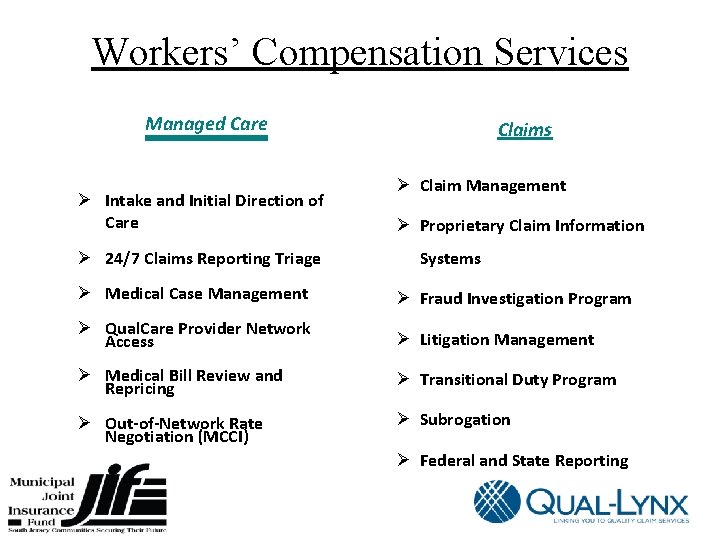
Workers’ Compensation Services Managed Care Ø Intake and Initial Direction of Care Ø 24/7 Claims Reporting Triage Claims Ø Claim Management Ø Proprietary Claim Information Systems Ø Medical Case Management Ø Fraud Investigation Program Ø Qual. Care Provider Network Access Ø Litigation Management Ø Medical Bill Review and Repricing Ø Transitional Duty Program Ø Out-of-Network Rate Negotiation (MCCI) Ø Subrogation Ø Federal and State Reporting
ROLES There are certain requirements for individual roles; however, sometimes the roles overlap. All roles have to work together! 37
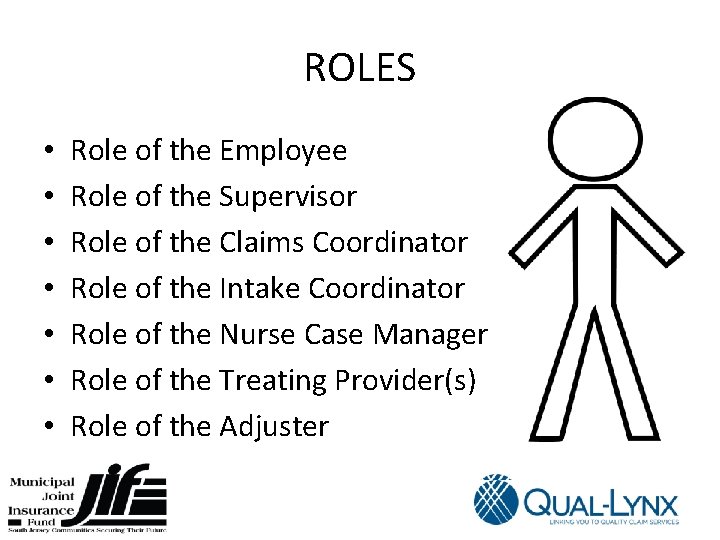
ROLES • • Role of the Employee Role of the Supervisor Role of the Claims Coordinator Role of the Intake Coordinator Role of the Nurse Case Manager Role of the Treating Provider(s) Role of the Adjuster 38
ROLE OF THE CLAIMS COORDINATOR • It is the responsibility of the Claims Coordinator to oversee the reporting of claims within the municipality and serve as a liaison between the municipality, the Claims Administrator (TPA), and the Managed Care Organization (MCO). • Early, accurate claim reporting is essential to controlling the costs associated with your Workers’ Compensation claims. 39
Timely Reporting Is Key In Workers’ Comp the Clock and Calendar are the Enemy Success is Based on Good Communication • • • Injuries are best reported and attended to early Claims reported more than three (3) days after the injury result in higher costs Immediate care from an appropriate provider equals quicker recoveries. This translates into less lost time and lower indemnity and medical costs. This enables our Nurse Case Managers to direct care to one of our EPO Providers Late reporting can lead to injuries becoming worse over time, complicating treatment and causing extra expense Late reporting makes it more difficult to determine whether the injury occurred on the job Late reporting jeopardizes the timely and thorough investigation of the claim
HOW DO I REPORT A WORKERS’ COMPENSATION CLAIM TO QUAL-LYNX? • Telephone ØWorkers’ Compensation: 888 -342 -3839 • • • Facsimile Ø Workers’ Compensation: 609 -601 -3196 Regular Mail Ø 100 Decadon Drive, Egg Harbor Township, NJ 08234 Email • If you receive a Claim Petition, immediately send it to Patty Davidson at Qual-Lynx! 41
WHEN AN EMPLOYEE IS INJURED • Show genuine concern for the injured employee’s welfare • Ensure First Aid has been administered • Do not use the emergency room unless emergency treatment is required • Direct injured employee to authorized physician • If serious or catastrophic injury, call 911 42
WHEN AN EMPLOYEE IS INJURED • Gather basic information: date, place and time of injury; how the injury occurred; type of injury; social security number; name of witnesses; etc. • Call the Intake Department at 1 -888 -342 -3839. • Tell the injured employee they will hear from an MCO representative to discuss medical care, or the TPA (an adjuster or supervisor), or both. 43
INTAKE PROCESS • Calls to the dedicated line, 888 -342 -3839, go directly to the Intake Department. • The Intake Coordinator determines who the caller is and identifies if the claim is report only or if treatment is required. • The Intake Coordinator interviews the caller to obtain the necessary information to complete the State of NJ First Report of Injury or Illness (FROI). The toll-free number is available 24 hours a day, 7 days a week! 44
Do NOT use the Emergency Room unless Emergency Treatment is Required Examples of Emergencies Ø Unconsciousness Ø Head Injury Ø Profuse bleeding Ø Unstable vital signs Ø Inability to move an extremity Ø Smoke inhalation Ø Eye trauma ****If serious or catastrophic injury, call 911****
Report Only Ø Report all incidents no matter how minor Ø Indicate “Refused Medical Treatment” Ø Tell employee that they MUST inform you if they later decide they need to see a doctor Ø Qual-Lynx will maintain a “suspense” file in case a claim for benefits later develops
REPORT ONLY vs. INCIDENT • REPORT ONLY CLAIMS Ø If the claim is for reporting purposes only, the information is entered into our systems and a claim file is generated with a Qual-Lynx claim number • MEDICAL ONLY OR LOST TIME (INDEMNITY) CLAIMS Ø The Intake Coordinator consults the MCO Nurse Case Manager Team Leader or Supervisor and/or the TPA Supervisor for direction of care. Ø If the injured worker has trauma to their head, a NCM talks to the injured party to complete a head injury checklist. This is a 13 -point questionnaire to determine if the claimant should be directed to the ER or to an Occupational Medicine Provider. Ø Once care is directed, the Intake Coordinator schedules the employee and forwards an authorization and DDI to the provider. Ø The Clinical Support Staff or NCM follows-up with the provider after the appointment to obtain the medical records and determine if further treatment is needed. The records are provided to the Adjuster for review. 47
WHEN AN EMPLOYEE IS INJURED • Gather basic information: date, place and time of injury; how the injury occurred; type of injury; social security number; name of witnesses; etc. (see FAR). • Call the Intake Department at 1 -888 -342 -3839. • Tell the injured employee they will hear from an MCO representative to discuss medical care, or the TPA (an adjuster or supervisor), or both. • After calling the Intake Department to report the claim and managed care intake process is complete, a claim number is generated and the claim is put in my Workflow. • I(or my Assistant Supervisor)reviews the claim and assigns an adjuster.
NURSE CASE MANAGEMENT TRIGGERS • Claims involving loss of 8 or more days from work • Claims involving a transitional duty designation for more than 21 days • Claims involving causality or any other initial “red flag” • Claims involving a repeat workers’ compensation claimant (case by case basis) • Claims where an MRI or other significant study is ordered, where a nurse case manager was not previously assigned • Claims not meeting any of the above criteria but at the direction of the JIF or Claims Adjuster/Supervisor
ROLE OF THE NURSE CASE MANAGER • Communication Ø Provide updated treatment plan and work status to Adjuster and Employer after every visit Ø Communicate with Injured Worker and Provider about appointments, plan of care and work status Ø Direct Clinical Support Staff to schedule appointments, therapy, or diagnostic testing for authorized services Ø Review cases with Adjuster at scheduled Large Loss Meetings or Roundtable Discussions 50
ROLE OF THE CLINICAL SUPPORT STAFF • Clinical Support Staff provide support to the Nursing Team and Medical Only Adjusters by performing necessary clerical duties. Schedules medical appointments Schedules initial physical therapy evaluation Schedules diagnostic studies Obtains and distributes medical notes and diagnostic reports Enters pre-authorizations for when treatment is authorized by the NCM or Medical Only Adjuster Ø Faxes pre-cert and Duty Determination Instruction (DDI) form to providers Ø Ø Ø 51
EPO – Exclusive Provider Organization • We have the largest provider network in New Jersey. • What do we hope to accomplish? Ø Ø Ø Ø Best of the best docs and facilities Preferred pricing Preferred service Providers Knowledgeable about Workers’ Compensation Communication Outcomes/Savings Quicker Return to Work Lower Cost 52
ROLE OF THE WC CLAIMS ADJUSTER • Once the claim is assigned, the adjuster must: Ø Contact the injured employee (for Lost Time cases only), employer, and nurse case manager or medical provider within 48 hours Ø Secure factual information to determine “compensability” Ø Review file for possible subrogation Ø Monitor medical treatment with assistance from a MCO representative to pursue a timely return to work, address causal relationship issues, and final discharge or MMI Ø Explore the possibility of transitional duty with the municipality Ø If employee is out of work, adjuster will verify the employee’s wages and obtain a 26 week wage statement. Once wages are verified, the adjuster will process wage replacement (TTD) checks, payable as directed by the employer Ø Adjuster will secure an increase in payment authority (if more than $10 K is needed) from the JIF Executive Committee to pay all benefits, expenses, and legal associated with the claim Ø Monitor litigation if a claim petition is filed 53
EMPLOYER CONTACT • • • Verify injured employee’s job description Confirm date of hire Confirm work schedule/number of hours worked per week Did the injured employee lose any time from work? If yes, what was the first day out of work? Has the injured employee returned to work? Does the municipality have transitional duty available? Confirm the dates of disability and wages Obtain 26 week wage statement (date of injury back 26 weeks) Has the injured worker had any prior work injuries? Keep employer/insured updated on medical status 54
EMPLOYEE CONTACT • Verify to whom the injured employee reported the work injury • Obtain employee’s medical history • If claim was reported late, why? • Confirm facts of the incident; how occurred; where occurred; any witnesses • Confirm employment • Question injuries received and mechanics of injury • Question previous injuries • Does the injured employee have a second job or any side jobs? • Confirm the name and address of the employee’s family physician • Does the employee have any questions? 55
ROLE OF THE SUPERVISOR • Maintain contact with the injured employee by periodically contacting them and express support. • The main reason injured employees retain lawyers is because they are uncertain of their benefits or concerned that they are not receiving adequate medical treatment. • Determine the “root cause” of the accident. 56
SUPERVISOR’S INCIDENT REPORT Root Cause Analysis • Immediately have the Supervisor’s Incident Report completed • Make certain the injured employee provides a detailed description of how the injury occurred: Ø Slip/Trip – what caused the fall; ice, water, waxed surface, electric cord, raised sidewalk, etc. ? Ø Fall from height – ladder, truck, height? Ø Fall forward, backward, strike body part; which body parts? Ø Defective equipment? Ø Where did injury occur (employer’s premises or private/ commercial venue)? 57
SUPERVISOR’S INCIDENT REPORT Did the supervisor physically inspect the location of injury? Any unsafe or unusual hazards present? Did employee alter equipment being used? Evidence of horseplay, intoxication, drug use? Was employer provided safety equipment in use? If yes, was it being used properly? • Any suspicions about how the accident/injury occurred? • Are you satisfied the accident/injury occurred as the employee described? • • •
RED FLAGS § Reported Late § Specific Details Cannot Be Recalled § Accident Not Witnessed § Secondary Employment § Incident Occurs Following Day(s) Off § Witness Accounts Inconsistent With Employee’s Version § Fails To Attend Appointments § Not Home When Tried To Be Reached or During GOTCHA Calls 59
60
TRANSITIONAL DUTY Studies have shown that many injured employees are capable of assuming their full responsibilities at an earlier date if they start a transitional plan before reaching MMI • Nurses and Adjusters remind providers of availability • Doctor evaluates the injured worker for capability and sets forth work restrictions • Employer is notified • Employer determines availability • Second Effort • Employer informs employee outlining alternative duty and sets a time for re-evaluation (not open-ended) • Employee re-evaluated at next provider visit • Transitional duty either continues or the employee is returned to full duty 61
About Transitional Duty • Serves as a “bridge” to full duty • Cuts down on need for replacement employees • Has positive psychological effects Pays off for you and employee Repeated studies have shown that the longer a worker is off the job, the less likely it is that he or she will ever come back. 62
More About Transitional Duty • Transitional Duty Policy • Educate supervisors, employees, physicians, and claims adjusters. • Spell out “temporary” nature of assignment • Have physician describe physical limitations Work with your safety and claims professionals to develop your modified duty or early return to work program. 63
G. O. T. C. H. A. Go Out To Check Home Activities • This investigative tool is invaluable in terms of cost containment. Investigators conduct unannounced, personal visits to each “lost time” claimant if the injured worker is out of work more than 14 days (or three weeks after surgery). • The opportunity to interview injured workers in their homes provides us with detailed information to support telephonic investigation. These visits confirm or deny the existence of malingering or fraudulent activity, and often highlight other factors that may inhibit a claimant’s timely return to work. In addition, a GOTCHA visit can lead to surveillance, if warranted. 64
G. O. T. C. H. A. Program Go Out To Check Home Activities Ø Backup verification of treatment, therapy, or surgery schedules. Ø Visits heighten the employee's awareness that their recovery and their claim are being monitored. Ø Investigator can detect "red flags" at home, which may not be apparent when personal contact has been made under other circumstances. Ø Visits strengthen the network of contact and reassures the claimant that the employer cares about his/her recovery and return to work Ø Unannounced visits may encourage an employee on the verge of recovery to get into the "return to work" mind set. Surveillance will be ordered, if necessary.
MMI Maximum Medical Improvement • Maximum medical improvement (MMI): Concept is when an employee is as fully restored as the nature of the injury will allow. • Alternate terms for MMI include “medical plateau, ” “as good as you’re going to get” (not cured, not healed, not good as new – none of those things), “employee’s condition is not expected to improve any further. ” • MMI is very important. It is the bright line that takes us from medical and temporary disability issues to permanency issues. • MMI on Day One does not mean MMI on Day 120. • The MMI opinion from the treating physician is only good on the date it was given. 66
LITIGATION • • WHAT IS A CLAIM PETITION PERMANENCY EVALUATION JUDGE OF WORKERS’ COMPENSATION SETTLEMENTS Ø ORDER APROVING SETTLEMENT Ø SECTION 20 DISMISSAL • Once award is paid, file will be closed • Employee has 2 years from date of last benefit payment to reopen, unless dismissed
IF A CLAIM PETITION IS FILED • If the Member receives a Claim Petition (CP) it should be immediately forwarded to Patty Davidson via email pdavidson@qual-lynx. com or facsimile 609 -601 -3164. • If a CP is filed, the adjuster will notify the Fund Commissioner to advise of the CP and to confirm work status. • Adjuster will send CP, copy of the file, and an assignment letter directly to a panel approved defense counsel who will file the appropriate answer. • Adjuster will maintain contact with defense attorney for claim resolution (additional investigation, permanency evaluations, settlement negotiations). • Adjuster will secure appropriate authority from the JIF Executive Committee for settlements beyond its’ authority level.
WHEN DOES A WORKERS’ COMPENSATION CASE END? • If no Claim Petition is filed: Ø Confirm all authorized treatment has concluded Ø MMI obtained Ø RTW established and employee is back at work or unable to work due to permanent restrictions Ø All outstanding medical bills that Qual-Lynx has received have been paid Ø Confirm there is no potential for subrogation Ø File is then closed (the injured employee has two years from the date of last benefit to reopen their claim) • If a Claim Petition is filed: litigation commences
Recording and Reporting of Occupational Injuries and Illnesses OSHA 300 Ø All public employers must maintain records of all workrelated injuries or illnesses Ø Report all fatalities or employee hospitalization within 8 hours Ø (800) 624 -1644 Contact JIF Safety Director for additional details or assistance.
Helpful Hints • Be sure to keep a copy of all information sent to Scibal to • • Qual-Lynx Whenever an employee approaches you regarding workers compensation benefits for an alleged injury, immediately report the claim to Qual-Lynx using the toll free telephone number and complete the Supervisor’s Incident Reporting the claim to Qual-Lynx does not automatically make the employee eligible for benefits. Any time you feel there are questionable circumstances surrounding the claim, contact Qual-Lynx immediately. Call in Workers Compensation claims to Qual-Lynx as quickly as possible (preferably the day they are reported to you), whether treatment is needed or not. If there is an accident (near miss) involving one of your employees which does not require medical care, a Supervisor’s Incident Report should still be completed and kept at the municipality for record purposes.
COMMUNICATION ü Employee ü Adjuster ü Nurse Case Manager ü Treating Provider(s) ü Clinical Support Staff ü Claims Coordinator ü Supervisor We’re all in this together! 72
Qual-Lynx WC CONTACT 100 Decadon Drive, Egg Harbor Township, NJ 08234 Patty Davidson, WC Supervisor pdavidson@qual-lynx. com 609 -653 -8400 x 2104 Tammy Langsdorf, WC Assistant Supervisor tlangsdorf@qual-lynx. com 609 -653 -8400 x 2097 73
Qual-Lynx MCO CONTACT 100 Decadon Drive, Egg Harbor Township, NJ 08234 Karen Beatty, Client Services Manager kbeatty@qual-lynx. com * 609 -653 -8400 x 3201 Peggy Holmes, NCM Team Supervisor pholmes@qual-lynx. com * 609 -653 -8400 x 3210 Russ Bayer, NCM Team Leader rbayer@qual-lynx. com * 609 -653 -8400 x 3204 74

QUESTIONS? ? ?
- Slides: 75