
Jetstream 31 J 31 in INTEXBMILAGRO Science Goals

Jetstream 31 (J 31) in INTEX-B/MILAGRO: Science Goals, Objectives, and Required Flight Patterns Phil Russell, Jens Redemann, Peter Pilewskie, Brian Cairns, Charles Gatebe, Michael King Portions presented at MILAGRO (MIRAGE-Mex/MCMA 2006/MAX-Mex) and INTEX-B Joint Science Teams Meeting 24 -28 October 2005, Boulder, Colorado
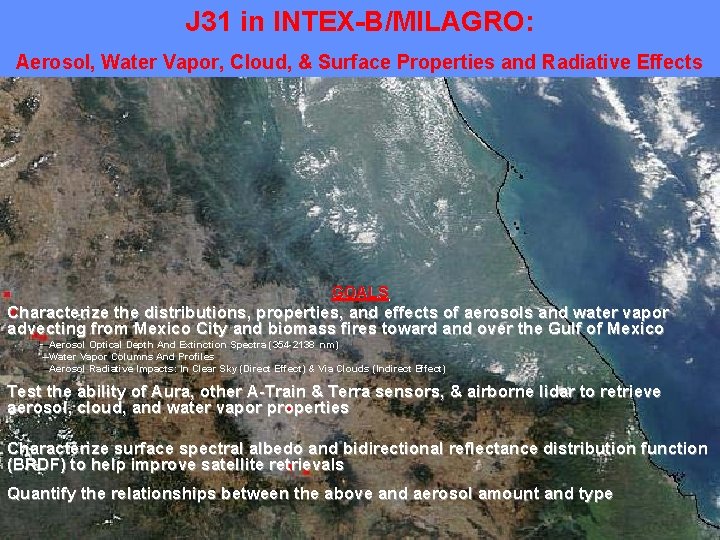
J 31 in INTEX-B/MILAGRO: Aerosol, Water Vapor, Cloud, & Surface Properties and Radiative Effects GOALS Characterize the distributions, properties, and effects of aerosols and water vapor advecting from Mexico City and biomass fires toward and over the Gulf of Mexico –Aerosol Optical Depth And Extinction Spectra (354 -2138 nm) –Water Vapor Columns And Profiles –Aerosol Radiative Impacts: In Clear Sky (Direct Effect) & Via Clouds (Indirect Effect) Test the ability of Aura, other A-Train & Terra sensors, & airborne lidar to retrieve aerosol, cloud, and water vapor properties Characterize surface spectral albedo and bidirectional reflectance distribution function (BRDF) to help improve satellite retrievals Quantify the relationships between the above and aerosol amount and type

J 31 in INTEX-B/MILAGRO: Payload Ames Airborne Tracking Sunphotometer (AATS) Solar Spectral Flux Radiometer (SSFR) Research Scanning Polarimeter (RSP) Position & Orientation System (POS) Cloud Absorption Radiometer (CAR) 3 Met Sensors & Nav/Met Data System 10/2/2020
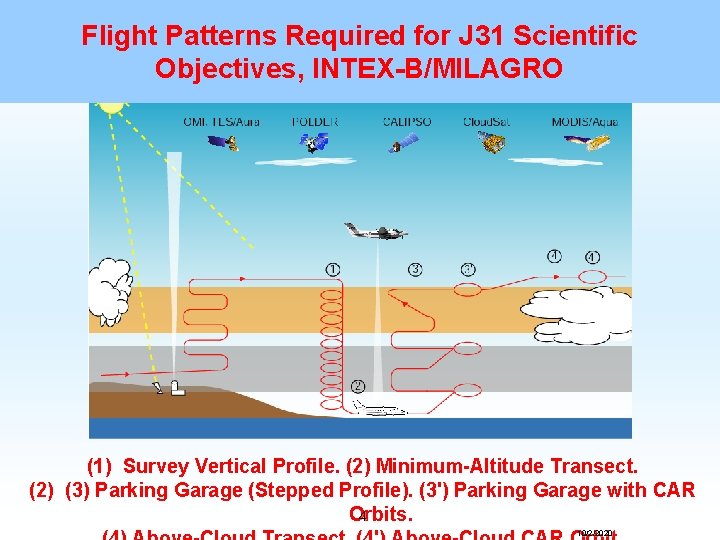
Flight Patterns Required for J 31 Scientific Objectives, INTEX-B/MILAGRO (1) Survey Vertical Profile. (2) Minimum-Altitude Transect. (2) (3) Parking Garage (Stepped Profile). (3') Parking Garage with CAR Orbits. 4 10/2/2020
J 31 Science Objectives by Sensor AATS • • • 1. Independent of other J 31 sensors Characterize horizontal & vertical distributions of aerosol optical depth (AOD) and extinction spectra (354 -2138 nm), water vapor columns and density Validate A-Train & Terra products (CALIPSO, OMI, MODIS, POLDER, TES, AIRS, MISR) Test closure with remote and in situ sensors on other platforms, including airborne lidar Test chemical transport models using AOD & extinction profiles Assess regional aerosol radiative effects SSFR • • • Retrieve cloud droplet radius, optical depth, and liquid water path Compare with satellite retrievals (MODIS) and remote & in situ sensors on the surface and other aircraft (incl. microwave, radar, optics, etc. ) Compare spectral irradiance from SSFR to that from 3 -d model using MODIS input Provide surface spectral albedo to help improve satellite aerosol retrievals Determine column solar radiative boundary conditions for modeling 5 studies 10/2/2020
J 31 Science Objectives by Sensor 1. Independent of other J 31 sensors RSP • • • Estimate direct and indirect effects of aerosols on radiative forcing of climate Evaluate aerosol and cloud retrieval algorithms for the NASA Glory mission Aerosol Polarimetry Sensor. Validate aerosol and cloud products from A-train & Terra (MODIS, MISR, POLDER on Parasol, OMI, CLOUDSAT) CAR • • • Measure bidirectional reflectance distribution function (BRDF) for variety of surfaces (e. g. , urban center, ocean, cloud, uniformly vegetated soil) at different sun angles & altitudes Retrieve BRDF and aerosol properties by combining CAR with AERONET Validate satellites and inter-compare with in-situ measurements (size distribution, SSA, albedo, etc. ) 6 10/2/2020
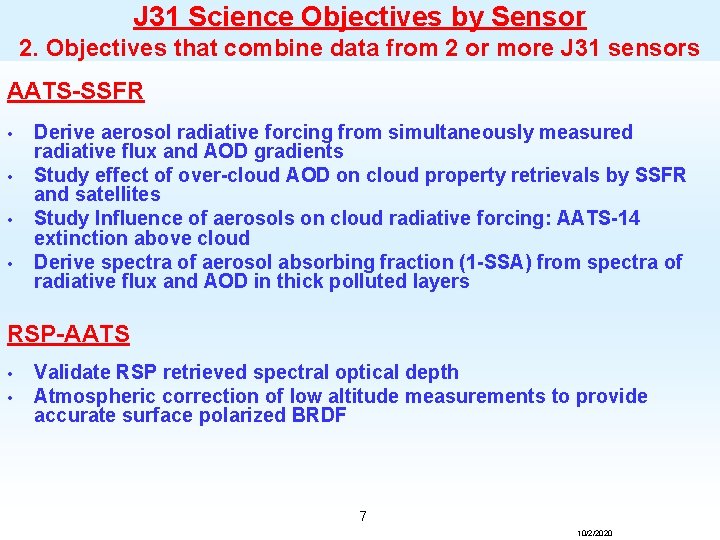
J 31 Science Objectives by Sensor 2. Objectives that combine data from 2 or more J 31 sensors AATS-SSFR • • Derive aerosol radiative forcing from simultaneously measured radiative flux and AOD gradients Study effect of over-cloud AOD on cloud property retrievals by SSFR and satellites Study Influence of aerosols on cloud radiative forcing: AATS-14 extinction above cloud Derive spectra of aerosol absorbing fraction (1 -SSA) from spectra of radiative flux and AOD in thick polluted layers RSP-AATS • • Validate RSP retrieved spectral optical depth Atmospheric correction of low altitude measurements to provide accurate surface polarized BRDF 7 10/2/2020
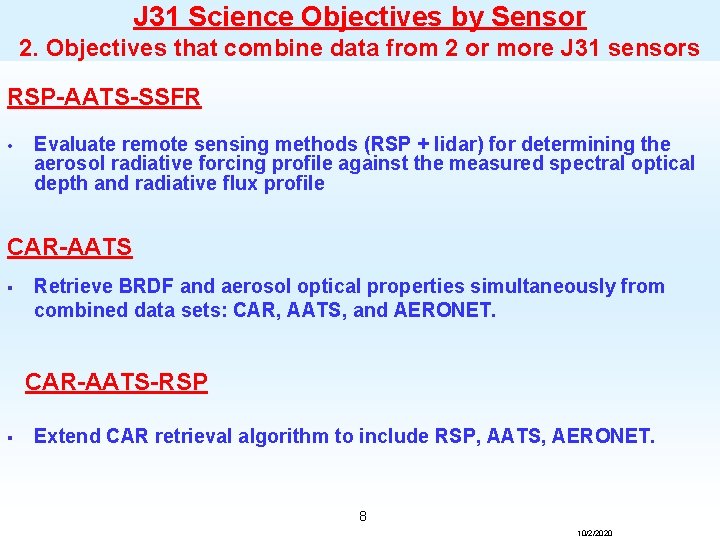
J 31 Science Objectives by Sensor 2. Objectives that combine data from 2 or more J 31 sensors RSP-AATS-SSFR • Evaluate remote sensing methods (RSP + lidar) for determining the aerosol radiative forcing profile against the measured spectral optical depth and radiative flux profile CAR-AATS § Retrieve BRDF and aerosol optical properties simultaneously from combined data sets: CAR, AATS, and AERONET. CAR-AATS-RSP § Extend CAR retrieval algorithm to include RSP, AATS, AERONET. 8 10/2/2020

Flight Patterns Required for J 31 Scientific Objectives, INTEX-B/MILAGRO (1) Survey Vertical Profile. (2) Minimum-Altitude Transect. (2) (3) Parking Garage (Stepped Profile). (3') Parking Garage with CAR Orbits. 9 10/2/2020
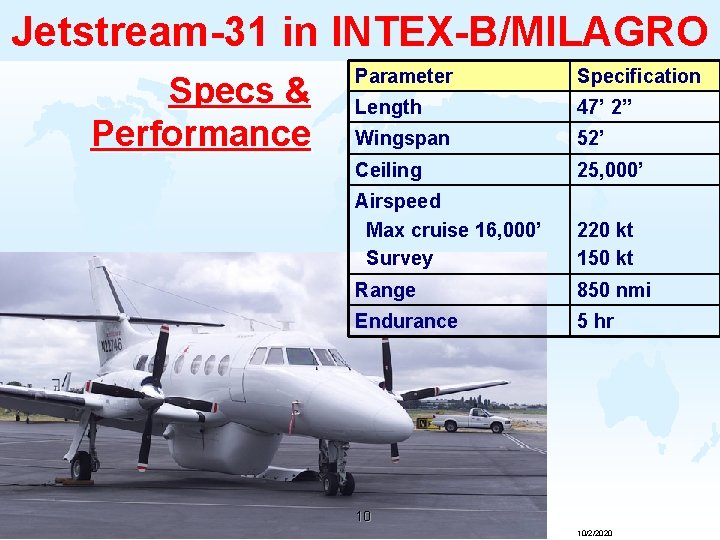
Jetstream-31 in INTEX-B/MILAGRO Specs & Performance Parameter Specification Length 47’ 2” Wingspan 52’ Ceiling 25, 000’ Airspeed Max cruise 16, 000’ Survey 220 kt 150 kt Range 850 nmi Endurance 5 hr 10 10/2/2020
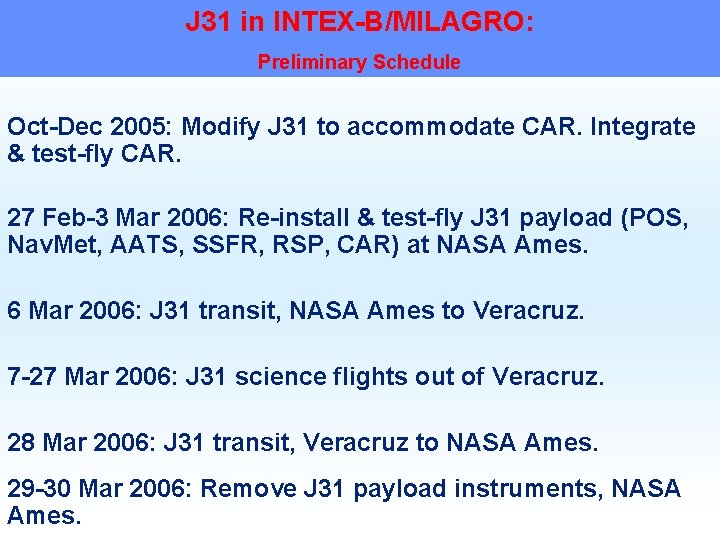
J 31 in INTEX-B/MILAGRO: Preliminary Schedule Oct-Dec 2005: Modify J 31 to accommodate CAR. Integrate & test-fly CAR. 27 Feb-3 Mar 2006: Re-install & test-fly J 31 payload (POS, Nav. Met, AATS, SSFR, RSP, CAR) at NASA Ames. 6 Mar 2006: J 31 transit, NASA Ames to Veracruz. 7 -27 Mar 2006: J 31 science flights out of Veracruz. 28 Mar 2006: J 31 transit, Veracruz to NASA Ames. 29 -30 Mar 2006: Remove J 31 payload instruments, NASA Ames.

End of Presentation Remainder of Slides are Backup 12 10/2/2020
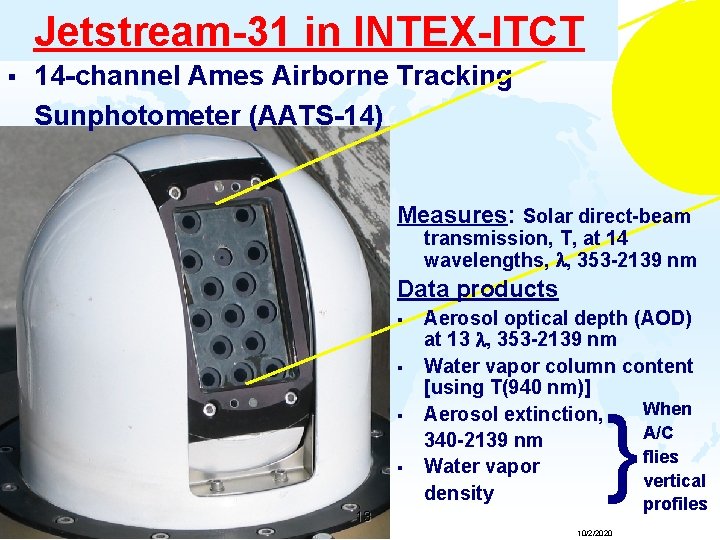
Jetstream-31 in INTEX-ITCT § 14 -channel Ames Airborne Tracking Sunphotometer (AATS-14) Measures: Solar direct-beam transmission, T, at 14 wavelengths, l, 353 -2139 nm Data products § § Aerosol optical depth (AOD) at 13 l, 353 -2139 nm Water vapor column content [using T(940 nm)] When Aerosol extinction, A/C 340 -2139 nm flies Water vapor vertical density } 13 10/2/2020 profiles
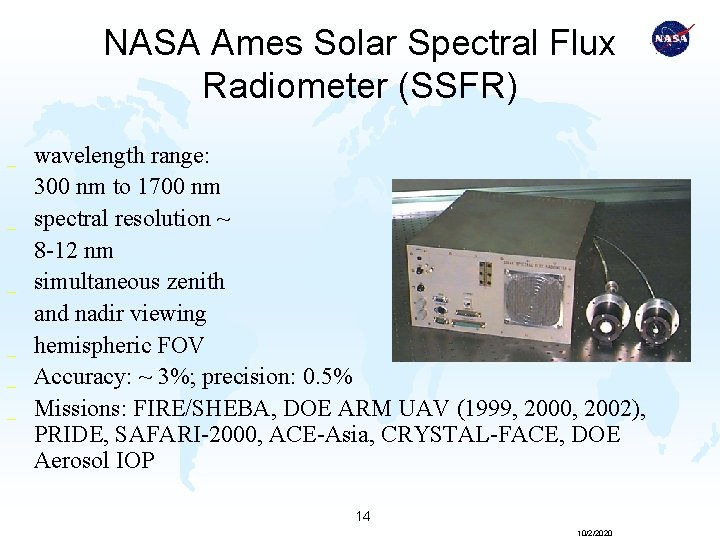
NASA Ames Solar Spectral Flux Radiometer (SSFR) _ _ _ wavelength range: 300 nm to 1700 nm spectral resolution ~ 8 -12 nm simultaneous zenith and nadir viewing hemispheric FOV Accuracy: ~ 3%; precision: 0. 5% Missions: FIRE/SHEBA, DOE ARM UAV (1999, 2000, 2002), PRIDE, SAFARI-2000, ACE-Asia, CRYSTAL-FACE, DOE Aerosol IOP 14 10/2/2020
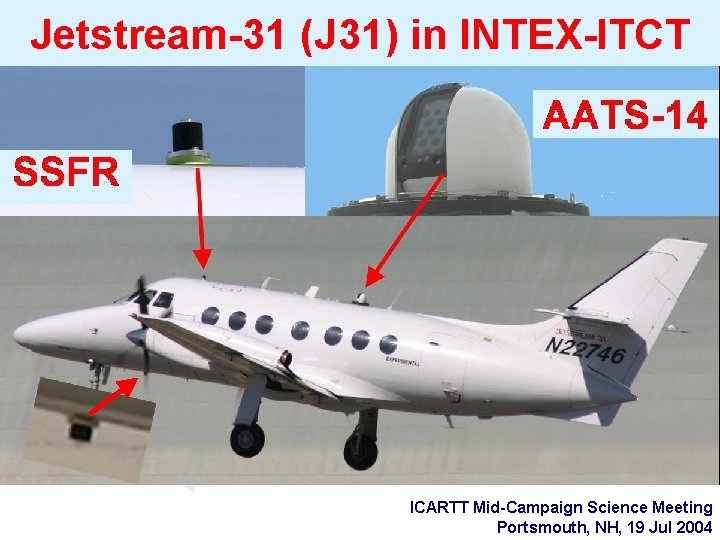
Jetstream-31 (J 31) in INTEX-ITCT ICARTT Mid-Campaign Science Meeting Portsmouth, NH, 19 Jul 2004
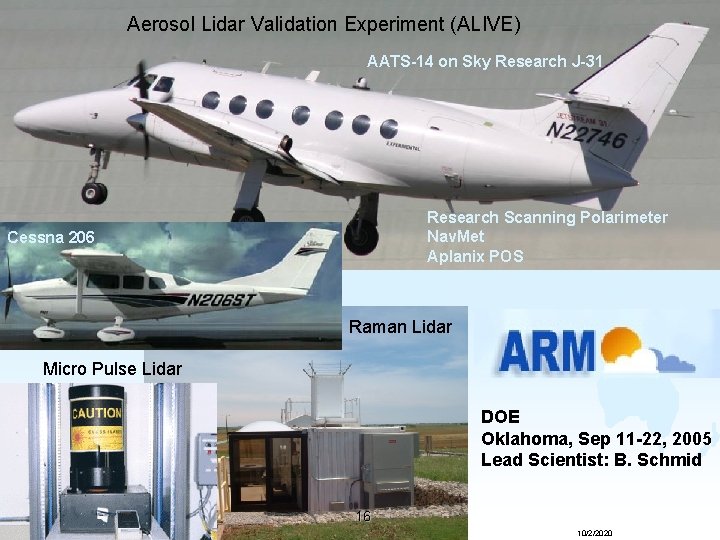
Aerosol Lidar Validation Experiment (ALIVE) AATS-14 on Sky Research J-31 Research Scanning Polarimeter Nav. Met Aplanix POS Cessna 206 Raman Lidar Micro Pulse Lidar DOE Oklahoma, Sep 11 -22, 2005 Lead Scientist: B. Schmid 16 10/2/2020
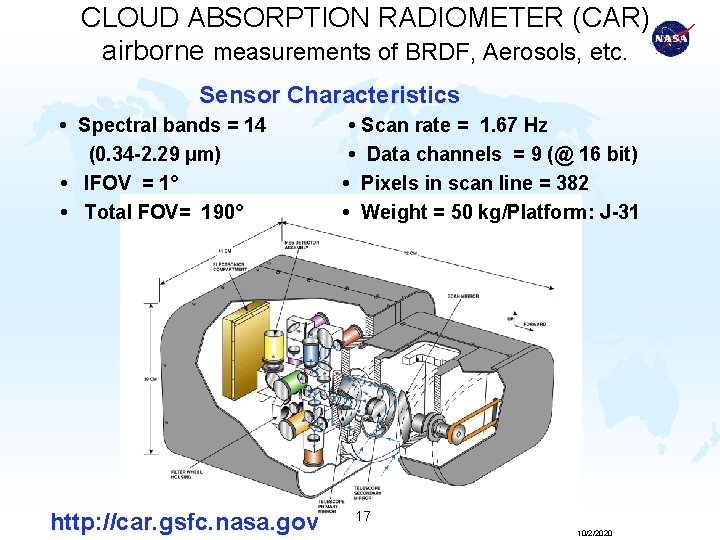
CLOUD ABSORPTION RADIOMETER (CAR) airborne measurements of BRDF, Aerosols, etc. Sensor Characteristics • Spectral bands = 14 (0. 34 -2. 29 µm) • IFOV = 1° • Total FOV= 190° http: //car. gsfc. nasa. gov • Scan rate = 1. 67 Hz • Data channels = 9 (@ 16 bit) • Pixels in scan line = 382 • Weight = 50 kg/Platform: J-31 17 10/2/2020
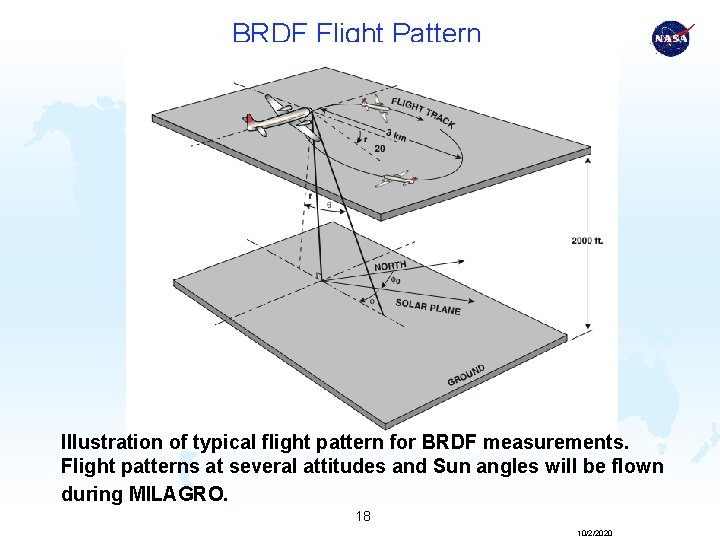
BRDF Flight Pattern Illustration of typical flight pattern for BRDF measurements. Flight patterns at several attitudes and Sun angles will be flown during MILAGRO. 18 10/2/2020
- Slides: 18