
Jetstream 31 J 31 in INTEXBMILAGRO Campaign Context
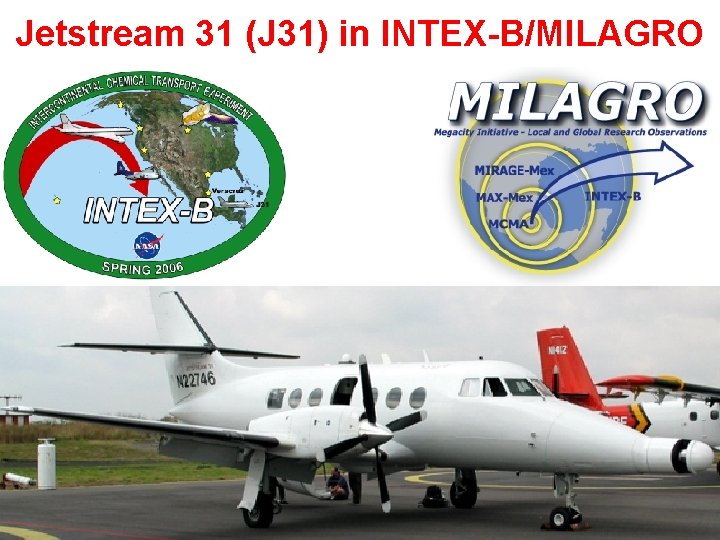
Jetstream 31 (J 31) in INTEX-B/MILAGRO

Campaign Context: In March 2006, INTEX-B/MILAGRO studied pollution from Mexico City and regional biomass burning, including sources, transport, transformations, and effects. MILAGRO included many measurements in and downwind of Mexico City, 5 A/C based in Veracruz, MX and 1 in Houston, TX.

Campaign Context: In March 2006, INTEX-B/MILAGRO studied pollution from Mexico City and regional biomass burning, including sources, transport, transformations, and effects. MILAGRO included many measurements in and downwind of Mexico City, 5 A/C based in Veracruz, MX and 1 in Houston, TX. J 31 Overview: For INTEX-B/MILAGRO the J 31 was equipped to measure solar energy and how that energy is affected by the above pollution and Earth's surfaces.
Because solar energy drives Earth's climate, the J 31 suite of measurements helps show changing atmospheric and surface properties can change the climate
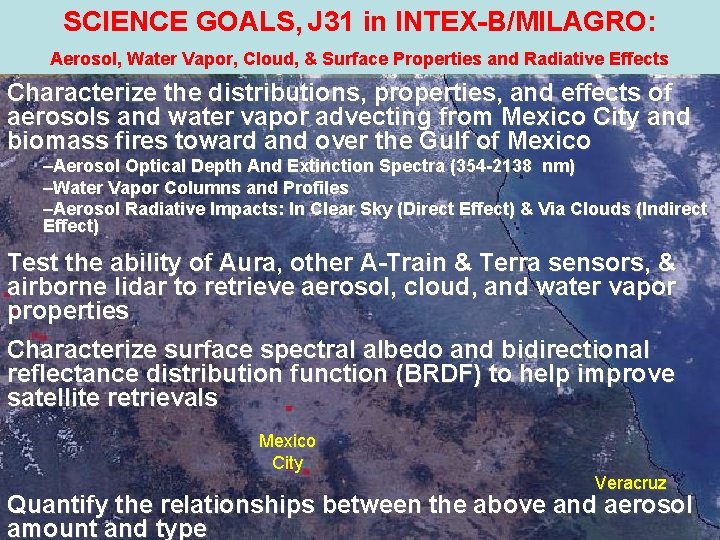
SCIENCE GOALS, J 31 in INTEX-B/MILAGRO: Aerosol, Water Vapor, Cloud, & Surface Properties and Radiative Effects Characterize the distributions, properties, and effects of aerosols and water vapor advecting from Mexico City and biomass fires toward and over the Gulf of Mexico –Aerosol Optical Depth And Extinction Spectra (354 -2138 nm) –Water Vapor Columns and Profiles –Aerosol Radiative Impacts: In Clear Sky (Direct Effect) & Via Clouds (Indirect Effect) Test the ability of Aura, other A-Train & Terra sensors, & airborne lidar to retrieve aerosol, cloud, and water vapor properties Characterize surface spectral albedo and bidirectional reflectance distribution function (BRDF) to help improve satellite retrievals Mexico City Veracruz Quantify the relationships between the above and aerosol amount and type
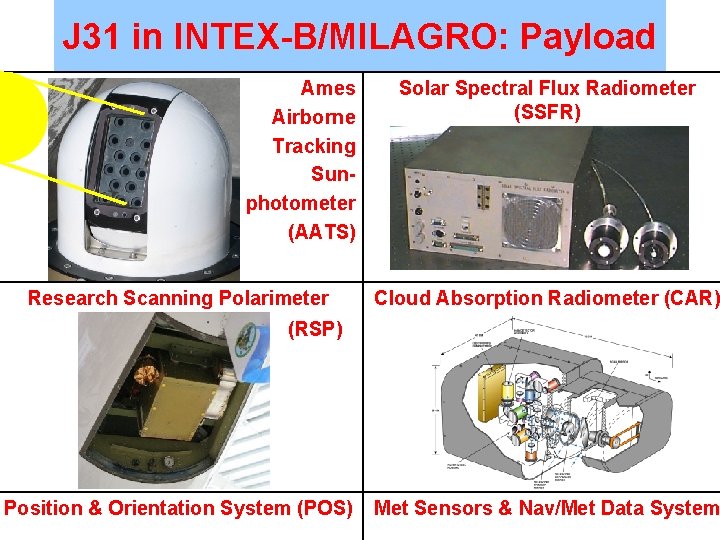
J 31 in INTEX-B/MILAGRO: Payload Ames Airborne Tracking Sunphotometer (AATS) Research Scanning Polarimeter (RSP) Position & Orientation System (POS) Solar Spectral Flux Radiometer (SSFR) Cloud Absorption Radiometer (CAR) Met Sensors & Nav/Met Data System
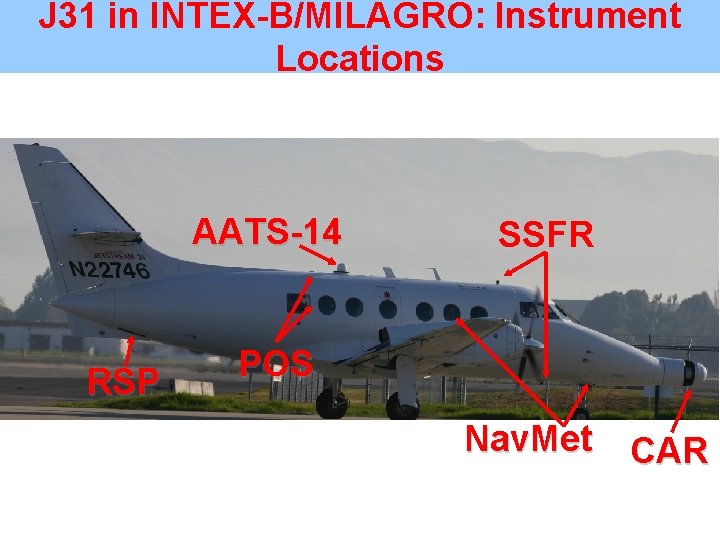
J 31 in INTEX-B/MILAGRO: Instrument Locations AATS-14 RSP SSFR POS Nav. Met CAR
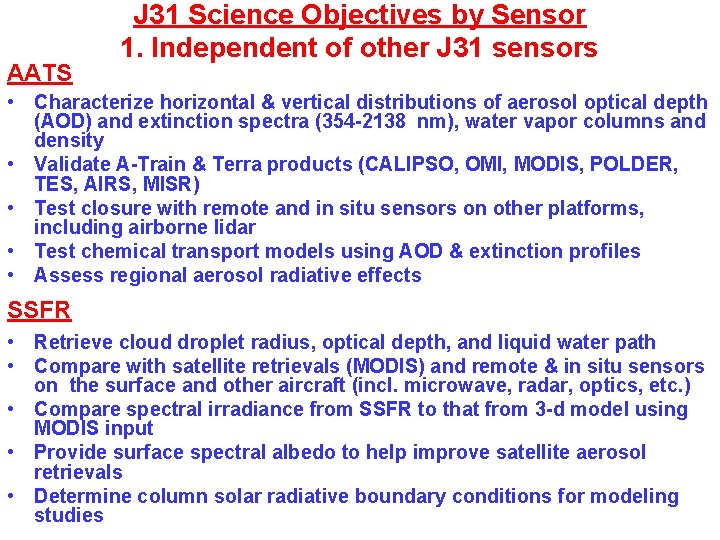
AATS J 31 Science Objectives by Sensor 1. Independent of other J 31 sensors • Characterize horizontal & vertical distributions of aerosol optical depth (AOD) and extinction spectra (354 -2138 nm), water vapor columns and density • Validate A-Train & Terra products (CALIPSO, OMI, MODIS, POLDER, TES, AIRS, MISR) • Test closure with remote and in situ sensors on other platforms, including airborne lidar • Test chemical transport models using AOD & extinction profiles • Assess regional aerosol radiative effects SSFR • Retrieve cloud droplet radius, optical depth, and liquid water path • Compare with satellite retrievals (MODIS) and remote & in situ sensors on the surface and other aircraft (incl. microwave, radar, optics, etc. ) • Compare spectral irradiance from SSFR to that from 3 -d model using MODIS input • Provide surface spectral albedo to help improve satellite aerosol retrievals • Determine column solar radiative boundary conditions for modeling studies
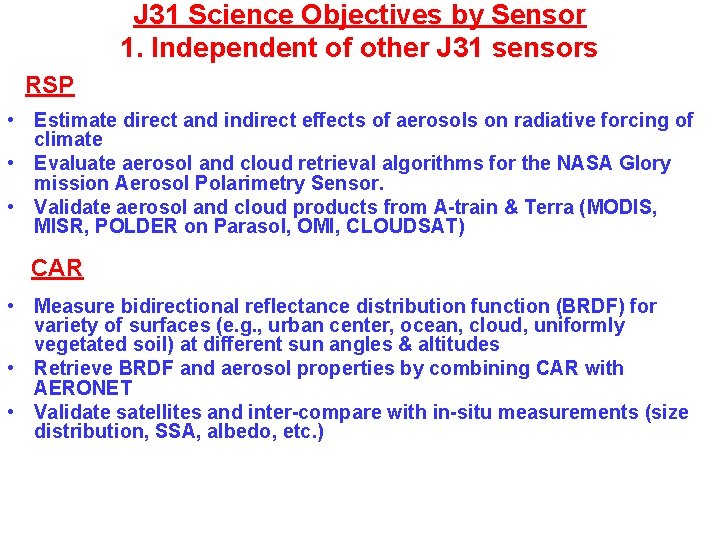
J 31 Science Objectives by Sensor 1. Independent of other J 31 sensors RSP • Estimate direct and indirect effects of aerosols on radiative forcing of climate • Evaluate aerosol and cloud retrieval algorithms for the NASA Glory mission Aerosol Polarimetry Sensor. • Validate aerosol and cloud products from A-train & Terra (MODIS, MISR, POLDER on Parasol, OMI, CLOUDSAT) CAR • Measure bidirectional reflectance distribution function (BRDF) for variety of surfaces (e. g. , urban center, ocean, cloud, uniformly vegetated soil) at different sun angles & altitudes • Retrieve BRDF and aerosol properties by combining CAR with AERONET • Validate satellites and inter-compare with in-situ measurements (size distribution, SSA, albedo, etc. )
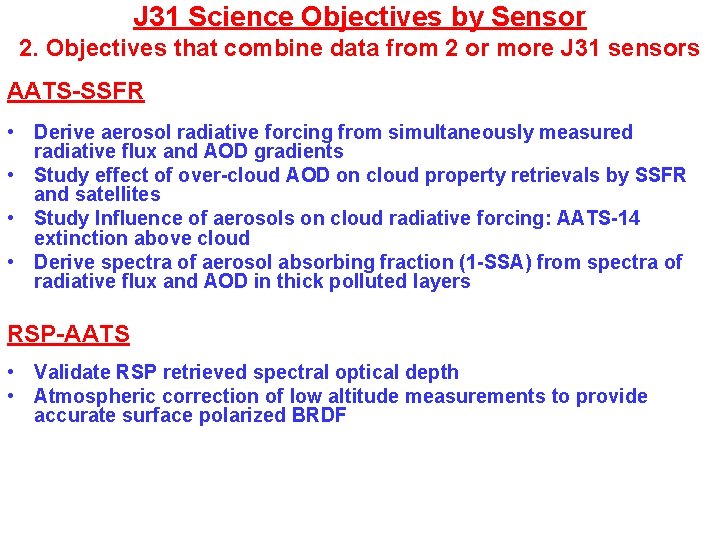
J 31 Science Objectives by Sensor 2. Objectives that combine data from 2 or more J 31 sensors AATS-SSFR • Derive aerosol radiative forcing from simultaneously measured radiative flux and AOD gradients • Study effect of over-cloud AOD on cloud property retrievals by SSFR and satellites • Study Influence of aerosols on cloud radiative forcing: AATS-14 extinction above cloud • Derive spectra of aerosol absorbing fraction (1 -SSA) from spectra of radiative flux and AOD in thick polluted layers RSP-AATS • Validate RSP retrieved spectral optical depth • Atmospheric correction of low altitude measurements to provide accurate surface polarized BRDF
J 31 Science Objectives by Sensor 2. Objectives that combine data from 2 or more J 31 sensors RSP-AATS-SSFR • Evaluate remote sensing methods (RSP + lidar) for determining the aerosol radiative forcing profile against the measured spectral optical depth and radiative flux profile CAR-AATS § Retrieve BRDF and aerosol optical properties simultaneously from combined data sets: CAR, AATS, and AERONET. CAR-AATS-RSP § Extend CAR retrieval algorithm to include RSP, AATS, AERONET.
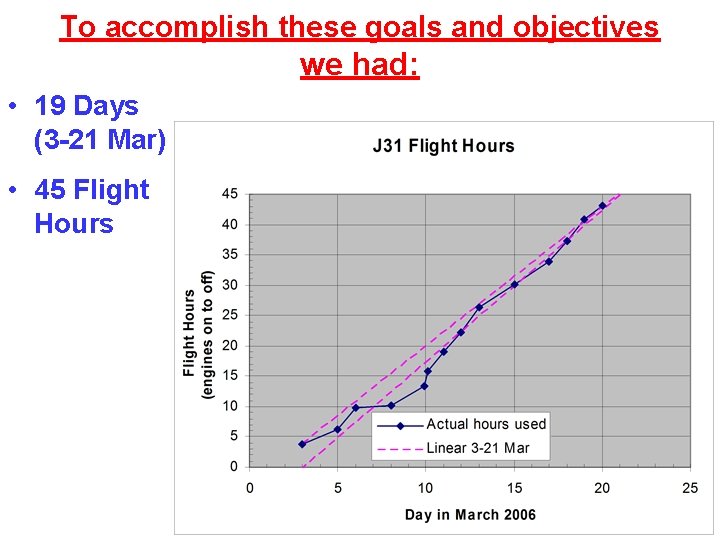
To accomplish these goals and objectives we had: • 19 Days (3 -21 Mar) • 45 Flight Hours
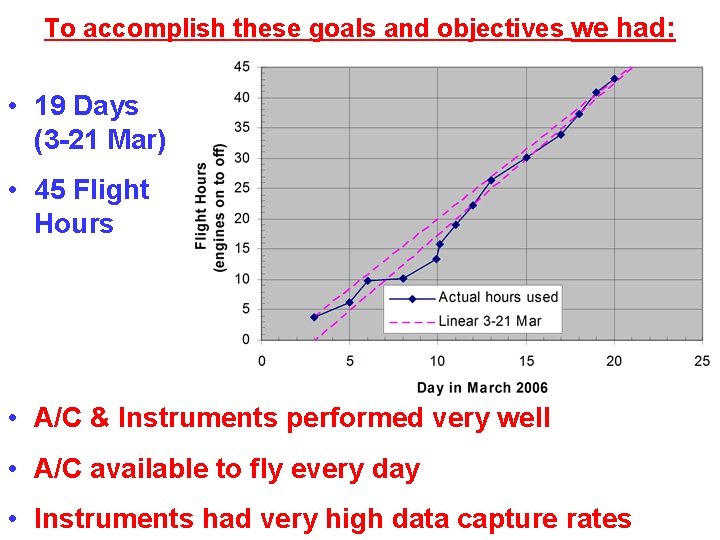
To accomplish these goals and objectives we had: • 19 Days (3 -21 Mar) • 45 Flight Hours • A/C & Instruments performed very well • A/C available to fly every day • Instruments had very high data capture rates
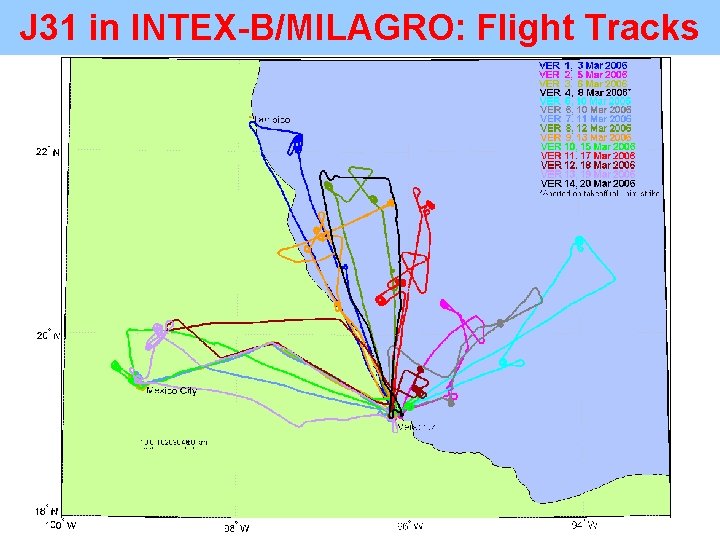
J 31 in INTEX-B/MILAGRO: Flight Tracks
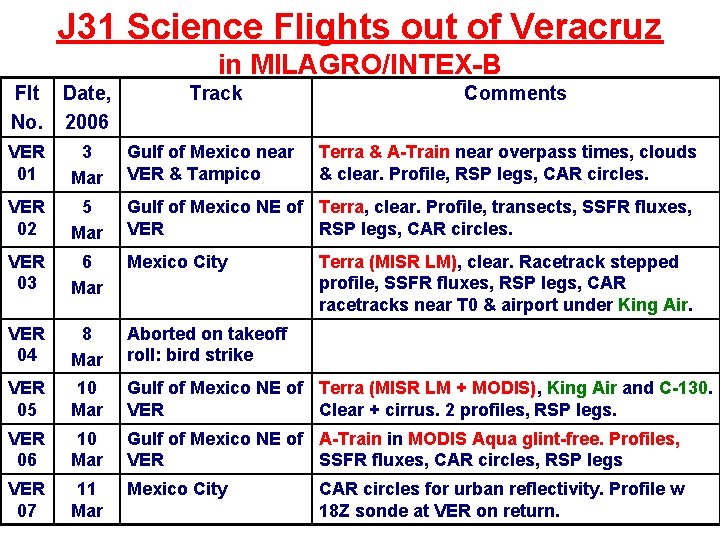
J 31 Science Flights out of Veracruz in MILAGRO/INTEX-B Flt Date, No. 2006 Track Comments VER 01 3 Mar Gulf of Mexico near VER & Tampico Terra & A-Train near overpass times, clouds & clear. Profile, RSP legs, CAR circles. VER 02 5 Mar Gulf of Mexico NE of Terra, clear. Profile, transects, SSFR fluxes, VER RSP legs, CAR circles. VER 03 6 Mar Mexico City VER 04 8 Mar Aborted on takeoff roll: bird strike VER 05 10 Mar Gulf of Mexico NE of Terra (MISR LM + MODIS), King Air and C-130. VER Clear + cirrus. 2 profiles, RSP legs. VER 06 10 Mar Gulf of Mexico NE of A-Train in MODIS Aqua glint-free. Profiles, VER SSFR fluxes, CAR circles, RSP legs VER 07 11 Mar Mexico City Terra (MISR LM), clear. Racetrack stepped profile, SSFR fluxes, RSP legs, CAR racetracks near T 0 & airport under King Air. CAR circles for urban reflectivity. Profile w 18 Z sonde at VER on return.
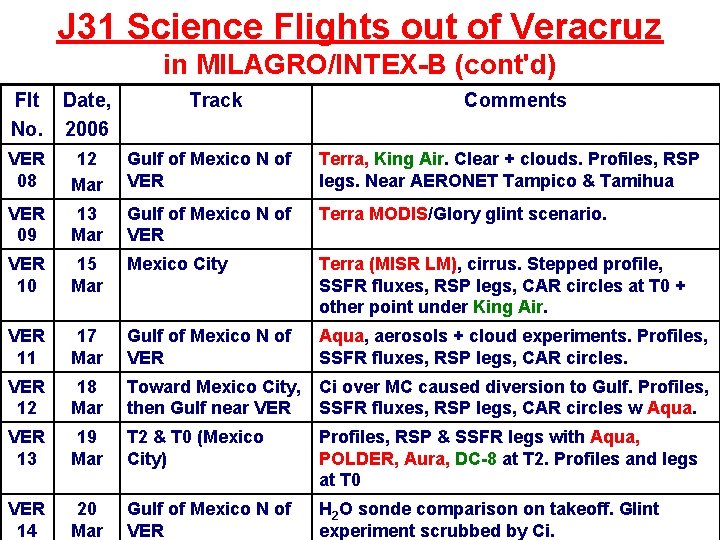
J 31 Science Flights out of Veracruz in MILAGRO/INTEX-B (cont'd) Flt Date, No. 2006 Track Comments VER 08 12 Mar Gulf of Mexico N of VER Terra, King Air. Clear + clouds. Profiles, RSP legs. Near AERONET Tampico & Tamihua VER 09 13 Mar Gulf of Mexico N of VER Terra MODIS/Glory glint scenario. VER 10 15 Mar Mexico City Terra (MISR LM), cirrus. Stepped profile, SSFR fluxes, RSP legs, CAR circles at T 0 + other point under King Air. VER 11 17 Mar Gulf of Mexico N of VER Aqua, aerosols + cloud experiments. Profiles, SSFR fluxes, RSP legs, CAR circles. VER 12 18 Mar Toward Mexico City, then Gulf near VER Ci over MC caused diversion to Gulf. Profiles, SSFR fluxes, RSP legs, CAR circles w Aqua. VER 13 19 Mar T 2 & T 0 (Mexico City) Profiles, RSP & SSFR legs with Aqua, POLDER, Aura, DC-8 at T 2. Profiles and legs at T 0 VER 14 20 Mar Gulf of Mexico N of VER H 2 O sonde comparison on takeoff. Glint experiment scrubbed by Ci.
- Slides: 16