
JetA Vaporization Computer Model A Fortran Code Written



- Slides: 18
Jet-A Vaporization Computer Model A Fortran Code Written by Prof. Polymeropolous of Rutgers University Steve Summer Project Engineer Federal Aviation Administration Fire Safety Section, AAR-422 IASFPWG – Seattle, WA International Aircraft Systems Fire Protection Working Group Seattle, WA March 12 – 13, 2002 03 -12 -02
Acknowledgements Ø Professor C. E. Polymeropolous of Rutgers University Ø David Adkins of the Boeing Company IASFPWG – Seattle, WA 03 -12 -02
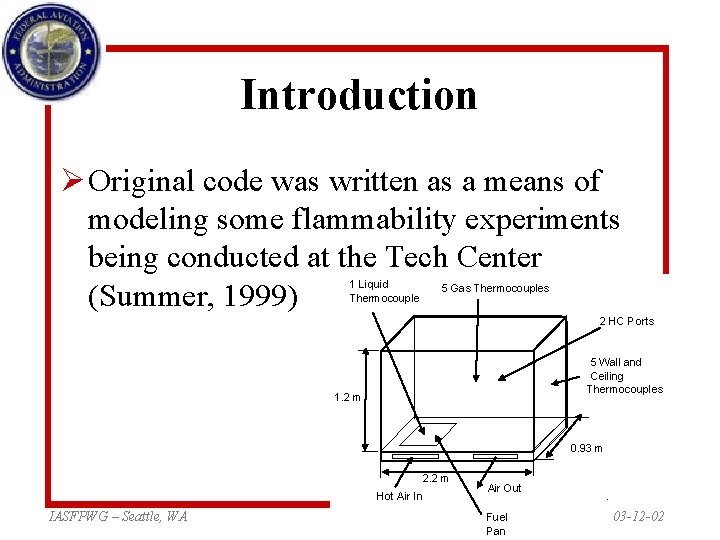
Introduction Ø Original code was written as a means of modeling some flammability experiments being conducted at the Tech Center (Summer, 1999) 1 Liquid Thermocouple 5 Gas Thermocouples 2 HC Ports 5 Wall and Ceiling Thermocouples 1. 2 m 0. 93 m 2. 2 m Hot Air In IASFPWG – Seattle, WA Air Out Fuel Pan 03 -12 -02
Introduction Ø This model proved a good method of predicting the evolution of hydrocarbons (i. e. it matched the experimental data). • Results were presented by Prof. Polymeropolous (10/01 Fire Safety Conference) Ø Could prove to be a key tool in performing fleet flammability studies. Ø Fortran code has been converted to a user-friendly Excel spreadsheet by David Adkins of Boeing. IASFPWG – Seattle, WA 03 -12 -02
Previous Work Ø Numerous previous investigations of free convection heat transfer within enclosures • Review papers: Catton (1978), Hoogendoon (1986), Ostrach (1988), etc. • Enclosure correlations Ø Few studies of heat and mass transfer within enclosures • Single component fuel evaporation in a fuel tank, Kosvic et al. (1971) • Computation of single component liquid evaporation within cylindrical enclosures, Bunama, Karim et al. (1997, 1999) Ø Computational and experimental study of Jet A vaporization in a test tank (Summer and Polymeropoulos, 2000) IASFPWG – Seattle, WA 03 -12 -02
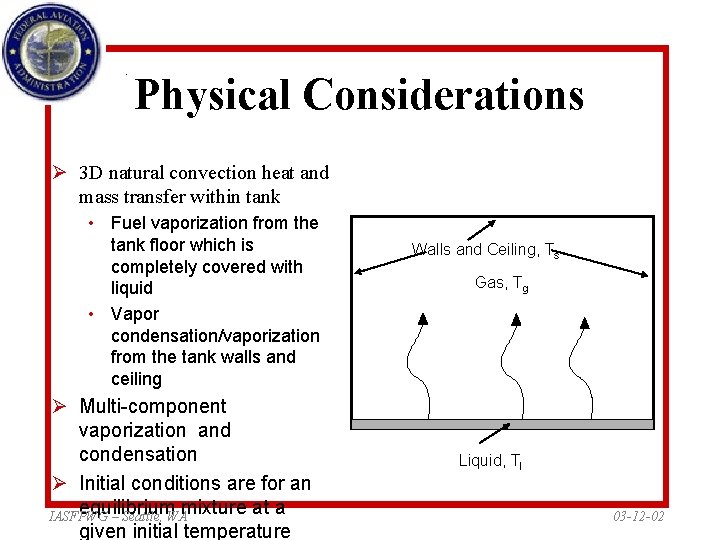
Physical Considerations Ø 3 D natural convection heat and mass transfer within tank • Fuel vaporization from the tank floor which is completely covered with liquid • Vapor condensation/vaporization from the tank walls and ceiling Ø Multi-component vaporization and condensation Ø Initial conditions are for an equilibrium mixture at a IASFPWG – Seattle, WA given initial temperature Walls and Ceiling, Ts Gas, Tg Liquid, Tl 03 -12 -02
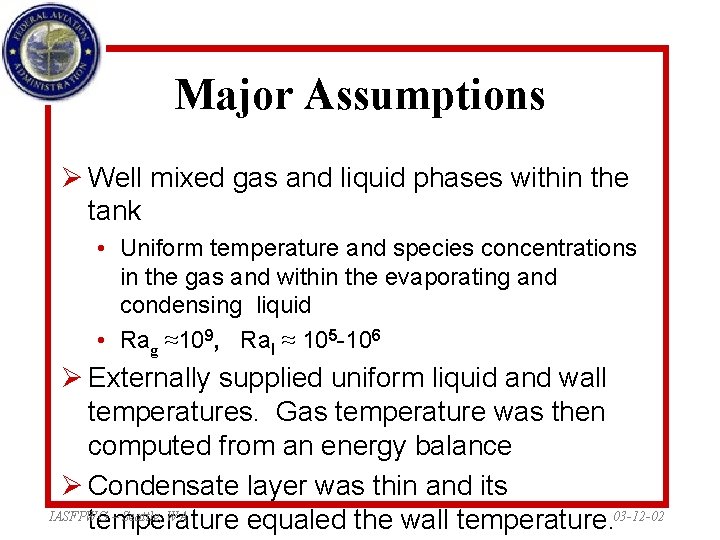
Major Assumptions Ø Well mixed gas and liquid phases within the tank • Uniform temperature and species concentrations in the gas and within the evaporating and condensing liquid • Rag ≈109, Ral ≈ 105 -106 Ø Externally supplied uniform liquid and wall temperatures. Gas temperature was then computed from an energy balance Ø Condensate layer was thin and its IASFPWG – Seattle, WA temperature equaled the wall temperature. 03 -12 -02
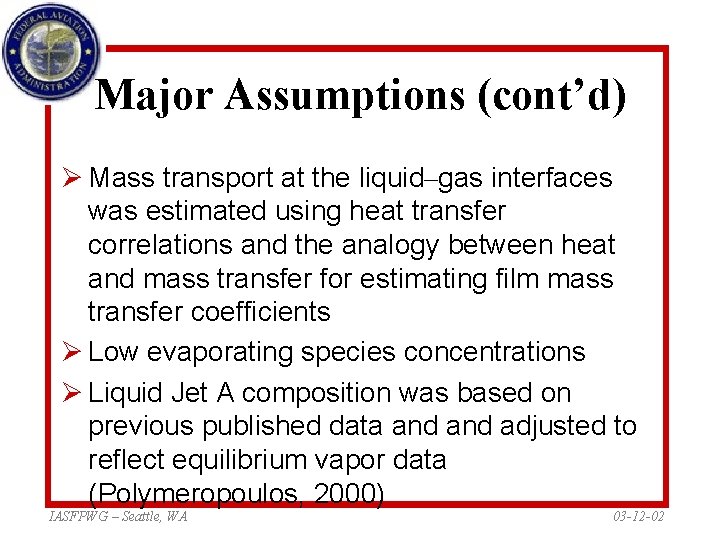
Major Assumptions (cont’d) Ø Mass transport at the liquid–gas interfaces was estimated using heat transfer correlations and the analogy between heat and mass transfer for estimating film mass transfer coefficients Ø Low evaporating species concentrations Ø Liquid Jet A composition was based on previous published data and adjusted to reflect equilibrium vapor data (Polymeropoulos, 2000) IASFPWG – Seattle, WA 03 -12 -02
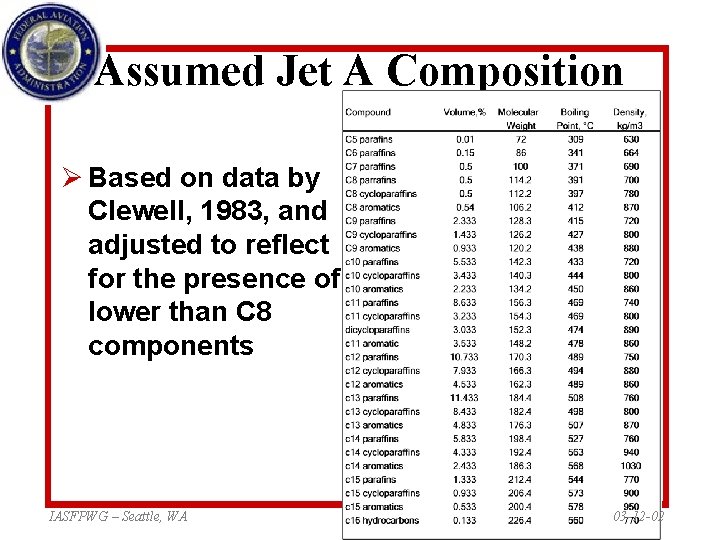
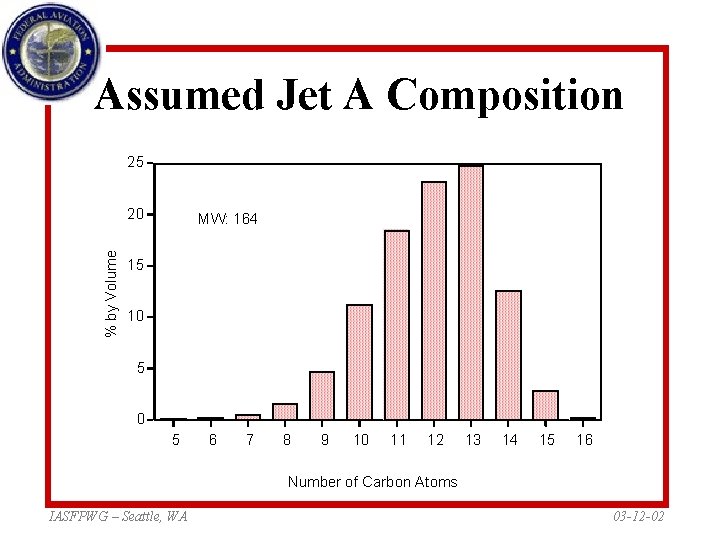
Assumed Jet A Composition Ø Based on data by Clewell, 1983, and adjusted to reflect for the presence of lower than C 8 components IASFPWG – Seattle, WA 03 -12 -02
Assumed Jet A Composition 25 % by Volume 20 MW: 164 15 10 5 6 7 8 9 10 11 12 13 14 15 16 Number of Carbon Atoms IASFPWG – Seattle, WA 03 -12 -02
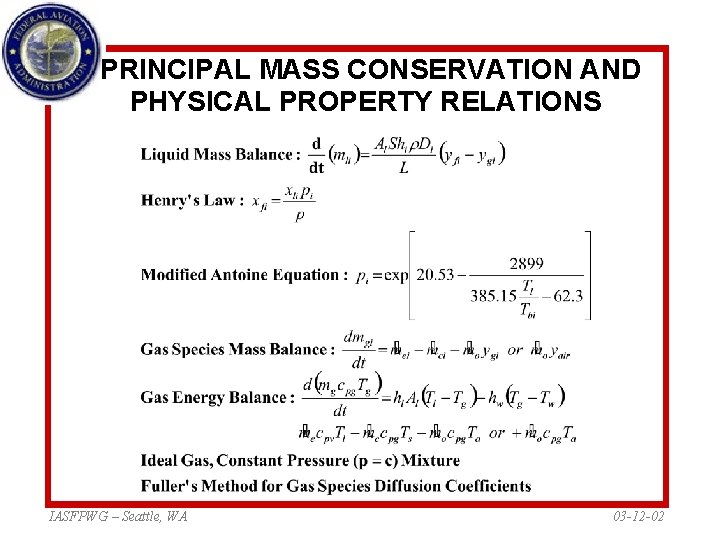
PRINCIPAL MASS CONSERVATION AND PHYSICAL PROPERTY RELATIONS IASFPWG – Seattle, WA 03 -12 -02
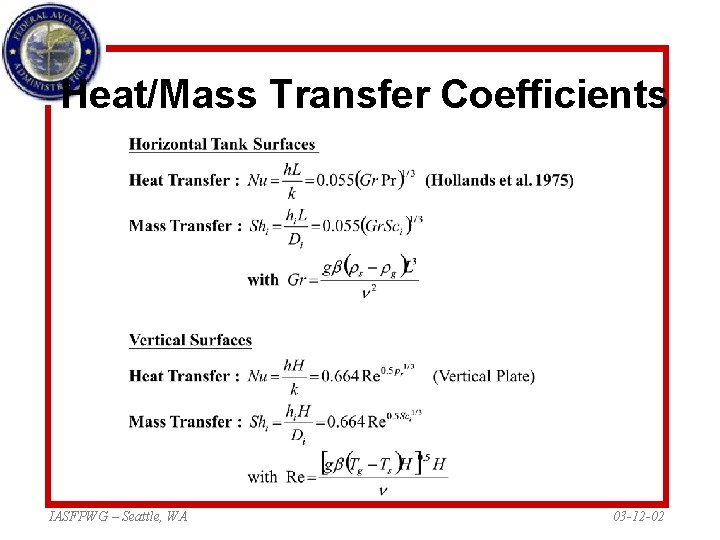
Heat/Mass Transfer Coefficients IASFPWG – Seattle, WA 03 -12 -02
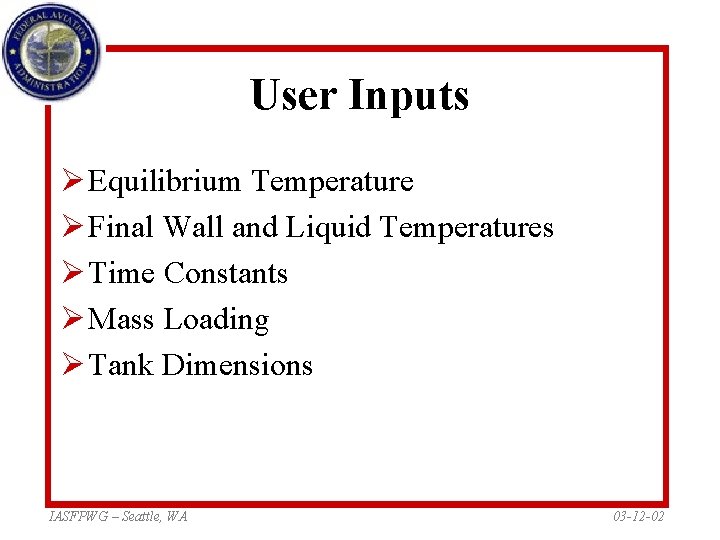
User Inputs Ø Equilibrium Temperature Ø Final Wall and Liquid Temperatures Ø Time Constants Ø Mass Loading Ø Tank Dimensions IASFPWG – Seattle, WA 03 -12 -02
Program Outputs Ø Equilibrium gas & liquid concentrations/species fractionation Ø Species fractionation as a function of time Ø Ullage, wall and liquid temperatures as a function of time Ø Ullage gas concentrations as a function of time • FAR, ppm. C 3 H 8 IASFPWG – Seattle, WA 03 -12 -02
Fortran Program Demonstration IASFPWG – Seattle, WA 03 -12 -02
Excel Version Demonstration IASFPWG – Seattle, WA 03 -12 -02
Sample Results IASFPWG – Seattle, WA 03 -12 -02
Future Work Ø Provide the ability to vary liquid fuel distribution throughout the tank. Ø Provide the ability to input temperature profiles for each tank surface. Ø Provide the ability to track pressure changes Ø Experimental validation tests will be conducted in the near future at the tech center. IASFPWG – Seattle, WA 03 -12 -02