
Jet Propulsion Laboratory California Institute of Technology AFTAWFIRST
Jet Propulsion Laboratory California Institute of Technology AFTA-WFIRST Coronagraph Instrument Status Report -- Exo. PAG Feng Zhao AFTA Coronagraph Instrument Manager 1/5 2014 Copyright 2013 California Institute of Technology. Government sponsorship acknowledged 1
Jet Propulsion Laboratory Outline California Institute of Technology • Introduction • Newly selected architecture description • Status and next steps • Summary 2
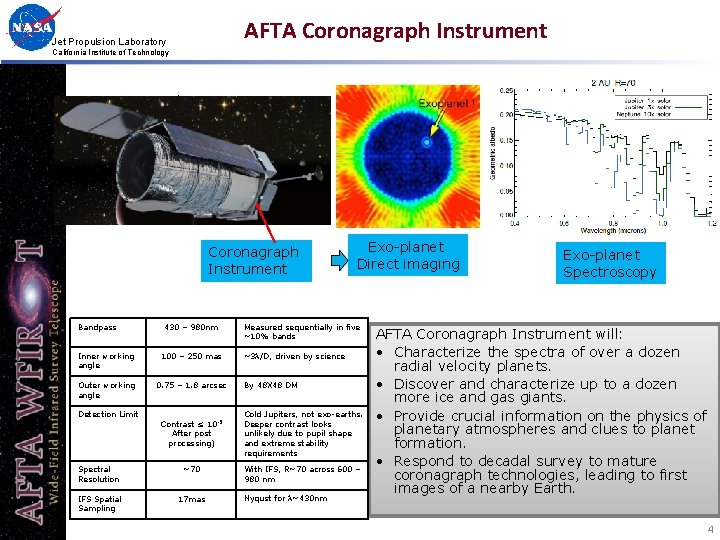
AFTA Coronagraph Instrument Jet Propulsion Laboratory California Institute of Technology Coronagraph Instrument Bandpass 430 – 980 nm Inner working angle 100 – 250 mas Outer working angle 0. 75 – 1. 8 arcsec Detection Limit Contrast ≤ 10 -9 After post processing) Spectral Resolution ~70 IFS Spatial Sampling 17 mas Exo-planet Direct imaging Measured sequentially in five ~10% bands ~3 /D, driven by science By 48 X 48 DM Cold Jupiters, not exo-earths. Deeper contrast looks unlikely due to pupil shape and extreme stability requirements With IFS, R~70 across 600 – 980 nm Nyqust for ~430 nm Exo-planet Spectroscopy AFTA Coronagraph Instrument will: • Characterize the spectra of over a dozen radial velocity planets. • Discover and characterize up to a dozen more ice and gas giants. • Provide crucial information on the physics of planetary atmospheres and clues to planet formation. • Respond to decadal survey to mature coronagraph technologies, leading to first images of a nearby Earth. 4

Functional Block Diagram Jet Propulsion Laboratory California Institute of Technology Star light suppression optics High contrast loop during initialization 1 k. X 1 K, Si low noise FPA; 150 K, IWA 0. 25/ arcsec, OWA 2. 5/ arcsec, (0. 43 -0. 98 um) Coronagraph FPA OTA (PM, SM) TM, relay, FSM DM #1, DM #2 Relay, Occulting Masks & Filters LOWFS Telemetry IFS FPA 2 k. X 2 k, Si low noise FPA; 150 K, (0. 6 -0. 98 um), R~70, 17 mas sampling LOWFS FPA Drift control loop (<2 Hz) Jitter control loop (250 Hz? ) Post processing Optics Control Detector Post processing on ground 5
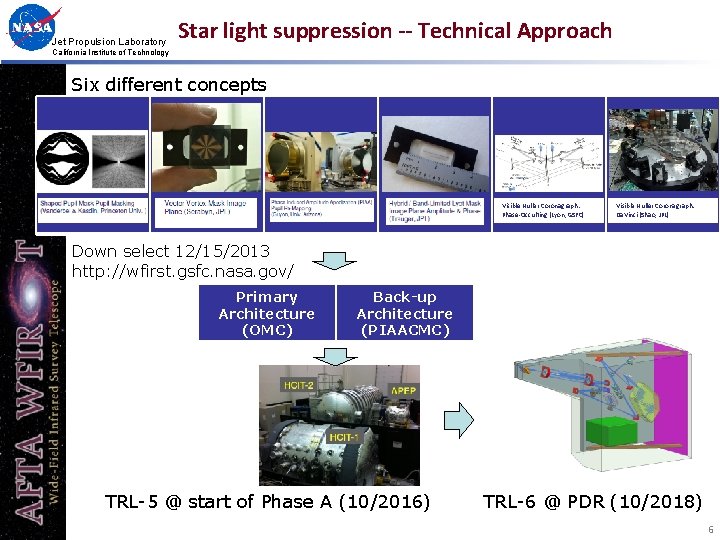
Jet Propulsion Laboratory Star light suppression -- Technical Approach California Institute of Technology Six different concepts Visible Nuller Coronagraph: Phase-Occulting (Lyon, GSFC) Visible Nuller Coronagraph: Da. Vinci (Shao, JPL) Down select 12/15/2013 http: //wfirst. gsfc. nasa. gov/ Primary Architecture (OMC) Back-up Architecture (PIAACMC) TRL-5 @ start of Phase A (10/2016) TRL-6 @ PDR (10/2018) 6

Primary Architecture: Occulting Mask Coronagraph = Shaped Pupil + Hybrid Lyot Jet Propulsion Laboratory California Institute of Technology – SP and HL masks share very similar optical layouts – Small increase in over all complexity compared with single mask implementation Pupil mask changer Occulting mask changer Lyot mask changer Pupil mask changer Lyot mask changer Occulting mask changer (magnified for illustration) c c FPA HL DM 1/FSM DM 2 SP To LOWFS DM 1/FSM FPA DM 2 To LOWFS 1 2 …… n 7
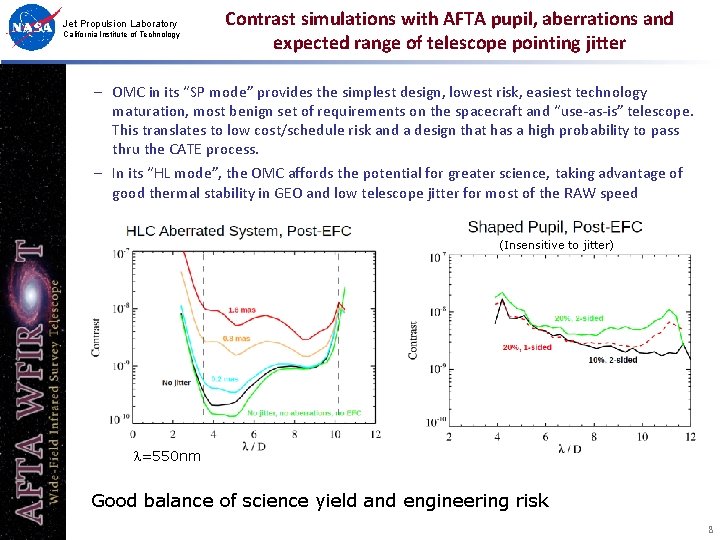
Jet Propulsion Laboratory California Institute of Technology Contrast simulations with AFTA pupil, aberrations and expected range of telescope pointing jitter – OMC in its “SP mode” provides the simplest design, lowest risk, easiest technology maturation, most benign set of requirements on the spacecraft and “use-as-is” telescope. This translates to low cost/schedule risk and a design that has a high probability to pass thru the CATE process. – In its “HL mode”, the OMC affords the potential for greater science, taking advantage of good thermal stability in GEO and low telescope jitter for most of the RAW speed (Insensitive to jitter) =550 nm Good balance of science yield and engineering risk 8
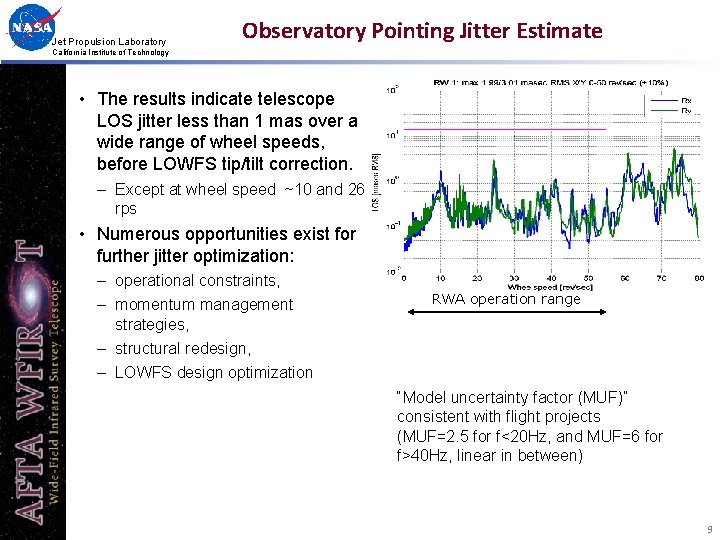
Jet Propulsion Laboratory Observatory Pointing Jitter Estimate California Institute of Technology • The results indicate telescope LOS jitter less than 1 mas over a wide range of wheel speeds, before LOWFS tip/tilt correction. – Except at wheel speed ~10 and 26 rps • Numerous opportunities exist for further jitter optimization: – operational constraints, – momentum management strategies, – structural redesign, – LOWFS design optimization RWA operation range “Model uncertainty factor (MUF)” consistent with flight projects (MUF=2. 5 for f<20 Hz, and MUF=6 for f>40 Hz, linear in between) 9
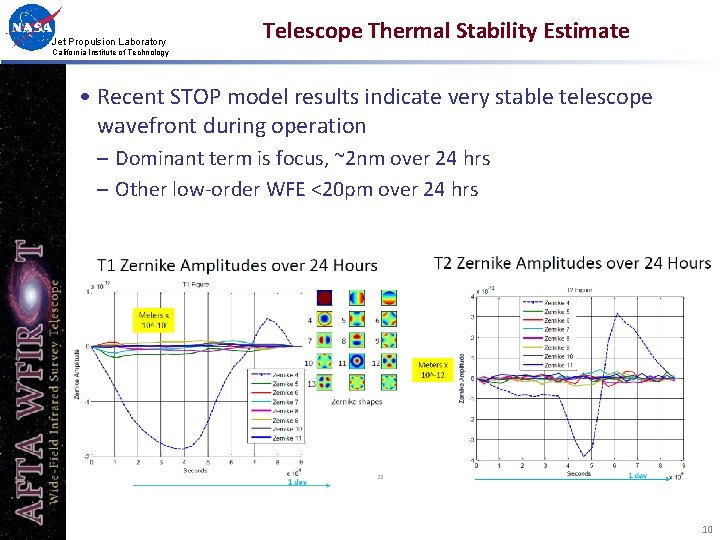
Jet Propulsion Laboratory Telescope Thermal Stability Estimate California Institute of Technology • Recent STOP model results indicate very stable telescope wavefront during operation – Dominant term is focus, ~2 nm over 24 hrs – Other low-order WFE <20 pm over 24 hrs 10
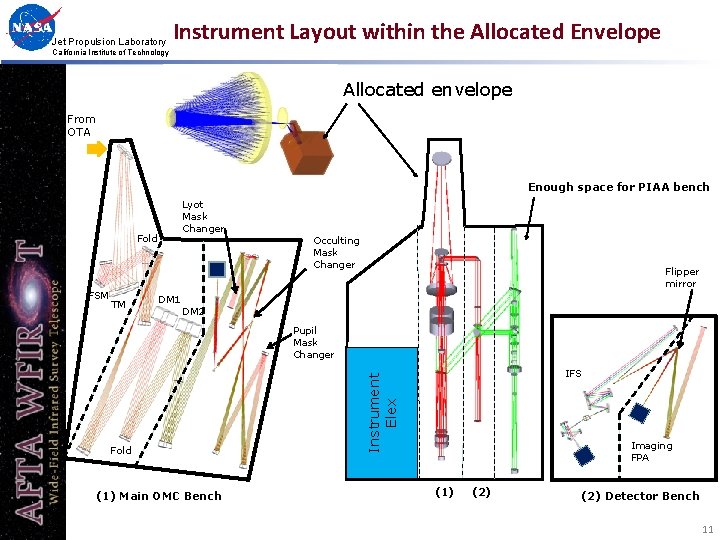
Jet Propulsion Laboratory Instrument Layout within the Allocated Envelope California Institute of Technology Allocated envelope From OTA Enough space for PIAA bench Lyot Mask Changer Fold FSM TM DM 1 Occulting Mask Changer Flipper mirror DM 2 Pupil Mask Changer (1) Main OMC Bench Instrument Elex Fold IFS Imaging FPA (1) (2) Detector Bench 11
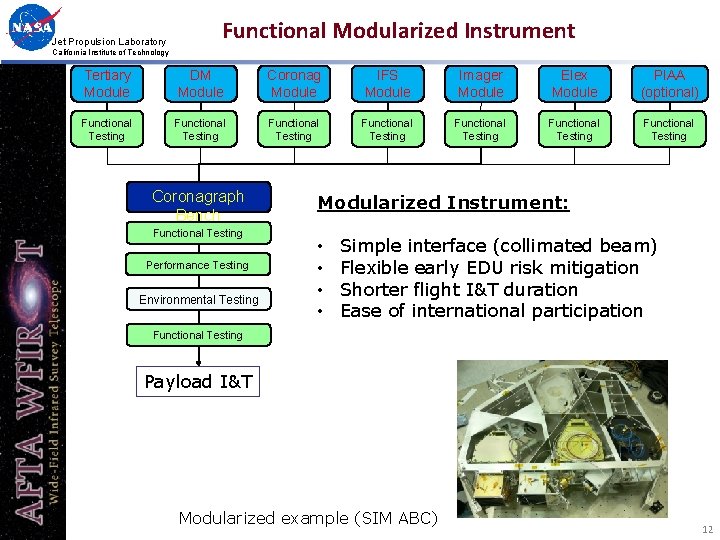
Jet Propulsion Laboratory Functional Modularized Instrument California Institute of Technology Tertiary Module DM Module Coronag Module IFS Module Imager Module Elex Module PIAA (optional) Functional Testing Functional Testing Coronagraph Bench Functional Testing Performance Testing Environmental Testing Modularized Instrument: • • Simple interface (collimated beam) Flexible early EDU risk mitigation Shorter flight I&T duration Ease of international participation Functional Testing Payload I&T Modularized example (SIM ABC) 12

Jet Propulsion Laboratory California Institute of Technology Active Optics Fine Steering Mirror (FSM) Deformable Mirror (DM) • To correct telescope line-of-sight (wavefront tip/tilt) error • Low risk with rich flight heritage • To correct telescope & instrument optical WFE (static and drift) • Low risk with good heritage: – Flight PMN actuators, driver electronics – HCIT contrast demonstration to 10 -10 – Assembly passed random vibe test (2012) Low risk for flight implementation 13
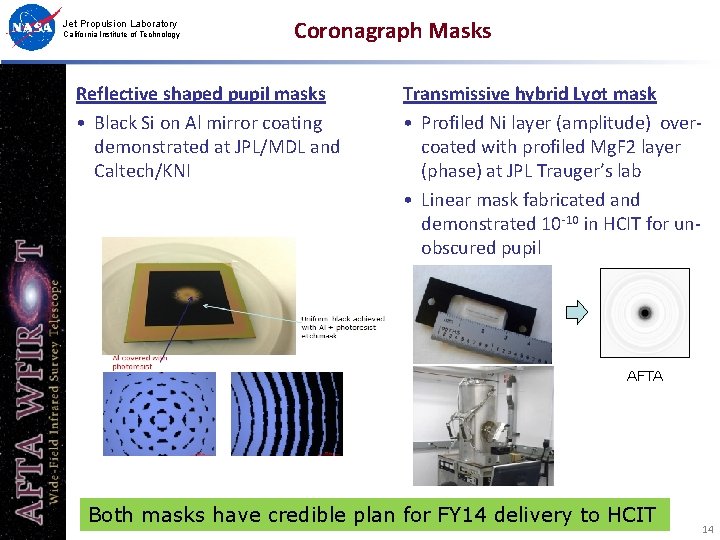
Jet Propulsion Laboratory California Institute of Technology Coronagraph Masks Reflective shaped pupil masks • Black Si on Al mirror coating demonstrated at JPL/MDL and Caltech/KNI Transmissive hybrid Lyot mask • Profiled Ni layer (amplitude) overcoated with profiled Mg. F 2 layer (phase) at JPL Trauger’s lab • Linear mask fabricated and demonstrated 10 -10 in HCIT for unobscured pupil AFTA Both masks have credible plan for FY 14 delivery to HCIT 14
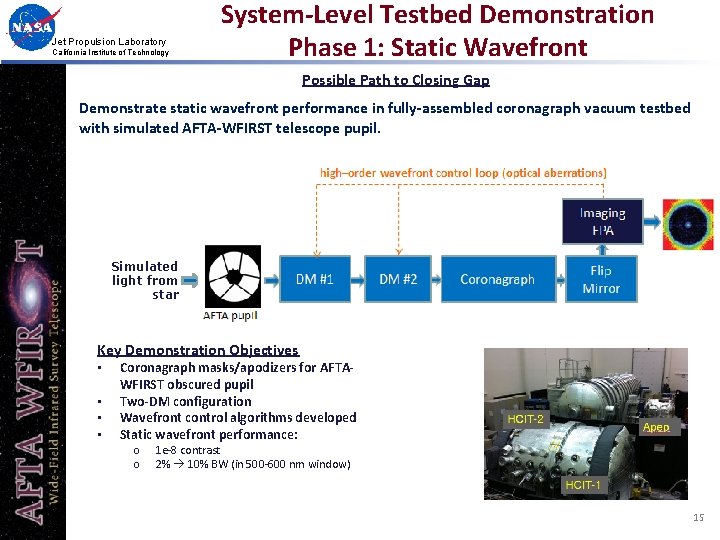
Jet Propulsion Laboratory California Institute of Technology System-Level Testbed Demonstration Phase 1: Static Wavefront Possible Path to Closing Gap Demonstrate static wavefront performance in fully-assembled coronagraph vacuum testbed with simulated AFTA-WFIRST telescope pupil. Simulated light from star Key Demonstration Objectives • • Coronagraph masks/apodizers for AFTAWFIRST obscured pupil Two-DM configuration Wavefront control algorithms developed Static wavefront performance: o o 1 e-8 contrast 2% 10% BW (in 500 -600 nm window) 15
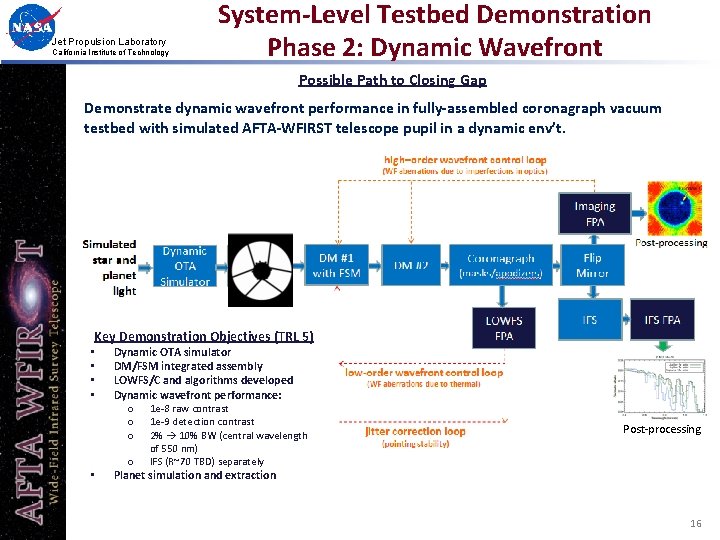
Jet Propulsion Laboratory California Institute of Technology System-Level Testbed Demonstration Phase 2: Dynamic Wavefront Possible Path to Closing Gap Demonstrate dynamic wavefront performance in fully-assembled coronagraph vacuum testbed with simulated AFTA-WFIRST telescope pupil in a dynamic env’t. Key Demonstration Objectives (TRL 5) • • • Dynamic OTA simulator DM/FSM integrated assembly LOWFS/C and algorithms developed Dynamic wavefront performance: o 1 e-8 raw contrast o 1 e-9 detection contrast o 2% 10% BW (central wavelength Post-processing of 550 nm) IFS (R~70 TBD) separately o Planet simulation and extraction 16
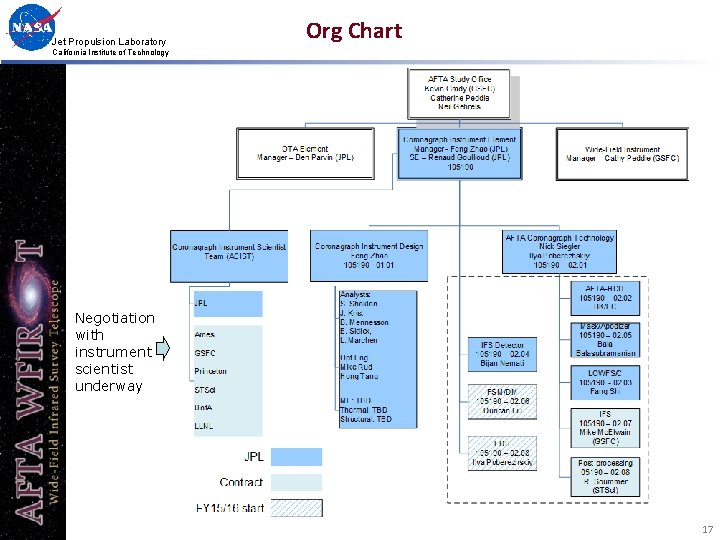
Jet Propulsion Laboratory Org Chart California Institute of Technology Negotiation with instrument scientist underway 17
Jet Propulsion Laboratory Next Steps California Institute of Technology • Technology Maturation: – Submit technology maturation plan to HQ with milestones FY 14 FY 16 (TRL-5 demonstration by 10/2016) • AFTA-WFIRST DRM: – SDT interim report 4/2014 – SDT final report 1/2015 – CATE 2/2015 • Wider community participation – ACIST – International partnership 18

Jet Propulsion Laboratory Summary California Institute of Technology • Exciting coronagraph technology maturation for a generic telescope (such as AFTA) – Benefit future exo-Earth imaging missions using a generic telescope (such as ATLAST) • AFTA-WFIRST Occulting Mask Coronagraph offers balanced science returns and engineering risks • Strong interest from community and international partners, modularized instrument design offers simple interface and flexible contributions 19
Jet Propulsion Laboratory Acknowledgement California Institute of Technology • Contributions from team members from JPL, GSFC, Princeton, Univ of Arizona, Ames, LLNL, STSc. I, Caltech 20
- Slides: 20