
Jet modifications at RHIC Marco van Leeuwen Utrecht


- Slides: 55
Jet modifications at RHIC Marco van Leeuwen, Utrecht University
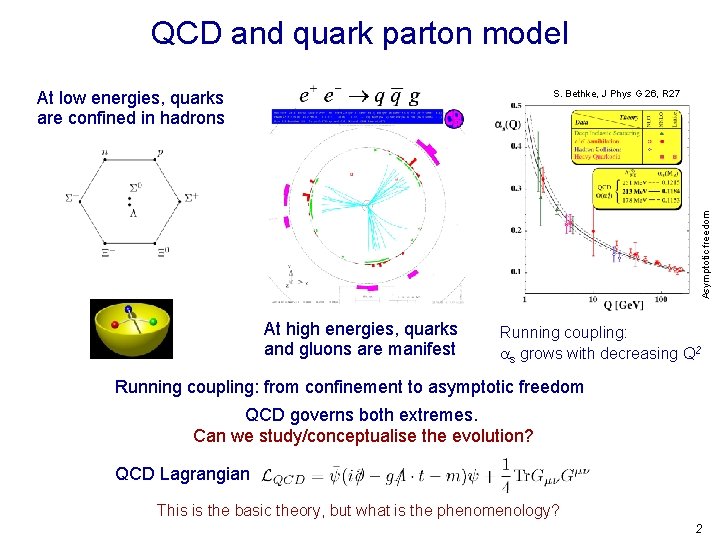
QCD and quark parton model At low energies, quarks are confined in hadrons Asymptotic freedom S. Bethke, J Phys G 26, R 27 At high energies, quarks and gluons are manifest Running coupling: s grows with decreasing Q 2 Running coupling: from confinement to asymptotic freedom QCD governs both extremes. Can we study/conceptualise the evolution? QCD Lagrangian This is the basic theory, but what is the phenomenology? 2
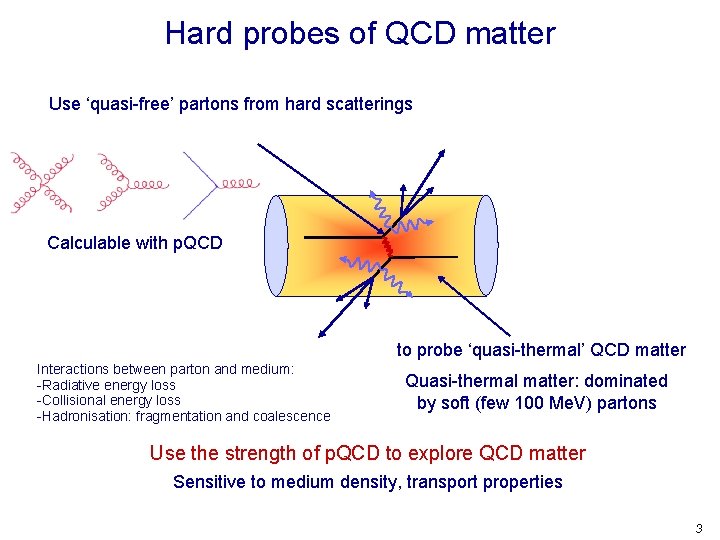
Hard probes of QCD matter Use ‘quasi free’ partons from hard scatterings Calculable with p. QCD to probe ‘quasi thermal’ QCD matter Interactions between parton and medium: Radiative energy loss Collisional energy loss Hadronisation: fragmentation and coalescence Quasi thermal matter: dominated by soft (few 100 Me. V) partons Use the strength of p. QCD to explore QCD matter Sensitive to medium density, transport properties 3
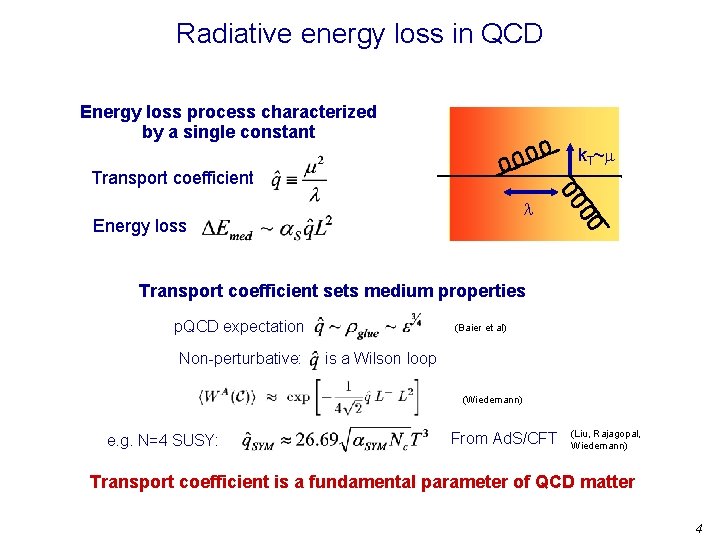
Radiative energy loss in QCD Energy loss process characterized by a single constant k. T~ Transport coefficient Energy loss Transport coefficient sets medium properties p. QCD expectation Non perturbative: (Baier et al) is a Wilson loop (Wiedemann) e. g. N=4 SUSY: From Ad. S/CFT (Liu, Rajagopal, Wiedemann) Transport coefficient is a fundamental parameter of QCD matter 4
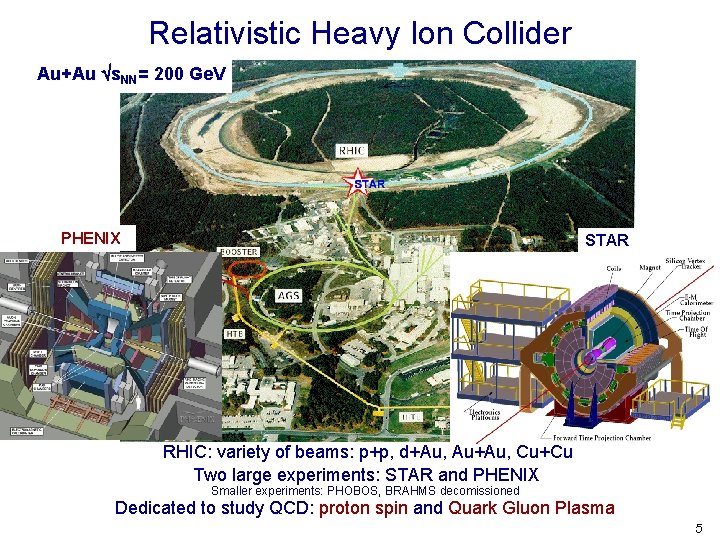
Relativistic Heavy Ion Collider Au+Au s. NN= 200 Ge. V PHENIX STAR RHIC: variety of beams: p+p, d+Au, Au+Au, Cu+Cu Two large experiments: STAR and PHENIX Smaller experiments: PHOBOS, BRAHMS decomissioned Dedicated to study QCD: proton spin and Quark Gluon Plasma 5
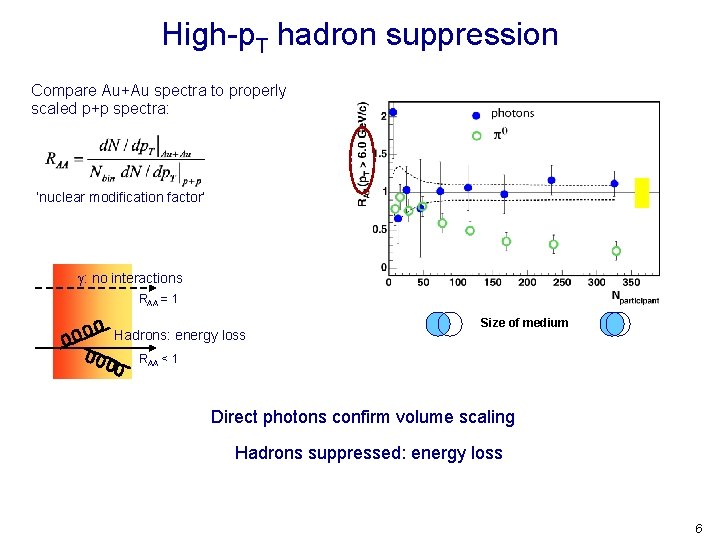
High p. T hadron suppression Compare Au+Au spectra to properly scaled p+p spectra: ‘nuclear modification factor’ : no interactions RAA = 1 Hadrons: energy loss Size of medium RAA < 1 Direct photons confirm volume scaling Hadrons suppressed: energy loss 6
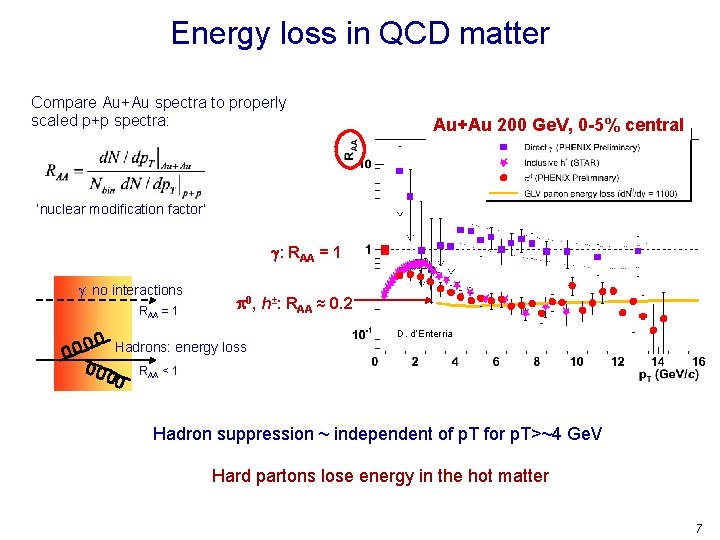
Energy loss in QCD matter Compare Au+Au spectra to properly scaled p+p spectra: Au+Au 200 Ge. V, 0 -5% central ‘nuclear modification factor’ : RAA = 1 : no interactions RAA = 1 0, h±: RAA ≈ 0. 2 D. d’Enterria Hadrons: energy loss RAA < 1 Hadron suppression ~ independent of p. T for p. T>~4 Ge. V Hard partons lose energy in the hot matter 7
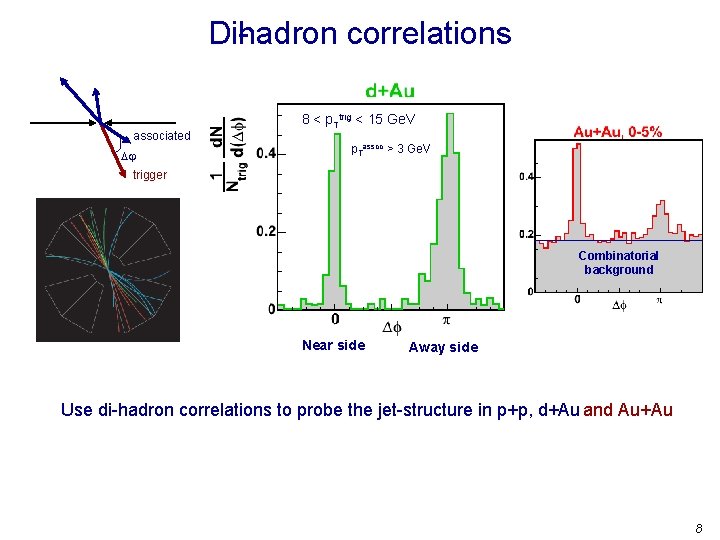
Di hadron correlations associated 8 < p. Ttrig < 15 Ge. V p. Tassoc > 3 Ge. V trigger Combinatorial background Near side Away side Use di hadron correlations to probe the jet structure in p+p, d+Au and Au+Au 8
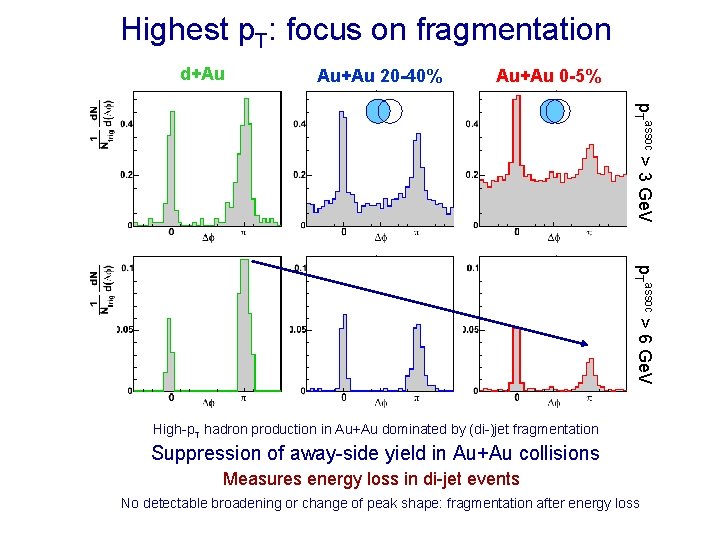
Highest p. T: focus on fragmentation d+Au Au+Au 20 -40% Au+Au 0 -5% p. Tassoc > 3 Ge. V p. Tassoc > 6 Ge. V High p. T hadron production in Au+Au dominated by (di )jet fragmentation Suppression of away side yield in Au+Au collisions Measures energy loss in di jet events No detectable broadening or change of peak shape: fragmentation after energy loss
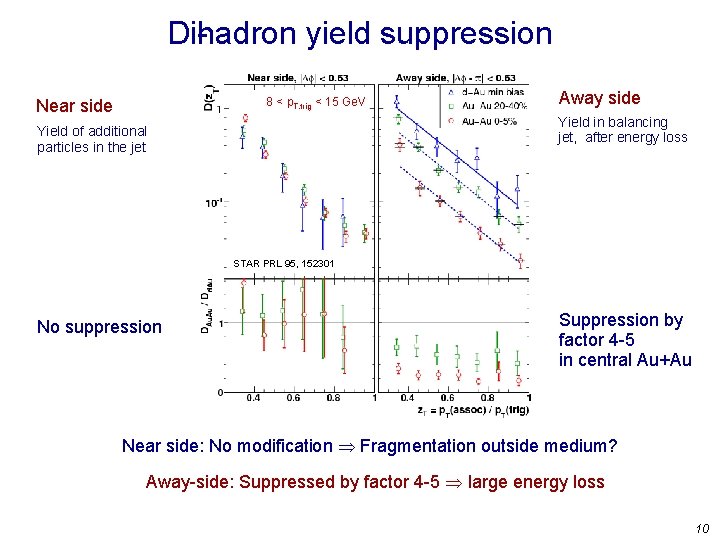
Di hadron yield suppression 8 < p. T, trig < 15 Ge. V Near side Away side Yield in balancing jet, after energy loss Yield of additional particles in the jet STAR PRL 95, 152301 No suppression Suppression by factor 4 5 in central Au+Au Near side: No modification Fragmentation outside medium? Away side: Suppressed by factor 4 5 large energy loss 10
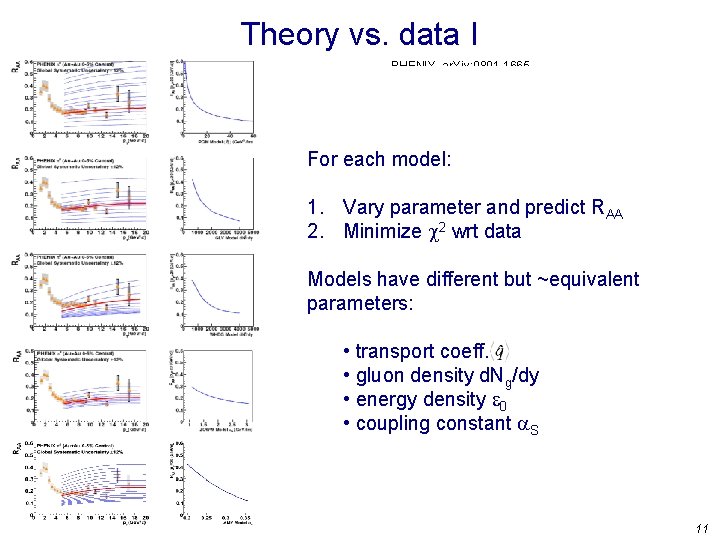
Theory vs. data I PHENIX, ar. Xiv: 0801. 1665, J. Nagle PQM (Loizides, Dainese, Paic), WWND 08 Multiple soft scatttering approx (Armesto, Salgado, Wiedemann) Realistic geometry For each model: GLV (Gyulassy, Levai, Vitev), opacity expansion (L/ ), average path length 1. Vary parameter and predict RAA 2. Minimize 2 wrt data Models have different but ~equivalent parameters: WHDG (Wicks, Horowitz, Djordjevic, Gyulassy) GLV + realistic geometry • transport coeff. • gluon density d. N /dy • energy density 0 • coupling constant S ZOWW (Zhang, Owens, Wang) Medium enhanced power corrections (higher g twist) Hard sphere geometry AMY (Arnold, Moore, Yaffe) Finite temperature effective field theory (Hard Thermal Loops) 11
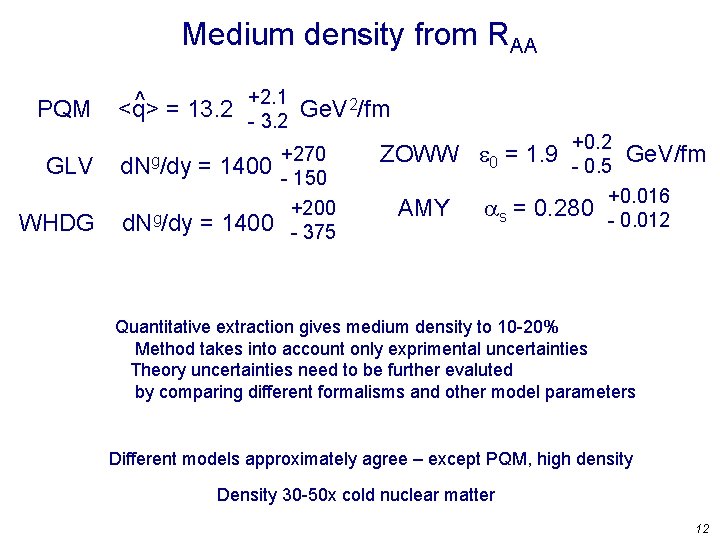
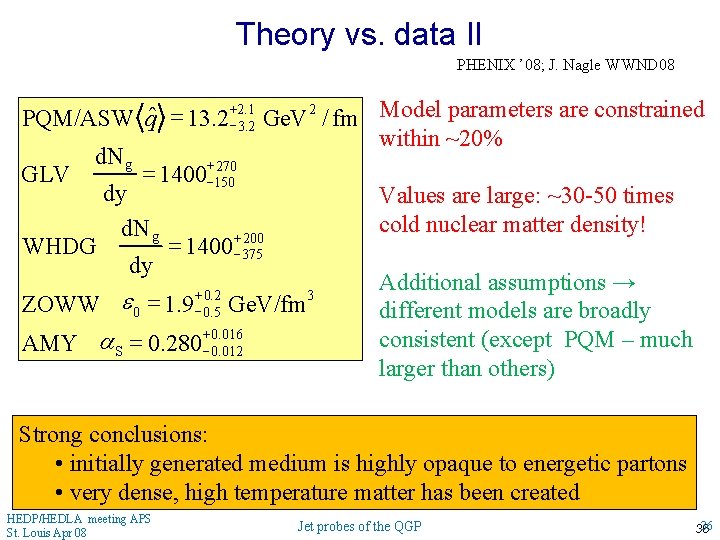
Medium density from RAA PQM GLV WHDG +2. 1 ^ <q> = 13. 2 Ge. V 2/fm d. Ng/dy = 1400 +270 150 +200 375 +0. 2 ZOWW 0 = 1. 9 0. 5 Ge. V/fm AMY +0. 016 s = 0. 280 0. 012 Quantitative extraction gives medium density to 10 20% Method takes into account only exprimental uncertainties Theory uncertainties need to be further evaluted by comparing different formalisms and other model parameters Different models approximately agree – except PQM, high density Density 30 50 x cold nuclear matter 12
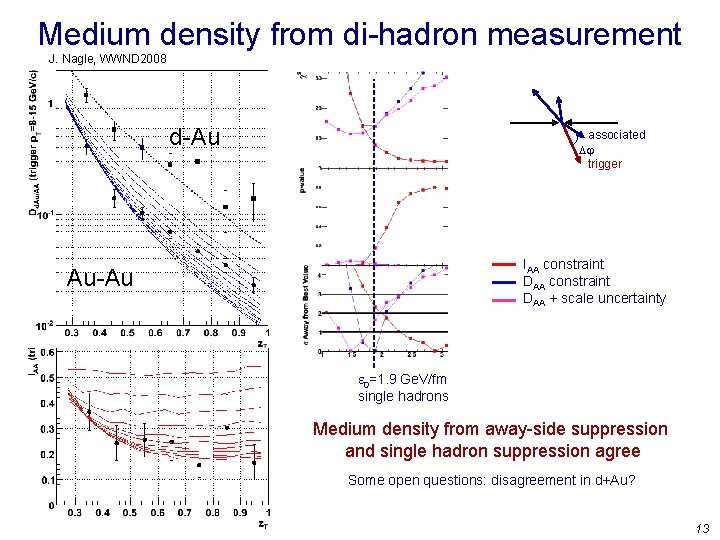
Medium density from di hadron measurement J. Nagle, WWND 2008 d Au associated trigger IAA constraint DAA + scale uncertainty Au Au 0=1. 9 Ge. V/fm single hadrons Medium density from away side suppression and single hadron suppression agree Some open questions: disagreement in d+Au? 13
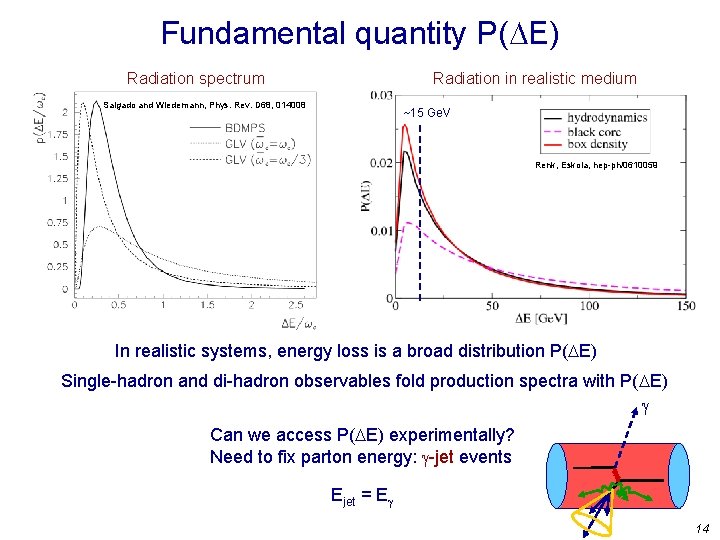
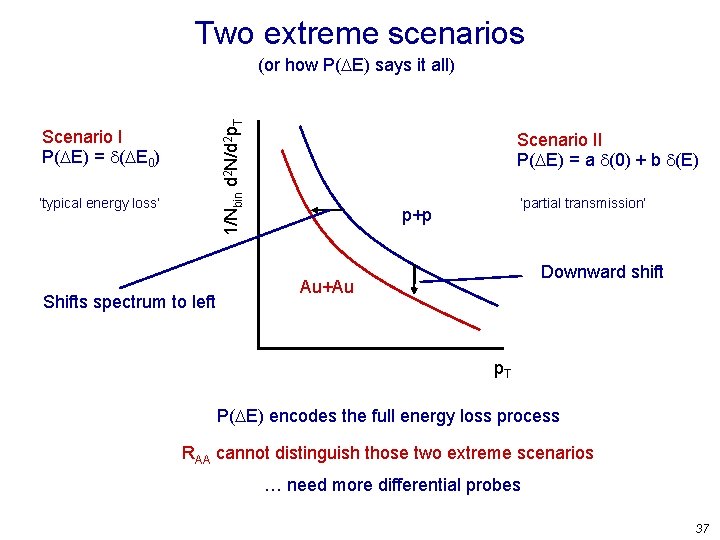
Fundamental quantity P( E) Radiation spectrum Radiation in realistic medium Salgado and Wiedemann, Phys. Rev. D 68, 014008 ~15 Ge. V Renk, Eskola, hep ph/0610059 In realistic systems, energy loss is a broad distribution P( E) Single hadron and di hadron observables fold production spectra with P( E) Can we access P( E) experimentally? Need to fix parton energy: jet events Ejet = E 14
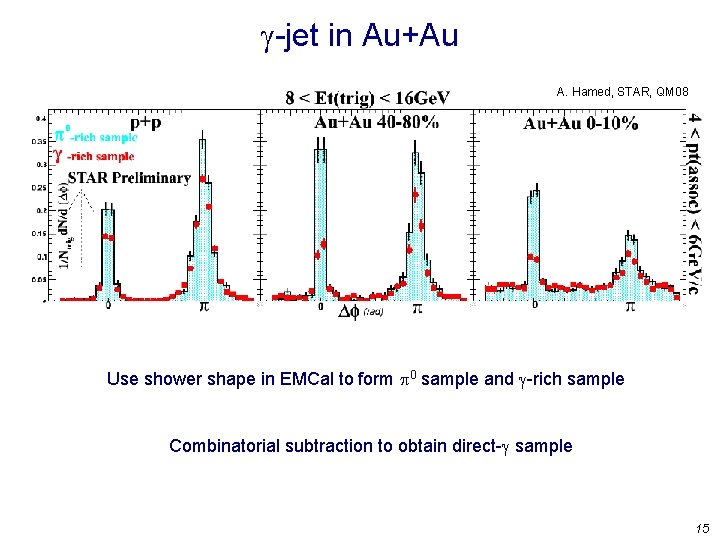
jet in Au+Au A. Hamed, STAR, QM 08 Use shower shape in EMCal to form 0 sample and rich sample Combinatorial subtraction to obtain direct sample 15
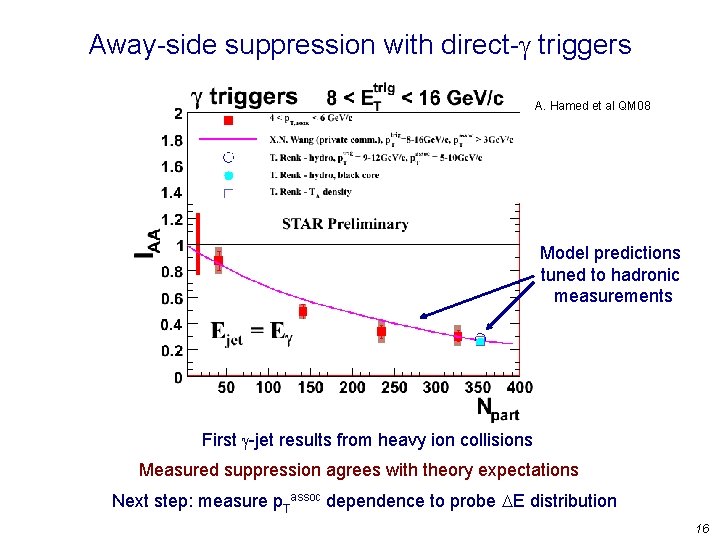
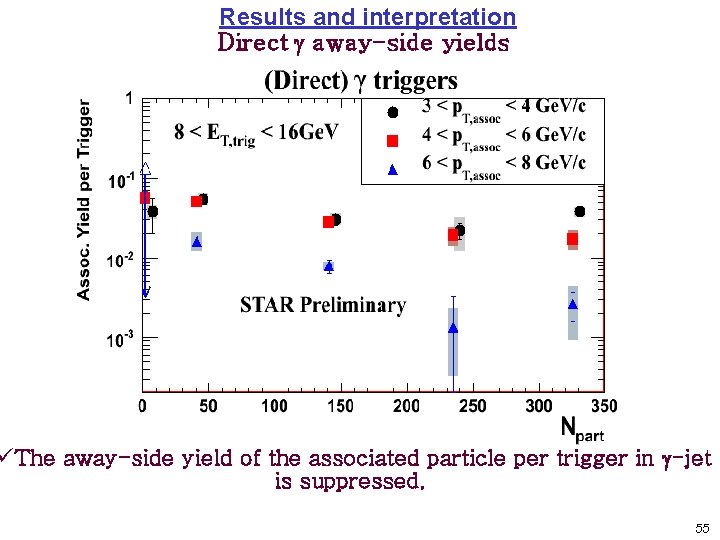
Away side suppression with direct triggers A. Hamed et al QM 08 Model predictions tuned to hadronic measurements First jet results from heavy ion collisions Measured suppression agrees with theory expectations Next step: measure p. Tassoc dependence to probe E distribution 16
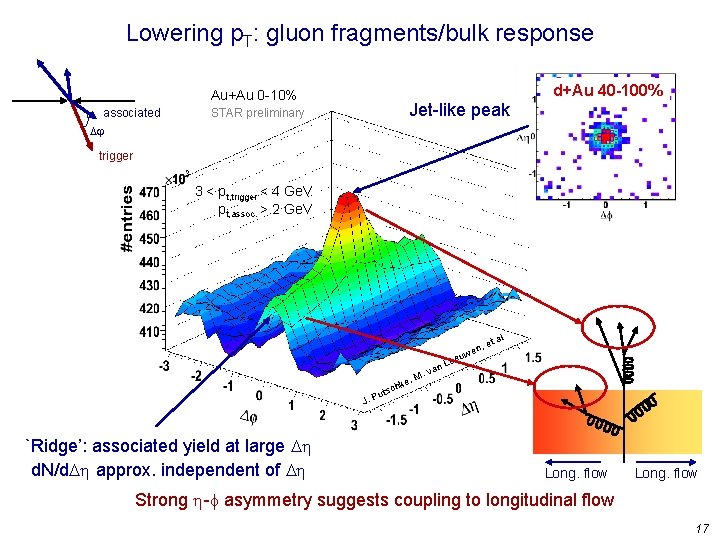
Lowering p. T: gluon fragments/bulk response d+Au 40 -100% Au+Au 0 10% associated Jet like peak STAR preliminary trigger 3 < pt, trigger < 4 Ge. V pt, assoc. > 2 Ge. V J. P `Ridge’: associated yield at large d. N/d approx. independent of l et a u Lee , M hke c uts n. va n, we Long. flow Strong asymmetry suggests coupling to longitudinal flow 17
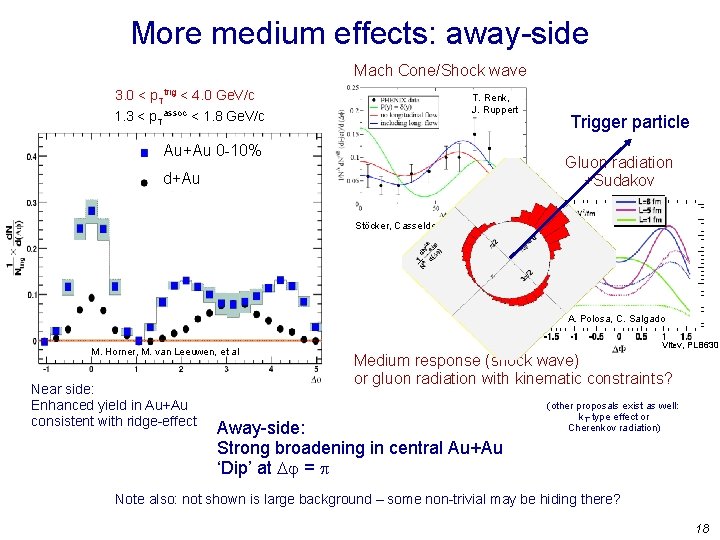
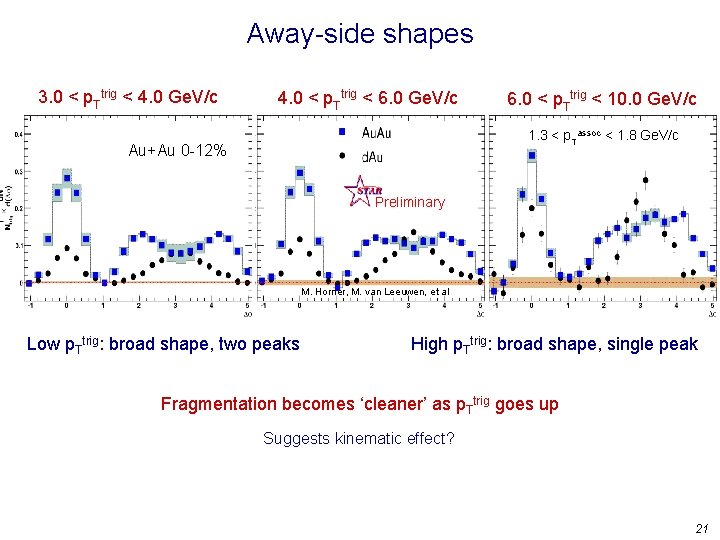
More medium effects: away side Mach Cone/Shock wave 3. 0 < p. Ttrig < 4. 0 Ge. V/c 1. 3 < p. Tassoc < 1. 8 Ge. V/c T. Renk, J. Ruppert Au+Au 0 10% Trigger particle Gluon radiation +Sudakov d+Au Stöcker, Casseldery Solana et al A. Polosa, C. Salgado M. Horner, M. van Leeuwen, et al Near side: Enhanced yield in Au+Au consistent with ridge effect Vitev, PLB 630 Medium response (shock wave) or gluon radiation with kinematic constraints? Away side: Strong broadening in central Au+Au ‘Dip’ at = (other proposals exist as well: k. T type effect or Cherenkov radiation) Note also: not shown is large background – some non trivial may be hiding there? 18
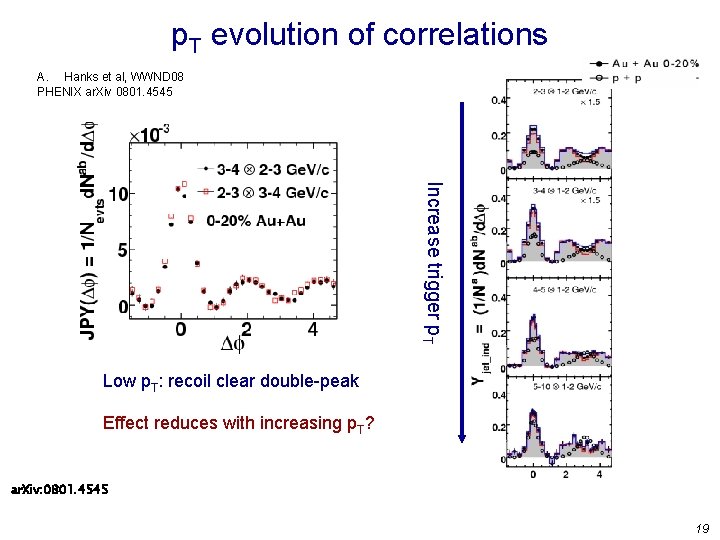
p. T evolution of correlations A. Hanks et al, WWND 08 PHENIX ar. Xiv 0801. 4545 Increase trigger p. T Low p. T: recoil clear double peak Effect reduces with increasing p. T? ar. Xiv: 0801. 4545 19
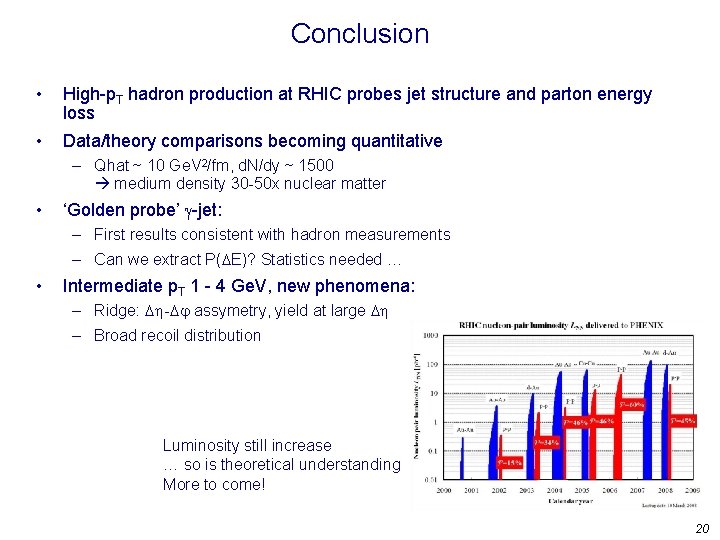
Conclusion • High p. T hadron production at RHIC probes jet structure and parton energy loss • Data/theory comparisons becoming quantitative – Qhat ~ 10 Ge. V 2/fm, d. N/dy ~ 1500 medium density 30 50 x nuclear matter • ‘Golden probe’ jet: – First results consistent with hadron measurements – Can we extract P( E)? Statistics needed … • Intermediate p. T 1 4 Ge. V, new phenomena: – Ridge: assymetry, yield at large – Broad recoil distribution Luminosity still increase … so is theoretical understanding More to come! 20
Away side shapes 3. 0 < p. Ttrig < 4. 0 Ge. V/c 4. 0 < p. Ttrig < 6. 0 Ge. V/c 6. 0 < p. Ttrig < 10. 0 Ge. V/c 1. 3 < p. Tassoc < 1. 8 Ge. V/c Au+Au 0 12% 0 -12% Preliminary M. Horner, M. van Leeuwen, et al Low p. Ttrig: broad shape, two peaks High p. Ttrig: broad shape, single peak Fragmentation becomes ‘cleaner’ as p. Ttrig goes up Suggests kinematic effect? 21
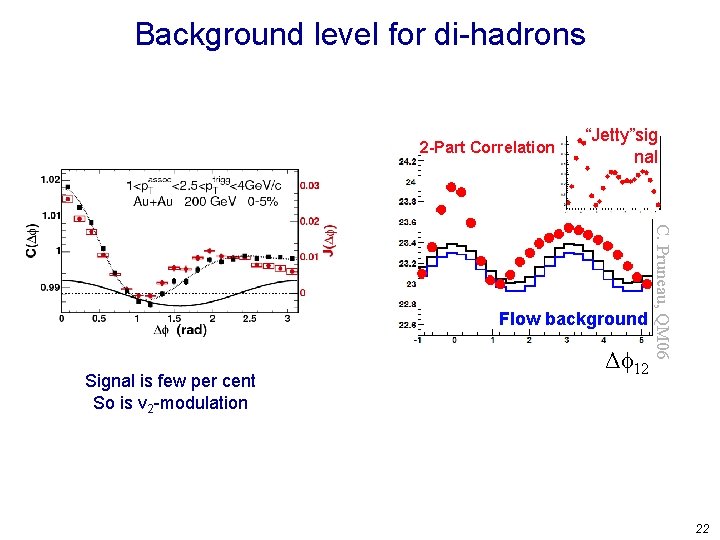
Background level for di hadrons 2 -Part Correlation “Jetty”sig nal Signal is few per cent So is v 2 modulation Δ 12 C. Pruneau, QM 06 Flow background 22
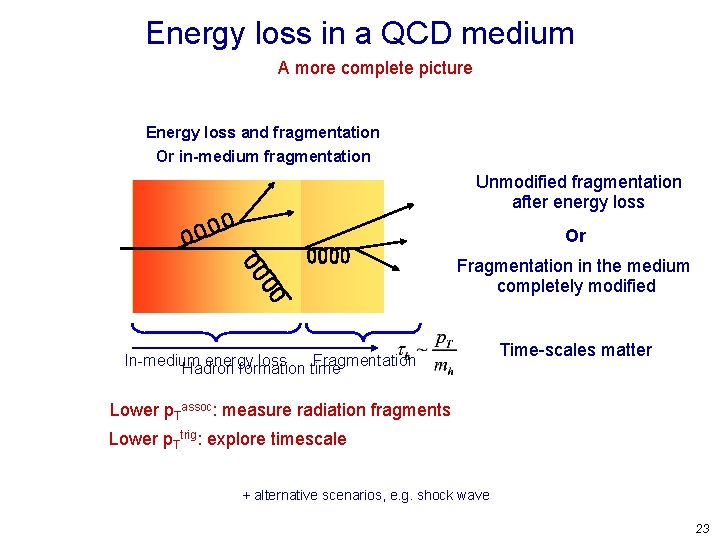
Energy loss in a QCD medium A more complete picture Energy loss and fragmentation Or in-medium fragmentation Unmodified fragmentation after energy loss Or Fragmentation in the medium completely modified In medium energy loss time Fragmentation Hadron formation Time scales matter Lower p. Tassoc: measure radiation fragments Lower p. Ttrig: explore timescale + alternative scenarios, e. g. shock wave 23
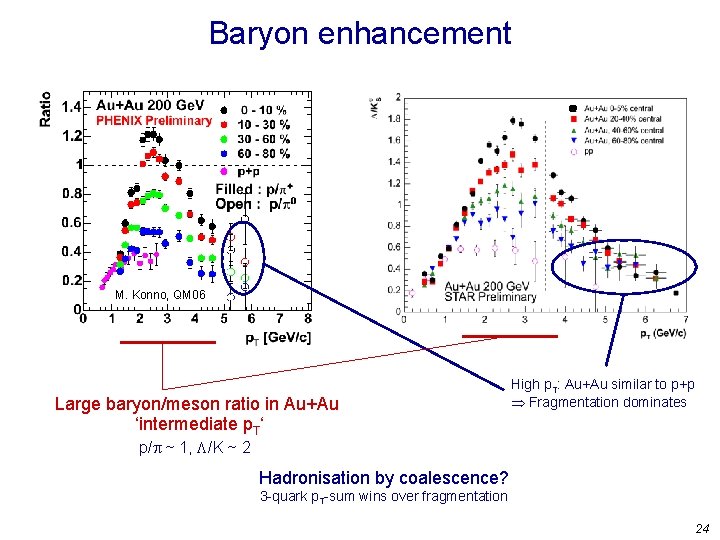
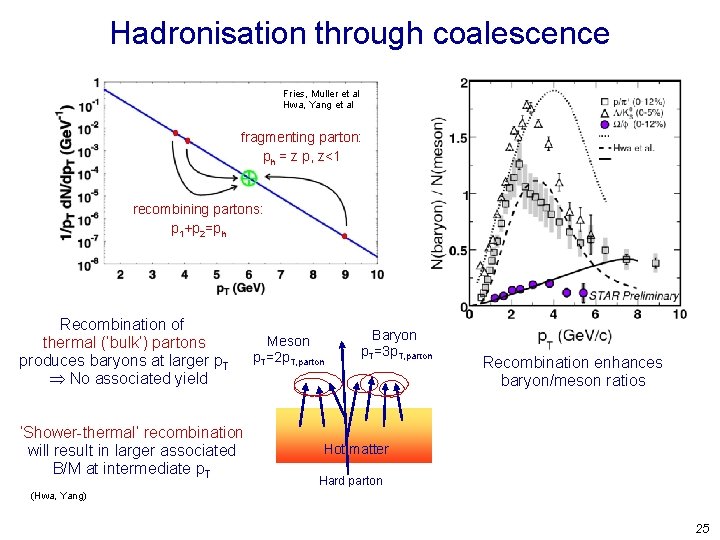
Baryon enhancement M. Konno, QM 06 Large baryon/meson ratio in Au+Au ‘intermediate p. T‘ High p. T: Au+Au similar to p+p Fragmentation dominates p/ ~ 1, /K ~ 2 Hadronisation by coalescence? 3 quark p. T sum wins over fragmentation 24
Hadronisation through coalescence Fries, Muller et al Hwa, Yang et al fragmenting parton: ph = z p, z<1 recombining partons: p 1+p 2=ph Recombination of thermal (‘bulk’) partons produces baryons at larger p. T No associated yield ‘Shower thermal’ recombination will result in larger associated B/M at intermediate p. T Meson p. T=2 p. T, parton Baryon p. T=3 p. T, parton Recombination enhances baryon/meson ratios Hot matter Hard parton (Hwa, Yang) 25
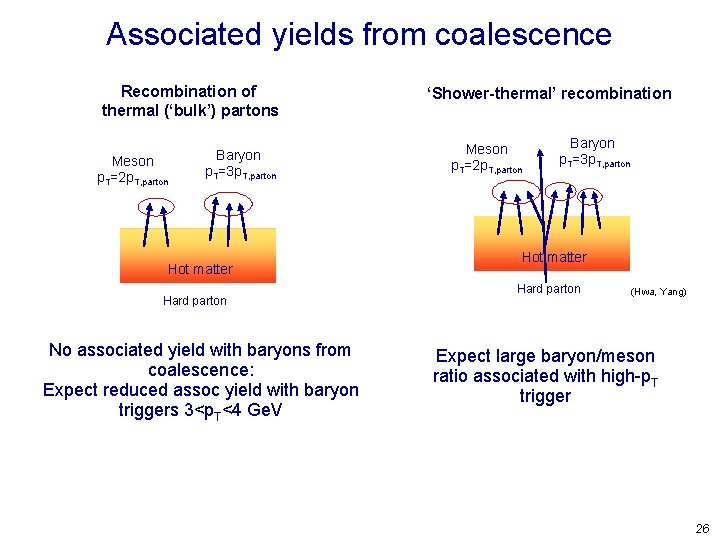
Associated yields from coalescence Recombination of thermal (‘bulk’) partons Meson p. T=2 p. T, parton Baryon p. T=3 p. T, parton Hot matter Hard parton No associated yield with baryons from coalescence: Expect reduced assoc yield with baryon triggers 3<p. T<4 Ge. V ‘Shower-thermal’ recombination Meson p. T=2 p. T, parton Baryon p. T=3 p. T, parton Hot matter Hard parton (Hwa, Yang) Expect large baryon/meson ratio associated with high p. T trigger 26
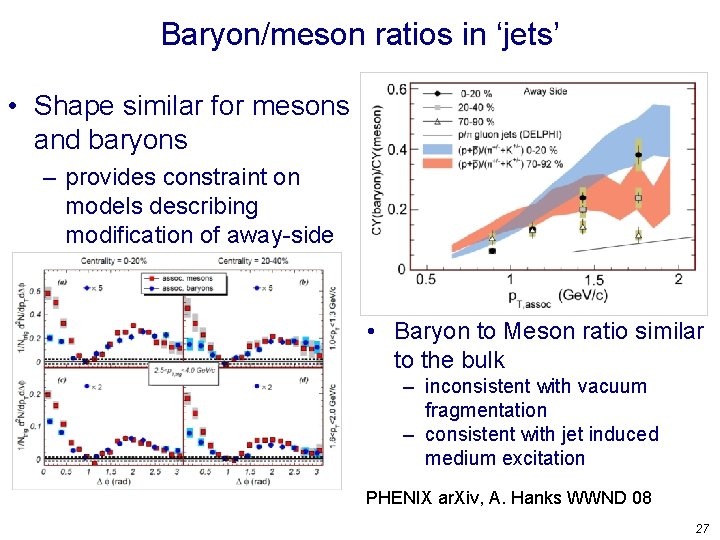
Baryon/meson ratios in ‘jets’ • Shape similar for mesons and baryons – provides constraint on models describing modification of away side • Baryon to Meson ratio similar to the bulk – inconsistent with vacuum fragmentation – consistent with jet induced medium excitation PHENIX ar. Xiv, A. Hanks WWND 08 27
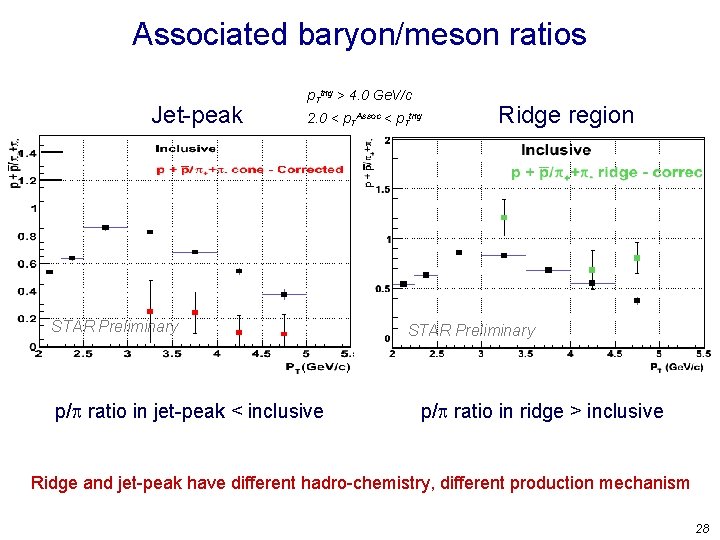
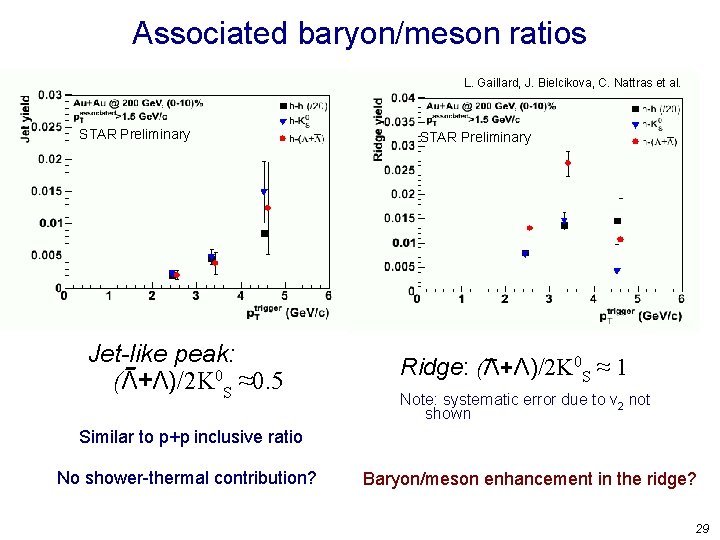
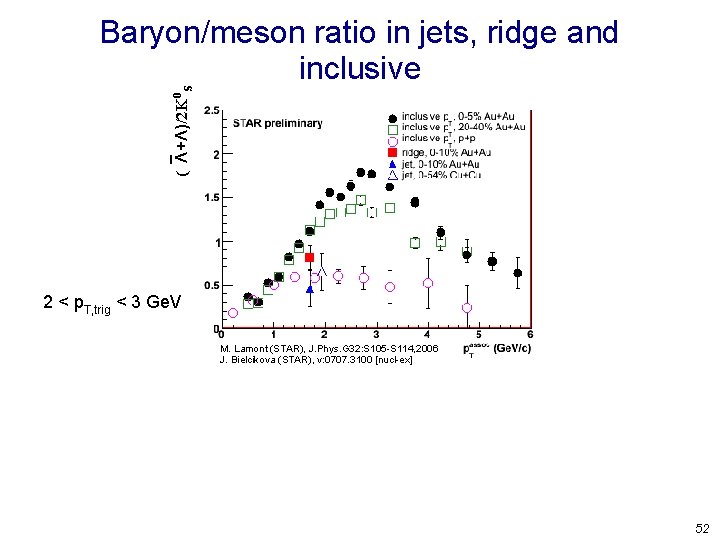
Associated baryon/meson ratios Jet peak p. Ttrig > 4. 0 Ge. V/c 2. 0 < p. TAssoc < p. Ttrig STAR Preliminary p/ ratio in jet peak < inclusive Ridge region STAR Preliminary p/ ratio in ridge > inclusive Ridge and jet peak have different hadro chemistry, different production mechanism 28
Associated baryon/meson ratios L. Gaillard, J. Bielcikova, C. Nattras et al. STAR Preliminary Jet-like peak: (Λ+Λ)/2 K 0 S ≈0. 5 STAR Preliminary Ridge: (Λ+Λ)/2 K 0 S ≈ 1 Note: systematic error due to v 2 not shown Similar to p+p inclusive ratio No shower thermal contribution? Baryon/meson enhancement in the ridge? 29
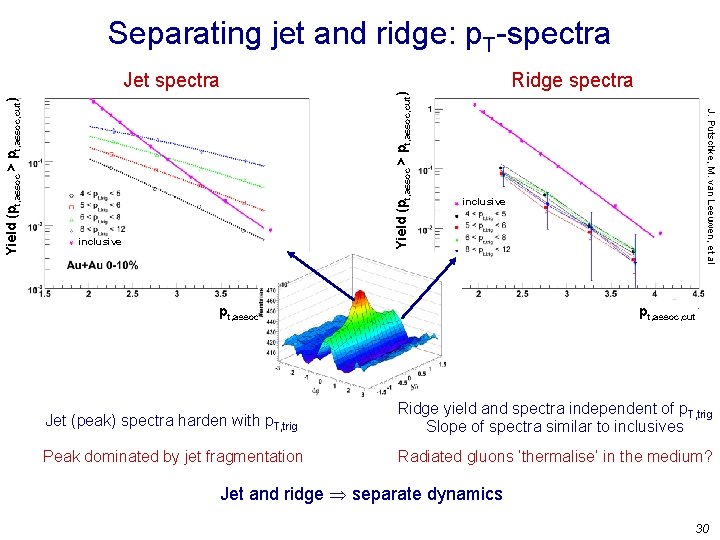
Separating jet and ridge: p. T spectra Yield (pt, assoc > pt, assoc, cut) Ridge spectra inclusive J. Putschke, M. van Leeuwen, et al Yield (pt, assoc > pt, assoc, cut) Jet spectra inclusive pt, assoc, cut Jet (peak) spectra harden with p. T, trig Ridge yield and spectra independent of p. T, trig Slope of spectra similar to inclusives Peak dominated by jet fragmentation Radiated gluons ‘thermalise’ in the medium? Jet and ridge separate dynamics 30
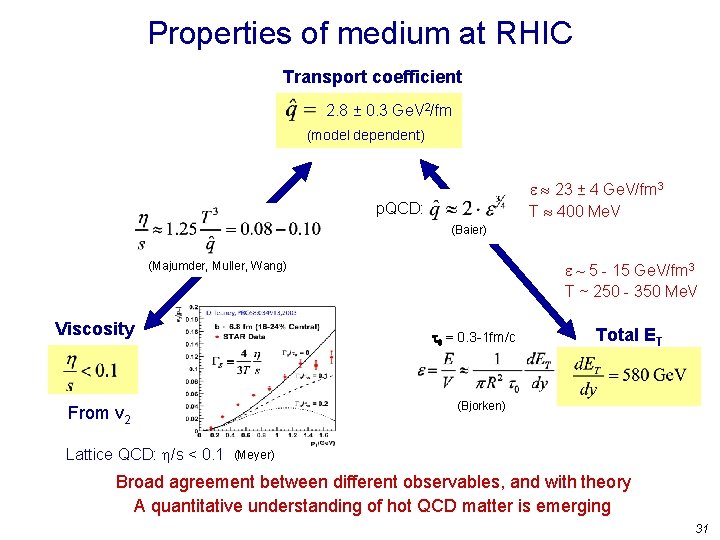
Properties of medium at RHIC Transport coefficient 2. 8 ± 0. 3 Ge. V 2/fm (model dependent) 23 ± 4 Ge. V/fm 3 T 400 Me. V p. QCD: (Baier) (Majumder, Muller, Wang) Viscosity = 0. 3 1 fm/c Total ET (Bjorken) From v 2 Lattice QCD: /s < 0. 1 ~ 5 15 Ge. V/fm 3 T ~ 250 350 Me. V (Meyer) Broad agreement between different observables, and with theory A quantitative understanding of hot QCD matter is emerging 31
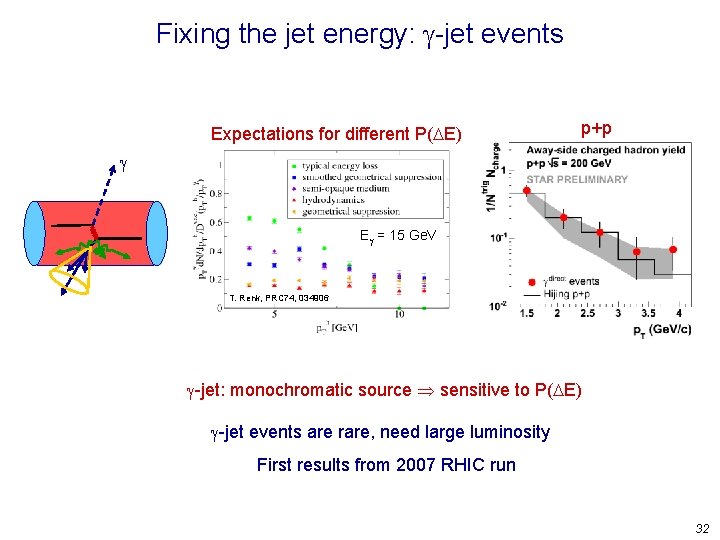
Fixing the jet energy: jet events Expectations for different P( E) p+p E = 15 Ge. V T. Renk, PRC 74, 034906 jet: monochromatic source sensitive to P( E) jet events are rare, need large luminosity First results from 2007 RHIC run 32
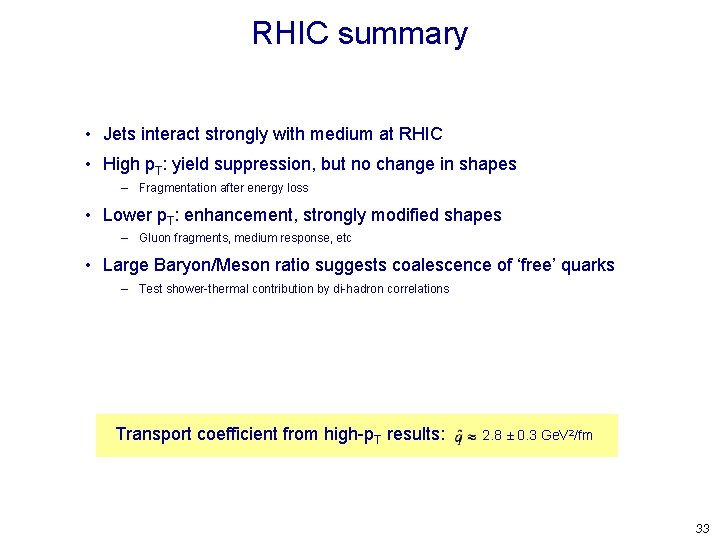
RHIC summary • Jets interact strongly with medium at RHIC • High p. T: yield suppression, but no change in shapes – Fragmentation after energy loss • Lower p. T: enhancement, strongly modified shapes – Gluon fragments, medium response, etc • Large Baryon/Meson ratio suggests coalescence of ‘free’ quarks – Test shower thermal contribution by di hadron correlations Transport coefficient from high p. T results: 2. 8 ± 0. 3 Ge. V 2/fm 33
Extra slides 34
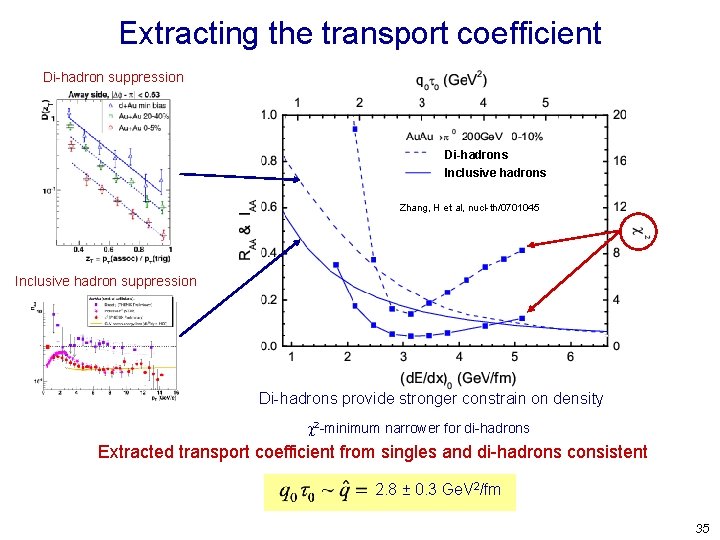
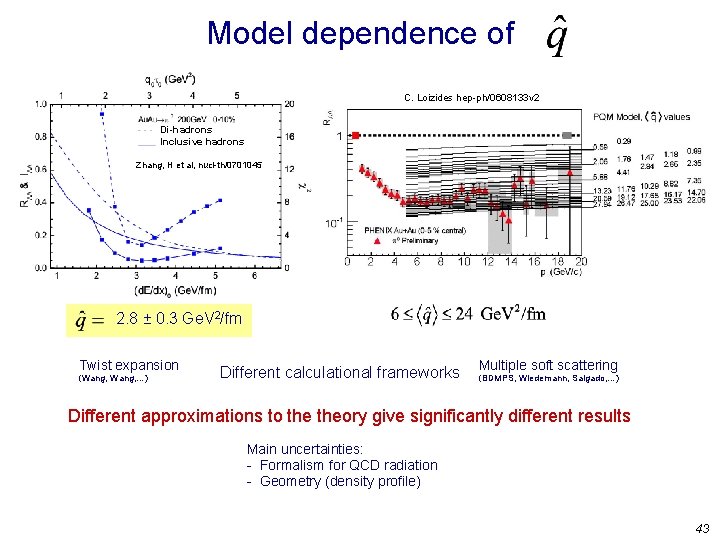
Extracting the transport coefficient Di hadron suppression Di-hadrons Inclusive hadrons Zhang, H et al, nucl th/0701045 Inclusive hadron suppression Di hadrons provide stronger constrain on density 2 minimum narrower for di hadrons Extracted transport coefficient from singles and di hadrons consistent 2. 8 ± 0. 3 Ge. V 2/fm 35
Theory vs. data II PHENIX ’ 08; J. Nagle WWND 08 + PQM/ASW qˆ = 13. 2 23. . 12 Ge. V 2 / fm Model parameters are constrained within ~20% d. N g 270 = 1400 + 150 GLV dy Values are large: ~30 -50 times cold nuclear matter density! d. N g + 200 = 1400 375 WHDG dy Additional assumptions → + 0. 2 3 ZOWW e 0 = 1. 9 0. 5 Ge. V/fm different models are broadly + 016 consistent (except PQM – much AMY a S = 0. 280 00. . 012 larger than others) Strong conclusions: • initially generated medium is highly opaque to energetic partons • very dense, high temperature matter has been created HEDP/HEDLA meeting APS St. Louis Apr 08 Jet probes of the QGP 36 36
Two extreme scenarios 1/Nbin d 2 N/d 2 p. T (or how P( E) says it all) Scenario I P( E) = ( E 0) ‘typical energy loss’ Shifts spectrum to left Scenario II P( E) = a (0) + b (E) ‘partial transmission’ p+p Downward shift Au+Au p. T P( E) encodes the full energy loss process RAA cannot distinguish those two extreme scenarios … need more differential probes 37
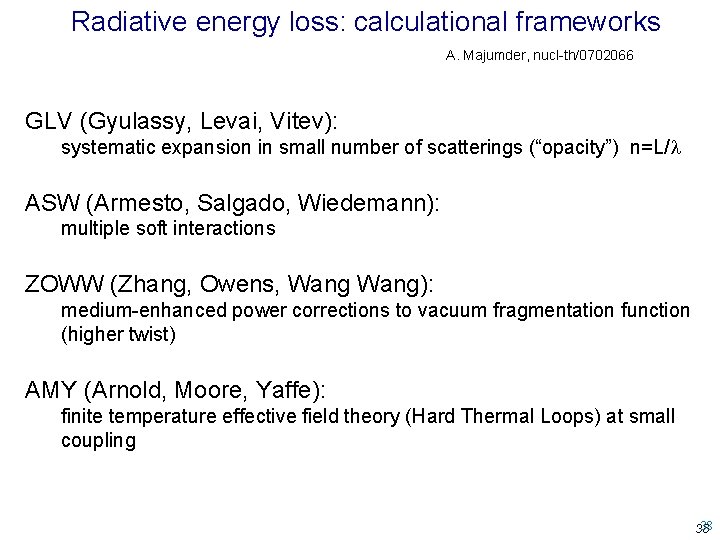
Radiative energy loss: calculational frameworks A. Majumder, nucl th/0702066 GLV (Gyulassy, Levai, Vitev): systematic expansion in small number of scatterings (“opacity”) n=L/ ASW (Armesto, Salgado, Wiedemann): multiple soft interactions ZOWW (Zhang, Owens, Wang): medium enhanced power corrections to vacuum fragmentation function (higher twist) AMY (Arnold, Moore, Yaffe): finite temperature effective field theory (Hard Thermal Loops) at small coupling 38 38
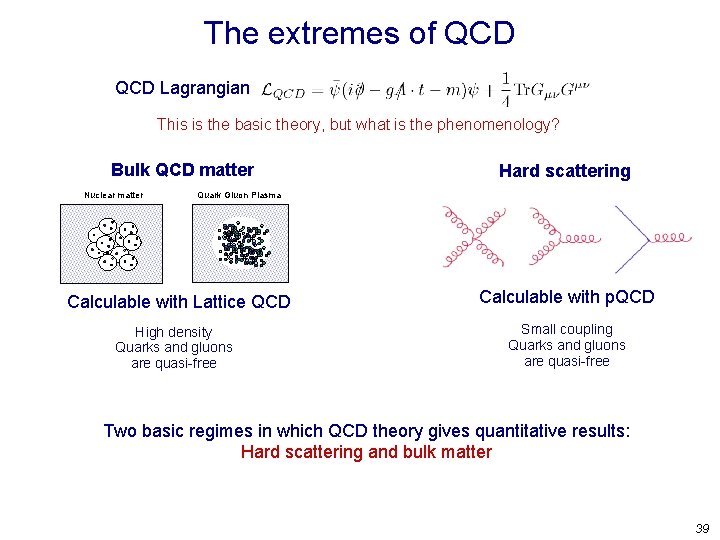
The extremes of QCD Lagrangian This is the basic theory, but what is the phenomenology? Bulk QCD matter Nuclear matter Hard scattering Quark Gluon Plasma Calculable with Lattice QCD High density Quarks and gluons are quasi free Calculable with p. QCD Small coupling Quarks and gluons are quasi free Two basic regimes in which QCD theory gives quantitative results: Hard scattering and bulk matter 39
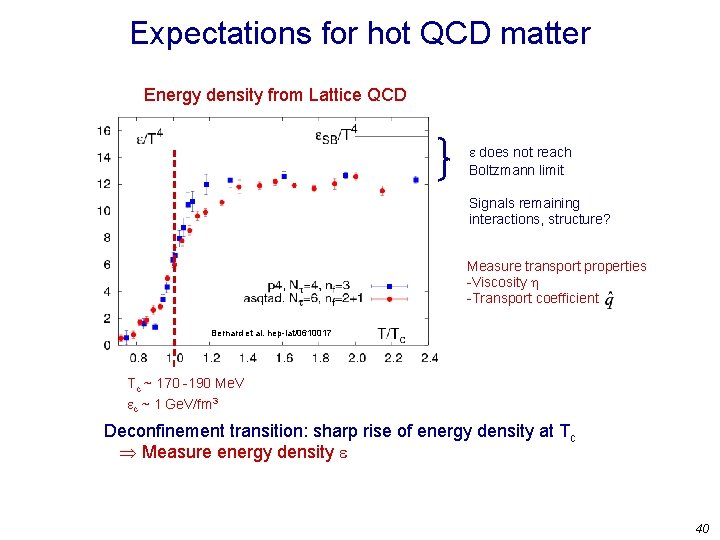
Expectations for hot QCD matter Energy density from Lattice QCD does not reach Boltzmann limit Signals remaining interactions, structure? Measure transport properties Viscosity Transport coefficient Bernard et al. hep lat/0610017 Tc ~ 170 190 Me. V c ~ 1 Ge. V/fm 3 Deconfinement transition: sharp rise of energy density at Tc Measure energy density 40
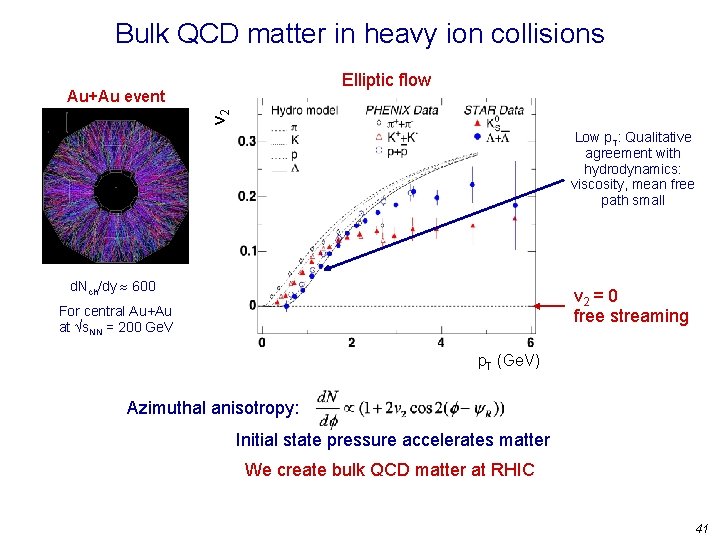
Bulk QCD matter in heavy ion collisions Elliptic flow v 2 Au+Au event Low p. T: Qualitative agreement with hydrodynamics: viscosity, mean free path small d. Nch/dy 600 v 2 = 0 free streaming For central Au+Au at √s. NN = 200 Ge. V p. T (Ge. V) Azimuthal anisotropy: Initial state pressure accelerates matter We create bulk QCD matter at RHIC 41
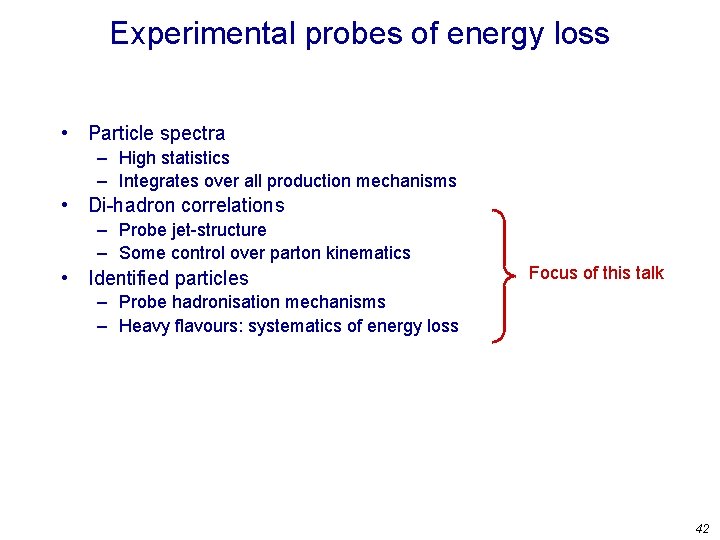
Experimental probes of energy loss • Particle spectra – High statistics – Integrates over all production mechanisms • Di hadron correlations – Probe jet structure – Some control over parton kinematics • Identified particles Focus of this talk – Probe hadronisation mechanisms – Heavy flavours: systematics of energy loss 42
Model dependence of C. Loizides hep ph/0608133 v 2 Di-hadrons Inclusive hadrons Zhang, H et al, nucl th/0701045 2. 8 ± 0. 3 Ge. V 2/fm Twist expansion (Wang, …) Different calculational frameworks Multiple soft scattering (BDMPS, Wiedemann, Salgado, …) Different approximations to theory give significantly different results Main uncertainties: Formalism for QCD radiation Geometry (density profile) 43
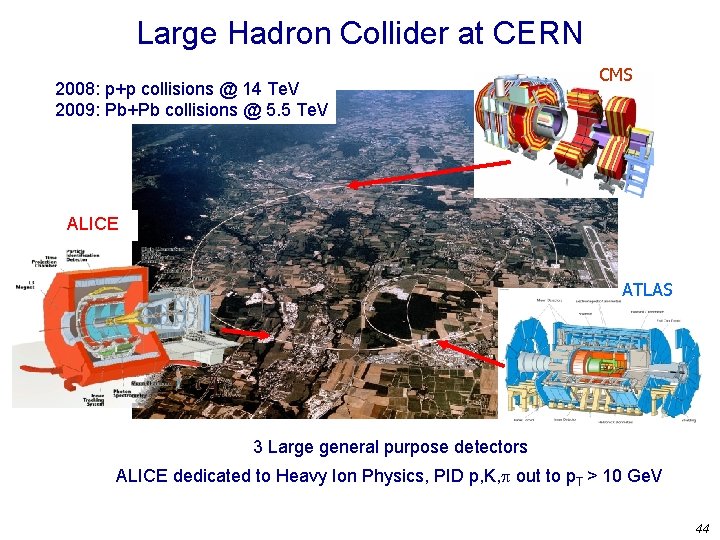
Large Hadron Collider at CERN 2008: p+p collisions @ 14 Te. V 2009: Pb+Pb collisions @ 5. 5 Te. V CMS ALICE ATLAS 3 Large general purpose detectors ALICE dedicated to Heavy Ion Physics, PID p, K, out to p. T > 10 Ge. V 44
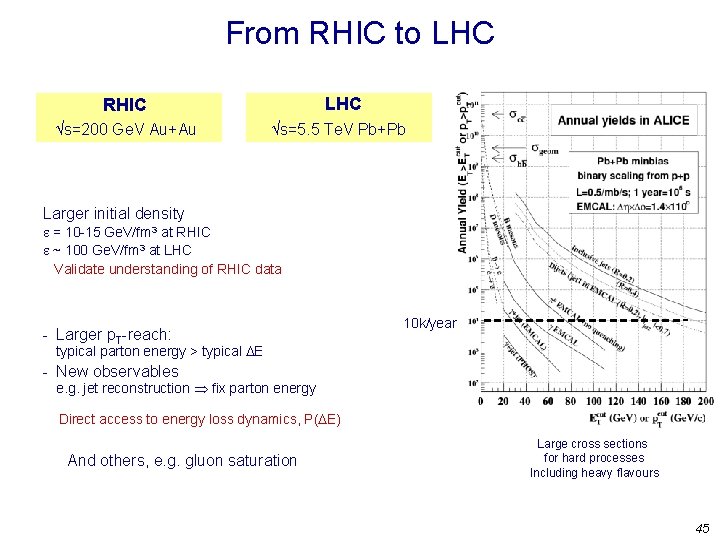
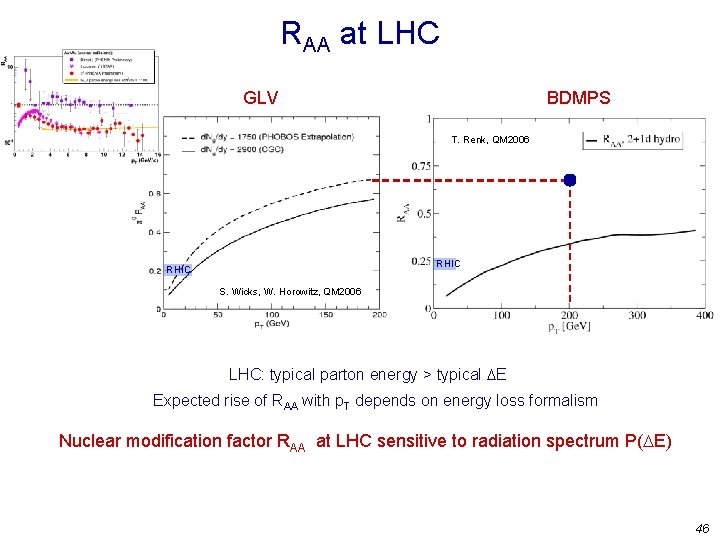
From RHIC to LHC RHIC s=200 Ge. V Au+Au s=5. 5 Te. V Pb+Pb Larger initial density = 10 15 Ge. V/fm 3 at RHIC ~ 100 Ge. V/fm 3 at LHC Validate understanding of RHIC data Larger p. T reach: 10 k/year typical parton energy > typical E New observables e. g. jet reconstruction fix parton energy Direct access to energy loss dynamics, P( E) And others, e. g. gluon saturation Large cross sections for hard processes Including heavy flavours 45
RAA at LHC GLV BDMPS T. Renk, QM 2006 RHIC S. Wicks, W. Horowitz, QM 2006 LHC: typical parton energy > typical E Expected rise of RAA with p. T depends on energy loss formalism Nuclear modification factor RAA at LHC sensitive to radiation spectrum P( E) 46
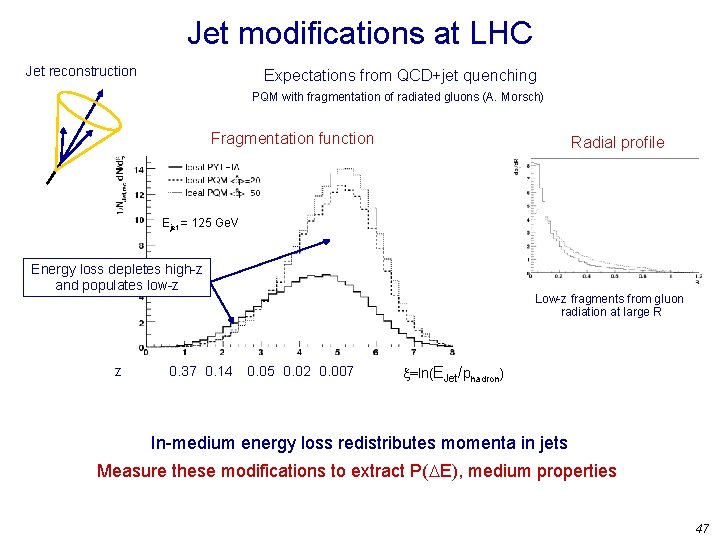
Jet modifications at LHC Jet reconstruction Expectations from QCD+jet quenching PQM with fragmentation of radiated gluons (A. Morsch) Fragmentation function Radial profile Ejet = 125 Ge. V Energy loss depletes high z and populates low z z 0. 37 0. 14 Low z fragments from gluon radiation at large R 0. 05 0. 02 0. 007 =ln(EJet/phadron) In medium energy loss redistributes momenta in jets Measure these modifications to extract P( E), medium properties 47
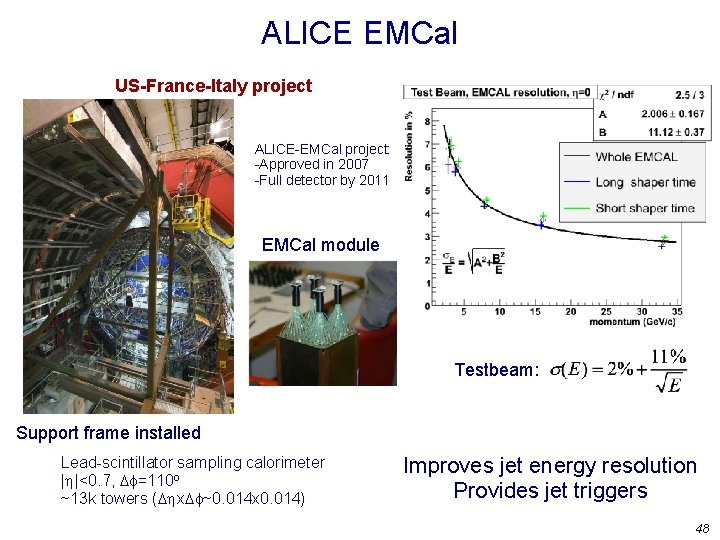
ALICE EMCal US-France-Italy project ALICE EMCal project: Approved in 2007 Full detector by 2011 EMCal module Testbeam: Support frame installed Lead scintillator sampling calorimeter | |<0. 7, =110 o ~13 k towers ( x ~0. 014 x 0. 014) Improves jet energy resolution Provides jet triggers 48
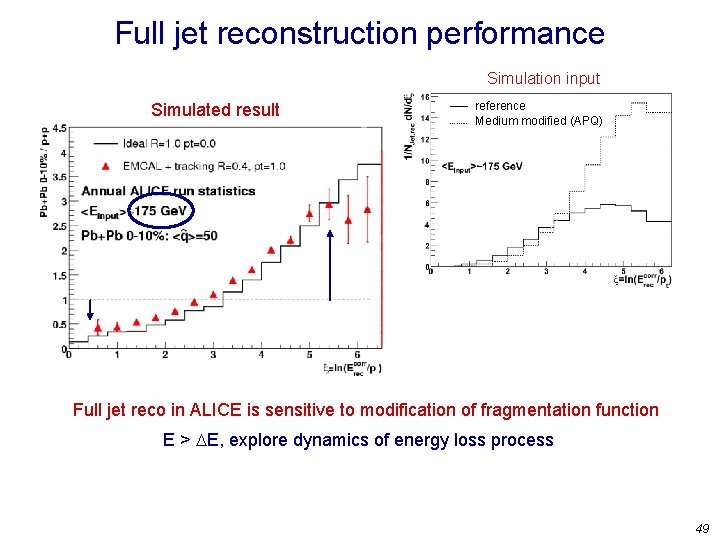
Full jet reconstruction performance Simulation input Simulated result reference Medium modified (APQ) Full jet reco in ALICE is sensitive to modification of fragmentation function E > E, explore dynamics of energy loss process 49
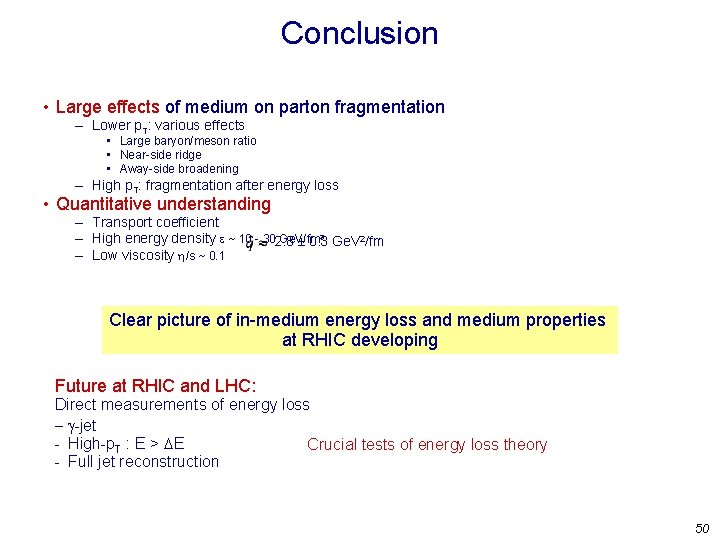
Conclusion • Large effects of medium on parton fragmentation – Lower p. T: various effects • Large baryon/meson ratio • Near side ridge • Away side broadening – High p. T: fragmentation after energy loss • Quantitative understanding – Transport coefficient 3 – High energy density ~ 10 302. 8 Ge. V/fm ± 0. 3 Ge. V 2/fm – Low viscosity /s ~ 0. 1 Clear picture of in medium energy loss and medium properties at RHIC developing Future at RHIC and LHC: Direct measurements of energy loss jet High p. T : E > E Crucial tests of energy loss theory Full jet reconstruction 50
Thank you for your attention 51
( Λ+Λ)/2 K 0 S Baryon/meson ratio in jets, ridge and inclusive 2 < p. T, trig < 3 Ge. V M. Lamont (STAR), J. Phys. G 32: S 105 S 114, 2006 J. Bielcikova (STAR), v: 0707. 3100 [nucl ex] 52
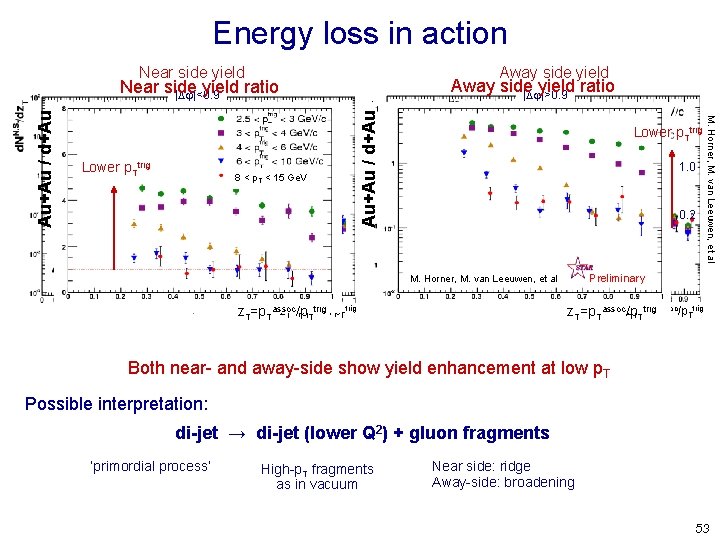
Energy loss in action Near side yield Away side yield ratio | |>0. 9 Lower p. Ttrig 8 < p. T < 15 Ge. V Au+Au / d+Au 8 < p. Ttrig < 15 Ge. V Lower p. Ttrig 8 < p. T < 15 Ge. V 1. 0 0. 2 Preliminary M. Horner, M. van Leeuwen, et al Au+Au / d+Au Near side yield ratio | |<0. 9 Preliminary M. Horner, M. van Leeuwen, et al trig assoc/p trig z. TT=p z. T=p. Tassoc/p T T trig /p trig z. T=p. Tassoc /p. TTassoc T Both near and away side show yield enhancement at low p. T Possible interpretation: di-jet → di-jet (lower Q 2) + gluon fragments ‘primordial process’ High p. T fragments as in vacuum Near side: ridge Away side: broadening 53
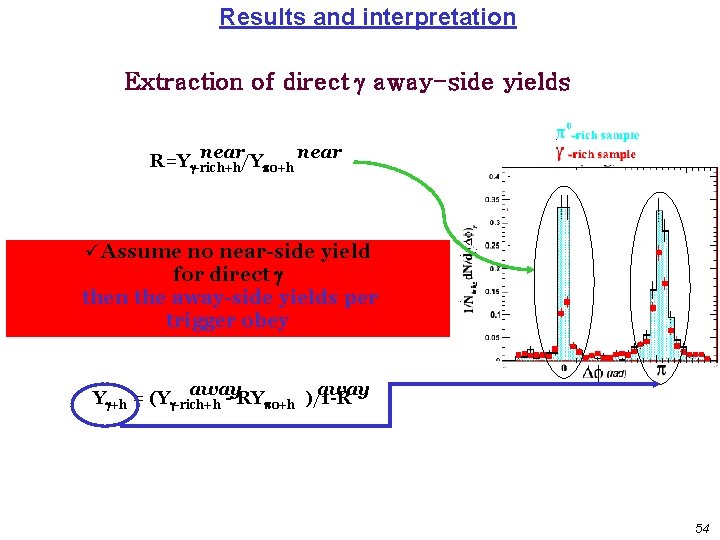
Results and interpretation Extraction of direct away-side yields near R=Y -rich+h/Y 0+h near Assume no near-side yield for direct then the away-side yields per trigger obey away Y +h = (Y -rich+h - RY 0+h )/1 -R 54
Results and interpretation Direct away-side yields The away-side yield of the associated particle per trigger in -jet is suppressed. 55