
JESUS ANOINTED BY A SINFUL WOMAN LUKE 7

JESUS ANOINTED BY A SINFUL WOMAN LUKE 7: 36 -47
Introduction In Luke 7: 36 -50, is the woman who brought an alabaster jar of fragrant oil to the Lord Jesus. Her story is one of the most powerful stories of repentance and forgiveness, one that shows the kind heart of God. A moving story of someone who expressed her love & affection knowing the weight of her sins are taken away. It is hard to express any love or even kindness to someone when we are not grateful. (A Pharisee’s Rudeness to Christ & a woman) Jesus reaching out to the rejected and despised. (Lepers, sick & sinners). A Bible story of a woman who did not have a good reputation or character. Luke gives the only record we have of this incident. (Mt 26: 7, Mk 14: 3, Jn 12: 3).
Introduction In Luke 7: 36 -50, is the woman who brought an alabaster jar of fragrant oil to the Lord Jesus. Her story is one of the most powerful stories of repentance and forgiveness, one that shows the kind heart of God. A moving story of someone who expressed her love & affection knowing the weight of her sins are taken away. It is hard to express any love or even kindness to someone when we are not grateful. (A Pharisee’s Rudeness to Christ & a woman) A Bible story of a woman who did not have a good reputation. Luke gives the only record we have of this incident. (Mt 26: 7, Mk 14: 3, Jn 12: 3).
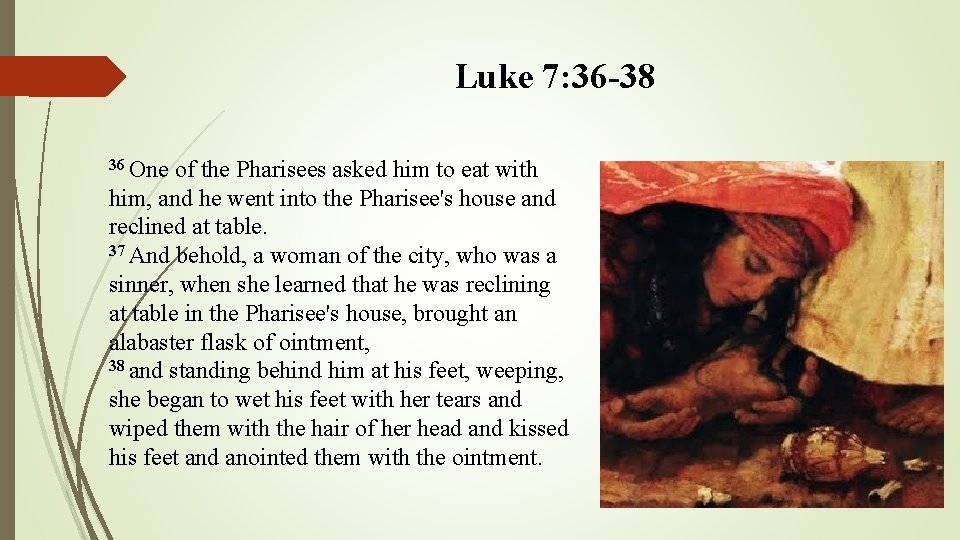
Luke 7: 36 -38 36 One of the Pharisees asked him to eat with him, and he went into the Pharisee's house and reclined at table. 37 And behold, a woman of the city, who was a sinner, when she learned that he was reclining at table in the Pharisee's house, brought an alabaster flask of ointment, 38 and standing behind him at his feet, weeping, she began to wet his feet with her tears and wiped them with the hair of her head and kissed his feet and anointed them with the ointment.
In Bible times there were 3 things that were always done when a guest came to your home - 3 common acts of courtesy. 1. There was always a basin of water with a towel, the feet of the guest were washed, either by a servant or by the host himself, because the roads were dusty, & they wore sandals. That was a refreshing & polite thing to do for your guest. 2. You would always greet your guests by grasping their shoulders & giving them what was called "the kiss of peace. " It was kind of like shaking hands today, a way of welcoming them into your home. 3. There was always perfume or a cooling ointment of some kind to be used to anoint the guest's head as an expression of welcome.
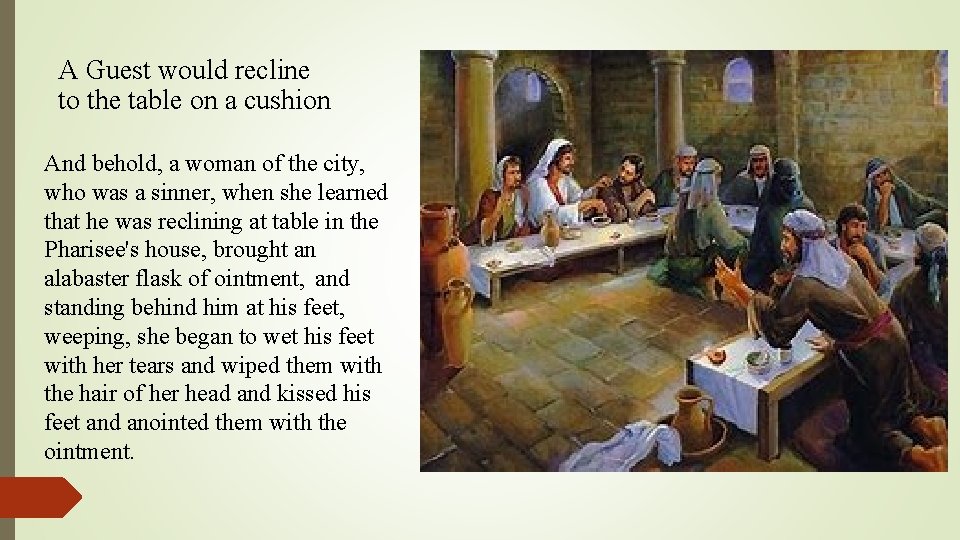
A Guest would recline to the table on a cushion And behold, a woman of the city, who was a sinner, when she learned that he was reclining at table in the Pharisee's house, brought an alabaster flask of ointment, and standing behind him at his feet, weeping, she began to wet his feet with her tears and wiped them with the hair of her head and kissed his feet and anointed them with the ointment.
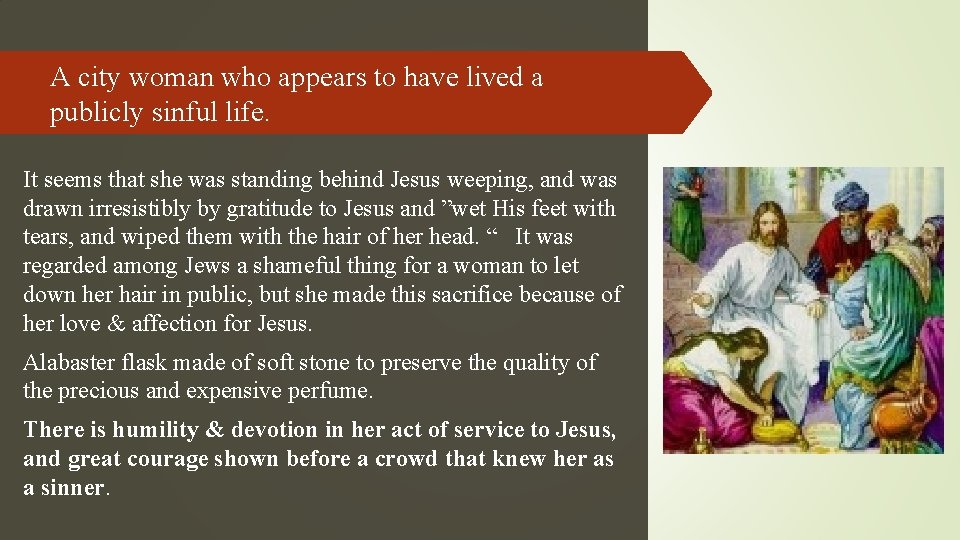
A city woman who appears to have lived a publicly sinful life. It seems that she was standing behind Jesus weeping, and was drawn irresistibly by gratitude to Jesus and ”wet His feet with tears, and wiped them with the hair of her head. “ It was regarded among Jews a shameful thing for a woman to let down her hair in public, but she made this sacrifice because of her love & affection for Jesus. Alabaster flask made of soft stone to preserve the quality of the precious and expensive perfume. There is humility & devotion in her act of service to Jesus, and great courage shown before a crowd that knew her as a sinner.
Luke 7: 39 -40 39 Now when the Pharisee who had invited him saw this, he said to himself, “If this man were a prophet, he would have known who and what sort of woman this is who is touching him, for she is a sinner. ” 40 And Jesus answering said to him, “Simon, I have something to say to you. ” And he answered, “Say it, Teacher. ”
The Pharisee reasons to himself that Jesus is not a prophet. Pharisees are religious leaders known for their strict adherence to the Law. Simon the Pharisee would have despised Jesus for allowing this women a sinner (of bad reputation) to touch him (how do we react to people of bad reputation? ). Jesus Himself appreciated her actions, for He saw the sincerity of her actions. ”Godly sorrow brings repentance that leads to salvation” 2 Cor. 7: 10. Jesus knew what the Pharisee was thinking.

Luke 7: 41 -43 41 “A certain moneylender had two debtors. One owed five hundred denarii, and the other fifty. 42 When they could not pay, he cancelled the debt of both. Now which of them will love him more? ” 43 Simon answered, “The one, I suppose, for whom he cancelled the larger debt. ” And he said to him, “You have judged rightly. ”
Realising how much we are in debt to Jesus often compared sin to a monetary debt. Neither of the debtors could pay the amount owed. (Helpless) The lender , out of the kindness and generosity of his heart, released them of their debt. Favour, Kindness, Benevolence & sympathy is the reason for this. Jesus asks “which of them will love him more” The attitude of 2 debtors toward the lender who forgave them both. The Pride of the Righteous compared to the Humble repentant sinner.
Luke 18: 9 -14 9 He also told this parable to some who trusted in themselves that they were righteous, and treated others with contempt: 10 “Two men went up into the temple to pray, one a Pharisee and the other a tax collector. 11 The Pharisee, standing by himself, prayed thus: ‘God, I thank you that I am not like other men, extortioners, unjust, adulterers, or even like this tax collector. 12 I fast twice a week; I give tithes of all that I get. ’ 13 But the tax collector, standing far off, would not even lift up his eyes to heaven, but beat his breast, saying, ‘God, be merciful to me, a sinner!’ 14 I tell you, this man went down to his house justified, rather than the other. For everyone who exalts himself will be humbled, but the one who humbles himself will be exalted. ”
Luke 7: 44 -47 44 Then turning toward the woman he said to Simon, “Do you see this woman? I entered your house; you gave me no water for my feet, but she has wet my feet with her tears and wiped them with her hair. 45 You gave me no kiss, but from the time I came in she has not ceased to kiss my feet. 46 You did not anoint my head with oil, but she has anointed my feet with ointment. 47 Therefore I tell you, her sins, which are many, are forgiven —for she loved much. But he who is forgiven little, loves little. ”
Politeness is a love characteristic in showing respect Simon failed to meet the most basic duties of a host. On the other hand, the woman’s actions showed overflowing love for Jesus. Overflowing and extravagant love is the expression of true forgiveness. 1 Cor. 13: 5. Love is not rude. Politeness should show in our love for God, without it, it would make the gospel message in effective. Politeness is defined as Having good manners, being considerate of others, being courteous. The women did not speak, but he actions volumes.
Luke 7: 48 -50 48 And he said to her, “Your sins are forgiven. ” 49 Then those who were at table with him began to say among themselves, “Who is this, who even forgives sins? ” 50 And he said to the woman, “Your faith has saved you; go in peace. ” Rom 3: 23 -24. 23 for all have sinned and fall short of the glory of God, 24 and are justified by his grace as a gift, through the redemption that is in Christ Jesus,

Conclusion Humility – Faith – Repentance, sorrow for sins leads to repentance, and from within her heart an overflowing love for Jesus. For if people don't see the love of Christ in us, they are less likely to see Him in the gospel we proclaim. Realise the weight of sin is taken away through Jesus – the love and affection it brought to this woman. She did not speak, but her actions did. We are not to judge others around us, especially those ‘sinful’ people? We need to realize that we all are morally in debt, when it comes to God’s standard.
- Slides: 16