
Jersey Compliance Officers Association Effective Span of Control
- Slides: 22
Jersey Compliance Officers’ Association Effective Span of Control or Using Culture to Control Compliance Simon Gould 10 May 2016
Introduction • A legal and practical perspective… • The compliance culture – what is it? • Who thinks they know what their firm’s culture is? • Who thinks their firm has a good culture? • Who thinks they can measure their firm’s culture? Simon Gould Slide 2
What are we going to cover? • Commentary on culture – whats all the fuss? • Jersey rules about compliance culture • What should we do about compliance culture • Effective span of control and accountability • Final thoughts Simon Gould Slide 3
Commentary on ‘culture’ • VW Emissions scandal – Everyone does it… • From the FT: “The head of a Wall Street bank once told me the lesson he had learned from financial scandals was that ethics are absolute, not comparative. “We don’t behave as badly as our rivals” was a tempting but dangerous attitude. ” • "We need in future a climate in which problems aren't hidden but can be openly communicated to superiors, " said Osterloh, who as chief of the VW works council represents employees on the board. "We need a culture in which it's possible and permissible to argue with your superior about the best way to go. " Simon Gould Slide 4
Commentary on ‘culture’ • FCA ‘Culture Project’ – thematic review of banking culture cancelled 2015 • “…it became even clearer that each firm has, and needs to have, its own approach. They need to build a strong culture from the top down…” • “The idiosyncratic nature of each individual institution meant that issuing generalised good and poor practice guidance was unlikely to be of sufficient value to justify continuing to focus our resources on the crossfirm work rather than by addressing this firm by firm with individual institutions. ” • “Now, our intention is to consult more widely, beginning internally, to develop a FCA-wide view on culture; including what we mean by culture and what our overall vision for culture is. ” Simon Gould Slide 5
Commentary on ‘culture’ • Speech by John Harris, Director General, Jersey Financial Services Commission 8 September 2015: • “We work very hard at identifying the three dominant risk factors within a culture of a firm that we evaluate on a regular basis that are likely to result in some of the worst crystallisation of risks that we see. Over dominant shareholder owners or controllers is obviously uppermost. The need to put short term revenue before the maintenance of long term business viability is another. Risk taking of the worst variety, by gaming the system and hoping you won’t get found out is another. ” Simon Gould Slide 6
Anchor Trust v JFSC, 2005 • Appeal against JFSC refusal to licence business • The JFSC referred to: “· a lack of competence; · a failure to acknowledge past mistakes; · a failure to take account of lessons learned; · a failure to be open with the Commission. This, and the other concerns set out in the Minded to Refuse Letter, has led the Executive to believe that, whatever procedural improvements have been made, the underlying culture of the firm has not really changed and lessons have not been learned. This is the fundamental reason why we cannot be satisfied that it is fit and proper to be licensed. ” Simon Gould Slide 7
Jersey rules on ‘culture’: AML Handbook • The Board must consider what barriers (including cultural barriers) exist to prevent the operation of effective systems and controls (including policies and procedures) to counter money laundering and financing of terrorism, and must take effective measures to address them. • Human factors, such as the inter-relationships between different employees, and between employees and customers, can result in the creation of damaging barriers. • Consideration of cultural barriers will be adequate where the Board considers the prevalence of specified 17 factors, as follows • Simon Gould Slide 8
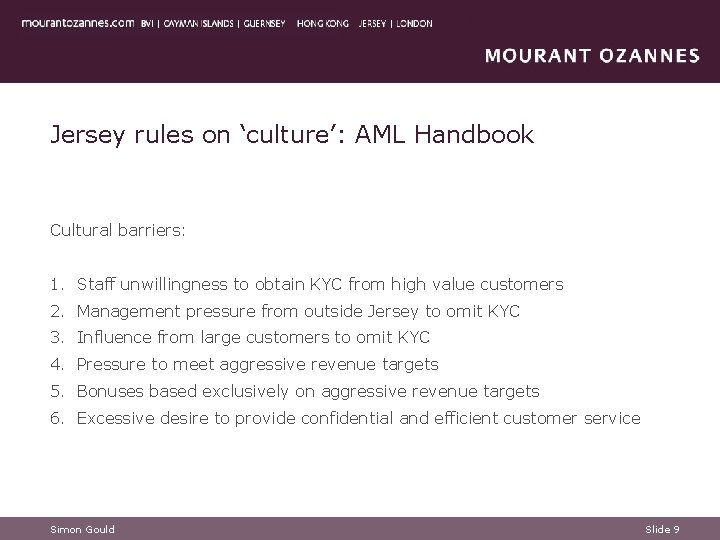
Jersey rules on ‘culture’: AML Handbook Cultural barriers: 1. Staff unwillingness to obtain KYC from high value customers 2. Management pressure from outside Jersey to omit KYC 3. Influence from large customers to omit KYC 4. Pressure to meet aggressive revenue targets 5. Bonuses based exclusively on aggressive revenue targets 6. Excessive desire to provide confidential and efficient customer service Simon Gould Slide 9
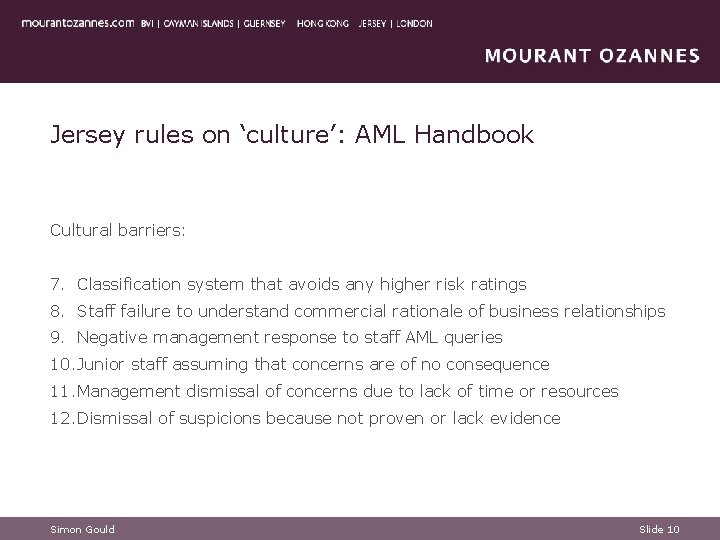
Jersey rules on ‘culture’: AML Handbook Cultural barriers: 7. Classification system that avoids any higher risk ratings 8. Staff failure to understand commercial rationale of business relationships 9. Negative management response to staff AML queries 10. Junior staff assuming that concerns are of no consequence 11. Management dismissal of concerns due to lack of time or resources 12. Dismissal of suspicions because not proven or lack evidence Simon Gould Slide 10
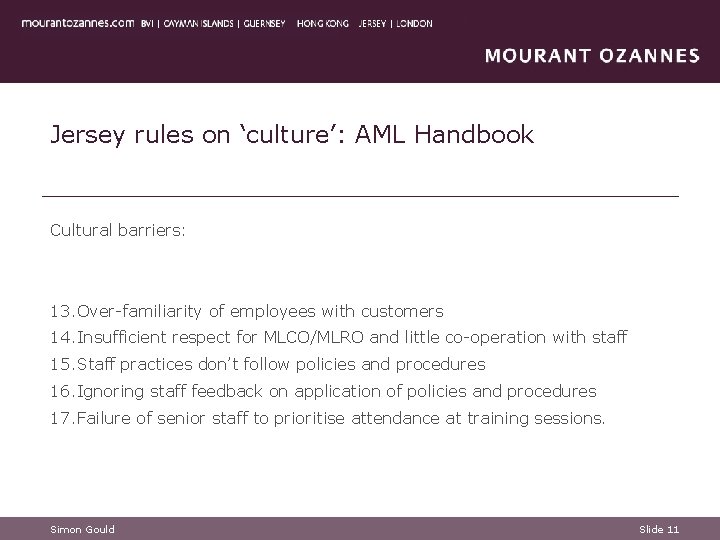
Jersey rules on ‘culture’: AML Handbook Cultural barriers: 13. Over-familiarity of employees with customers 14. Insufficient respect for MLCO/MLRO and little co-operation with staff 15. Staff practices don’t follow policies and procedures 16. Ignoring staff feedback on application of policies and procedures 17. Failure of senior staff to prioritise attendance at training sessions. Simon Gould Slide 11
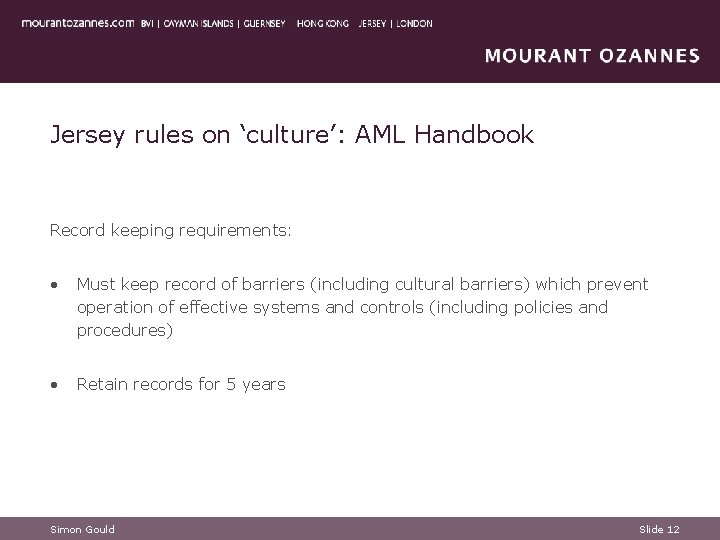
Jersey rules on ‘culture’: AML Handbook Record keeping requirements: • Must keep record of barriers (including cultural barriers) which prevent operation of effective systems and controls (including policies and procedures) • Retain records for 5 years Simon Gould Slide 12
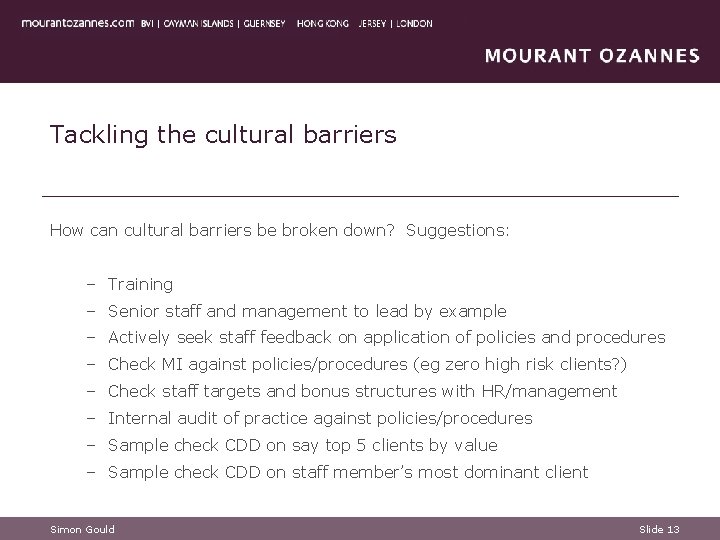
Tackling the cultural barriers How can cultural barriers be broken down? Suggestions: – Training – Senior staff and management to lead by example – Actively seek staff feedback on application of policies and procedures – Check MI against policies/procedures (eg zero high risk clients? ) – Check staff targets and bonus structures with HR/management – Internal audit of practice against policies/procedures – Sample check CDD on say top 5 clients by value – Sample check CDD on staff member’s most dominant client Simon Gould Slide 13
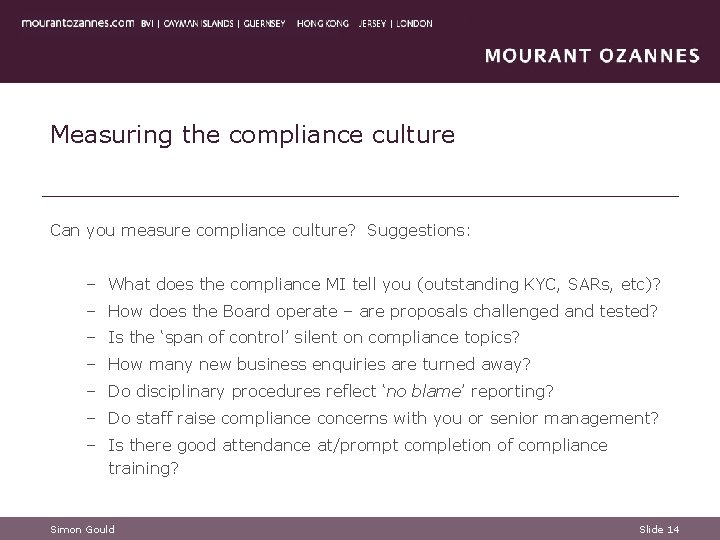
Measuring the compliance culture Can you measure compliance culture? Suggestions: – What does the compliance MI tell you (outstanding KYC, SARs, etc)? – How does the Board operate – are proposals challenged and tested? – Is the ‘span of control’ silent on compliance topics? – How many new business enquiries are turned away? – Do disciplinary procedures reflect ‘no blame’ reporting? – Do staff raise compliance concerns with you or senior management? – Is there good attendance at/prompt completion of compliance training? Simon Gould Slide 14
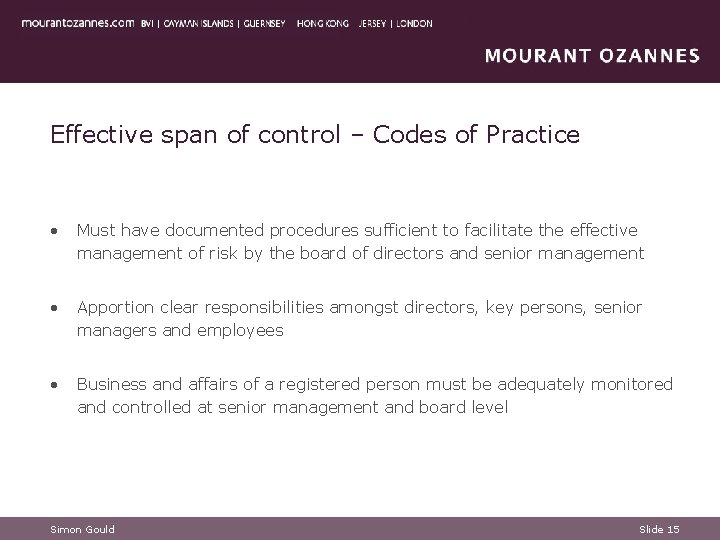
Effective span of control – Codes of Practice • Must have documented procedures sufficient to facilitate the effective management of risk by the board of directors and senior management • Apportion clear responsibilities amongst directors, key persons, senior managers and employees • Business and affairs of a registered person must be adequately monitored and controlled at senior management and board level Simon Gould Slide 15
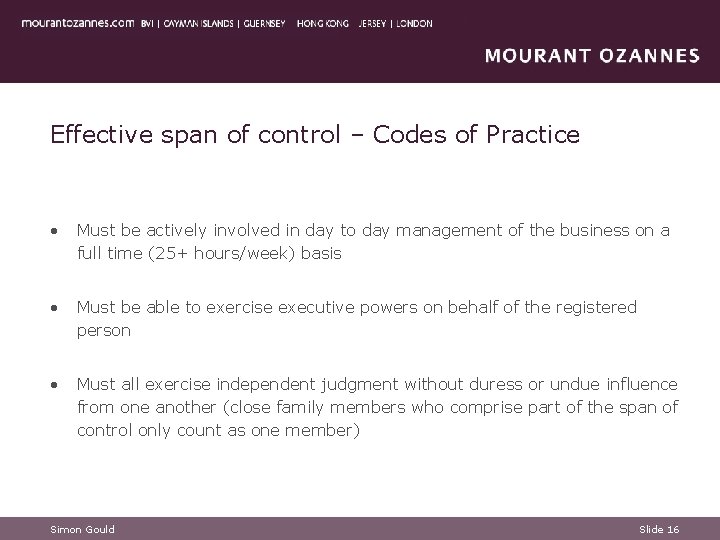
Effective span of control – Codes of Practice • Must be actively involved in day to day management of the business on a full time (25+ hours/week) basis • Must be able to exercise executive powers on behalf of the registered person • Must all exercise independent judgment without duress or undue influence from one another (close family members who comprise part of the span of control only count as one member) Simon Gould Slide 16
Accountability for compliance culture failures • The UK Senior Managers Regime “is based on the understanding that the banking sector needs to change and that a culture of personal responsibility has to be embedded in firms. The work that [the FCA is] doing to implement the [new regime is] at the heart of our programme to drive through cultural change in industry”. • “The new regime will ensure that individuals, their employers and regulators know who is responsible for what, and when things go wrong the right people will be held to account. A map showing individuals’ and firms’ responsibilities will cover the Senior Managers with overall responsibility in a firm, ensuring that the regulators can focus on the individuals whom firms genuinely see as accountable. ” Simon Gould Slide 17
Accountability for compliance culture failures • Individuals may be subject to JFSC directions and public statements • Moneyval call for greater evidence of enforcement • Are we trying to create a ‘no blame’ culture in a climate of fear? • See JFSC’s consultation on MIFID II - financial penalties for individuals? Simon Gould Slide 18
Practical steps to enhance span of control • Apportion and map key responsibilities • Establish decision-making procedures to address: – ‘groupthink’ (practice of thinking or making decisions as a group, resulting typically in unchallenged poor quality decisions) – conflicting interests of span of control/senior managers – personal biases, factions and diversity – line management • Establish a risk and compliance committee Simon Gould Slide 19
Final thoughts • No ‘silver bullet’ solution – it’s about human nature • Start at the top • Foster a ‘no blame’ culture, except for deliberately hidden failures • Foster a culture of professional responsibility and resolution • Consider boardroom dynamics • Don’t expect everyone to follow procedures • Address the culture in your own firm • Tackle intangible culture with real actions Simon Gould Slide 20
Questions? Simon Gould Slide 21
Contact details: Simon Gould simon. gould@mourantozannes. com T + 44 1534 676367 Mourant Ozannes is one of the world's leading offshore law firms. We advise on the laws of the BVI, Cayman Islands, Guernsey and Jersey.