
Jeremy Harmer Chapter One Learners Kathrine Tatlonghari September

Jeremy Harmer Chapter One: “Learners” Kathrine Tatlonghari September 10, 2012 SLS 303
+ Overview n Reasons for learning n Different Contexts for learning n Learner Differences n The importance of student motivation n Responsibility for learning n Provide possible solutions
+ Reasons for learning n English is the global language n Many have different reasons for learning English (or a second/foreign language) Moved into a target-language community n English for a Specific Purpose (ESP) n Example: Business English n English for Academic Purposes (EAP) n
+ Key Point n The purpose for learning affects what Ss want/need to learn and influences what they are taught.
+ Context for learning n Examples Influence of schools: n Large classes VS one-to-one teaching n In-school VS In-company teaching n Real VS Virtual learning environment Key points: n Size of class affect how we teach n School Curriculum/ Learner Outcomes n Teach to the test
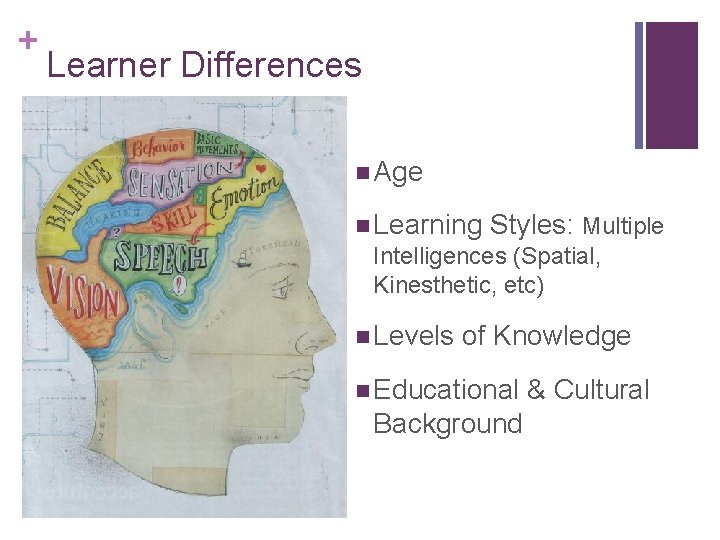
+ Learner Differences n Age n Learning Styles: Multiple Intelligences (Spatial, Kinesthetic, etc) n Levels of Knowledge n Educational & Cultural Background
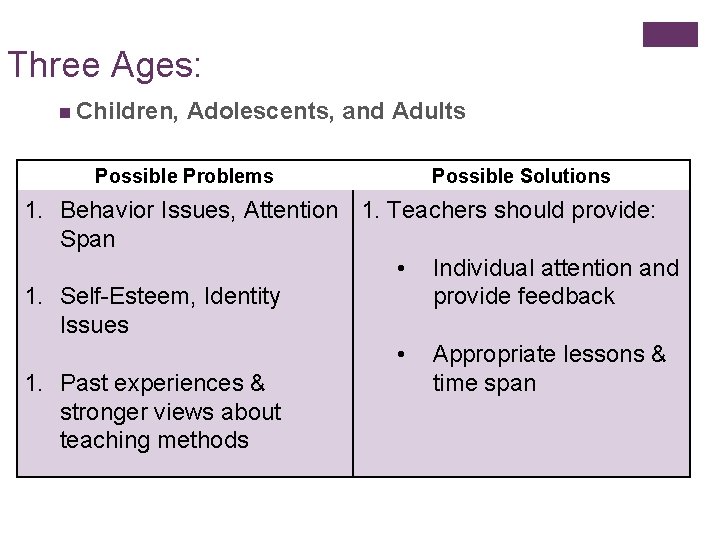
Three Ages: n Children, Adolescents, and Adults Possible Problems Possible Solutions 1. Behavior Issues, Attention 1. Teachers should provide: Span • Individual attention and 1. Self-Esteem, Identity provide feedback Issues • Appropriate lessons & 1. Past experiences & time span stronger views about teaching methods
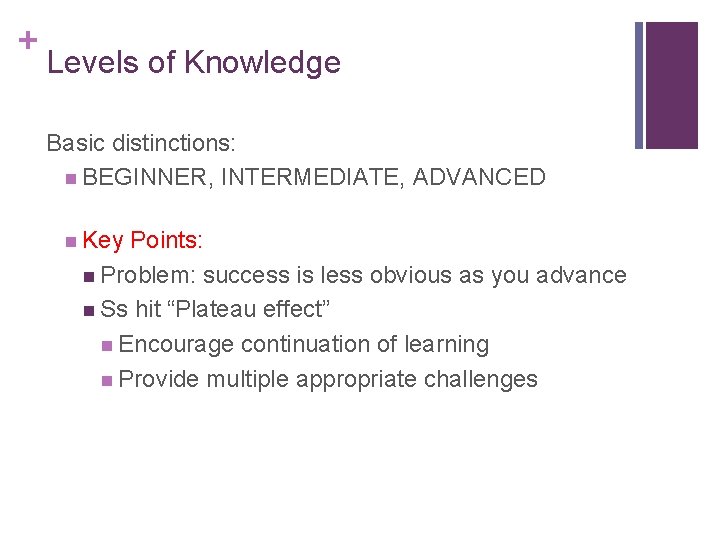
+ Levels of Knowledge Basic distinctions: n BEGINNER, INTERMEDIATE, ADVANCED n Key Points: n Problem: success is less obvious as you advance n Ss hit “Plateau effect” n Encourage continuation of learning n Provide multiple appropriate challenges
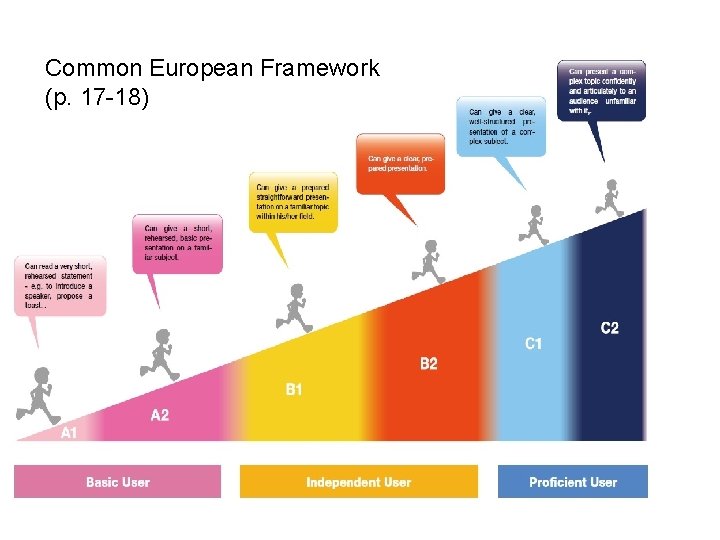
Common European Framework (p. 17 -18)
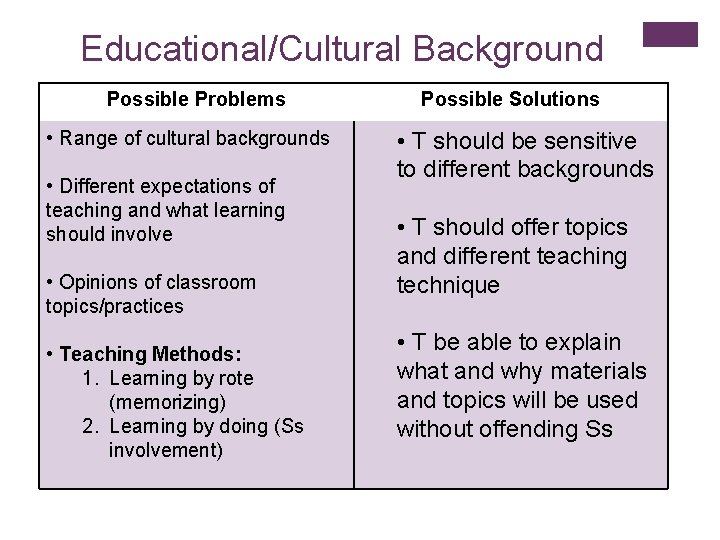
Educational/Cultural Background Possible Problems • Range of cultural backgrounds • Different expectations of teaching and what learning should involve • Opinions of classroom topics/practices • Teaching Methods: 1. Learning by rote (memorizing) 2. Learning by doing (Ss involvement) Possible Solutions • T should be sensitive to different backgrounds • T should offer topics and different teaching technique • T be able to explain what and why materials and topics will be used without offending Ss
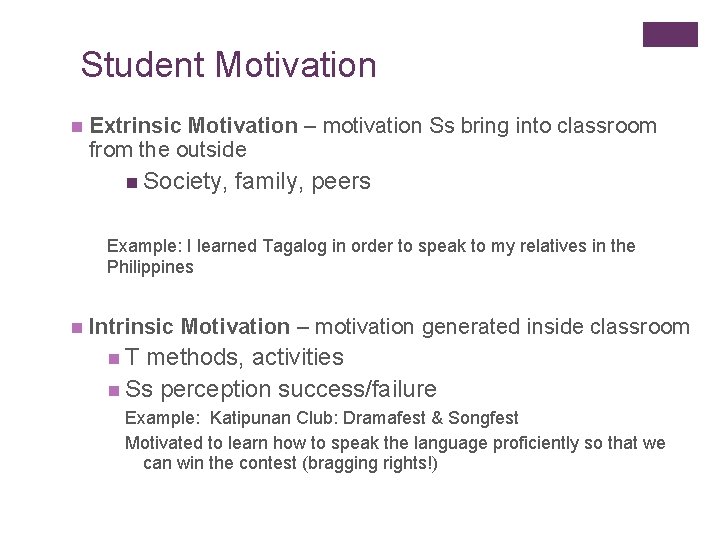
Student Motivation n Extrinsic Motivation – motivation Ss bring into classroom from the outside n Society, family, peers Example: I learned Tagalog in order to speak to my relatives in the Philippines n Intrinsic Motivation – motivation generated inside classroom n T methods, activities n Ss perception success/failure Example: Katipunan Club: Dramafest & Songfest Motivated to learn how to speak the language proficiently so that we can win the contest (bragging rights!)
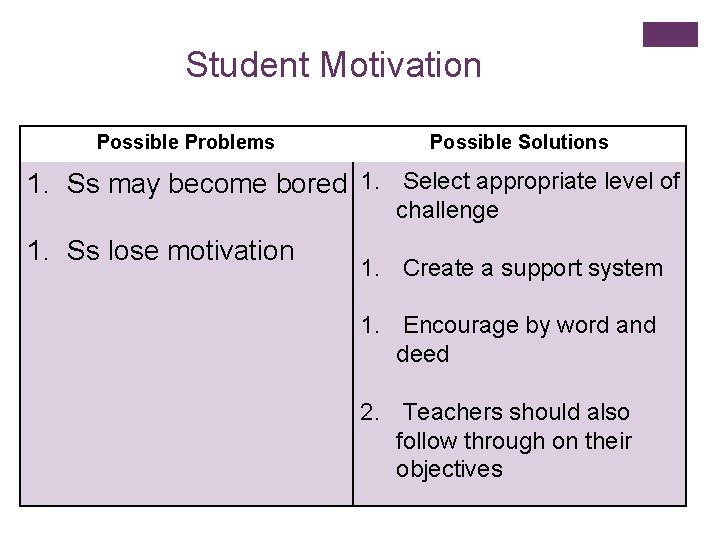
Student Motivation Possible Problems Possible Solutions 1. Ss may become bored 1. Select appropriate level of challenge 1. Ss lose motivation 1. Create a support system 1. Encourage by word and deed 2. Teachers should also follow through on their objectives
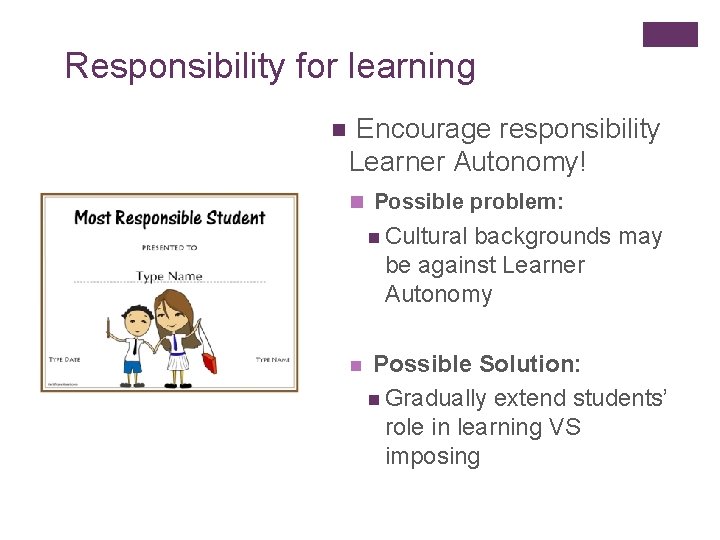
Responsibility for learning n Encourage responsibility Learner Autonomy! n Possible problem: n Cultural backgrounds may be against Learner Autonomy n Possible Solution: n Gradually extend students’ role in learning VS imposing
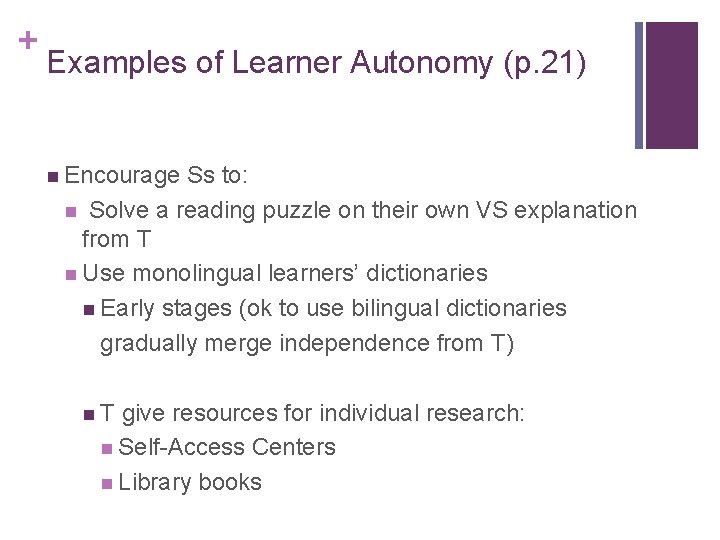
+ Examples of Learner Autonomy (p. 21) n Encourage Ss to: n Solve a reading puzzle on their own VS explanation from T n Use monolingual learners’ dictionaries n Early stages (ok to use bilingual dictionaries gradually merge independence from T) n T give resources for individual research: n Self-Access Centers n Library books
+ Summary n Talked about importance of motivation, learner differences, and learner levels and how to cater to their needs. n All learners have their own expectations with learning and the best we can do is to offer support and be sensitive with Ss differences and at the same time encourage autonomy. “Real motivation comes from within each individual, from the students themselves. ” (p 21)

Any questions?
+ Discussion Questions 1. Define Intrinsic/Extrinsic Motivation 2. How might Education/Cultural background affect a teacher’s pedagogical approach in a classroom? 3. Scenario: n Suppose I am a new student from the Philippines. I am enrolled in 10 th grade English Language Arts and was assigned to write a 3 -page paper on the story of Beowulf due the following week. I have an upper-intermediate knowledge of English but am intimidated by my Englishspeaking classmates. As a teacher, what might you do to motivate my completion of the assignment?

+ Wrap Up/ THANK YOU! n More resources: n SLS 302 – “How Languages are Learned” by Lightbown & Spada n More on Harmer: n “How to teach listening, speaking, reading, writing, grammar, culture and etc. ” series by Harmer
- Slides: 18