
Jeopardy th 7 Grade Think Like A Scientist
- Slides: 27
Jeopardy! th 7 Grade- Think Like A Scientist Directions: To review material, start slide show. To verify an answer, click the screen once. Click a second time to continue to the next slide!
Final Jeopardy A. Science can be used by many people, not just scientists Your friend is building a model boat but is having problems getting it to float. You know that the density of water is about 1. 0 g/ml. Together with your friend you find the mass of the boat to be 500 g and the volume to be 450 ml. Based on these measurements you tell your friend that he must reduce the mass of his boat by at least 50 grams. He reduces the mass by 80 grams and his boat now floats. Which of these statements relates to this situation? A. Science can be used by many people, not just scientists B. Science can be used by scientists but not by most people C. Science is too complicated to be used to solve problems D. Science is not useful in everyday life
$200 B. A basic procedure to help solve a problem Scientific Method is… A. The way scientists live B. A basic procedure to help solve a problem C. The creation of science D. The way we explain science
$400 A. Finding a problem or asking a question The first step to the Scientific Method is: A. Finding a problem or asking a question B. Being a Scientist C. Creating a procedure D. Graphing your results
$600 D. Identify your Independent and Dependent Variables Before you can make a hypothesis, you need to: A. Record your data B. Become a Scientist C. Create a Data Table D. Identify your Independent and Dependent Variables
$800 B. Can be used as an everyday problem solving strategy. Scientific method… A. Can only be used by scientists B. Can be used as an everyday problem solving strategy. C. Is the only time science can happen D. Does not work with everyday life
$1000 C. Can also be the beginning of the scientific method because it is a loop. The conclusion of an experiment is: A. The end of the scientific method B. Can never include addition questions C. Can also be the beginning of the scientific method because it is a loop. D. Can never identify additional problems
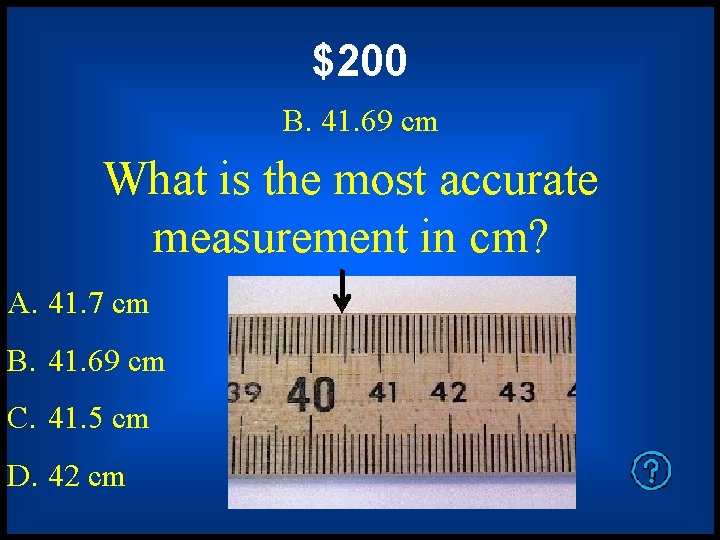
$200 B. 41. 69 cm What is the most accurate measurement in cm? A. 41. 7 cm B. 41. 69 cm C. 41. 5 cm D. 42 cm
$400 D. meters Units of Volume include all of the following except: A. m. L B. liters C. cm 3 D. meters
$600 B. Are a system of measurement that scientist agreed upon to help bridge the scientific community. SI Units… A. Are numbers B. Are a system of measurement that scientist agreed upon to help bridge the scientific community. C. are the only system of measurement D. Are a system of measurement that scientists don’t use in the United States
$800 A. The accuracy of the instrument being used and the precision in which we can measure. Measurement is limited by: A. The accuracy of the instrument being used and the precision in which we can measure. B. Machines C. The accuracy of the object being used and the precision of the light bulb. D. Accuracy and Precision
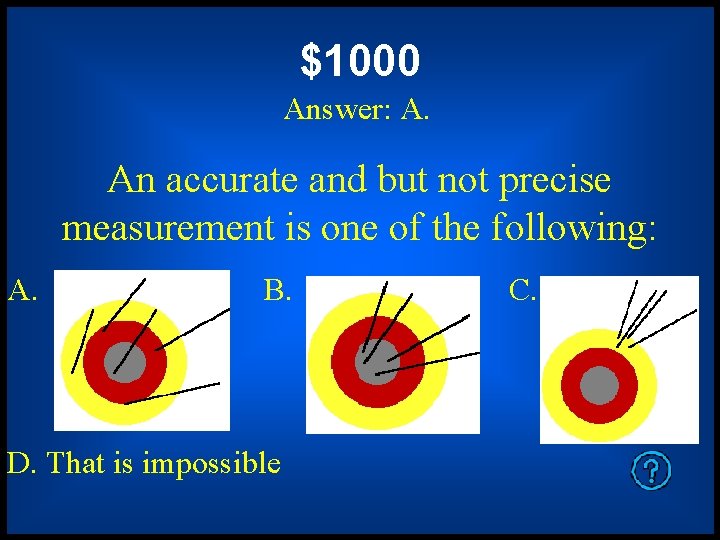
$1000 Answer: A. An accurate and but not precise measurement is one of the following: A. B. D. That is impossible C.
$200 A. It is a jeopardy game An Inference about this, and only this screen is: A. It is a jeopardy game. B. The questions are in yellow. C. The background is blue. D. There is a question mark on the right.
$400 D. The effects gravity has on your pencil If you through your pencil in the air, you observe A. Gravity B. The Earths magnetic pull C. The air D. The effects gravity has on your pencil
$600 D. What you infer You can’t observe… A. A theory B. A measurement C. What you see D. What you infer
$800 B. What you don’t see This is what you make an inference on. A. What you see B. What you don’t see C. Measurements D. What you smell
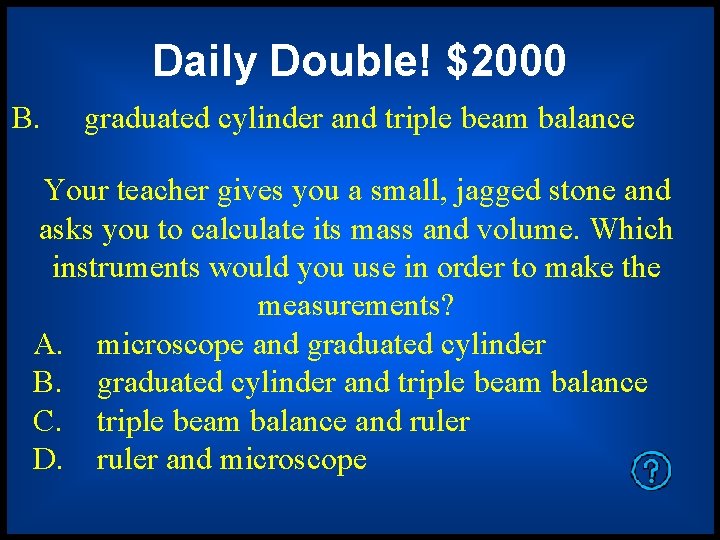
Daily Double! $2000 B. graduated cylinder and triple beam balance Your teacher gives you a small, jagged stone and asks you to calculate its mass and volume. Which instruments would you use in order to make the measurements? A. microscope and graduated cylinder B. graduated cylinder and triple beam balance C. triple beam balance and ruler D. ruler and microscope
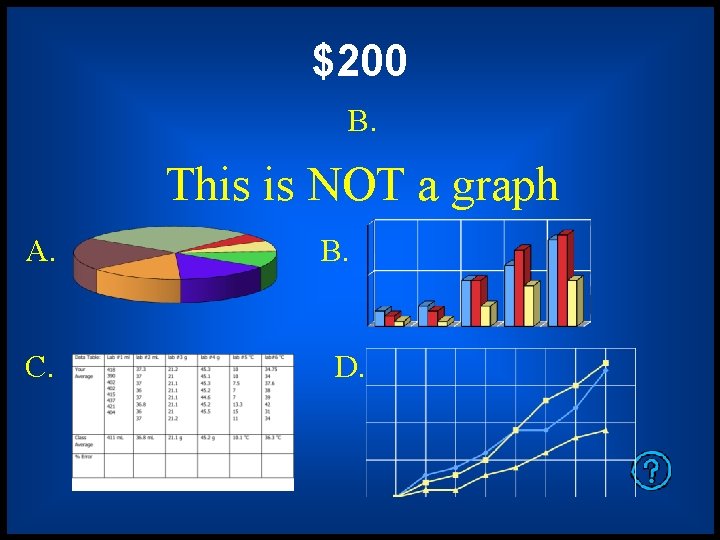
$200 B. This is NOT a graph A. C. B. D.
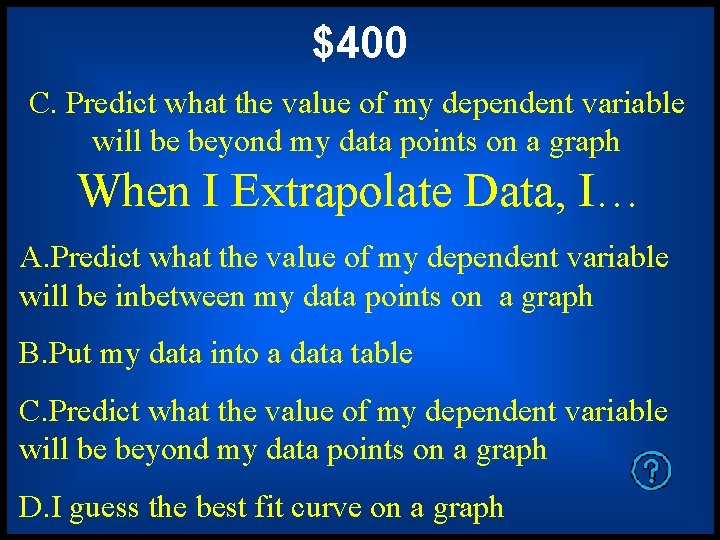
$400 C. Predict what the value of my dependent variable will be beyond my data points on a graph When I Extrapolate Data, I… A. Predict what the value of my dependent variable will be inbetween my data points on a graph B. Put my data into a data table C. Predict what the value of my dependent variable will be beyond my data points on a graph D. I guess the best fit curve on a graph
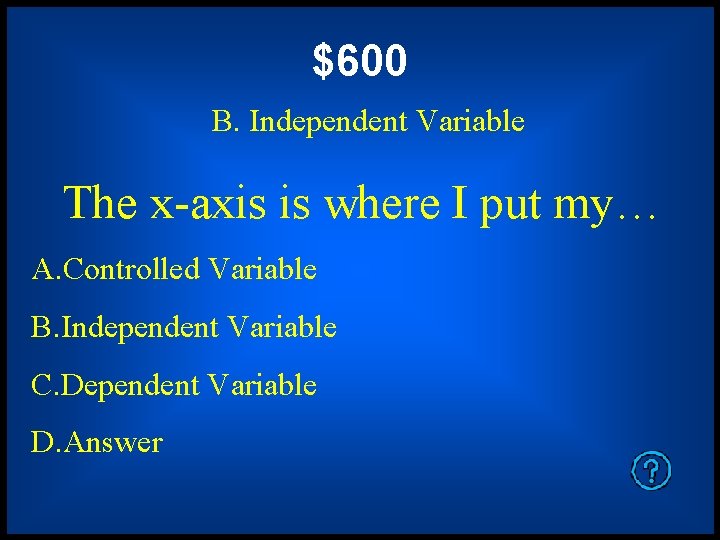
$600 B. Independent Variable The x-axis is where I put my… A. Controlled Variable B. Independent Variable C. Dependent Variable D. Answer
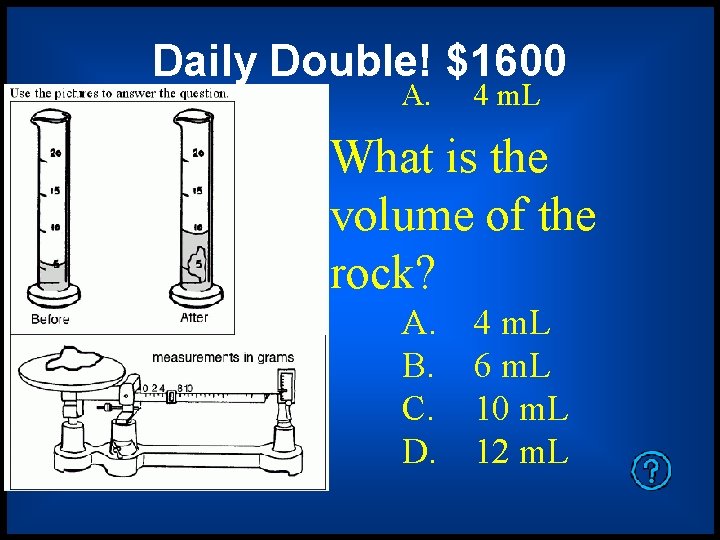
Daily Double! $1600 A. 4 m. L What is the volume of the rock? A. B. C. D. 4 m. L 6 m. L 10 m. L 12 m. L
$1000 A. Names of my lab parners These are all apart of a good graph EXCEPT… A. Name of my lab partners B. The Title C. Units D. Scales
$200 A. A 7 th grade science student travels to a rainforest and observes the leaves of jungle plants. He then travels to a desert and observes leaves on native plants there. He concludes that large, flat leaves give plants in the jungle an advantage, and plants in the desert do better if they have small leaves. Which best describes the student’s conclusion? A. It is a good conclusion because he based it on observable evidence. B. It is a good conclusion because he already learned about it in science class. C. It is a poor conclusion because he only saw what he expected to see. D. It is a poor conclusion because he didn’t do an experiment.
$400 A. Evidence includes information such as numeric facts and figures. How would you distinguish between inference and evidence in a magazine or journal article? A. Evidence includes information such as numeric facts and figures. B. Evidence includes conclusions based on data. C. An inference includes fact and/or figures without conclusions. D. Inferences are conclusions that are always biased.
$600 D. Which answer below best describes the future of our modern classification system for biological organisms? A. It will probably stay the same because scientists have learned all there is to know about classifying organisms B. It will probably stay the same because scientists don't like to change things C. It will probably change because scientists like to change things from time to time D. It will probably change because new technology will provide better information on classifying organisms
$800 B. Two students performed investigations to explore the hypothesis that particles of matter are continually in motion. Student one opened a bottle of perfume in a classroom and the aroma could soon be smelled in distant parts of the classroom. Student two shined a flashlight in a dark classroom and noticed many particles moving through the beam of light. Which best describes the investigations, conclusions and methods? A. Niether students found evidence to support the hypothesis that particles of matter continually move B. Both students did find evidence to support the hypothesis that particles of matter continually move C. Both students found evidence that particles are not constantly moving D. Student one found evidence to support the hypothesis, while student two did not
$1000 D. Melinda works at a water treatment plant. She wants to find out whether particle size affects the way particles settle in water. Can Melinda use scientific methods to answer her question? A. No. It is not possible to know why particles settle in water the way they do. B. No. Only scientists can use real scientific methods. C. Yes. Any time someone asks a question they are doing science. D. Yes. Science is a way of knowing that many people use, not just scientists.