
JEOPARDY Earthquakes and Volcanoes Earthquake 1 Earthquake 2
- Slides: 42
JEOPARDY Earthquakes and Volcanoes
Earthquake 1 Earthquake 2 Volcano 1 Volcano 2 100 100 200 200 300 300 400 400 500 500
Earthquake 1 100 points When an earthquake occurs, energy is released in the form of _____. a. seismic waves c. magnitude b. faults d. tsunamis
Earthquake 1 100 points ANSWER a. seismic waves
Earthquake 1 200 points What kind of waves causes particles in rocks to move back and forth (compressions) in the same direction? a. surface waves c. secondary waves b. primary waves d. tsunami waves
Earthquake 1 200 points ANSWER b. primary waves
Earthquakes 1 300 points An earthquake’s ________ is the point on Earth’s surface directly above where the earthquake initially started. a. elastic limit c. epicenter b. focus d. primary wave
Earthquakes 1 300 points ANSWER c. epicenter
Earthquakes 1 400 points The Richter scale measures the _____ of an earthquake. a. magnitude c. liquefaction b. intensity d. fault
Earthquakes 1 400 points ANSWER a. magnitude
Earthquakes 1 500 points Rocks are subject to the force of tension where Earth’s plates ______. a. slide past each other c. move apart b. come together d. slide over one another
Earthquakes 1 500 points ANSWER c. move apart
Earthquakes 2 100 points If a major earthquake occurred in a populated inland area far from the shore, which of these would be LEAST likely to result? a. damage to buildings and structures b. tsunamis c. loss of human lives d. landslides
Earthquakes 2 100 points ANSWER b. tsunamis
Earthquakes 2 200 points Buildings in areas where earthquakes happen frequently need to be seismically safe. Which of the following describes how a building in these areas should be built? a. Buildings should be built so they will stand rigidly and not be able to sway b. Buildings should have rubber moorings so they will sway c. Buildings should be built without reinforcing rods d. Buildings should be built only on epicenters
Earthquakes 2 200 points ANSWER b. Buildings should have rubber moorings so they will sway
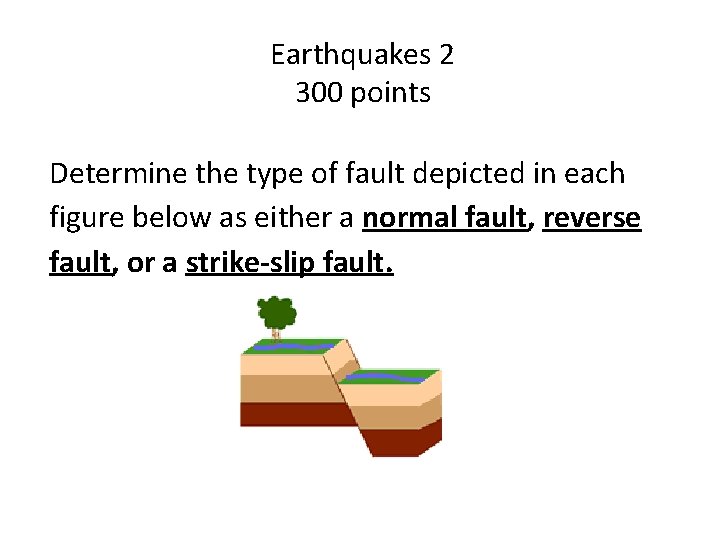
Earthquakes 2 300 points Determine the type of fault depicted in each figure below as either a normal fault, reverse fault, or a strike-slip fault.
Earthquake 2 300 points Answer normal fault
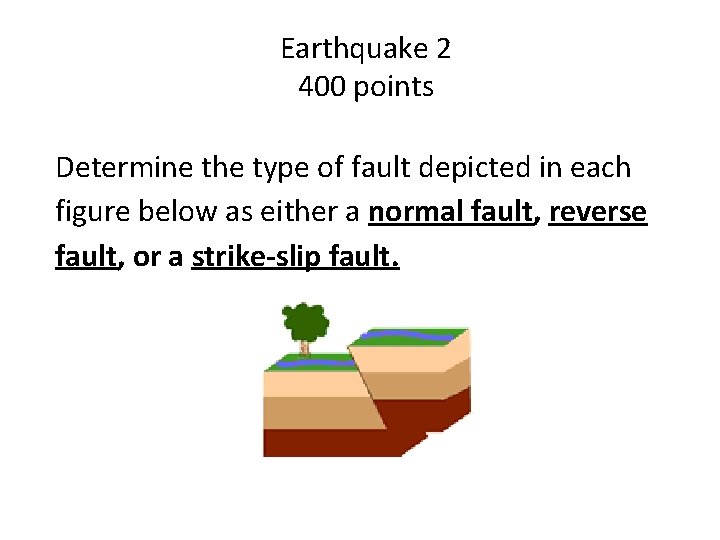
Earthquake 2 400 points Determine the type of fault depicted in each figure below as either a normal fault, reverse fault, or a strike-slip fault.
Earthquake 2 400 points ANSWER reverse fault
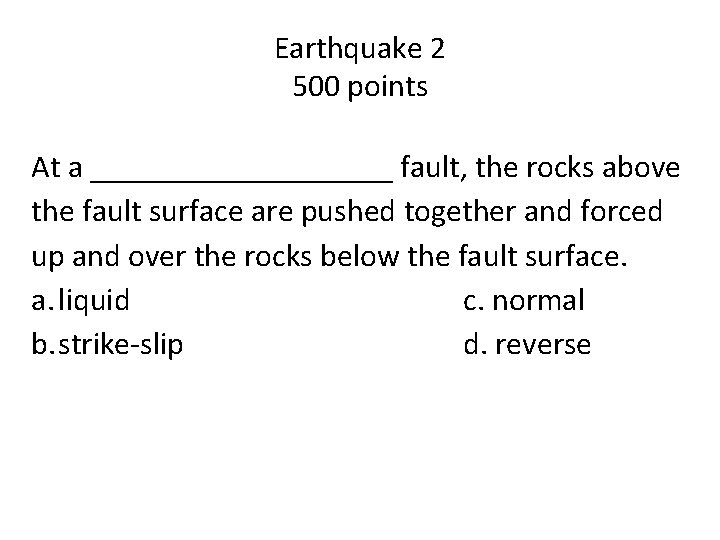
Earthquake 2 500 points At a __________ fault, the rocks above the fault surface are pushed together and forced up and over the rocks below the fault surface. a. liquid c. normal b. strike-slip d. reverse
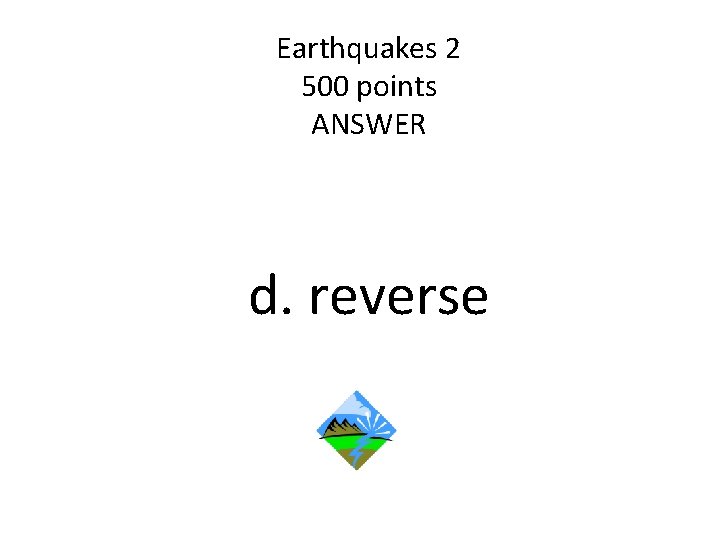
Earthquakes 2 500 points ANSWER d. reverse
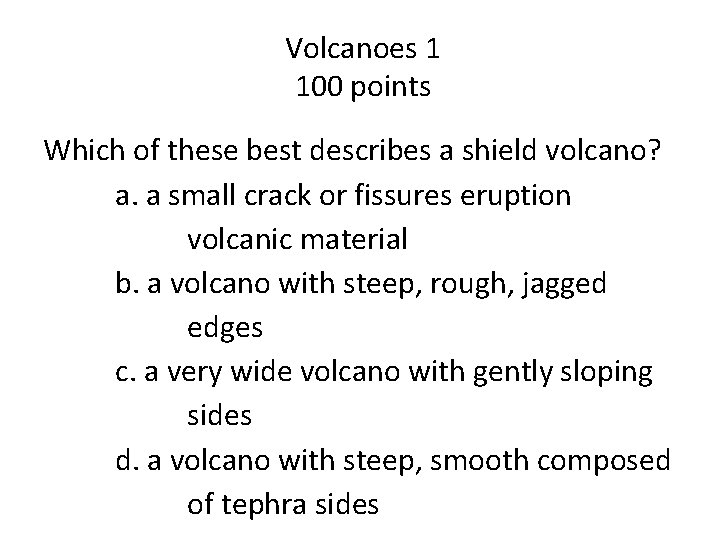
Volcanoes 1 100 points Which of these best describes a shield volcano? a. a small crack or fissures eruption volcanic material b. a volcano with steep, rough, jagged edges c. a very wide volcano with gently sloping sides d. a volcano with steep, smooth composed of tephra sides
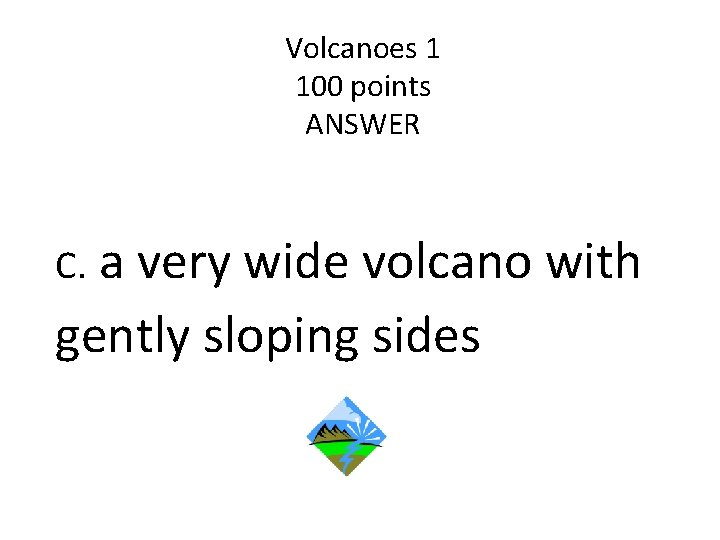
Volcanoes 1 100 points ANSWER a very wide volcano with gently sloping sides C.
Volcano 1 200 points Which statement about lava flow is accurate? a. They always move rapidly b. They destroy everything in their paths c. They always cool down and change into magma d. They are not very damaging to the environment
Volcano 1 200 points ANSWER b. They destroy everything in their paths
Volcano 1 300 points Which of the following best describes a composite volcano? a. a small crack or fissures eruption volcanic material b. a volcano with steep, rough, jagged edges c. a very wide volcano with gently sloping sides d. a volcano with steep, smooth composed of tephra sides
Volcano 1 300 points ANSWER b. a volcano with steep, rough, jagged edges
Volcano 1 400 points Why is Hawaii made of volcanoes? a. plates are moving apart b. a hot spot exists c. plates are moving together d. rift zones exist
Volcano 1 400 points ANSWER b. a hot spot exists
Volcano 1 500 points The most likely cause of the slow movement of magma toward Earth’s surface is that the ______. a. magma is more dense than the rock around it b. magma is less dense than the rock around it c. magma is hotter than the rock around it d. magma is cooler than the rock around it
Volcano 1 500 points ANSWER b. magma is less dense than the rock around it
Volcano 2 100 points What kind of magma produces violent volcanic eruptions? a. those rich in silica b. those low in silica c. those forming shield volcanoes d. those rich in iron
Volcano 2 100 points ANSWER a. those rich in silica
Volcano 2 200 points Magma that has pushed up through layers of rocks (Perpendicularly at a 90* angle) and hardened is called______. a. sill c. dike b. caldera d. vent
Volcano 2 200 points ANSWER c. dike
Volcano 2 300 points What is the largest intrusive igneous rock body? a. dike c. sill b. volcanic neck d. batholith
Volcano 2 300 points ANSWER d. batholith
Volcano 2 400 points Which of the following is made of alternating layers of ash and cooled lava flows? a. shield volcano c. composite volcano b. plateau basalts d. cinder cone volcano
Volcano 2 400 points ANSWER c. composite volcano
Volcano 2 500 points Which of the following forms when the top of a volcano collapses into a partially emptied magma chamber? a. fissure c. caldera b. crater d. volcanic neck
Volcano 2 500 points c. caldera