
Jenna Tilt tiltjoregonstate edu ENVISIONING AN EQUITABLE RESILIENT
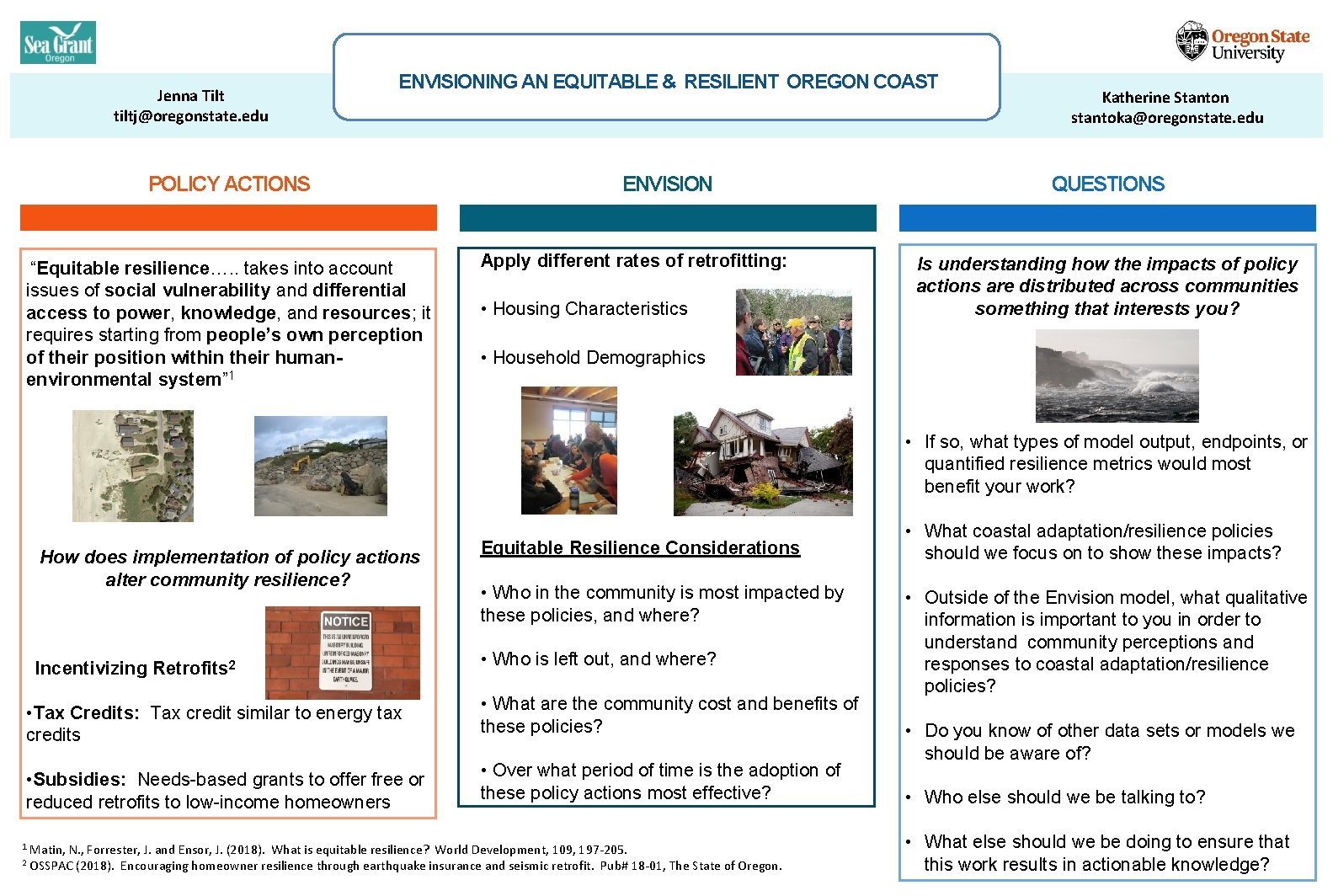
Jenna Tilt tiltj@oregonstate. edu ENVISIONING AN EQUITABLE & RESILIENT OREGON COAST POLICY ACTIONS “Equitable resilience…. . takes into account issues of social vulnerability and differential access to power, knowledge, and resources; it requires starting from people’s own perception of their position within their humanenvironmental system” 1 ENVISION Apply different rates of retrofitting: • Housing Characteristics Katherine Stanton stantoka@oregonstate. edu QUESTIONS Is understanding how the impacts of policy actions are distributed across communities something that interests you? • Household Demographics • If so, what types of model output, endpoints, or quantified resilience metrics would most benefit your work? How does implementation of policy actions alter community resilience? Incentivizing Retrofits 2 Equitable Resilience Considerations • Who in the community is most impacted by these policies, and where? • Who is left out, and where? • Tax Credits: Tax credit similar to energy tax credits • What are the community cost and benefits of these policies? • Subsidies: Needs-based grants to offer free or reduced retrofits to low-income homeowners • Over what period of time is the adoption of these policy actions most effective? Matin, N. , Forrester, J. and Ensor, J. (2018). What is equitable resilience? World Development, 109, 197 -205. 2 OSSPAC (2018). Encouraging homeowner resilience through earthquake insurance and seismic retrofit. Pub# 18 -01, The State of Oregon. 1 • What coastal adaptation/resilience policies should we focus on to show these impacts? • Outside of the Envision model, what qualitative information is important to you in order to understand community perceptions and responses to coastal adaptation/resilience policies? • Do you know of other data sets or models we should be aware of? • Who else should we be talking to? • What else should we be doing to ensure that this work results in actionable knowledge?
- Slides: 1