
JELLO OPTICS How Does Light Bend Refraction Light
JELL-O OPTICS

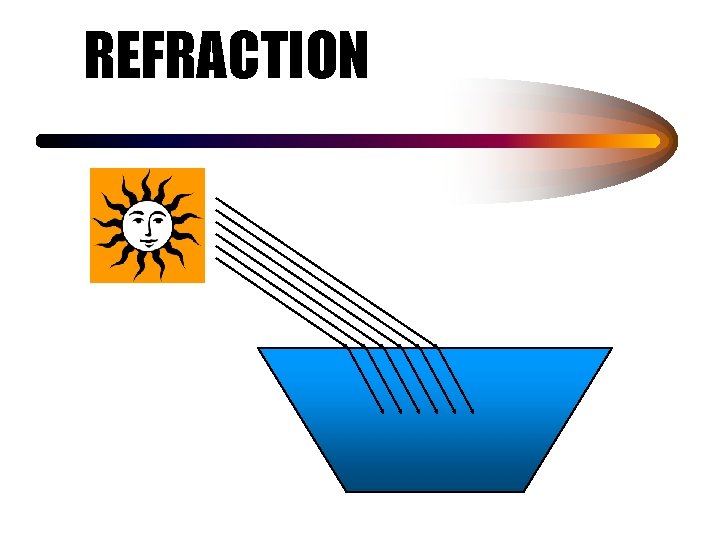
How Does Light Bend? • Refraction • Light travels slower through dense materials: • Water • Plastic / Glass & • JELL-O! • Light bends when it enters a substance at an angle. • This is known as REFRACTION!
REFRACTION
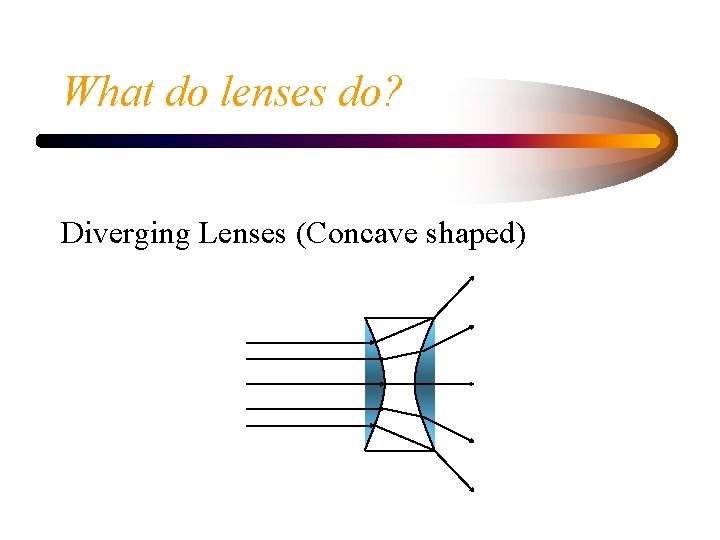
What do lenses do? Diverging Lenses (Concave shaped)
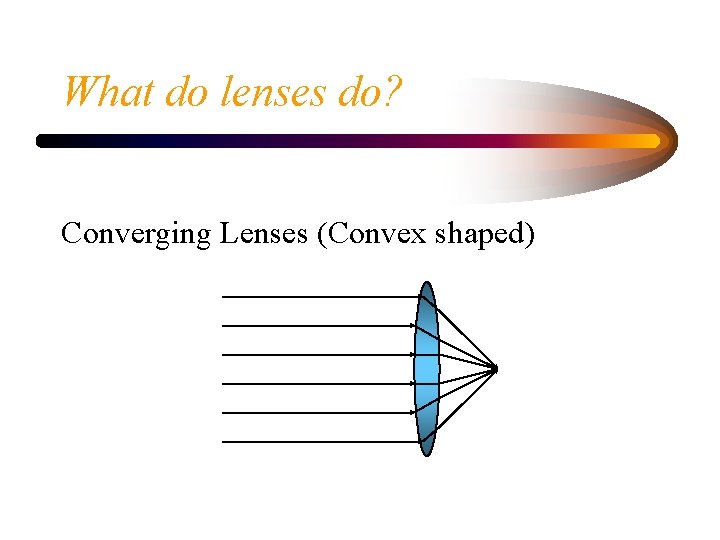
What do lenses do? Converging Lenses (Convex shaped)
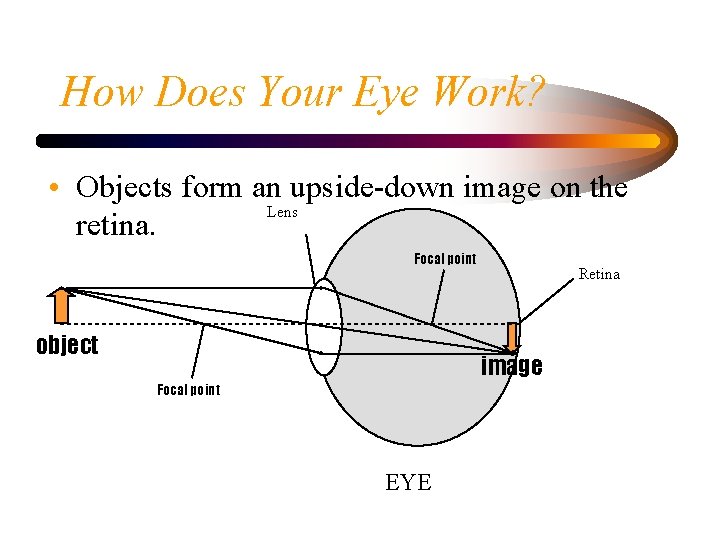
How Does Your Eye Work? • Objects form an upside-down image on the Lens retina. Focal point object Retina image Focal point EYE
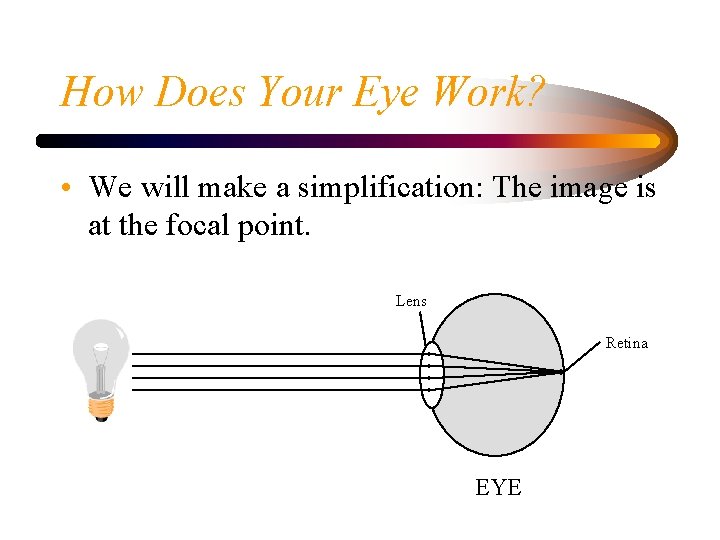
How Does Your Eye Work? • We will make a simplification: The image is at the focal point. Lens Retina EYE
How Do We Correct Vision Problems? • Scientists and engineers have found ways to solve these problems. • Corrective lenses. – Glasses – Contacts
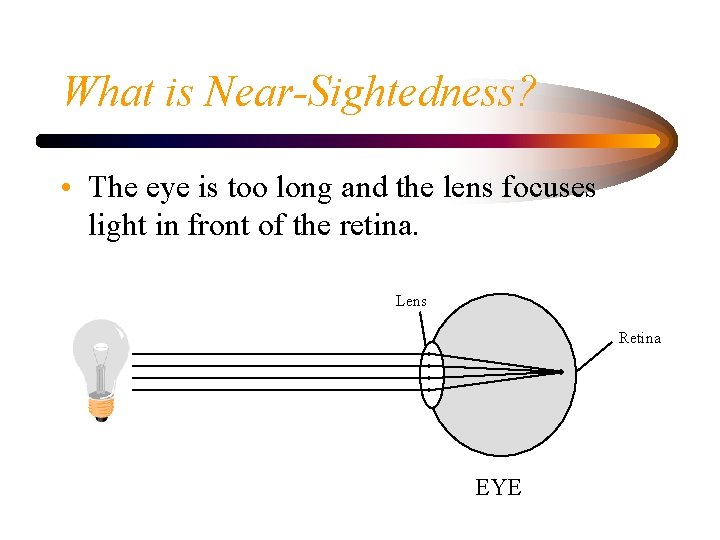
What is Near-Sightedness? • The eye is too long and the lens focuses light in front of the retina. Lens Retina EYE
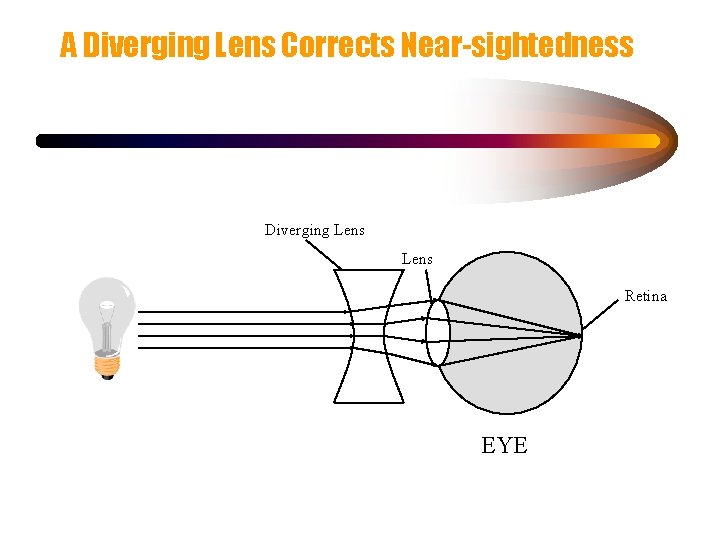
A Diverging Lens Corrects Near-sightedness Diverging Lens Retina EYE

What is Far-Sightedness? • The eye is too short and the lens focuses light behind the retina. Lens Retina EYE

A Converging Lens Corrects Far-sightedness Converging Lens Retina EYE

ENGINEERS CLEAR OUR VIEW • Thanks to Engineering and Science, millions of people have improved vision.
Materials List • Two Laser Pointers (or other light sources) • Target Superstore for about $12. 00 a piece. • Knox gelatin • 32 Envelopes for $10. 00. • Double the amount of gelatin in the recipe, this makes it very firm. Don’t add sugar or coloring. • Put wax-paper into the pan before filling with gelatin so you can remove the gelatin in one piece. • Converging and Diverging Lenses (optional) • Edmund Scientific <www. scientificsonline. com> • ranges from cheap to very expensive.
Demonstration • Prepare gelatin the night before to allow it to set up. – • Put wax paper into the gelatin pan so you can remove the gelatin out of the pan in one piece. Refraction demonstration. – Cut the gelatin with a sharp knife so you can shine lasers into a smooth flat surface. Do not use a serrated knife to cut the gelatin, the surfaces must be as smooth as possible to minimize reflections at the surface. – – • Lens demonstration. – – – • Shine a laser into the gelatin at an angle (like the sun picture). Move the laser (or gelatin) around to see different refraction angles. Shine parallel lasers through a diverging lens into the gelatin to see the divergence. Shine parallel lasers through a converging lens into the gelatin to see the convergence to a focal point. If you don’t have any lenses, cut lens shapes out of the gelatin for this part. It still works pretty well. Eye demonstration. – Follow the figures and place a converging lens so that the laser focus on a “retina. ” Move the lens closer and further from the “retina” to simulate farsightedness and nearsightedness. – • Correct the vision with the appropriate lens. Conclusion. – Cut odd shapes out of the gelatin and let the kids shine lasers into them. Be creative!
- Slides: 15