
Jeffersonian to Jacksonian Democracy The struggle to define
![James Monroe [1816 -1824]](https://slidetodoc.com/presentation_image_h2/6a28fef6d16c2fc038a42c1181c0cf01/image-22.jpg "James Monroe [1816 -1824]")
- Slides: 52
Jeffersonian to Jacksonian Democracy The struggle to define and extend democratic ideals in the face of major changes
Jefferson Election of 1800 Ended in a tie between Jefferson and Burr Hamilton turned the tide in favor of Jefferson Impact of the outcome 12 th Amendment- Electors would cast two separate votes. One for the President and one for the Vice President, in an attempt to avoid a tie situation. Burr holds a grudge against Hamilton- kills him in a duel years later
Jefferson as President Changes in government Reduced government spending Revenue- only from customs duties and sale of lands Smaller Executive branch Reduced Military size/spending Smaller army and navy But increased navy to combat pirates Louisiana Purchase Negotiations with Spain for the port of New Orleans Negotiations with France- Napoleon’s offer Significance- Doubles the US
Jefferson and Madison Foreign Issues France and England attacks on US ships Embargo Act Cut off trade with BOTH nations Impact: Economic Ruin Regional Views vs. National Views? Non-Intercourse Act Trade with ONE of the nations and NOT the other Impact: War of 1812
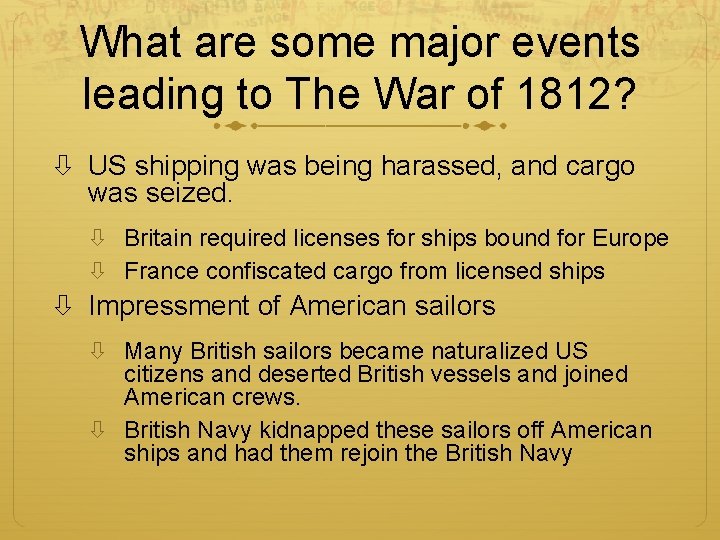
What are some major events leading to The War of 1812? US shipping was being harassed, and cargo was seized. Britain required licenses for ships bound for Europe France confiscated cargo from licensed ships Impressment of American sailors Many British sailors became naturalized US citizens and deserted British vessels and joined American crews. British Navy kidnapped these sailors off American ships and had them rejoin the British Navy
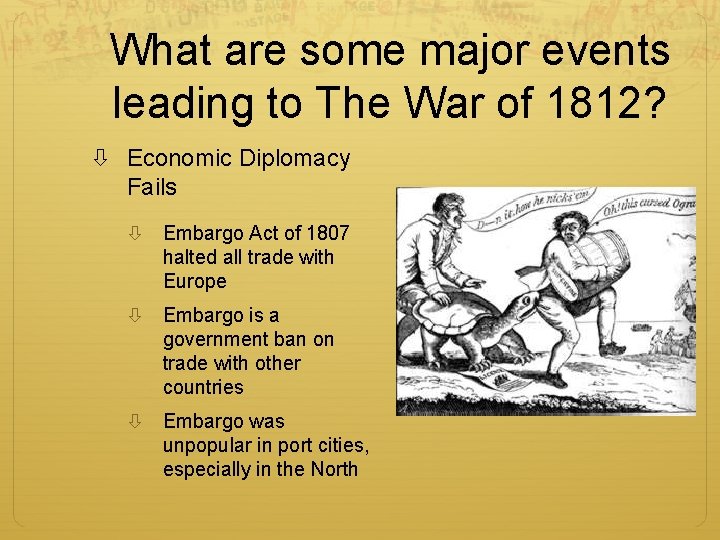
What are some major events leading to The War of 1812? Economic Diplomacy Fails Embargo Act of 1807 halted all trade with Europe Embargo is a government ban on trade with other countries Embargo was unpopular in port cities, especially in the North
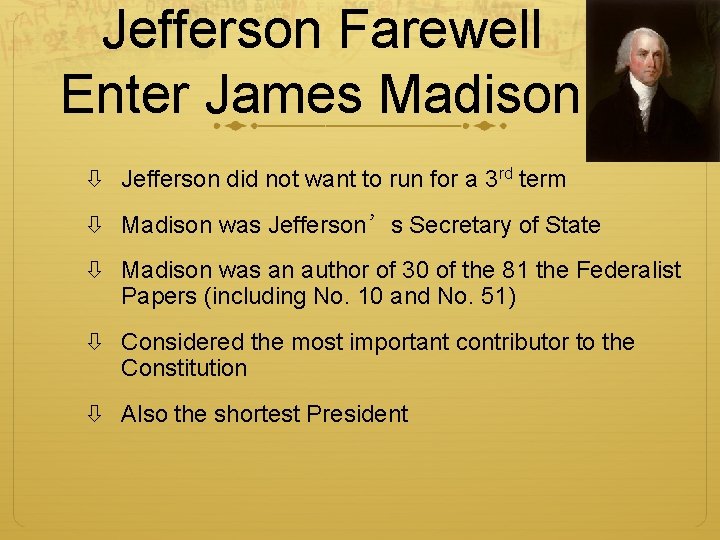
Jefferson Farewell Enter James Madison Jefferson did not want to run for a 3 rd term Madison was Jefferson’s Secretary of State Madison was an author of 30 of the 81 the Federalist Papers (including No. 10 and No. 51) Considered the most important contributor to the Constitution Also the shortest President
What was Madison’s role leading up to The War of 1812? Non-Intercourse Act Forbade trade with France and Britain; however President could reopen trade when either France or Britain lifted restrictions Was this successful? Why or Why not War Hawks Southern congressmen favored war, even though it hurt the east Why did the War Hawks want war?
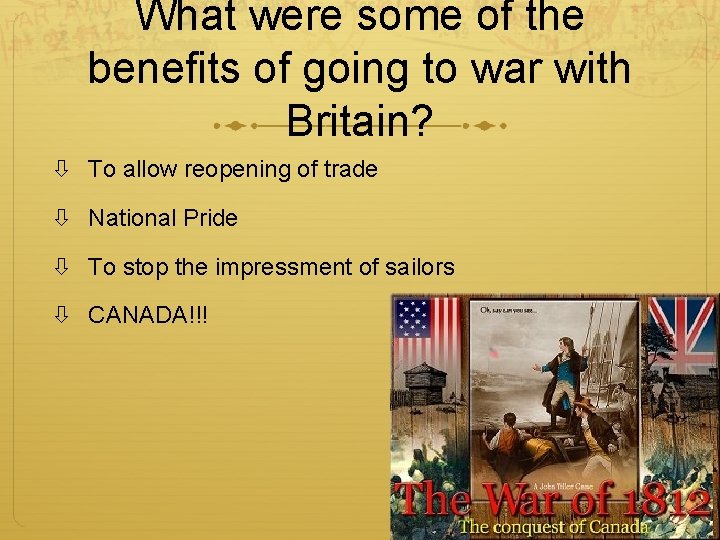
What were some of the benefits of going to war with Britain? To allow reopening of trade National Pride To stop the impressment of sailors CANADA!!!
What were some drawbacks to going to war? Not everyone in the US wanted to go to war Military was small Standing Army was small Militia comprised most of our forces, and they did not like to fight outside of their state borders Navy was quite small only 22 ships Britain was a great Superpower and could crush us like a bug and we could lose territory that was gained in the Treaty of Paris or the Louisiana Purchase
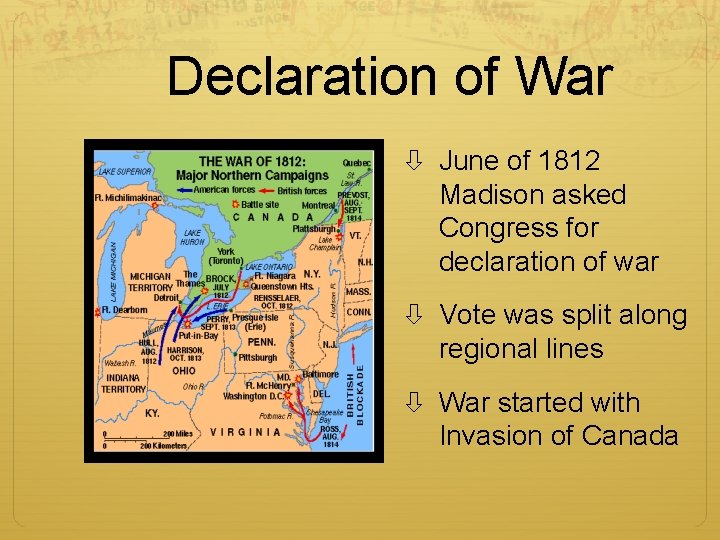
Declaration of War June of 1812 Madison asked Congress for declaration of war Vote was split along regional lines War started with Invasion of Canada
Key Battles US Burns York (now Toronto) US figured the Canadians would welcome the Americans and quickly join the US to expel Britain from North America…this did not happen Perry Defeated the British on Lake Erie This gave the US control of Lake Erie Britain Blockades the Eastern Seaboard This prevented shipping from leaving, and made the war more unpopular in the Northeast
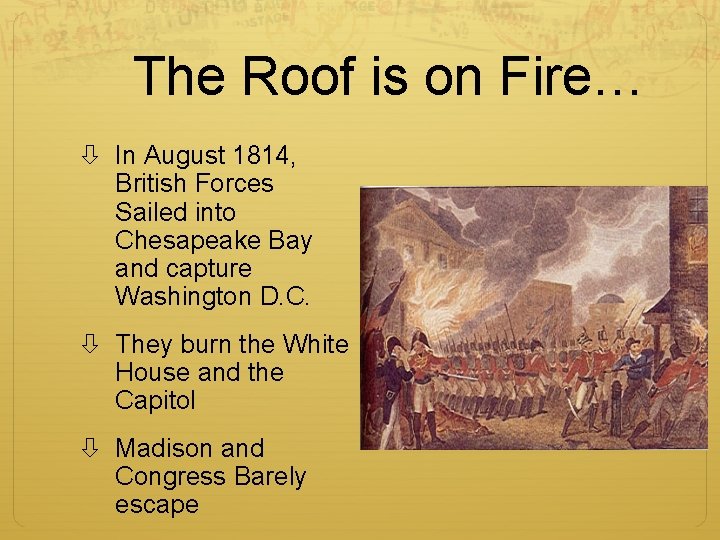
The Roof is on Fire… In August 1814, British Forces Sailed into Chesapeake Bay and capture Washington D. C. They burn the White House and the Capitol Madison and Congress Barely escape
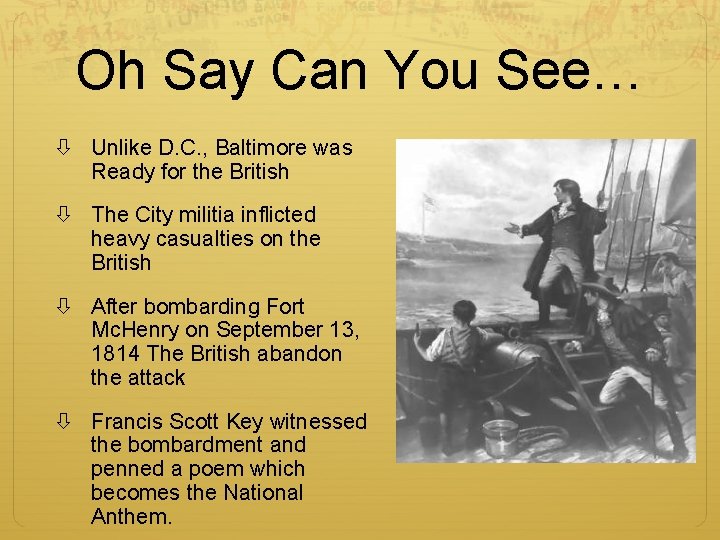
Oh Say Can You See… Unlike D. C. , Baltimore was Ready for the British The City militia inflicted heavy casualties on the British After bombarding Fort Mc. Henry on September 13, 1814 The British abandon the attack Francis Scott Key witnessed the bombardment and penned a poem which becomes the National Anthem.
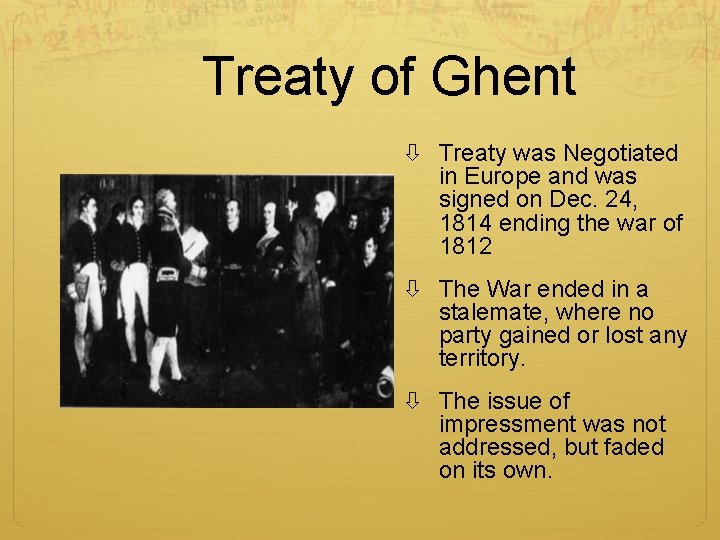
Treaty of Ghent Treaty was Negotiated in Europe and was signed on Dec. 24, 1814 ending the war of 1812 The War ended in a stalemate, where no party gained or lost any territory. The issue of impressment was not addressed, but faded on its own.
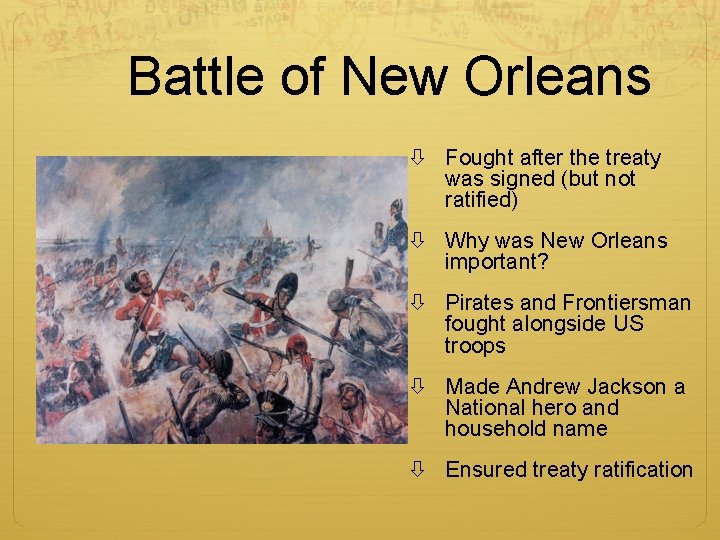
Battle of New Orleans Fought after the treaty was signed (but not ratified) Why was New Orleans important? Pirates and Frontiersman fought alongside US troops Made Andrew Jackson a National hero and household name Ensured treaty ratification
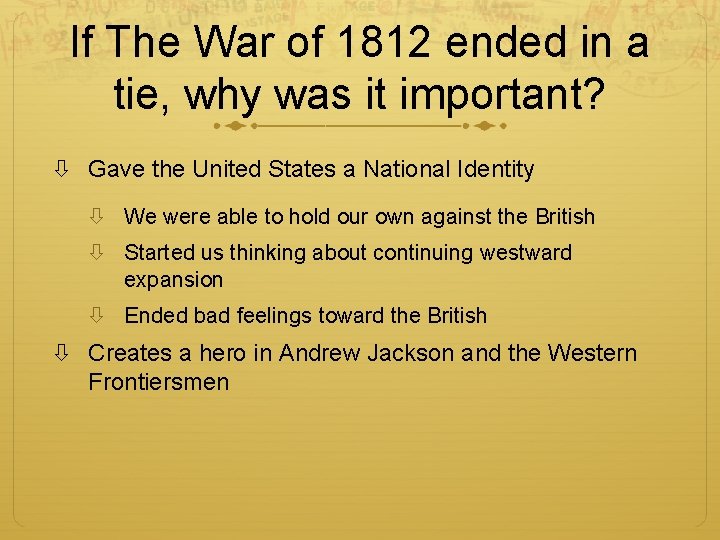
If The War of 1812 ended in a tie, why was it important? Gave the United States a National Identity We were able to hold our own against the British Started us thinking about continuing westward expansion Ended bad feelings toward the British Creates a hero in Andrew Jackson and the Western Frontiersmen
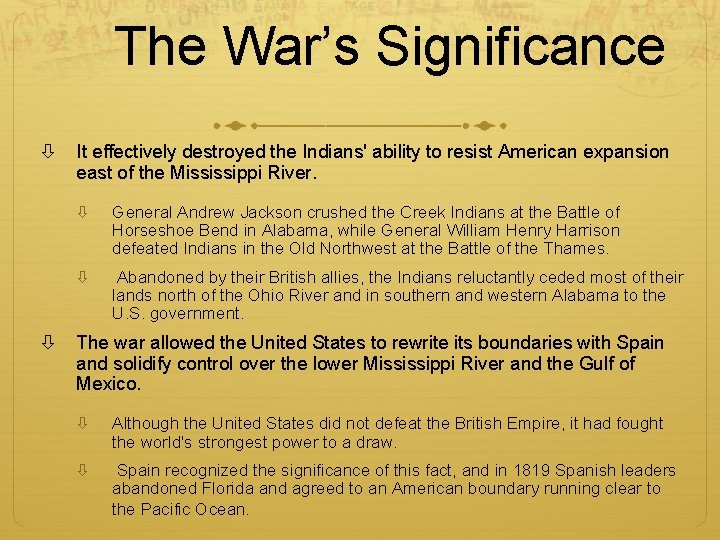
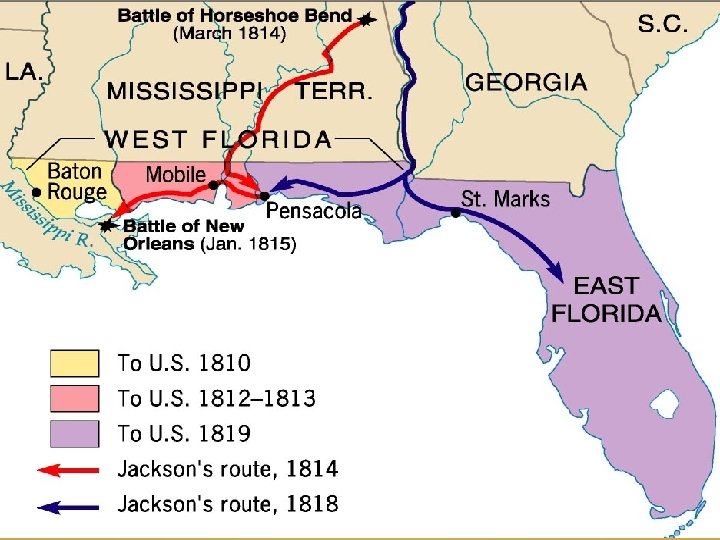
The War’s Significance It effectively destroyed the Indians' ability to resist American expansion east of the Mississippi River. General Andrew Jackson crushed the Creek Indians at the Battle of Horseshoe Bend in Alabama, while General William Henry Harrison defeated Indians in the Old Northwest at the Battle of the Thames. Abandoned by their British allies, the Indians reluctantly ceded most of their lands north of the Ohio River and in southern and western Alabama to the U. S. government. The war allowed the United States to rewrite its boundaries with Spain and solidify control over the lower Mississippi River and the Gulf of Mexico. Although the United States did not defeat the British Empire, it had fought the world's strongest power to a draw. Spain recognized the significance of this fact, and in 1819 Spanish leaders abandoned Florida and agreed to an American boundary running clear to the Pacific Ocean.
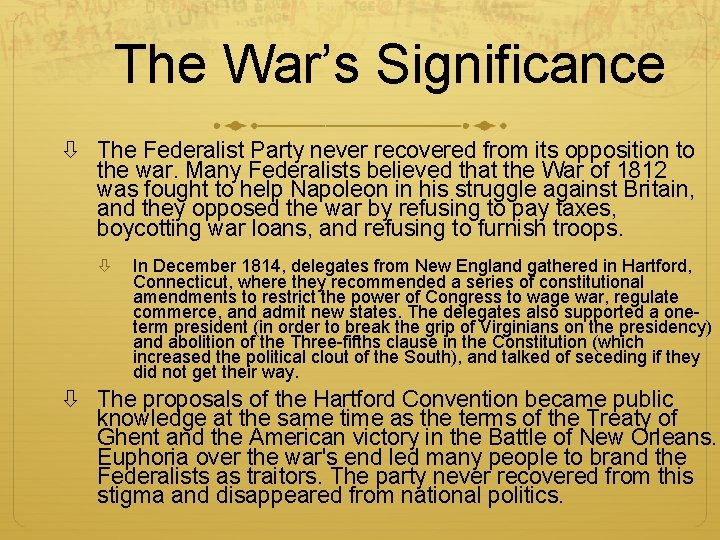
The War’s Significance The Federalist Party never recovered from its opposition to the war. Many Federalists believed that the War of 1812 was fought to help Napoleon in his struggle against Britain, and they opposed the war by refusing to pay taxes, boycotting war loans, and refusing to furnish troops. In December 1814, delegates from New England gathered in Hartford, Connecticut, where they recommended a series of constitutional amendments to restrict the power of Congress to wage war, regulate commerce, and admit new states. The delegates also supported a oneterm president (in order to break the grip of Virginians on the presidency) and abolition of the Three-fifths clause in the Constitution (which increased the political clout of the South), and talked of seceding if they did not get their way. The proposals of the Hartford Convention became public knowledge at the same time as the terms of the Treaty of Ghent and the American victory in the Battle of New Orleans. Euphoria over the war's end led many people to brand the Federalists as traitors. The party never recovered from this stigma and disappeared from national politics.
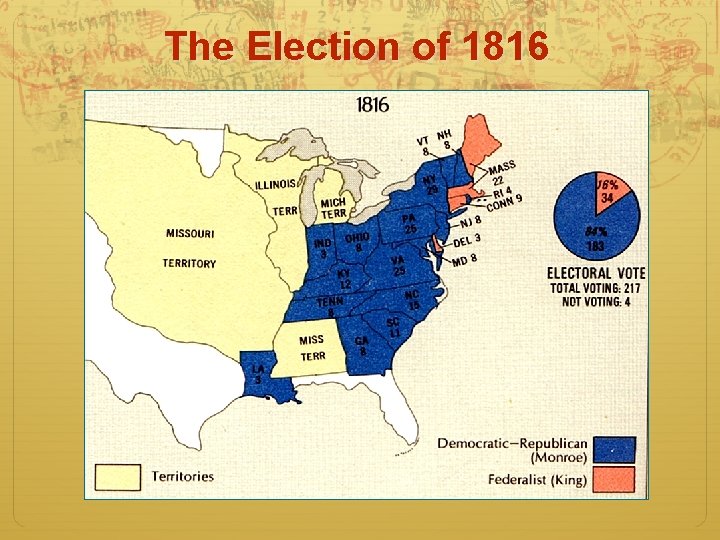
The Election of 1816
James Monroe [1816 -1824]
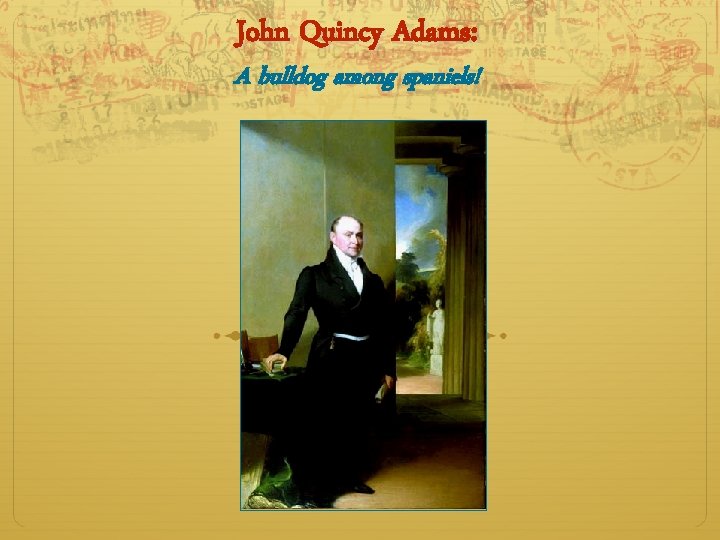
John Quincy Adams: A bulldog among spaniels!
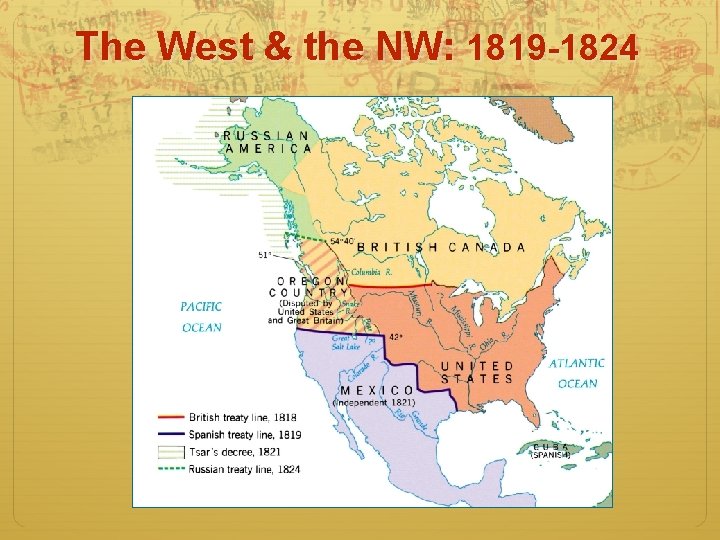
The West & the NW: 1819 -1824
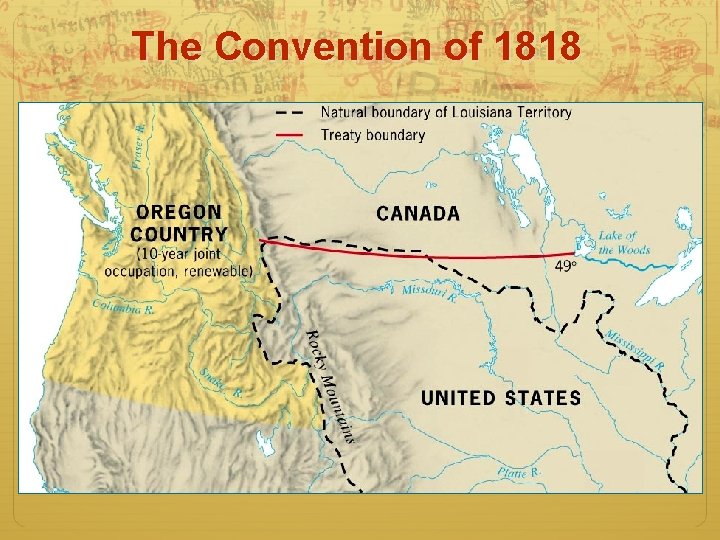
The Convention of 1818
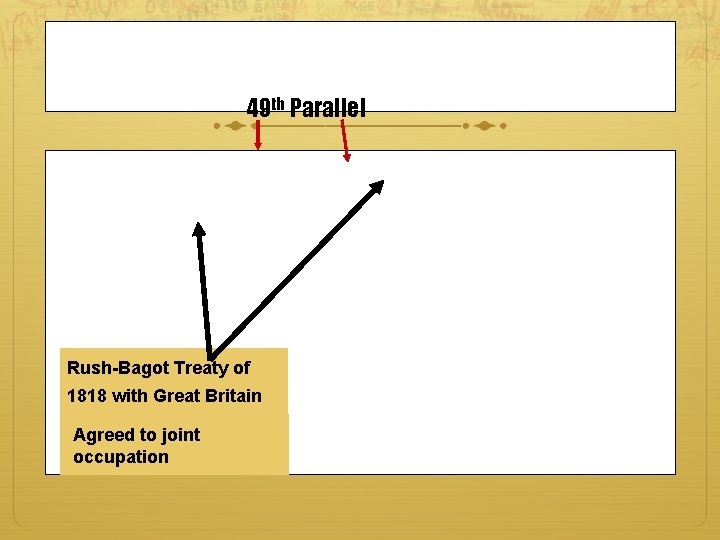
49 th Parallel Rush-Bagot Treaty of 1818 with Great Britain Agreed to joint occupation
Rush-Bagot Agreement (1817 -18) Treaty with Great Britain Shared Oregon Territory for 10 years the setting of the northern limits of the Louisiana Territory at the 49 th parallel US agreed to cede land above 49 th parallel GB agreed to cede land below 49 th parallel
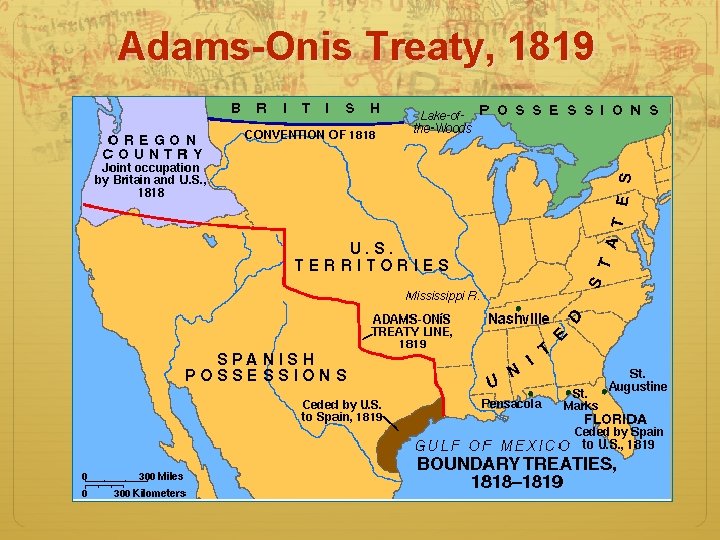
Adams-Onis Treaty, 1819
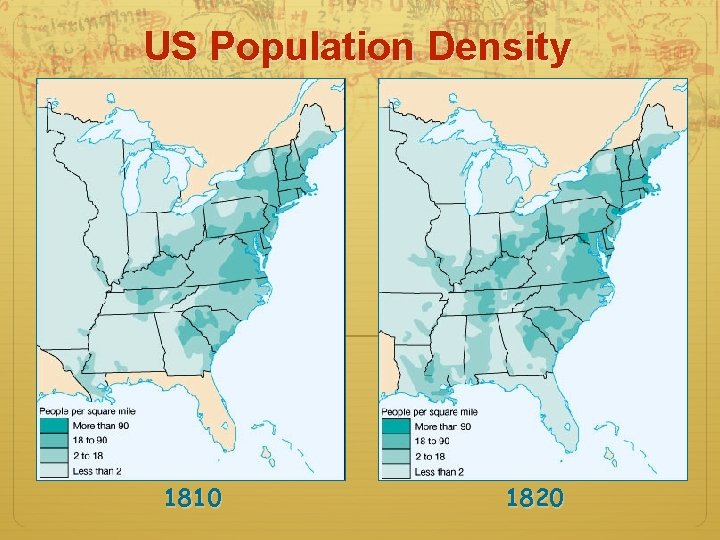
US Population Density 1810 1820
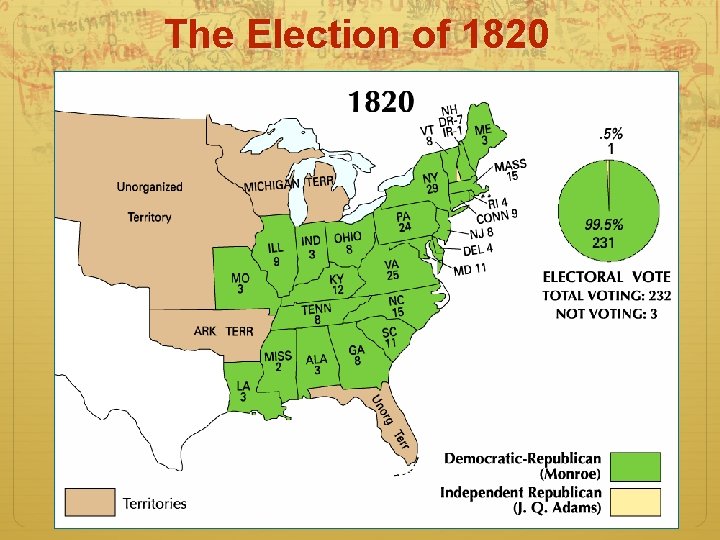
The Election of 1820
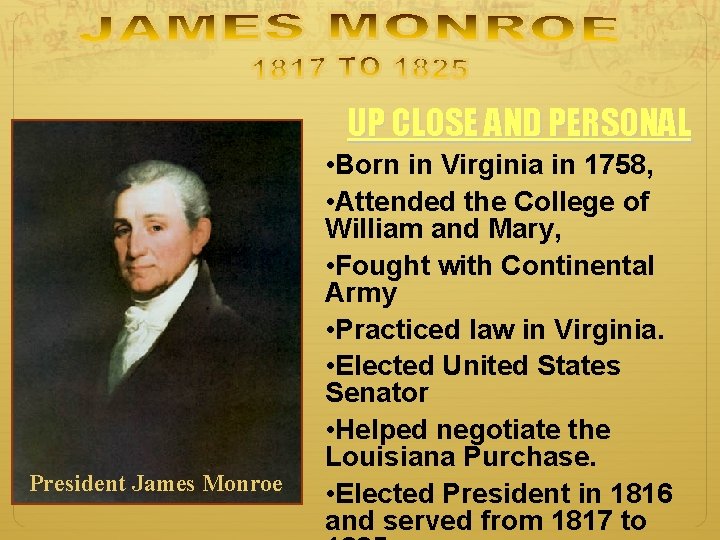
UP CLOSE AND PERSONAL President James Monroe • Born in Virginia in 1758, • Attended the College of William and Mary, • Fought with Continental Army • Practiced law in Virginia. • Elected United States Senator • Helped negotiate the Louisiana Purchase. • Elected President in 1816 and served from 1817 to
Spirit of Nationalism in US §patriotism or national oneness §Country is united, confident, and growing § 1791 -1819, 9 states joined the original 13. One political party---Republican party Respect from Europe Monroe first president to visit all states. Boston newspaper declared an “Era of Good Feelings” had began. §But, time period was not free of problems.
Cultural Nationalism Patriotic themes infused every aspect of American society from books and paintings of Revolutionary heroes to Noah Webster’s blue-backed speller that promoted patriotism Economic Nationalism Running parallel with cultural nationalism was a political movement to support the growth of the nation’s economy----AMERICAN SYSTEM Political Nationalism Movement to bring about the support for national government is over the states. Supreme court decisions support the concept of national government over the states.
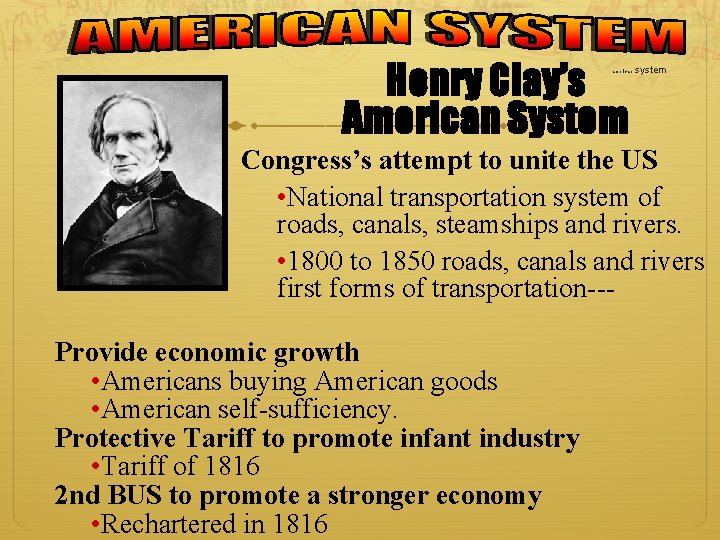
Henry Clay’s American System american system Congress’s attempt to unite the US • National transportation system of roads, canals, steamships and rivers. • 1800 to 1850 roads, canals and rivers first forms of transportation--Provide economic growth • Americans buying American goods • American self-sufficiency. Protective Tariff to promote infant industry • Tariff of 1816 2 nd BUS to promote a stronger economy • Rechartered in 1816
National Transportation system Cumberland Road and Erie Canal first internal improvements to unite the US the first steamboat on western waters was in 1811. 1800 to 1850 roads, canals and rivers first forms of transportation 1850 to 1860 the railroad is added The Land Act of 1820 gave the West its wish by authorizing a buyer to purchase 80 acres of land at a minimum of $1. 25 an acre in cash; the West demanded transportation.
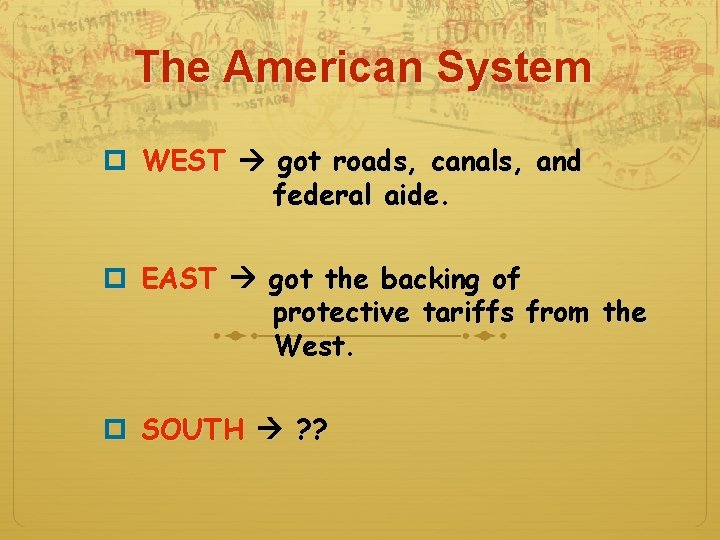
The American System p WEST got roads, canals, and federal aide. p EAST got the backing of protective tariffs from the West. p SOUTH ? ?
Population shift from the east to the West Acquisition of Native Americans’ lands Land easy to obtain Economic pressures Improved transportation Immigration
New Questions and Issues Greatest importance to western states were: “Cheap money” (easy credit) from state banks rather than from the Bank of the United States Land made available at low prices by the government Improved transportation Westerners could not agree whether to permit slavery or exclude it
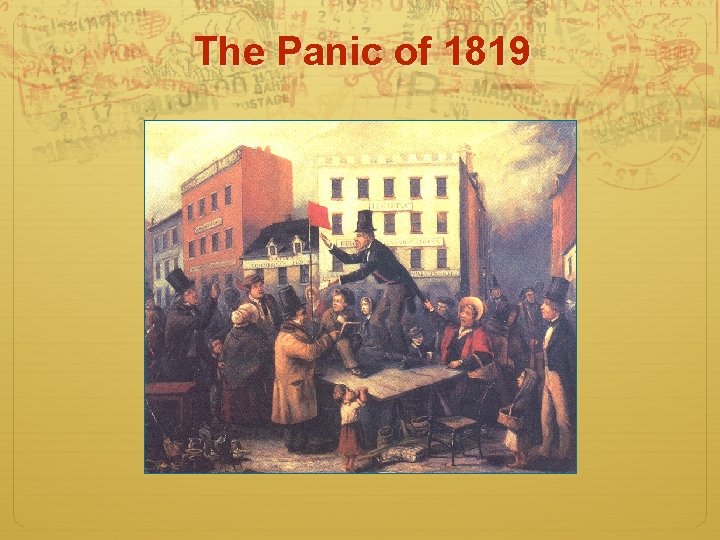
The Panic of 1819
The Panic of 1819 Largely the fault of the Second Bank of the United States’ tightening of credit in an effort to control inflation Many state banks closed The value of money fell There were large increases in unemployment, bankruptcies, and imprisonment for debt Depression was most severe in the West The economic crisis changed many Western voters’ political outlook
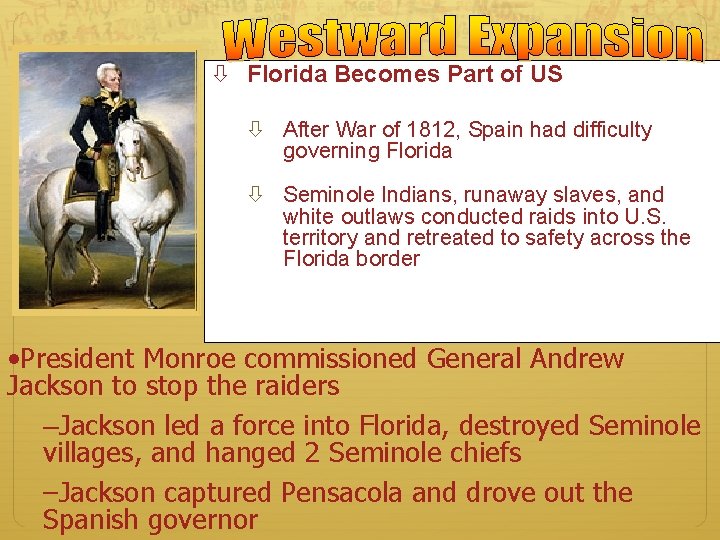
Florida Becomes Part of US After War of 1812, Spain had difficulty governing Florida Seminole Indians, runaway slaves, and white outlaws conducted raids into U. S. territory and retreated to safety across the Florida border • President Monroe commissioned General Andrew Jackson to stop the raiders –Jackson led a force into Florida, destroyed Seminole villages, and hanged 2 Seminole chiefs –Jackson captured Pensacola and drove out the Spanish governor
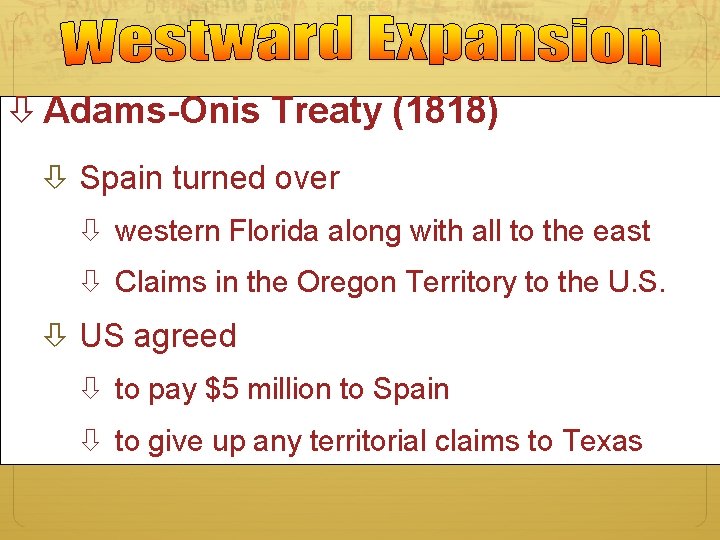
Adams-Onis Treaty (1818) Spain turned over western Florida along with all to the east Claims in the Oregon Territory to the U. S. US agreed to pay $5 million to Spain to give up any territorial claims to Texas
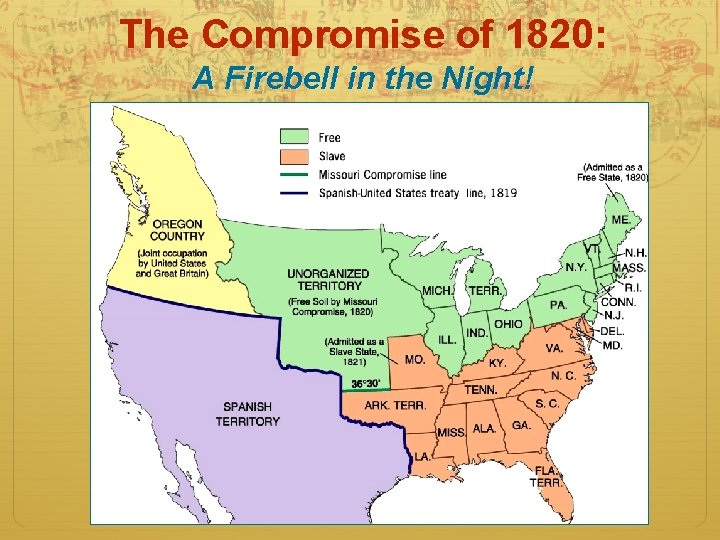
The Compromise of 1820: A Firebell in the Night!
The Tallmadge Amendment p All slaves born in Missouri after the territory became a state would be freed at the age of 25. p Passed by the House, not in the Senate. p The North controlled the House, and the South had enough power to block it in the Senate.
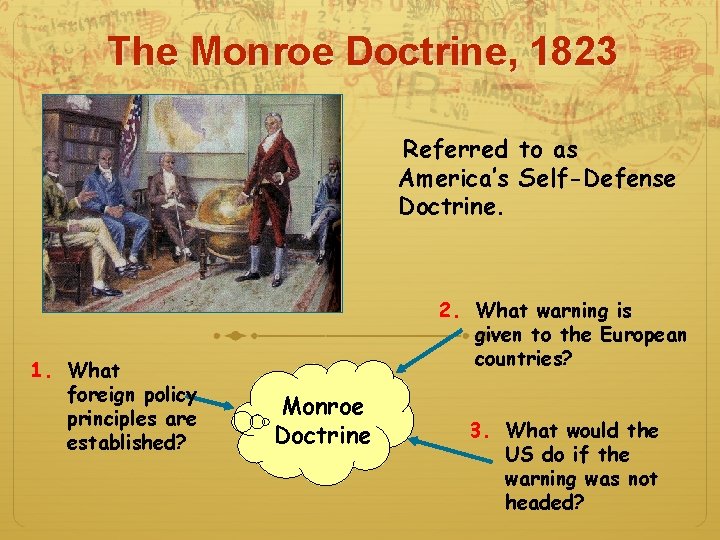
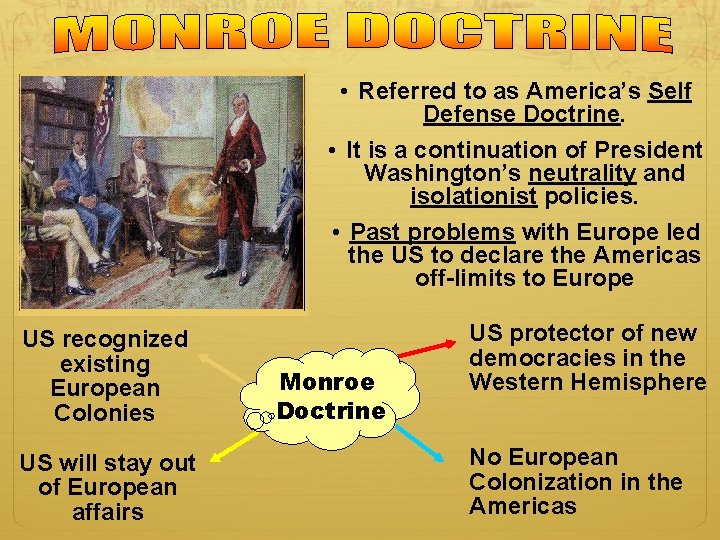
The Monroe Doctrine, 1823 Referred to as America’s Self-Defense Doctrine. 1. What foreign policy principles are established? 2. What warning is given to the European countries? Monroe Doctrine 3. What would the US do if the warning was not headed?
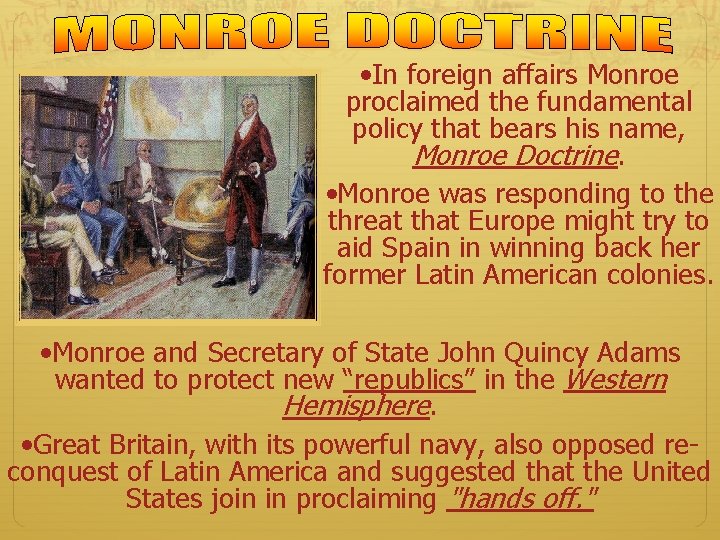
monroe doctrine • In foreign affairs Monroe proclaimed the fundamental policy that bears his name, Monroe Doctrine. • Monroe was responding to the threat that Europe might try to aid Spain in winning back her former Latin American colonies. • Monroe and Secretary of State John Quincy Adams wanted to protect new “republics” in the Western Hemisphere. • Great Britain, with its powerful navy, also opposed reconquest of Latin America and suggested that the United States join in proclaiming "hands off. "
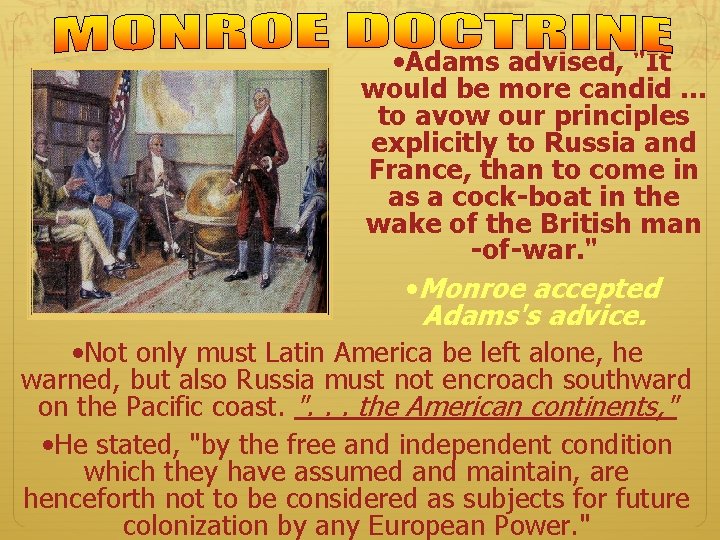
monroe doctrine • Adams advised, "It would be more candid. . . to avow our principles explicitly to Russia and France, than to come in as a cock-boat in the wake of the British man -of-war. " • Monroe accepted Adams's advice. • Not only must Latin America be left alone, he warned, but also Russia must not encroach southward on the Pacific coast. ". . . the American continents, " • He stated, "by the free and independent condition which they have assumed and maintain, are henceforth not to be considered as subjects for future colonization by any European Power. "
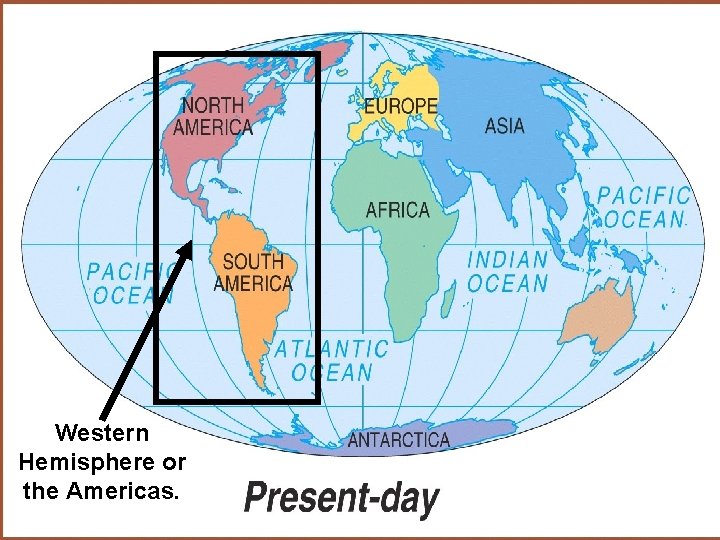
Western Hemisphere or the Americas.
• Referred to as America’s Self Defense Doctrine. • It is a continuation of President Washington’s neutrality and isolationist policies. • Past problems with Europe led the US to declare the Americas off-limits to Europe US recognized existing European Colonies US will stay out of European affairs Monroe Doctrine US protector of new democracies in the Western Hemisphere No European Colonization in the Americas
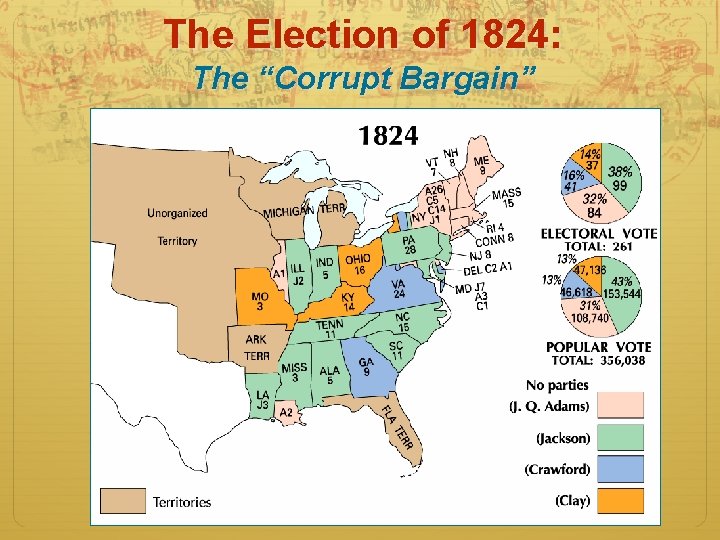
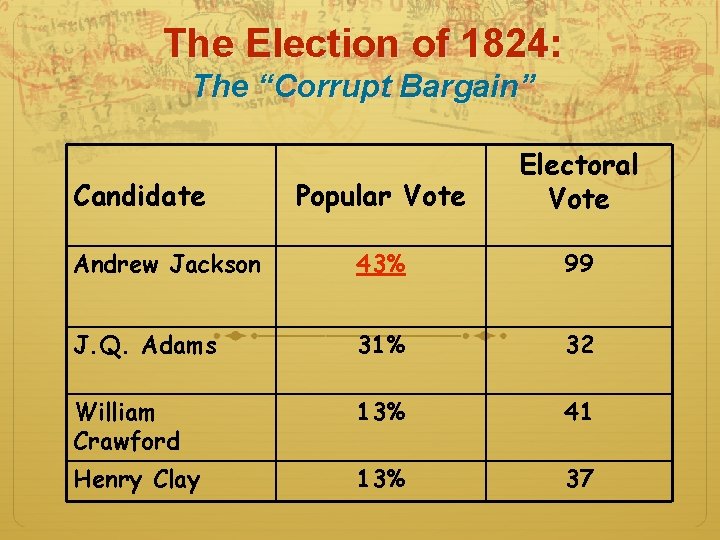
The Election of 1824: The “Corrupt Bargain”
The Election of 1824: The “Corrupt Bargain” Popular Vote Electoral Vote Andrew Jackson 43% 99 J. Q. Adams 31% 32 William Crawford 13% 41 Henry Clay 13% 37 Candidate