
Jefferson Takes Office Unit 9 Section 1 Jefferson
- Slides: 19
Jefferson Takes Office Unit 9 Section 1
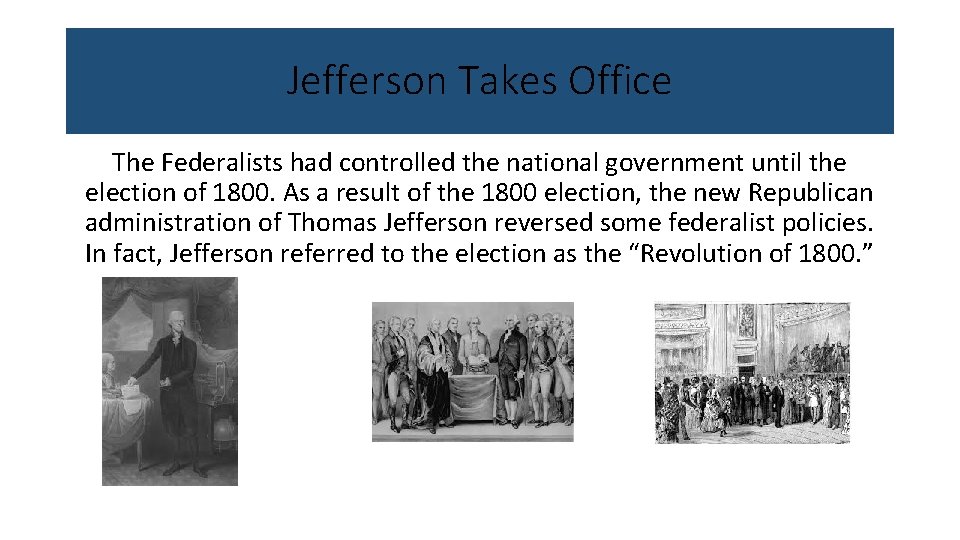
Jefferson Takes Office The Federalists had controlled the national government until the election of 1800. As a result of the 1800 election, the new Republican administration of Thomas Jefferson reversed some federalist policies. In fact, Jefferson referred to the election as the “Revolution of 1800. ”
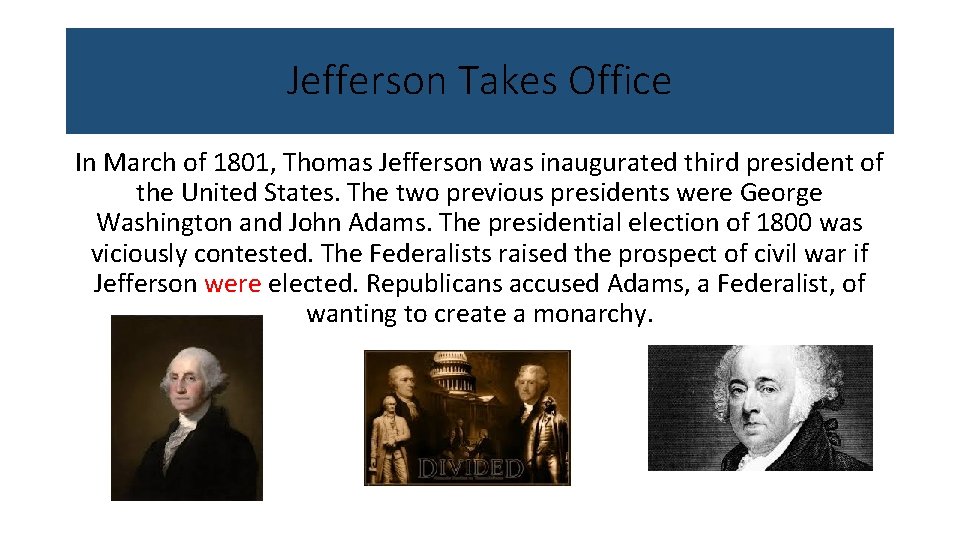
Jefferson Takes Office In March of 1801, Thomas Jefferson was inaugurated third president of the United States. The two previous presidents were George Washington and John Adams. The presidential election of 1800 was viciously contested. The Federalists raised the prospect of civil war if Jefferson were elected. Republicans accused Adams, a Federalist, of wanting to create a monarchy.
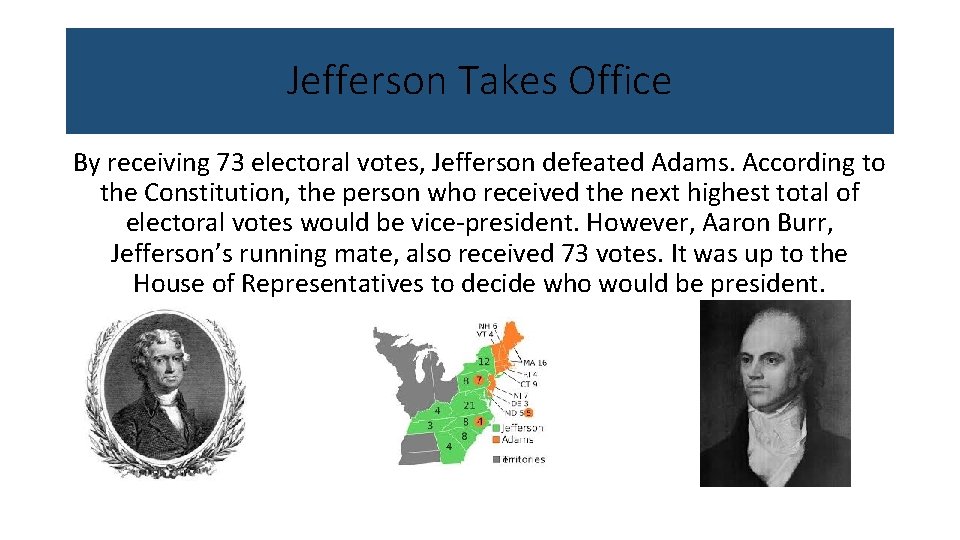
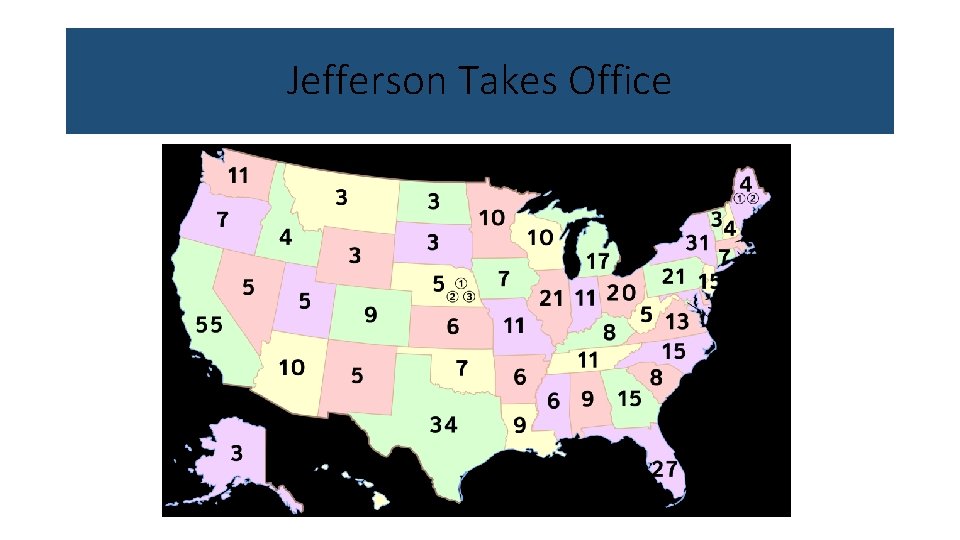
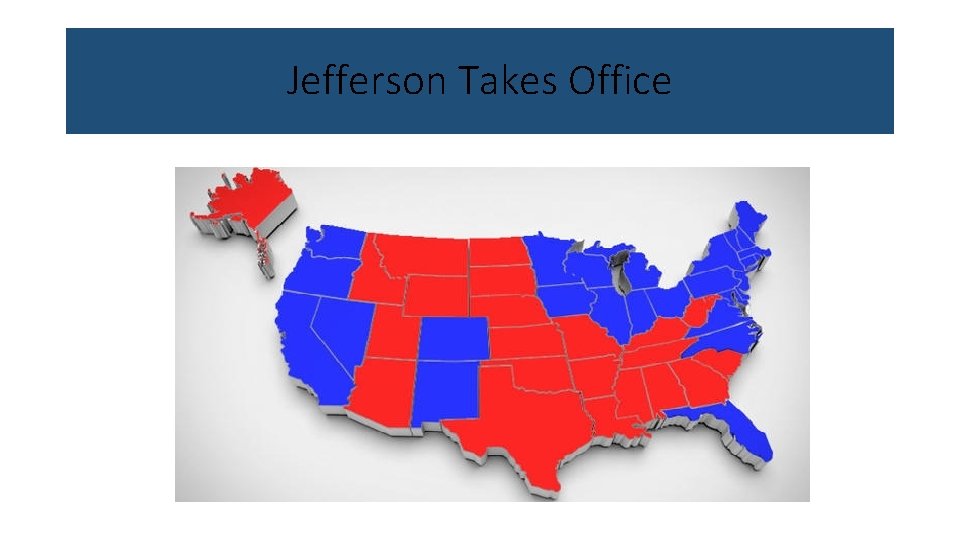
Jefferson Takes Office By receiving 73 electoral votes, Jefferson defeated Adams. According to the Constitution, the person who received the next highest total of electoral votes would be vice-president. However, Aaron Burr, Jefferson’s running mate, also received 73 votes. It was up to the House of Representatives to decide who would be president.
Jefferson Takes Office
Jefferson Takes Office
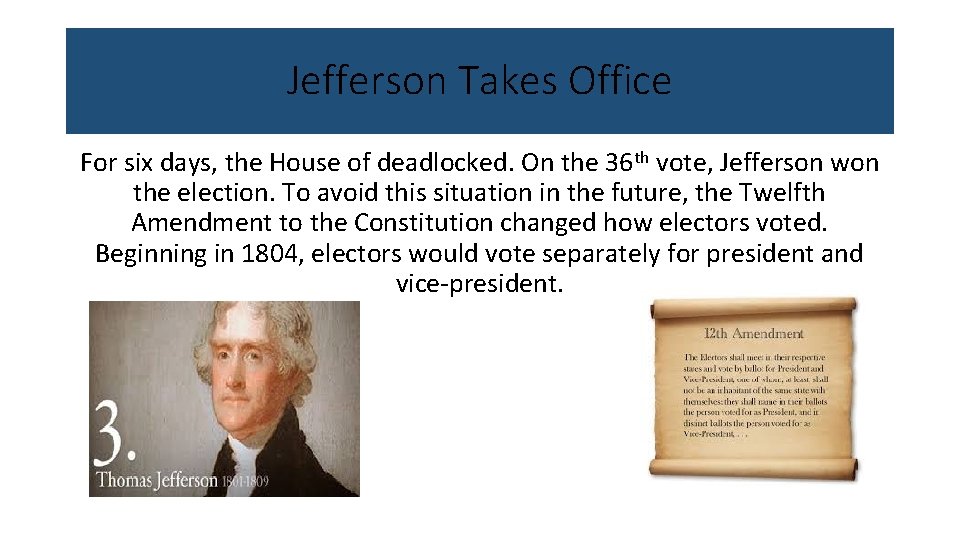
Jefferson Takes Office For six days, the House of deadlocked. On the 36 th vote, Jefferson won the election. To avoid this situation in the future, the Twelfth Amendment to the Constitution changed how electors voted. Beginning in 1804, electors would vote separately for president and vice-president.
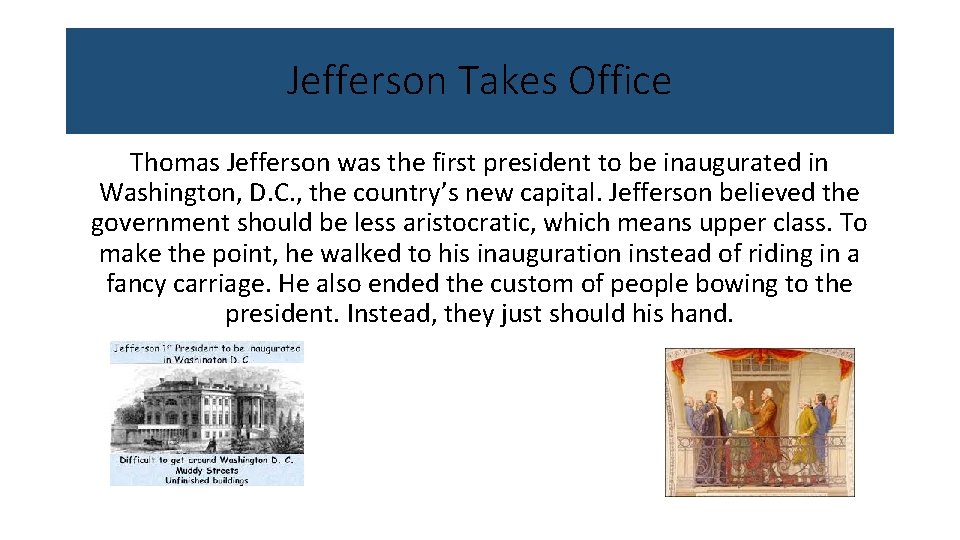
Jefferson Takes Office Thomas Jefferson was the first president to be inaugurated in Washington, D. C. , the country’s new capital. Jefferson believed the government should be less aristocratic, which means upper class. To make the point, he walked to his inauguration instead of riding in a fancy carriage. He also ended the custom of people bowing to the president. Instead, they just should his hand.
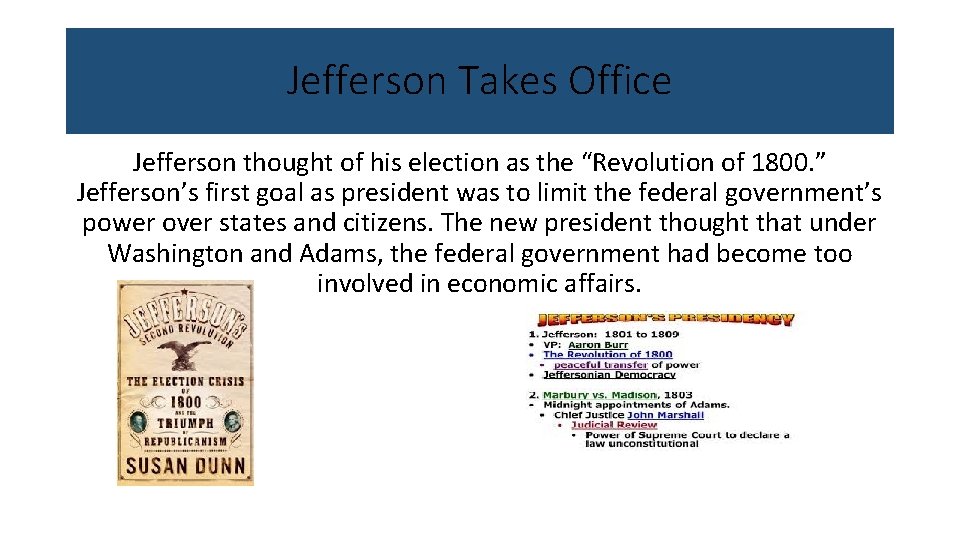
Jefferson Takes Office Jefferson thought of his election as the “Revolution of 1800. ” Jefferson’s first goal as president was to limit the federal government’s power over states and citizens. The new president thought that under Washington and Adams, the federal government had become too involved in economic affairs.
Jefferson Takes Office Jefferson believed in the idea of laissez faire, from the French term for “let alone. ” Laissez faire means that the government should not interfere in the economy. Jefferson put his laissez faire ideas into practice when he reduced the number of people in government. He fired all tax collectors and cut the number of U. S. diplomats.
Jefferson Takes Office Larger cuts came from shrinking the military. Jefferson cut the army’s budget in half, reducing the army’s size from 4, 000 to about 2, 500 soldiers. At the same time, Jefferson eliminated all federal taxes inside the country. Now, most tax revenue came from the tariff on imported goods. Revenue is the income for the government from taxes, licenses and other areas, as part of a city state or nation.
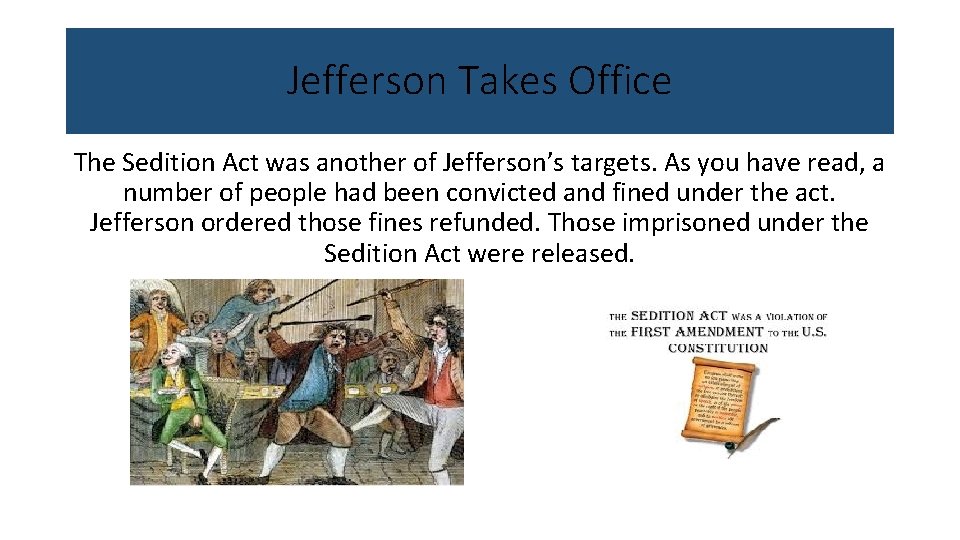
Jefferson Takes Office The Sedition Act was another of Jefferson’s targets. As you have read, a number of people had been convicted and fined under the act. Jefferson ordered those fines refunded. Those imprisoned under the Sedition Act were released.
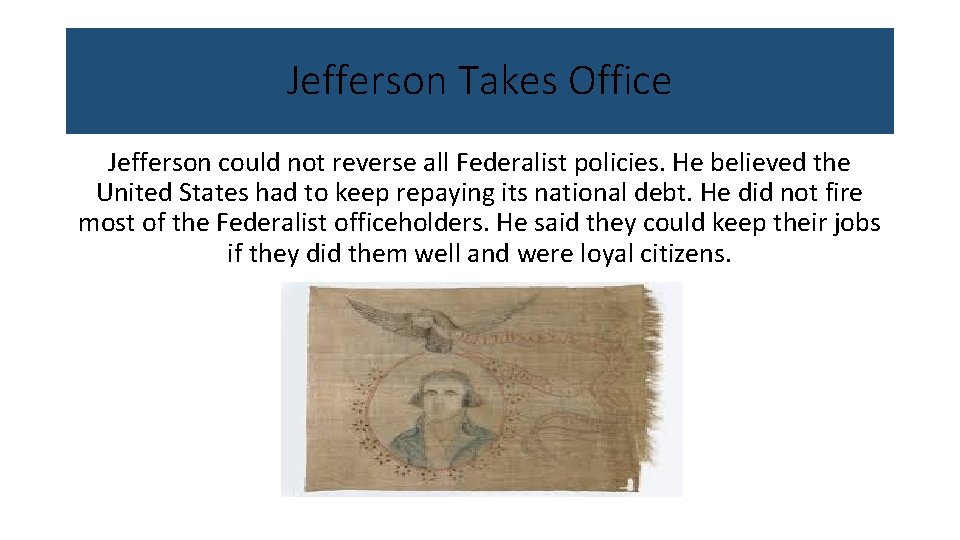
Jefferson Takes Office Jefferson could not reverse all Federalist policies. He believed the United States had to keep repaying its national debt. He did not fire most of the Federalist officeholders. He said they could keep their jobs if they did them well and were loyal citizens.
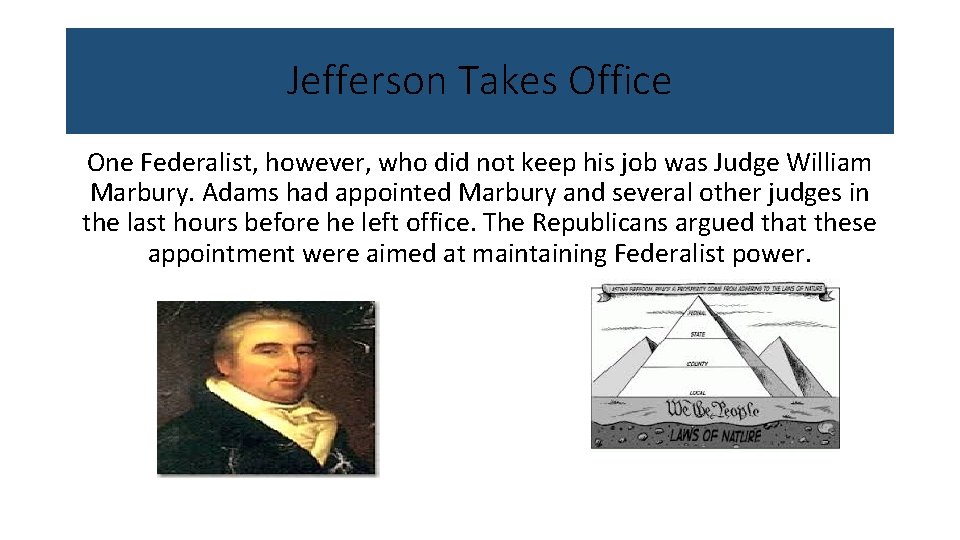
Jefferson Takes Office One Federalist, however, who did not keep his job was Judge William Marbury. Adams had appointed Marbury and several other judges in the last hours before he left office. The Republicans argued that these appointment were aimed at maintaining Federalist power.
Jefferson Takes Office When Jefferson took office, he ordered James Madison, his secretary of state, to cease work on the appointments. Marbury then sued Madison, citing the Judiciary Act of 1789. This act gave the Supreme Court the power to review cases brought against a federal official.
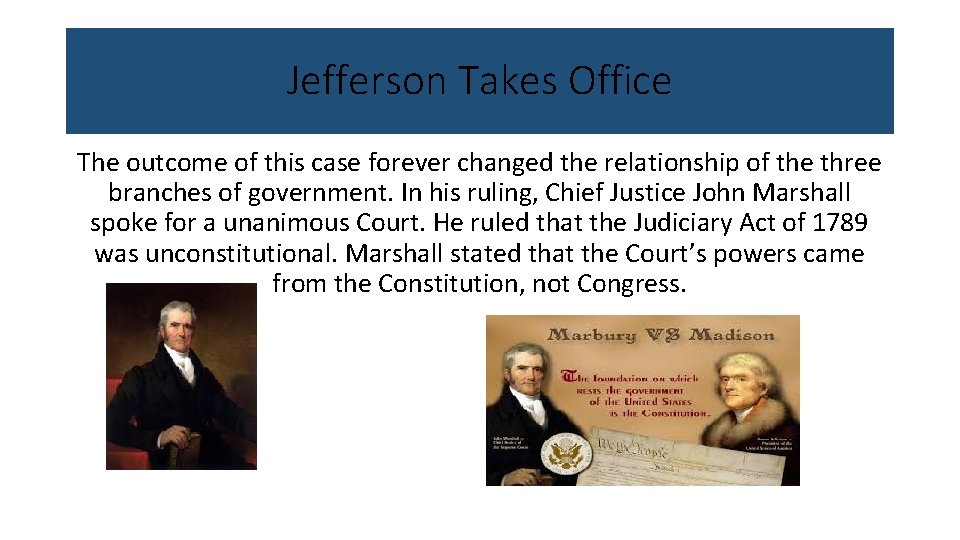
Jefferson Takes Office The outcome of this case forever changed the relationship of the three branches of government. In his ruling, Chief Justice John Marshall spoke for a unanimous Court. He ruled that the Judiciary Act of 1789 was unconstitutional. Marshall stated that the Court’s powers came from the Constitution, not Congress.
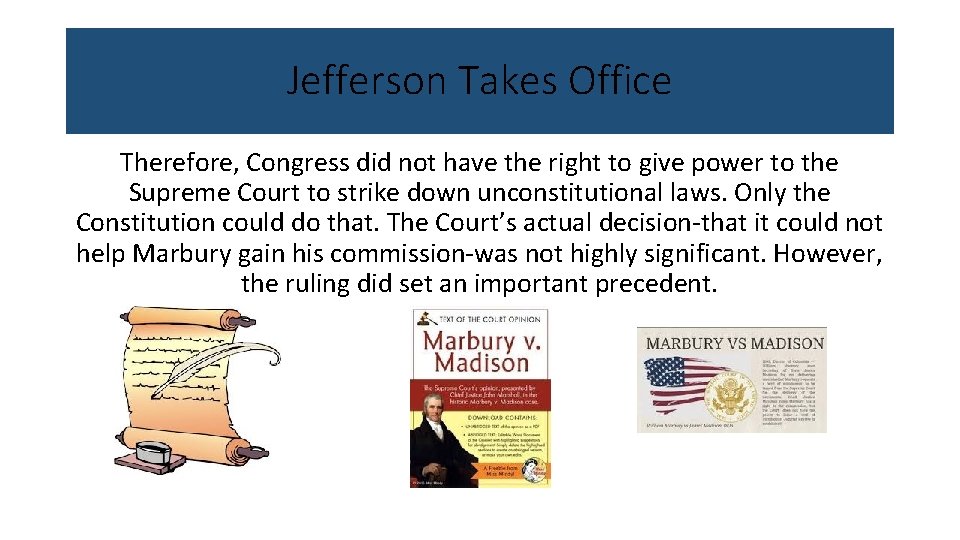
Jefferson Takes Office Therefore, Congress did not have the right to give power to the Supreme Court to strike down unconstitutional laws. Only the Constitution could do that. The Court’s actual decision-that it could not help Marbury gain his commission-was not highly significant. However, the ruling did set an important precedent.
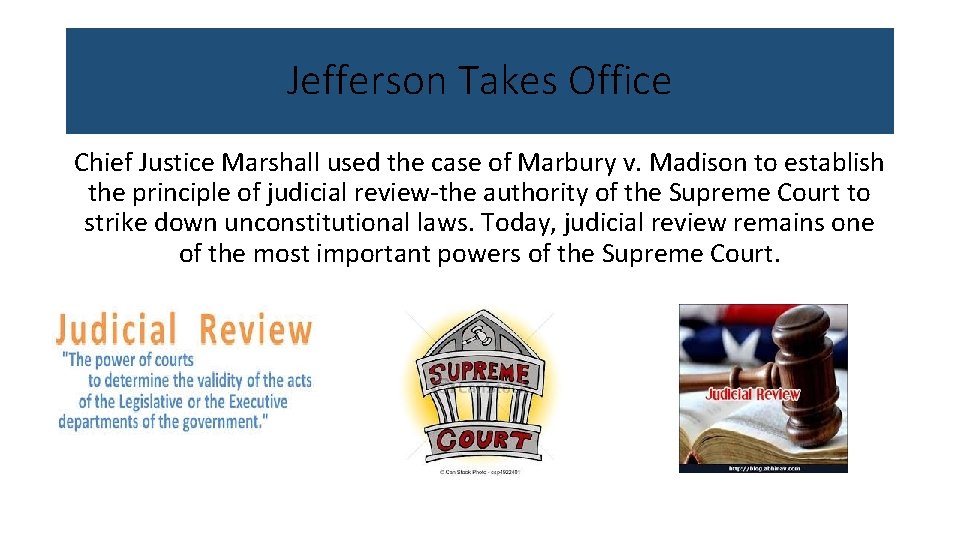
Jefferson Takes Office Chief Justice Marshall used the case of Marbury v. Madison to establish the principle of judicial review-the authority of the Supreme Court to strike down unconstitutional laws. Today, judicial review remains one of the most important powers of the Supreme Court.
Jefferson Takes Office The End