
Jefferson Lab High Power Beam Dump Refurbishment David
Jefferson Lab High Power Beam Dump Refurbishment David Hamlette, RRPT Rad. Con Field Operations Manager 1
Welcome to Jefferson Lab Managed and operated for the DOE by the Jefferson Science Associates, LLC (JSA) • Continuous Electron Beam Accelerator Facility (CEBAF) – 2 superconducting RF linacs, 2 arcs with four experimental halls • Low Energy Recirculation Facility (LERF) – 120 Me. V energy-recovery linac 2
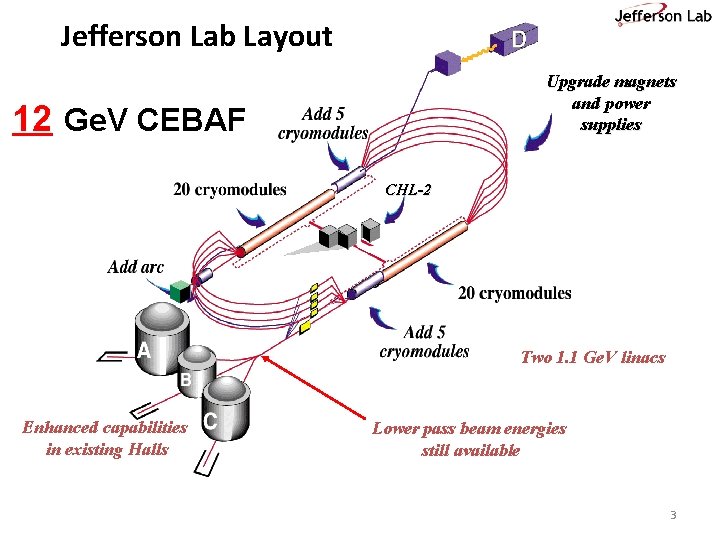
Jefferson Lab Layout Upgrade magnets and power supplies 11 6 Ge. V CEBAF 12 CHL-2 Two 1. 1 0. 6 Ge. V linacs Enhanced capabilities in existing Halls Lower pass beam energies still available 3
4
5
6
7
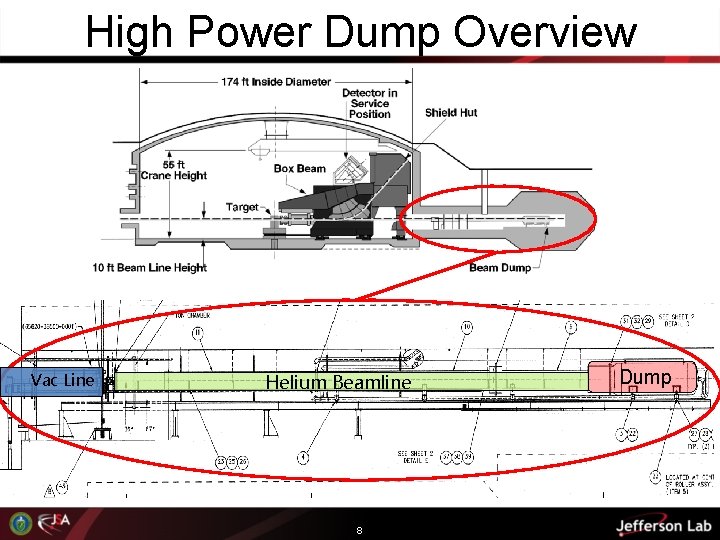
High Power Dump Overview Vac Line Helium Beamline 8 Dump
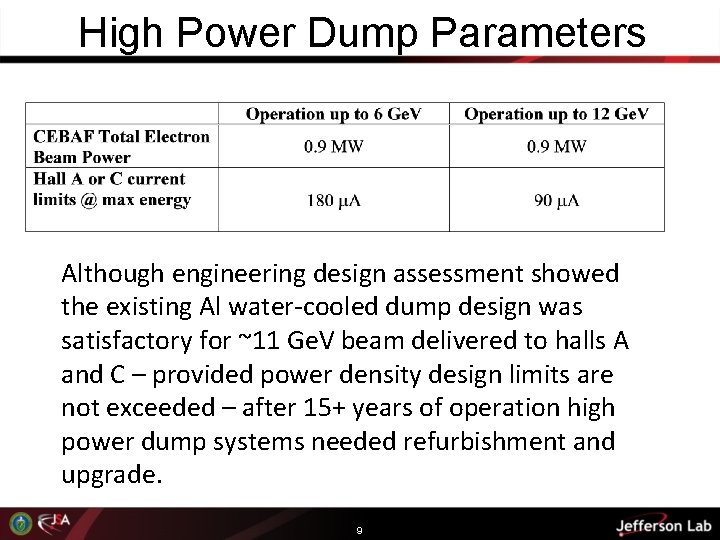
High Power Dump Parameters Although engineering design assessment showed the existing Al water-cooled dump design was satisfactory for ~11 Ge. V beam delivered to halls A and C – provided power density design limits are not exceeded – after 15+ years of operation high power dump systems needed refurbishment and upgrade. 9
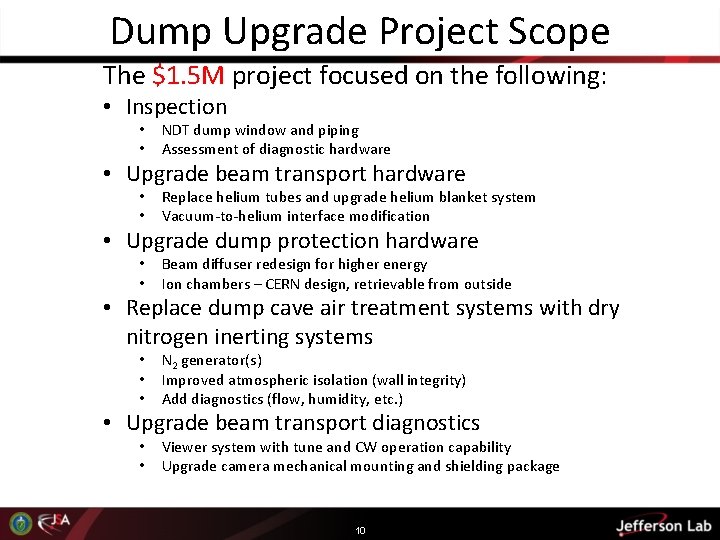
Dump Upgrade Project Scope The $1. 5 M project focused on the following: • Inspection • • NDT dump window and piping Assessment of diagnostic hardware • Upgrade beam transport hardware • • Replace helium tubes and upgrade helium blanket system Vacuum-to-helium interface modification • Upgrade dump protection hardware • • Beam diffuser redesign for higher energy Ion chambers – CERN design, retrievable from outside • Replace dump cave air treatment systems with dry nitrogen inerting systems • • • N 2 generator(s) Improved atmospheric isolation (wall integrity) Add diagnostics (flow, humidity, etc. ) • Upgrade beam transport diagnostics • • Viewer system with tune and CW operation capability Upgrade camera mechanical mounting and shielding package 10
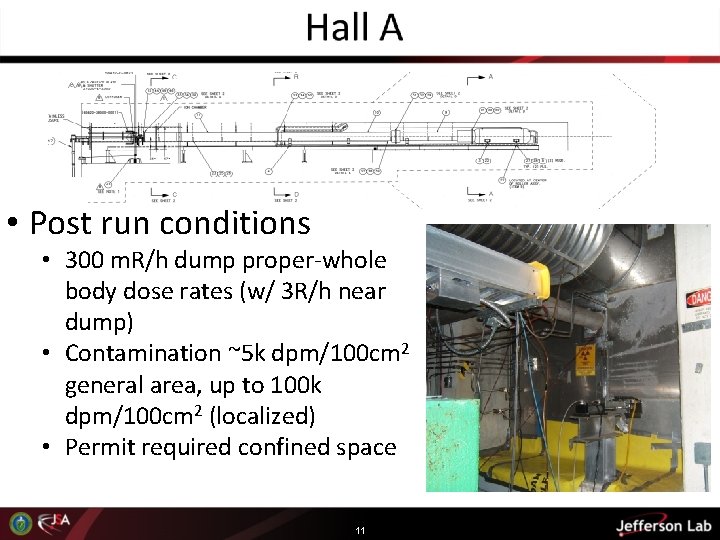
• Post run conditions • 300 m. R/h dump proper-whole body dose rates (w/ 3 R/h near dump) • Contamination ~5 k dpm/100 cm 2 general area, up to 100 k dpm/100 cm 2 (localized) • Permit required confined space 11
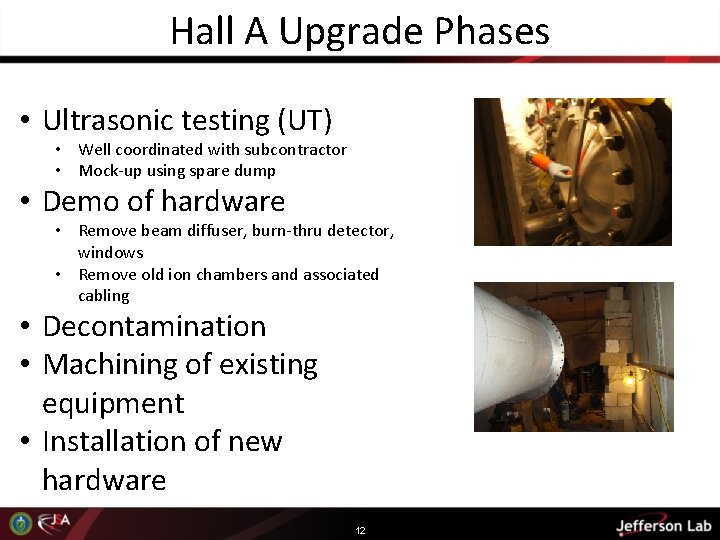
Hall A Upgrade Phases • Ultrasonic testing (UT) • Well coordinated with subcontractor • Mock-up using spare dump • Demo of hardware • Remove beam diffuser, burn-thru detector, windows • Remove old ion chambers and associated cabling • Decontamination • Machining of existing equipment • Installation of new hardware 12
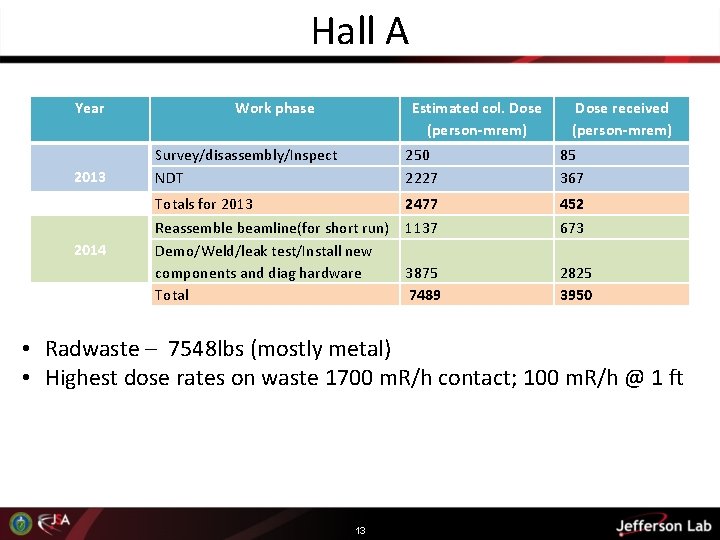
Hall A Year 2013 2014 Work phase Estimated col. Dose (person-mrem) Dose received (person-mrem) Survey/disassembly/Inspect NDT 250 2227 85 367 Totals for 2013 Reassemble beamline(for short run) Demo/Weld/leak test/Install new components and diag hardware Total 2477 1137 452 673 3875 7489 2825 3950 • Radwaste – 7548 lbs (mostly metal) • Highest dose rates on waste 1700 m. R/h contact; 100 m. R/h @ 1 ft 13
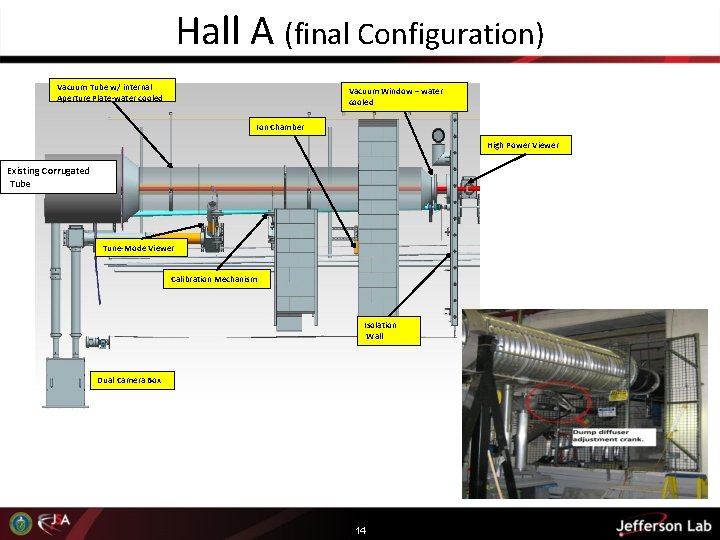
Hall A (final Configuration) Vacuum Tube w/ internal Aperture Plate-water cooled Vacuum Window – water cooled Ion Chamber High Power Viewer Existing Corrugated Tube Tune-Mode Viewer Calibration Mechanism Isolation Wall Dual Camera Box 14
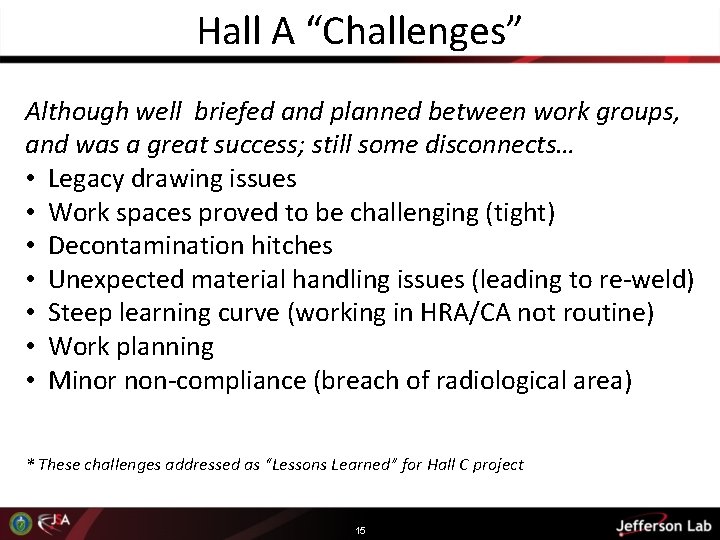
Hall A “Challenges” Although well briefed and planned between work groups, and was a great success; still some disconnects… • Legacy drawing issues • Work spaces proved to be challenging (tight) • Decontamination hitches • Unexpected material handling issues (leading to re-weld) • Steep learning curve (working in HRA/CA not routine) • Work planning • Minor non-compliance (breach of radiological area) * These challenges addressed as “Lessons Learned” for Hall C project 15
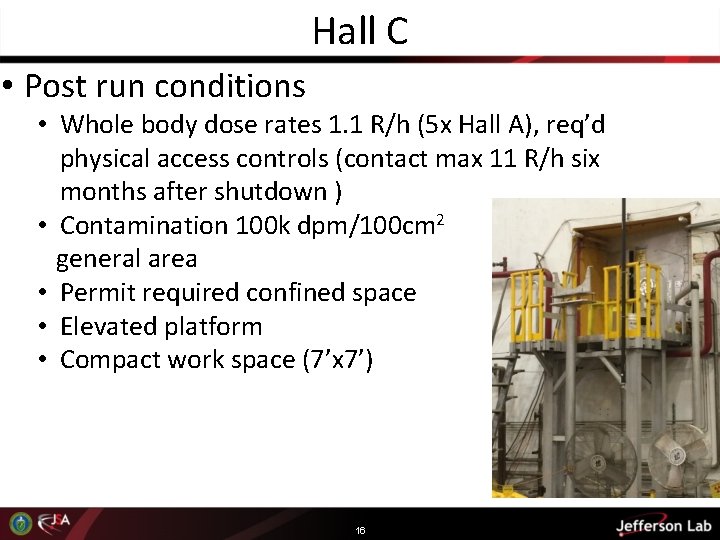
Hall C • Post run conditions • Whole body dose rates 1. 1 R/h (5 x Hall A), req’d physical access controls (contact max 11 R/h six months after shutdown ) • Contamination 100 k dpm/100 cm 2 general area • Permit required confined space • Elevated platform • Compact work space (7’x 7’) 16
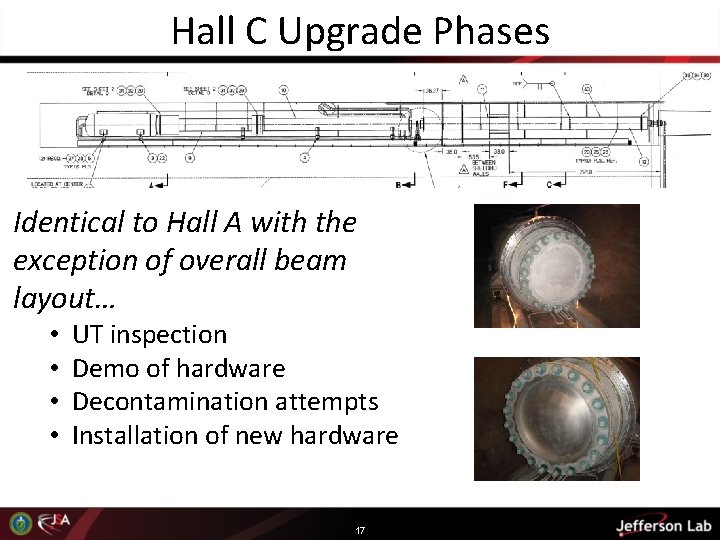
Hall C Upgrade Phases Identical to Hall A with the exception of overall beam layout… • • UT inspection Demo of hardware Decontamination attempts Installation of new hardware 17
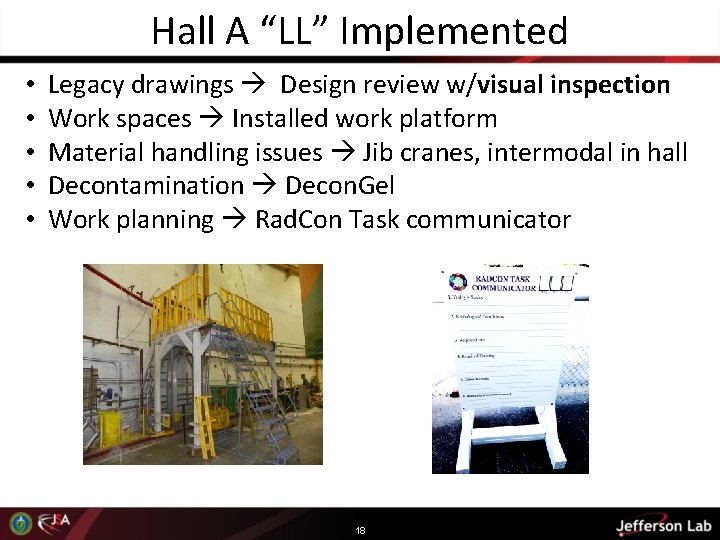
Hall A “LL” Implemented • • • Legacy drawings Design review w/visual inspection Work spaces Installed work platform Material handling issues Jib cranes, intermodal in hall Decontamination Decon. Gel Work planning Rad. Con Task communicator 18
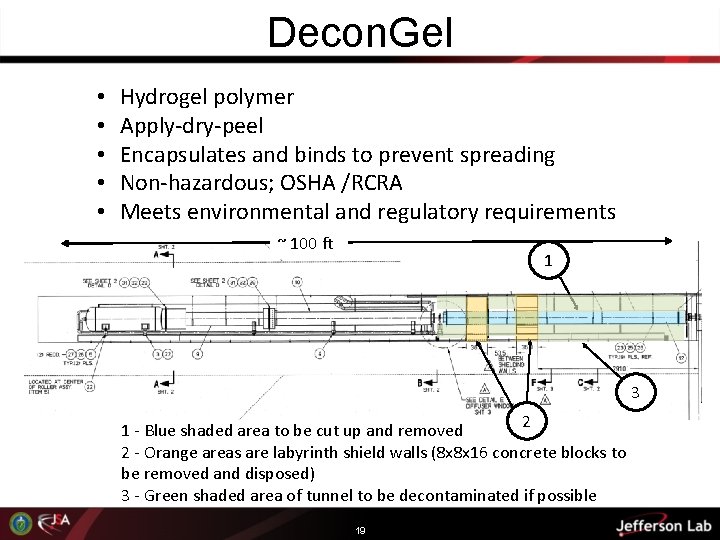
Decon. Gel • • • Hydrogel polymer Apply-dry-peel Encapsulates and binds to prevent spreading Non-hazardous; OSHA /RCRA Meets environmental and regulatory requirements ~ 100 ft 1 3 2 1 - Blue shaded area to be cut up and removed 2 - Orange areas are labyrinth shield walls (8 x 8 x 16 concrete blocks to be removed and disposed) 3 - Green shaded area of tunnel to be decontaminated if possible 19
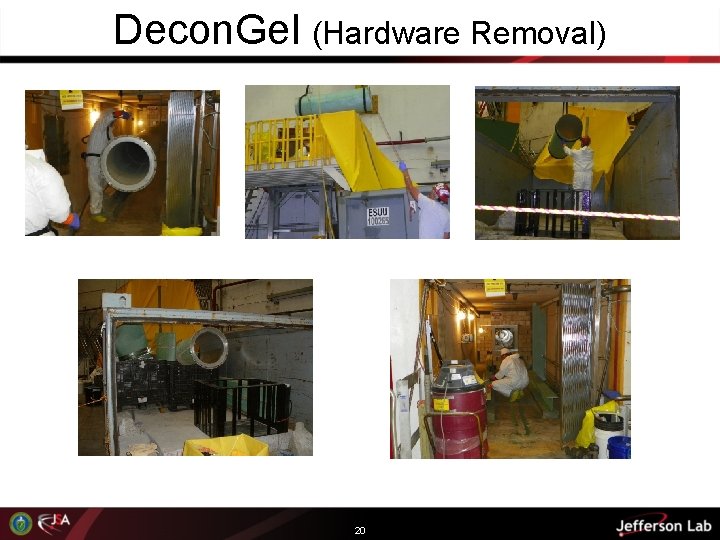
Decon. Gel (Hardware Removal) 20
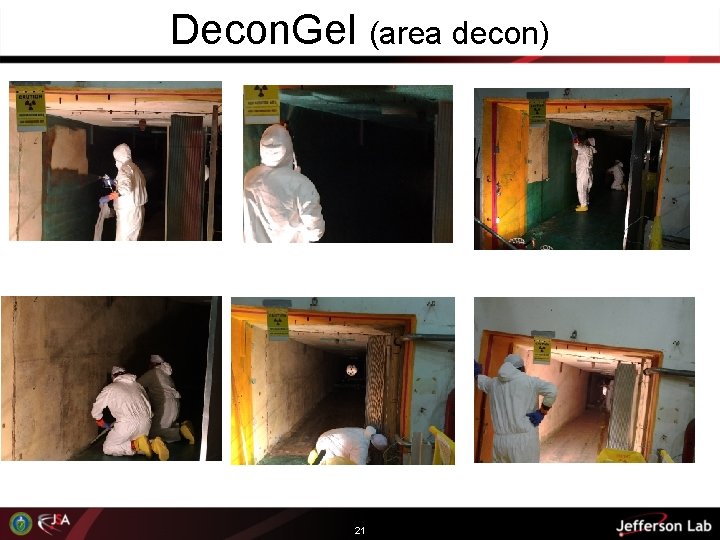
Decon. Gel (area decon) 21
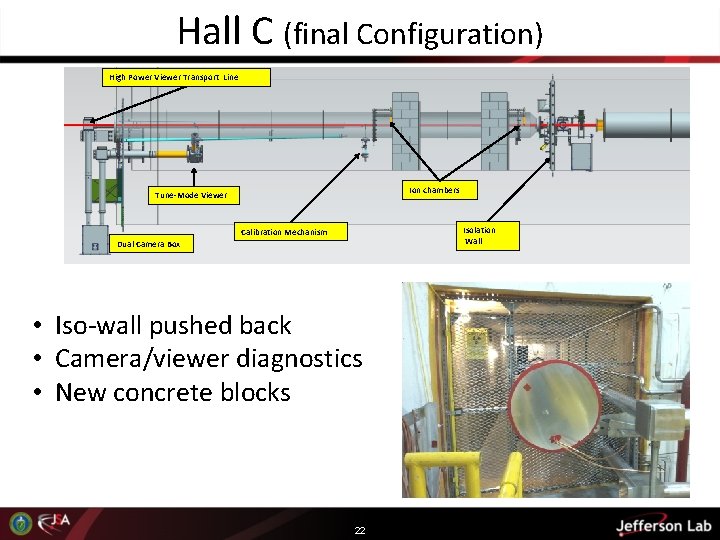
Hall C (final Configuration) High Power Viewer Transport Line Ion chambers Tune-Mode Viewer Isolation Wall Calibration Mechanism Dual Camera Box • Iso-wall pushed back • Camera/viewer diagnostics • New concrete blocks 22
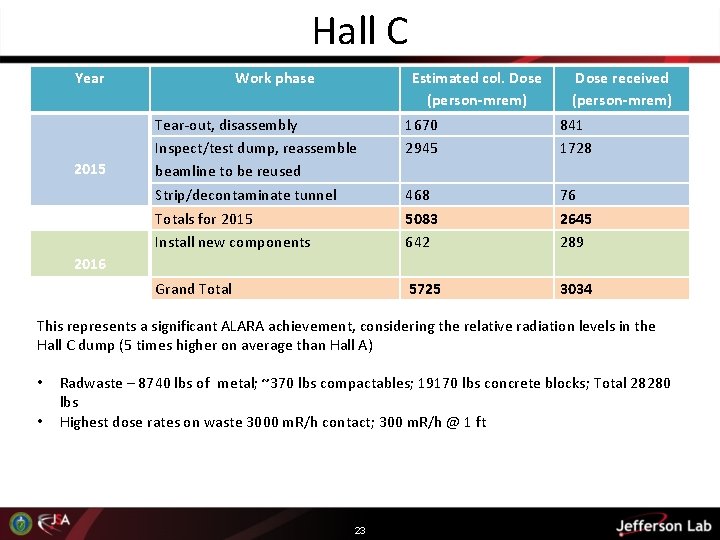
Hall C Year 2015 2016 Work phase Estimated col. Dose (person-mrem) Dose received (person-mrem) Tear-out, disassembly Inspect/test dump, reassemble beamline to be reused 1670 2945 841 1728 Strip/decontaminate tunnel Totals for 2015 Install new components 468 5083 642 76 2645 289 Grand Total 5725 3034 This represents a significant ALARA achievement, considering the relative radiation levels in the Hall C dump (5 times higher on average than Hall A) • • Radwaste – 8740 lbs of metal; ~370 lbs compactables; 19170 lbs concrete blocks; Total 28280 lbs Highest dose rates on waste 3000 m. R/h contact; 300 m. R/h @ 1 ft 23
Hall C “Challenges” Daily brief w/ Task communicator was very effective, however, there were still areas that created re-work and/or minor delays • Legacy Drawing issues cont’d • Work spaces proved to be challenging (tighter) • Decon. Gel learning curve • Medical emergency in radiological area 24
Summary Slide ü What created the potential rad impact? Both activation and contamination ü How many tons of material are affected? ~30000 lbs steel, aluminum, concrete ü Evaluation approach: IFB ü What organizations provided assistance? Multi-Divisional effort (Engineering, Industrial Hygiene, Installation, Physics) ü What percentages or tonnage were released as scrap, landfill waste, rad waste, reuse? Essentially all materials removed from dump were radwaste 25
- Slides: 25