
Jeanne Rothermel Tiffiney Smith Southeast RPDC Quality Evaluations












- Slides: 54
Jeanne Rothermel Tiffiney Smith Southeast RPDC Quality Evaluations and Eligibility Determinations
2 Introductions
3 Learner Intentions • Use a problem-solving model to generate quality referrals. • Conduct a review of existing data. • Implement quality assessment practices. • Use many sources of data to make quality eligibility determinations. • Write evaluation reports to synthesize all observed and assessed information. • Make quality eligibility determinations.
4 Essential Questions • How does one use a problem solving model to generate quality referrals? • How does one conduct a quality review of existing data? • What needs to be included in a written evaluation report to synthesize all observed and assessed information? • How does one use many sources of data to make quality eligibility determinations?
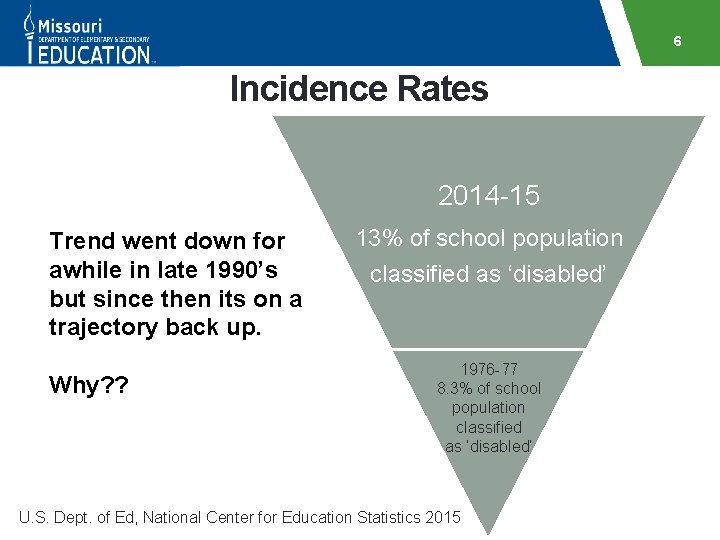
6 Incidence Rates 2014 -15 Trend went down for awhile in late 1990’s but since then its on a trajectory back up. Why? ? 13% of school population classified as ‘disabled’ 1976 -77 8. 3% of school population classified as ‘disabled’ U. S. Dept. of Ed, National Center for Education Statistics 2015
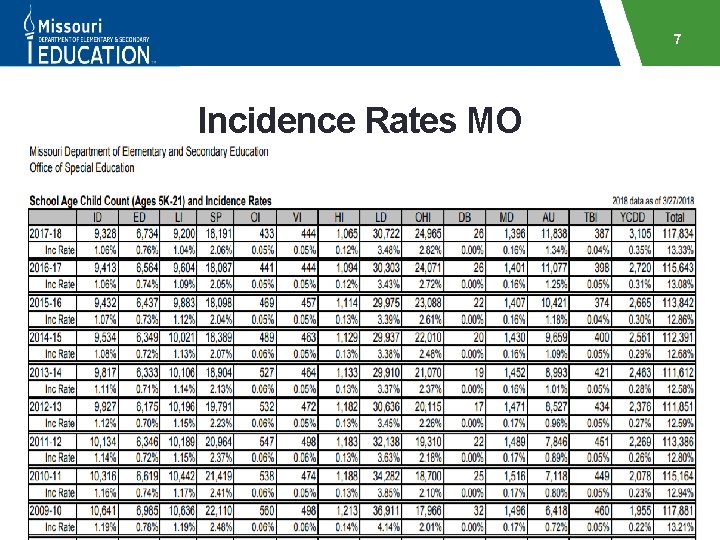
7 Incidence Rates MO
8 What Do We Know About Special Education?
9
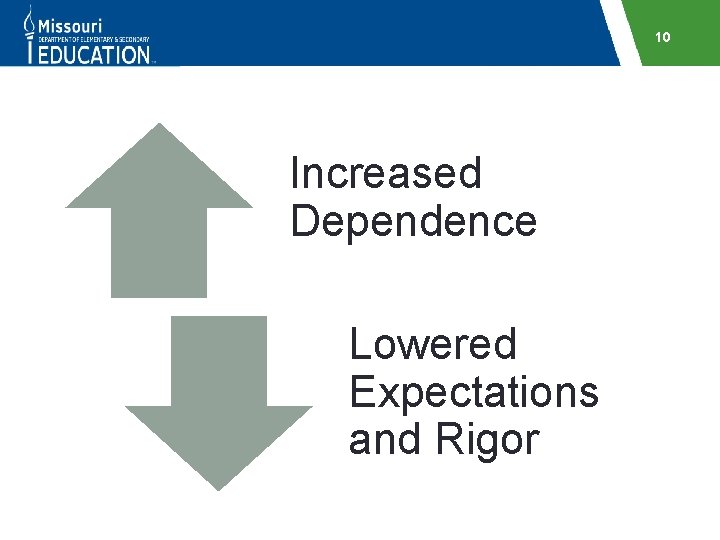
10 Increased Dependence Lowered Expectations and Rigor
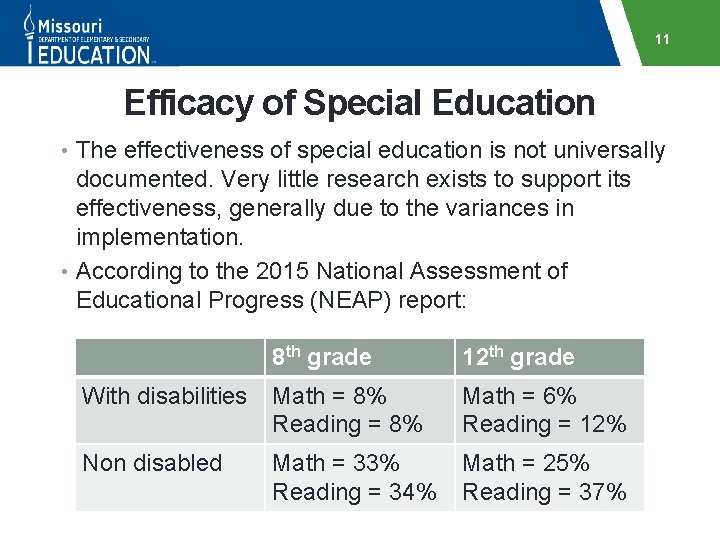
11 Efficacy of Special Education • The effectiveness of special education is not universally documented. Very little research exists to support its effectiveness, generally due to the variances in implementation. • According to the 2015 National Assessment of Educational Progress (NEAP) report: 8 th grade 12 th grade With disabilities Math = 8% Reading = 8% Math = 6% Reading = 12% Non disabled Math = 33% Reading = 34% Math = 25% Reading = 37%
12 The “IDEA is not a panacea for all of life’s ills. ” Maricus W. v. Lanett City Bd. Of Educ. , 141 F. Supp. 2 nd 1064 (M. D. Ala. 2001)
13 So, now what? If we know special education wasn’t designed to be the panacea for all the woes of education, how do we keep this in check?
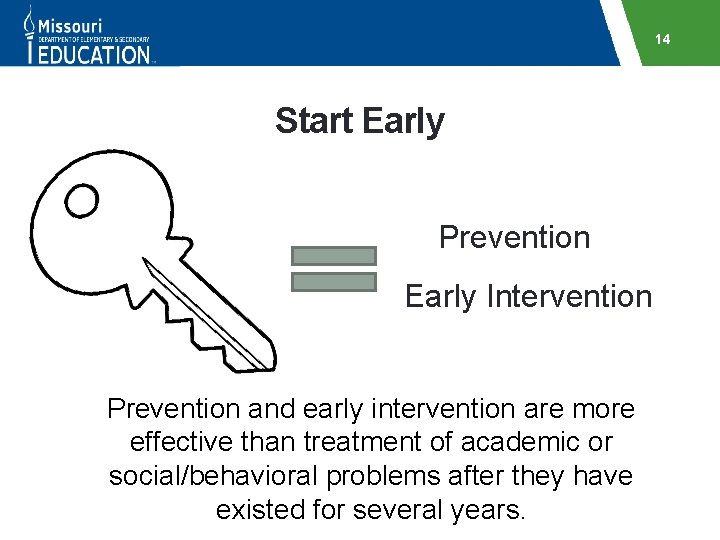
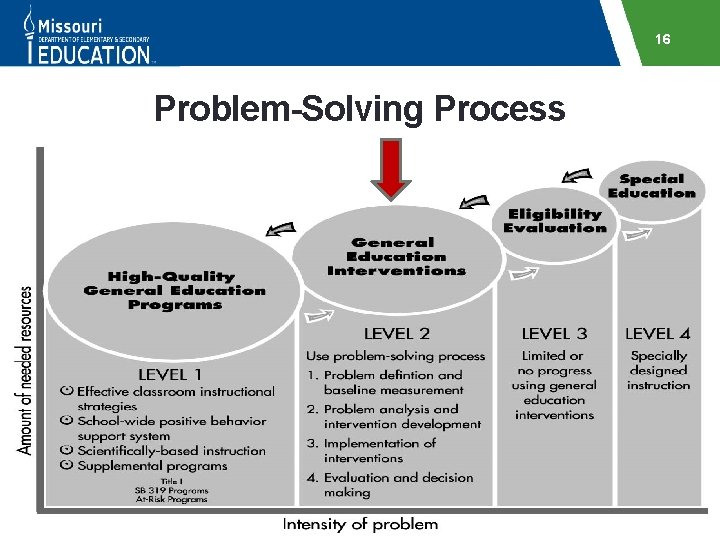
14 Start Early Prevention Early Intervention Prevention and early intervention are more effective than treatment of academic or social/behavioral problems after they have existed for several years.
15 Prevention and Early Intervention The response to individualized intervention data in general education is critical to determining special education need and to measuring adverse educational impact.
16 Problem-Solving Process
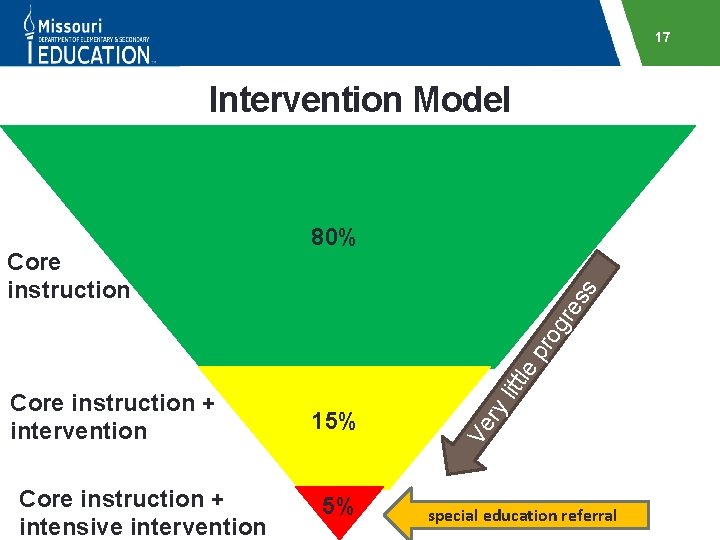
17 Intervention Model Core instruction + intensive intervention ss 5% ry 15% Ve Core instruction + intervention litt le pr og re Core instruction 80% special education referral
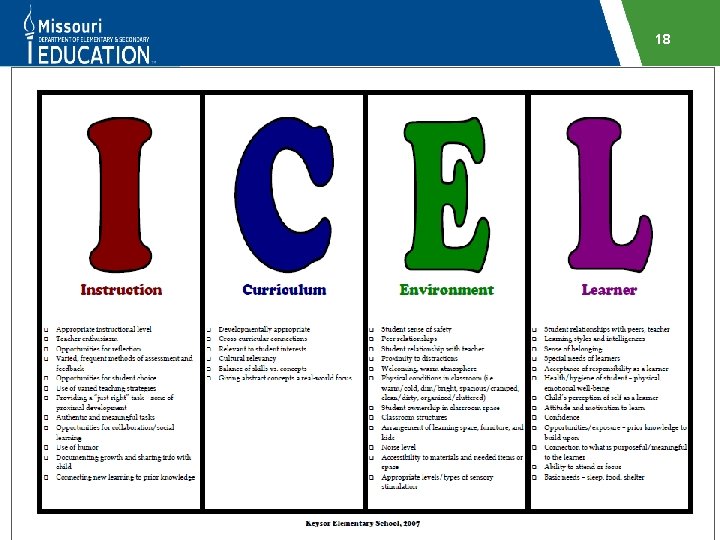
18
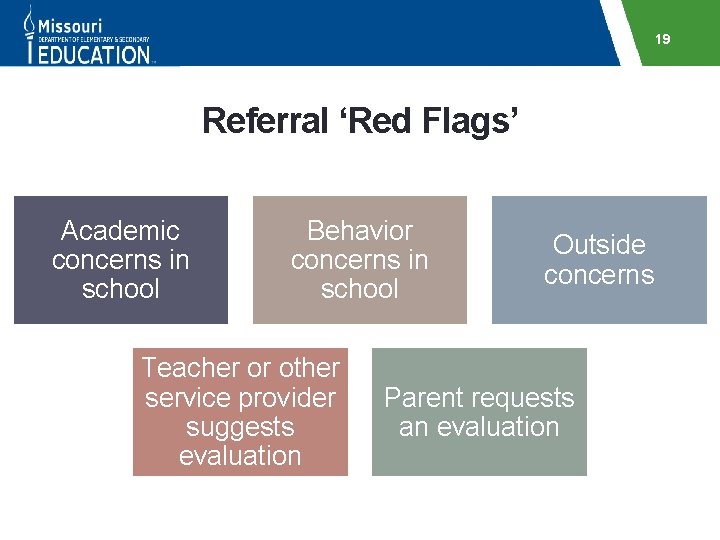
19 Referral ‘Red Flags’ Academic concerns in school Behavior concerns in school Teacher or other service provider suggests evaluation Outside concerns Parent requests an evaluation
20 Referral ‘Red Flags’ “Remember, however, that not one of these ‘red flags’ alone would typically be sufficient to trigger the child-find duty, but that the more that exist in a particular situation, the more likely it is that the duty would be triggered. ” Julie Weatherly, ESQ
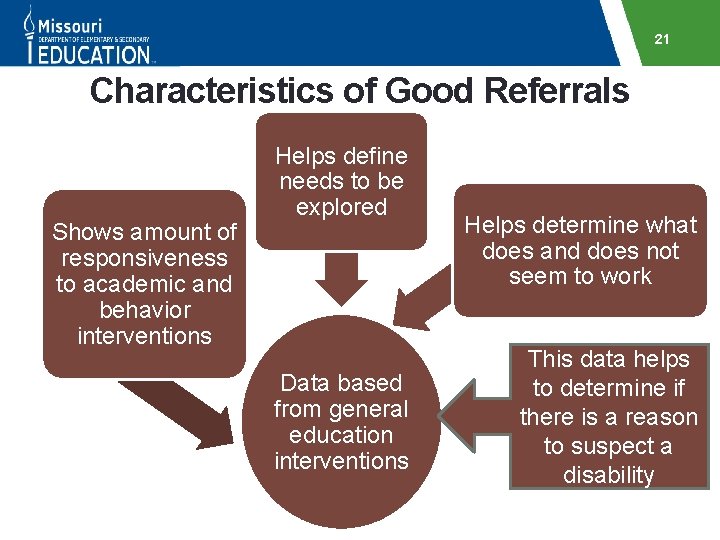
21 Characteristics of Good Referrals Shows amount of responsiveness to academic and behavior interventions Helps define needs to be explored Data based from general education interventions Helps determine what does and does not seem to work This data helps to determine if there is a reason to suspect a disability
22 Now what?
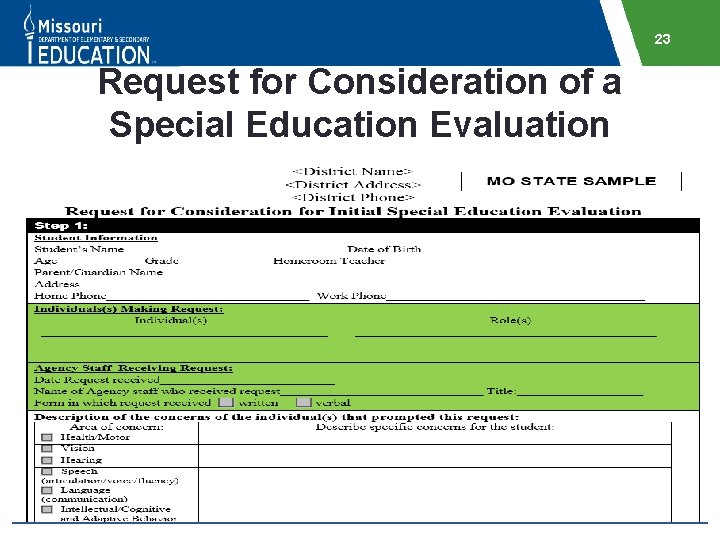
23 Request for Consideration of a Special Education Evaluation
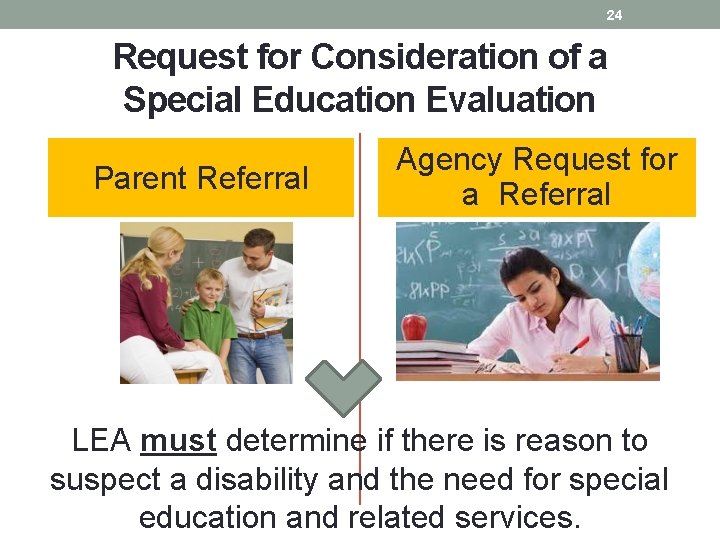
24 Request for Consideration of a Special Education Evaluation Parent Referral Agency Request for a Referral LEA must determine if there is reason to suspect a disability and the need for special education and related services.
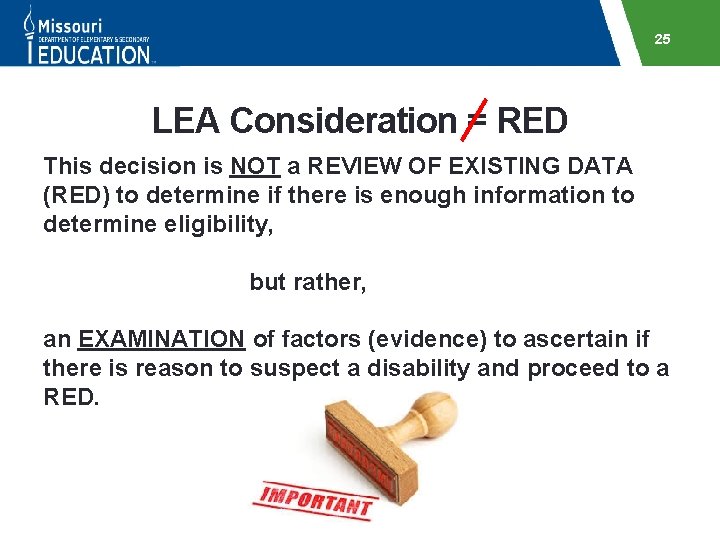
25 LEA Consideration = RED This decision is NOT a REVIEW OF EXISTING DATA (RED) to determine if there is enough information to determine eligibility, but rather, an EXAMINATION of factors (evidence) to ascertain if there is reason to suspect a disability and proceed to a RED.
26 Evaluation Data
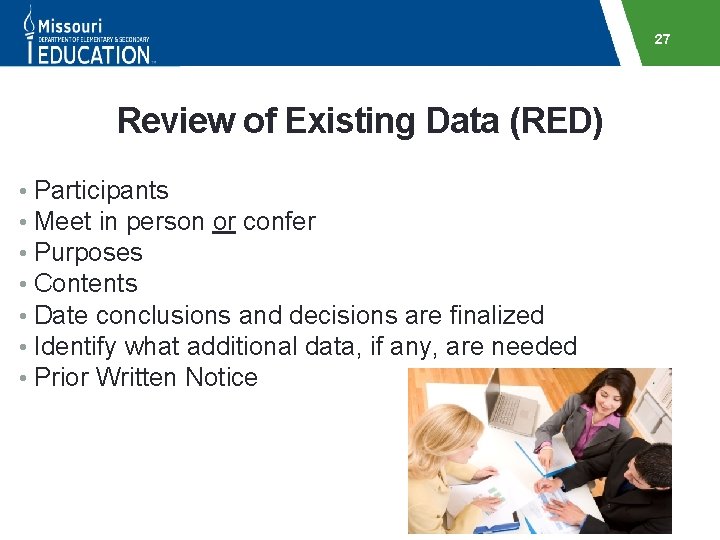
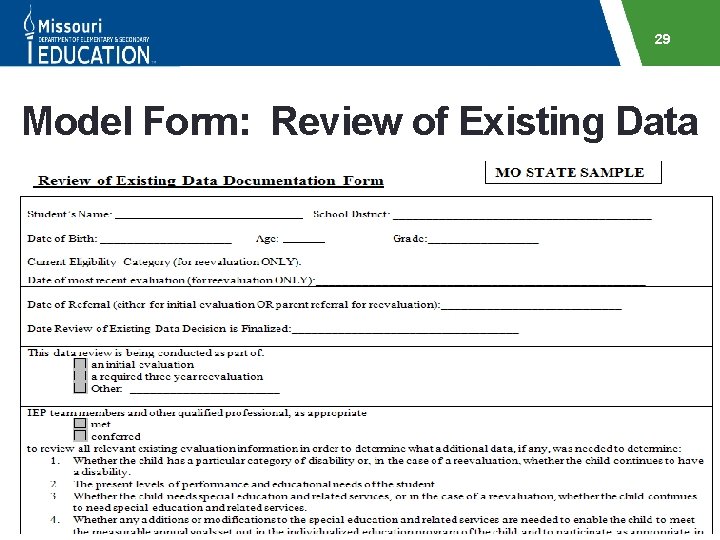
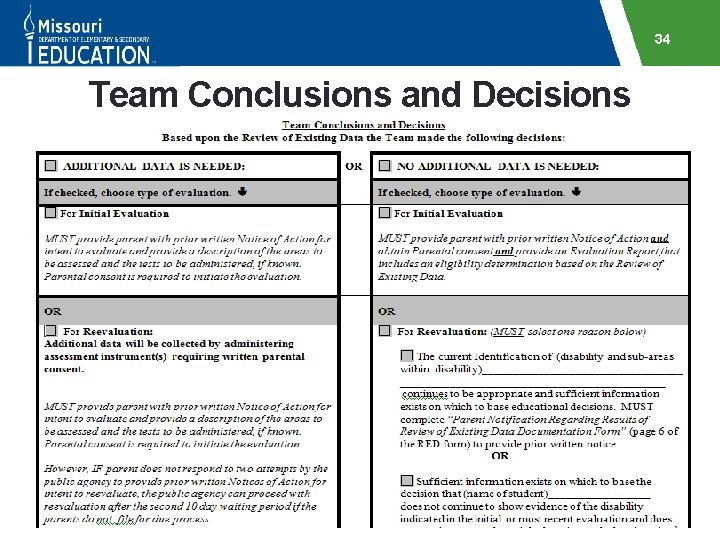
27 Review of Existing Data (RED) • Participants • Meet in person or confer • Purposes • Contents • Date conclusions and decisions are finalized • Identify what additional data, if any, are needed • Prior Written Notice
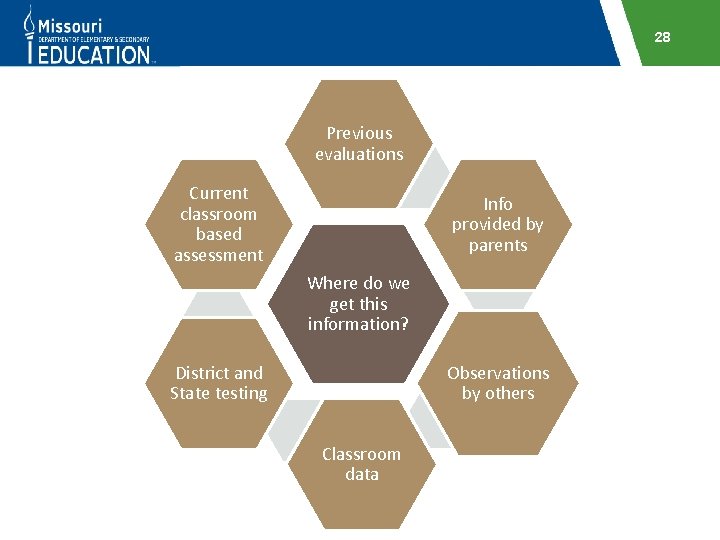
28 Previous evaluations Current classroom based assessment Info provided by parents Where do we get this information? Observations by others District and State testing Classroom data
29 Model Form: Review of Existing Data
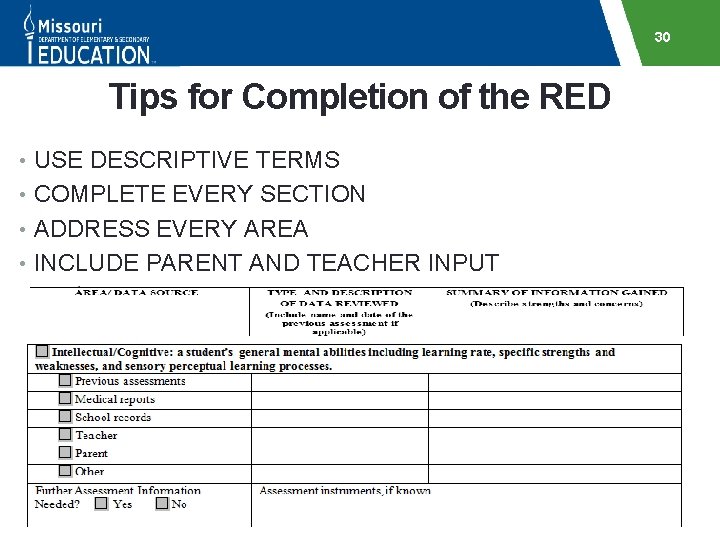
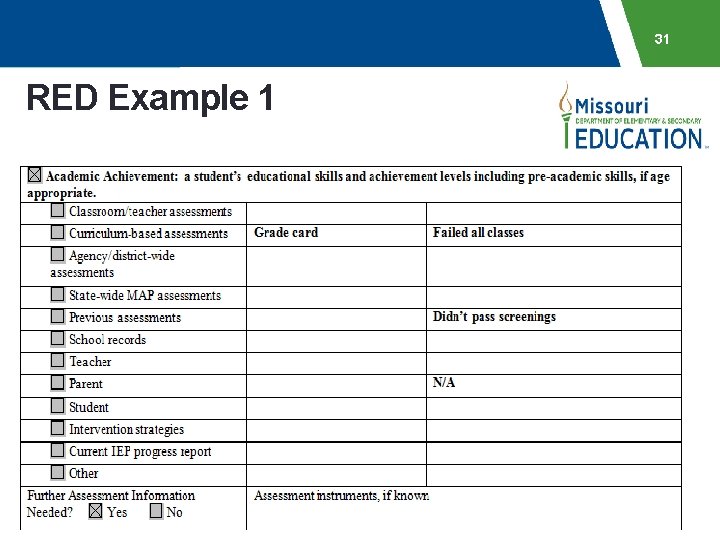
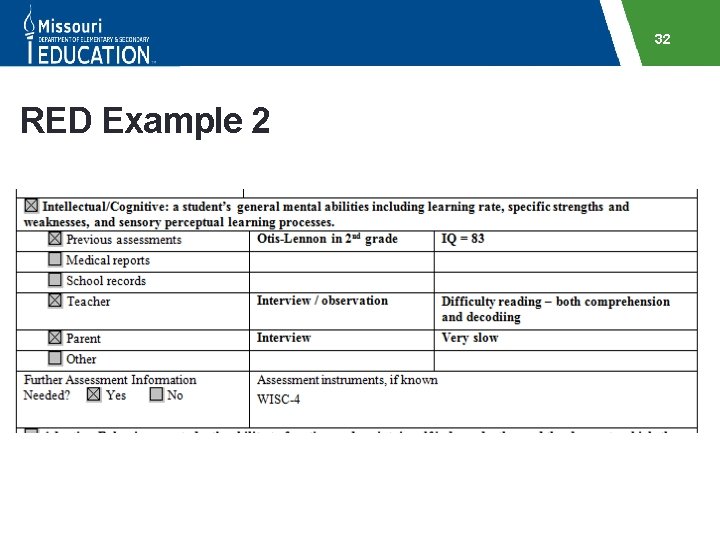
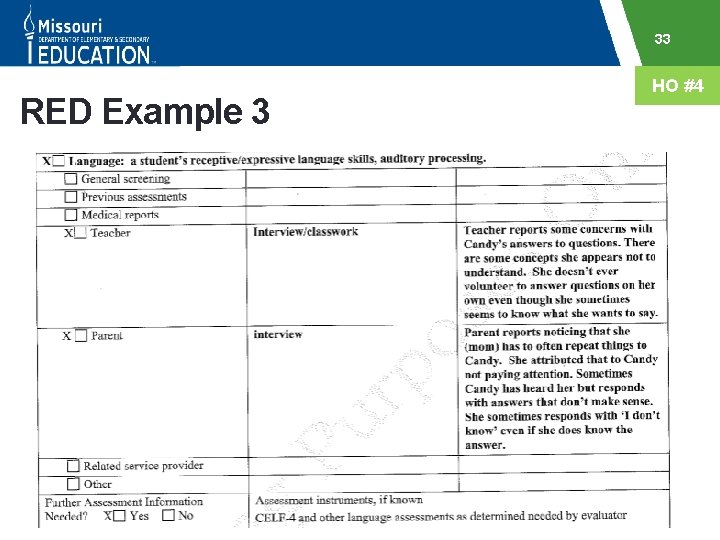
30 Tips for Completion of the RED • USE DESCRIPTIVE TERMS • COMPLETE EVERY SECTION • ADDRESS EVERY AREA • INCLUDE PARENT AND TEACHER INPUT
31 RED Example 1
32 RED Example 2
33 RED Example 3 HO #4
34 Team Conclusions and Decisions
35 Evaluation Practices and Procedures And Eligibility Determinations
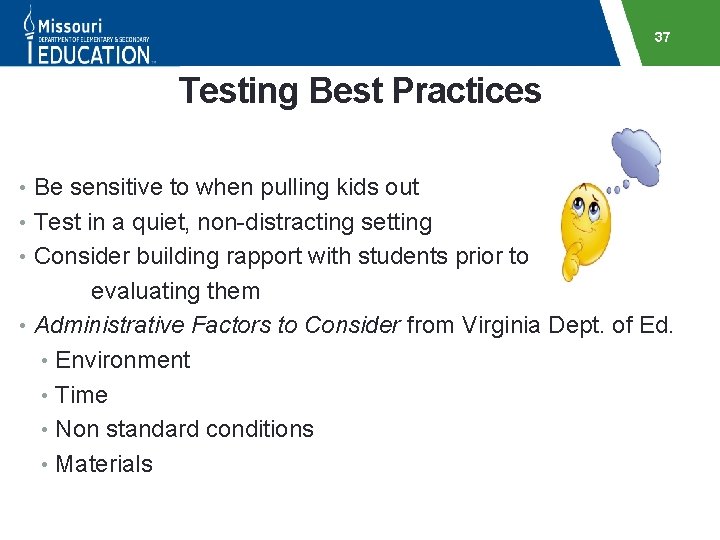
37 Testing Best Practices • Be sensitive to when pulling kids out • Test in a quiet, non-distracting setting • Consider building rapport with students prior to evaluating them • Administrative Factors to Consider from Virginia Dept. of Ed. • Environment • Time • Non standard conditions • Materials
38 Consider this Evaluations are often poorly related to referral concerns; the same battery with little variation is used in most eligibility evaluations. Data collected in an eligibility evaluation is poorly related to information needed on what to teach, how to teach it, and how to assess progress. (Ysseldyke, Vanderwood, & Shriner, 1997)
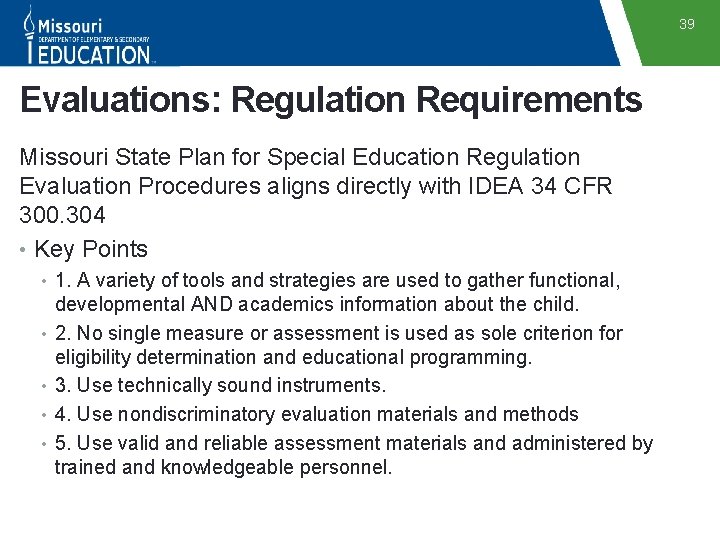
39 Evaluations: Regulation Requirements Missouri State Plan for Special Education Regulation Evaluation Procedures aligns directly with IDEA 34 CFR 300. 304 • Key Points • 1. A variety of tools and strategies are used to gather functional, • • developmental AND academics information about the child. 2. No single measure or assessment is used as sole criterion for eligibility determination and educational programming. 3. Use technically sound instruments. 4. Use nondiscriminatory evaluation materials and methods 5. Use valid and reliable assessment materials and administered by trained and knowledgeable personnel.
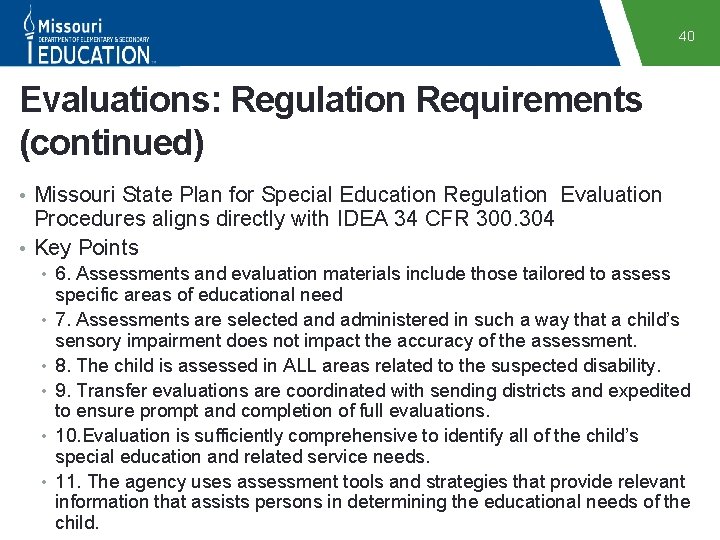
40 Evaluations: Regulation Requirements (continued) • Missouri State Plan for Special Education Regulation Evaluation Procedures aligns directly with IDEA 34 CFR 300. 304 • Key Points • 6. Assessments and evaluation materials include those tailored to assess • • • specific areas of educational need 7. Assessments are selected and administered in such a way that a child’s sensory impairment does not impact the accuracy of the assessment. 8. The child is assessed in ALL areas related to the suspected disability. 9. Transfer evaluations are coordinated with sending districts and expedited to ensure prompt and completion of full evaluations. 10. Evaluation is sufficiently comprehensive to identify all of the child’s special education and related service needs. 11. The agency uses assessment tools and strategies that provide relevant information that assists persons in determining the educational needs of the child.
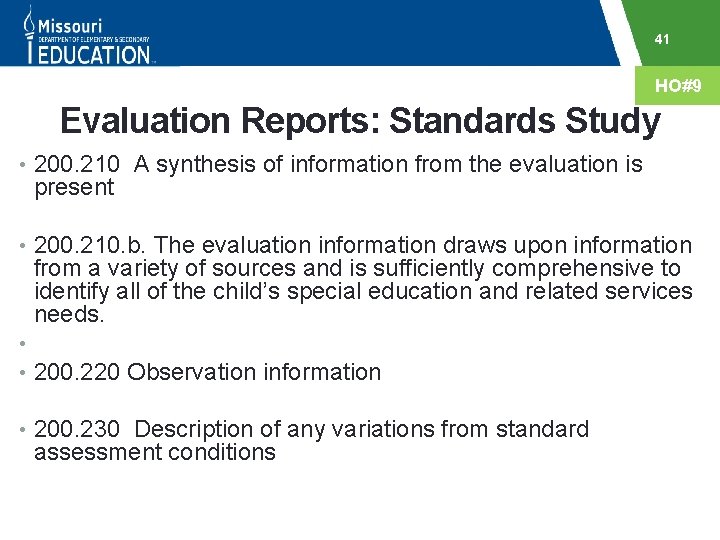
41 HO#9 Evaluation Reports: Standards Study • 200. 210 A synthesis of information from the evaluation is present • 200. 210. b. The evaluation information draws upon information from a variety of sources and is sufficiently comprehensive to identify all of the child’s special education and related services needs. • • 200. 220 Observation information • 200. 230 Description of any variations from standard assessment conditions
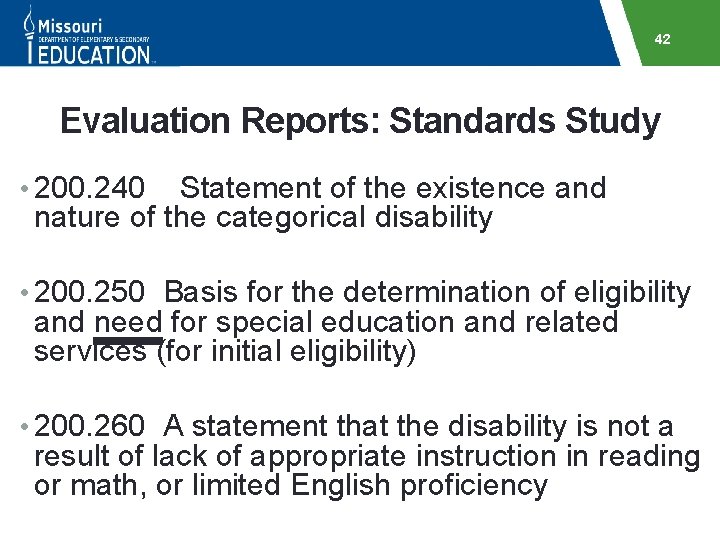
42 Evaluation Reports: Standards Study • 200. 240 Statement of the existence and nature of the categorical disability • 200. 250 Basis for the determination of eligibility and need for special education and related services (for initial eligibility) • 200. 260 A statement that the disability is not a result of lack of appropriate instruction in reading or math, or limited English proficiency
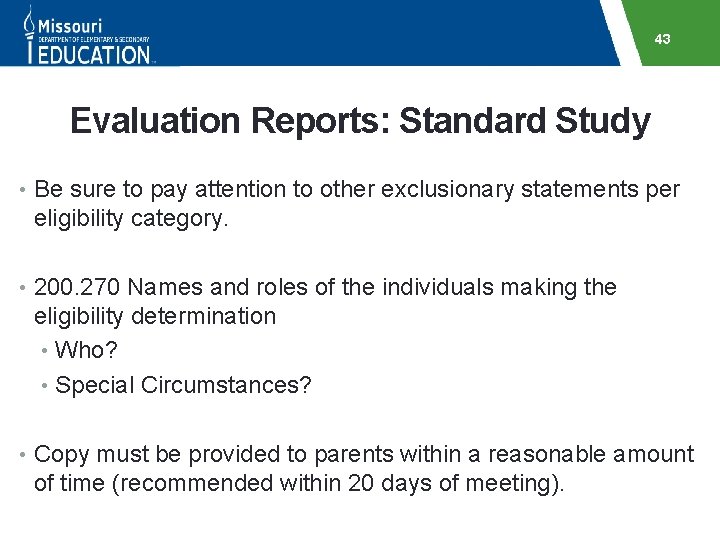
43 Evaluation Reports: Standard Study • Be sure to pay attention to other exclusionary statements per eligibility category. • 200. 270 Names and roles of the individuals making the eligibility determination • Who? • Special Circumstances? • Copy must be provided to parents within a reasonable amount of time (recommended within 20 days of meeting).
44 Determination of Eligibility
45 Determination of Eligibility “Upon completing the administration of tests and other evaluation materials, a group of qualified professionals, which includes the parent of the child, must determine whether the child is a child with a disability. ” 300. 306(a)(1) 200. 270 (a)
46 Data Based Decision Making in Eligibility Determinations
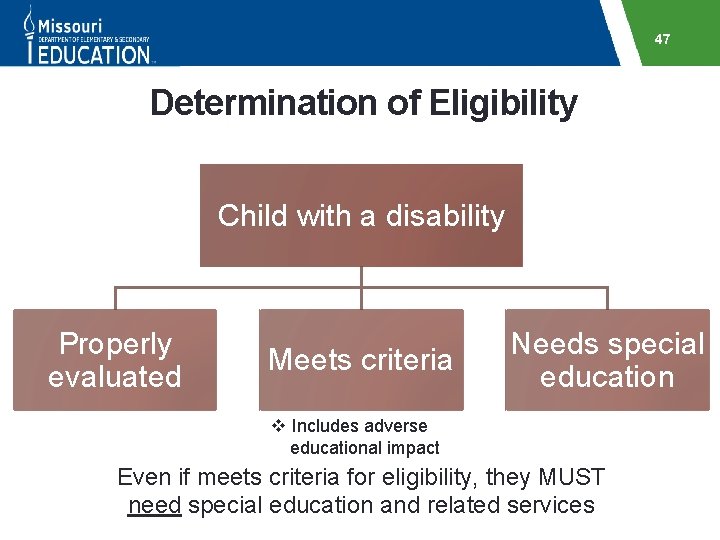
47 Determination of Eligibility Child with a disability Properly evaluated Meets criteria Needs special education v Includes adverse educational impact Even if meets criteria for eligibility, they MUST need special education and related services
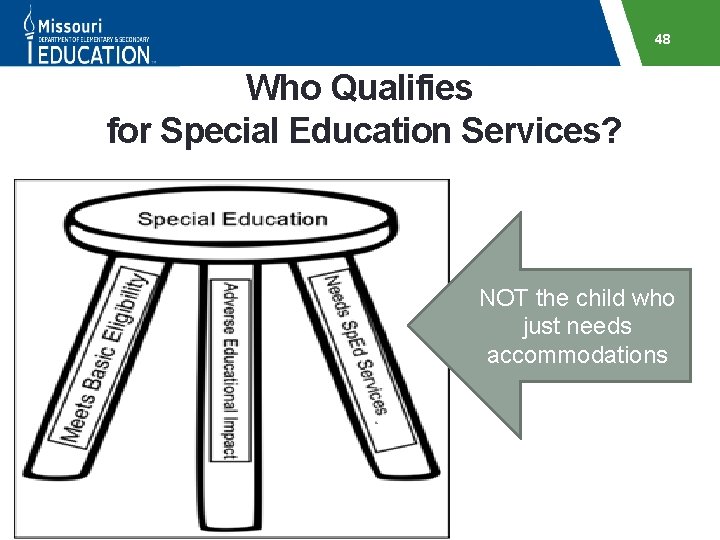
48 Who Qualifies for Special Education Services? NOT the child who just needs accommodations
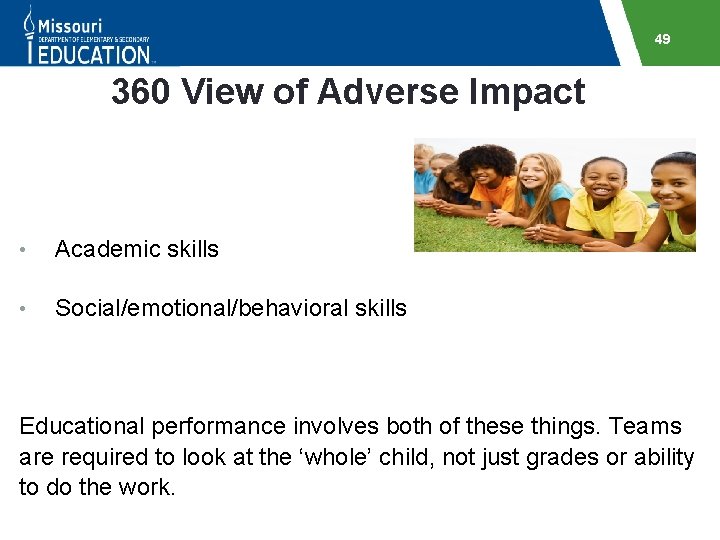
49 360 View of Adverse Impact • Academic skills • Social/emotional/behavioral skills Educational performance involves both of these things. Teams are required to look at the ‘whole’ child, not just grades or ability to do the work.
49 Adverse Educational Impact • Adverse effect must be current and actual, not potential • Speculation that the student may experience adversity isn’t sufficient to establish current eligibility • “It is not whether something, when considered in the abstract, can adversely affect a student’s educational performance, but whether in reality is does. ” (7 th Cir. 2010, Marshall Joint School District No. 2 v C. D) • Avoid using “might” or “could” in eligibility determinations
50 Test Data Interpretation • Synthesis of information is more than running the computer • • generated score report Evaluation staff must understand the meaning of assessment statistics specific to each assessment tool Each eligibility team member must have a basic understanding of what the test scores mean and the interpretation of the scores Impossible to define the student’s individualized adverse educational impact and need for specially designed instruction from “naked numbers” alone Collaborative conversations during the eligibility determination meetings that look for patterns and trends in data are critical to making quality eligibility determinations
51 Let’s Take a Closer Look at the Criteria for the 16 Eligibility Categories Autism Deaf/Blind Emotional Disturbance Hearing Impairments/Deafness Intellectual Disability Language Impairment* Multiple Disabilities Orthopedic Impairments Other Health Impaired Specific Learning Disabilities Sound System Disorder(Artic/Phonology) * Speech-Fluency * Speech-Voice* Traumatic Brain Injury Visual Impairment/Blindness Young Child with Developmental Delay * Eligibility criteria change 2019
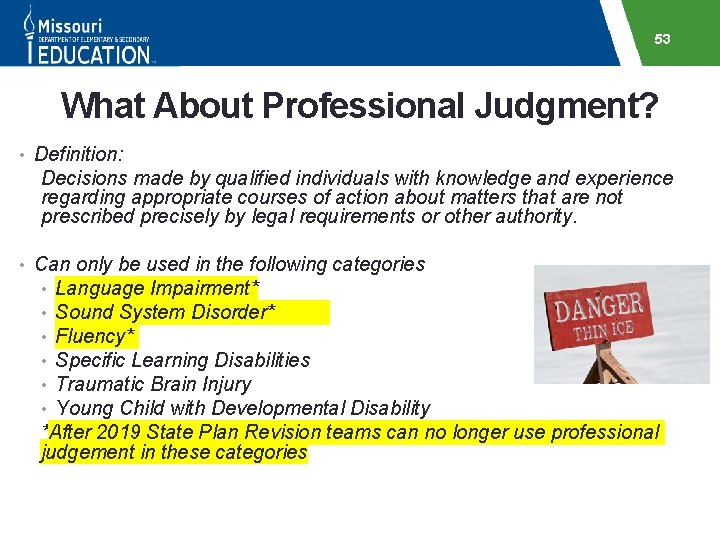
53 What About Professional Judgment? • Definition: Decisions made by qualified individuals with knowledge and experience regarding appropriate courses of action about matters that are not prescribed precisely by legal requirements or other authority. • Can only be used in the following categories • Language Impairment* • Sound System Disorder* • Fluency* • Specific Learning Disabilities • Traumatic Brain Injury • Young Child with Developmental Disability *After 2019 State Plan Revision teams can no longer use professional judgement in these categories
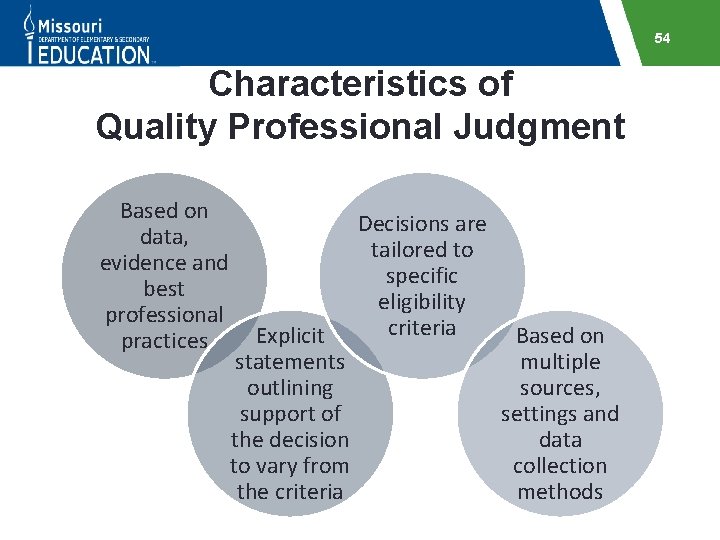
54 Characteristics of Quality Professional Judgment Based on data, evidence and best professional practices Explicit statements outlining support of the decision to vary from the criteria Decisions are tailored to specific eligibility criteria Based on multiple sources, settings and data collection methods
58
59 Questions? Please contact: Tiffiney Smith: tdsmith@semo. edu Jeanne Rothermel: