
Jean Monnet Activities in Erasmus Programme APPLICATION PROCESS
- Slides: 25
Jean Monnet Activities in Erasmus+ Programme APPLICATION PROCESS Education, Audiovisual and Culture Executive Agency Education, Audiovisual & Culture Executive Agency 1
Before starting the application Detailed consultation of the reference documents: 1. Call for Proposals http: //eur-lex. europa. eu/legal-content/EN/ 2. Erasmus+ Guide http: //ec. europa. eu/programmes/erasmusplus/documents/erasmus-plus-programme-guide_en. pdf
Before starting the application 1. Applicants must have an ECAS (European Commission Authentication Service) account. http: //ec. europa. eu/visits/documents/ecas-step-bystep_en. pdf 2. The applicant organisation (and for the Jean Monnet Networks – also the partner institutions involved) must be registered in the Participant Portal and receive a Participant Identification Code (PIC). http: //ec. europa. eu/education/participants/portal/de sktop/en/organisations/register. html
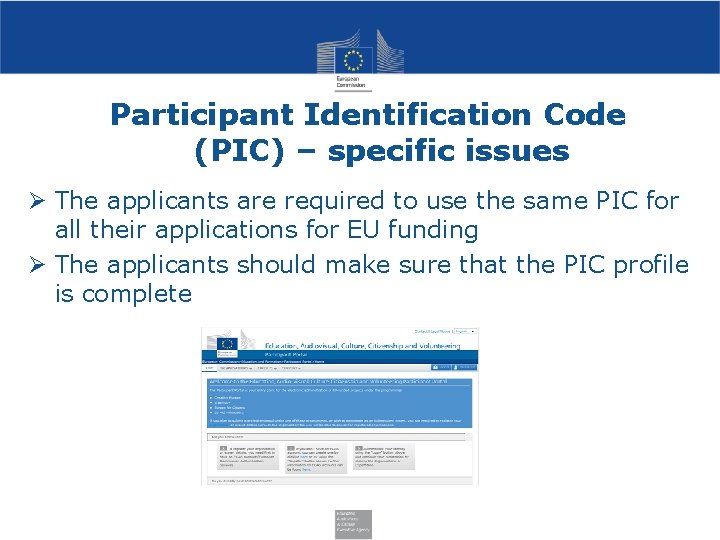
Participant Identification Code (PIC) – specific issues The applicants are required to use the same PIC for all their applications for EU funding The applicants should make sure that the PIC profile is complete
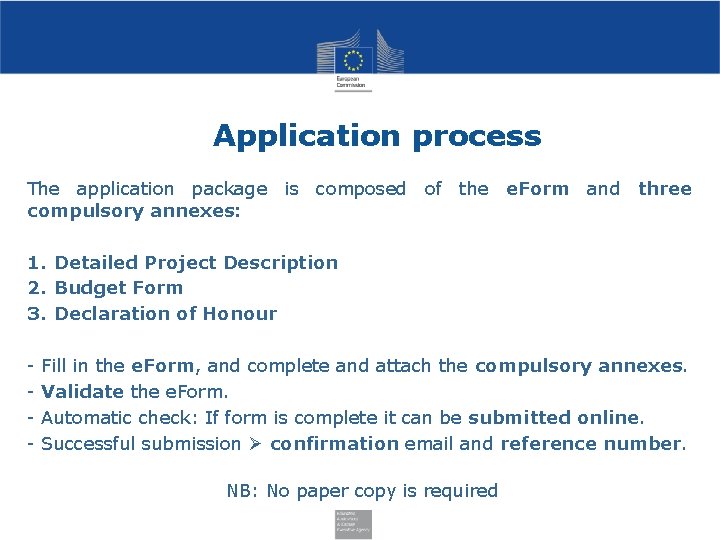
Application process The application package is composed of the e. Form and three compulsory annexes: 1. Detailed Project Description 2. Budget Form 3. Declaration of Honour - Fill in the e. Form, and complete and attach the compulsory annexes. Validate the e. Form. Automatic check: If form is complete it can be submitted online. Successful submission confirmation email and reference number. NB: No paper copy is required
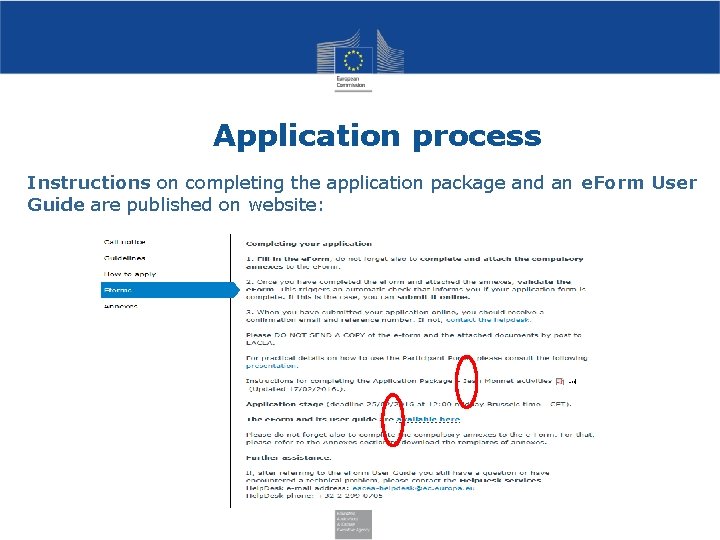
Application process Instructions on completing the application package and an e. Form User Guide are published on website:
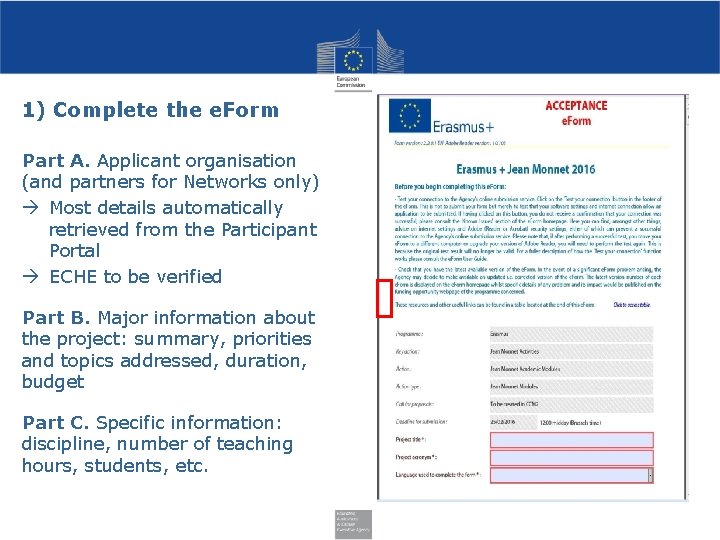
1) Complete the e. Form Part A. Applicant organisation (and partners for Networks only) à Most details automatically retrieved from the Participant Portal à ECHE to be verified Part B. Major information about the project: summary, priorities and topics addressed, duration, budget Part C. Specific information: discipline, number of teaching hours, students, etc.
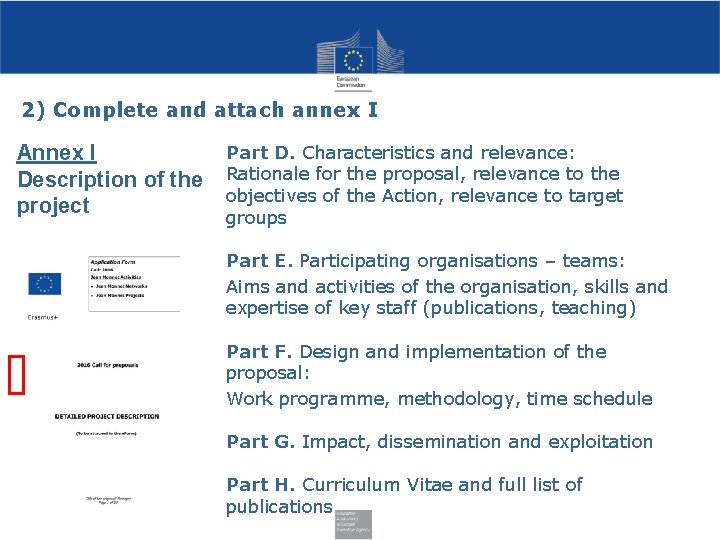
2) Complete and attach annex I Annex I Description of the project Part D. Characteristics and relevance: Rationale for the proposal, relevance to the objectives of the Action, relevance to target groups Part E. Participating organisations – teams: Aims and activities of the organisation, skills and expertise of key staff (publications, teaching) Part F. Design and implementation of the proposal: Work programme, methodology, time schedule Part G. Impact, dissemination and exploitation Part H. Curriculum Vitae and full list of publications
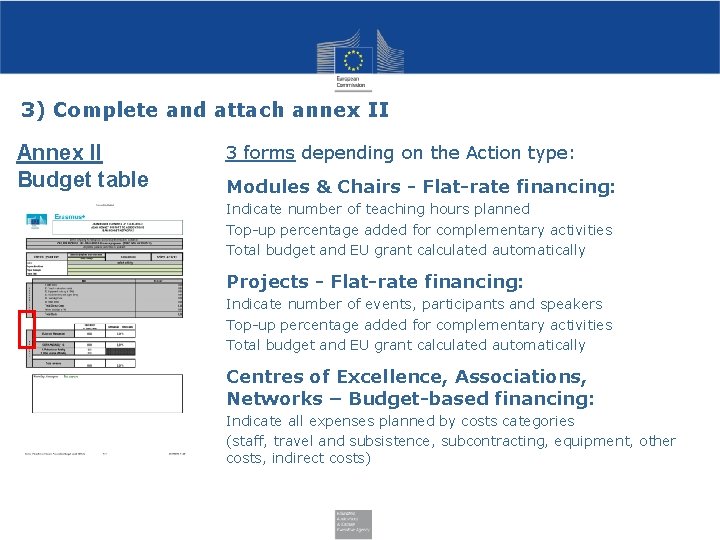
3) Complete and attach annex II Annex II Budget table 3 forms depending on the Action type: Modules & Chairs - Flat-rate financing: Indicate number of teaching hours planned Top-up percentage added for complementary activities Total budget and EU grant calculated automatically Projects - Flat-rate financing: Indicate number of events, participants and speakers Top-up percentage added for complementary activities Total budget and EU grant calculated automatically Centres of Excellence, Associations, Networks – Budget-based financing: Indicate all expenses planned by costs categories (staff, travel and subsistence, subcontracting, equipment, other costs, indirect costs)
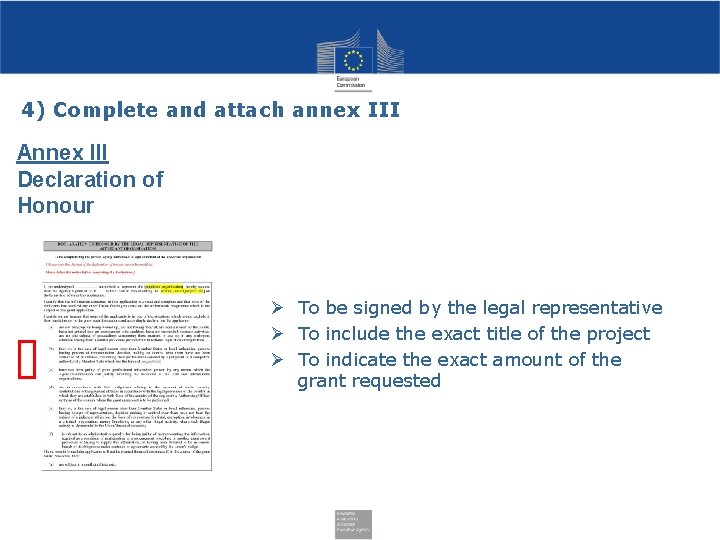
4) Complete and attach annex III Annex III Declaration of Honour To be signed by the legal representative To include the exact title of the project To indicate the exact amount of the grant requested
Then what happens? Evaluation Process 1. Eligibility verification against selection criteria 2. Quality assessment against 4 award criteria All proposals are assessed by independent experts Proposals are ranked according to their assessed quality 11
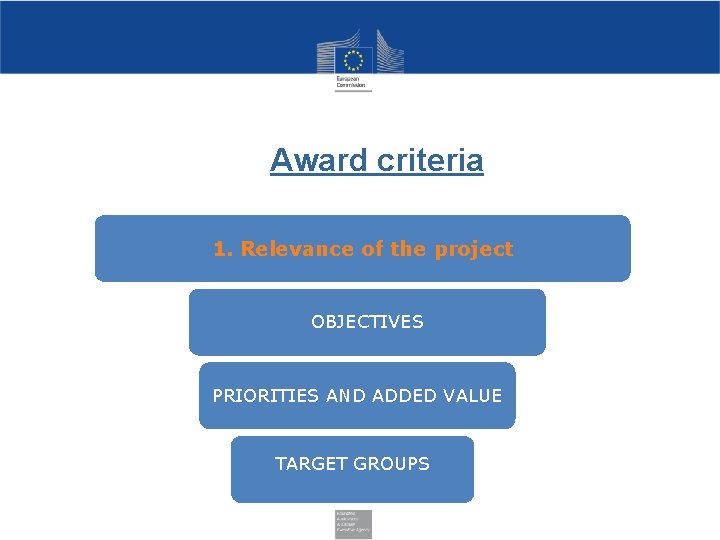
Award criteria 1. Relevance of the project OBJECTIVES PRIORITIES AND ADDED VALUE TARGET GROUPS
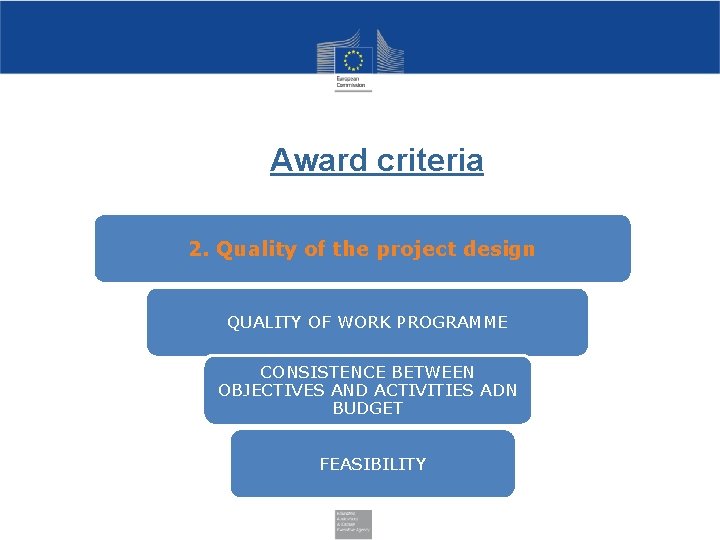
Award criteria 2. Quality of the project design QUALITY OF WORK PROGRAMME CONSISTENCE BETWEEN OBJECTIVES AND ACTIVITIES ADN BUDGET FEASIBILITY
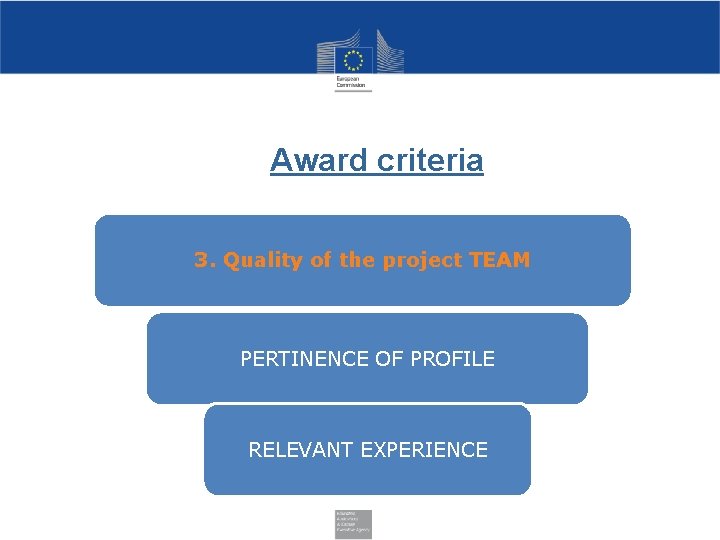
Award criteria 3. Quality of the project TEAM PERTINENCE OF PROFILE RELEVANT EXPERIENCE
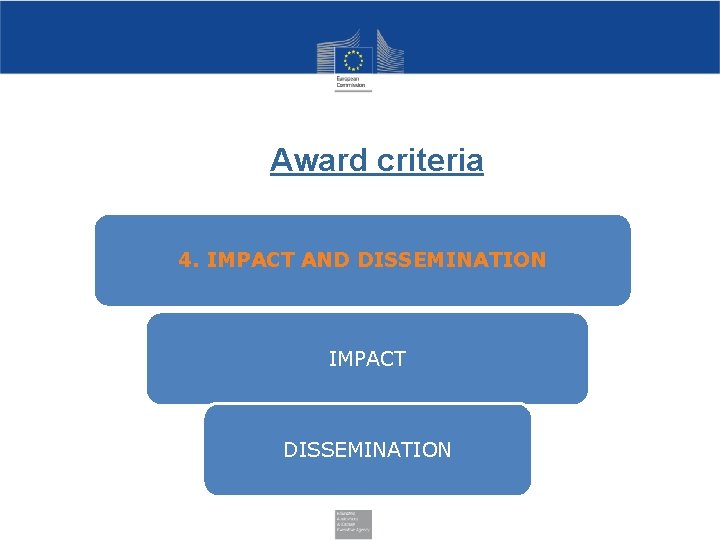
Award criteria 4. IMPACT AND DISSEMINATION IMPACT DISSEMINATION
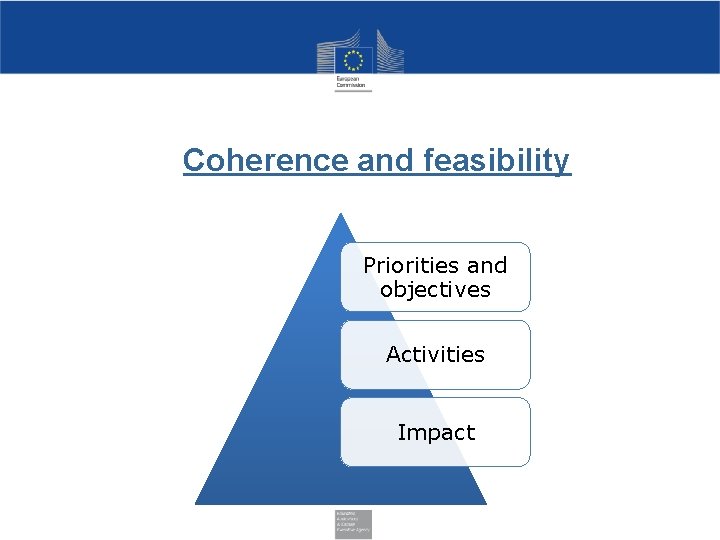
Coherence and feasibility Priorities and objectives Activities Impact
Then what happens? Selection Process • The best proposals are selected for funding • All candidates are informed, and results are published • Contracts are prepared for successful projects • Start of the projects 1 September of the year of application 17
Example of Good Practice Example - Jean Monnet Module in European Banking and Financial Integration in EU, 2007 -2010 Universitatea Alexandru Loan Cazu Iasi, Romania Prof. Gabriel Stefura Aims • Due to the great demand for accurate information regarding the European integration process and to its position in the social environment, the UAIC Iassy can and must act like a leader in bringing Europe closer to the citizens and highlighting the implications of this process Activities • Course on European Banking and Financial Integration, to train future European citizens in Romania • Information about European economic integration at postgraduate level • Promote and strengthen active European citizenship through understanding that the economic impact of enlargement will be significant as a bigger and more integrated market boosts economic growth • Promote the active participation of students/citizens in the process of European integration through reflection and debate on the various economic aspects of this process; Target groups • Students, teachers, trainers, civil society
Example of Good Practice Example - Jean Monnet Chair in European Integration and Youth 2010 -2014 National University of Ireland, Maynooth Dr Maurice DEVLIN Aims • To respond to unprecedented increase in emphasis on youth policy at EU level in recent years • To consolidate and expand European integration studies for youth and community work students at the National University of Ireland, Maynooth • To explore ways of furthering the European dimension in vocational and professional youth and community work, education and training Activities • Lectures, including a module for vocational and professional students • Doctoral seminars • Training course for civil society groups Target groups • Higher education institutions at national level, civil society groups and organisations and academics and students from outside the EU • gathering together academics and practitioners working in the field of youth studies
Example of Good Practice Example - Jean Monnet Centre of Excellence Between Globality and Locality: Europe in a Global Context 2010 -2013 Institute of Social and European Studies Foundation (ISES), Köszeg, Hungary Prof. Ferenc MISZLIVETZ Aims • To target disadvantaged regions and populations with new post graduate courses in European Studies • To combine theoretical and practical studies, responding to changing social and economic conditions, international political, social, economic and cultural life • To provide public space for multi-stakeholder debates on the challenges of European integration and Europe's role in the world • To enhance regional cooperation and integration through exchanges between institutions of higher education in Member States and EU neighbourhoods Activities • Master programmes, new university courses and summer courses • Cross-border lecture series, roundtable debates and conference for students, educators, civil society, business and government • Publications, Website
Target groups • Key beneficiaries are students, policy makers, practitioners, civil society • Students come primarily from Central Europe, the Baltics, the Balkans and former Soviet republics, also Turkey and Africa (e. g. Cameroun) • Cooperation with other Hungarian Universities, other institutions in field of European Integration, in particular through the Jean Monnet network • Particularly good contacts with European Integration initiatives in Turkey and Latin America • All academic programmes open to civil society participation, including MA programmes and the Summer University • Concerted effort to recruit civil society participants to its events and cultural programmes • The Centre successfully creates links between academia, business community and government of the city and region, hereby contributing to local and regional development
Example of Good Practice Example - Jean Monnet Network European Identity, Culture, Exchanges and Mulitlingualism 2014 -2017 Sofiiski Universitet Sveti Kliment Ohridski, + 7 Partners from China, BE, UK, LU, PL, IE, SK Assoc. Prof Maria STOICHEVA Aims • European identity formation, theme with three dimensions of more focused research (patterns of European identity and citizenship among students studying courses in the area of EU Studies eliminating the constraint of knowledge deficit and information about European affairs), identities in urban contexts (the European multilingual city) and the issue of emerging new European young researchers’ identities (exchanges and doctoral studies – an international study of processes and outcomes in the EU) • core task of the network to build knowledge and become reference point for researchers in these EU-related themes
Activities • 3 summer schools, 13 events (seminars, workshops, conferences and final conference), 10 major deliverables (books, collection of papers, conference proceedings, thematic issues of national journals, working papers) Target groups • Core target group are young researchers (doctorate students, potential doctorate students and young researchers who have obtained a Ph. D degree in the past 5 years), doctorate students from other scientific fields
Example of Good Practice Example - Jean Monnet Project L'Europe: parle m'en au Lycée 2013 -2014 Fondation Nationale des Sciences Politiques, Dijon, France Prof Lukas MACEK Aims • To increase awareness of EU issues at high schools in Burgundy (focusing both on students and teachers) • To identify and develop a network of people (with a direct link to secondary education) interested in EU affairs and willing to promote awareness of EU citizenship, knowledge of the EU etc. within the high school student population • To create a network which will develop its activities far beyond the period of the present project’s implementation • To enhance teachers’ willingness, competence and creativity regarding the introduction of the “EU subject” into their courses and/or into their contribution other activities for students
More information – Jean Monnet • Erasmus+ Programme Guide and 2017 General Call for proposals: http: //ec. europa. eu/programmes/erasmus-plus/discover/guide/index_en. htm • Jean Monnet Activities: http: //eacea. ec. europa. eu/erasmus-plus/actions/jean-monnet_en • Funding - Jean Monnet Activities within Erasmus+: http: //eacea. ec. europa. eu/erasmus-plus/funding_en • Jean Monnet Directory: https: //eacea. ec. europa. eu/Jean. Monnet. Directory/#/search-screen/ • Jean Monnet selection results: http: //eacea. ec. europa. eu/erasmus-plus/selection-results_en • Jean Monnet Cluster 2016: Good practices in the context of 'A Union of shared values – The role of Education & Civil Society' http: //eacea. ec. europa. eu/erasmus-plus/library_en • Erasmus+ Project Results – Jean Monnet: Erasmus+ platform for dissemination and exploitation of project results http: //ec. europa. eu/programmes/erasmus-plus/projects/ • Mailbox Jean Monnet: EACEA-AJM@ec. europa. eu 25 Erasmus+