
JCTVCA 116 Heinrich Hertz Institute Fraunhofer Institute for
- Slides: 28
JCTVC-A 116 Heinrich Hertz Institute Fraunhofer Institute for Telecommunications Video Coding Technology Proposal by Fraunhofer HHI M. Winken, S. Boße, B. Bross, P. Helle, T. Hinz, H. Kirchhoffer, H. Lakshman, D. Marpe, S. Oudin, M. Preiß, H. Schwarz, M. Siekmann, K. Sühring, T. Wiegand
Outline § Overview – Generalized Picture Partitioning for Prediction and Transform Coding – Signalling using two nested quad-tree structures – – – – Spatial intra prediction Motion representation and coding Merging of motion partitions Sub-sample interpolation for inter prediction In-Loop filtering Transform coding of prediction residuals Entropy coding § Encoder Control Heinrich Hertz Institute Fraunhofer Institute for Telecommunications § Codec components § Average Objective Coding Efficiency § Summary
Basic Approach & Summary Heinrich Hertz Institute Fraunhofer Institute for Telecommunications § Generalization of concepts in H. 264/AVC § Idea: use a simple structure to show potential
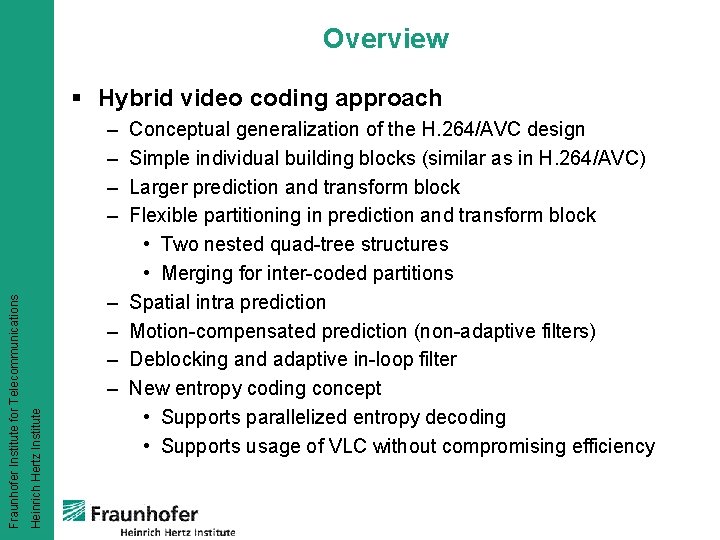
Overview § Hybrid video coding approach – – Heinrich Hertz Institute Fraunhofer Institute for Telecommunications – – Conceptual generalization of the H. 264/AVC design Simple individual building blocks (similar as in H. 264/AVC) Larger prediction and transform block Flexible partitioning in prediction and transform block • Two nested quad-tree structures • Merging for inter-coded partitions Spatial intra prediction Motion-compensated prediction (non-adaptive filters) Deblocking and adaptive in-loop filter New entropy coding concept • Supports parallelized entropy decoding • Supports usage of VLC without compromising efficiency
Overview § High-level syntax is similar to H. 264/AVC – NAL units – Sequence parameter sets – Picture parameter sets Heinrich Hertz Institute Fraunhofer Institute for Telecommunications § Internal bit depth – Accuracy of 14 bit for • intra prediction signal • motion-compensated prediction signal • reconstructed residual signal – Rounding to 8 bits after reconstruction of a block – Reference pictures have an accuracy of 8 bits
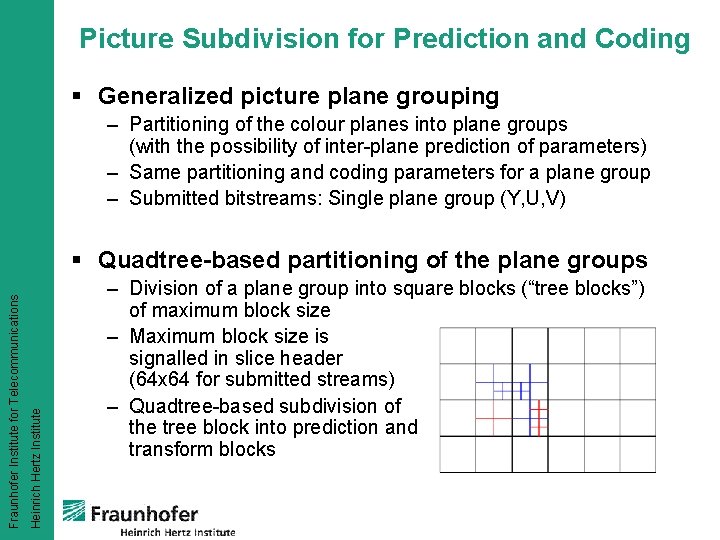
Picture Subdivision for Prediction and Coding § Generalized picture plane grouping – Partitioning of the colour planes into plane groups (with the possibility of inter-plane prediction of parameters) – Same partitioning and coding parameters for a plane group – Submitted bitstreams: Single plane group (Y, U, V) Heinrich Hertz Institute Fraunhofer Institute for Telecommunications § Quadtree-based partitioning of the plane groups – Division of a plane group into square blocks (“tree blocks”) of maximum block size – Maximum block size is signalled in slice header (64 x 64 for submitted streams) – Quadtree-based subdivision of the tree block into prediction and transform blocks
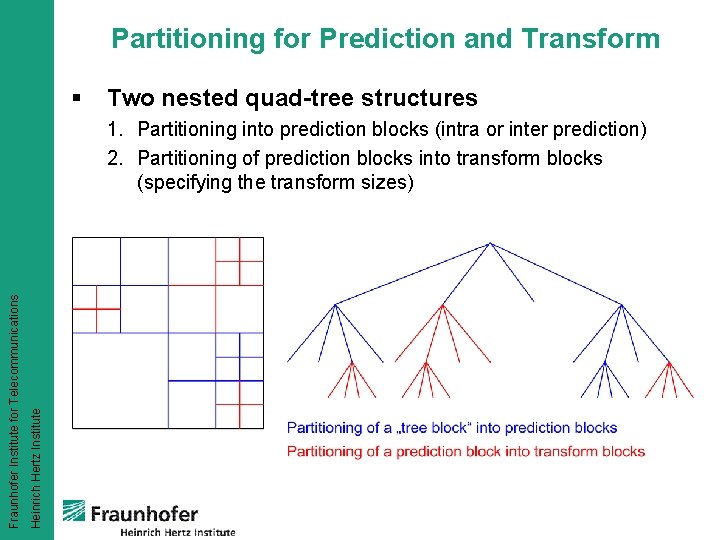
Partitioning for Prediction and Transform § Two nested quad-tree structures Heinrich Hertz Institute Fraunhofer Institute for Telecommunications 1. Partitioning into prediction blocks (intra or inter prediction) 2. Partitioning of prediction blocks into transform blocks (specifying the transform sizes)
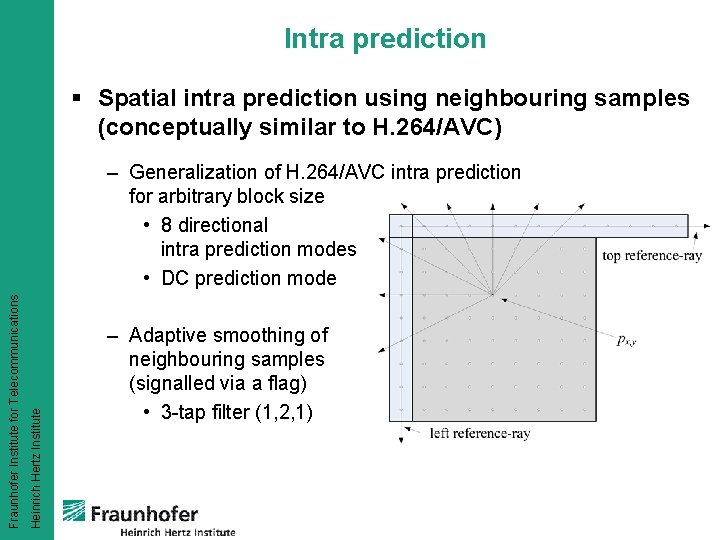
Intra prediction § Spatial intra prediction using neighbouring samples (conceptually similar to H. 264/AVC) Heinrich Hertz Institute Fraunhofer Institute for Telecommunications – Generalization of H. 264/AVC intra prediction for arbitrary block size • 8 directional intra prediction modes • DC prediction mode – Adaptive smoothing of neighbouring samples (signalled via a flag) • 3 -tap filter (1, 2, 1)
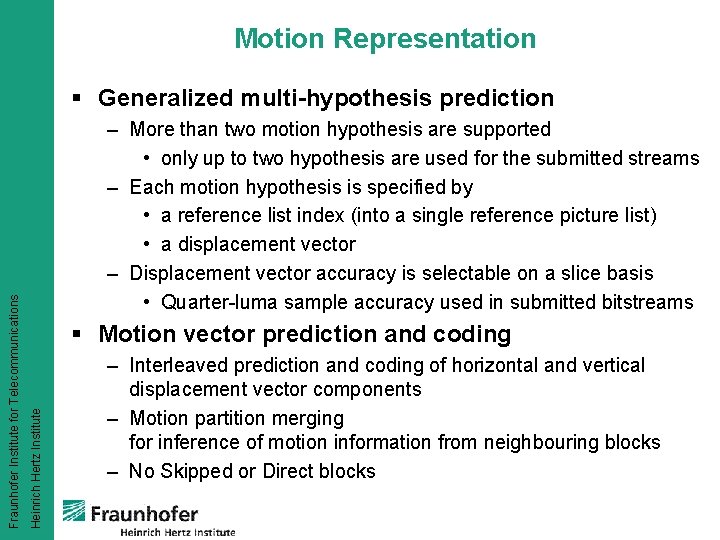
Motion Representation – More than two motion hypothesis are supported • only up to two hypothesis are used for the submitted streams – Each motion hypothesis is specified by • a reference list index (into a single reference picture list) • a displacement vector – Displacement vector accuracy is selectable on a slice basis • Quarter-luma sample accuracy used in submitted bitstreams § Motion vector prediction and coding Heinrich Hertz Institute Fraunhofer Institute for Telecommunications § Generalized multi-hypothesis prediction – Interleaved prediction and coding of horizontal and vertical displacement vector components – Motion partition merging for inference of motion information from neighbouring blocks – No Skipped or Direct blocks
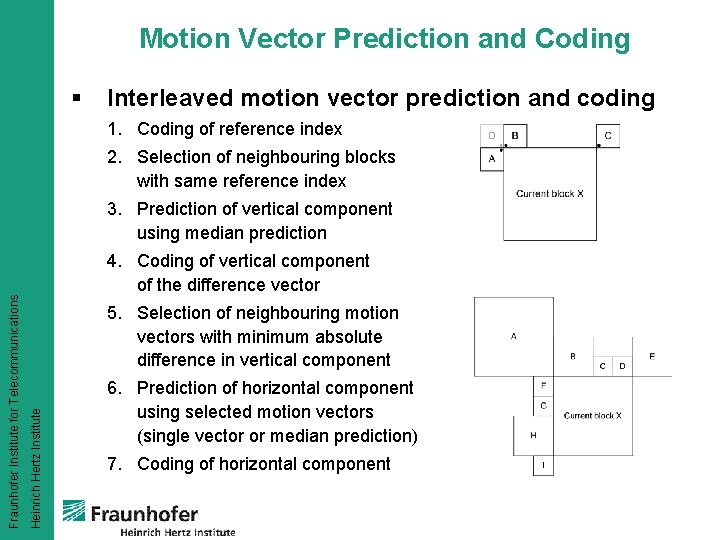
Motion Vector Prediction and Coding § Interleaved motion vector prediction and coding 1. Coding of reference index 2. Selection of neighbouring blocks with same reference index 3. Prediction of vertical component using median prediction 5. Selection of neighbouring motion vectors with minimum absolute difference in vertical component Heinrich Hertz Institute Fraunhofer Institute for Telecommunications 4. Coding of vertical component of the difference vector 6. Prediction of horizontal component using selected motion vectors (single vector or median prediction) 7. Coding of horizontal component
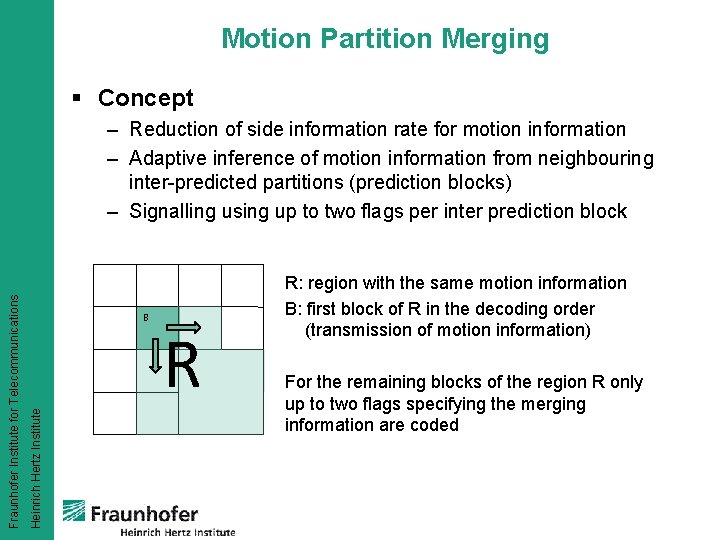
Motion Partition Merging § Concept B Heinrich Hertz Institute Fraunhofer Institute for Telecommunications – Reduction of side information rate for motion information – Adaptive inference of motion information from neighbouring inter-predicted partitions (prediction blocks) – Signalling using up to two flags per inter prediction block R R: region with the same motion information B: first block of R in the decoding order (transmission of motion information) For the remaining blocks of the region R only up to two flags specifying the merging information are coded
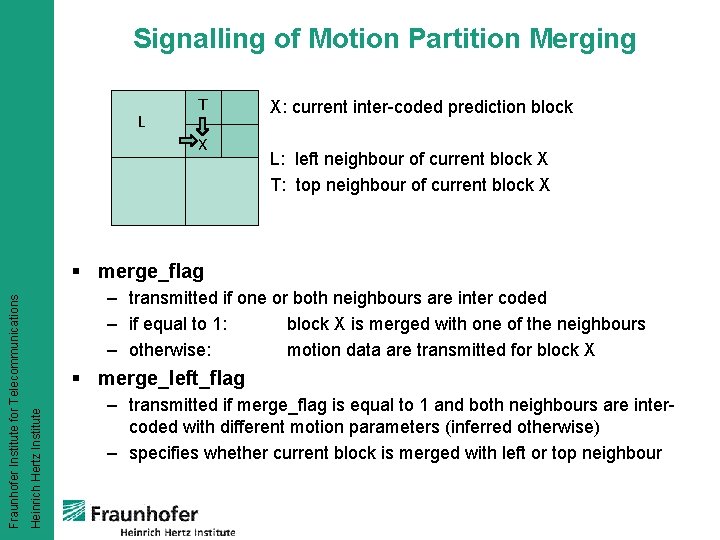
Signalling of Motion Partition Merging L T X X: current inter-coded prediction block L: left neighbour of current block X T: top neighbour of current block X – transmitted if one or both neighbours are inter coded – if equal to 1: block X is merged with one of the neighbours – otherwise: motion data are transmitted for block X § merge_left_flag Heinrich Hertz Institute Fraunhofer Institute for Telecommunications § merge_flag – transmitted if merge_flag is equal to 1 and both neighbours are intercoded with different motion parameters (inferred otherwise) – specifies whether current block is merged with left or top neighbour
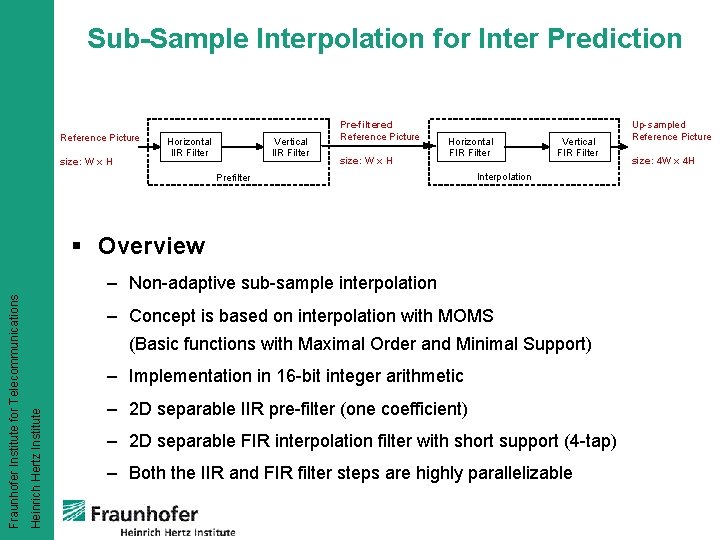
Sub-Sample Interpolation for Inter Prediction Reference Picture size: W x H Vertical IIR Filter Horizontal IIR Filter Pre-filtered Reference Picture size: W x H Horizontal FIR Filter Prefilter Vertical FIR Filter Interpolation § Overview – Concept is based on interpolation with MOMS (Basic functions with Maximal Order and Minimal Support) – Implementation in 16 -bit integer arithmetic Heinrich Hertz Institute Fraunhofer Institute for Telecommunications – Non-adaptive sub-sample interpolation – 2 D separable IIR pre-filter (one coefficient) – 2 D separable FIR interpolation filter with short support (4 -tap) – Both the IIR and FIR filter steps are highly parallelizable Up-sampled Reference Picture size: 4 W x 4 H
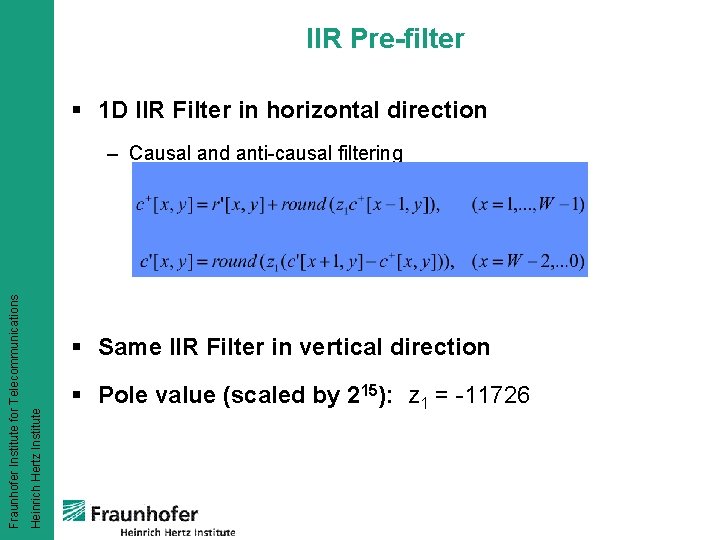
IIR Pre-filter § 1 D IIR Filter in horizontal direction § Same IIR Filter in vertical direction Heinrich Hertz Institute Fraunhofer Institute for Telecommunications – Causal and anti-causal filtering § Pole value (scaled by 215): z 1 = -11726
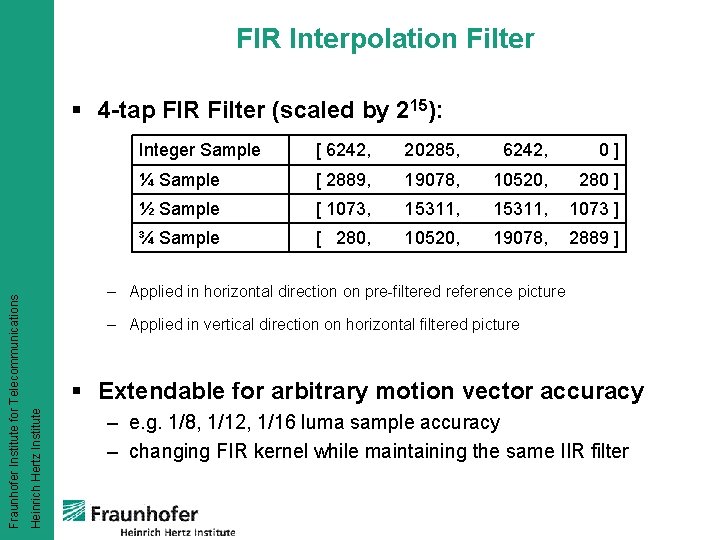
FIR Interpolation Filter Integer Sample [ 6242, 20285, 6242, 0] ¼ Sample [ 2889, 19078, 10520, 280 ] ½ Sample [ 1073, 15311, 1073 ] ¾ Sample [ 280, 10520, 19078, 2889 ] – Applied in horizontal direction on pre-filtered reference picture – Applied in vertical direction on horizontal filtered picture § Extendable for arbitrary motion vector accuracy Heinrich Hertz Institute Fraunhofer Institute for Telecommunications § 4 -tap FIR Filter (scaled by 215): – e. g. 1/8, 1/12, 1/16 luma sample accuracy – changing FIR kernel while maintaining the same IIR filter
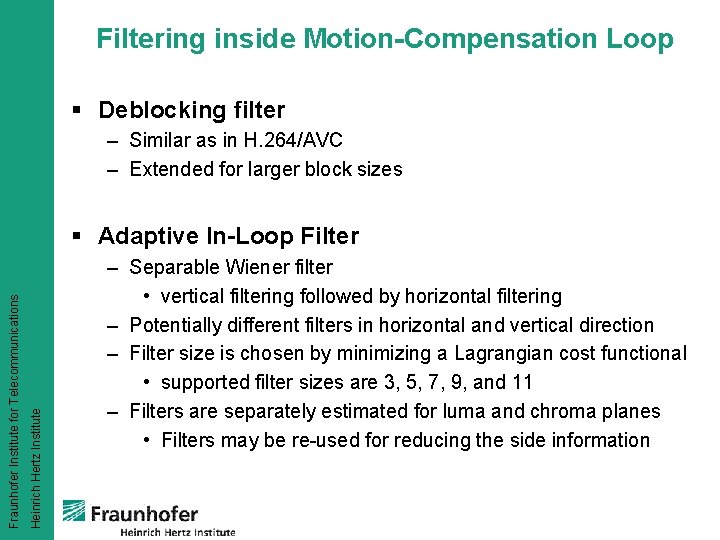
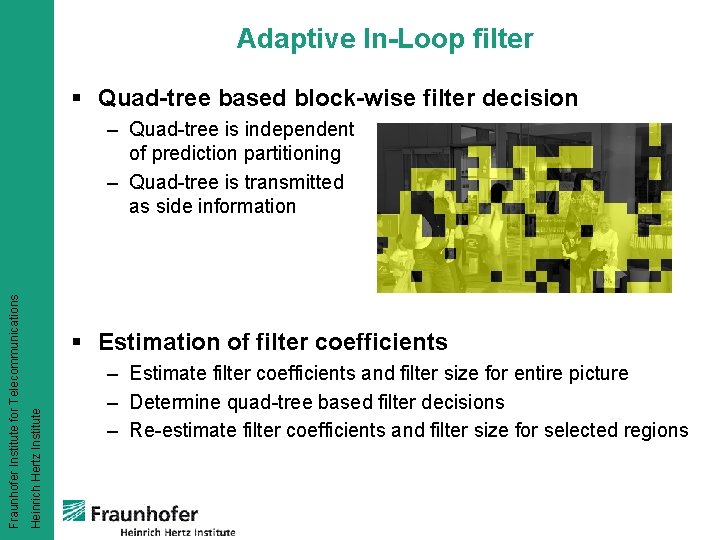
Filtering inside Motion-Compensation Loop § Deblocking filter – Similar as in H. 264/AVC – Extended for larger block sizes Heinrich Hertz Institute Fraunhofer Institute for Telecommunications § Adaptive In-Loop Filter – Separable Wiener filter • vertical filtering followed by horizontal filtering – Potentially different filters in horizontal and vertical direction – Filter size is chosen by minimizing a Lagrangian cost functional • supported filter sizes are 3, 5, 7, 9, and 11 – Filters are separately estimated for luma and chroma planes • Filters may be re-used for reducing the side information
Adaptive In-Loop filter § Quad-tree based block-wise filter decision § Estimation of filter coefficients Heinrich Hertz Institute Fraunhofer Institute for Telecommunications – Quad-tree is independent of prediction partitioning – Quad-tree is transmitted as side information – Estimate filter coefficients and filter size for entire picture – Determine quad-tree based filter decisions – Re-estimate filter coefficients and filter size for selected regions
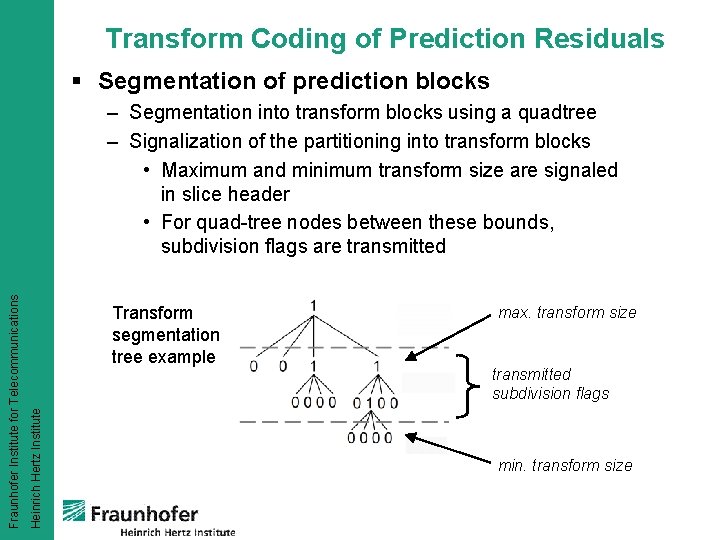
Transform Coding of Prediction Residuals § Segmentation of prediction blocks Transform segmentation tree example Heinrich Hertz Institute Fraunhofer Institute for Telecommunications – Segmentation into transform blocks using a quadtree – Signalization of the partitioning into transform blocks • Maximum and minimum transform size are signaled in slice header • For quad-tree nodes between these bounds, subdivision flags are transmitted max. transform size transmitted subdivision flags min. transform size
Transform Coding – Separable Nx. N transforms – Integer approximations of DCT-II kernels (obtained by scaling and rounding of DCT-II kernel) – 32 bit integer implementation with multiplications and additions (employing symmetries of basis functions) – Integer transform kernels haven’t been optimized for low-complexity implementations (using bit shifts and additions) § Quantization Heinrich Hertz Institute Fraunhofer Institute for Telecommunications § Transform kernels – Similar to H. 264/AVC – Uniform scalar quantization without extra dead-zone – 52 quantizers with logarithmically increasing step size
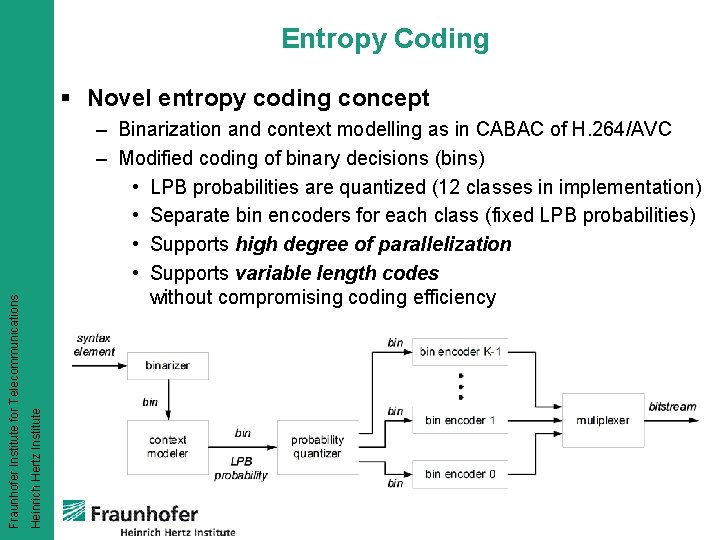
Entropy Coding – Binarization and context modelling as in CABAC of H. 264/AVC – Modified coding of binary decisions (bins) • LPB probabilities are quantized (12 classes in implementation) • Separate bin encoders for each class (fixed LPB probabilities) • Supports high degree of parallelization • Supports variable length codes without compromising coding efficiency Heinrich Hertz Institute Fraunhofer Institute for Telecommunications § Novel entropy coding concept
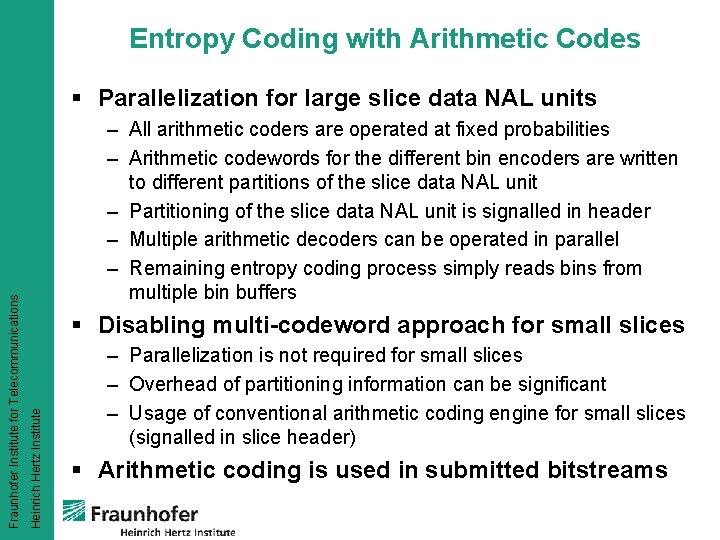
Entropy Coding with Arithmetic Codes – All arithmetic coders are operated at fixed probabilities – Arithmetic codewords for the different bin encoders are written to different partitions of the slice data NAL unit – Partitioning of the slice data NAL unit is signalled in header – Multiple arithmetic decoders can be operated in parallel – Remaining entropy coding process simply reads bins from multiple bin buffers § Disabling multi-codeword approach for small slices Heinrich Hertz Institute Fraunhofer Institute for Telecommunications § Parallelization for large slice data NAL units – Parallelization is not required for small slices – Overhead of partitioning information can be significant – Usage of conventional arithmetic coding engine for small slices (signalled in slice header) § Arithmetic coding is used in submitted bitstreams
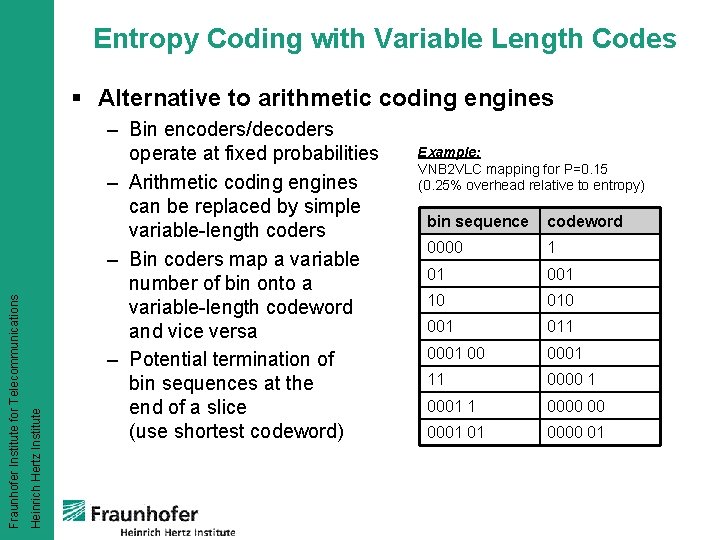
Entropy Coding with Variable Length Codes Heinrich Hertz Institute Fraunhofer Institute for Telecommunications § Alternative to arithmetic coding engines – Bin encoders/decoders operate at fixed probabilities – Arithmetic coding engines can be replaced by simple variable-length coders – Bin coders map a variable number of bin onto a variable-length codeword and vice versa – Potential termination of bin sequences at the end of a slice (use shortest codeword) Example: VNB 2 VLC mapping for P=0. 15 (0. 25% overhead relative to entropy) bin sequence codeword 0000 1 01 001 10 001 011 0001 00 0001 11 0000 1 0001 1 0000 00 0001 01 0000 01
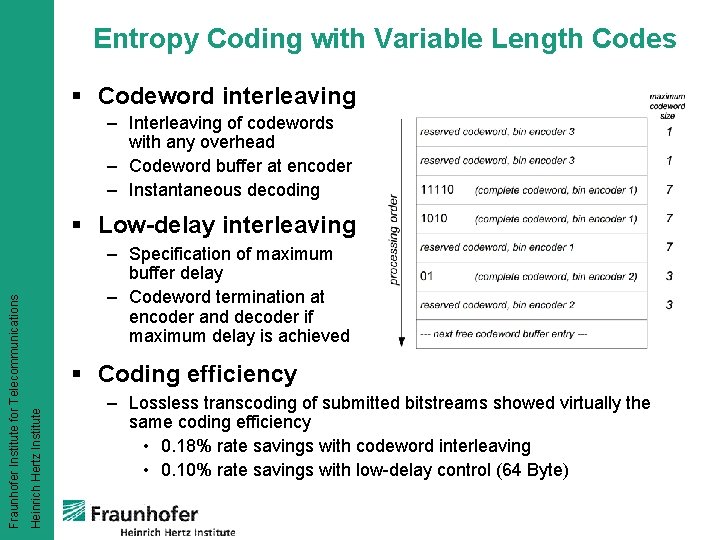
Entropy Coding with Variable Length Codes § Codeword interleaving – Interleaving of codewords with any overhead – Codeword buffer at encoder – Instantaneous decoding – Specification of maximum buffer delay – Codeword termination at encoder and decoder if maximum delay is achieved § Coding efficiency Heinrich Hertz Institute Fraunhofer Institute for Telecommunications § Low-delay interleaving – Lossless transcoding of submitted bitstreams showed virtually the same coding efficiency • 0. 18% rate savings with codeword interleaving • 0. 10% rate savings with low-delay control (64 Byte)
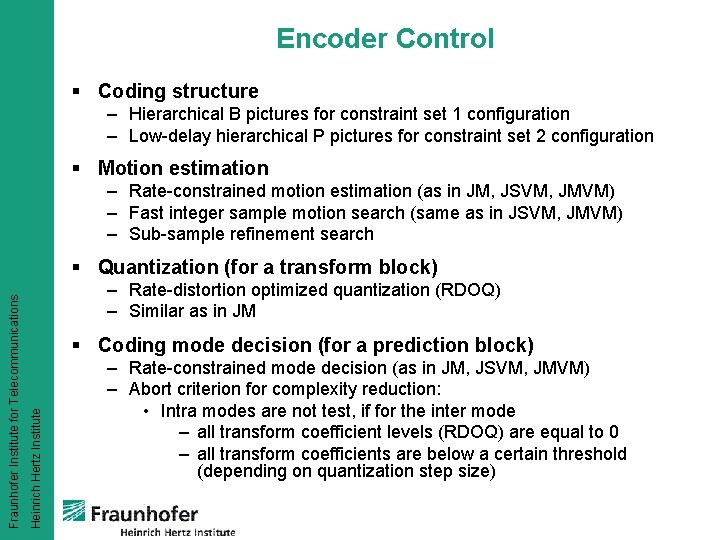
Encoder Control § Coding structure – Hierarchical B pictures for constraint set 1 configuration – Low-delay hierarchical P pictures for constraint set 2 configuration § Motion estimation – Rate-constrained motion estimation (as in JM, JSVM, JMVM) – Fast integer sample motion search (same as in JSVM, JMVM) – Sub-sample refinement search – Rate-distortion optimized quantization (RDOQ) – Similar as in JM § Coding mode decision (for a prediction block) Heinrich Hertz Institute Fraunhofer Institute for Telecommunications § Quantization (for a transform block) – Rate-constrained mode decision (as in JM, JSVM, JMVM) – Abort criterion for complexity reduction: • Intra modes are not test, if for the inter mode – all transform coefficient levels (RDOQ) are equal to 0 – all transform coefficients are below a certain threshold (depending on quantization step size)
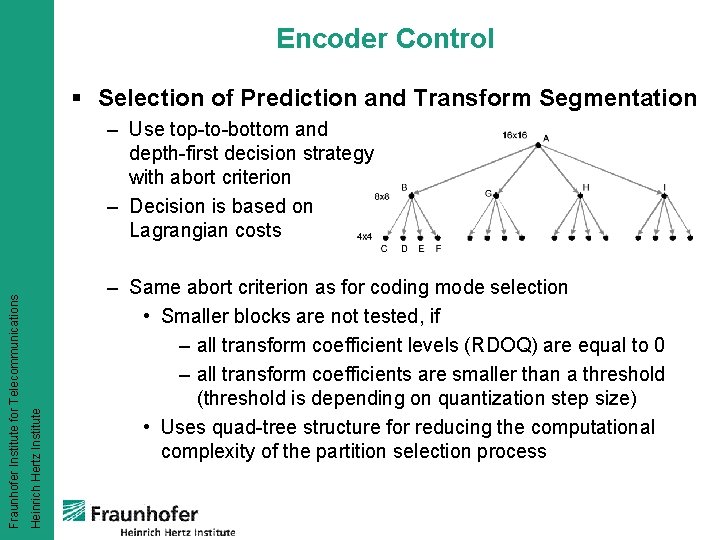
Encoder Control § Selection of Prediction and Transform Segmentation Heinrich Hertz Institute Fraunhofer Institute for Telecommunications – Use top-to-bottom and depth-first decision strategy with abort criterion – Decision is based on Lagrangian costs – Same abort criterion as for coding mode selection • Smaller blocks are not tested, if – all transform coefficient levels (RDOQ) are equal to 0 – all transform coefficients are smaller than a threshold (threshold is depending on quantization step size) • Uses quad-tree structure for reducing the computational complexity of the partition selection process
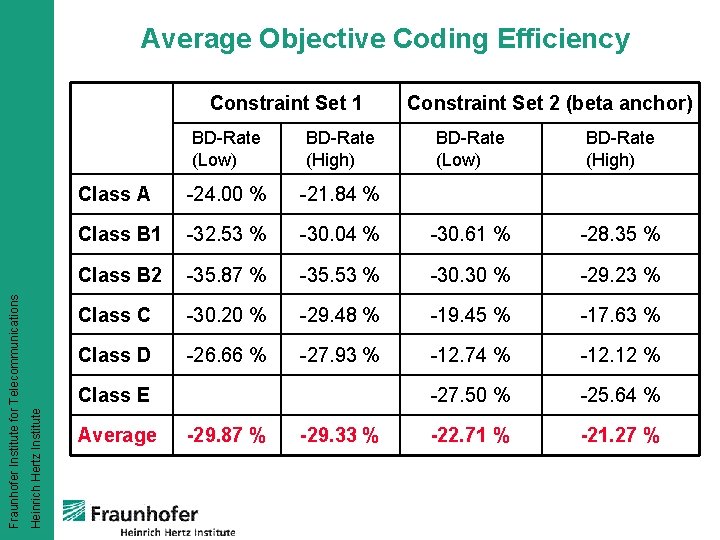
Average Objective Coding Efficiency BD-Rate (Low) BD-Rate (High) Class A -24. 00 % -21. 84 % Class B 1 -32. 53 % Class B 2 Constraint Set 2 (beta anchor) BD-Rate (Low) BD-Rate (High) -30. 04 % -30. 61 % -28. 35 % -35. 87 % -35. 53 % -30. 30 % -29. 23 % Class C -30. 20 % -29. 48 % -19. 45 % -17. 63 % Class D -26. 66 % -27. 93 % -12. 74 % -12. 12 % -27. 50 % -25. 64 % -22. 71 % -21. 27 % Class E Heinrich Hertz Institute Fraunhofer Institute for Telecommunications Constraint Set 1 Average -29. 87 % -29. 33 %
Software § Standard C++ Implementation § Platform independent – Compiles under Windows and Linux (32/64 bit) – Only ~55. 000 LOC (vs. ~150. 000 LOC for JM 17. 0) – Virtually no redundant code – English naming of variables and comments § No external libraries needed § Optional multi-threaded encoding (boost-library needed) Heinrich Hertz Institute Fraunhofer Institute for Telecommunications § Focus on modular design and easy extensibility § Slim code base – Parallel encoding of independent pictures (depends on the GOP string) – No need to regard multi-threading related issues when changing the encoding algorithm inside of a picture – E. g. CS 1 bitstreams were encoded almost 8 times faster than singlethreaded (on a computer with 8 cores)
Summary – Generalization of H. 264/AVC concepts – Support of larger block sizes for prediction and transform – Flexible quad-tree based partitioning into prediction blocks (with additional merging for inter-coded blocks) – Flexible quad-tree based partitioning into transform blocks – Spatial intra prediction – Motion-compensated prediction using non-adaptive filters – Deblocking and adaptive loop filter – Novel entropy coding approach Heinrich Hertz Institute Fraunhofer Institute for Telecommunications § Hybrid video coding approach § Average objective coding results – About 29 -30% bit rate savings for high-delay cases – About 22% bit rate savings for low-delay cases