
JCE A Javabased Commissioning Environment tool Hiroyuki Sako
JCE A Java-based Commissioning Environment tool Hiroyuki Sako, JAEA (hiroyuki. sako@j-parc. jp) Hiroshi Ikeda, Visible Information Center Inc. SAD Workshop 06, 6 Sep 2006 • • Motivation and background Status of development Summary Demo
Advantages of SAD as a beam commissioning tool – Seamless handlings of device control, data monitoring, model calculations, in a unified platform – Flexible interpreter language SAD script • Convenient as commissioning language since it runs without compilation (quick developing a tool and easy debugging). Successful in KEKB ÞIn J-PARC we considered SAD as a primary candidate of commissioning tool
To use SAD; • It is necessary to maintain (and debug) the SAD codes • Addition of J-PARC own functionalities is necessary – Controls, modeling, data analysis • For these, we needed to understand the details of the codes and also make necessary modifications for easy extension and maintenance scheme
Looking into SAD code We struggled to read and understand the codes for a few months. But, it is found to be very hard; – Highly technical Fortran codes to analyze SAD script syntax – Use of common blocks and indexes to arrays – Documents and comments are not enough • Script analysis parts and core parts are interlaced deeply and hard to separate A completely new tool easy to understand in a modern OO technology is a solution (JAVA Commissioning Environment = JCE)
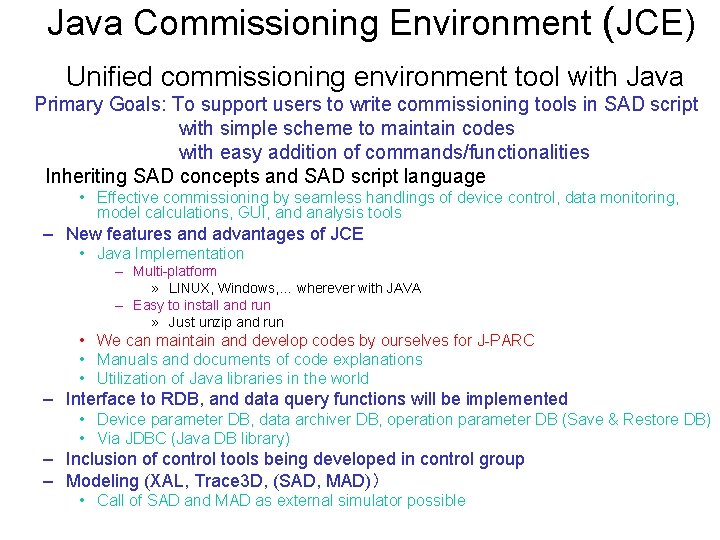
Java Commissioning Environment (JCE) Unified commissioning environment tool with Java Primary Goals: To support users to write commissioning tools in SAD script with simple scheme to maintain codes with easy addition of commands/functionalities Inheriting SAD concepts and SAD script language • Effective commissioning by seamless handlings of device control, data monitoring, model calculations, GUI, and analysis tools – New features and advantages of JCE • Java Implementation – Multi-platform » LINUX, Windows, … wherever with JAVA – Easy to install and run » Just unzip and run • We can maintain and develop codes by ourselves for J-PARC • Manuals and documents of code explanations • Utilization of Java libraries in the world – Interface to RDB, and data query functions will be implemented • Device parameter DB, data archiver DB, operation parameter DB (Save & Restore DB) • Via JDBC (Java DB library) – Inclusion of control tools being developed in control group – Modeling (XAL, Trace 3 D, (SAD, MAD)) • Call of SAD and MAD as external simulator possible
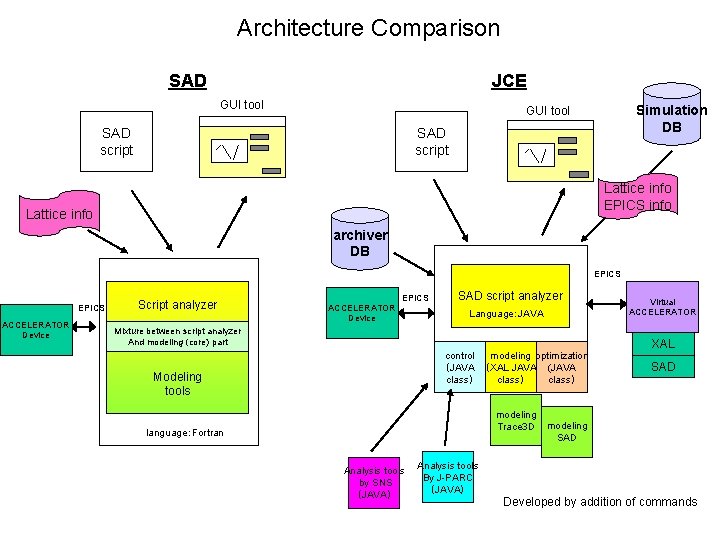
Architecture Comparison SAD JCE GUI tool Simulation DB GUI tool SAD script Lattice info EPICS info Lattice info archiver DB EPICS ACCELERATOR Device Script analyzer EPICS ACCELERATOR Device EPICS SAD script analyzer Language:JAVA Mixture between script analyzer And modeling (core) part control (JAVA class) Modeling tools modeling optimization (XAL JAVA (JAVA class) modeling Trace 3 D language:Fortran Analysis tools by SNS (JAVA) Virtual ACCELERATOR XAL SAD modeling SAD Analysis tools By J-PARC (JAVA) Developed by addition of commands
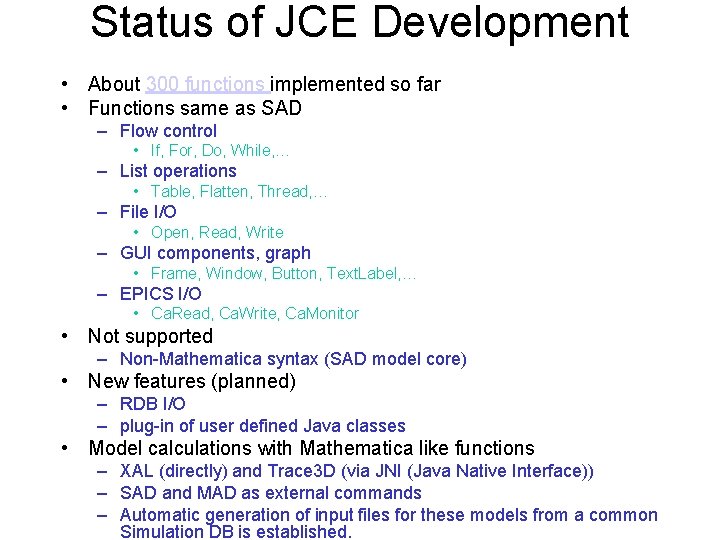
Status of JCE Development • About 300 functions implemented so far • Functions same as SAD – Flow control • If, For, Do, While, … – List operations • Table, Flatten, Thread, … – File I/O • Open, Read, Write – GUI components, graph • Frame, Window, Button, Text. Label, … – EPICS I/O • Ca. Read, Ca. Write, Ca. Monitor • Not supported – Non-Mathematica syntax (SAD model core) • New features (planned) – RDB I/O – plug-in of user defined Java classes • Model calculations with Mathematica like functions – XAL (directly) and Trace 3 D (via JNI (Java Native Interface)) – SAD and MAD as external commands – Automatic generation of input files for these models from a common Simulation DB is established.
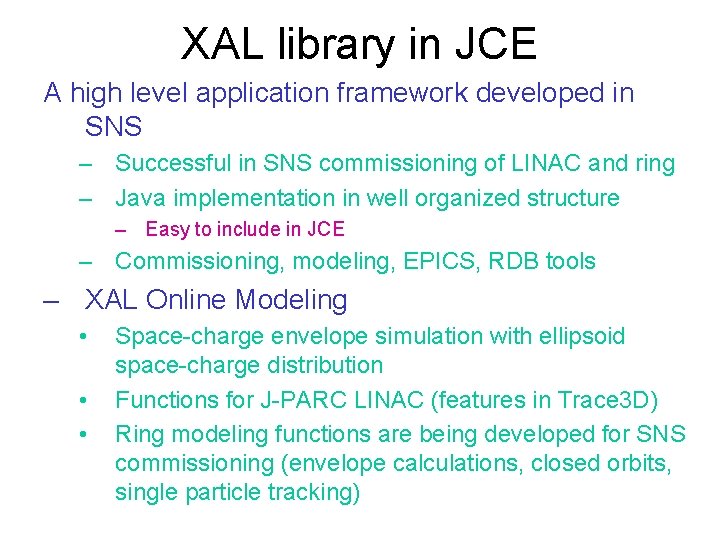
XAL library in JCE A high level application framework developed in SNS – Successful in SNS commissioning of LINAC and ring – Java implementation in well organized structure – Easy to include in JCE – Commissioning, modeling, EPICS, RDB tools – XAL Online Modeling • • • Space-charge envelope simulation with ellipsoid space-charge distribution Functions for J-PARC LINAC (features in Trace 3 D) Ring modeling functions are being developed for SNS commissioning (envelope calculations, closed orbits, single particle tracking)
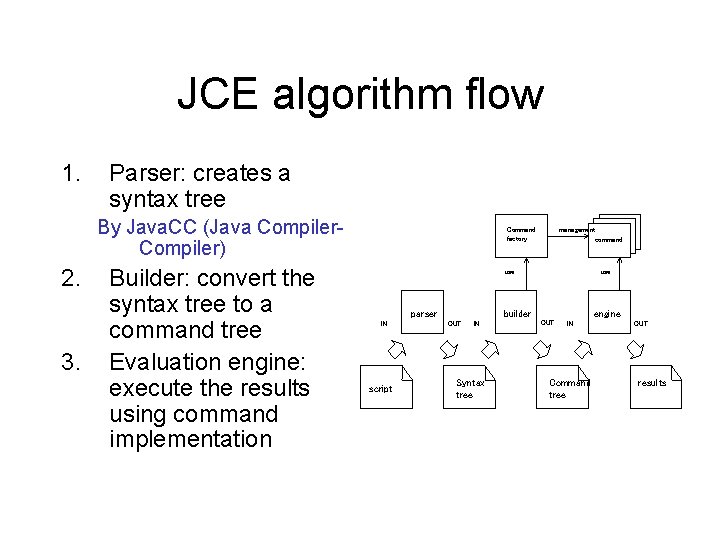
JCE algorithm flow 1. Parser: creates a syntax tree By Java. CC (Java Compiler) 2. 3. Builder: convert the syntax tree to a command tree Evaluation engine: execute the results using command implementation Command factory management コマンド command use parser IN script use builder OUT IN Syntax tree engine OUT IN Command tree OUT results
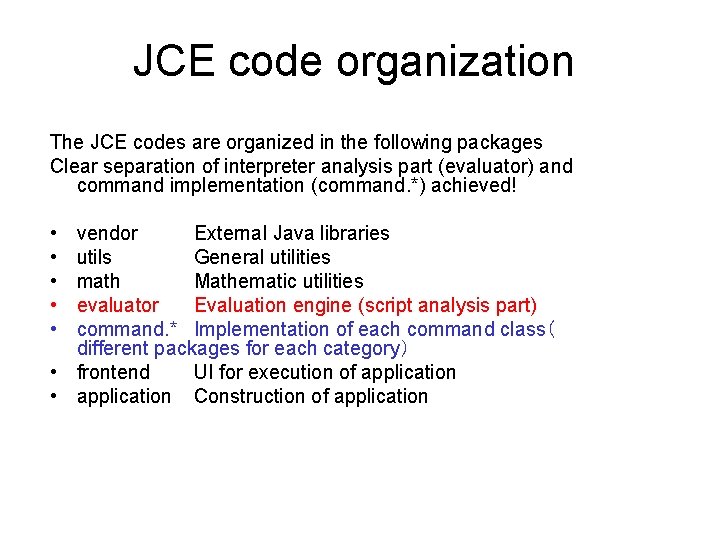
JCE code organization The JCE codes are organized in the following packages Clear separation of interpreter analysis part (evaluator) and command implementation (command. *) achieved! • • • vendor External Java libraries utils General utilities math Mathematic utilities evaluator Evaluation engine (script analysis part) command. * Implementation of each command class( different packages for each category) • frontend UI for execution of application • application Construction of application
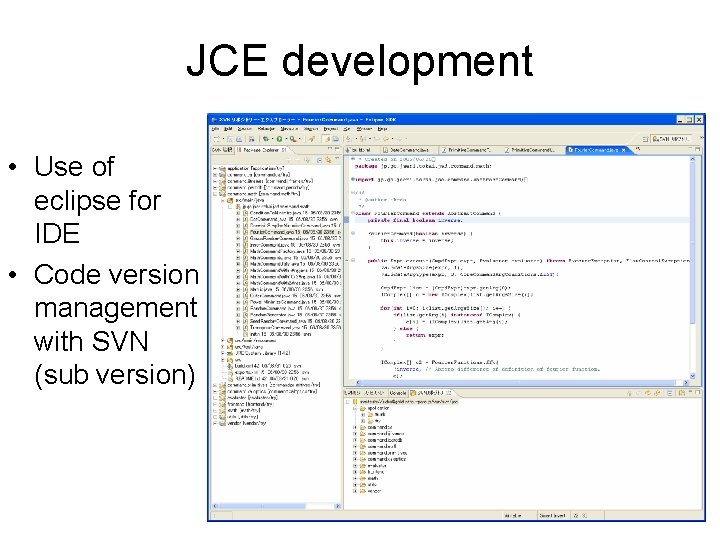
JCE development • Use of eclipse for IDE • Code version management with SVN (sub version)
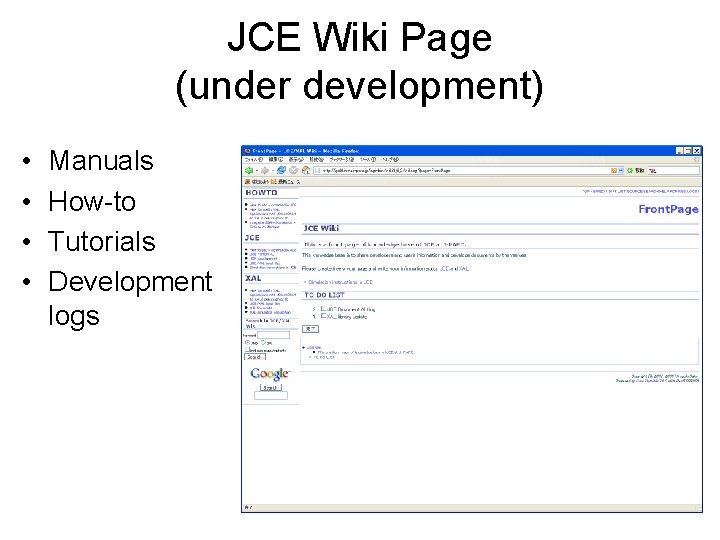
JCE Wiki Page (under development) • • Manuals How-to Tutorials Development logs
Summary and perspectives • JCE has been developed in Java for simple maintenance scheme and extensibility but keeping the concepts of SAD as a powerful commissioning platform • We start developing tools for LINAC commissioning in Dec
Demo script of a simple orbit correction in LINAC-MEBT 1 • MEBT 1: a beam transport line with 10 steering dipole magnets, 8 quadrupoles and 8 BPM’s • Initial beam position has offset – Orbit has deviations • Calculate optimum steering magnet settings to correct orbit deviations – With Simplex minimization algorithm • Set the obtained magnet parameters to a virtual accelerator via EPICS and monitor the BPM position data
- Slides: 14