
Javas for Statement Algorithmic Pattern The Determinate loop


- Slides: 10
Java's for Statement
Algorithmic Pattern: The Determinate loop w We often need to perform some action a specific number of times: Generate 89 paychecks — Count down to 0 (take 1 second of the clock) — Simulate playing a game of "Let's Make a Deal" 10, 000 times — w The determinate loop pattern repeats some action a specific number of times
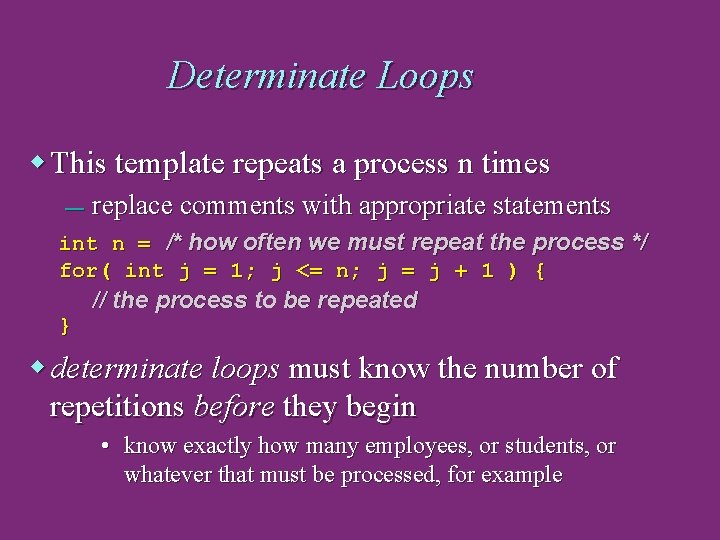
Determinate Loops w This template repeats a process n times — replace comments with appropriate statements int n = /* how often we must repeat the process */ for( int j = 1; j <= n; j = j + 1 ) { // the process to be repeated } w determinate loops must know the number of repetitions before they begin • know exactly how many employees, or students, or whatever that must be processed, for example
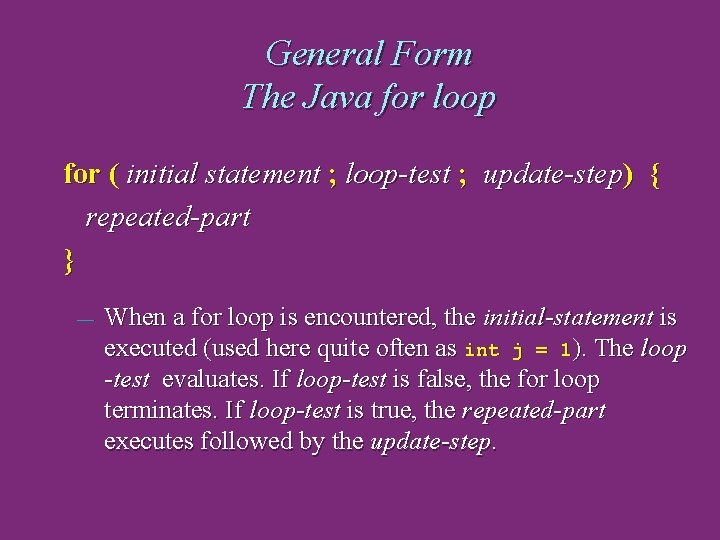
General Form The Java for loop for ( initial statement ; loop-test ; update-step) { repeated-part } — When a for loop is encountered, the initial-statement is executed (used here quite often as int j = 1). The loop -test evaluates. If loop-test is false, the for loop terminates. If loop-test is true, the repeated-part executes followed by the update-step.
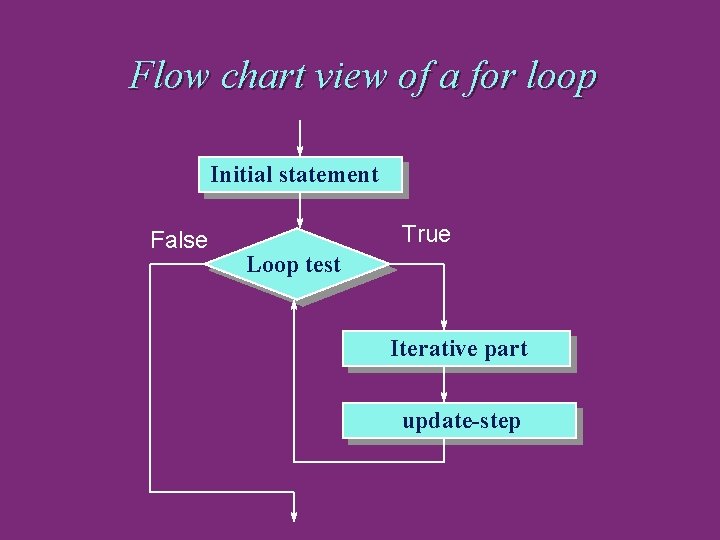
Flow chart view of a for loop Initial statement False True Loop test Iterative part update-step
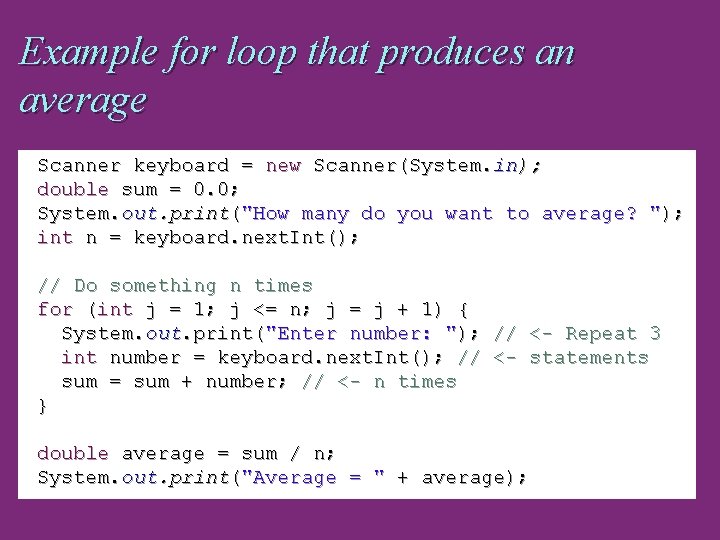
Example for loop that produces an average Scanner keyboard = new Scanner(System. in); double sum = 0. 0; System. out. print("How many do you want to average? "); int n = keyboard. next. Int(); // Do something n times for (int j = 1; j <= n; j = j + 1) { System. out. print("Enter number: "); int number = keyboard. next. Int(); // sum = sum + number; // <- n times } // <- <- Repeat 3 statements double average = sum / n; System. out. print("Average = " + average);
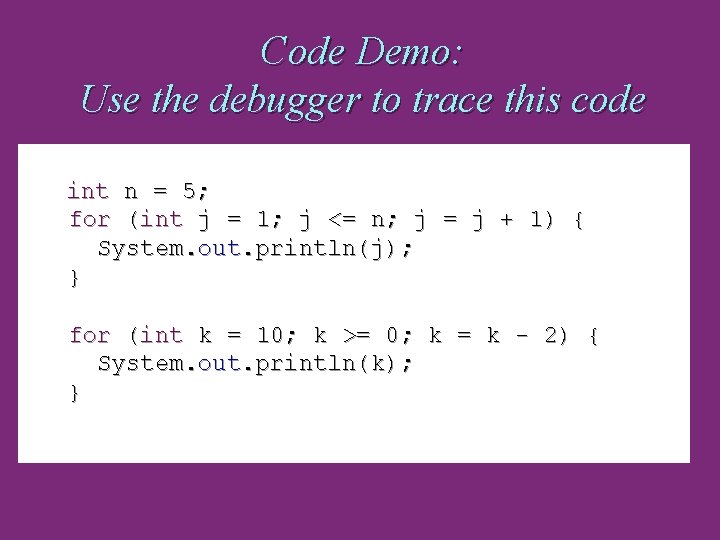
Code Demo: Use the debugger to trace this code int n = 5; for (int j = 1; j <= n; j = j + 1) { System. out. println(j); } for (int k = 10; k >= 0; k = k - 2) { System. out. println(k); }
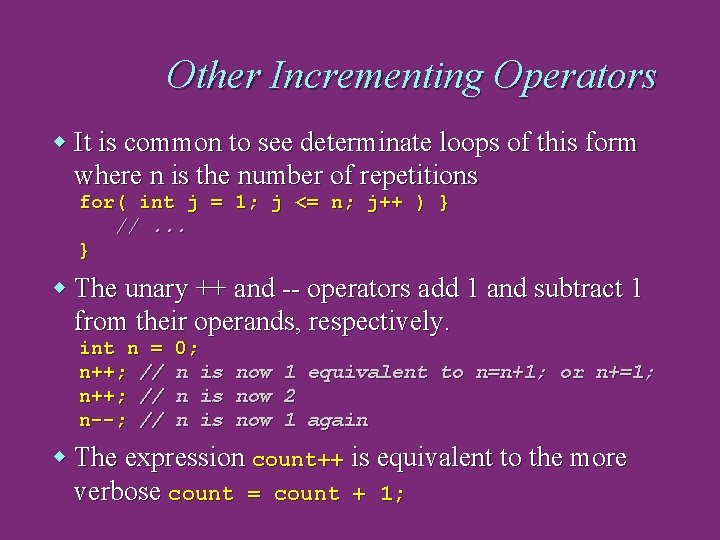
Other Incrementing Operators w It is common to see determinate loops of this form where n is the number of repetitions for( int j = 1; j <= n; j++ ) } //. . . } w The unary ++ and -- operators add 1 and subtract 1 from their operands, respectively. int n = n++; // n--; // 0; n is now 1 equivalent to n=n+1; or n+=1; n is now 2 n is now 1 again w The expression count++ is equivalent to the more verbose count = count + 1;
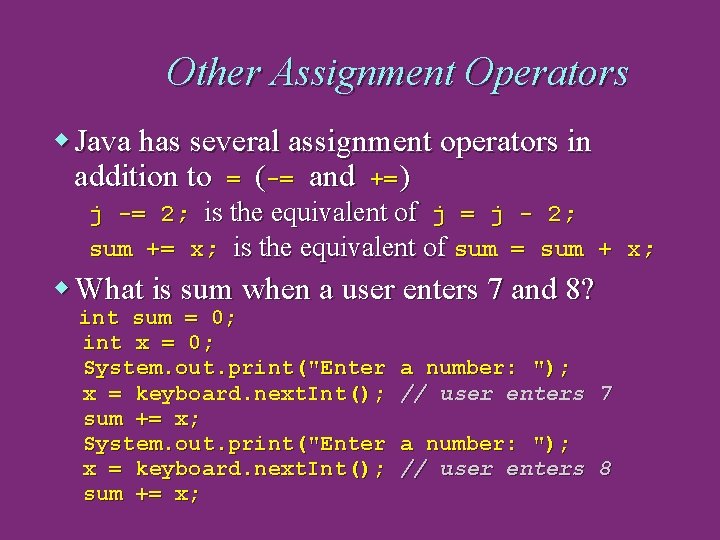
Other Assignment Operators w Java has several assignment operators in addition to = (-= and +=) j -= 2; is the equivalent of j = j - 2; sum += x; is the equivalent of sum = sum + x; w What is sum when a user enters 7 and 8? int sum = 0; int x = 0; System. out. print("Enter x = keyboard. next. Int(); sum += x; a number: "); // user enters 7 a number: "); // user enters 8