
Java Workshop on COMSOL FEM Automated Workflow Outline


- Slides: 14
Java Workshop on COMSOL FEM Automated Workflow
Outline • STEAM conventions • FEM workflow • Magnet as a composition of physical domains • The example of coil domain • Identification of handles for Geometry and Properties • Proposal for an API-free low level 3
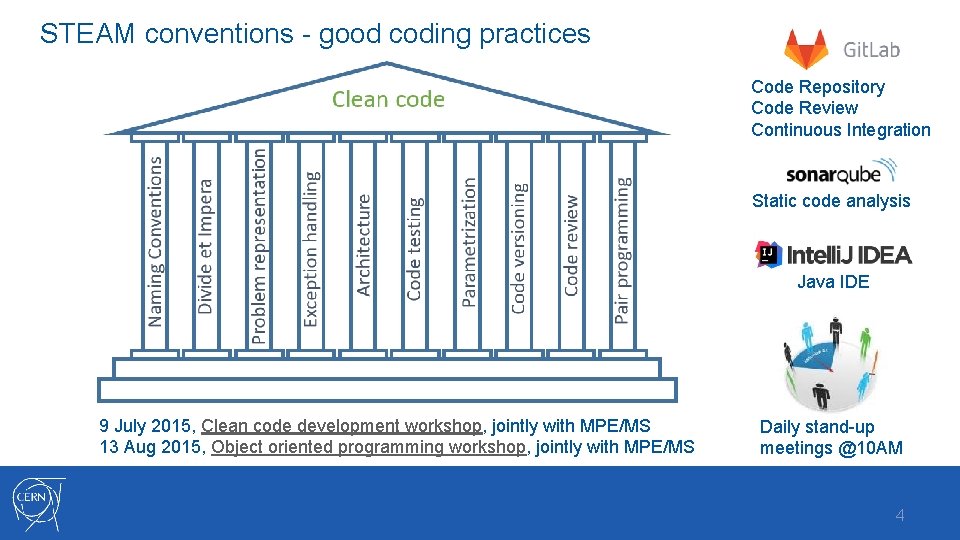
STEAM conventions - good coding practices Code Repository Code Review Continuous Integration Static code analysis Java IDE 9 July 2015, Clean code development workshop, jointly with MPE/MS 13 Aug 2015, Object oriented programming workshop, jointly with MPE/MS Daily stand-up meetings @10 AM 4
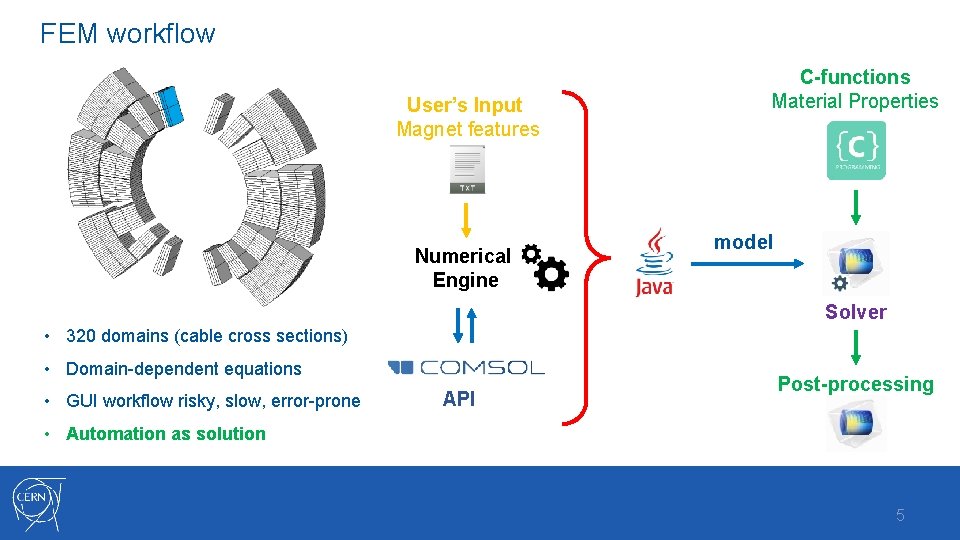
FEM workflow User’s Input Magnet features Numerical Engine C-functions Material Properties model Solver • 320 domains (cable cross sections) • Domain-dependent equations • GUI workflow risky, slow, error-prone API Post-processing • Automation as solution 5
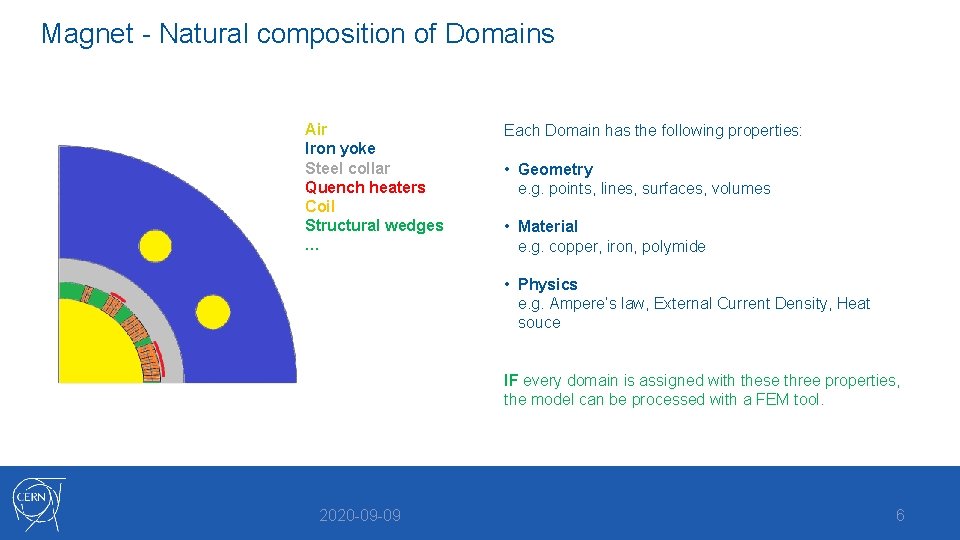
Magnet - Natural composition of Domains Air Iron yoke Steel collar Quench heaters Coil Structural wedges … Each Domain has the following properties: • Geometry e. g. points, lines, surfaces, volumes • Material e. g. copper, iron, polymide • Physics e. g. Ampere’s law, External Current Density, Heat souce IF every domain is assigned with these three properties, the model can be processed with a FEM tool. 2020 -09 -09 6
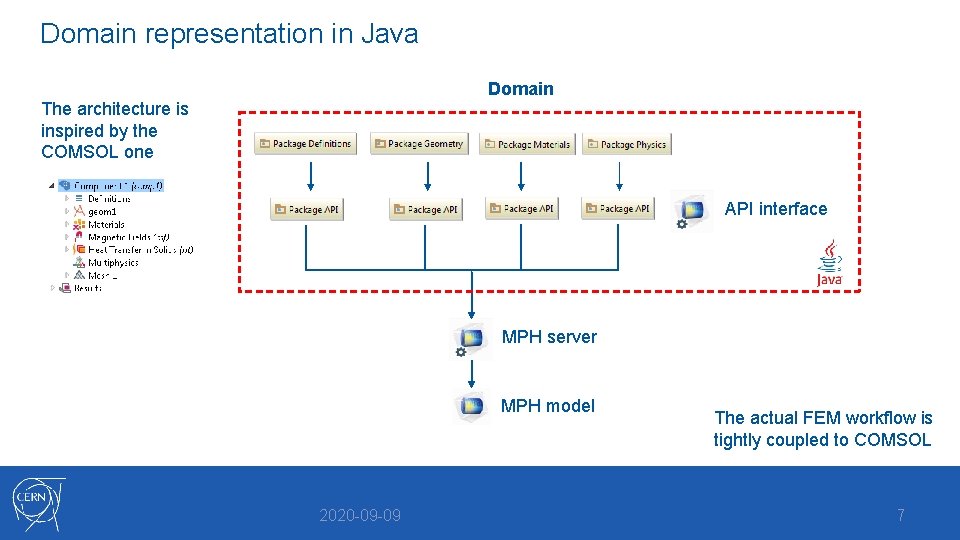
Domain representation in Java Domain The architecture is inspired by the COMSOL one API interface MPH server MPH model 2020 -09 -09 The actual FEM workflow is tightly coupled to COMSOL 7
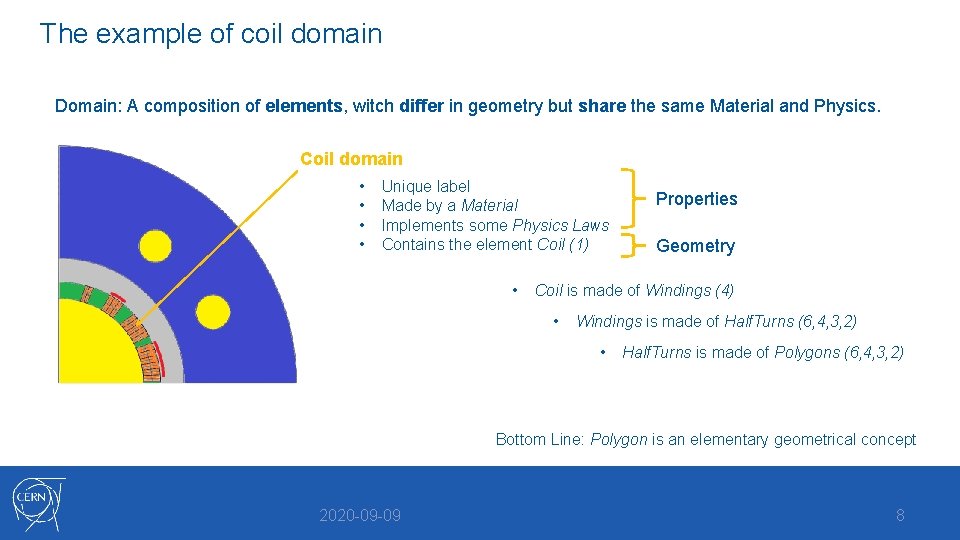
The example of coil domain Domain: A composition of elements, witch differ in geometry but share the same Material and Physics. Coil domain • • Unique label Made by a Material Implements some Physics Laws Contains the element Coil (1) • Properties Geometry Coil is made of Windings (4) • Windings is made of Half. Turns (6, 4, 3, 2) • Half. Turns is made of Polygons (6, 4, 3, 2) Bottom Line: Polygon is an elementary geometrical concept 2020 -09 -09 8
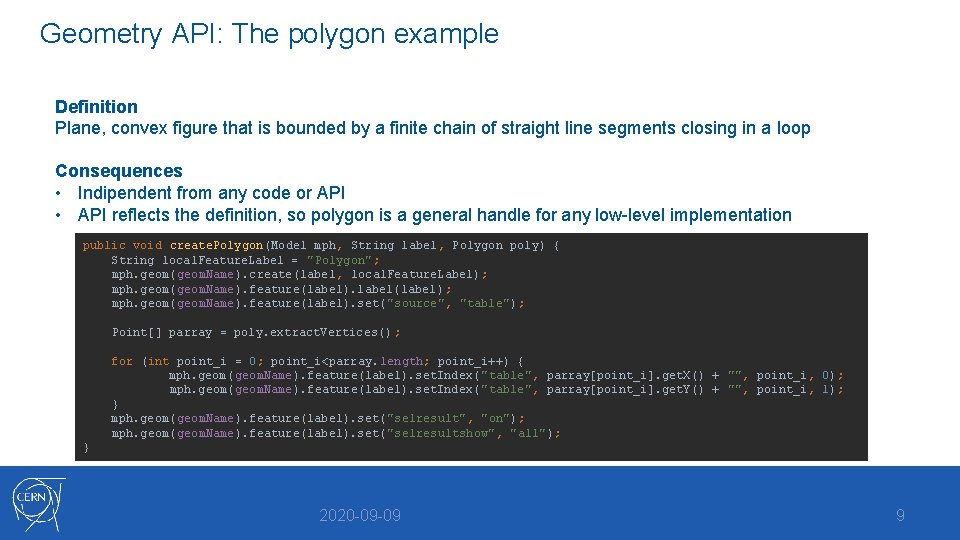
Geometry API: The polygon example Definition Plane, convex figure that is bounded by a finite chain of straight line segments closing in a loop Consequences • Indipendent from any code or API • API reflects the definition, so polygon is a general handle for any low-level implementation public void create. Polygon(Model mph, String label, Polygon poly) { String local. Feature. Label = "Polygon"; mph. geom(geom. Name). create(label, local. Feature. Label); mph. geom(geom. Name). feature(label). label(label) ; mph. geom(geom. Name). feature(label). set("source", "table"); Point[] parray = poly. extract. Vertices() ; for (int point_i = 0; point_i<parray. length; point_i++) { mph. geom(geom. Name). feature(label). set. Index( "table", parray[point_i]. get. X() + "", point_i, 0); mph. geom(geom. Name). feature(label). set. Index( "table", parray[point_i]. get. Y() + "", point_i, 1); } mph. geom(geom. Name). feature(label). set("selresult", "on"); mph. geom(geom. Name). feature(label). set("selresultshow", "all"); } 2020 -09 -09 9
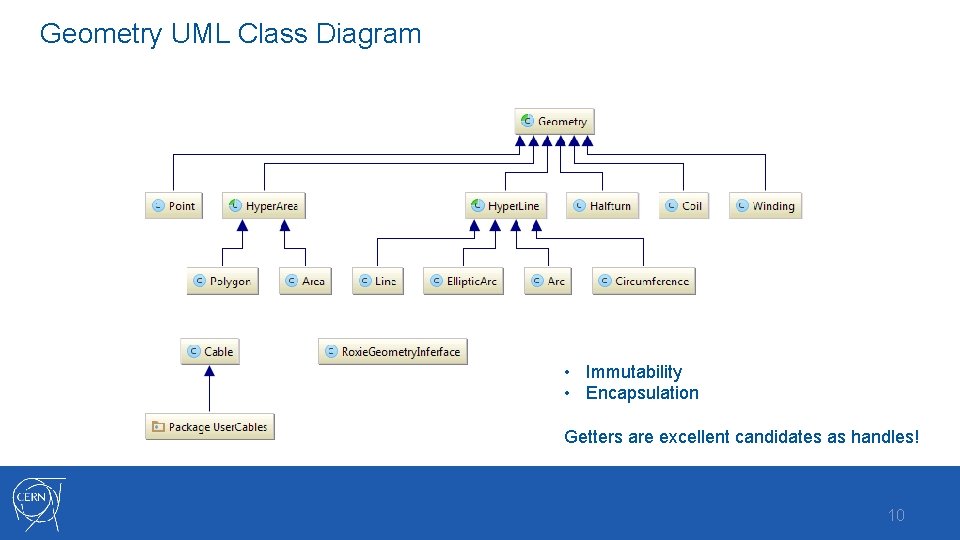
Geometry UML Class Diagram • Immutability • Encapsulation Getters are excellent candidates as handles! 10
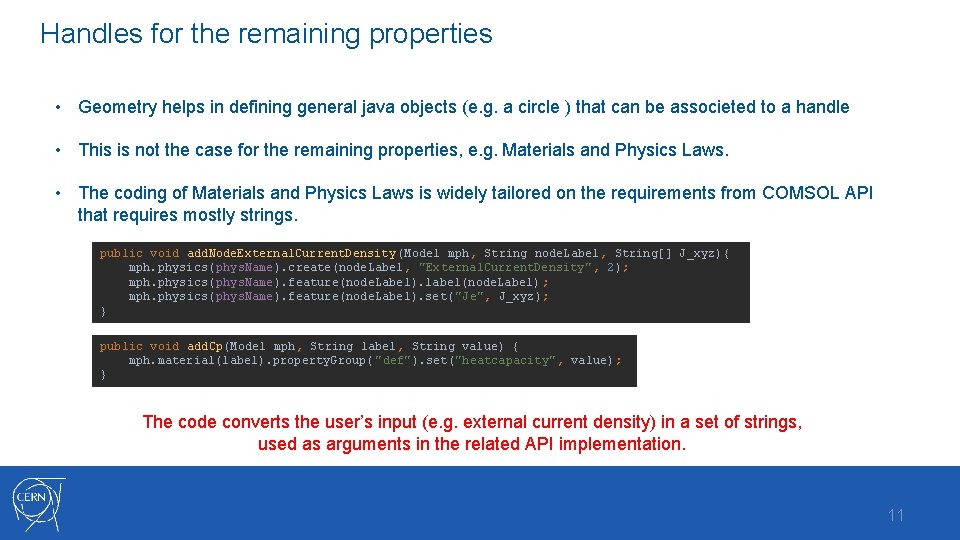
Handles for the remaining properties • Geometry helps in defining general java objects (e. g. a circle ) that can be associeted to a handle • This is not the case for the remaining properties, e. g. Materials and Physics Laws. • The coding of Materials and Physics Laws is widely tailored on the requirements from COMSOL API that requires mostly strings. public void add. Node. External. Current. Density (Model mph, String node. Label, String[] J_xyz){ mph. physics(phys. Name). create(node. Label, "External. Current. Density" , 2); mph. physics(phys. Name). feature(node. Label). label(node. Label) ; mph. physics(phys. Name). feature(node. Label). set( "Je", J_xyz); } public void add. Cp(Model mph, String label, String value) { mph. material(label). property. Group( "def"). set("heatcapacity", value); } The code converts the user’s input (e. g. external current density) in a set of strings, used as arguments in the related API implementation. 11
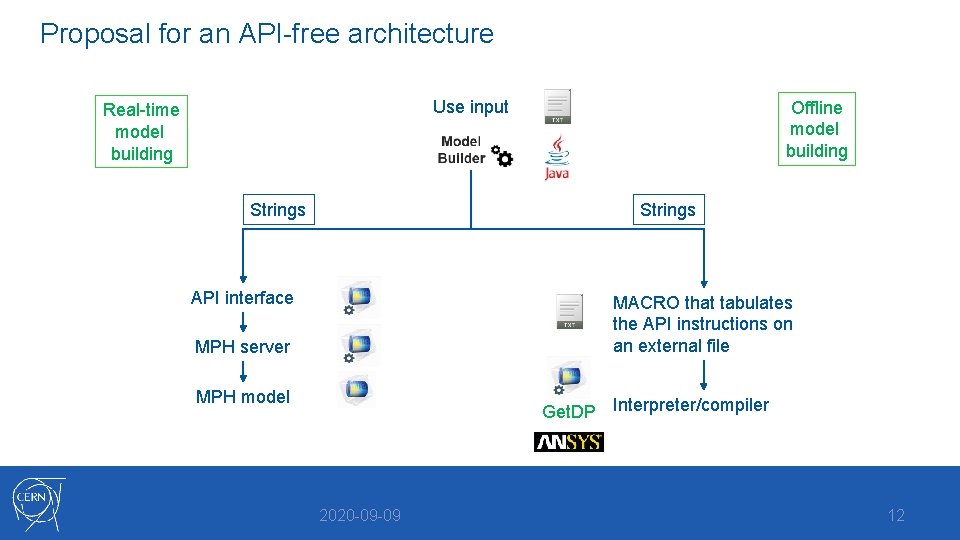
Proposal for an API-free architecture Use input Real-time model building Strings Offline model building Strings API interface MACRO that tabulates the API instructions on an external file MPH server MPH model Get. DP Interpreter/compiler 2020 -09 -09 12
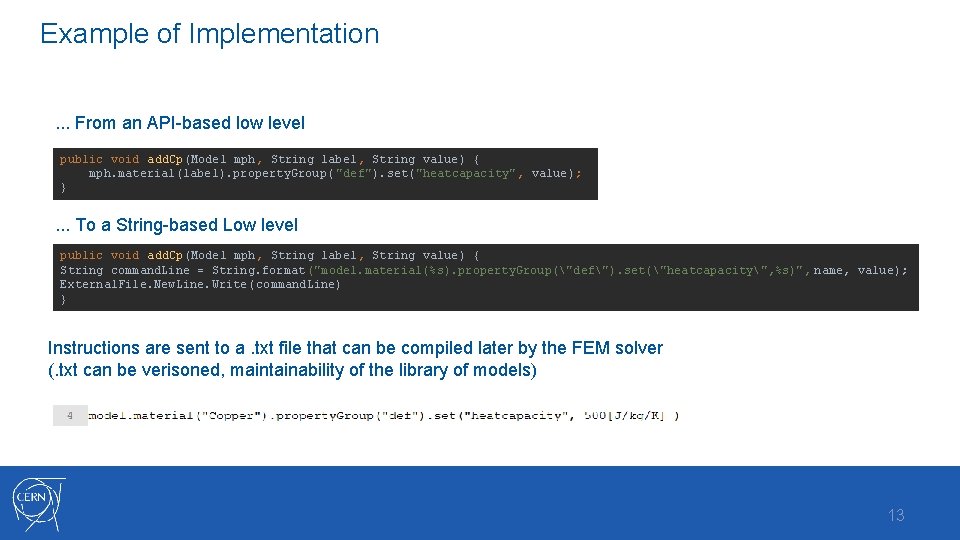
Example of Implementation. . . From an API-based low level public void add. Cp(Model mph, String label, String value) { mph. material(label). property. Group( "def"). set("heatcapacity", value); } . . . To a String-based Low level public void add. Cp(Model mph, String label, String value) { String command. Line = String. format ("model. material(%s). property. Group("def"). set("heatcapacity", %s)", name, value); External. File. New. Line. Write( command. Line) } Instructions are sent to a. txt file that can be compiled later by the FEM solver (. txt can be verisoned, maintainability of the library of models) 13