
Java specification checking Evaluation of a tool for


- Slides: 24
Java specification checking Evaluation of a tool for use on M 250 “Object-oriented Java Programming” Anton Dil and Sue Truby
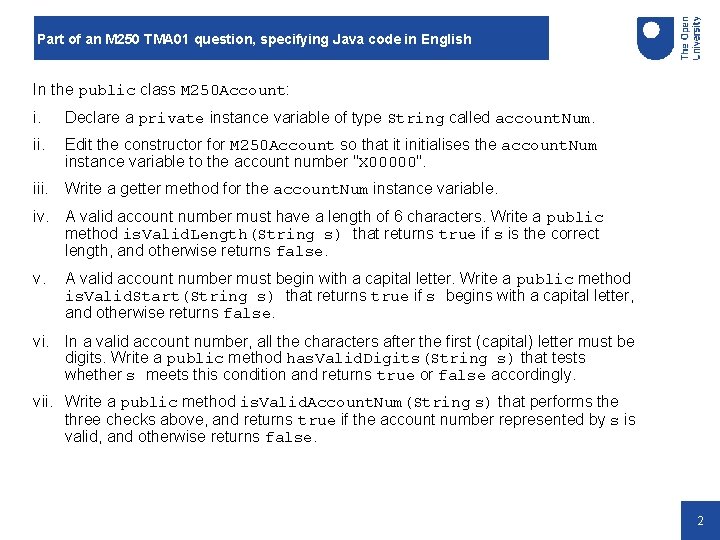
Part of an M 250 TMA 01 question, specifying Java code in English In the public class M 250 Account: i. Declare a private instance variable of type String called account. Num. ii. Edit the constructor for M 250 Account so that it initialises the account. Num instance variable to the account number "X 00000". iii. Write a getter method for the account. Num instance variable. iv. A valid account number must have a length of 6 characters. Write a public method is. Valid. Length(String s) that returns true if s is the correct length, and otherwise returns false. v. A valid account number must begin with a capital letter. Write a public method is. Valid. Start(String s) that returns true if s begins with a capital letter, and otherwise returns false. vi. In a valid account number, all the characters after the first (capital) letter must be digits. Write a public method has. Valid. Digits(String s) that tests whether s meets this condition and returns true or false accordingly. vii. Write a public method is. Valid. Account. Num(String s) that performs the three checks above, and returns true if the account number represented by s is valid, and otherwise returns false. 2
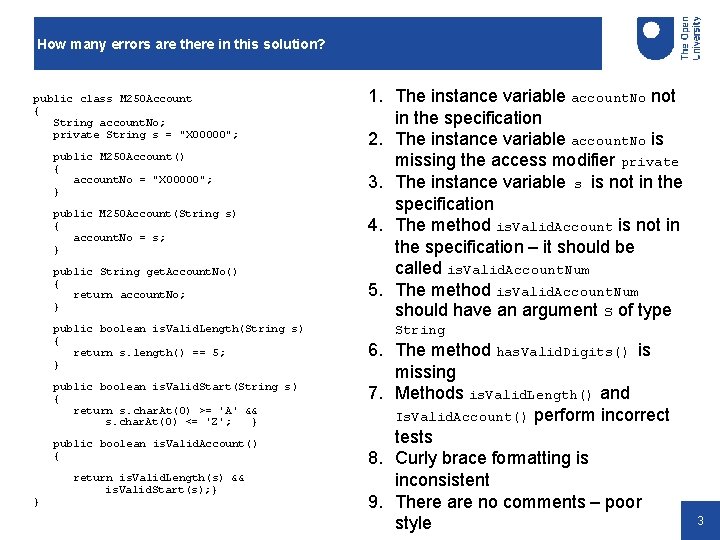
How many errors are there in this solution? public class M 250 Account { String account. No; private String s = "X 00000"; public M 250 Account() { account. No = "X 00000"; } public M 250 Account(String s) { account. No = s; } public String get. Account. No() { return account. No; } public boolean is. Valid. Length(String s) { return s. length() == 5; } public boolean is. Valid. Start(String s) { return s. char. At(0) >= 'A' && s. char. At(0) <= 'Z'; } public boolean is. Valid. Account() { } return is. Valid. Length(s) && is. Valid. Start(s); } 1. The instance variable account. No not in the specification 2. The instance variable account. No is missing the access modifier private 3. The instance variable s is not in the specification 4. The method is. Valid. Account is not in the specification – it should be called is. Valid. Account. Num 5. The method is. Valid. Account. Num should have an argument s of type String 6. The method has. Valid. Digits() is missing 7. Methods is. Valid. Length() and Is. Valid. Account() perform incorrect tests 8. Curly brace formatting is inconsistent 9. There are no comments – poor style 3
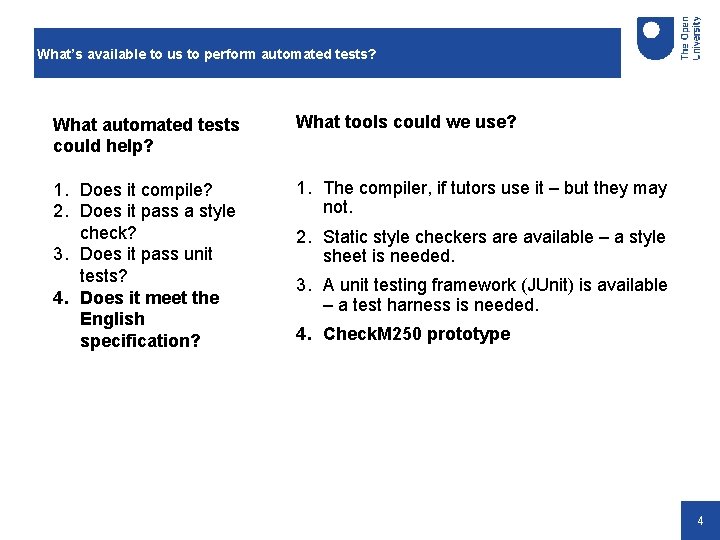
What’s available to us to perform automated tests? What automated tests could help? What tools could we use? 1. Does it compile? 2. Does it pass a style check? 3. Does it pass unit tests? 4. Does it meet the English specification? 1. The compiler, if tutors use it – but they may not. 2. Static style checkers are available – a style sheet is needed. 3. A unit testing framework (JUnit) is available – a test harness is needed. 4. Check. M 250 prototype 4
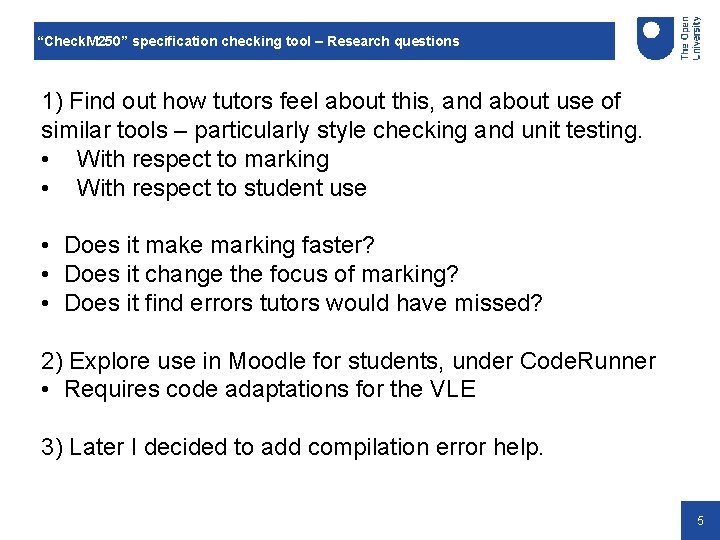
“Check. M 250” specification checking tool – Research questions 1) Find out how tutors feel about this, and about use of similar tools – particularly style checking and unit testing. • With respect to marking • With respect to student use • Does it make marking faster? • Does it change the focus of marking? • Does it find errors tutors would have missed? 2) Explore use in Moodle for students, under Code. Runner • Requires code adaptations for the VLE 3) Later I decided to add compilation error help. 5
Design of the tool How the tool works
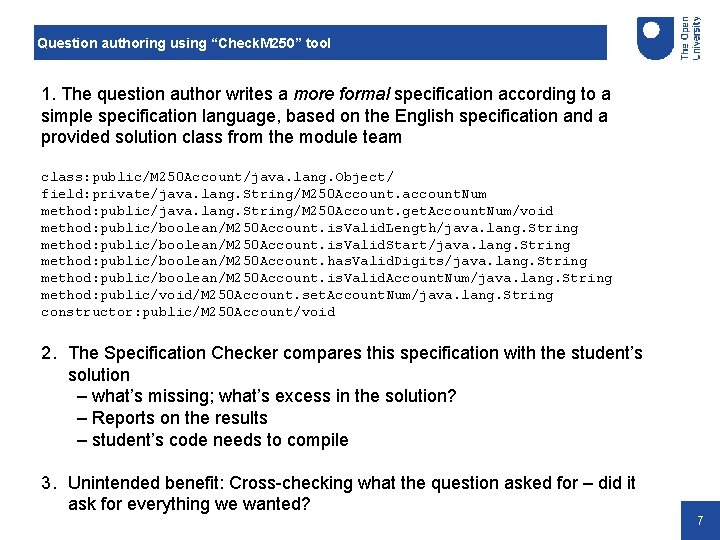
Question authoring using “Check. M 250” tool 1. The question author writes a more formal specification according to a simple specification language, based on the English specification and a provided solution class from the module team class: public/M 250 Account/java. lang. Object/ field: private/java. lang. String/M 250 Account. account. Num method: public/java. lang. String/M 250 Account. get. Account. Num/void method: public/boolean/M 250 Account. is. Valid. Length/java. lang. String method: public/boolean/M 250 Account. is. Valid. Start/java. lang. String method: public/boolean/M 250 Account. has. Valid. Digits/java. lang. String method: public/boolean/M 250 Account. is. Valid. Account. Num/java. lang. String method: public/void/M 250 Account. set. Account. Num/java. lang. String constructor: public/M 250 Account/void 2. The Specification Checker compares this specification with the student’s solution – what’s missing; what’s excess in the solution? – Reports on the results – student’s code needs to compile 3. Unintended benefit: Cross-checking what the question asked for – did it ask for everything we wanted? 7
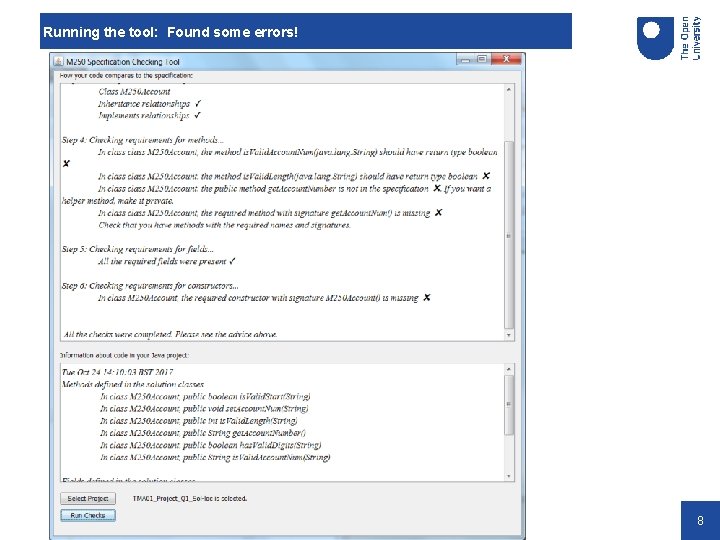
Running the tool: Found some errors! 8
Student facing tool
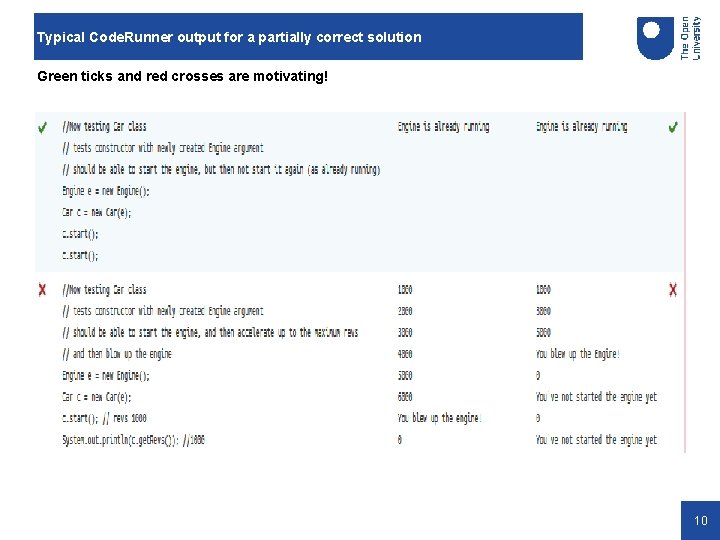
Typical Code. Runner output for a partially correct solution Green ticks and red crosses are motivating! 10
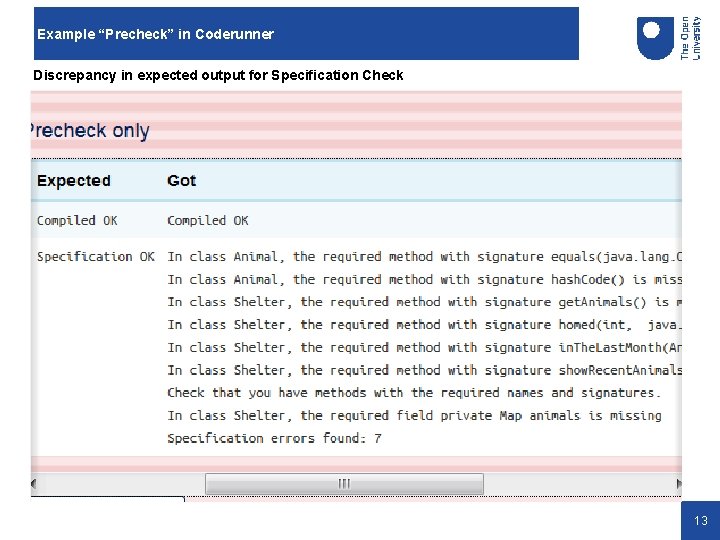
Example “Precheck” in Coderunner Discrepancy in expected output for Specification Check 13
Results Some results from the survey
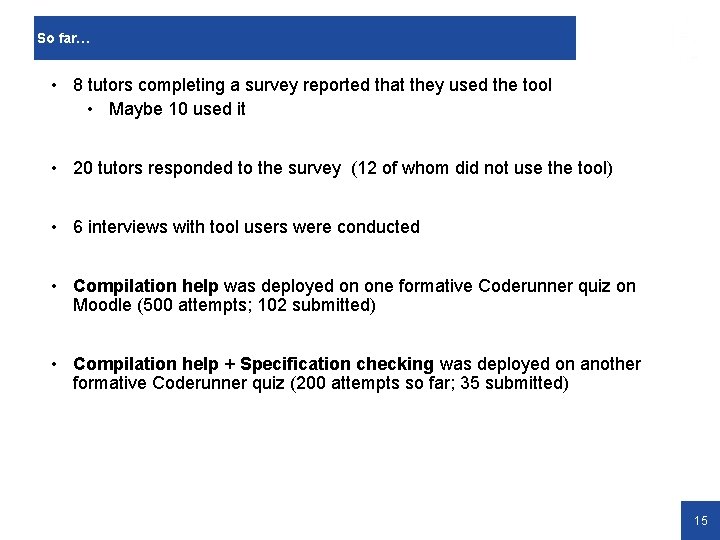
So far… • 8 tutors completing a survey reported that they used the tool • Maybe 10 used it • 20 tutors responded to the survey (12 of whom did not use the tool) • 6 interviews with tool users were conducted • Compilation help was deployed on one formative Coderunner quiz on Moodle (500 attempts; 102 submitted) • Compilation help + Specification checking was deployed on another formative Coderunner quiz (200 attempts so far; 35 submitted) 15
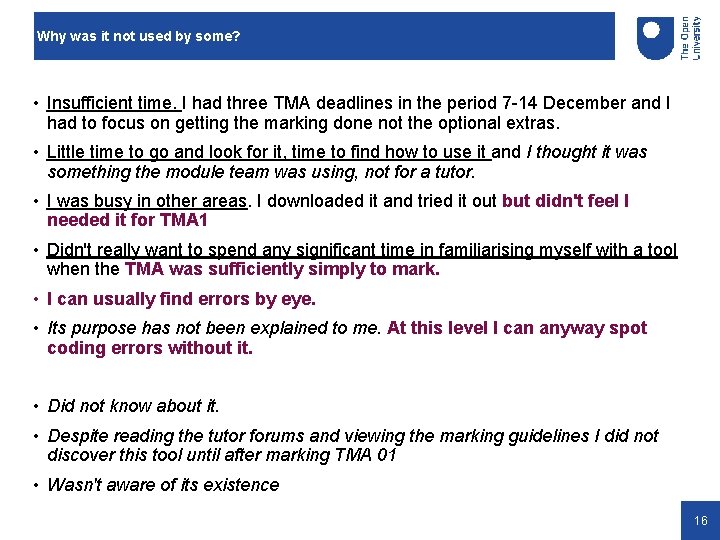
Why was it not used by some? • Insufficient time. I had three TMA deadlines in the period 7 -14 December and I had to focus on getting the marking done not the optional extras. • Little time to go and look for it, time to find how to use it and I thought it was something the module team was using, not for a tutor. • I was busy in other areas. I downloaded it and tried it out but didn't feel I needed it for TMA 1 • Didn't really want to spend any significant time in familiarising myself with a tool when the TMA was sufficiently simply to mark. • I can usually find errors by eye. • Its purpose has not been explained to me. At this level I can anyway spot coding errors without it. • Did not know about it. • Despite reading the tutor forums and viewing the marking guidelines I did not discover this tool until after marking TMA 01 • Wasn't aware of its existence 16
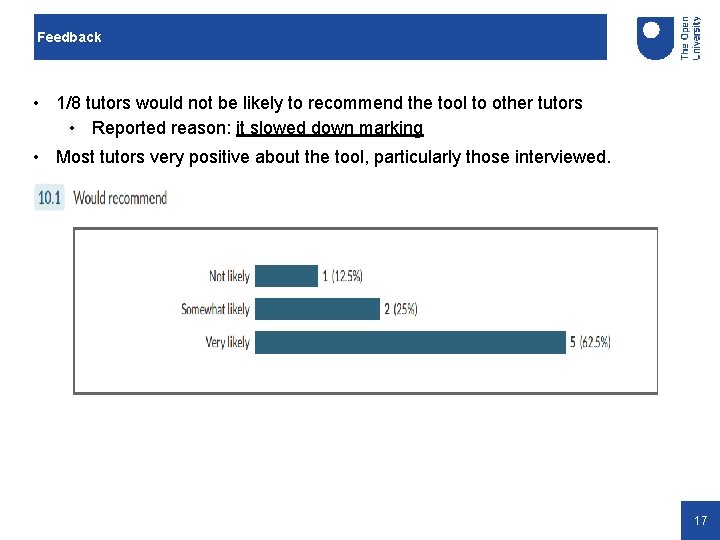
Feedback • 1/8 tutors would not be likely to recommend the tool to other tutors • Reported reason: it slowed down marking • Most tutors very positive about the tool, particularly those interviewed. 17
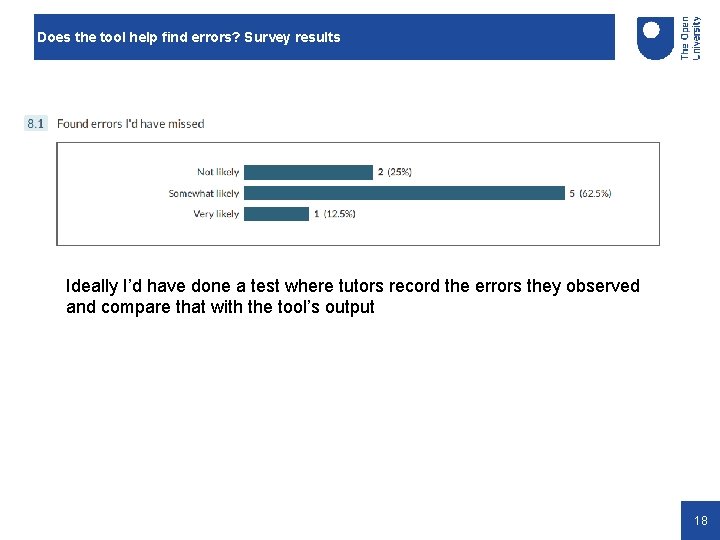
Does the tool help find errors? Survey results Ideally I’d have done a test where tutors record the errors they observed and compare that with the tool’s output 18
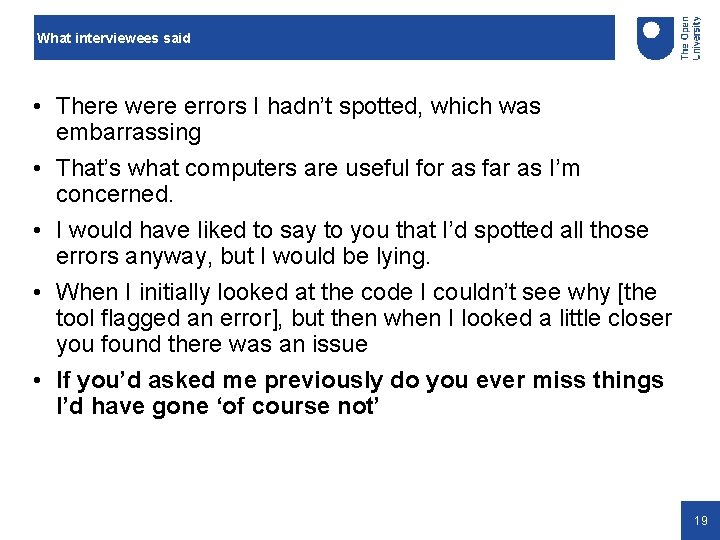
What interviewees said • There were errors I hadn’t spotted, which was embarrassing • That’s what computers are useful for as far as I’m concerned. • I would have liked to say to you that I’d spotted all those errors anyway, but I would be lying. • When I initially looked at the code I couldn’t see why [the tool flagged an error], but then when I looked a little closer you found there was an issue • If you’d asked me previously do you ever miss things I’d have gone ‘of course not’ 19
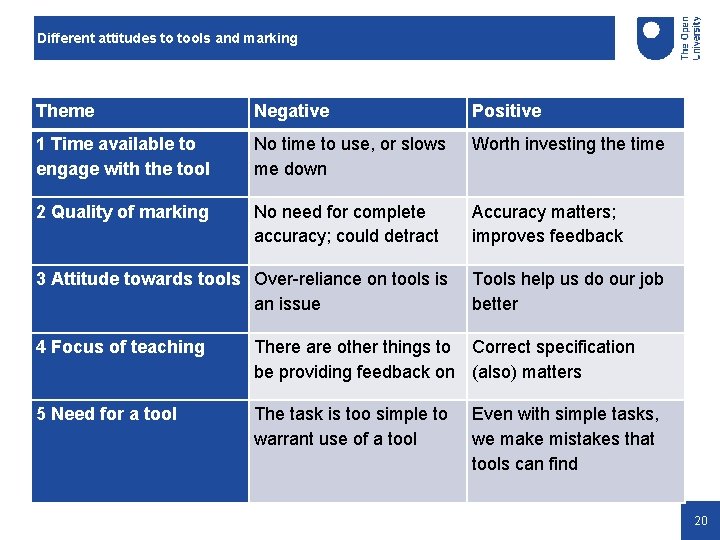
Different attitudes to tools and marking Theme Negative Positive 1 Time available to engage with the tool No time to use, or slows me down Worth investing the time 2 Quality of marking No need for complete accuracy; could detract Accuracy matters; improves feedback 3 Attitude towards tools Over-reliance on tools is an issue Tools help us do our job better 4 Focus of teaching There are other things to Correct specification be providing feedback on (also) matters 5 Need for a tool The task is too simple to warrant use of a tool Even with simple tasks, we make mistakes that tools can find 20
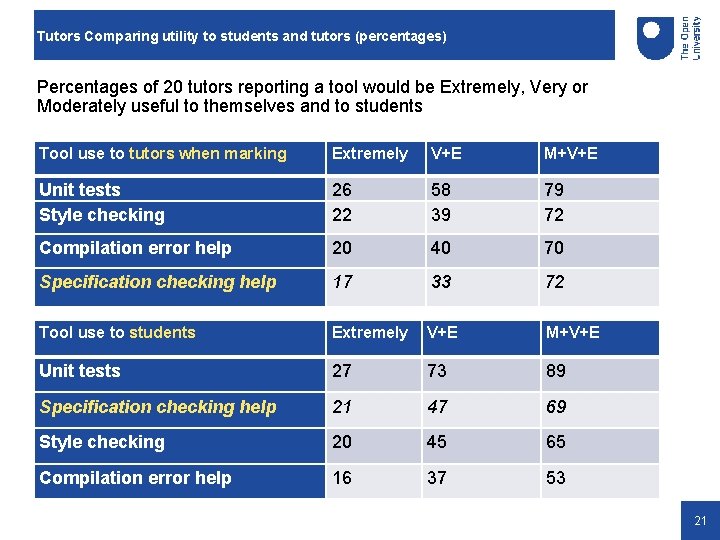
Tutors Comparing utility to students and tutors (percentages) Percentages of 20 tutors reporting a tool would be Extremely, Very or Moderately useful to themselves and to students Tool use to tutors when marking Extremely V+E M+V+E Unit tests Style checking 26 22 58 39 79 72 Compilation error help 20 40 70 Specification checking help 17 33 72 Tool use to students Extremely V+E M+V+E Unit tests 27 73 89 Specification checking help 21 47 69 Style checking 20 45 65 Compilation error help 16 37 53 21
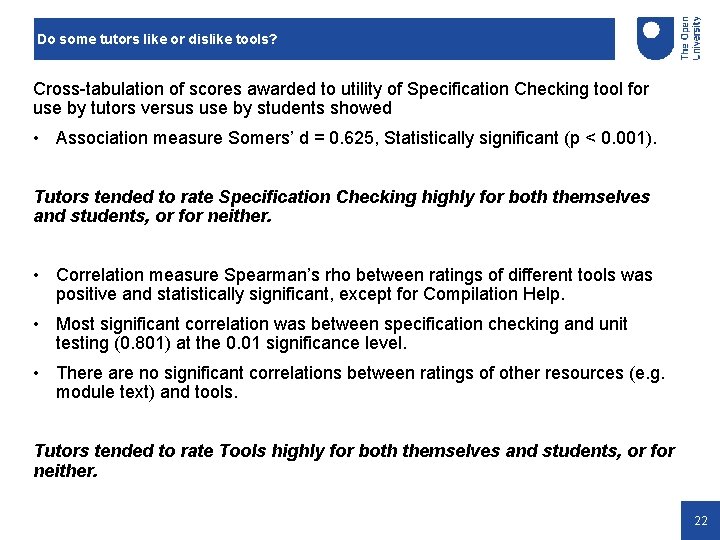
Do some tutors like or dislike tools? Cross-tabulation of scores awarded to utility of Specification Checking tool for use by tutors versus use by students showed • Association measure Somers’ d = 0. 625, Statistically significant (p < 0. 001). Tutors tended to rate Specification Checking highly for both themselves and students, or for neither. • Correlation measure Spearman’s rho between ratings of different tools was positive and statistically significant, except for Compilation Help. • Most significant correlation was between specification checking and unit testing (0. 801) at the 0. 01 significance level. • There are no significant correlations between ratings of other resources (e. g. module text) and tools. Tutors tended to rate Tools highly for both themselves and students, or for neither. 22
Conclusions and future work Where to from here?
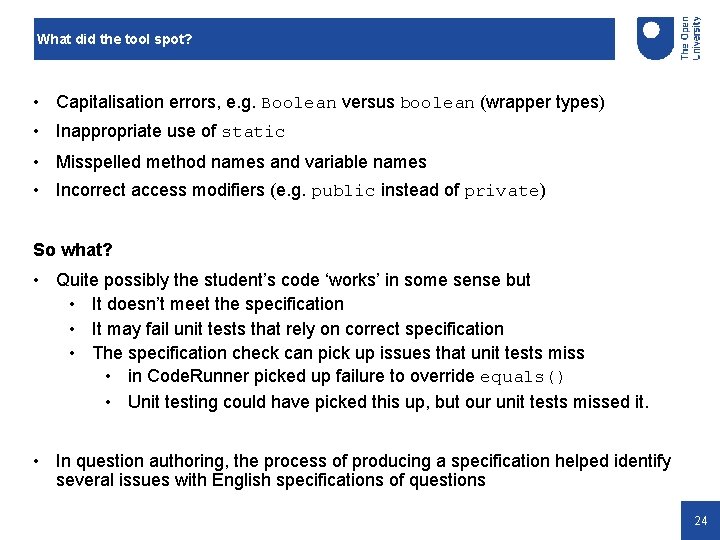
What did the tool spot? • Capitalisation errors, e. g. Boolean versus boolean (wrapper types) • Inappropriate use of static • Misspelled method names and variable names • Incorrect access modifiers (e. g. public instead of private) So what? • Quite possibly the student’s code ‘works’ in some sense but • It doesn’t meet the specification • It may fail unit tests that rely on correct specification • The specification check can pick up issues that unit tests miss • in Code. Runner picked up failure to override equals() • Unit testing could have picked this up, but our unit tests missed it. • In question authoring, the process of producing a specification helped identify several issues with English specifications of questions 24
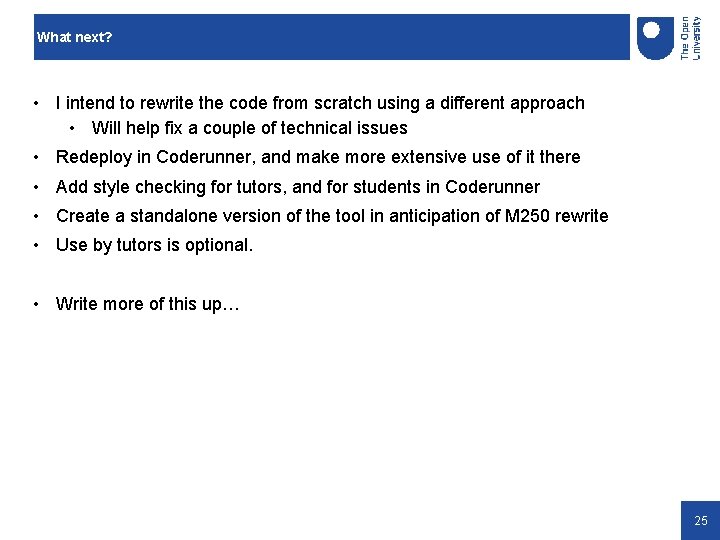
What next? • I intend to rewrite the code from scratch using a different approach • Will help fix a couple of technical issues • Redeploy in Coderunner, and make more extensive use of it there • Add style checking for tutors, and for students in Coderunner • Create a standalone version of the tool in anticipation of M 250 rewrite • Use by tutors is optional. • Write more of this up… 25
THANK YOU