
Java Path Finder JPF cs 498 dm Software
- Slides: 25
Java Path. Finder (JPF) cs 498 dm Software Testing January 19, 2012
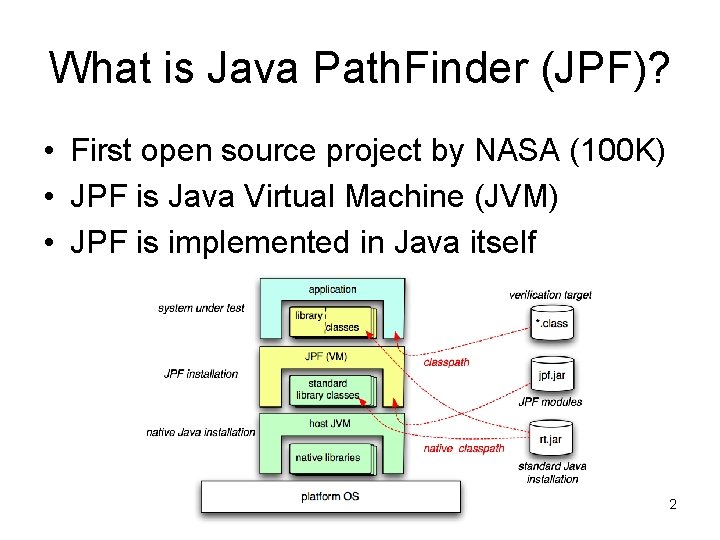
What is Java Path. Finder (JPF)? • First open source project by NASA (100 K) • JPF is Java Virtual Machine (JVM) • JPF is implemented in Java itself 2
Demo JPF as JVM • Obtain a copy – hg clone http: //babelfish. arc. nasa. gov/hg/jpf-core • Build – ant • Run – Hello. World. java – java Hello. World – bin/jpf Hello. World 3
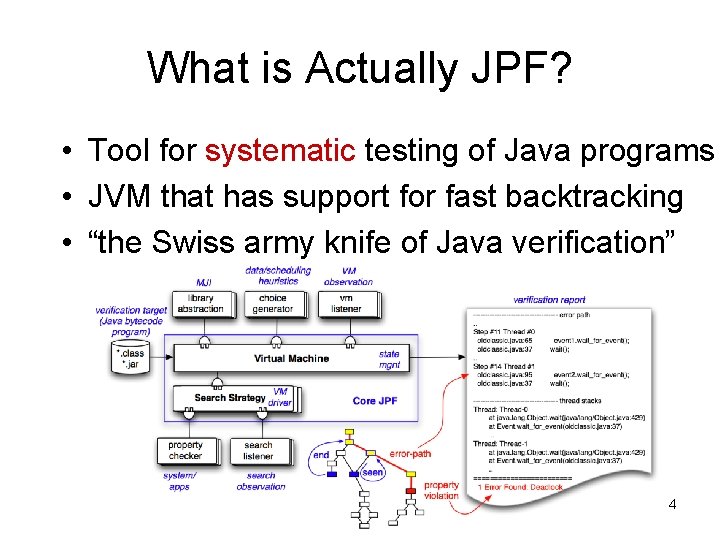
What is Actually JPF? • Tool for systematic testing of Java programs • JVM that has support for fast backtracking • “the Swiss army knife of Java verification” 4
Non-determinism • Explicit non-determinism with Verify. get. Int • JPF can be used to find concurrency bugs • Thread interleavings are another form of non-determinism 5
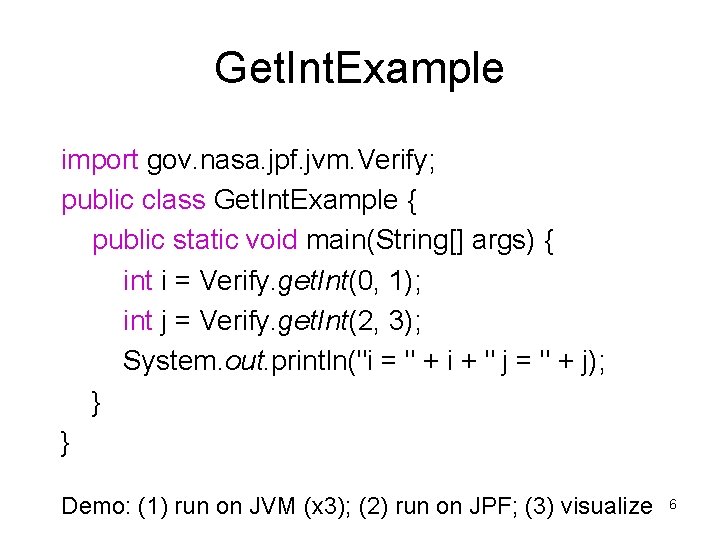
Get. Int. Example import gov. nasa. jpf. jvm. Verify; public class Get. Int. Example { public static void main(String[] args) { int i = Verify. get. Int(0, 1); int j = Verify. get. Int(2, 3); System. out. println("i = " + i + " j = " + j); } } Demo: (1) run on JVM (x 3); (2) run on JPF; (3) visualize 6
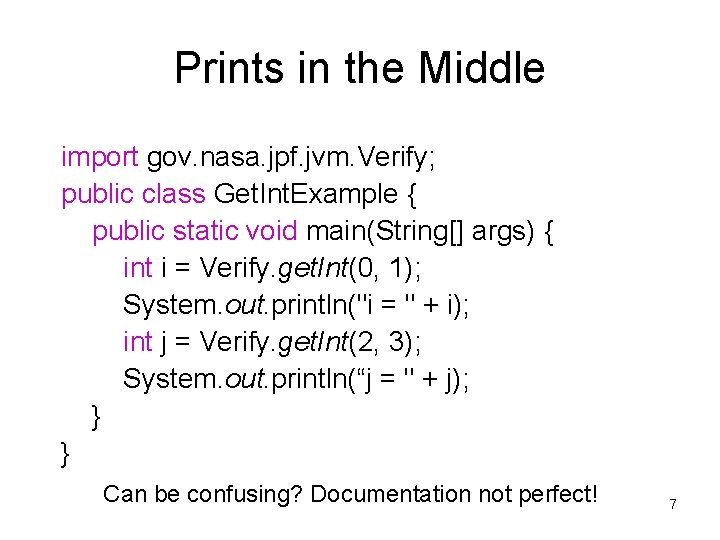
Prints in the Middle import gov. nasa. jpf. jvm. Verify; public class Get. Int. Example { public static void main(String[] args) { int i = Verify. get. Int(0, 1); System. out. println("i = " + i); int j = Verify. get. Int(2, 3); System. out. println(“j = " + j); } } Can be confusing? Documentation not perfect! 7
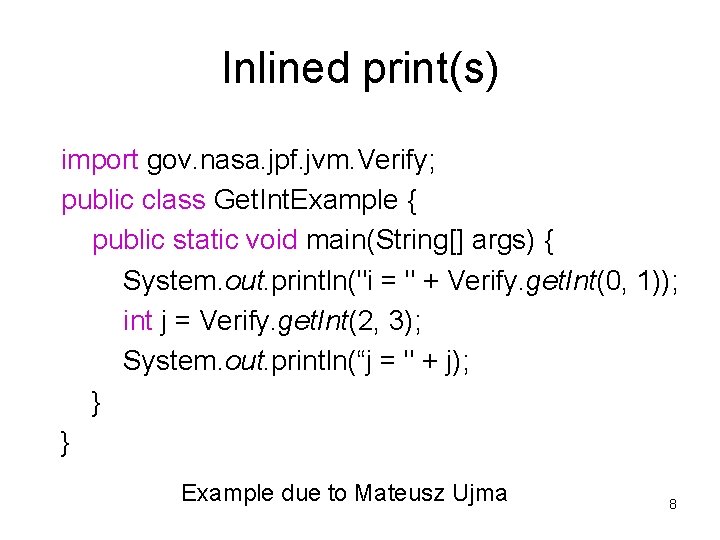
Inlined print(s) import gov. nasa. jpf. jvm. Verify; public class Get. Int. Example { public static void main(String[] args) { System. out. println("i = " + Verify. get. Int(0, 1)); int j = Verify. get. Int(2, 3); System. out. println(“j = " + j); } } Example due to Mateusz Ujma 8
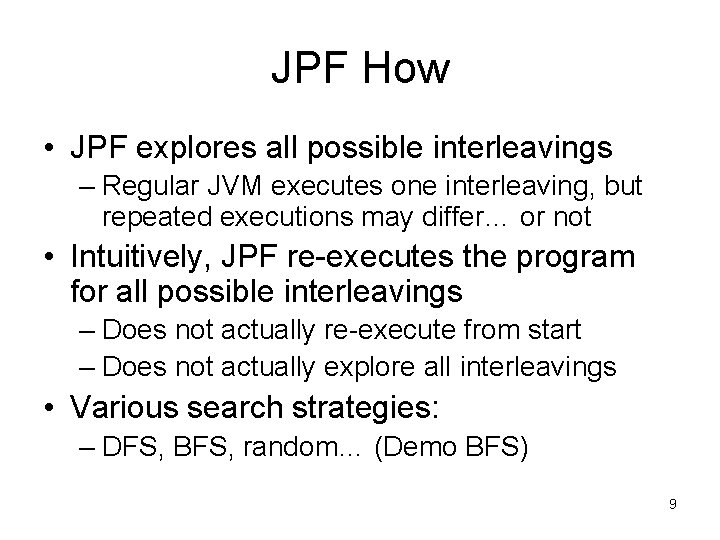
JPF How • JPF explores all possible interleavings – Regular JVM executes one interleaving, but repeated executions may differ… or not • Intuitively, JPF re-executes the program for all possible interleavings – Does not actually re-execute from start – Does not actually explore all interleavings • Various search strategies: – DFS, BFS, random… (Demo BFS) 9
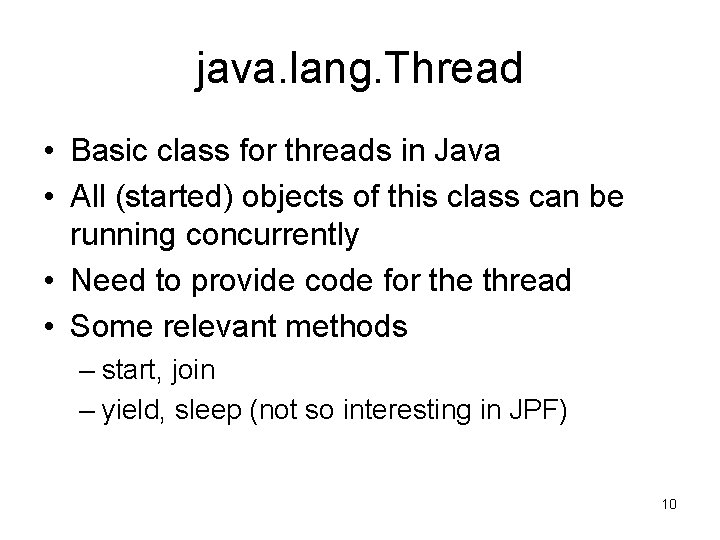
java. lang. Thread • Basic class for threads in Java • All (started) objects of this class can be running concurrently • Need to provide code for the thread • Some relevant methods – start, join – yield, sleep (not so interesting in JPF) 10
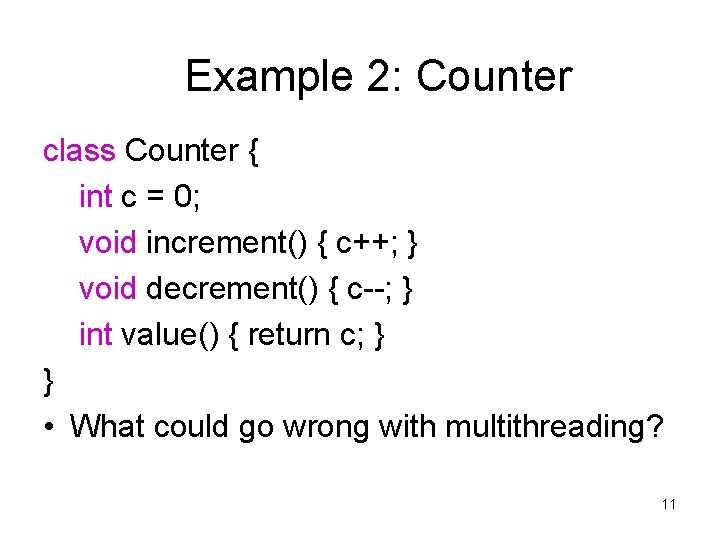
Example 2: Counter class Counter { int c = 0; void increment() { c++; } void decrement() { c--; } int value() { return c; } } • What could go wrong with multithreading? 11
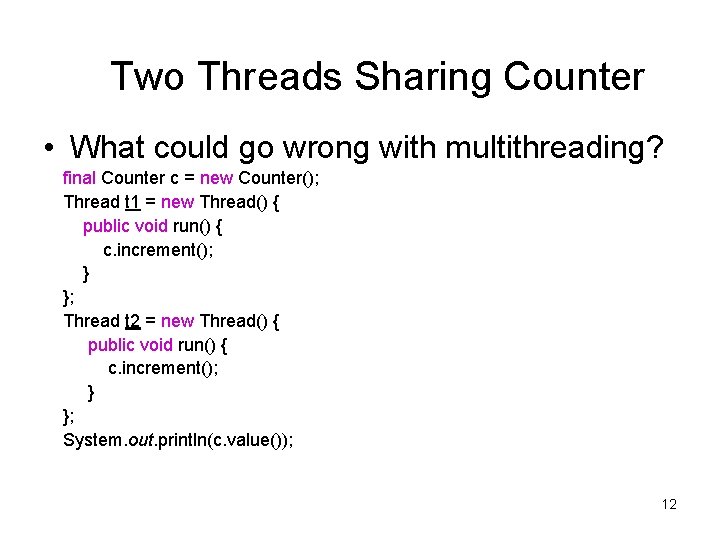
Two Threads Sharing Counter • What could go wrong with multithreading? final Counter c = new Counter(); Thread t 1 = new Thread() { public void run() { c. increment(); } }; Thread t 2 = new Thread() { public void run() { c. increment(); } }; System. out. println(c. value()); 12
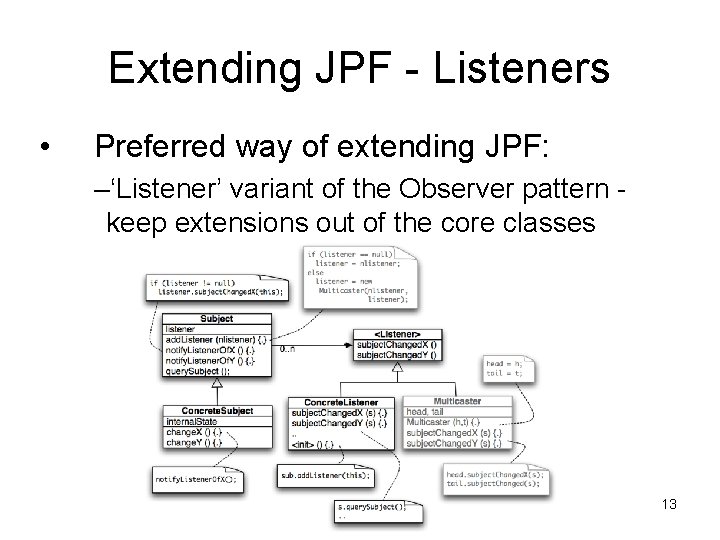
Extending JPF - Listeners • Preferred way of extending JPF: –‘Listener’ variant of the Observer pattern keep extensions out of the core classes 13
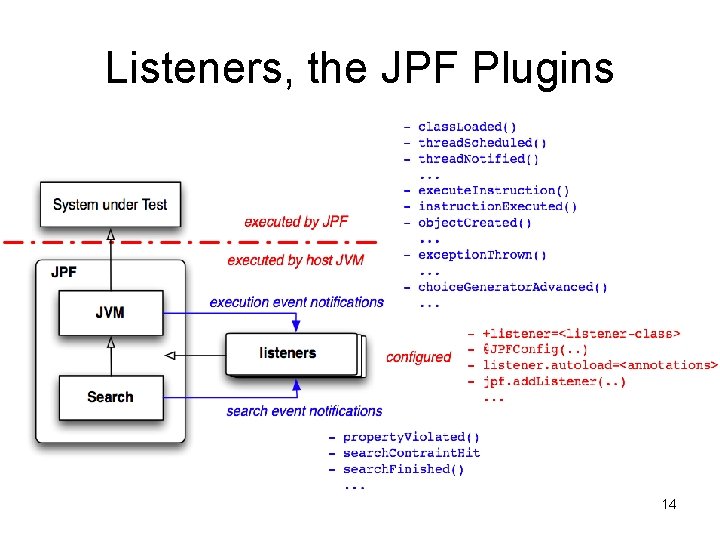
Listeners, the JPF Plugins 14
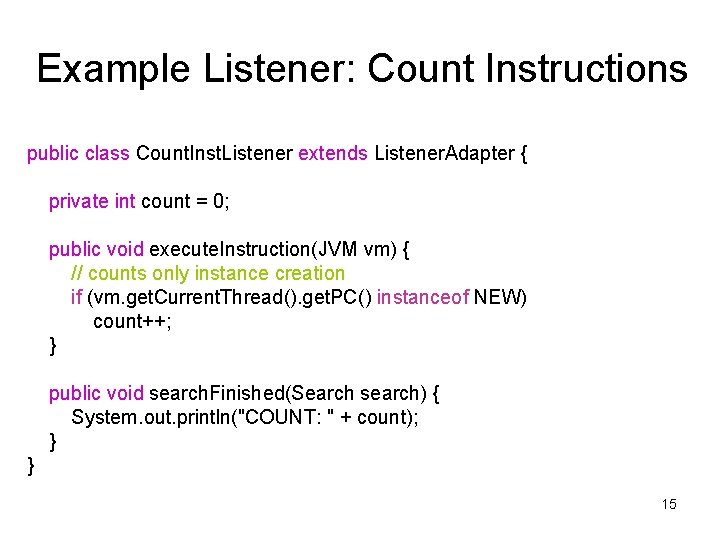
Example Listener: Count Instructions public class Count. Inst. Listener extends Listener. Adapter { private int count = 0; public void execute. Instruction(JVM vm) { // counts only instance creation if (vm. get. Current. Thread(). get. PC() instanceof NEW) count++; } public void search. Finished(Search search) { System. out. println("COUNT: " + count); } } 15
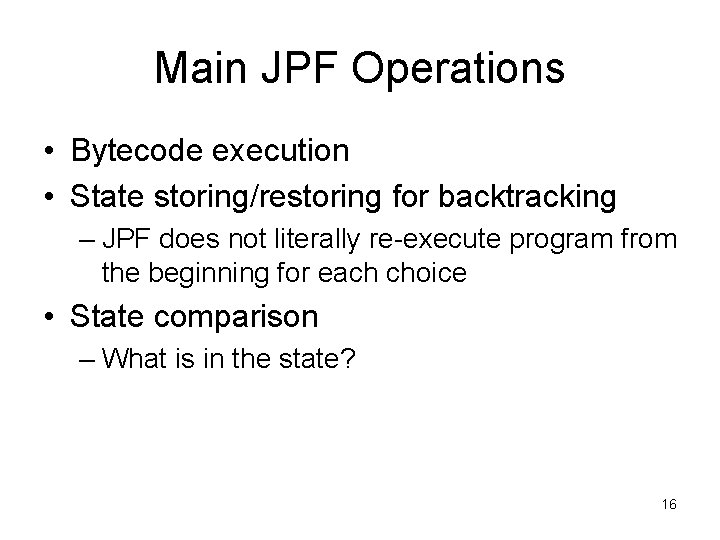
Main JPF Operations • Bytecode execution • State storing/restoring for backtracking – JPF does not literally re-execute program from the beginning for each choice • State comparison – What is in the state? 16
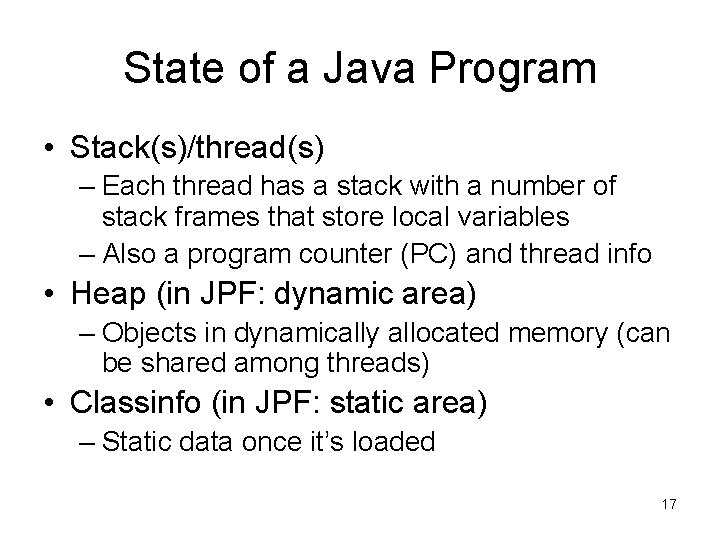
State of a Java Program • Stack(s)/thread(s) – Each thread has a stack with a number of stack frames that store local variables – Also a program counter (PC) and thread info • Heap (in JPF: dynamic area) – Objects in dynamically allocated memory (can be shared among threads) • Classinfo (in JPF: static area) – Static data once it’s loaded 17
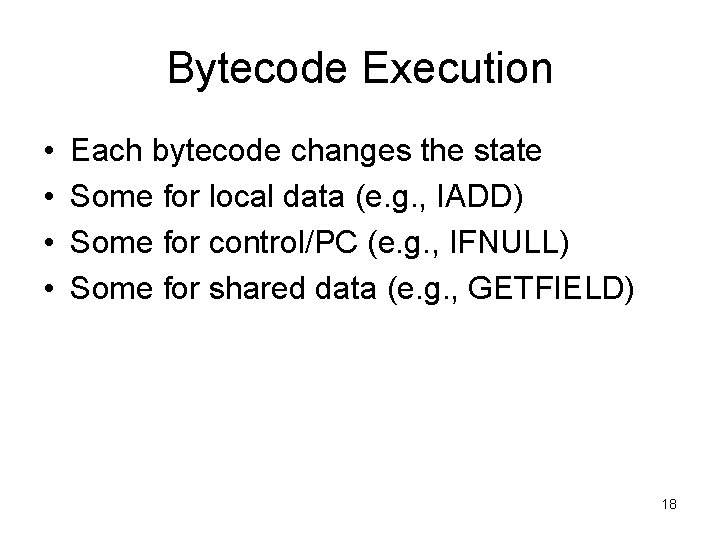
Bytecode Execution • • Each bytecode changes the state Some for local data (e. g. , IADD) Some for control/PC (e. g. , IFNULL) Some for shared data (e. g. , GETFIELD) 18
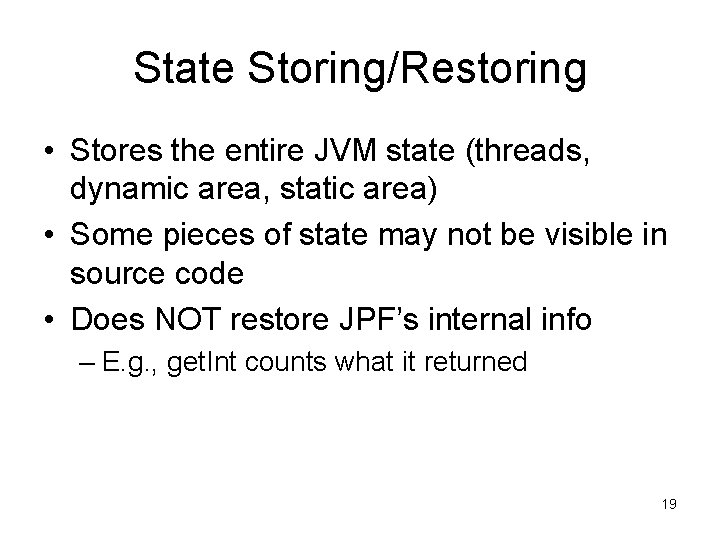
State Storing/Restoring • Stores the entire JVM state (threads, dynamic area, static area) • Some pieces of state may not be visible in source code • Does NOT restore JPF’s internal info – E. g. , get. Int counts what it returned 19
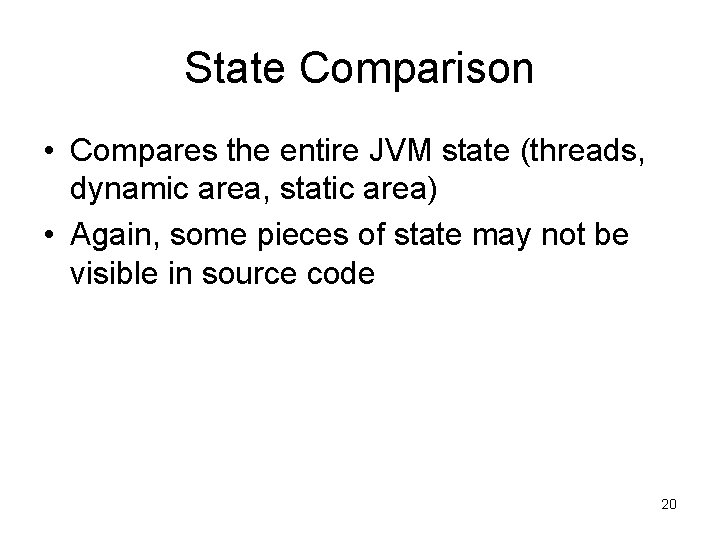
State Comparison • Compares the entire JVM state (threads, dynamic area, static area) • Again, some pieces of state may not be visible in source code 20
JPF Search • • Start program from the beginning Execute bytecodes to get to a new state Compare if that state was already seen If not, explore successors from the state • Various search strategies: – DFS, BFS, random… 21
Reminder: Project • Testing a part of JPF • Deliverables – Proposal (due in three weeks) – Progress report (around midterm) – Final report (by the grade submission deadline) – Bug reports (hopefully you’ll find some bugs) • Extra bonus points for reporting bugs to us 22
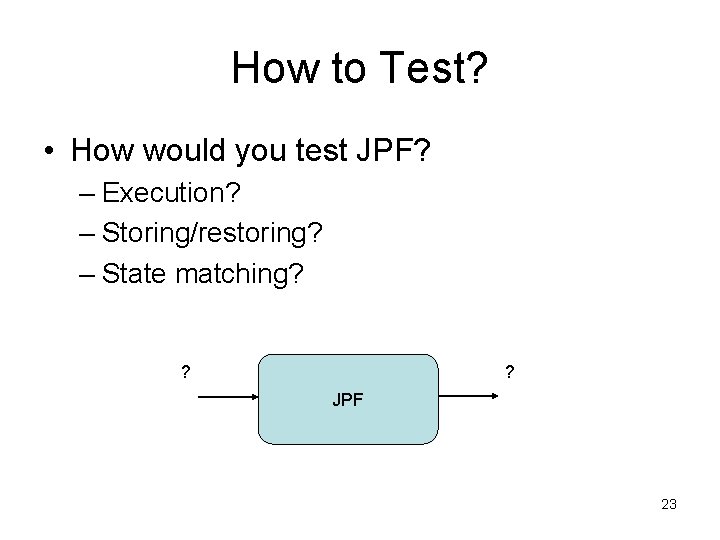
How to Test? • How would you test JPF? – Execution? – Storing/restoring? – State matching? ? ? JPF 23
Contributions from Darko's Students • http: //mir. cs. illinois. edu/jpf/ • http: //babelfish. arc. nasa. gov/trac/jpf/wiki/projects/jpf-actor • Personal experience – Have been working with JPF since 2007 – Dozen of bug reports – Numerous patches (enhancements and bug fixes) • http: //mir. cs. illinois. edu/~gliga/patches. html – – http: //babelfish. arc. nasa. gov/trac/jpf/wiki/projects/jpf-delayed X 10 X: Model checking X 10 programs with JPF Granted write access for jpf-core in 2010 Visited NASA Ames in December 2011 24
Conclusions • JPF is “the Swiss army knife of Java verification” • Complex system – Bytecode execution – State storing/restoring for backtracking – State comparison • Your project will focus on testing one of the main (sub)parts of JPF 25