
Java Methods ObjectOriented Programming and Data Structures 3
Java Methods Object-Oriented Programming and Data Structures 3 rd AP edition Maria Litvin ● Gary Litvin Chapter chapter 10 = new Chapter(10); Implementing and Using Classes Copyright © 2015 by Maria Litvin, Gary Litvin, and Skylight Publishing. All rights reserved. 1
Objectives: • Review public and private fields and methods • Learn the syntax for defining constructors and creating objects • Learn the syntax for defining and calling methods • Learn how parameters are passed to constructors and methods and how to return values from methods • Learn about static and instance fields and methods 2
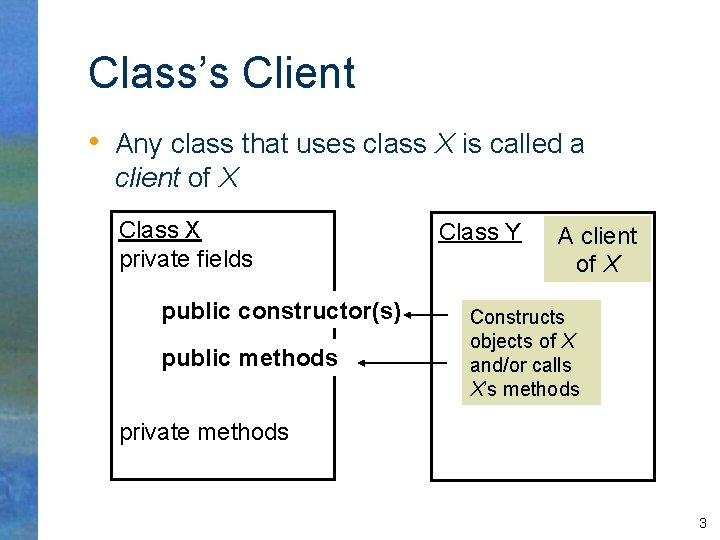
Class’s Client • Any class that uses class X is called a client of X Class X private fields public constructor(s) public methods Class Y A client of X Constructs objects of X and/or calls X’s methods private methods 3

Public vs. Private • Public constructors and methods of a class constitute its interface with classes that use it — its clients. • All fields are usually declared private — they are hidden from clients. • Static constants occasionally can be public. • “Helper” methods that are needed only inside the class are declared private. 4
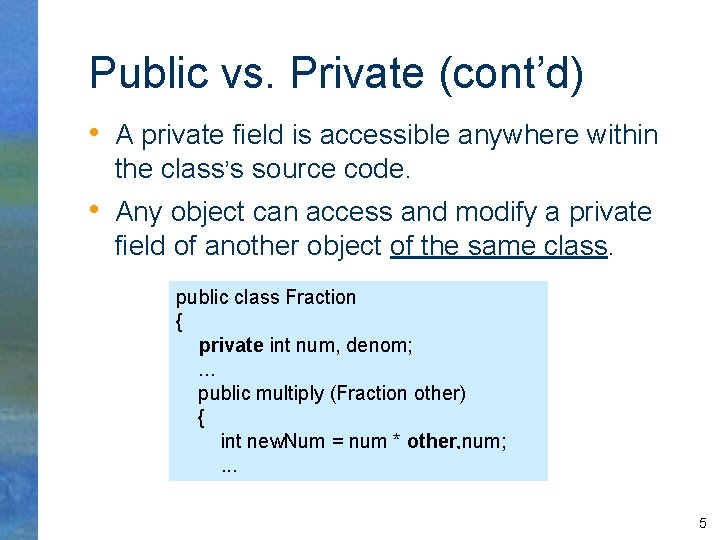
Public vs. Private (cont’d) • A private field is accessible anywhere within the class’s source code. • Any object can access and modify a private field of another object of the same class. public class Fraction { private int num, denom; . . . public multiply (Fraction other) { int new. Num = num * other. num; . . . 5
Accessors and Modifiers • A programmer often provides methods, called accessors, that return values of private fields; methods that set values of private fields are called modifiers or mutators. • Accessors’ names often start with get, and modifiers’ names often start with set. • These are not precise categories: the same method can modify several fields or modify a field and also return its old or new value. 6
Encapsulation • Hiding the implementation details of a class (making all fields and helper methods private) is called encapsulation. • Encapsulation helps in program maintenance: a change in one class does not affect other classes. • A client of a class interacts with the class only through well-documented public constructors and methods; this facilitates team development. 7
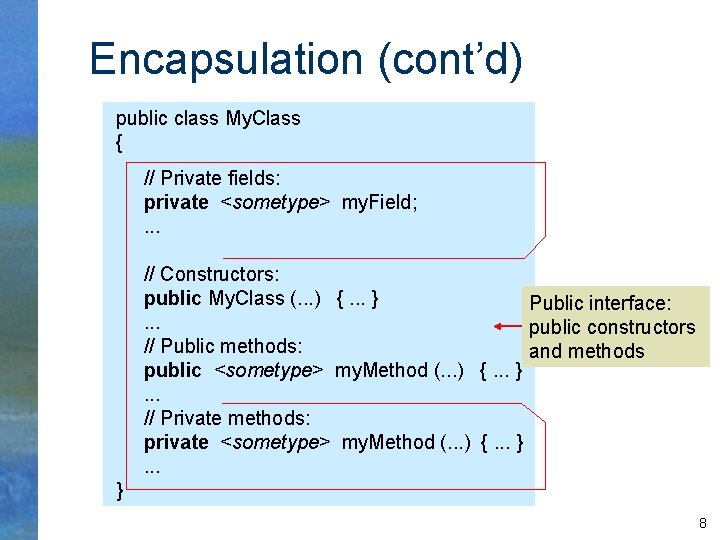
Encapsulation (cont’d) public class My. Class { // Private fields: private <sometype> my. Field; . . . // Constructors: public My. Class (. . . ) {. . . } Public interface: . . . public constructors // Public methods: and methods public <sometype> my. Method (. . . ) {. . . }. . . // Private methods: private <sometype> my. Method (. . . ) {. . . } 8
Constructors • A constructor is a procedure for creating objects of the class. • A constructor often initializes an object’s fields. • Constructors do not have a return type (not even void) and they do not return a value. • All constructors in a class have the same name — the name of the class. • Constructors may take parameters. 9
Constructors (cont’d) • If a class has more than one constructor, they must have different numbers and/or types of parameters. • Programmers often provide a “no-args” constructor that takes no parameters (a. k. a. arguments). • If a programmer does not define any constructors, Java provides one default no -args constructor, which allocates memory and sets fields to the default values. 10
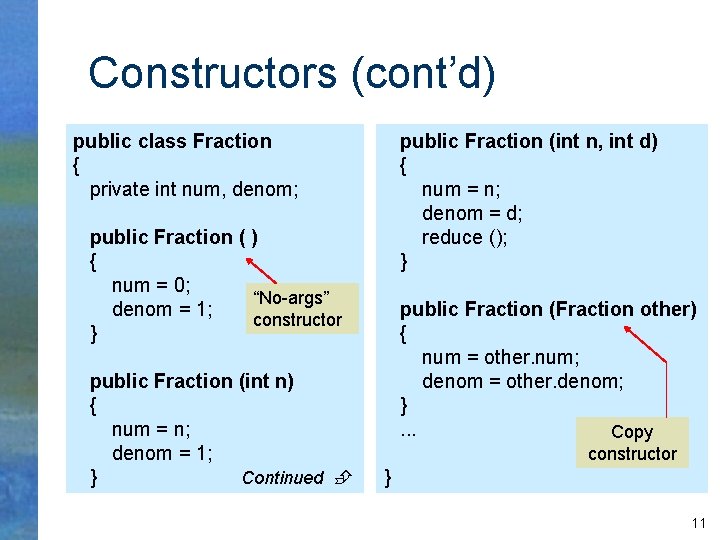
Constructors (cont’d) public class Fraction { private int num, denom; public Fraction (int n, int d) { num = n; denom = d; reduce (); } public Fraction ( ) { num = 0; “No-args” denom = 1; constructor } public Fraction (int n) { num = n; denom = 1; } Continued public Fraction (Fraction other) { num = other. num; denom = other. denom; }. . . Copy constructor } 11
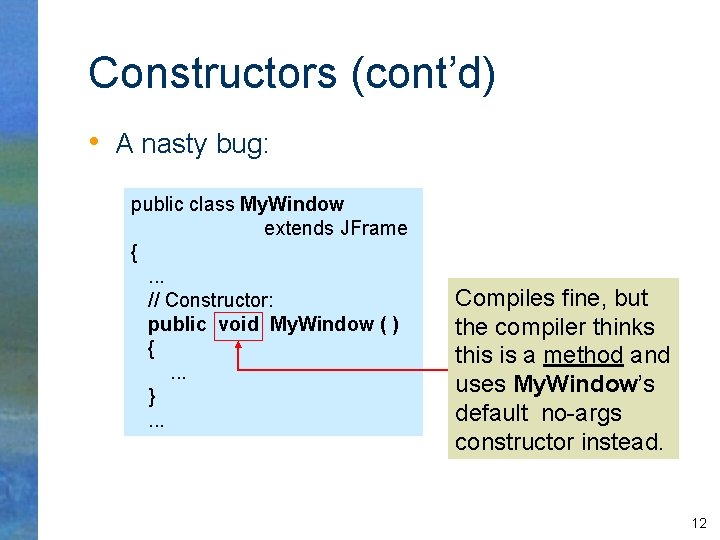
Constructors (cont’d) • A nasty bug: public class My. Window extends JFrame {. . . // Constructor: public void My. Window ( ) {. . . }. . . Compiles fine, but the compiler thinks this is a method and uses My. Window’s default no-args constructor instead. 12
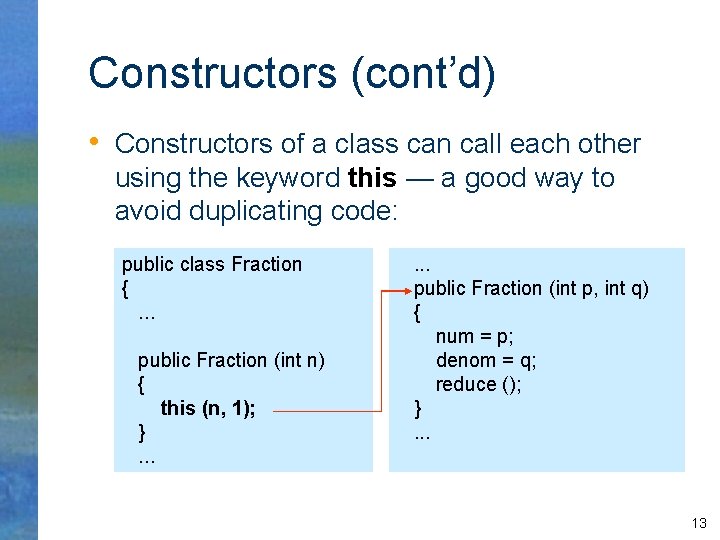
Constructors (cont’d) • Constructors of a class can call each other using the keyword this — a good way to avoid duplicating code: public class Fraction {. . . public Fraction (int n) { this (n, 1); }. . . public Fraction (int p, int q) { num = p; denom = q; reduce (); }. . . 13
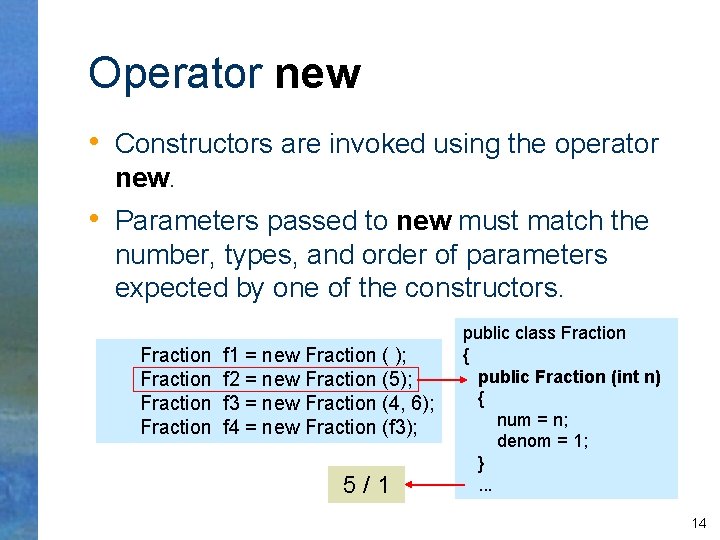
Operator new • Constructors are invoked using the operator new. • Parameters passed to new must match the number, types, and order of parameters expected by one of the constructors. Fraction f 1 = new Fraction ( ); f 2 = new Fraction (5); f 3 = new Fraction (4, 6); f 4 = new Fraction (f 3); 5/1 public class Fraction { public Fraction (int n) { num = n; denom = 1; }. . . 14
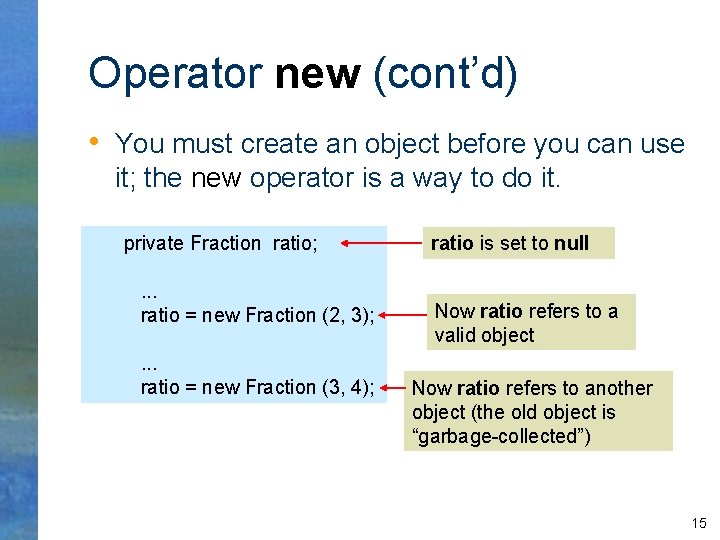
Operator new (cont’d) • You must create an object before you can use it; the new operator is a way to do it. private Fraction ratio; . . . ratio = new Fraction (2, 3); . . . ratio = new Fraction (3, 4); ratio is set to null Now ratio refers to a valid object Now ratio refers to another object (the old object is “garbage-collected”) 15
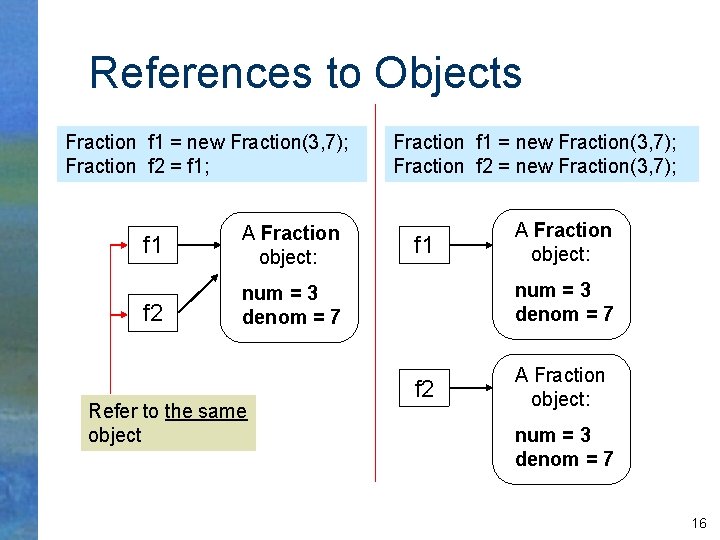
References to Objects Fraction f 1 = new Fraction(3, 7); Fraction f 2 = f 1; f 1 A Fraction object: f 2 num = 3 denom = 7 Refer to the same object Fraction f 1 = new Fraction(3, 7); Fraction f 2 = new Fraction(3, 7); f 1 A Fraction object: num = 3 denom = 7 f 2 A Fraction object: num = 3 denom = 7 16
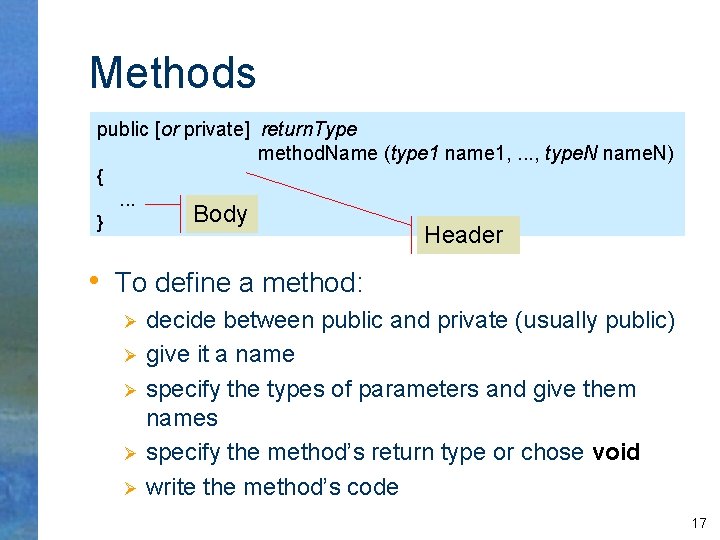
Methods public [or private] return. Type method. Name (type 1 name 1, . . . , type. N name. N) { . . . } Body Header • To define a method: Ø Ø Ø decide between public and private (usually public) give it a name specify the types of parameters and give them names specify the method’s return type or chose void write the method’s code 17
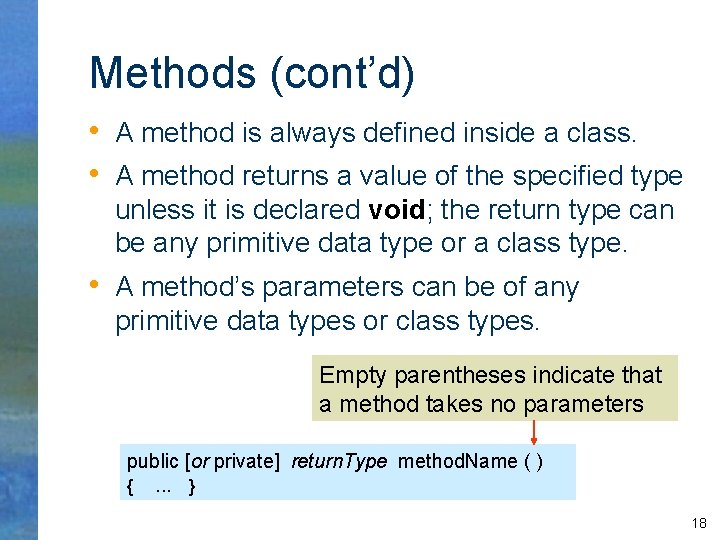
Methods (cont’d) • A method is always defined inside a class. • A method returns a value of the specified type unless it is declared void; the return type can be any primitive data type or a class type. • A method’s parameters can be of any primitive data types or class types. Empty parentheses indicate that a method takes no parameters public [or private] return. Type method. Name ( ) {. . . } 18
Methods: Java Style • A method name starts with a lowercase letter. • Method names often sound like verbs. • The name of a method that returns the value of a field often starts with get: get. Width, get. X • The name of a method that sets the value of a field often starts with set: set. Location, set. Text 19
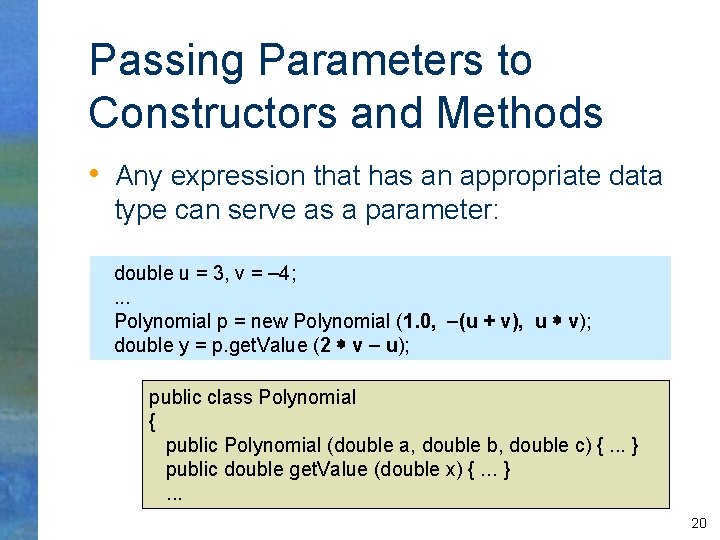
Passing Parameters to Constructors and Methods • Any expression that has an appropriate data type can serve as a parameter: double u = 3, v = -4; . . . Polynomial p = new Polynomial (1. 0, -(u + v), u * v); double y = p. get. Value (2 * v - u); public class Polynomial { public Polynomial (double a, double b, double c) {. . . } public double get. Value (double x) {. . . }. . . 20
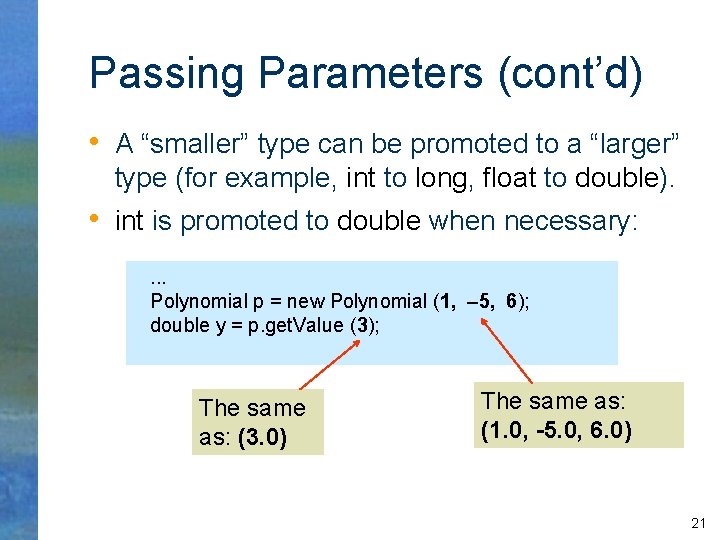
Passing Parameters (cont’d) • A “smaller” type can be promoted to a “larger” type (for example, int to long, float to double). • int is promoted to double when necessary: . . . Polynomial p = new Polynomial (1, -5, 6); double y = p. get. Value (3); The same as: (3. 0) The same as: (1. 0, -5. 0, 6. 0) 21
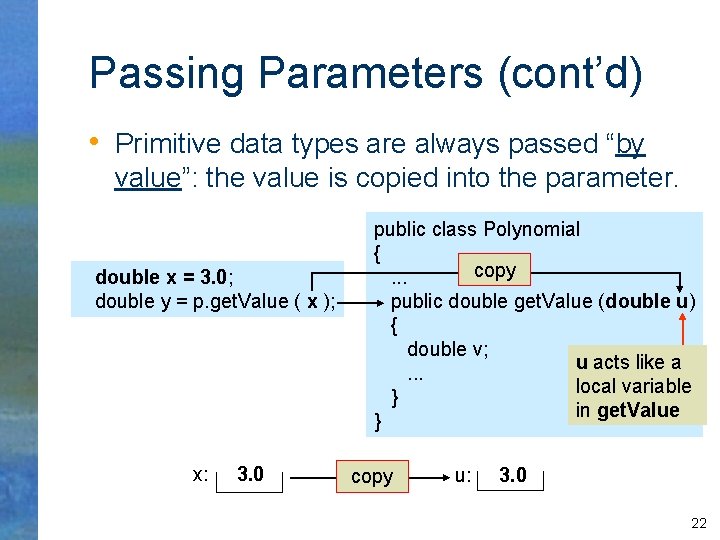
Passing Parameters (cont’d) • Primitive data types are always passed “by value”: the value is copied into the parameter. double x = 3. 0; double y = p. get. Value ( x ); x: 3. 0 public class Polynomial { copy. . . public double get. Value (double u) { double v; u acts like a. . . local variable } in get. Value } copy u: 3. 0 22
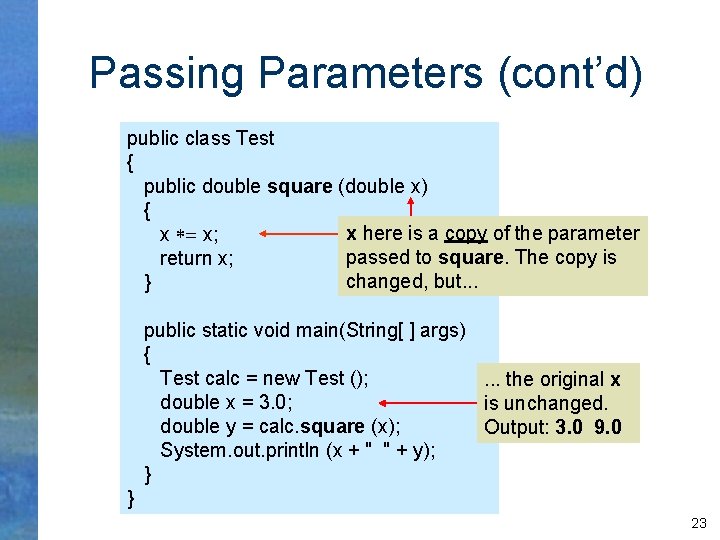
Passing Parameters (cont’d) public class Test { public double square (double x) { x here is a copy of the parameter x *= x; passed to square. The copy is return x; changed, but. . . } public static void main(String[ ] args) { Test calc = new Test (); . . . the original x double x = 3. 0; is unchanged. double y = calc. square (x); Output: 3. 0 9. 0 System. out. println (x + " " + y); } } 23
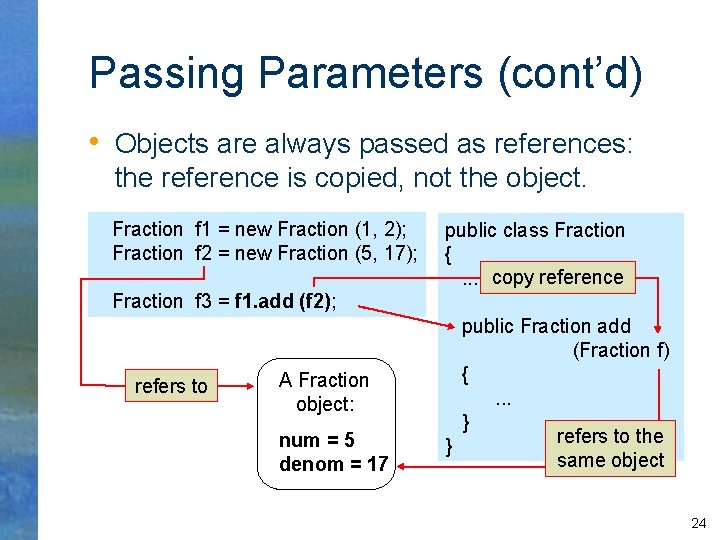
Passing Parameters (cont’d) • Objects are always passed as references: the reference is copied, not the object. Fraction f 1 = new Fraction (1, 2); Fraction f 2 = new Fraction (5, 17); public class Fraction {. . . copy reference Fraction f 3 = f 1. add (f 2); refers to A Fraction object: num = 5 denom = 17 public Fraction add (Fraction f) {. . . } refers to the } same object 24
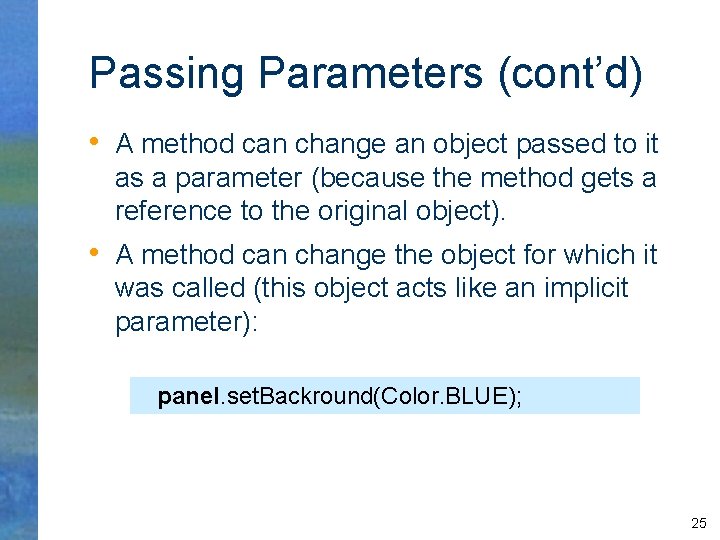
Passing Parameters (cont’d) • A method can change an object passed to it as a parameter (because the method gets a reference to the original object). • A method can change the object for which it was called (this object acts like an implicit parameter): panel. set. Backround(Color. BLUE); 25
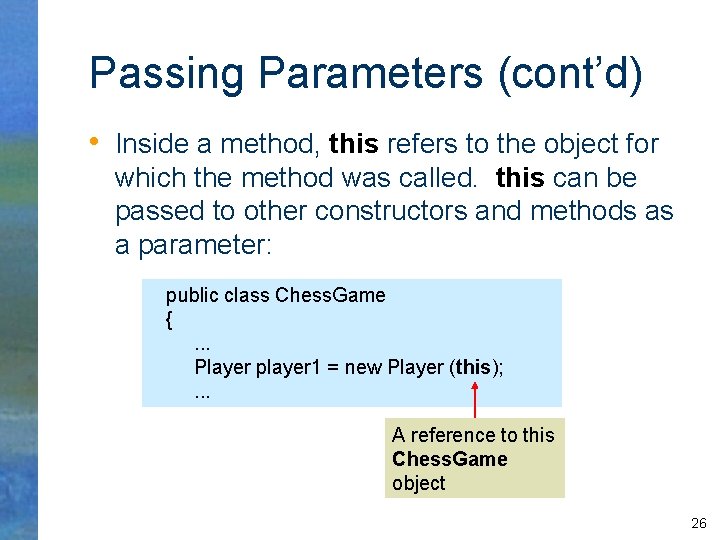
Passing Parameters (cont’d) • Inside a method, this refers to the object for which the method was called. this can be passed to other constructors and methods as a parameter: public class Chess. Game {. . . Player player 1 = new Player (this); . . . A reference to this Chess. Game object 26
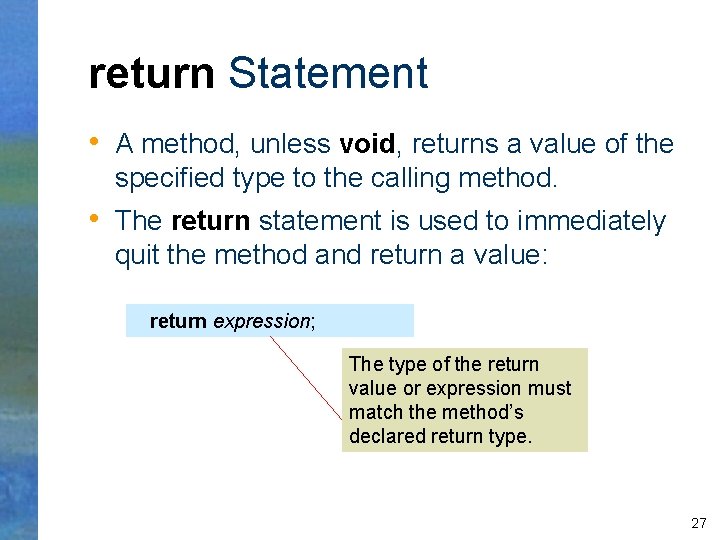
return Statement • A method, unless void, returns a value of the specified type to the calling method. • The return statement is used to immediately quit the method and return a value: return expression; The type of the return value or expression must match the method’s declared return type. 27
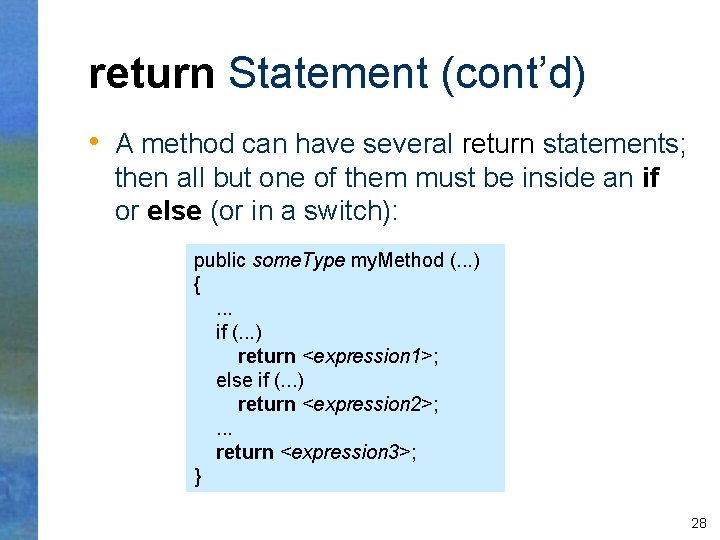
return Statement (cont’d) • A method can have several return statements; then all but one of them must be inside an if or else (or in a switch): public some. Type my. Method (. . . ) {. . . if (. . . ) return <expression 1>; else if (. . . ) return <expression 2>; . . . return <expression 3>; } 28
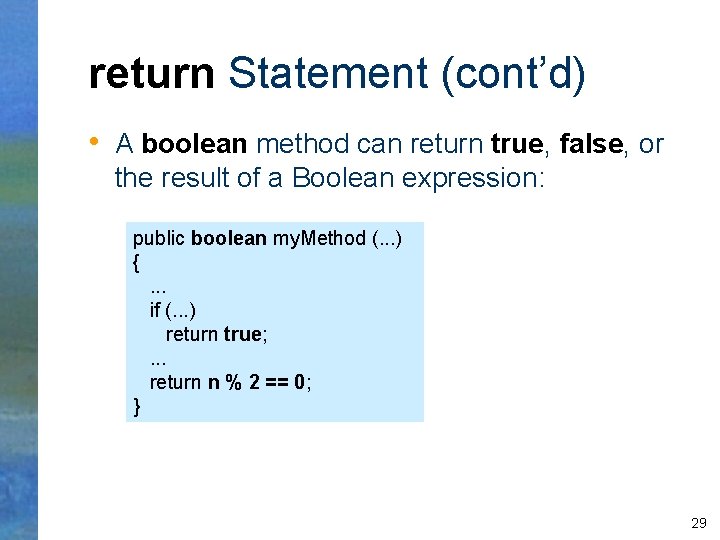
return Statement (cont’d) • A boolean method can return true, false, or the result of a Boolean expression: public boolean my. Method (. . . ) {. . . if (. . . ) return true; . . . return n % 2 == 0; } 29
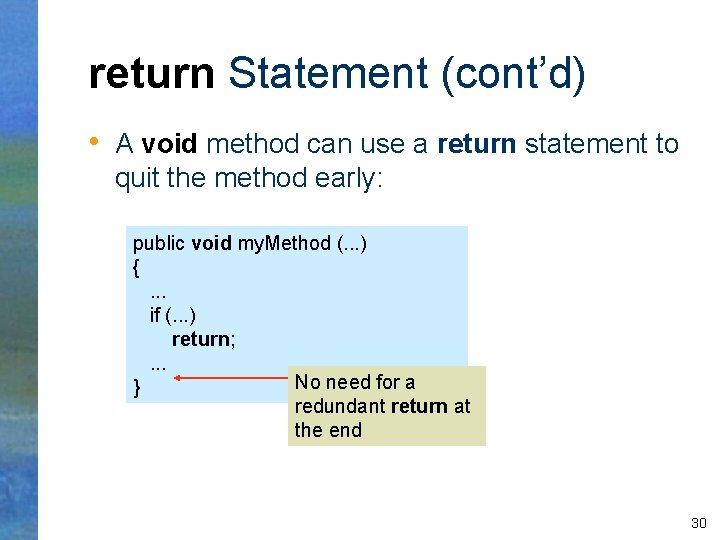
return Statement (cont’d) • A void method can use a return statement to quit the method early: public void my. Method (. . . ) {. . . if (. . . ) return; . . . No need for a } redundant return at the end 30
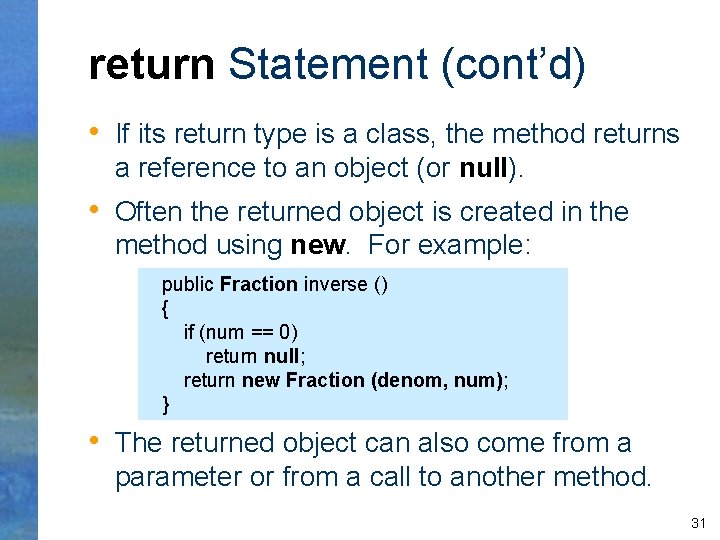
return Statement (cont’d) • If its return type is a class, the method returns a reference to an object (or null). • Often the returned object is created in the method using new. For example: public Fraction inverse () { if (num == 0) return null; return new Fraction (denom, num); } • The returned object can also come from a parameter or from a call to another method. 31
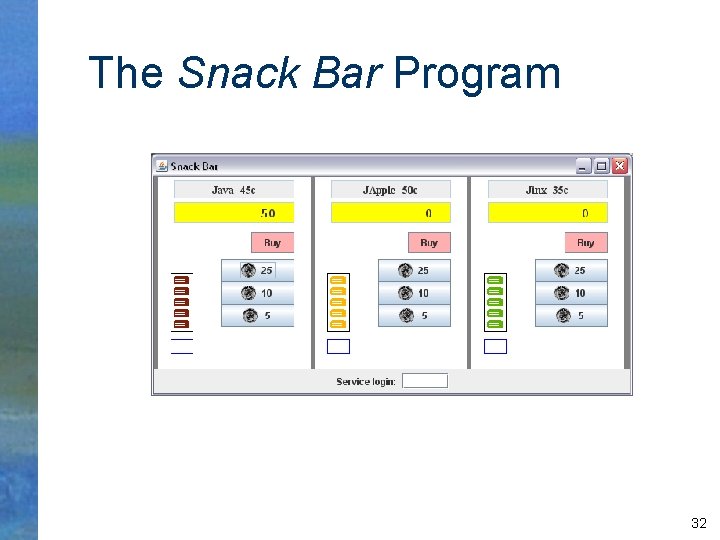
The Snack Bar Program 32
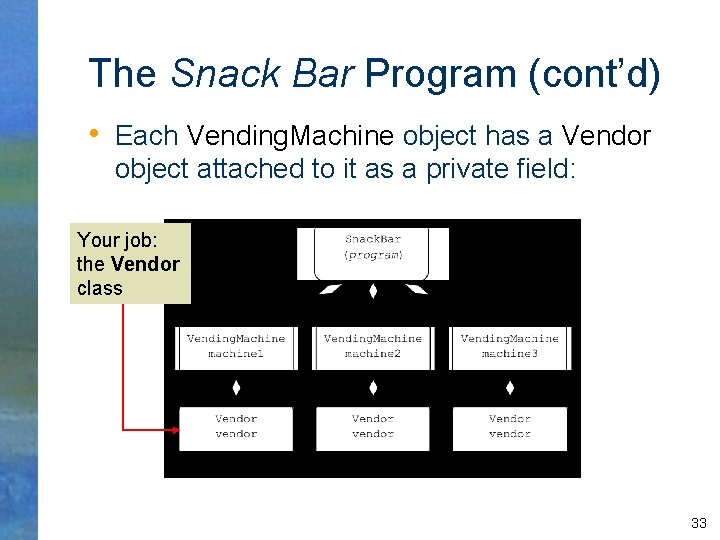
The Snack Bar Program (cont’d) • Each Vending. Machine object has a Vendor object attached to it as a private field: Your job: the Vendor class 33
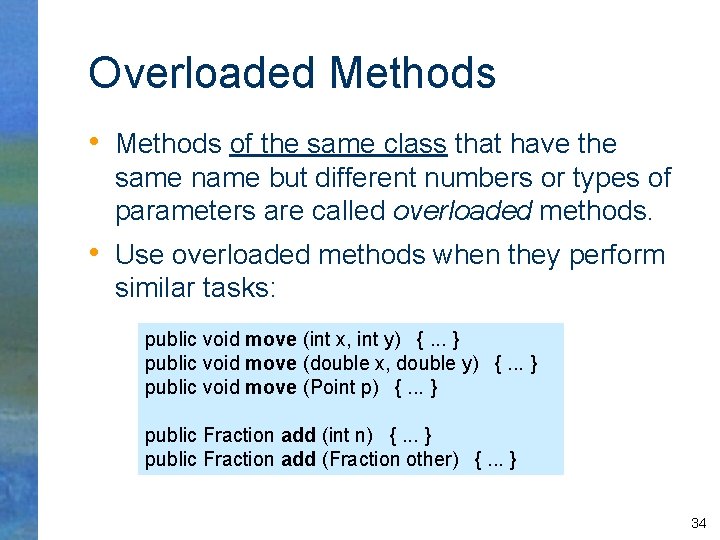
Overloaded Methods • Methods of the same class that have the same name but different numbers or types of parameters are called overloaded methods. • Use overloaded methods when they perform similar tasks: public void move (int x, int y) {. . . } public void move (double x, double y) {. . . } public void move (Point p) {. . . } public Fraction add (int n) {. . . } public Fraction add (Fraction other) {. . . } 34
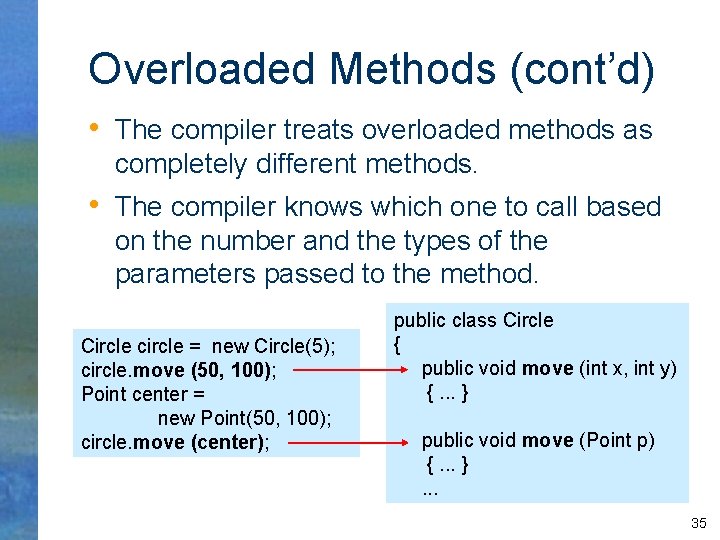
Overloaded Methods (cont’d) • The compiler treats overloaded methods as completely different methods. • The compiler knows which one to call based on the number and the types of the parameters passed to the method. Circle circle = new Circle(5); circle. move (50, 100); Point center = new Point(50, 100); circle. move (center); public class Circle { public void move (int x, int y) {. . . } public void move (Point p) {. . . }. . . 35
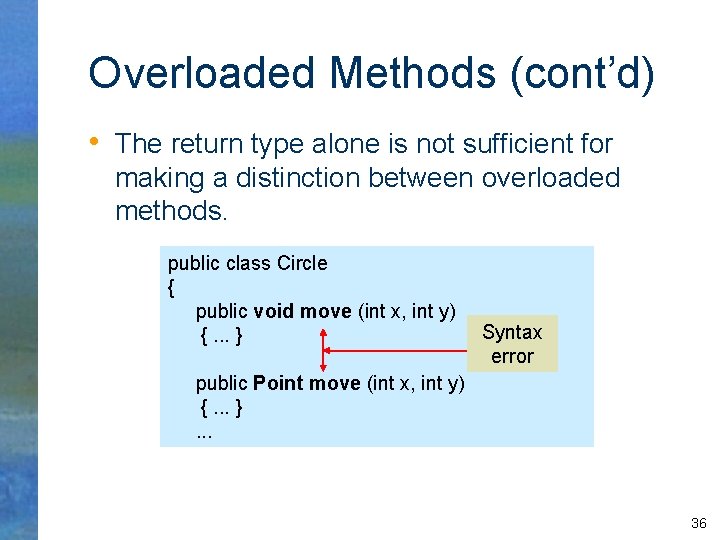
Overloaded Methods (cont’d) • The return type alone is not sufficient for making a distinction between overloaded methods. public class Circle { public void move (int x, int y) {. . . } Syntax error public Point move (int x, int y) {. . . }. . . 36
Static Fields • A static field (a. k. a. class field or class variable) is shared by all objects of the class. • A non-static field (a. k. a. instance field or instance variable) belongs to an individual object. 37
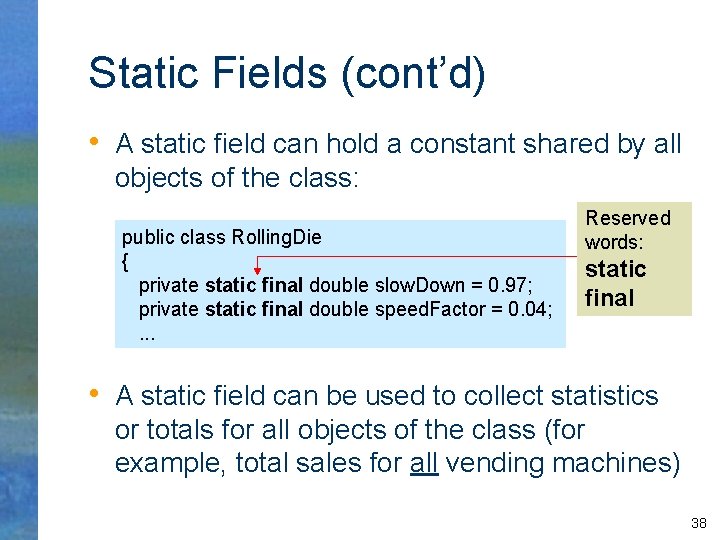
Static Fields (cont’d) • A static field can hold a constant shared by all objects of the class: public class Rolling. Die { private static final double slow. Down = 0. 97; private static final double speed. Factor = 0. 04; . . . Reserved words: static final • A static field can be used to collect statistics or totals for all objects of the class (for example, total sales for all vending machines) 38
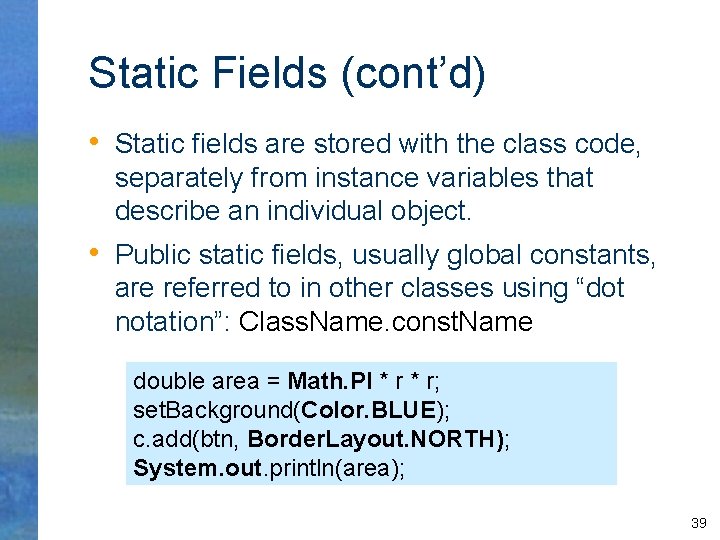
Static Fields (cont’d) • Static fields are stored with the class code, separately from instance variables that describe an individual object. • Public static fields, usually global constants, are referred to in other classes using “dot notation”: Class. Name. const. Name double area = Math. PI * r; set. Background(Color. BLUE); c. add(btn, Border. Layout. NORTH); System. out. println(area); 39
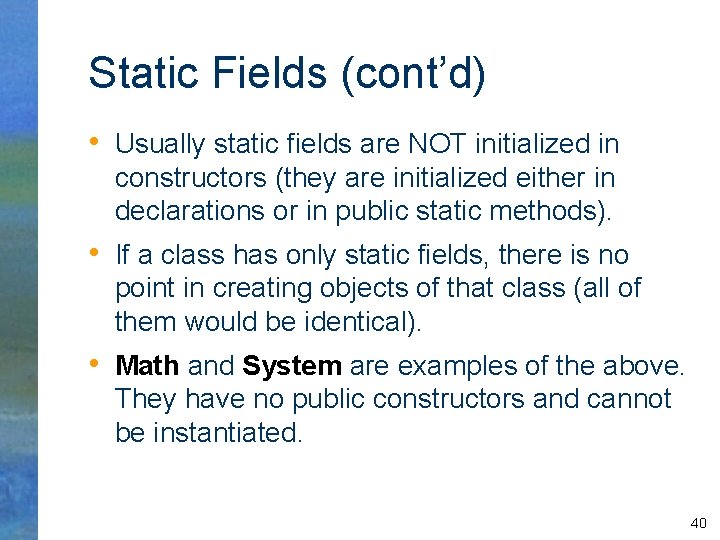
Static Fields (cont’d) • Usually static fields are NOT initialized in constructors (they are initialized either in declarations or in public static methods). • If a class has only static fields, there is no point in creating objects of that class (all of them would be identical). • Math and System are examples of the above. They have no public constructors and cannot be instantiated. 40
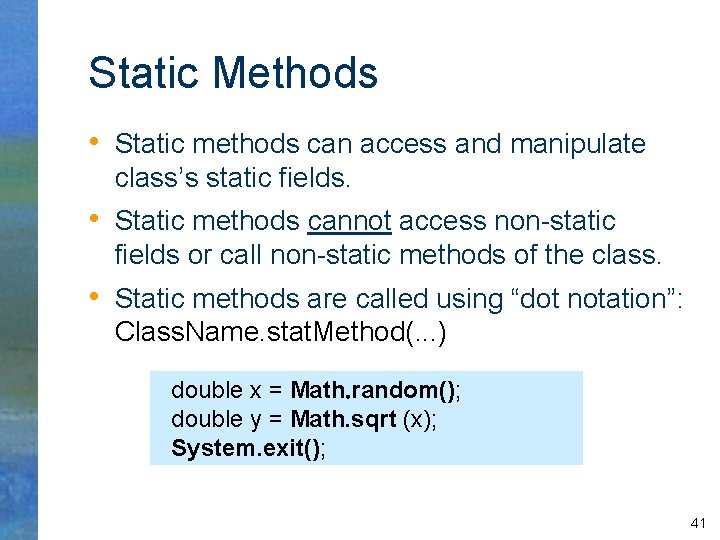
Static Methods • Static methods can access and manipulate class’s static fields. • Static methods cannot access non-static fields or call non-static methods of the class. • Static methods are called using “dot notation”: Class. Name. stat. Method(. . . ) double x = Math. random(); double y = Math. sqrt (x); System. exit(); 41
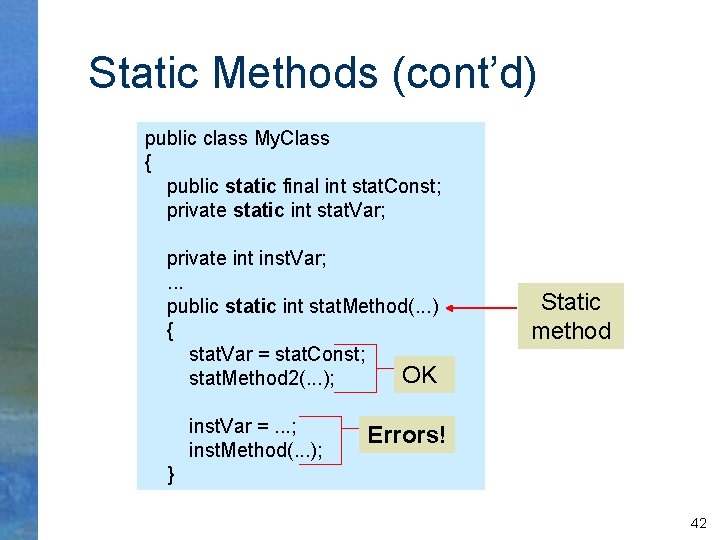
Static Methods (cont’d) public class My. Class { public static final int stat. Const; private static int stat. Var; private int inst. Var; . . . public static int stat. Method(. . . ) { stat. Var = stat. Const; OK stat. Method 2(. . . ); inst. Var =. . . ; inst. Method(. . . ); Static method Errors! } 42
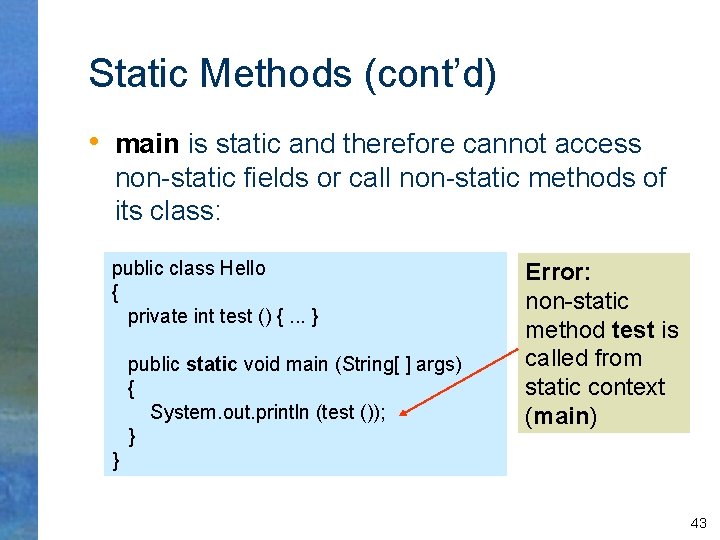
Static Methods (cont’d) • main is static and therefore cannot access non-static fields or call non-static methods of its class: public class Hello { private int test () {. . . } public static void main (String[ ] args) { System. out. println (test ()); } Error: non-static method test is called from static context (main) } 43
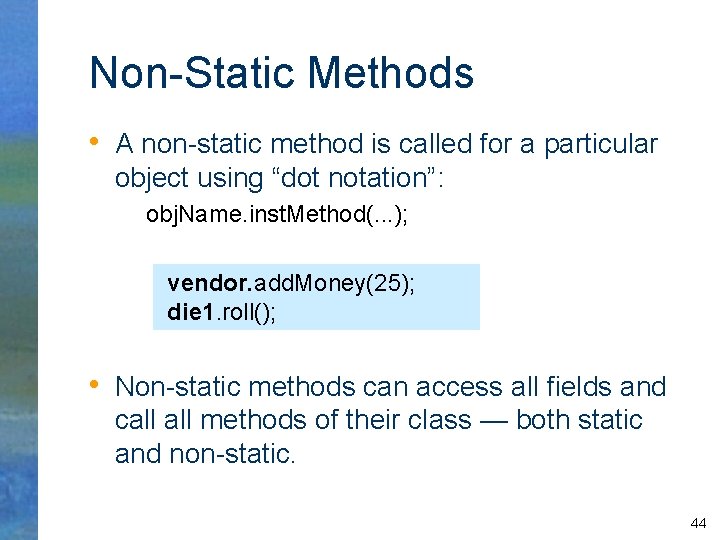
Non-Static Methods • A non-static method is called for a particular object using “dot notation”: obj. Name. inst. Method(. . . ); vendor. add. Money(25); die 1. roll(); • Non-static methods can access all fields and call methods of their class — both static and non-static. 44
Review: • Are you allowed to define a class with no constructors? • Can a class have two different no-args constructors? • What is a good style for naming constructors? • What is the common Java style for method names? 45
Review (cont’d): • Are parameters of primitive data types passed to methods “by value” or “by reference”? • Can a method have more than one return statement? • Can a method have no return statements? • Can a method create a new object and return it to the calling method? 46
Review (cont’d): • When is it appropriate to define overloaded methods? • Describe the difference between static and instance variables. • What is the syntax for referring to a public static field outside the class? 47
Review (cont’d): • Can non-static methods access static fields? • Can static methods access instance variables? • Can static methods have local variables? 48
- Slides: 48