
Java ecommerce technologies for distributed enterprise computing Martin

Java e-commerce: technologies for distributed enterprise computing Martin Cooke Java E-Commerce © Martin Cooke, 2004
Today’s lecture • What the course does & doesn’t cover • How money is made on the net: business models • Course timetable, assignment and resources 9/18/2020 Java E-Commerce © Martin Cooke, 2004 2
What’s in the course … and what isn’t Java E-Commerce © Martin Cooke, 2004
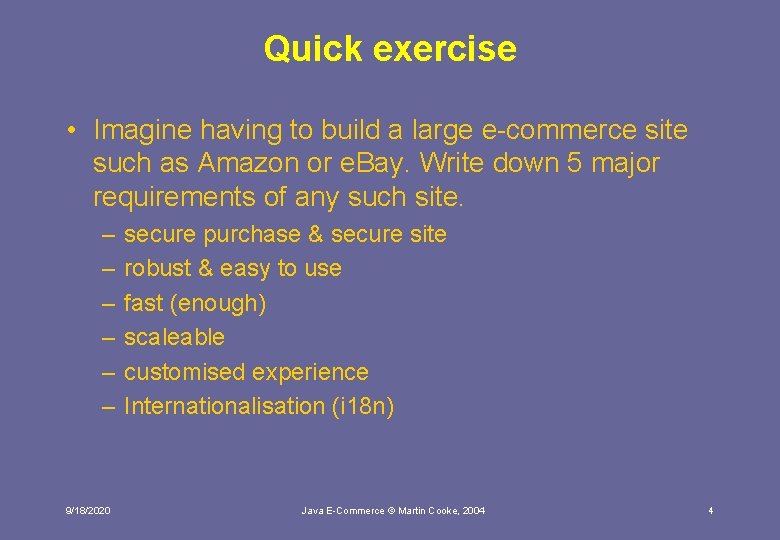
Quick exercise • Imagine having to build a large e-commerce site such as Amazon or e. Bay. Write down 5 major requirements of any such site. – – – 9/18/2020 secure purchase & secure site robust & easy to use fast (enough) scaleable customised experience Internationalisation (i 18 n) Java E-Commerce © Martin Cooke, 2004 4
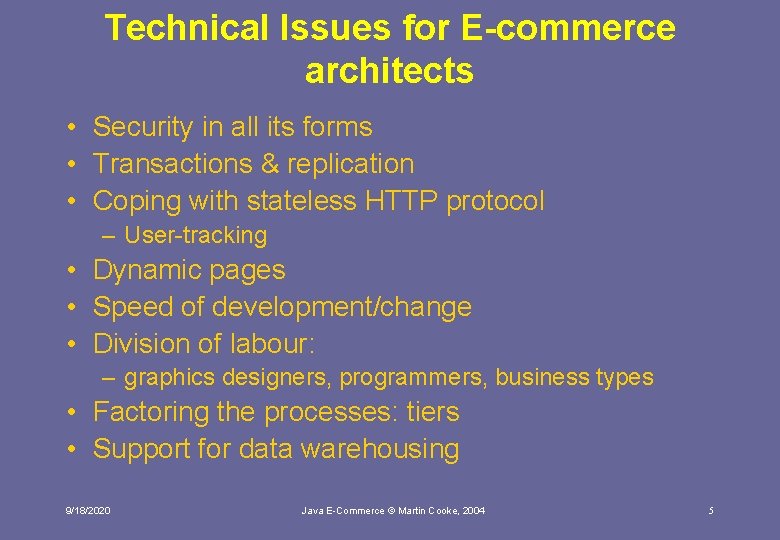
Technical Issues for E-commerce architects • Security in all its forms • Transactions & replication • Coping with stateless HTTP protocol – User-tracking • Dynamic pages • Speed of development/change • Division of labour: – graphics designers, programmers, business types • Factoring the processes: tiers • Support for data warehousing 9/18/2020 Java E-Commerce © Martin Cooke, 2004 5
A question Q What distinguishes an e-commerce system from any other large system deployed on the web? A Not much. Such sites must be secure, robust, scaleable, etc… 9/18/2020 Java E-Commerce © Martin Cooke, 2004 6
Enterprise computing • Most of the aforementioned concerns apply to the architecture of any enterprise level solution • Enterprise systems include those for e-commerce, but also denote – Internal, web-enabled, systems – Systems with no element of “commerce” as it is usually understood • This course discusses technology which applies to enterprise-level systems, not simply those involving e-commerce 9/18/2020 Java E-Commerce © Martin Cooke, 2004 7
What isn’t here • • • Design Multimedia delivery Hosting Mobile internet Management Ethics – Is it a good thing that Hotmail has access to the personal messages of over 100 million inhabitants of the globe? (Iron law of capitalism: if it is technically possible and will generate a profit, it almost certainly will happen) 9/18/2020 Java E-Commerce © Martin Cooke, 2004 8
How money is being made on the net In principle… Java E-Commerce © Martin Cooke, 2004
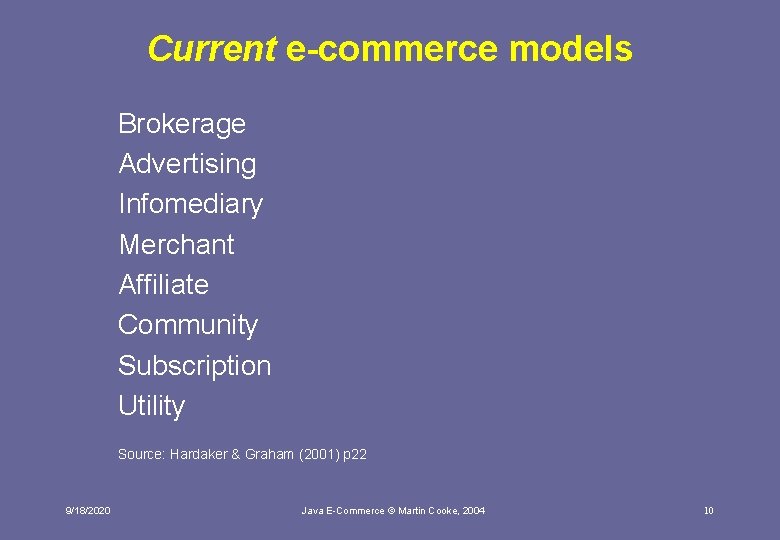
Current e-commerce models Brokerage Advertising Infomediary Merchant Affiliate Community Subscription Utility Source: Hardaker & Graham (2001) p 22 9/18/2020 Java E-Commerce © Martin Cooke, 2004 10
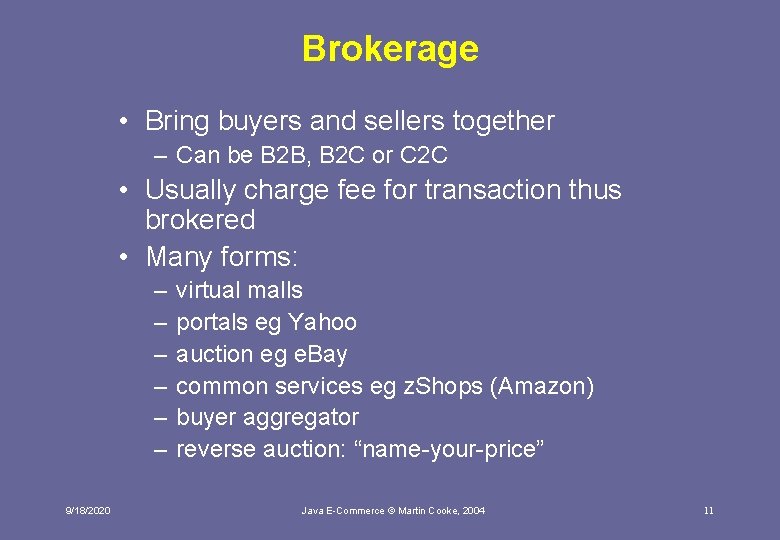
Brokerage • Bring buyers and sellers together – Can be B 2 B, B 2 C or C 2 C • Usually charge fee for transaction thus brokered • Many forms: – – – 9/18/2020 virtual malls portals eg Yahoo auction eg e. Bay common services eg z. Shops (Amazon) buyer aggregator reverse auction: “name-your-price” Java E-Commerce © Martin Cooke, 2004 11
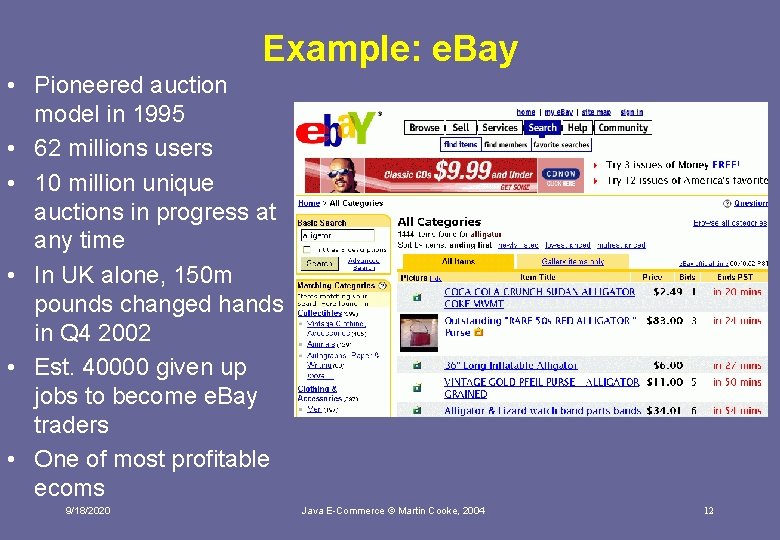
Example: e. Bay • Pioneered auction model in 1995 • 62 millions users • 10 million unique auctions in progress at any time • In UK alone, 150 m pounds changed hands in Q 4 2002 • Est. 40000 given up jobs to become e. Bay traders • One of most profitable ecoms 9/18/2020 Java E-Commerce © Martin Cooke, 2004 12
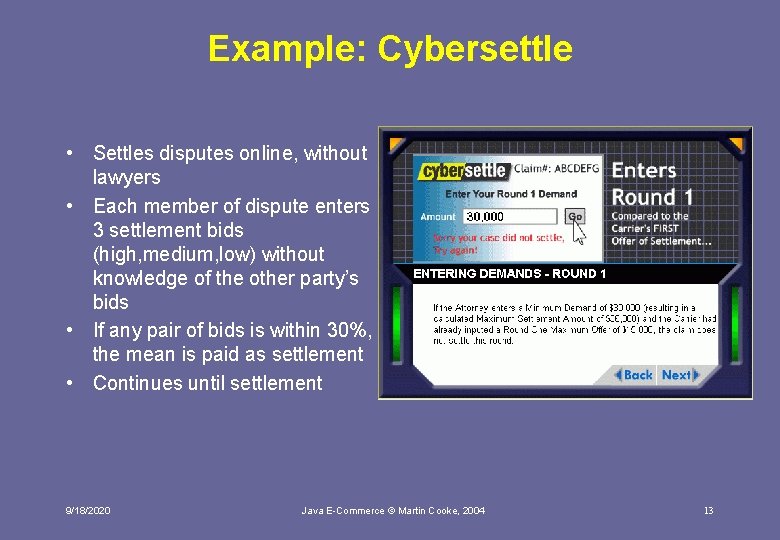
Example: Cybersettle • Settles disputes online, without lawyers • Each member of dispute enters 3 settlement bids (high, medium, low) without knowledge of the other party’s bids • If any pair of bids is within 30%, the mean is paid as settlement • Continues until settlement 9/18/2020 Java E-Commerce © Martin Cooke, 2004 13
Advertising • Since the web started as a publishing medium, advertising was the early (and obvious) business model • Traditional CPM (cost per 1000 model) used in eg TV is becoming redundant • Focus on narrowcasting via intelligent software agents 9/18/2020 Java E-Commerce © Martin Cooke, 2004 14
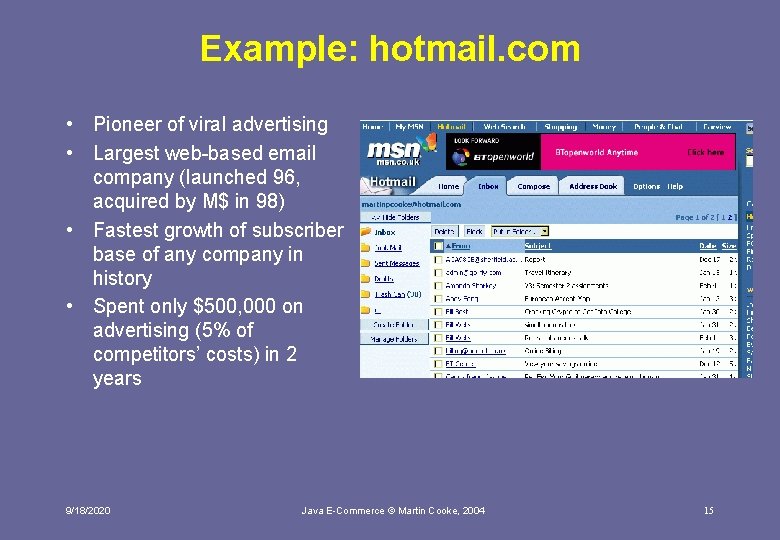
Example: hotmail. com • Pioneer of viral advertising • Largest web-based email company (launched 96, acquired by M$ in 98) • Fastest growth of subscriber base of any company in history • Spent only $500, 000 on advertising (5% of competitors’ costs) in 2 years 9/18/2020 Java E-Commerce © Martin Cooke, 2004 15
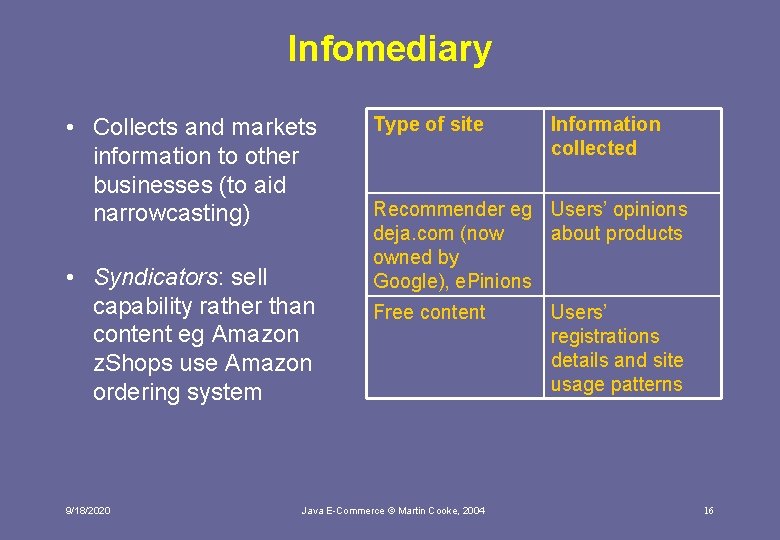
Infomediary • Collects and markets information to other businesses (to aid narrowcasting) • Syndicators: sell capability rather than content eg Amazon z. Shops use Amazon ordering system 9/18/2020 Type of site Information collected Recommender eg Users’ opinions deja. com (now about products owned by Google), e. Pinions Free content Java E-Commerce © Martin Cooke, 2004 Users’ registrations details and site usage patterns 16
Merchant model • Selling goods and services online – Existing wholesalers and retailers (“e-tailers”): clicks & mortar, sometimes aggregated into malls – Virtual merchant eg Amazon • Shopping trolley technology – Standard steps: find, add to trolley, checkout – Additional options: track shipping, cancel before despatch • E-wallets (next lecture) 9/18/2020 Java E-Commerce © Martin Cooke, 2004 17
Affiliate model • Site offers financial incentives (usually % of revenue) to affiliates for any sales generates from affiliate sites – Pay-per-click – Pay-per-lead – Pay-per-sale • • Generates estimated 15 -18% of sales Affiliates typically receive 7 -15% commission Downside for affiliates: loss of ‘stickiness’ Affiliate solution providers (eg tracking) are infomediaries – Linkshare. com 9/18/2020 Java E-Commerce © Martin Cooke, 2004 18
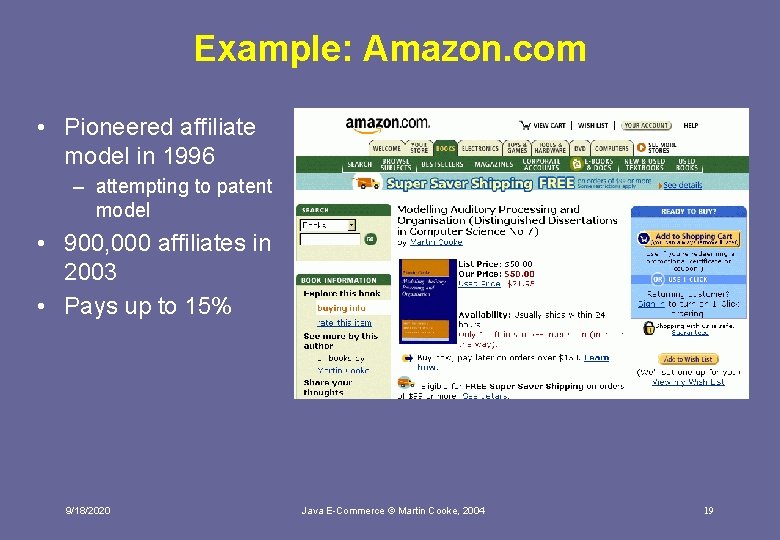
Example: Amazon. com • Pioneered affiliate model in 1996 – attempting to patent model • 900, 000 affiliates in 2003 • Pays up to 15% 9/18/2020 Java E-Commerce © Martin Cooke, 2004 19
Subscription model • Customers pay to access information – Wall Street Journal • Roughly 50% of users say they won’t (ever) pay for content - and maybe the other half will only pay for porn? • Runs counter to most web developments • Related models – subscribe to premium services after hooking users with free, but limited, content • eg Studyspanish. com – Microsubscription • eg pay for recipe rather than for whole cookery book 9/18/2020 Java E-Commerce © Martin Cooke, 2004 20
Utility model • Pay-as-you-go (micropayments) as in other utilities such as electricity, phone etc • Pay by the byte • Much touted, but not much in evidence yet, apart from free ISPs which receive revenue from phone company for time online 9/18/2020 Java E-Commerce © Martin Cooke, 2004 21
Summary of business models • Some are novel – eg affiliate • New ones appearing all the time • Behind webfront, business as usual for many companies, but others are purely virtual 9/18/2020 Java E-Commerce © Martin Cooke, 2004 22
Course timetable 2004 • • • Wed@9, 10 & 1 3 lectures a week for weeks 1 -6; none thereafter No lab sessions, but you will need to familiarise yourself with relevant software, download, obtain logins etc 9/18/2020 Java E-Commerce © Martin Cooke, 2004 23
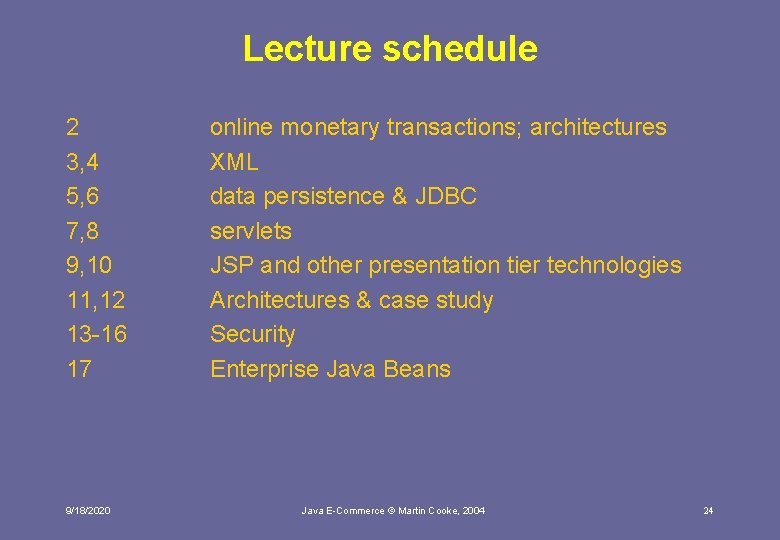
Lecture schedule 2 3, 4 5, 6 7, 8 9, 10 11, 12 13 -16 17 9/18/2020 online monetary transactions; architectures XML data persistence & JDBC servlets JSP and other presentation tier technologies Architectures & case study Security Enterprise Java Beans Java E-Commerce © Martin Cooke, 2004 24
Assessment • • • No written examination 3 -stage group assignment – Self-selected groups of 2 -4 – Stage 1: shooting tracer bullets – Stage 2: full development – Stage 3: shared testing Develop a multi-tiered web application to manage the departmental demonstrating system 9/18/2020 Java E-Commerce © Martin Cooke, 2004 25
Homework • Prepare for your assignment by – Choosing a grouplet and emailing the names to me – Visiting the departmental demonstrators page to get an initial idea of requirements http: //www. dcs. shef. ac. uk/campus/demonstrating. html 9/18/2020 Java E-Commerce © Martin Cooke, 2004 26
Resources Java E-Commerce © Martin Cooke, 2004
Lecture notes • Will be made available on website shortly after each lecture • You’ll also find – details of the assignment, soon – links to software required for the assignment – links to interesting articles 9/18/2020 Java E-Commerce © Martin Cooke, 2004 28
Books (this lecture) • Deitel, Deitel & Steinbuhler (2001) E-business & e -commerce for managers, Prentice-Hall, 0 -13032364 -0 • Hardaker & Graham (2001) Wired Marketing: energising business for e-Commerce, Wiley, 0471 -49645 -6 • Norris & West (2001) e. Business Essentials, Wiley, 0 -471 -52183 -3 9/18/2020 Java E-Commerce © Martin Cooke, 2004 29
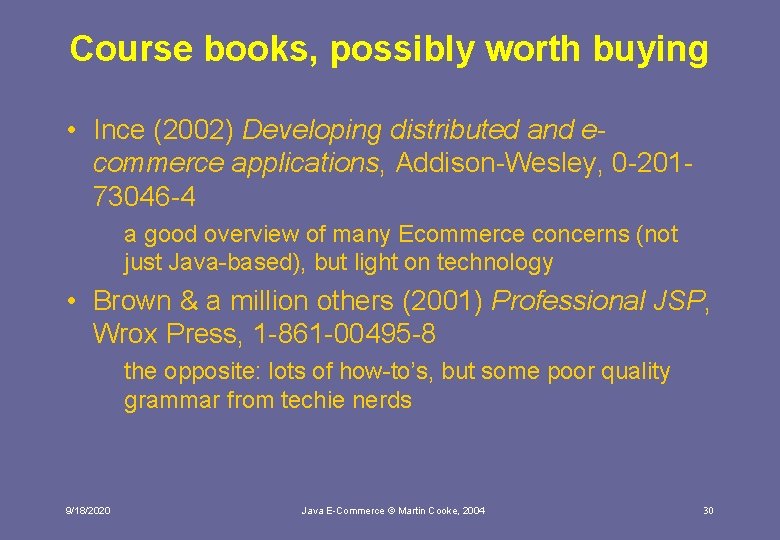
Course books, possibly worth buying • Ince (2002) Developing distributed and ecommerce applications, Addison-Wesley, 0 -20173046 -4 a good overview of many Ecommerce concerns (not just Java-based), but light on technology • Brown & a million others (2001) Professional JSP, Wrox Press, 1 -861 -00495 -8 the opposite: lots of how-to’s, but some poor quality grammar from techie nerds 9/18/2020 Java E-Commerce © Martin Cooke, 2004 30
- Slides: 30