
Java and Object Orientedness ANNWESHA BANERJEE Introduction Java
Java and Object Orientedness ANNWESHA BANERJEE
Introduction �Java is a general-purpose computer programming language that is concurrent, class-based, objectoriented.
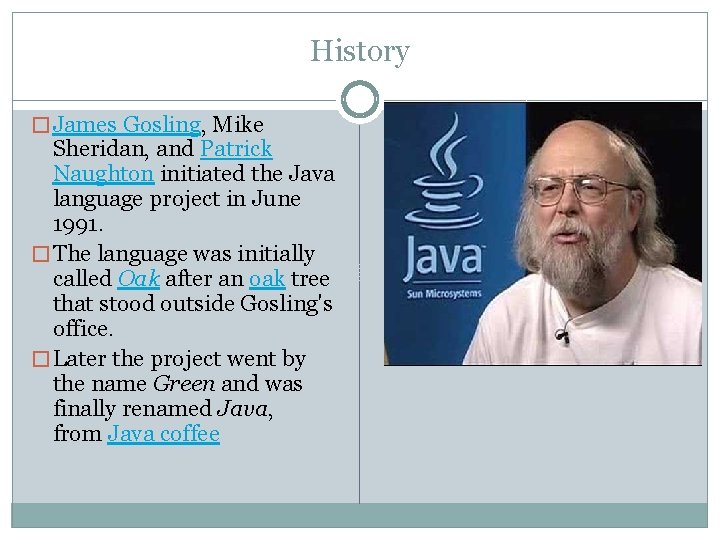
History � James Gosling, Mike Sheridan, and Patrick Naughton initiated the Java language project in June 1991. � The language was initially called Oak after an oak tree that stood outside Gosling's office. � Later the project went by the name Green and was finally renamed Java, from Java coffee
History �Sun Microsystems released the first public implementation as Java 1. 0 in 1995. �On November 13, 2006, Sun released much of its Java virtual machine (JVM) as free and open-source software. � Following Oracle Corporation's acquisition of Sun Microsystems in 2009– 10, Oracle has described itself as the "steward of Java technology
Principles �There were five primary goals in the creation of the Java language: It must be "simple, object-oriented, and familiar". It must be "robust and secure". It must be "architecture-neutral and portable". It must execute with "high performance". It must be "interpreted, threaded, and dynamic".
Versions �As of 2015, only Java 8 is officially supported. Major release versions of Java, along with their release dates: JDK 1. 0 (January 23, 1996) JDK 1. 1 (February 19, 1997) J 2 SE 1. 2 (December 8, 1998) J 2 SE 1. 3 (May 8, 2000) J 2 SE 1. 4 (February 6, 2002) J 2 SE 5. 0 (September 30, 2004) Java SE 6 (December 11, 2006) Java SE 7 (July 28, 2011) Java SE 8 (March 18, 2014)
Features �Simple �Secure � Portable � Object-oriented � Robust � Multithreaded � Architecture-neutral � Interpreted � High performance � Distributed � Dynamic
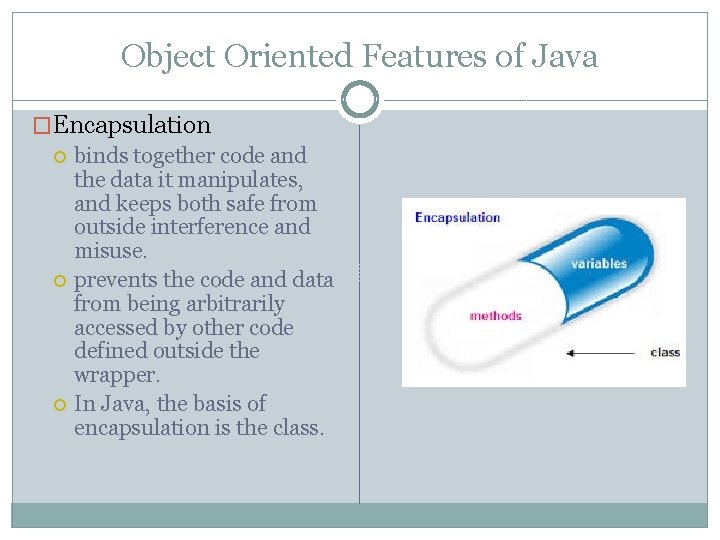
Object Oriented Features of Java �Encapsulation binds together code and the data it manipulates, and keeps both safe from outside interference and misuse. prevents the code and data from being arbitrarily accessed by other code defined outside the wrapper. In Java, the basis of encapsulation is the class.
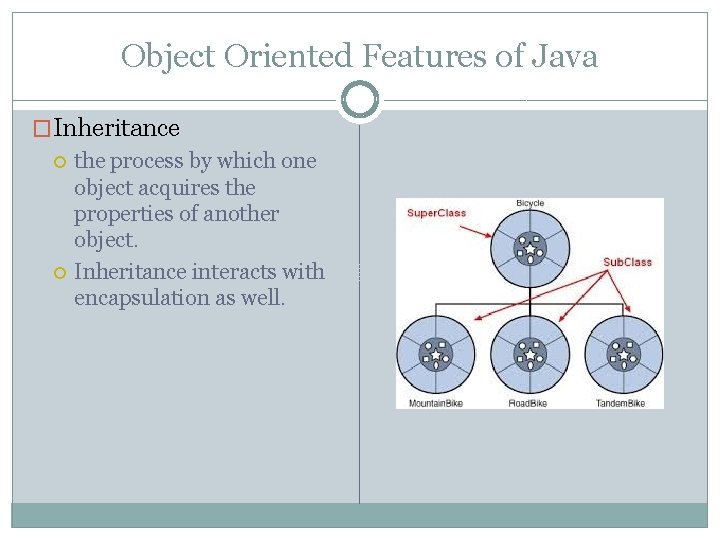
Object Oriented Features of Java �Inheritance the process by which one object acquires the properties of another object. Inheritance interacts with encapsulation as well.
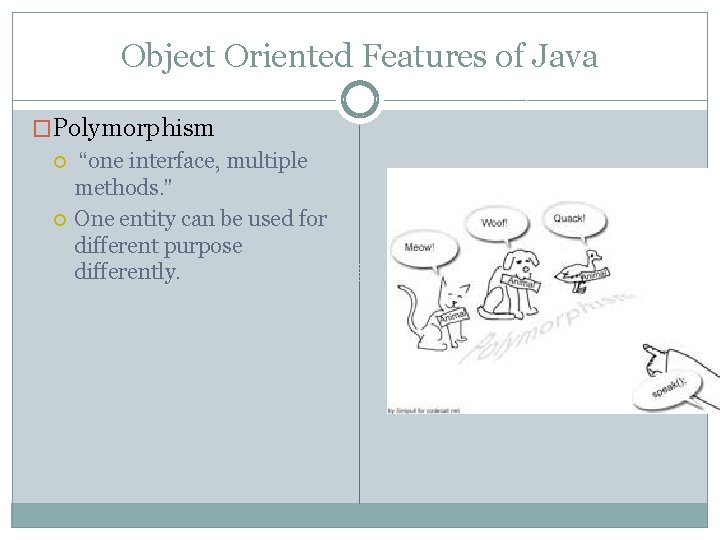
Object Oriented Features of Java �Polymorphism “one interface, multiple methods. ” One entity can be used for different purpose differently.
Polymorphism, Encapsulation, and Inheritance Work Together �When properly applied, polymorphism, encapsulation, and inheritance combine to produce a programming environment that supports the development of far more robust and scalable programs than does the processoriented model. �A well-designed hierarchy of classes is the basis for reusing the code in which you have invested time and effort developing and testing. Encapsulation allows you to migrate your implementations over time without breaking the code that depends on the public interface of your classes. Polymorphism allows you to create clean, sensible, readable, and resilient code.

�Thank You
- Slides: 12