
Java 8 Java 8 is the biggest change
Java 8 • Java 8 is the biggest change to Java since the inception of the language • Lambdas are the most important new addition • Java is playing catch-up: most major programming languages already have support for lambda expressions • A big challenge was to introduce lambdas without requiring recompilation of existing binaries
What is Functional Programming? • A style of programming that treats computation as the evaluation of mathematical functions • Eliminates side effects • Treats data as being immutable • Expressions have referential transparency • Functions can take functions as arguments and return functions as results • Prefers recursion over explicit for-loops
Why do Functional Programming? • Functional programming allows us to write easier-to-understand, more declarative, more concise programs than imperative programming • Allows us to focus on the problem rather than the code • Facilitates parallelism
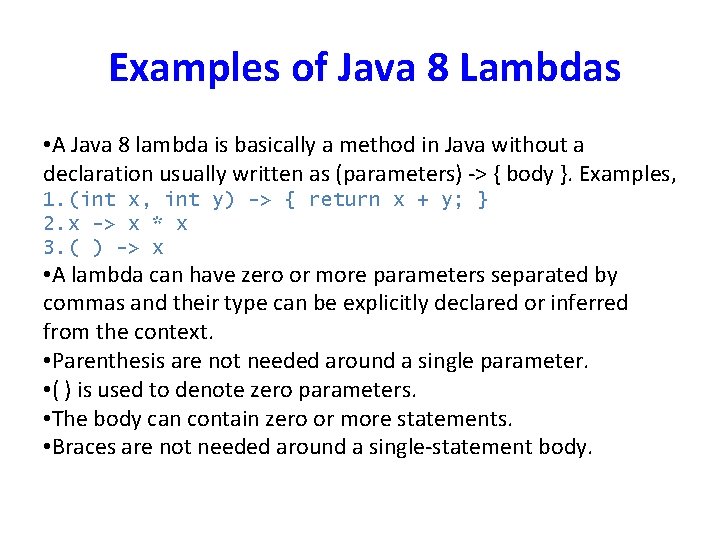
Examples of Java 8 Lambdas • A Java 8 lambda is basically a method in Java without a declaration usually written as (parameters) -> { body }. Examples, 1. (int x, int y) -> { return x + y; } 2. x -> x * x 3. ( ) -> x • A lambda can have zero or more parameters separated by commas and their type can be explicitly declared or inferred from the context. • Parenthesis are not needed around a single parameter. • ( ) is used to denote zero parameters. • The body can contain zero or more statements. • Braces are not needed around a single-statement body.

Behavior Parameterization
Benefits of Lambdas in Java 8 • Enabling functional programming • Writing leaner more compact code • Facilitating parallel programming • Developing more generic, flexible and reusable APIs • Being able to pass behaviors as well as data to functions
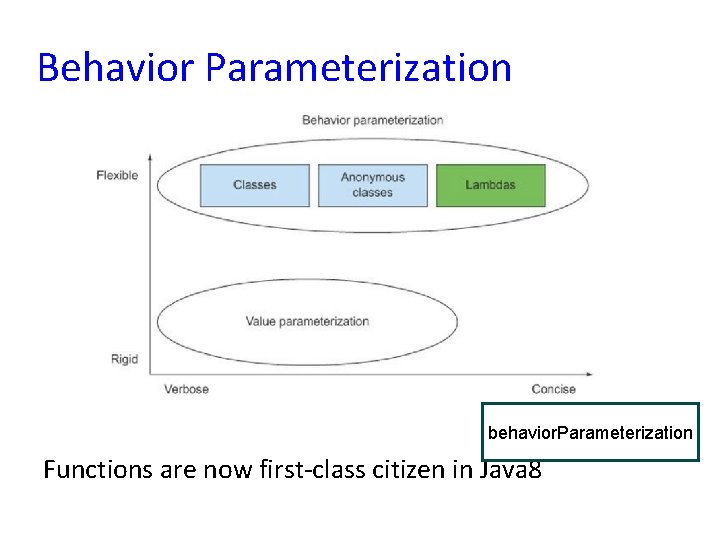
Behavior Parameterization behavior. Parameterization Functions are now first-class citizen in Java 8

Strategy Pattern
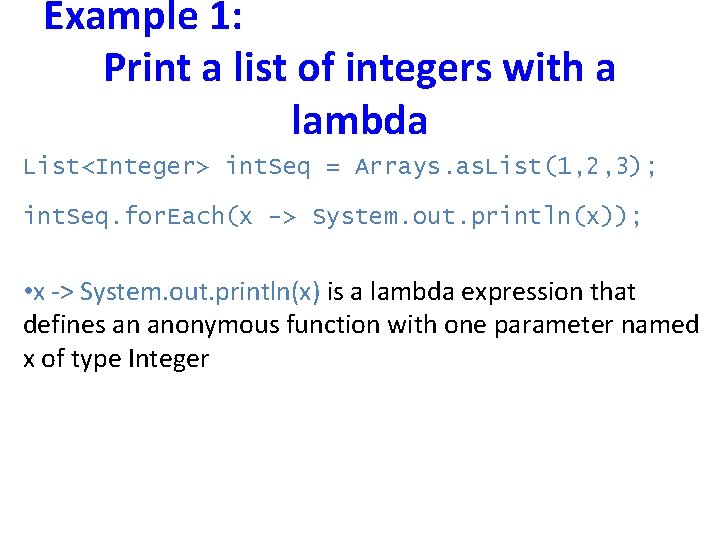
Example 1: Print a list of integers with a lambda List<Integer> int. Seq = Arrays. as. List(1, 2, 3); int. Seq. for. Each(x -> System. out. println(x)); • x -> System. out. println(x) is a lambda expression that defines an anonymous function with one parameter named x of type Integer
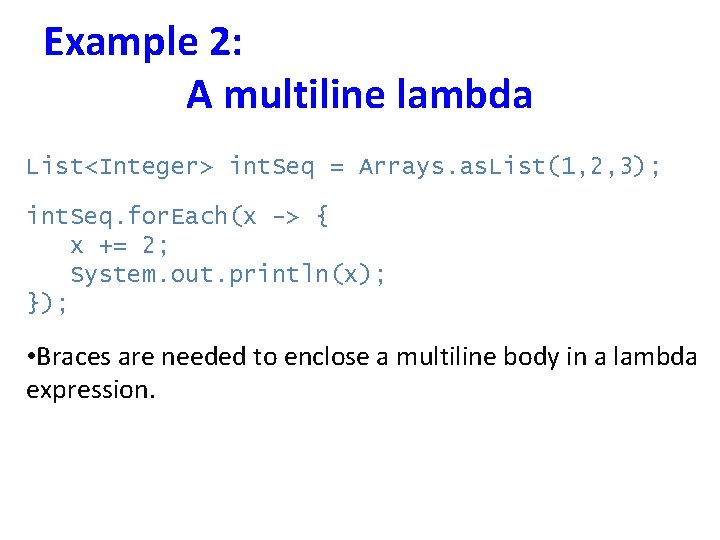
Example 2: A multiline lambda List<Integer> int. Seq = Arrays. as. List(1, 2, 3); int. Seq. for. Each(x -> { x += 2; System. out. println(x); }); • Braces are needed to enclose a multiline body in a lambda expression.
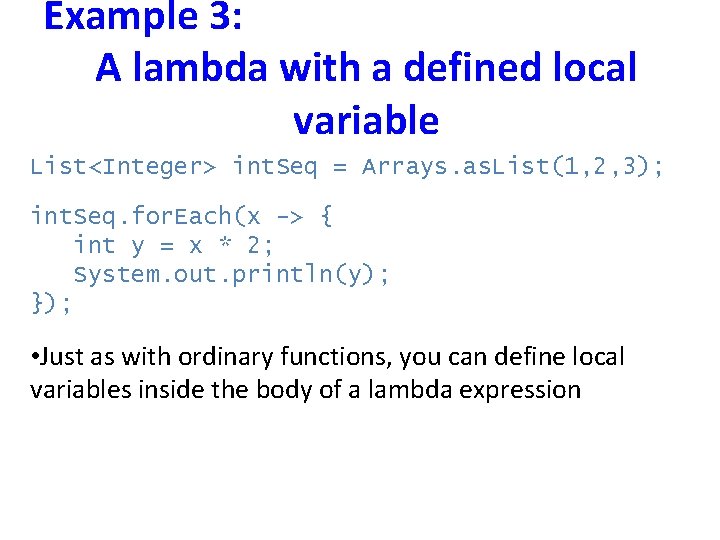
Example 3: A lambda with a defined local variable List<Integer> int. Seq = Arrays. as. List(1, 2, 3); int. Seq. for. Each(x -> { int y = x * 2; System. out. println(y); }); • Just as with ordinary functions, you can define local variables inside the body of a lambda expression
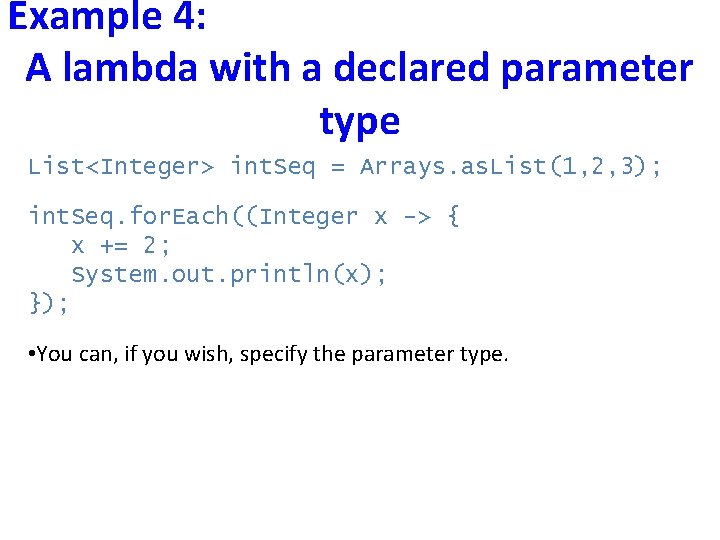
Example 4: A lambda with a declared parameter type List<Integer> int. Seq = Arrays. as. List(1, 2, 3); int. Seq. for. Each((Integer x -> { x += 2; System. out. println(x); }); • You can, if you wish, specify the parameter type.
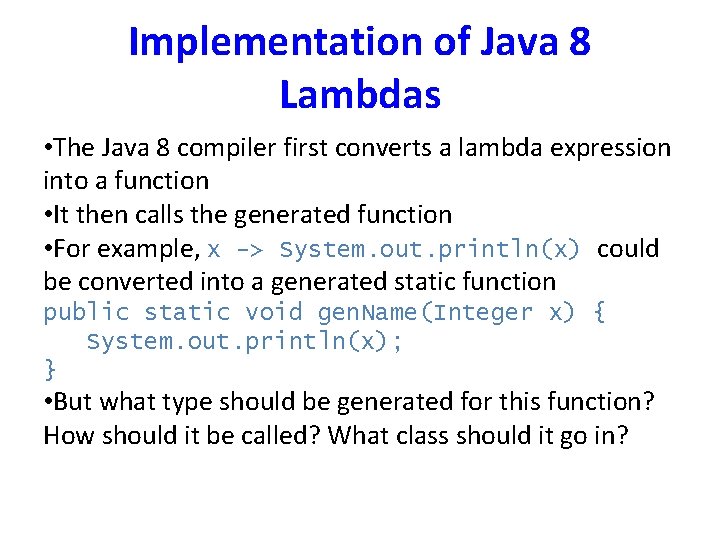
Implementation of Java 8 Lambdas • The Java 8 compiler first converts a lambda expression into a function • It then calls the generated function • For example, x -> System. out. println(x) could be converted into a generated static function public static void gen. Name(Integer x) { System. out. println(x); } • But what type should be generated for this function? How should it be called? What class should it go in?
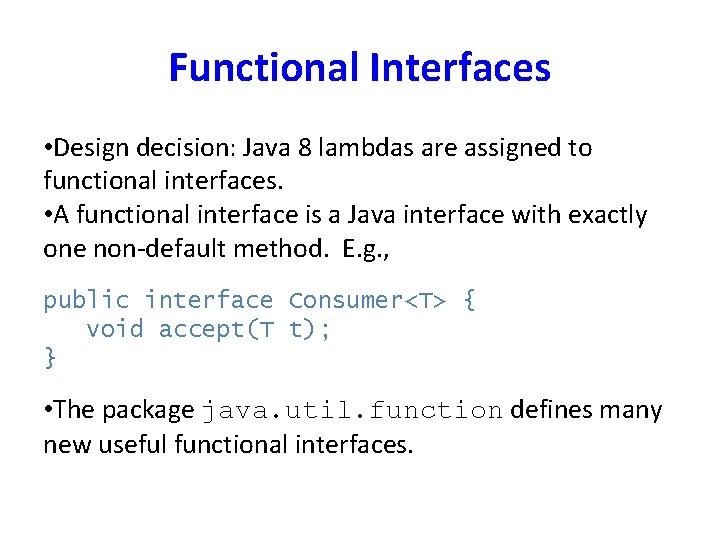
Functional Interfaces • Design decision: Java 8 lambdas are assigned to functional interfaces. • A functional interface is a Java interface with exactly one non-default method. E. g. , public interface Consumer<T> { void accept(T t); } • The package java. util. function defines many new useful functional interfaces.
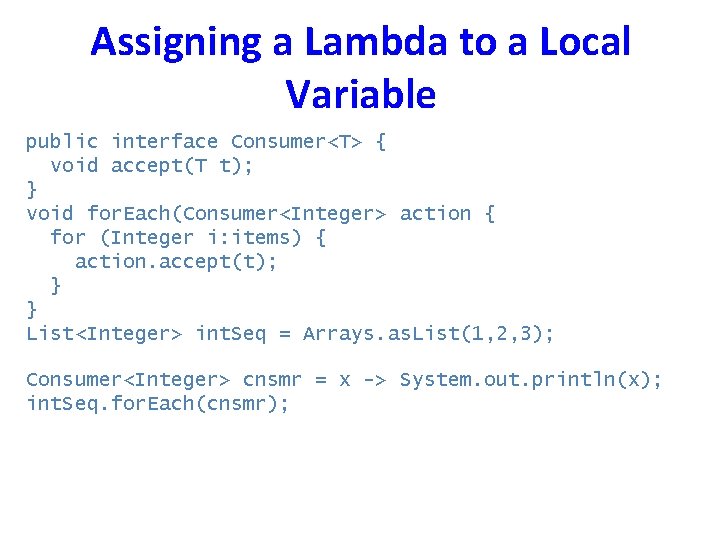
Assigning a Lambda to a Local Variable public interface Consumer<T> { void accept(T t); } void for. Each(Consumer<Integer> action { for (Integer i: items) { action. accept(t); } } List<Integer> int. Seq = Arrays. as. List(1, 2, 3); Consumer<Integer> cnsmr = x -> System. out. println(x); int. Seq. for. Each(cnsmr);
Properties of the Generated Method • The method generated from a Java 8 lambda expression has the same signature as the method in the functional interface • The type is the same as that of the functional interface to which the lambda expression is assigned • The lambda expression becomes the body of the method in the interface
Variable Capture • Lambdas can interact with variables defined outside the body of the lambda • Using these variables is called variable capture
![Local Variable Capture Example public class LVCExample { public static void main(String[] args) {](http://slidetodoc.com/presentation_image_h2/a7bea392073ab83d0857c6e0eeeeb2b7/image-18.jpg "Local Variable Capture Example public class LVCExample { public static void main(String[] args) {")
Local Variable Capture Example public class LVCExample { public static void main(String[] args) { List<Integer> int. Seq = Arrays. as. List(1, 2, 3); int var = 10; int. Seq. for. Each(x -> System. out. println(x + var)); } } • Note: local variables used inside the body of a lambda must be final or effectively final
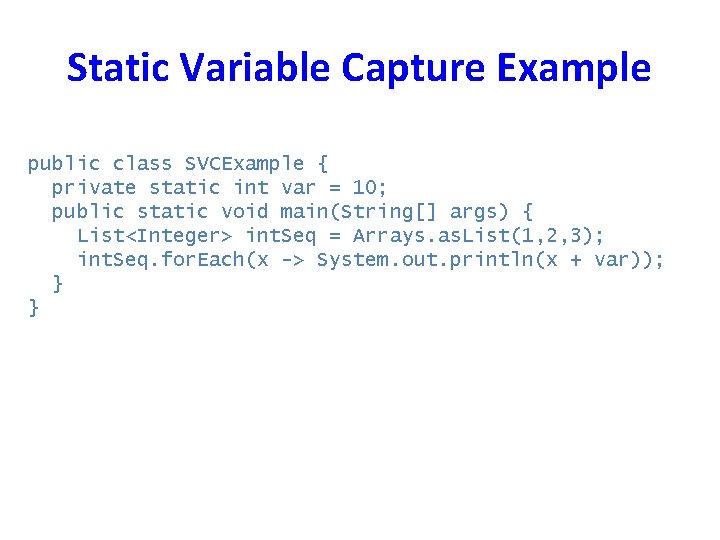
Static Variable Capture Example public class SVCExample { private static int var = 10; public static void main(String[] args) { List<Integer> int. Seq = Arrays. as. List(1, 2, 3); int. Seq. for. Each(x -> System. out. println(x + var)); } }
Method References • Method references can be used to pass an existing function in places where a lambda is expected • The signature of the referenced method needs to match the signature of the functional interface method
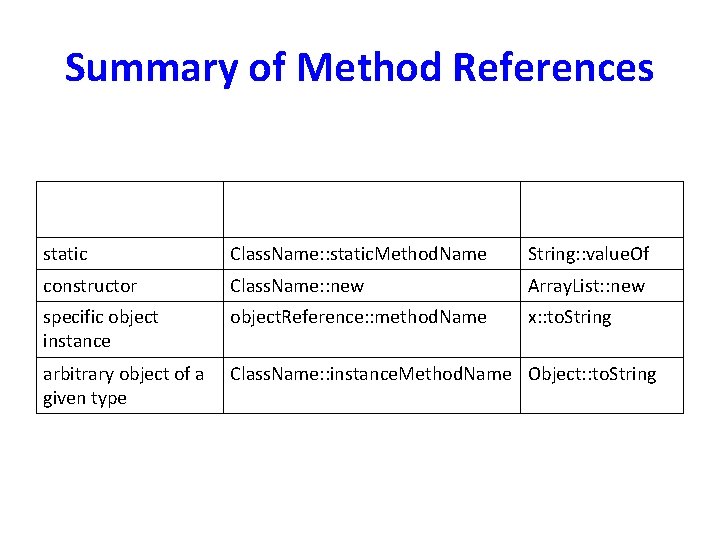
Summary of Method References Method Reference Type Syntax Example static Class. Name: : static. Method. Name String: : value. Of constructor Class. Name: : new Array. List: : new specific object instance object. Reference: : method. Name x: : to. String arbitrary object of a given type Class. Name: : instance. Method. Name Object: : to. String
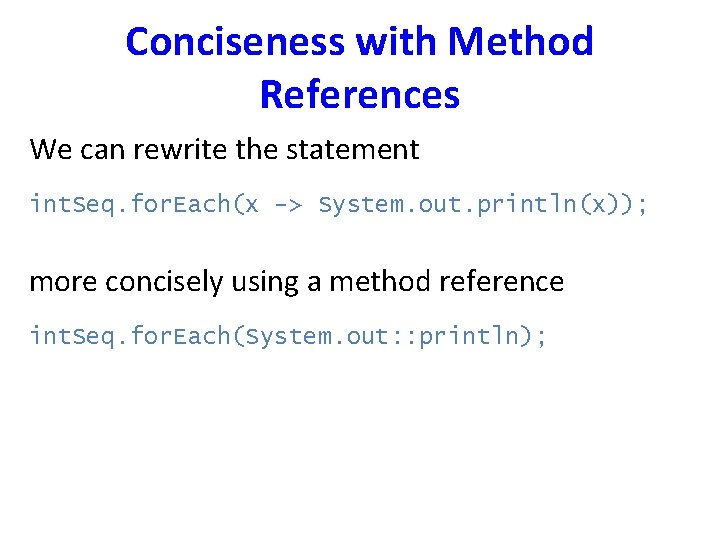
Conciseness with Method References We can rewrite the statement int. Seq. for. Each(x -> System. out. println(x)); more concisely using a method reference int. Seq. for. Each(System. out: : println);
Streams
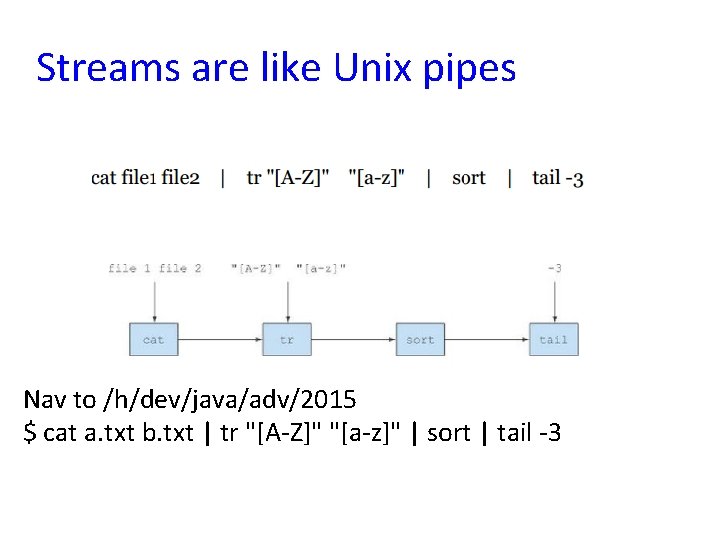
Streams are like Unix pipes Nav to /h/dev/java/adv/2015 $ cat a. txt b. txt | tr "[A-Z]" "[a-z]" | sort | tail -3
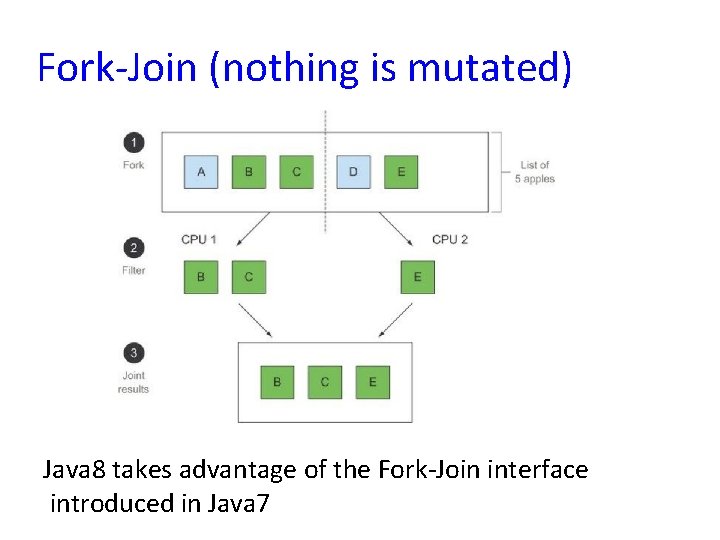
Fork-Join (nothing is mutated) Java 8 takes advantage of the Fork-Join interface introduced in Java 7
Collections versus Streams Collections are grouped in space. Streams are grouped in time. As with time, you can not visit the past or future. Similar to an iterator that has been spent. Imagine trying to visit a frame streamed from an online video server that has not yet been sent to the client; impossible!
Stream API • The new java. util. stream package provides utilities to support functional-style operations on streams of values. • A common way to obtain a stream is from a collection: Stream<T> stream = collection. stream(); • Streams can be sequential or parallel. • Streams are useful for selecting values and performing actions on the results.
Stream Operations • An intermediate operation keeps a stream open for further operations. Intermediate operations are lazy. • A terminal operation must be the final operation on a stream. Once a terminal operation is invoked, the stream is consumed and is no longer usable.
Example Intermediate Operations • filter excludes all elements that don’t match a Predicate. • map performs a one-to-one transformation of elements using a Function.
A Stream Pipeline A stream pipeline has three components: 1. A source such as a Collection, an array, a generator function, or an IO channel; 2. Zero or more intermediate operations; and 3. A terminal operation
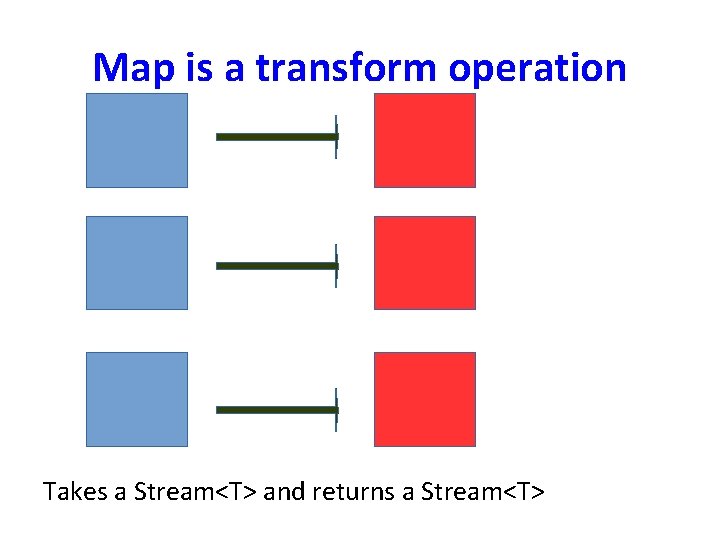
Map is a transform operation Takes a Stream<T> and returns a Stream<T>
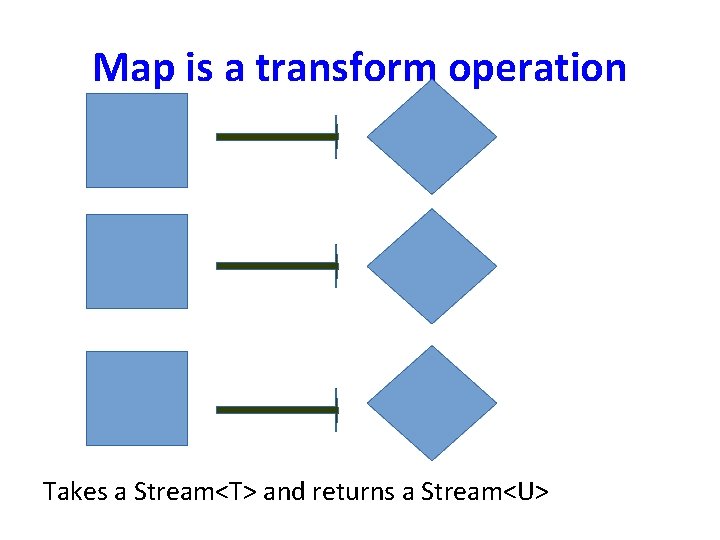
Map is a transform operation Takes a Stream<T> and returns a Stream<U>
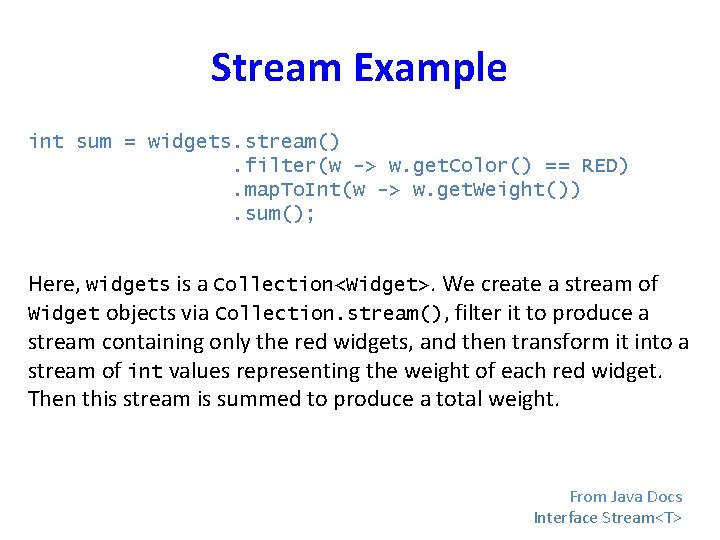
Stream Example int sum = widgets. stream(). filter(w -> w. get. Color() == RED). map. To. Int(w -> w. get. Weight()). sum(); Here, widgets is a Collection<Widget>. We create a stream of Widget objects via Collection. stream(), filter it to produce a stream containing only the red widgets, and then transform it into a stream of int values representing the weight of each red widget. Then this stream is summed to produce a total weight. From Java Docs Interface Stream<T>
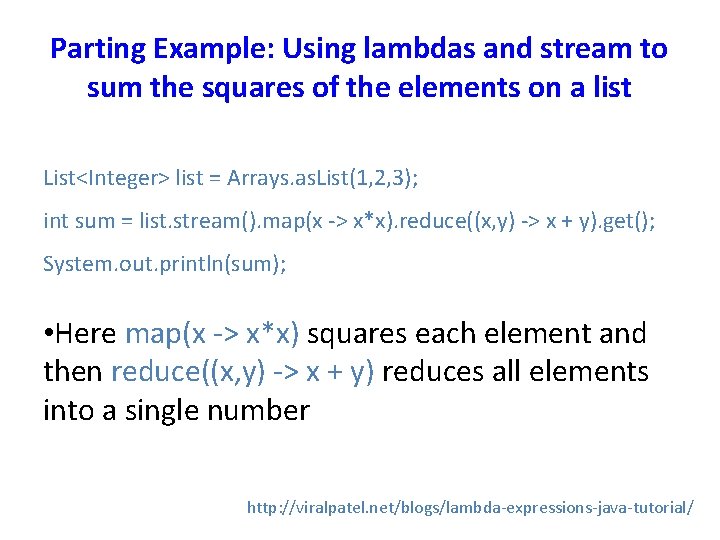
Parting Example: Using lambdas and stream to sum the squares of the elements on a list List<Integer> list = Arrays. as. List(1, 2, 3); int sum = list. stream(). map(x -> x*x). reduce((x, y) -> x + y). get(); System. out. println(sum); • Here map(x -> x*x) squares each element and then reduce((x, y) -> x + y) reduces all elements into a single number http: //viralpatel. net/blogs/lambda-expressions-java-tutorial/
Default methods
The default methods A Virtual Extension Method aka default aka defender methods are not the same as abstract methods. difference between Java 8 interfaces with default methods and abstract classes: Abstract class can hold state of object. Abstract class can have constructors and member variables. Whereas interfaces with Java 8 default methods cannot maintain state. Used for backwards compatibility; look at Collections. java in the Java 8 JDK.
Default Methods Java 8 uses lambda expressions and default methods in conjunction with the Java collections framework to achieve backward compatibility with existing published interfaces For a full discussion see Brian Goetz, Lambdas in Java: A peek under the hood. https: //www. youtube. com/watch? v=MLksir. K 9 nn. E
References A lot of the material in this lecture is discussed in much more detail in these informative references: • The Java Tutorials, http: //docs. oracle. com/javase/tutorial/java/index. html • Lambda Expressions, http: //docs. oracle. com/javase/tutorial/java. OO/lambdaexpr essions. html • Adib Saikali, Java 8 Lambda Expressions and Streams, www. youtube. com/watch? v=8 p. Dm_k. H 4 YKY • Brian Goetz, Lambdas in Java: A peek under the hood. https: //www. youtube. com/watch? v=MLksir. K 9 nn. E
- Slides: 38