
Jass 2006 St Petersburg Dynamics and Control of
Jass 2006 St. Petersburg Dynamics and Control of Hexapod Systems 2/27/2021 1
Table of Contents • • What is a Hexapod? History Advantages and disadvantages of a Hexapod Examples of application Mathematical description – Kinematics Mathematical descriptions – Dynamics Controlling of a Hexapod Simulation of the controller 2/27/2021 JASS 2006 – St. Petersburg Daniela Gewald 2
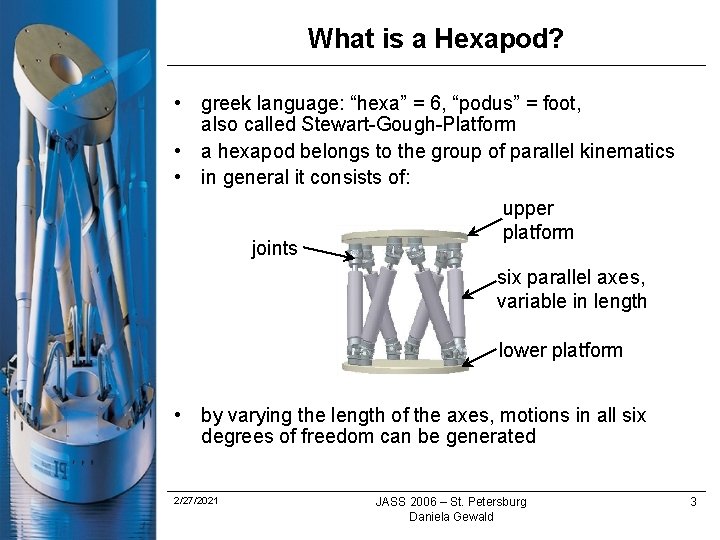
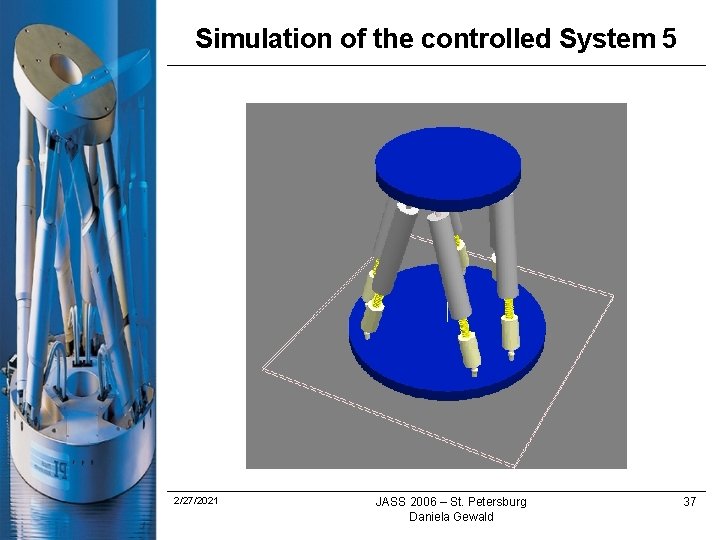
What is a Hexapod? • greek language: “hexa” = 6, “podus” = foot, also called Stewart-Gough-Platform • a hexapod belongs to the group of parallel kinematics • in general it consists of: joints upper platform six parallel axes, variable in length lower platform • by varying the length of the axes, motions in all six degrees of freedom can be generated 2/27/2021 JASS 2006 – St. Petersburg Daniela Gewald 3
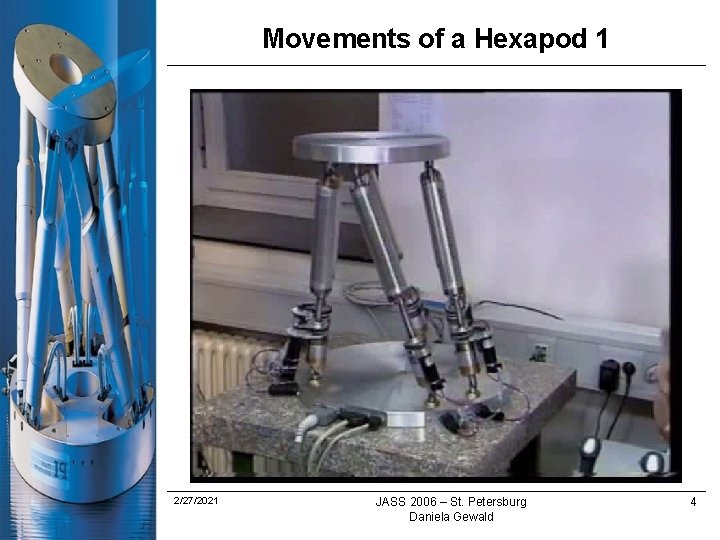
Movements of a Hexapod 1 2/27/2021 JASS 2006 – St. Petersburg Daniela Gewald 4
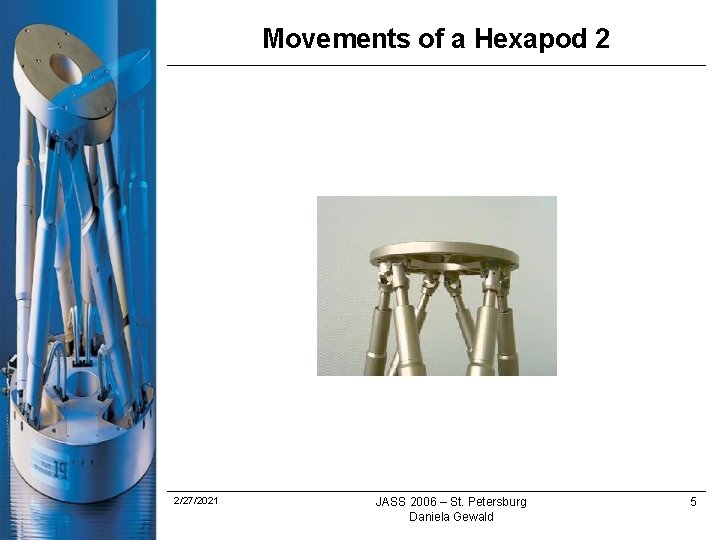
Movements of a Hexapod 2 2/27/2021 JASS 2006 – St. Petersburg Daniela Gewald 5
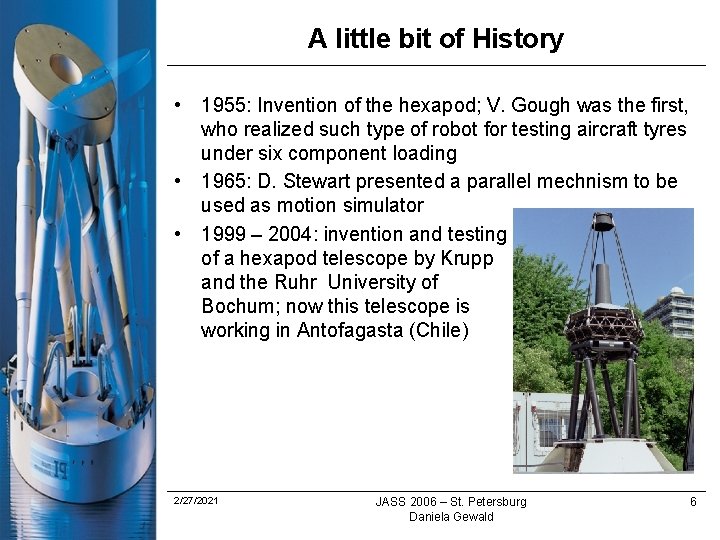
A little bit of History • 1955: Invention of the hexapod; V. Gough was the first, who realized such type of robot for testing aircraft tyres under six component loading • 1965: D. Stewart presented a parallel mechnism to be used as motion simulator • 1999 – 2004: invention and testing of a hexapod telescope by Krupp and the Ruhr University of Bochum; now this telescope is working in Antofagasta (Chile) 2/27/2021 JASS 2006 – St. Petersburg Daniela Gewald 6
Advantages and Disadvantages Advantages: • high system stiffness as a result of the parallel system structure • high load/weight ratio • non-cumulative joint errors • lot of similar parts reduction of producing costs • precise movements, also under heavily alternating loads and high accelerations • arrangement of all motors for the single axes near the basis strong basis motor is not necessary Main disadvantage: strictly limited workspace, determined by the axes stroke and the maximum angle of the joints 2/27/2021 JASS 2006 – St. Petersburg Daniela Gewald 7
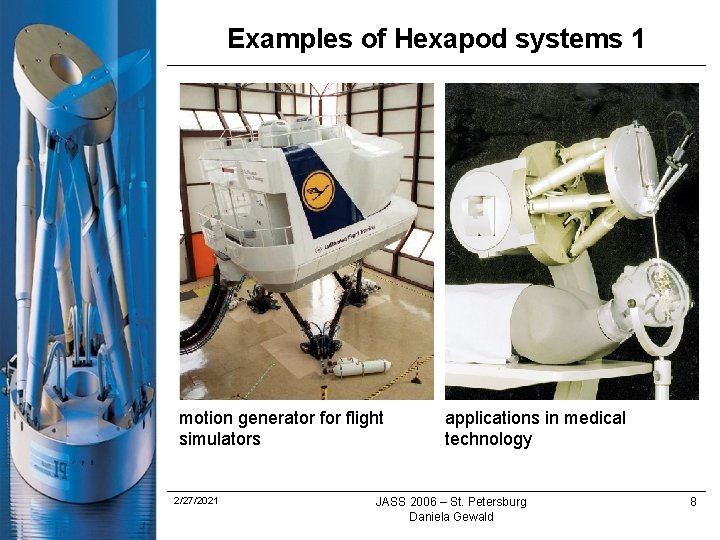
Examples of Hexapod systems 1 motion generator flight simulators 2/27/2021 applications in medical technology JASS 2006 – St. Petersburg Daniela Gewald 8
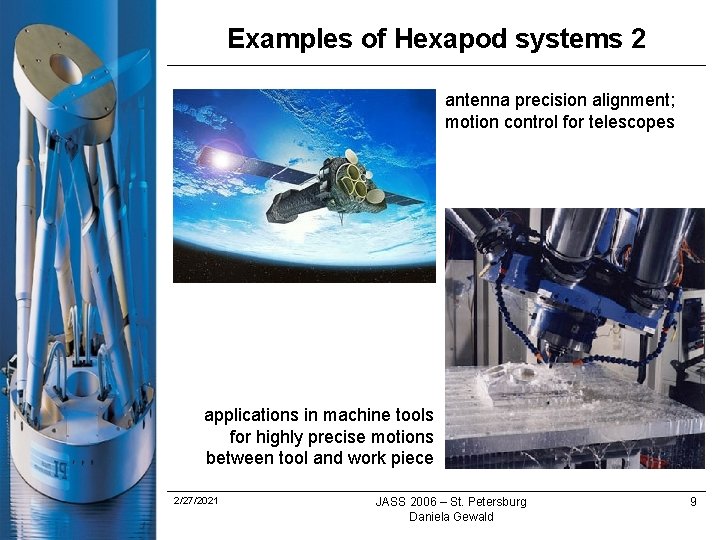
Examples of Hexapod systems 2 antenna precision alignment; motion control for telescopes applications in machine tools for highly precise motions between tool and work piece 2/27/2021 JASS 2006 – St. Petersburg Daniela Gewald 9
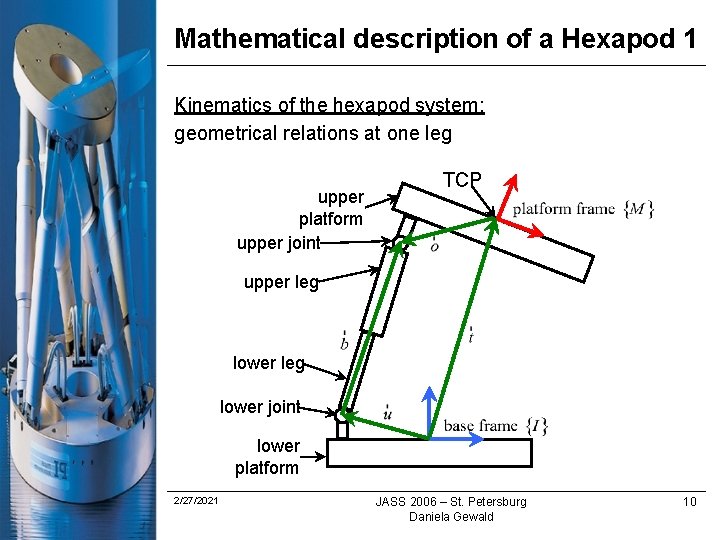
Mathematical description of a Hexapod 1 Kinematics of the hexapod system: geometrical relations at one leg upper platform upper joint TCP upper leg lower joint lower platform 2/27/2021 JASS 2006 – St. Petersburg Daniela Gewald 10
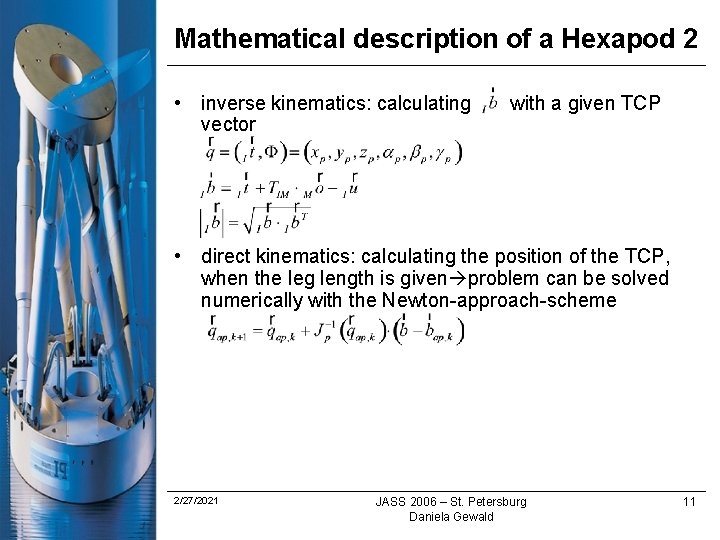
Mathematical description of a Hexapod 2 • inverse kinematics: calculating vector with a given TCP • direct kinematics: calculating the position of the TCP, when the leg length is given problem can be solved numerically with the Newton-approach-scheme 2/27/2021 JASS 2006 – St. Petersburg Daniela Gewald 11
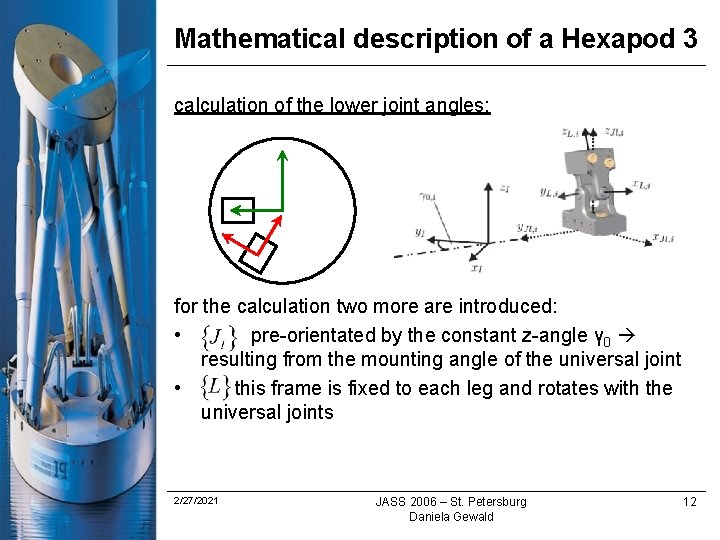
Mathematical description of a Hexapod 3 calculation of the lower joint angles: for the calculation two more are introduced: • pre-orientated by the constant z-angle γ 0 resulting from the mounting angle of the universal joint • this frame is fixed to each leg and rotates with the universal joints 2/27/2021 JASS 2006 – St. Petersburg Daniela Gewald 12
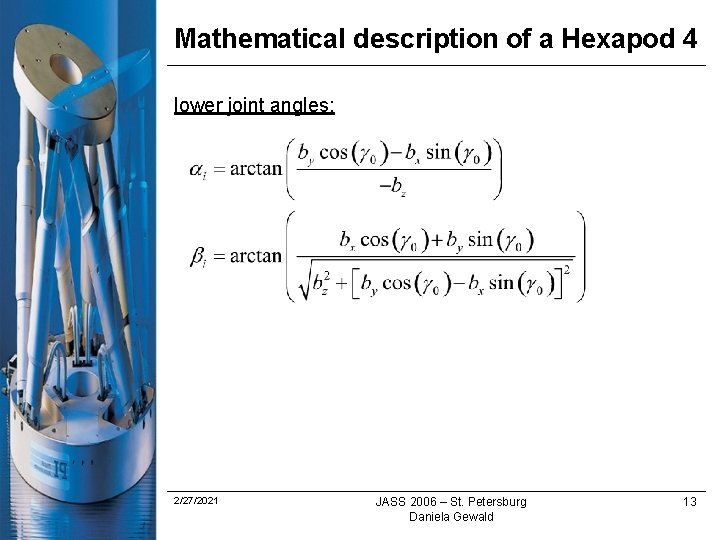
Mathematical description of a Hexapod 4 lower joint angles: 2/27/2021 JASS 2006 – St. Petersburg Daniela Gewald 13
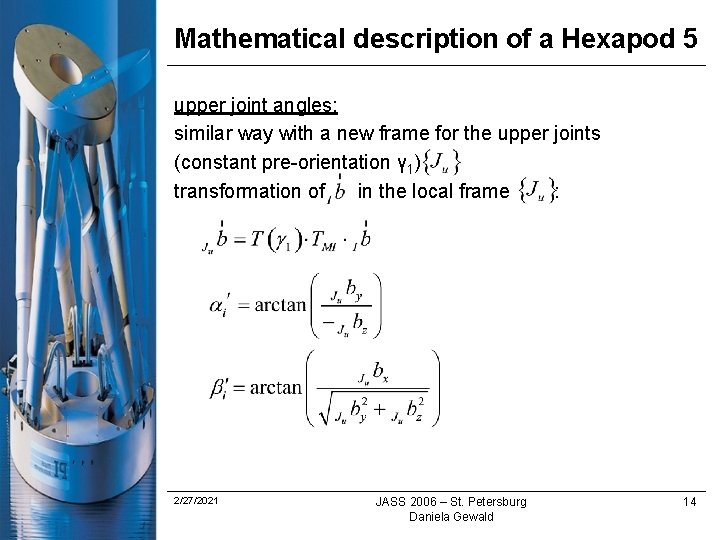
Mathematical description of a Hexapod 5 upper joint angles: similar way with a new frame for the upper joints (constant pre-orientation γ 1) transformation of in the local frame : 2/27/2021 JASS 2006 – St. Petersburg Daniela Gewald 14
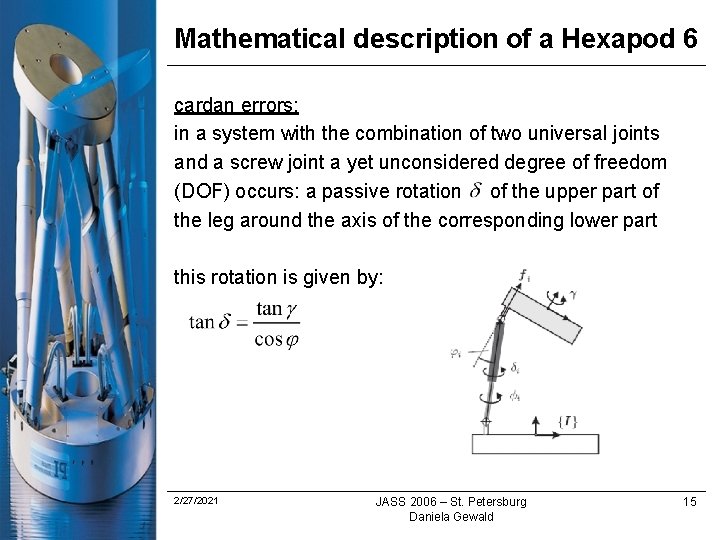
Mathematical description of a Hexapod 6 cardan errors: in a system with the combination of two universal joints and a screw joint a yet unconsidered degree of freedom (DOF) occurs: a passive rotation of the upper part of the leg around the axis of the corresponding lower part this rotation is given by: 2/27/2021 JASS 2006 – St. Petersburg Daniela Gewald 15
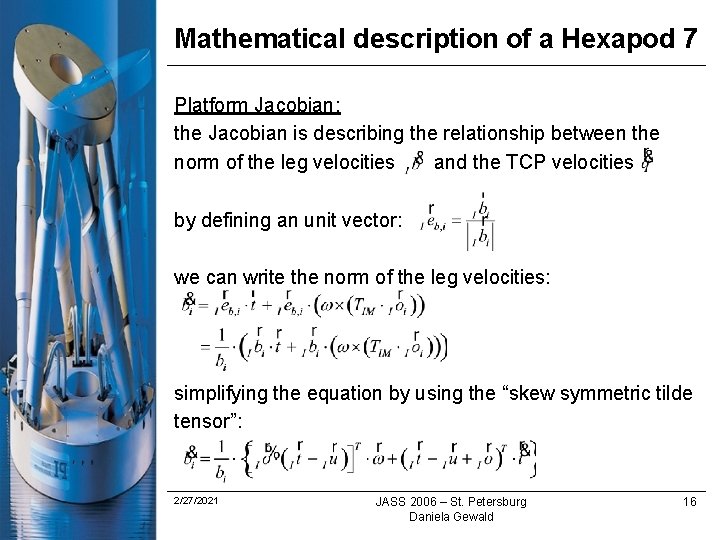
Mathematical description of a Hexapod 7 Platform Jacobian: the Jacobian is describing the relationship between the norm of the leg velocities and the TCP velocities by defining an unit vector: we can write the norm of the leg velocities: simplifying the equation by using the “skew symmetric tilde tensor”: 2/27/2021 JASS 2006 – St. Petersburg Daniela Gewald 16
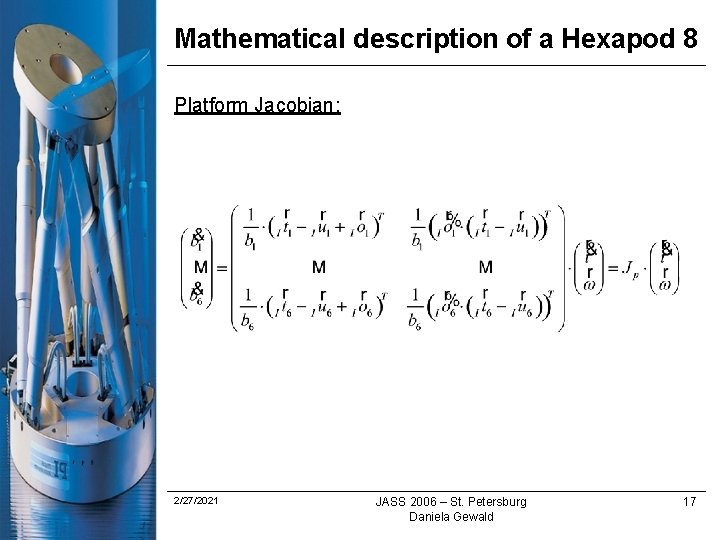
Mathematical description of a Hexapod 8 Platform Jacobian: 2/27/2021 JASS 2006 – St. Petersburg Daniela Gewald 17
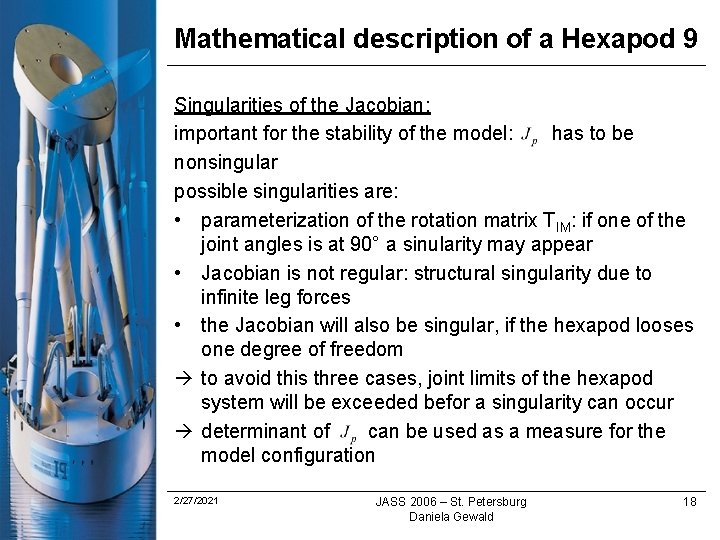
Mathematical description of a Hexapod 9 Singularities of the Jacobian: important for the stability of the model: has to be nonsingular possible singularities are: • parameterization of the rotation matrix TIM: if one of the joint angles is at 90° a sinularity may appear • Jacobian is not regular: structural singularity due to infinite leg forces • the Jacobian will also be singular, if the hexapod looses one degree of freedom to avoid this three cases, joint limits of the hexapod system will be exceeded befor a singularity can occur determinant of can be used as a measure for the model configuration 2/27/2021 JASS 2006 – St. Petersburg Daniela Gewald 18
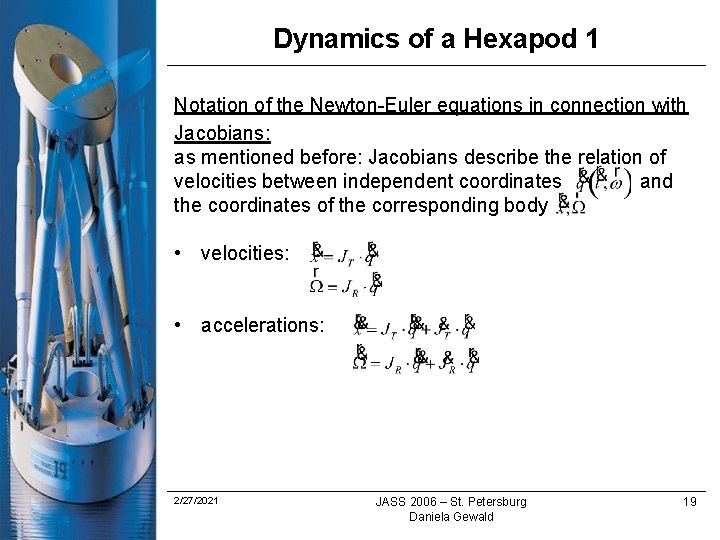
Dynamics of a Hexapod 1 Notation of the Newton-Euler equations in connection with Jacobians: as mentioned before: Jacobians describe the relation of velocities between independent coordinates and the coordinates of the corresponding body • velocities: • accelerations: 2/27/2021 JASS 2006 – St. Petersburg Daniela Gewald 19
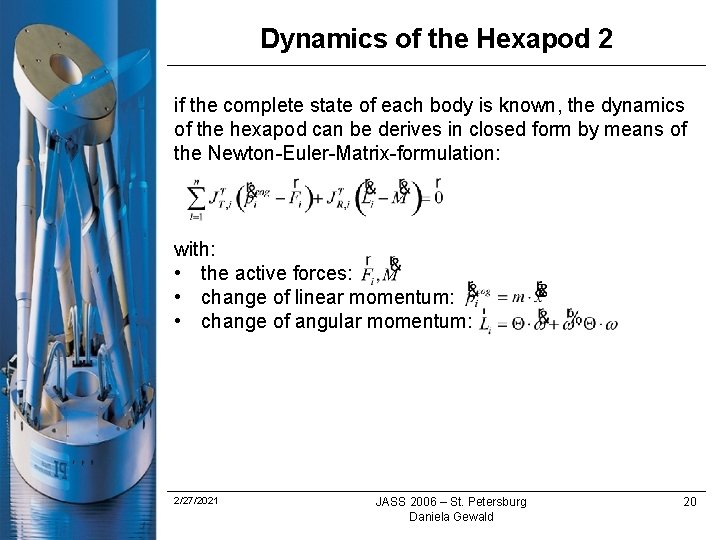
Dynamics of the Hexapod 2 if the complete state of each body is known, the dynamics of the hexapod can be derives in closed form by means of the Newton-Euler-Matrix-formulation: with: • the active forces: • change of linear momentum: • change of angular momentum: 2/27/2021 JASS 2006 – St. Petersburg Daniela Gewald 20
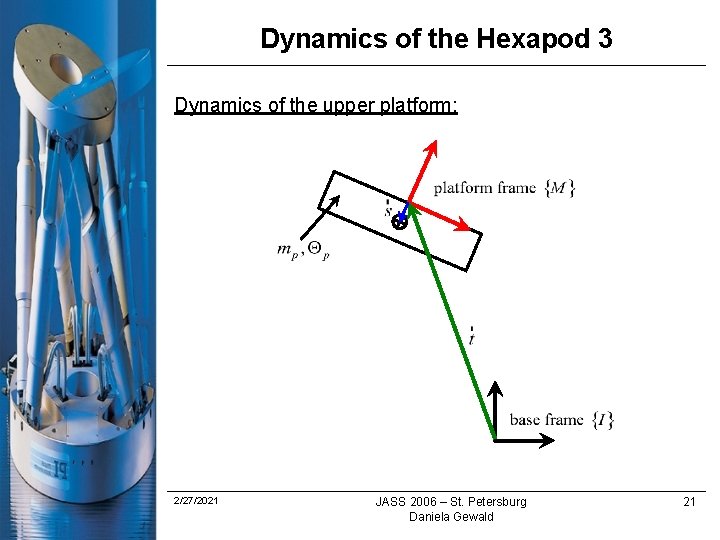
Dynamics of the Hexapod 3 Dynamics of the upper platform: 2/27/2021 JASS 2006 – St. Petersburg Daniela Gewald 21
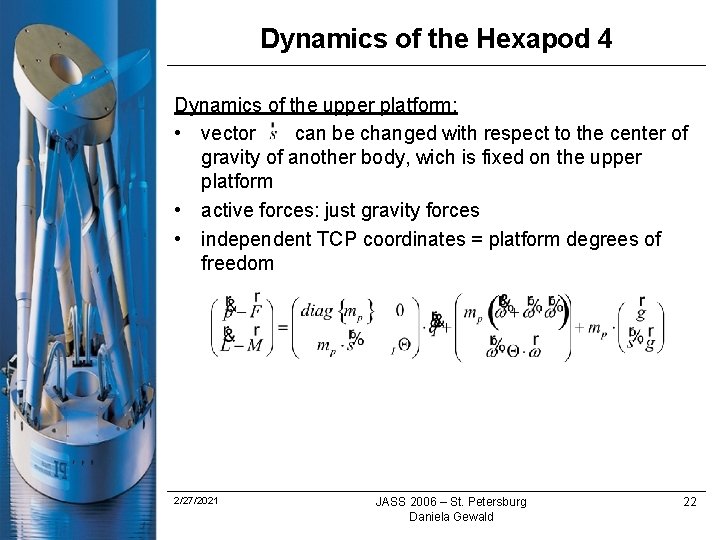
Dynamics of the Hexapod 4 Dynamics of the upper platform: • vector can be changed with respect to the center of gravity of another body, wich is fixed on the upper platform • active forces: just gravity forces • independent TCP coordinates = platform degrees of freedom 2/27/2021 JASS 2006 – St. Petersburg Daniela Gewald 22
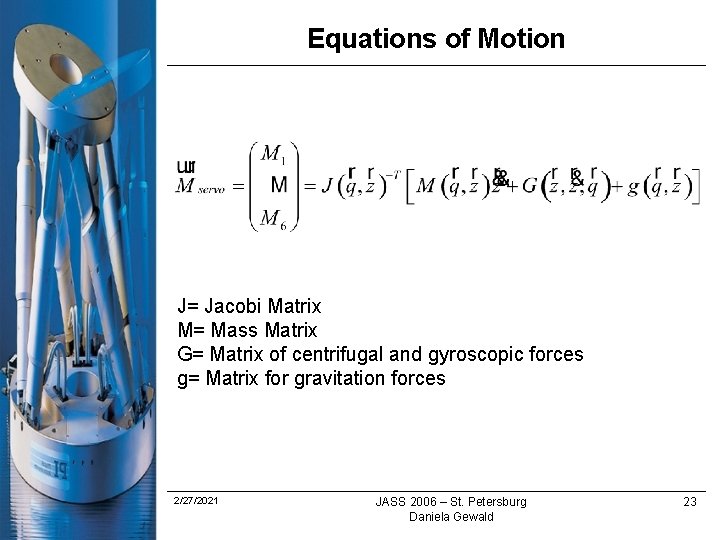
Equations of Motion J= Jacobi Matrix M= Mass Matrix G= Matrix of centrifugal and gyroscopic forces g= Matrix for gravitation forces 2/27/2021 JASS 2006 – St. Petersburg Daniela Gewald 23
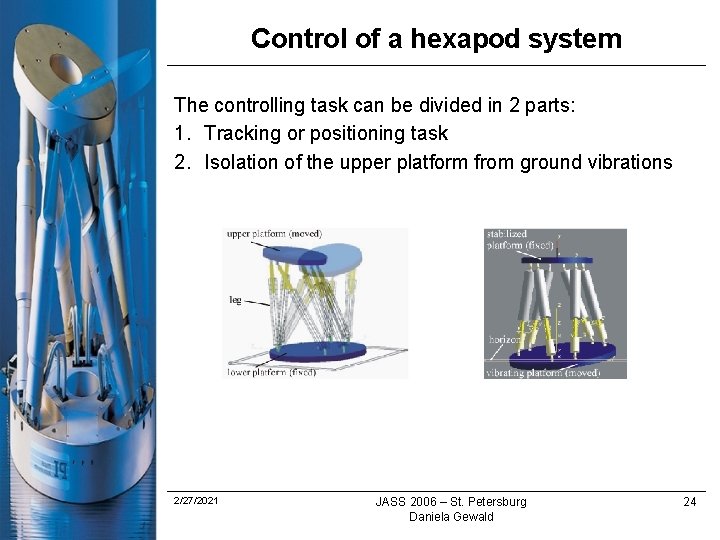
Control of a hexapod system The controlling task can be divided in 2 parts: 1. Tracking or positioning task 2. Isolation of the upper platform from ground vibrations 2/27/2021 JASS 2006 – St. Petersburg Daniela Gewald 24
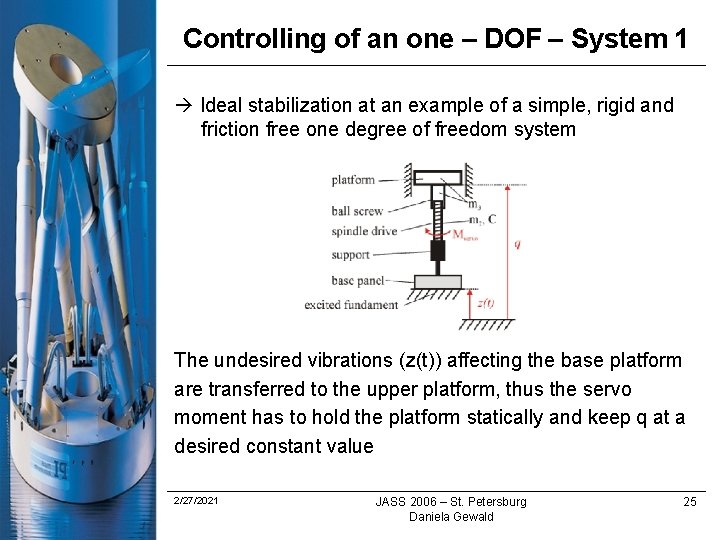
Controlling of an one – DOF – System 1 Ideal stabilization at an example of a simple, rigid and friction free one degree of freedom system The undesired vibrations (z(t)) affecting the base platform are transferred to the upper platform, thus the servo moment has to hold the platform statically and keep q at a desired constant value 2/27/2021 JASS 2006 – St. Petersburg Daniela Gewald 25
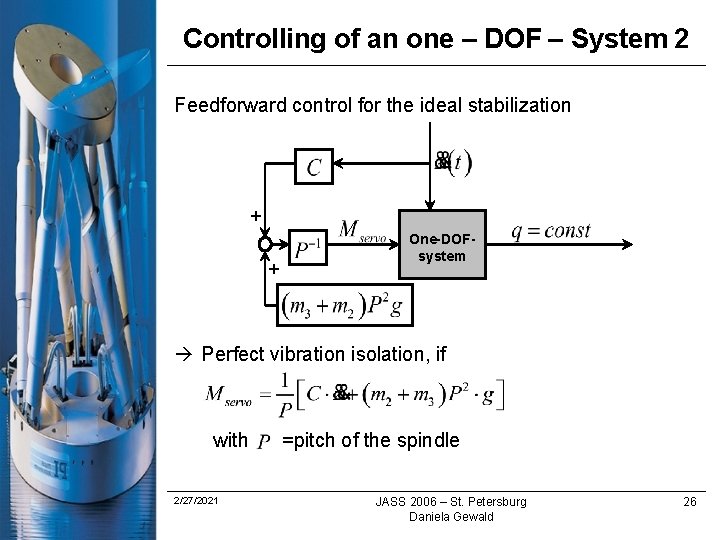
Controlling of an one – DOF – System 2 Feedforward control for the ideal stabilization + + One-DOFsystem Perfect vibration isolation, if with 2/27/2021 =pitch of the spindle JASS 2006 – St. Petersburg Daniela Gewald 26
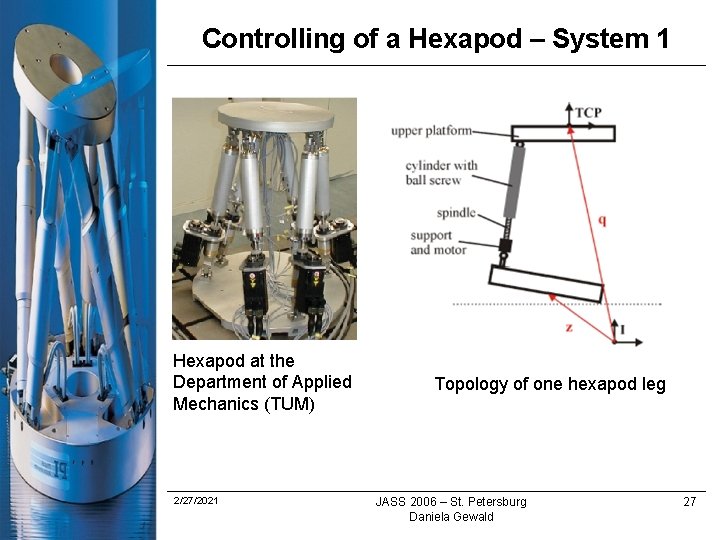
Controlling of a Hexapod – System 1 Hexapod at the Department of Applied Mechanics (TUM) 2/27/2021 Topology of one hexapod leg JASS 2006 – St. Petersburg Daniela Gewald 27
Controlling of a Hexapod – System 2 Differences between the hexapod and the one-DOFsystem: more complex equations, because of closed kinematical loops this loops are the reason for the high stiffness of the system, which allows to assume the hexapod as a rigid Multi-Body-System (MBS) Effects to be considered, when designing a controller: • parameter uncertainties • external disturbance forces • measurement noise undesired TCP motions may occur besides the feedforward controller a feedback controller, that can compensate residual vibrations of the TCP, is needed • also important: both tasks (tracking control and vibration isolation) should be treated by the controller 2/27/2021 JASS 2006 – St. Petersburg Daniela Gewald 28
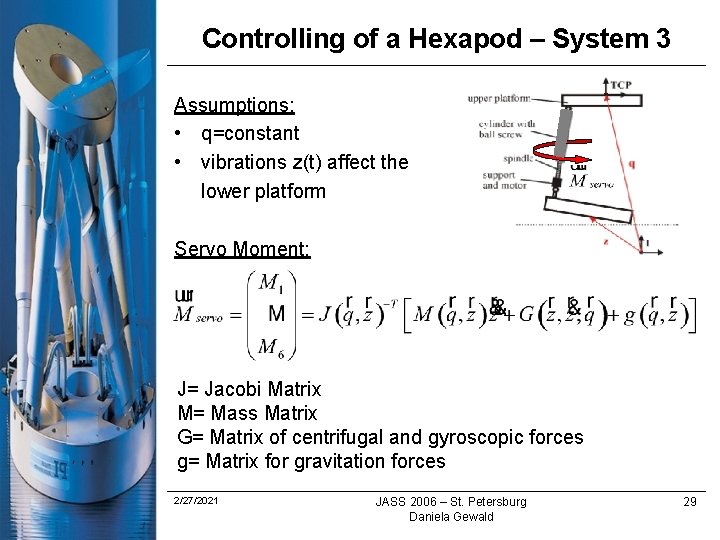
Controlling of a Hexapod – System 3 Assumptions: • q=constant • vibrations z(t) affect the lower platform Servo Moment: J= Jacobi Matrix M= Mass Matrix G= Matrix of centrifugal and gyroscopic forces g= Matrix for gravitation forces 2/27/2021 JASS 2006 – St. Petersburg Daniela Gewald 29
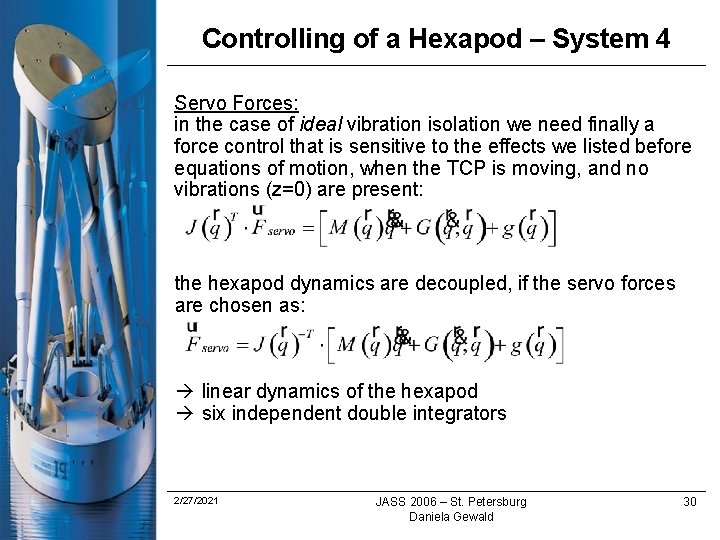
Controlling of a Hexapod – System 4 Servo Forces: in the case of ideal vibration isolation we need finally a force control that is sensitive to the effects we listed before equations of motion, when the TCP is moving, and no vibrations (z=0) are present: the hexapod dynamics are decoupled, if the servo forces are chosen as: linear dynamics of the hexapod six independent double integrators 2/27/2021 JASS 2006 – St. Petersburg Daniela Gewald 30
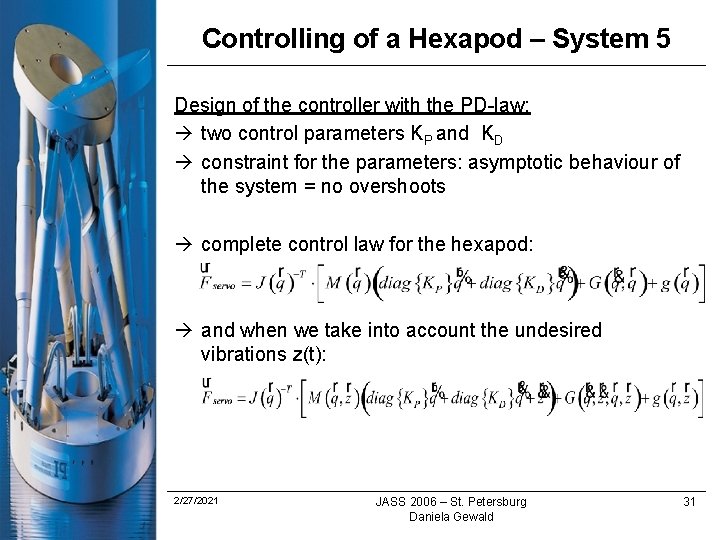
Controlling of a Hexapod – System 5 Design of the controller with the PD-law: two control parameters KP and KD constraint for the parameters: asymptotic behaviour of the system = no overshoots complete control law for the hexapod: and when we take into account the undesired vibrations z(t): 2/27/2021 JASS 2006 – St. Petersburg Daniela Gewald 31
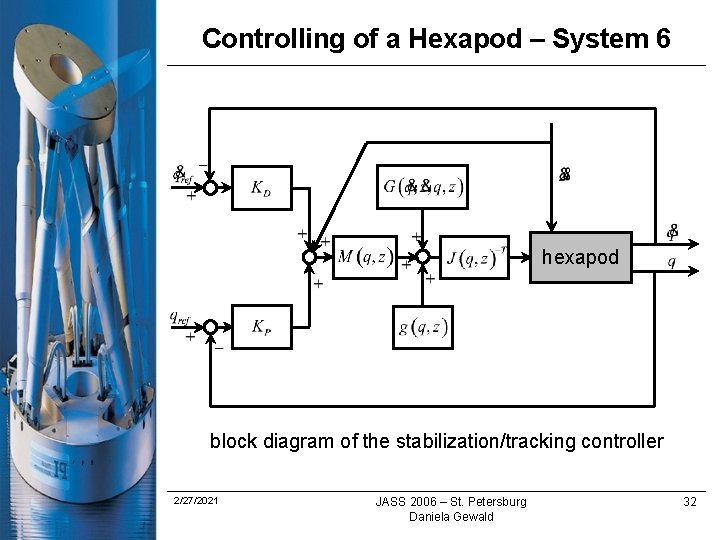
Controlling of a Hexapod – System 6 hexapod block diagram of the stabilization/tracking controller 2/27/2021 JASS 2006 – St. Petersburg Daniela Gewald 32
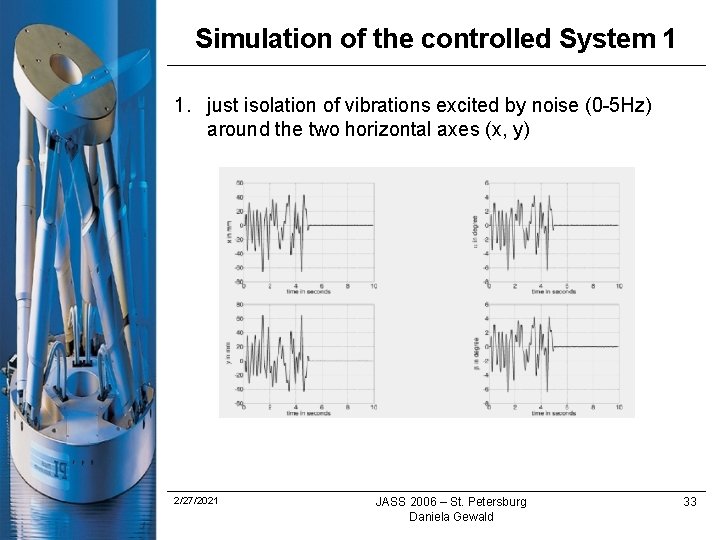
Simulation of the controlled System 1 1. just isolation of vibrations excited by noise (0 -5 Hz) around the two horizontal axes (x, y) 2/27/2021 JASS 2006 – St. Petersburg Daniela Gewald 33
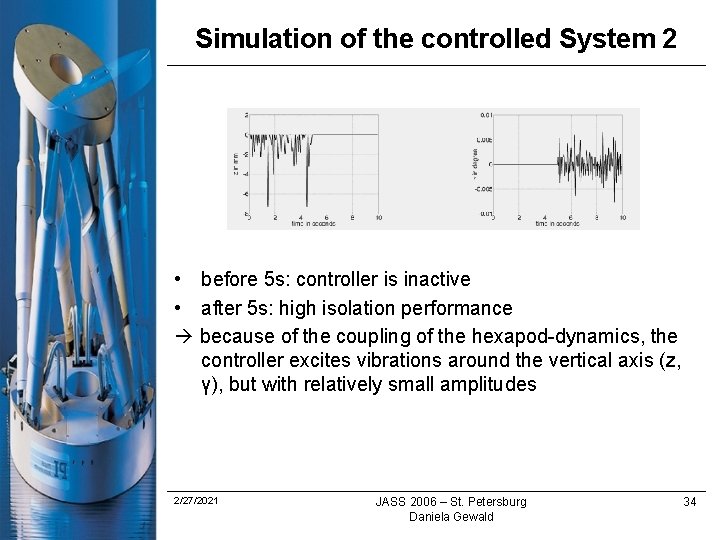
Simulation of the controlled System 2 • before 5 s: controller is inactive • after 5 s: high isolation performance because of the coupling of the hexapod-dynamics, the controller excites vibrations around the vertical axis (z, γ), but with relatively small amplitudes 2/27/2021 JASS 2006 – St. Petersburg Daniela Gewald 34
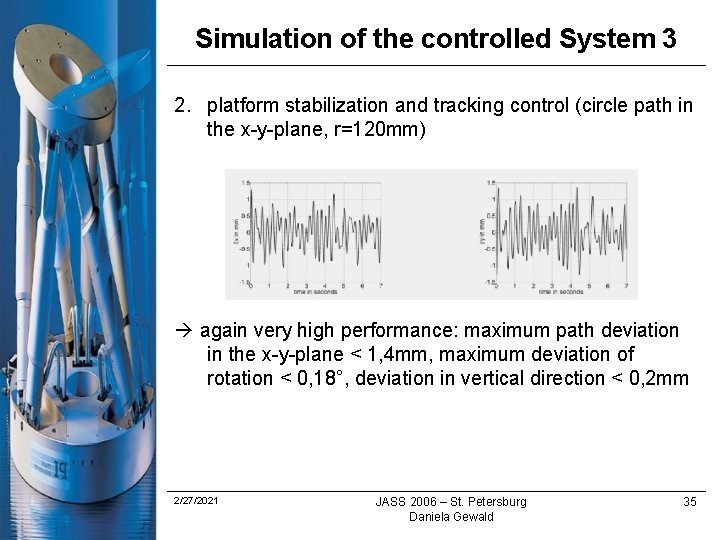
Simulation of the controlled System 3 2. platform stabilization and tracking control (circle path in the x-y-plane, r=120 mm) again very high performance: maximum path deviation in the x-y-plane < 1, 4 mm, maximum deviation of rotation < 0, 18°, deviation in vertical direction < 0, 2 mm 2/27/2021 JASS 2006 – St. Petersburg Daniela Gewald 35
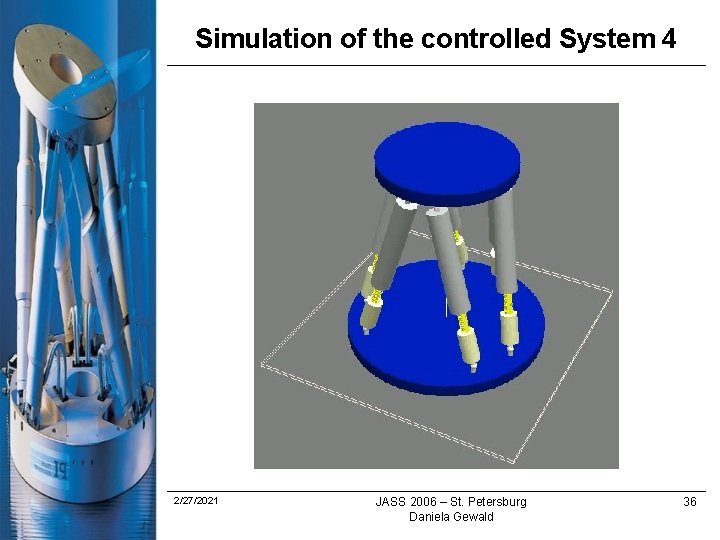
Simulation of the controlled System 4 2/27/2021 JASS 2006 – St. Petersburg Daniela Gewald 36
Simulation of the controlled System 5 2/27/2021 JASS 2006 – St. Petersburg Daniela Gewald 37
- Slides: 37