
Japans support to realize Leapfrog Low Carbon Development
Japan’s support to realize “Leapfrog” Low Carbon Development in Asian Cities Kotaro Kawamata Director, International Cooperation Office Ministry of the Environment, Japan August, 2013 Jakarta, Indonesia
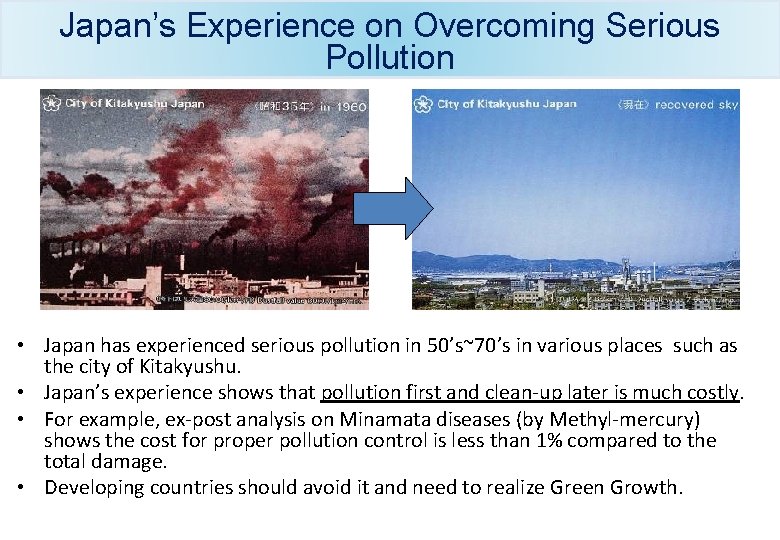
Japan’s Experience on Overcoming Serious Pollution • Japan has experienced serious pollution in 50’s~70’s in various places such as the city of Kitakyushu. • Japan’s experience shows that pollution first and clean-up later is much costly. • For example, ex-post analysis on Minamata diseases (by Methyl-mercury) shows the cost for proper pollution control is less than 1% compared to the total damage. • Developing countries should avoid it and need to realize Green Growth.
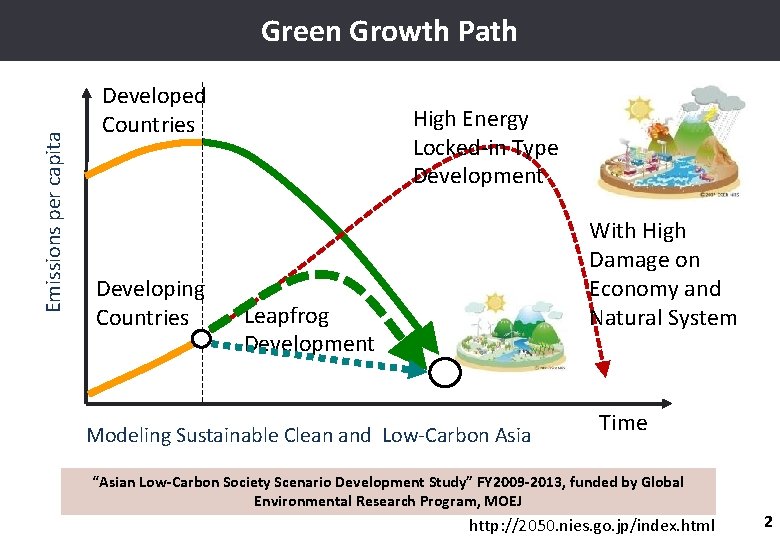
Emissions per capita Green Growth Path Developed Countries Developing Countries High Energy Locked-in Type Development With High Damage on Economy and Natural System Leapfrog Development Modeling Sustainable Clean and Low-Carbon Asia Time “Asian Low-Carbon Society Scenario Development Study” FY 2009 -2013, funded by Global Environmental Research Program, MOEJ http: //2050. nies. go. jp/index. html 2
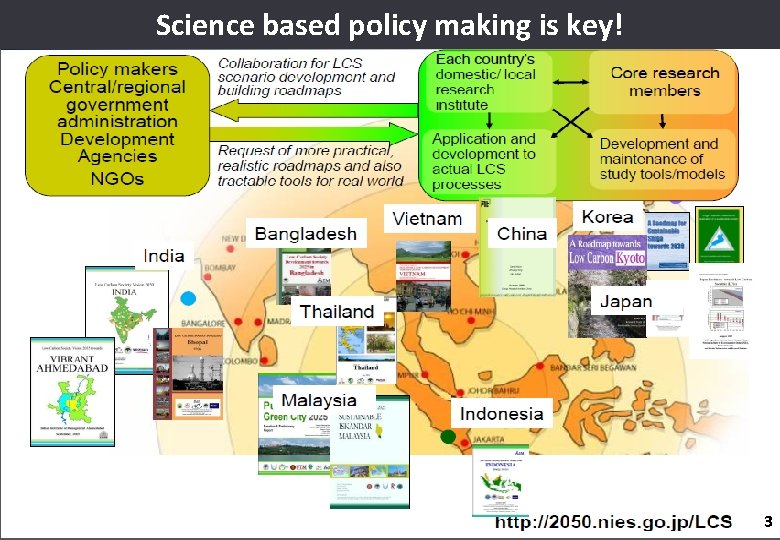
Science based policy making is key! 3
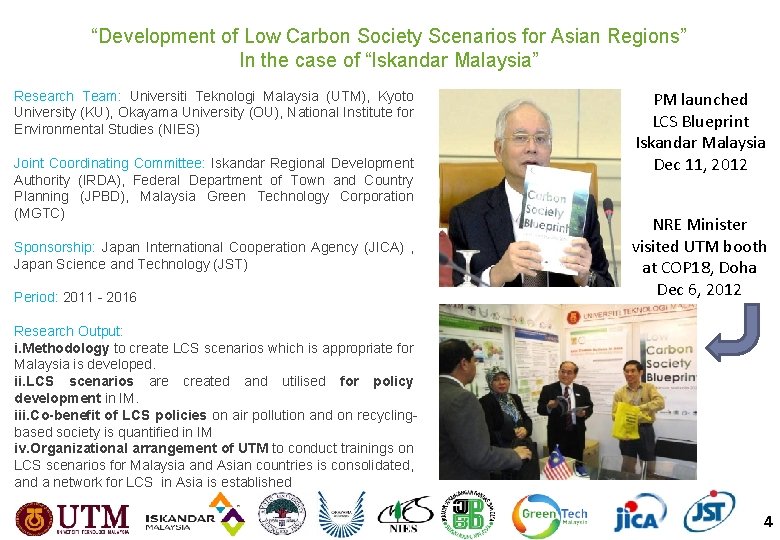
“Development of Low Carbon Society Scenarios for Asian Regions” In the case of “Iskandar Malaysia” Research Team: Universiti Teknologi Malaysia (UTM), Kyoto University (KU), Okayama University (OU), National Institute for Environmental Studies (NIES) Joint Coordinating Committee: Iskandar Regional Development Authority (IRDA), Federal Department of Town and Country Planning (JPBD), Malaysia Green Technology Corporation (MGTC) Sponsorship: Japan International Cooperation Agency (JICA) , Japan Science and Technology (JST) Period: 2011 - 2016 PM launched LCS Blueprint Iskandar Malaysia Dec 11, 2012 NRE Minister visited UTM booth at COP 18, Doha Dec 6, 2012 Research Output: i. Methodology to create LCS scenarios which is appropriate for Malaysia is developed. ii. LCS scenarios are created and utilised for policy development in IM. iii. Co-benefit of LCS policies on air pollution and on recyclingbased society is quantified in IM iv. Organizational arrangement of UTM to conduct trainings on LCS scenarios for Malaysia and Asian countries is consolidated, and a network for LCS in Asia is established 4
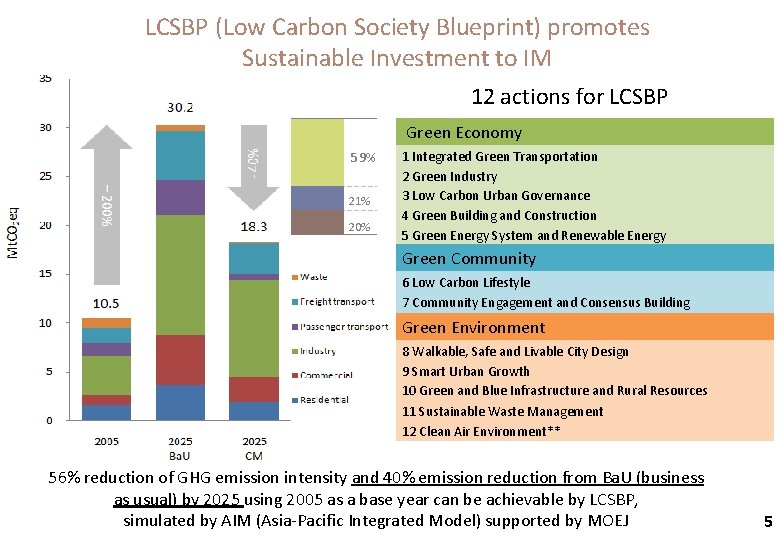
LCSBP (Low Carbon Society Blueprint) promotes Sustainable Investment to IM 12 actions for LCSBP Green Economy 59% 21% 20% 1 Integrated Green Transportation 2 Green Industry 3 Low Carbon Urban Governance 4 Green Building and Construction 5 Green Energy System and Renewable Energy Green Community 6 Low Carbon Lifestyle 7 Community Engagement and Consensus Building Green Environment 8 Walkable, Safe and Livable City Design 9 Smart Urban Growth 10 Green and Blue Infrastructure and Rural Resources 11 Sustainable Waste Management 12 Clean Air Environment** 56% reduction of GHG emission intensity and 40% emission reduction from Ba. U (business as usual) by 2025 using 2005 as a base year can be achievable by LCSBP, simulated by AIM (Asia-Pacific Integrated Model) supported by MOEJ 5
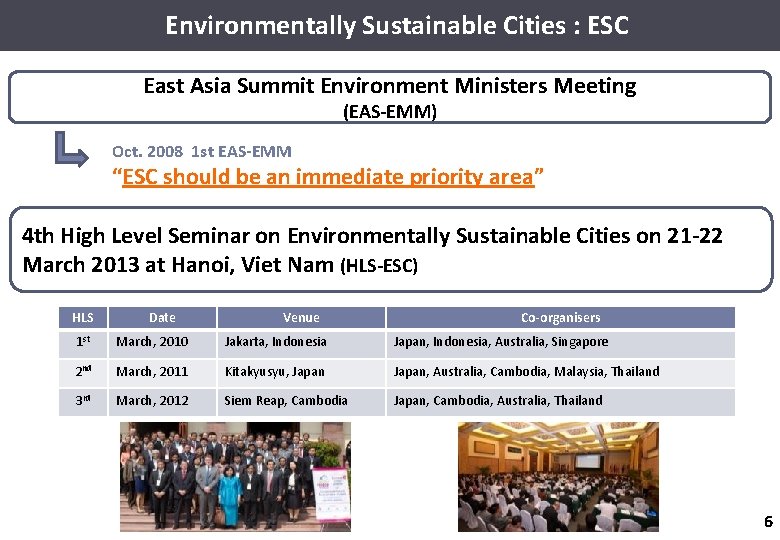
Environmentally Sustainable Cities : ESC East Asia Summit Environment Ministers Meeting (EAS-EMM) Oct. 2008 1 st EAS-EMM “ESC should be an immediate priority area” 4 th High Level Seminar on Environmentally Sustainable Cities on 21 -22 March 2013 at Hanoi, Viet Nam (HLS-ESC) HLS Date Venue Co-organisers 1 st March, 2010 Jakarta, Indonesia Japan, Indonesia, Australia, Singapore 2 nd March, 2011 Kitakyusyu, Japan, Australia, Cambodia, Malaysia, Thailand 3 rd March, 2012 Siem Reap, Cambodia Japan, Cambodia, Australia, Thailand 6
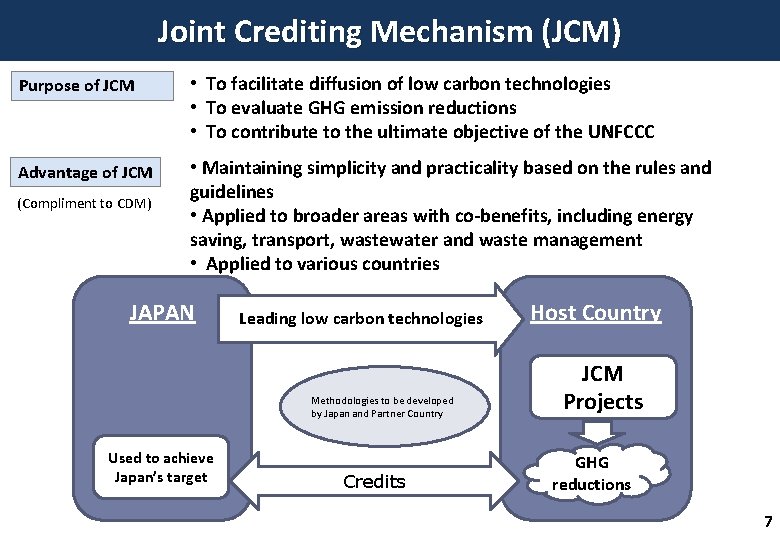
Joint Crediting Mechanism (JCM) Purpose of JCM • To facilitate diffusion of low carbon technologies • To evaluate GHG emission reductions • To contribute to the ultimate objective of the UNFCCC Advantage of JCM • Maintaining simplicity and practicality based on the rules and guidelines • Applied to broader areas with co-benefits, including energy saving, transport, wastewater and waste management • Applied to various countries (Compliment to CDM) JAPAN Leading low carbon technologies Methodologies to be developed by Japan and Partner Country Used to achieve Japan’s target Credits Host Country JCM Projects GHG reductions 7
New Expanded Program for ESC 8
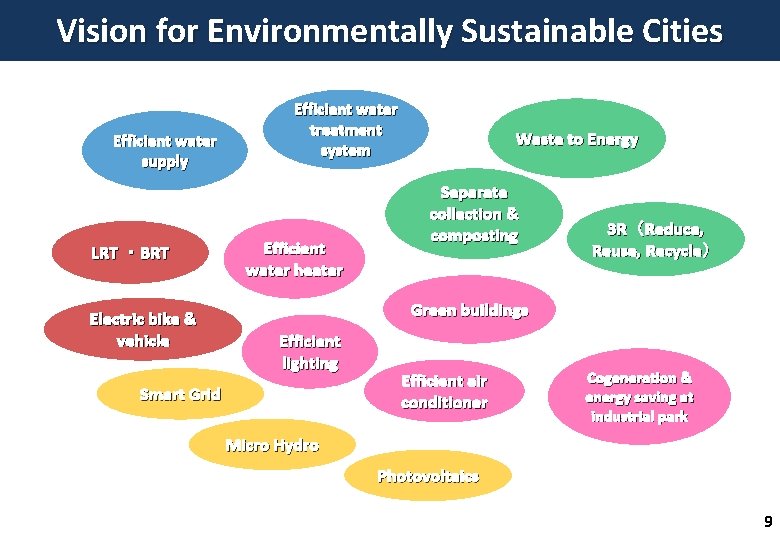
Vision for Environmentally Sustainable Cities Efficient water supply LRT ・BRT Electric bike & vehicle Efficient water treatment system Efficient water heater Waste to Energy Separate collection & composting 3 R(Reduce, Reuse, Recycle) Green buildings Efficient lighting Smart Grid Efficient air conditioner Cogeneration & energy saving at industrial park Micro Hydro Photovoltaics 9
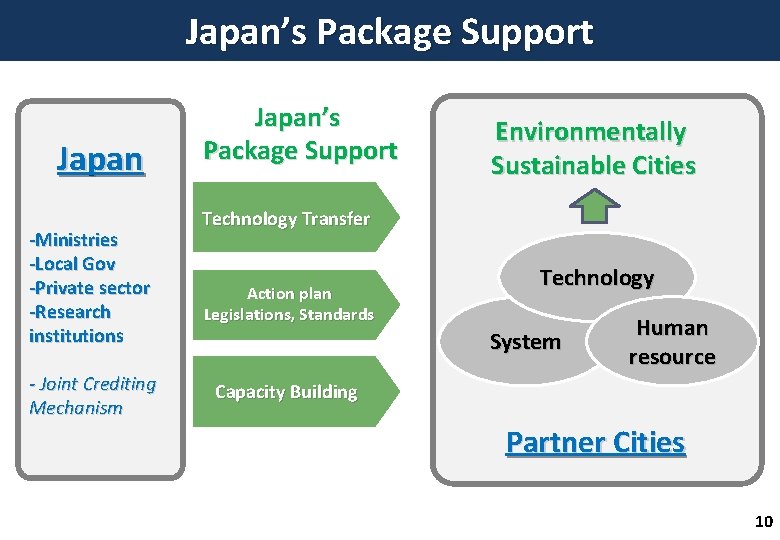
Japan’s Package Support Japan -Ministries -Local Gov -Private sector -Research institutions - Joint Crediting Mechanism Japan’s Package Support Environmentally Sustainable Cities Technology Transfer Action plan Legislations, Standards Technology System Human resource Capacity Building Partner Cities 10
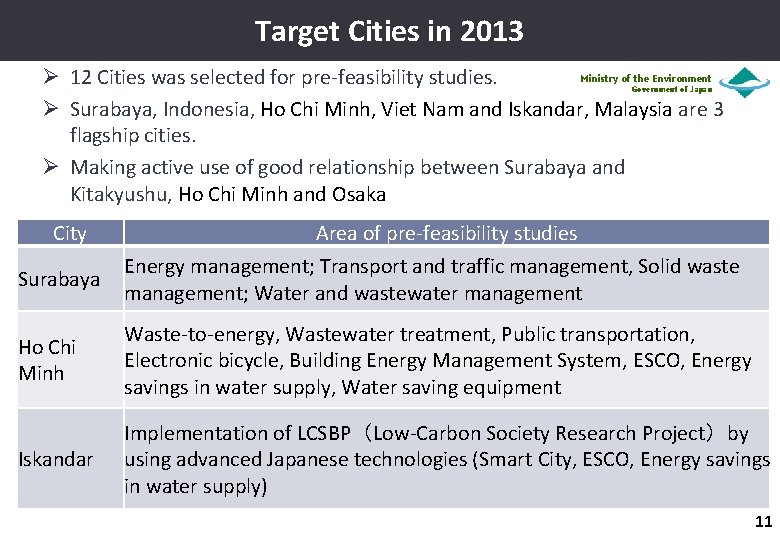
Target Cities in 2013 Ministry of the Environment Ø 12 Cities was selected for pre-feasibility studies. Ø Surabaya, Indonesia, Ho Chi Minh, Viet Nam and Iskandar, Malaysia are 3 flagship cities. Ø Making active use of good relationship between Surabaya and Kitakyushu, Ho Chi Minh and Osaka Government of Japan City Surabaya Area of pre-feasibility studies Energy management; Transport and traffic management, Solid waste management; Water and wastewater management Ho Chi Minh Waste-to-energy, Wastewater treatment, Public transportation, Electronic bicycle, Building Energy Management System, ESCO, Energy savings in water supply, Water saving equipment Iskandar Implementation of LCSBP(Low-Carbon Society Research Project)by using advanced Japanese technologies (Smart City, ESCO, Energy savings in water supply) 11
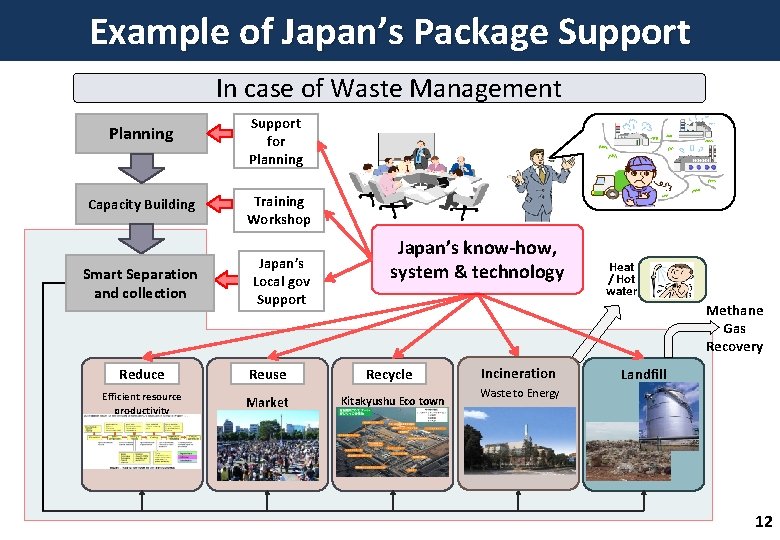
Example of Japan’s Package Support In case of Waste Management Planning Capacity Building Smart Separation and collection Support for Planning Training Workshop Japan’s Local gov Support Japan’s know-how, system & technology Heat / Hot water Methane Gas Recovery Reduce Reuse Recycle Efficient resource productivity Market Kitakyushu Eco town Incineration Landfill Waste to Energy 12
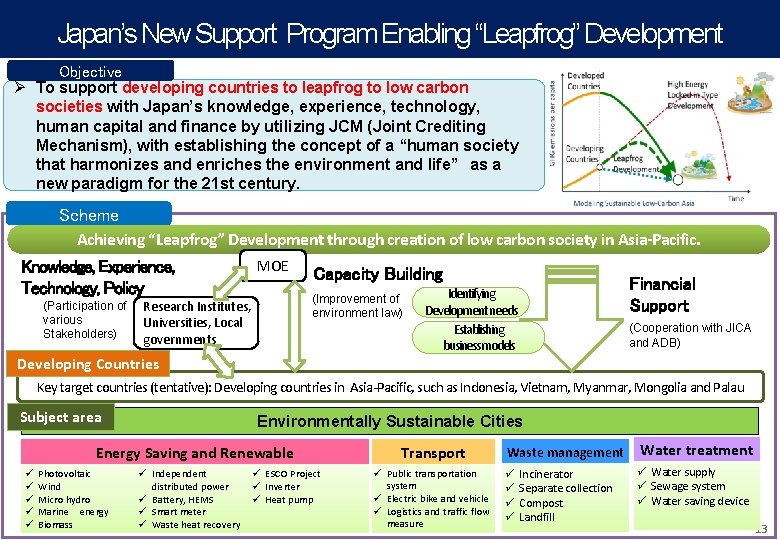
Japan’s New Support Program Enabling “Leapfrog” Development Objective Ø To support developing countries to leapfrog to low carbon societies with Japan’s knowledge, experience, technology, human capital and finance by utilizing JCM (Joint Crediting Mechanism), with establishing the concept of a “human society that harmonizes and enriches the environment and life” as a new paradigm for the 21 st century. Scheme Achieving “Leapfrog” Development through creation of low carbon society in Asia-Pacific. Knowledge, Experience, Technology, Policy (Participation of various Stakeholders) MOE Capacity Building (Improvement of environment law) Research Institutes, Universities, Local governments Developing Countries Financial Support Identifying Development needs Establishing businessmodels (Cooperation with JICA and ADB) Key target countries (tentative): Developing countries in Asia-Pacific, such as Indonesia, Vietnam, Myanmar, Mongolia and Palau Subject area Environmentally Sustainable Cities Energy Saving and Renewable ü ü ü Photovoltaic Wind Micro hydro Marine energy Biomass ü Independent distributed power ü Battery, HEMS ü Smart meter ü Waste heat recovery ü ESCO Project ü Inverter ü Heat pump Transport ü Public transportation system ü Electric bike and vehicle ü Logistics and traffic flow measure Waste management ü ü Incinerator Separate collection Compost Landfill Water treatment ü Water supply ü Sewage system ü Water saving device 13
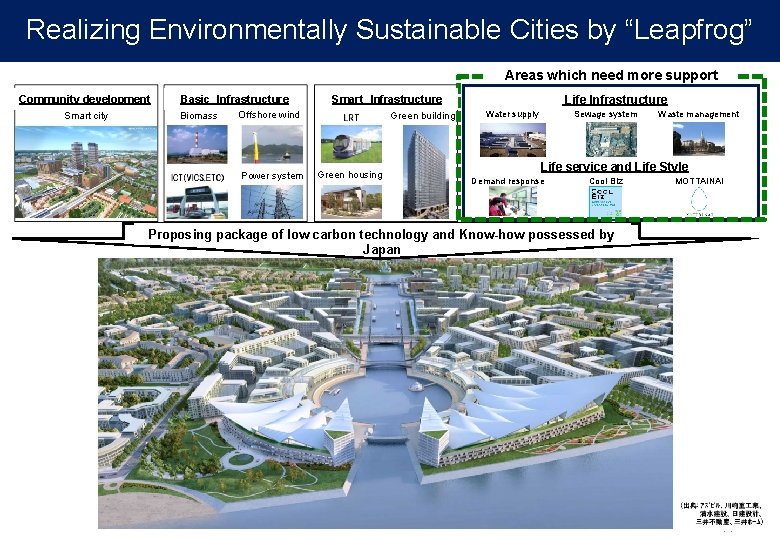
Realizing Environmentally Sustainable Cities by “Leapfrog” Areas which need more support Community development Smart city Basic Infrastructure Biomass Smart Infrastructure Offshore wind Power system Green building Green housing Life Infrastructure Water supply Sewage system Waste management Life service and Life Style Demand response Cool Biz MOTTAINAI Proposing package of low carbon technology and Know-how possessed by Japan 14
- Slides: 15