
Japans industrialization The Tokugawa shogunate Shoguns main job

Japan’s industrialization
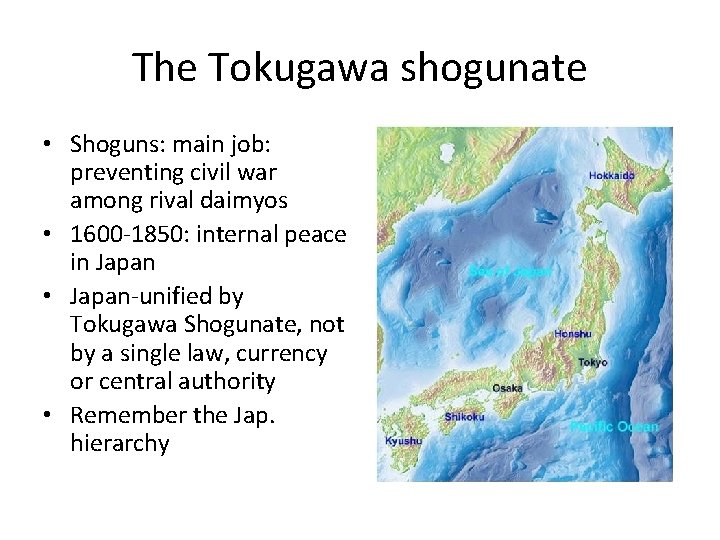
The Tokugawa shogunate • Shoguns: main job: preventing civil war among rival daimyos • 1600 -1850: internal peace in Japan • Japan-unified by Tokugawa Shogunate, not by a single law, currency or central authority • Remember the Jap. hierarchy
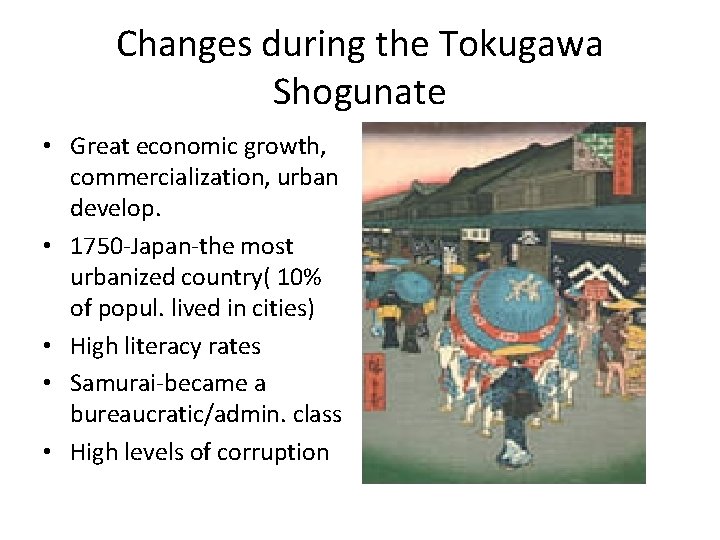
Changes during the Tokugawa Shogunate • Great economic growth, commercialization, urban develop. • 1750 -Japan-the most urbanized country( 10% of popul. lived in cities) • High literacy rates • Samurai-became a bureaucratic/admin. class • High levels of corruption
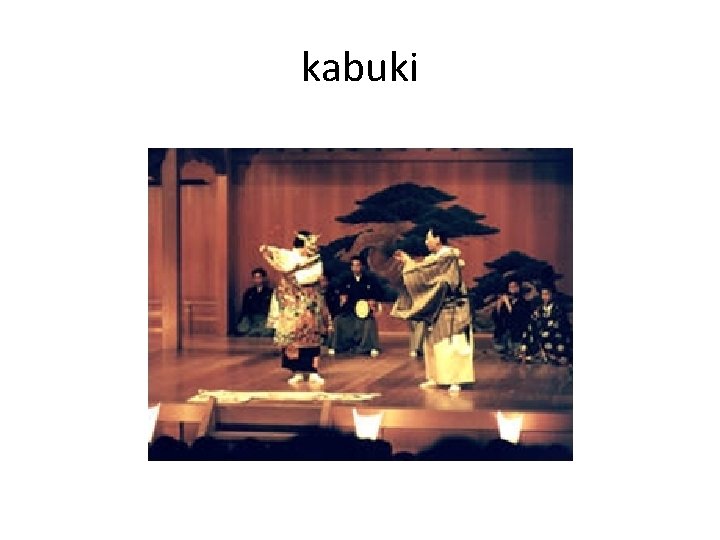
kabuki
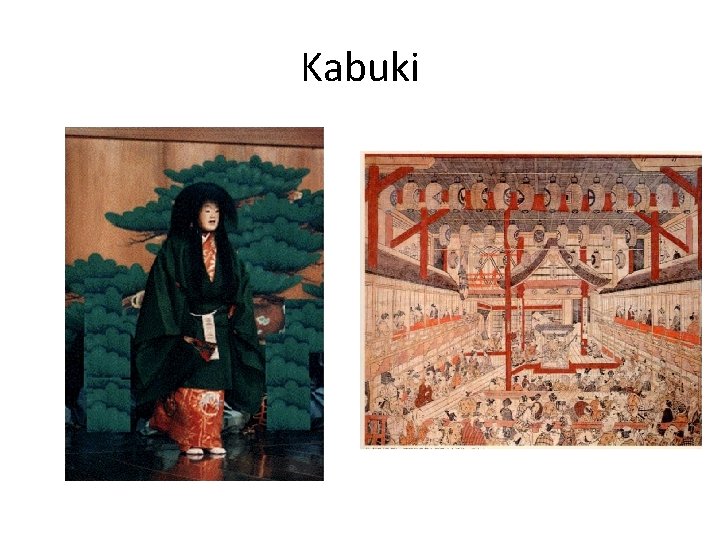
Kabuki
Changes during the Tokugawa Shogunate • 1853, Commodore Perry ( sent by U. S. ) demanded the opening of trade ports • The shogun accepted, his acceptance=civil war • 1868 -a group of young samurai restored in power the 15 yrs. emperor Meiji • He inaugurated the Meiji Era
Meiji Era • A series of reforms that transform radically the Japanese society, 1853 -1900 • At the end of it Japan was powerful modern, industrialized and united. • Had its own E Asian empire.
Modernization Japanese style • Creation of national unity 1) All Japanese became equal( the daimyos & samurai lost their privileges) 2) Dismantled the Confucian-based social order • Interest in study the West( science, fashion) 1) stud. sent to study abroad 2) Official missions sent to the West 3) Borrowing from the West
• Shinto-state cult • State-guided industr. a)govern. established model factories, built railroads b) The factories were sold to private investors c) moderniz. without foreign debt. d)Society paid the price: poverty, infanticide
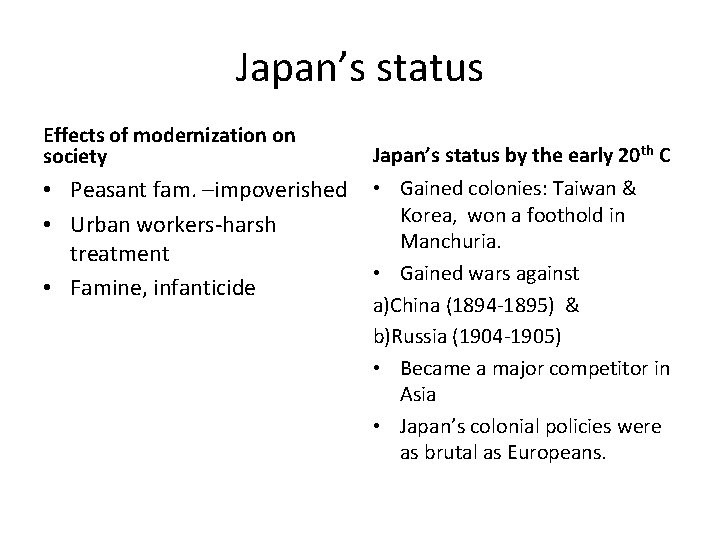
Japan’s status Effects of modernization on society • Peasant fam. –impoverished • Urban workers-harsh treatment • Famine, infanticide Japan’s status by the early 20 th C • Gained colonies: Taiwan & Korea, won a foothold in Manchuria. • Gained wars against a)China (1894 -1895) & b)Russia (1904 -1905) • Became a major competitor in Asia • Japan’s colonial policies were as brutal as Europeans.
Ch. 20 Colonial encounters, 1750 -1914
What differences were between the 1 st and 2 nd wave of colonialism?
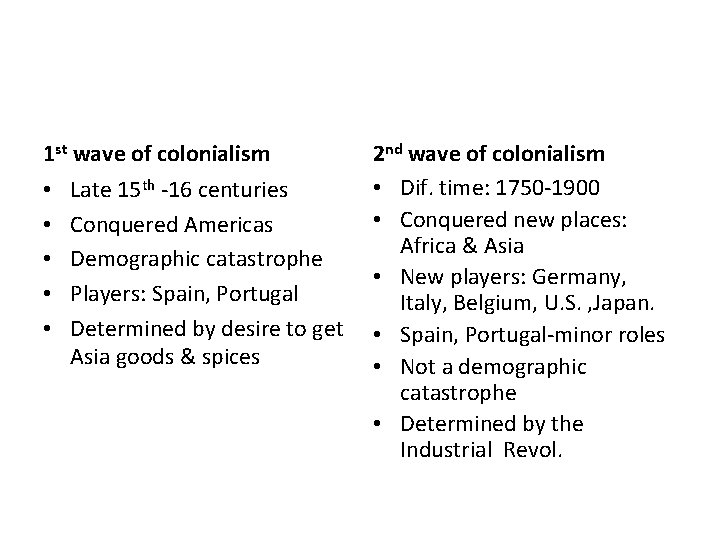
1 st wave of colonialism • • • Late 15 th -16 centuries Conquered Americas Demographic catastrophe Players: Spain, Portugal Determined by desire to get Asia goods & spices 2 nd wave of colonialism • Dif. time: 1750 -1900 • Conquered new places: Africa & Asia • New players: Germany, Italy, Belgium, U. S. , Japan. • Spain, Portugal-minor roles • Not a demographic catastrophe • Determined by the Industrial Revol.
On what was based the establishment of the 2 nd wave of European empires? What was the Europ. advantage? How did a country become a colony?
Europ. conquest • The establishment of the 2 nd wave of Europ. Empires was based on military force. • Europ. advantage: organiz. , drill, superior military technology( repeating rifles, machineguns). • Europ. Conquest a) India & Indonesia: taken over by Europ. after they’ve been monopolized by East India Company
Europ. conquest b)Africa, SE Asia & the Pacific islands: deliberate conquest • 1875 -1900: “the scramble for Africa” based on strong Europ. Rivalry • After the Berlin Conf. , the Europ. powers decided to divided completely Africa. c)Australia & New Zealand: coloniz. similar to N America d) U. S. & Russia: continual expansion e) Taiwan & Korea: Japanese took over in a manner similar to Europ. f) Ethiopia & Siam( Thailand)avoided colonization g) Liberia: settled by freed U. S. slaves
What were the reactions to colonial occupation?
Reactions to colonial occupation • Traumatic consequences b/c of loss of life, property & independence a) Cooperation with Europ. in order to 1) keep their privileges 2) be employed in army 3) a small class of natives was raised with W education; the governm. relied on them over time.
Reaction to colonial occupation b) Rebellions Before the rebellion: India was under East India Company’s rule( 1765 -1857) Indian Rebellion(Sepoy rebellion) 1857 -1858 Causes: Indians were not allowed to join the Indian Civil Service; have to pay heavy taxes Pretext: the innovation of a new type of rifle Goal: the revival of the Mughal Empire Effect: British assumed direct control over India
What were the characteristics of the colonial empires?
Colonial empires' characteristics a) Education for native pop. was limited to basic, practical matters. b) Racism was strong in areas with numerous Europ. settlers c) Colonial policies: were dictatorships d) Racial classifications were against Christian & enlightenment ideas e) Colonizers –against the spread of modernization to the colonies.
What were the effects of colonial rule on people’s ways of working?
Effects of colonial rule a) Unpaid labor on public projects b) Abuses ( the worst abuses were in the Congo Free State-high demands of labor; Belgium stopped the abuse & took control of Congo in 1908) c) “cultivation system” in Indonesia: peasants had to cultivate 20% of their land to cash crops to pay their taxes d) Areas that resisted the “cultivation system” E. g. German East Africa( 1905 rebellion, forced cotton cultiv. ), Mozambique-peasants sabotage.
Effects of colonial rule a)Cash-crops agriculture • Many small farmers developed export agriculture • Many colonies specialized in one or two cash crops, creating dependence. E. g. Ghana-leading supplier of cocoa by 1911 b)Wage labor • Condit. of work in Europ. enterprises: low pay, harsh condit. , high death rate. • People moved to Europ. plantations b/c they lost their own land
- Slides: 24