
JAPANS BANKING SYSTEM FROM THE BUBBLE AND CRISIS

JAPAN’S BANKING SYSTEM: FROM THE BUBBLE AND CRISIS TO RECONSTRUCTION Masahiro Kawai Institute of Social Science University of Tokyo Japan Center for Global Partnership Conference “Macro/Financial Issues and International Economic Relations: Policy Options for Japan and the United States” Tokyo, May 13, 2004
PRESENTATION I. II. INTRODUCTION MACROECONOMIC DEVELOPMENTS AND THE BANKING SECTOR III. CAUSES OF THE BANKING SECTOR CRISIS AND DIFFICULTIES IV. IMPACT OF BANKING SECTOR DISTRESS V. POLICY FRAMEWORKS FOR BANK RESTRUCTURING AND ITS PROGRESS VI. CONCLUDING REMARKS
I. INTRODUCTION • What are the factors behind the recent banking sector difficulty, particularly the 1997 -98 systemic crisis, in Japan? • Why did the government fail to address the problem early, quickly and decisively? • Since the crisis, has the FSA formulated and implemented a comprehensive policy to resolve banking sector problems? • Has there been sufficient progress on financial sector and corporate sector restructuring? • Is the worst over in the Japanese banking system? Is the banking sector solvent? What are risks? • What should be done to transform the Japanese banking system into a competitive market-based system?
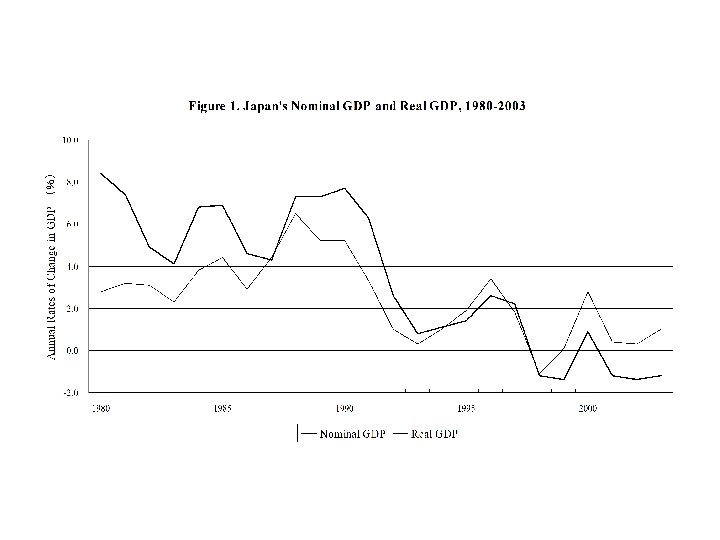
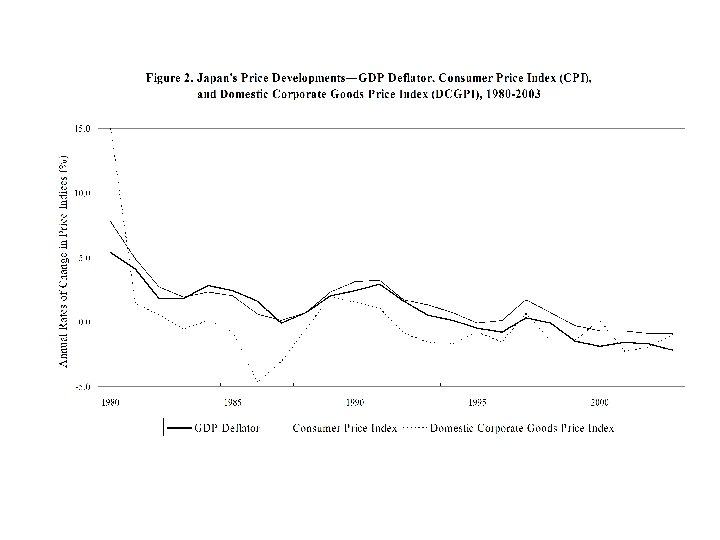
II. MACROECONOMIC DEVELOPMENTS AND THE BANKIG SECTOR 1. Macroeconomic Performance and Policy • Output stagnation (Figure 1) : The average annual growth rate of real GDP was 1. 1 percent during the last decade, 1992 -2002. Near-zero growth (0. 1%) in 1998 -2002. In addition, nominal GDP has been more stagnant (-1. 2% in 1998 -02). • Price deflation (Figure 2) : The average annual inflation rates during 1992 -2002 were low or negative at 0. 2% for CPI and 0. 1% for GDP price deflators. The GDP deflator fell in 19952002 (except 1997) at 1. 0% per year and CPI fell in 1999 -2002 at 0. 7% per year. • High unemployment rate, reaching a peak of 5. 5%. • Keynesian fiscal spending in 1992 -2002, rising from the average size of 32% of GDP in 1991 to 39% in the early 2000 s, with a declining fiscal revenue (from 34% of GDP in 1991 to 31% recently).
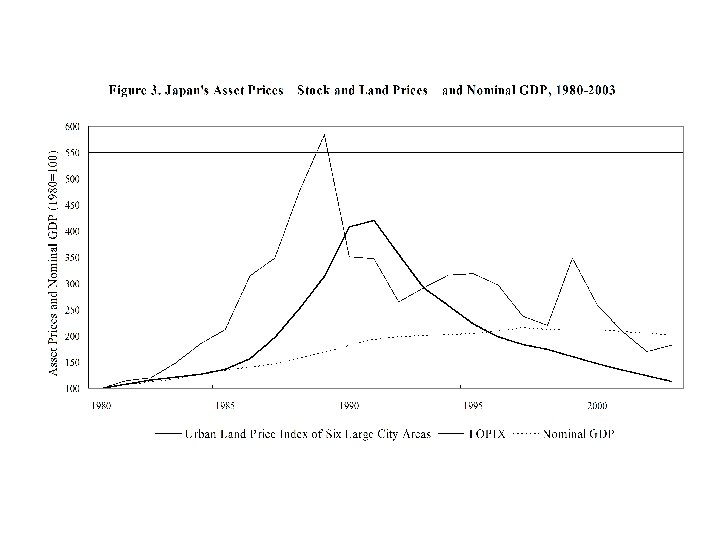
II. MACROECONOMIC DEVELOPMENTS AND THE BANKIG SECTOR (cont’d) 2. Asset Prices • There was an asset price bubble in the late 1980 s. The increases in asset prices were much faster than nominal GDP (Figure 3). • The equity price reached its peak in December 1989 and has since then declined as a trend. • The urban land price for six major city areas reached its peak in September 1991 and since then has been declining persistently. • Relative to nominal GDP (1980=100), the land price became lower in 1996 and the equity price in 2002.
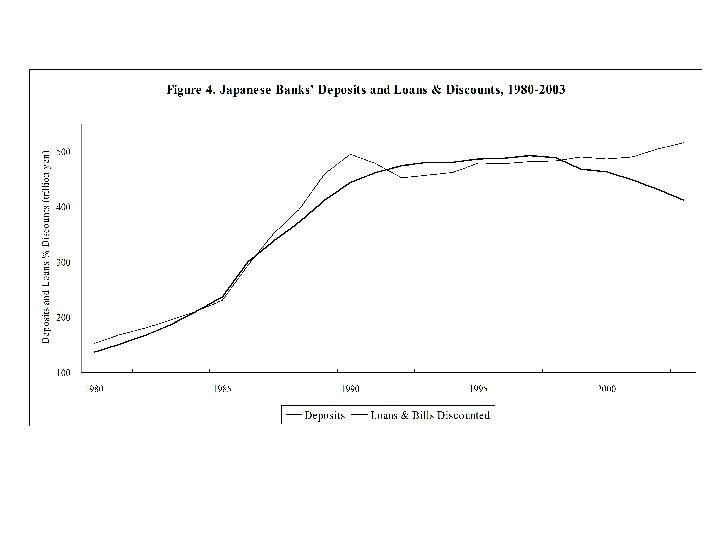
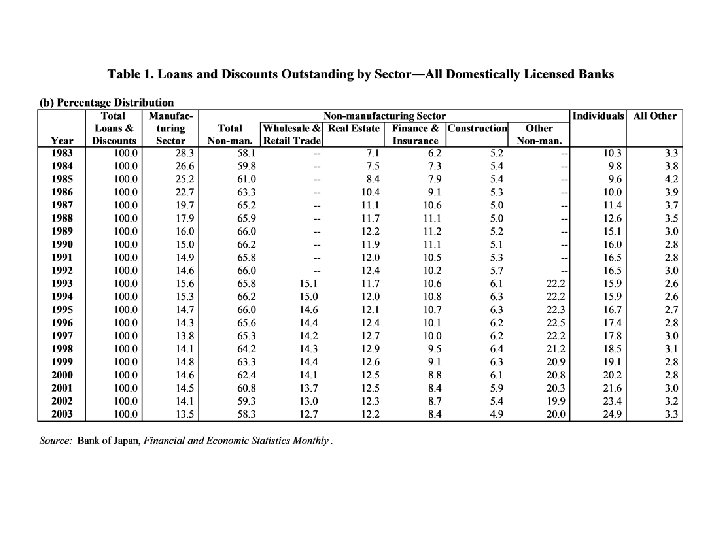
II. MACROECONOMIC DEVELOPMENTS AND THE BANKIG SECTOR (cont’d) 3. Banking Sector Conditions • Expansion of bank loans in the late 1980 s, together with the expansion of bank deposits (Figure 4). Loans were extended to firms with assets such as land as a collateral. • Loans were concentrated in wholesale and retail trade, real estate, finance and insurance, and construction (Table 1). • The bursting of the bubble in the early 1990 s made highly indebted firms in these sectors unable to repay due to the decline in collateral values, thus creating non-performing loans (NPLs). • But bank exposure to certain sectors, such as real estate and construction, continued to expand until the second half or the middle of the 1990 s. • As a result, NPLs rapidly increased in the banking sector, and the banking system fell into a systemic crisis in 1997 -98.
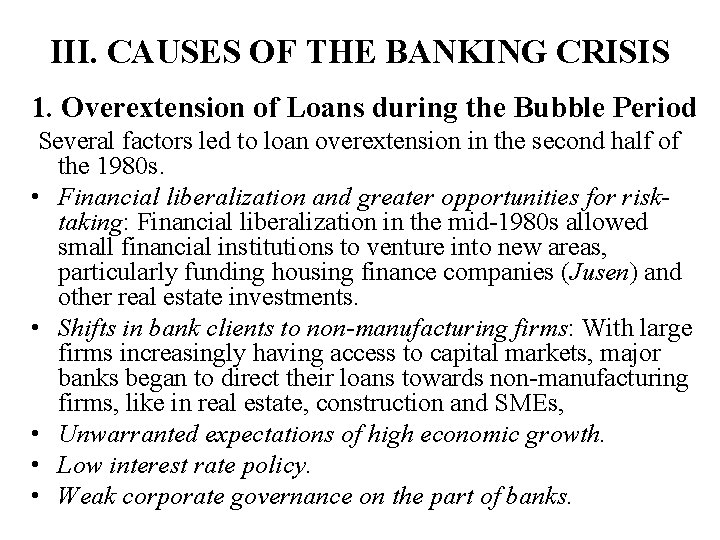
III. CAUSES OF THE BANKING CRISIS 1. Overextension of Loans during the Bubble Period Several factors led to loan overextension in the second half of the 1980 s. • Financial liberalization and greater opportunities for risktaking: Financial liberalization in the mid-1980 s allowed small financial institutions to venture into new areas, particularly funding housing finance companies (Jusen) and other real estate investments. • Shifts in bank clients to non-manufacturing firms: With large firms increasingly having access to capital markets, major banks began to direct their loans towards non-manufacturing firms, like in real estate, construction and SMEs, • Unwarranted expectations of high economic growth. • Low interest rate policy. • Weak corporate governance on the part of banks.
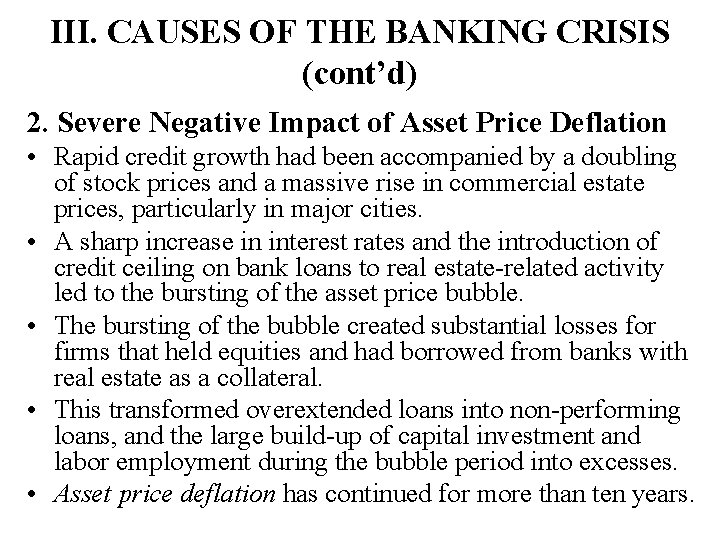
III. CAUSES OF THE BANKING CRISIS (cont’d) 2. Severe Negative Impact of Asset Price Deflation • Rapid credit growth had been accompanied by a doubling of stock prices and a massive rise in commercial estate prices, particularly in major cities. • A sharp increase in interest rates and the introduction of credit ceiling on bank loans to real estate-related activity led to the bursting of the asset price bubble. • The bursting of the bubble created substantial losses for firms that held equities and had borrowed from banks with real estate as a collateral. • This transformed overextended loans into non-performing loans, and the large build-up of capital investment and labor employment during the bubble period into excesses. • Asset price deflation has continued for more than ten years.
III. CUASES OF THE BANKING CRISIS (Cont’d) 3. Policy Failure to Contain the Problem Quickly • Policymakers initially had a strong bias against the bubble and continued to suppress asset prices even after the price collapse. • Hesitation in taking decisive measures for fear that it might touch off a banking sector panic. • The initial approach was based on the expectation that a resumption of economic growth would restore financial health of banks and their clients. • Keynesian fiscal policy sustained minimum growth. • There was no domestic or external pressure to accelerate the resolution of banking problems.
IV. IMPACT OF BANKIG DISTRESS 1. Collapse of the Traditional “Convoy System” • Until the 1990 s, the process for managing bank failure was largely ad hoc, based on the informal “convoy system. ” • Using its branch licensing authority, MOF encouraged stronger, healthier banks to absorb insolvent institutions through informal, administratively orchestrated, bank P&A transactions. • In addition, BOJ often provided liquidity assistance to prevent systemic crises. • But it became increasingly difficult to persuade banks to provide assistance to other troubled banks because even relatively strong banks faced serious NPL problems. • Major shareholders and firms associated with Hokkaido Takushoku Bank, Yamaichi Securities and Sanyo Securities refused to help them. Relatively strong banks also refused to provide assistance. • Temporary nationalization of the Long-Term Credit Bank of Japan in October 1998 signified the end of the “convoy system. ”
IV. IMPACT OF BANKIG DISTRESS (cont’d) 2. Downsizing of Bank Business • One response to the banking crisis has been further deregulation, rather than stopping it, along with the principle of “Financial Big Bang, ” and the encouragement of mergers and consolidation. • The temporarily nationalized LTCB was sold to foreign stakes. • Commercial banks have been forced to rethink their business strategies by downsizing their operations -End of quantitative targets (maximization of deposit collection and loan extension) -Focus on core competency -Retreat from foreign operations
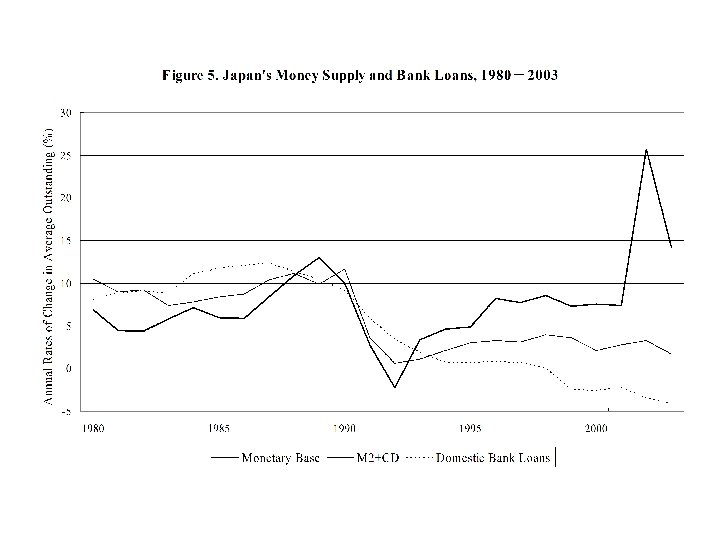
IV. IMPACT OF BANKIG DISTRESS (cont’d) 3. Impacts on Monetary and Fiscal Policy • Commercial banks with large NPLs have not been expanding loans, and indebted firms have had no appetite to borrow, and instead have been repaying their bank loans to reduce debt. • Weaker monetary transmission mechanisms: -Under the zero interest rate policy, BOJ switched to “quantitative easing” (March 2001) providing liquidity to the banking sector. Monetary base has been growing relatively fast, but M 2&CD has not been growing as fast (Figure 5). -Absence of banks’ normal financial intermediary function weakens monetary policy transmission mechanisms. • Fiscal worsening: Rise in government spending, decline in tax revenue, large budget deficits and mounting public debt.
V. POLICY FRAMEWORKS FOR BANK RESTRUCTURING AND ITS PROGRESS 1. Stabilization of the Banking System • The banking sector was in systemic crisis in late 1997 to 1998. The banking sector has been stabilized since then due to more decisive policy actions. • Means of stabilizing the banking sector: -Blanket deposit guarantee -Extension of emergency liquidity assistance to troubled banks -Financial assistance to promote mergers among troubled financial institutions -Decision to inject capital to weak but viable banks -Temporary nationalization of non-viable banks
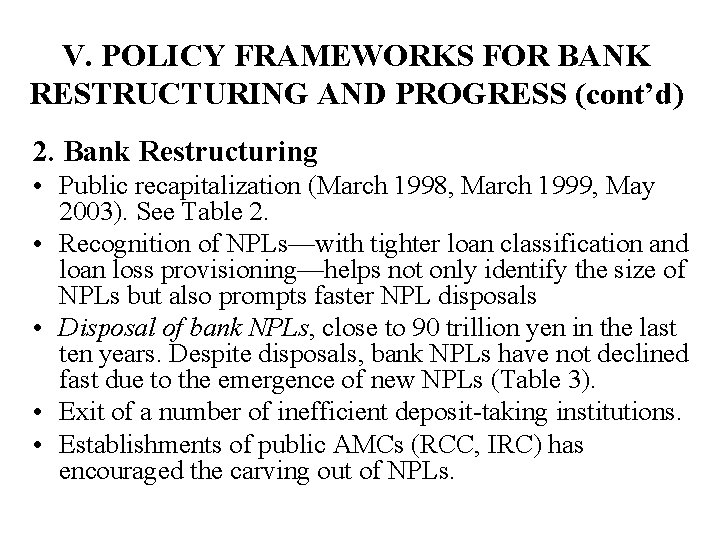
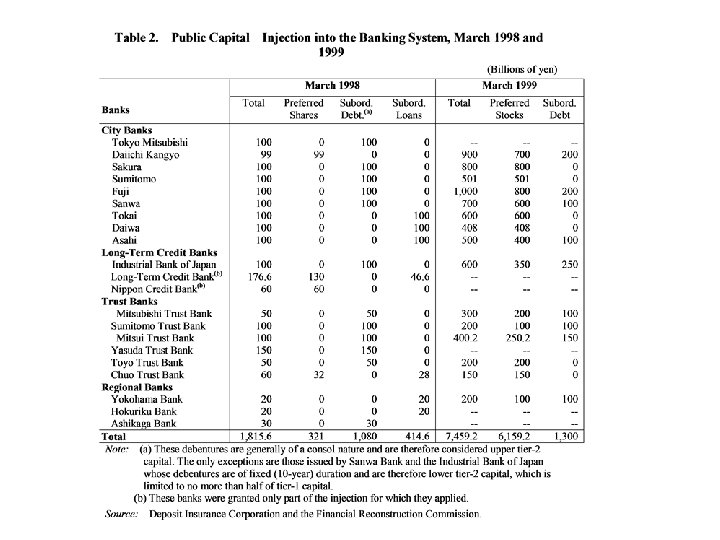
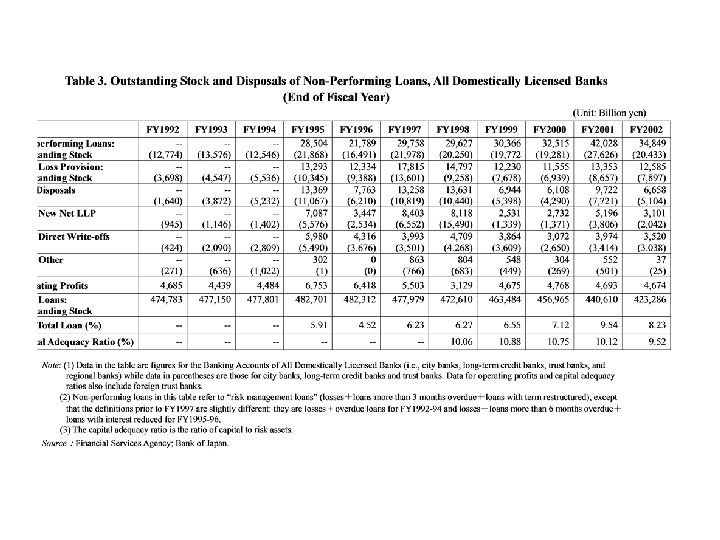
V. POLICY FRAMEWORKS FOR BANK RESTRUCTURING AND PROGRESS (cont’d) 2. Bank Restructuring • Public recapitalization (March 1998, March 1999, May 2003). See Table 2. • Recognition of NPLs—with tighter loan classification and loan loss provisioning—helps not only identify the size of NPLs but also prompts faster NPL disposals • Disposal of bank NPLs, close to 90 trillion yen in the last ten years. Despite disposals, bank NPLs have not declined fast due to the emergence of new NPLs (Table 3). • Exit of a number of inefficient deposit-taking institutions. • Establishments of public AMCs (RCC, IRC) has encouraged the carving out of NPLs.
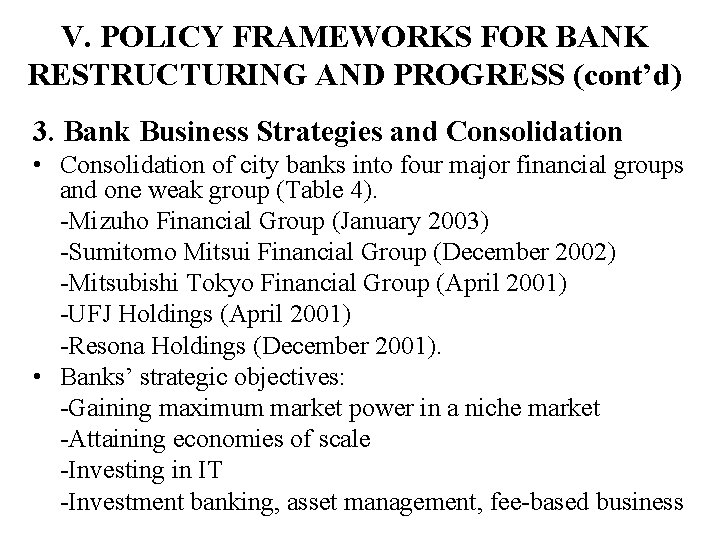
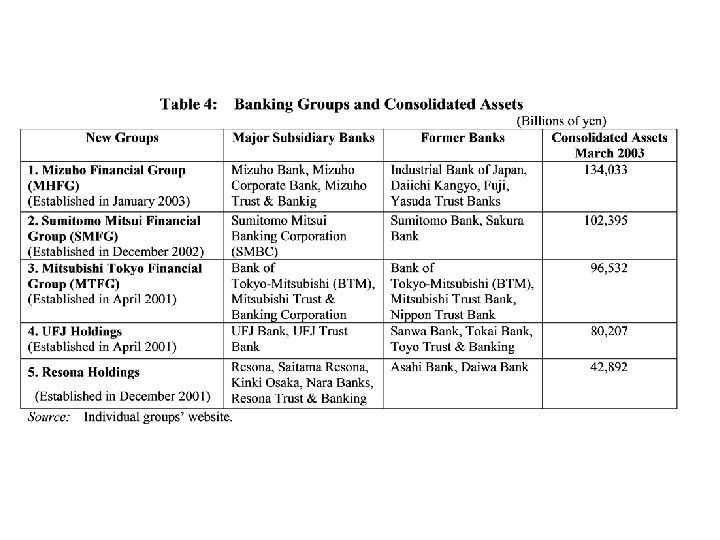
V. POLICY FRAMEWORKS FOR BANK RESTRUCTURING AND PROGRESS (cont’d) 3. Bank Business Strategies and Consolidation • Consolidation of city banks into four major financial groups and one weak group (Table 4). -Mizuho Financial Group (January 2003) -Sumitomo Mitsui Financial Group (December 2002) -Mitsubishi Tokyo Financial Group (April 2001) -UFJ Holdings (April 2001) -Resona Holdings (December 2001). • Banks’ strategic objectives: -Gaining maximum market power in a niche market -Attaining economies of scale -Investing in IT -Investment banking, asset management, fee-based business
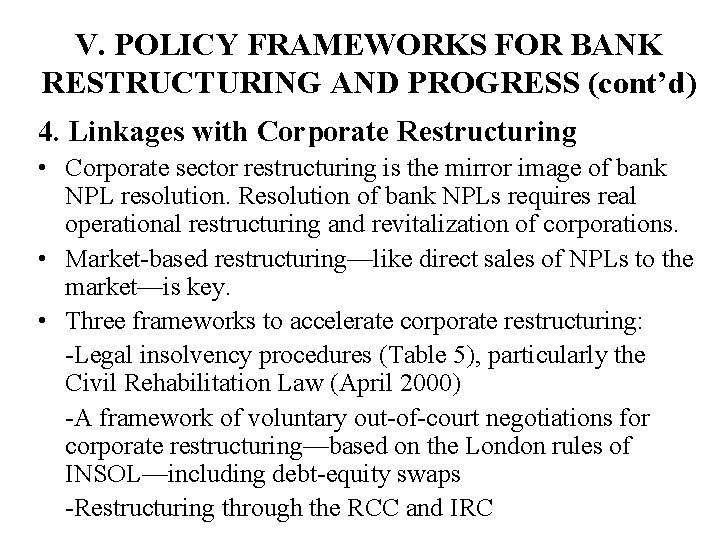
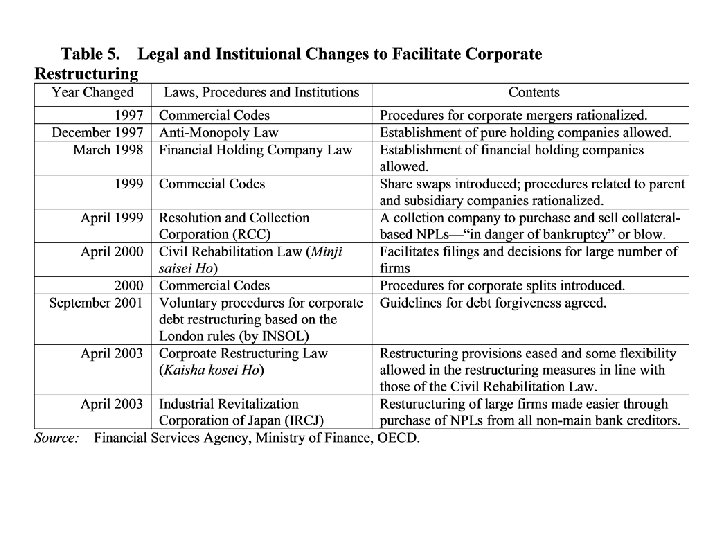
V. POLICY FRAMEWORKS FOR BANK RESTRUCTURING AND PROGRESS (cont’d) 4. Linkages with Corporate Restructuring • Corporate sector restructuring is the mirror image of bank NPL resolution. Resolution of bank NPLs requires real operational restructuring and revitalization of corporations. • Market-based restructuring—like direct sales of NPLs to the market—is key. • Three frameworks to accelerate corporate restructuring: -Legal insolvency procedures (Table 5), particularly the Civil Rehabilitation Law (April 2000) -A framework of voluntary out-of-court negotiations for corporate restructuring—based on the London rules of INSOL—including debt-equity swaps -Restructuring through the RCC and IRC
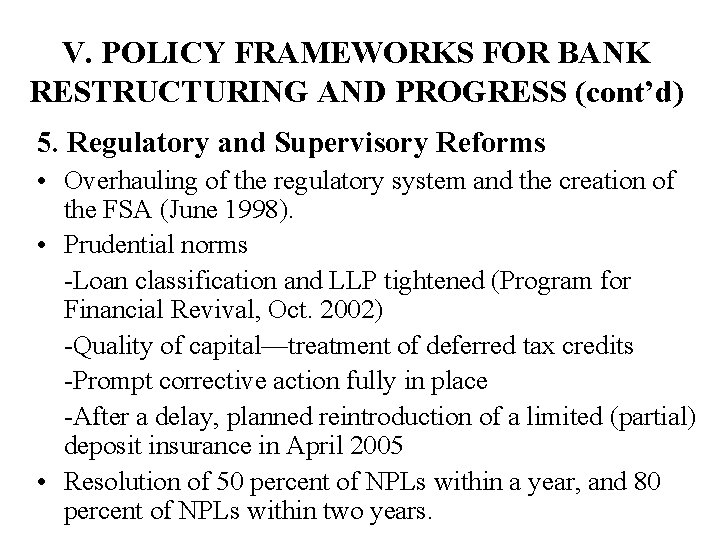
V. POLICY FRAMEWORKS FOR BANK RESTRUCTURING AND PROGRESS (cont’d) 5. Regulatory and Supervisory Reforms • Overhauling of the regulatory system and the creation of the FSA (June 1998). • Prudential norms -Loan classification and LLP tightened (Program for Financial Revival, Oct. 2002) -Quality of capital—treatment of deferred tax credits -Prompt corrective action fully in place -After a delay, planned reintroduction of a limited (partial) deposit insurance in April 2005 • Resolution of 50 percent of NPLs within a year, and 80 percent of NPLs within two years.
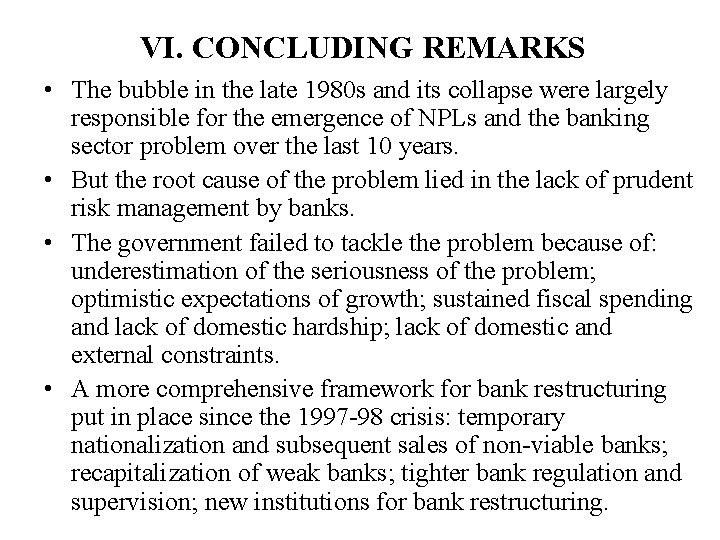
VI. CONCLUDING REMARKS • The bubble in the late 1980 s and its collapse were largely responsible for the emergence of NPLs and the banking sector problem over the last 10 years. • But the root cause of the problem lied in the lack of prudent risk management by banks. • The government failed to tackle the problem because of: underestimation of the seriousness of the problem; optimistic expectations of growth; sustained fiscal spending and lack of domestic hardship; lack of domestic and external constraints. • A more comprehensive framework for bank restructuring put in place since the 1997 -98 crisis: temporary nationalization and subsequent sales of non-viable banks; recapitalization of weak banks; tighter bank regulation and supervision; new institutions for bank restructuring.
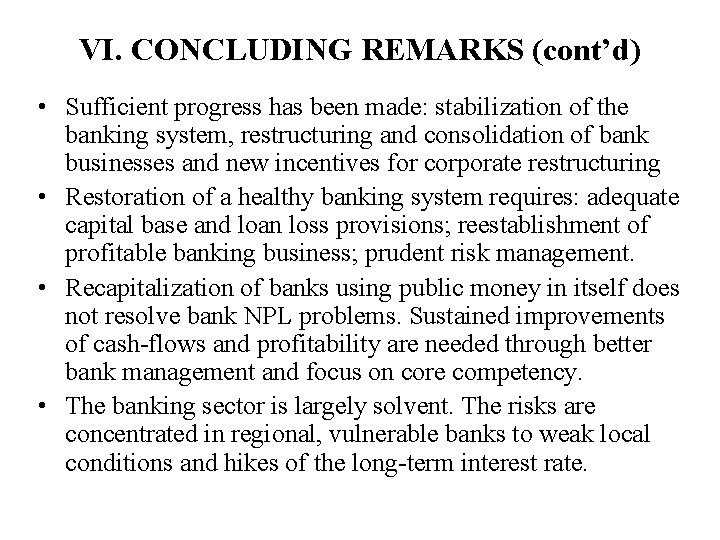
VI. CONCLUDING REMARKS (cont’d) • Sufficient progress has been made: stabilization of the banking system, restructuring and consolidation of bank businesses and new incentives for corporate restructuring • Restoration of a healthy banking system requires: adequate capital base and loan loss provisions; reestablishment of profitable banking business; prudent risk management. • Recapitalization of banks using public money in itself does not resolve bank NPL problems. Sustained improvements of cash-flows and profitability are needed through better bank management and focus on core competency. • The banking sector is largely solvent. The risks are concentrated in regional, vulnerable banks to weak local conditions and hikes of the long-term interest rate.
- Slides: 29