
Japanese Professional Engineer and The Institution of Professional












- Slides: 32
Japanese Professional Engineer and The Institution of Professional Engineers, Japan July. 2018 1
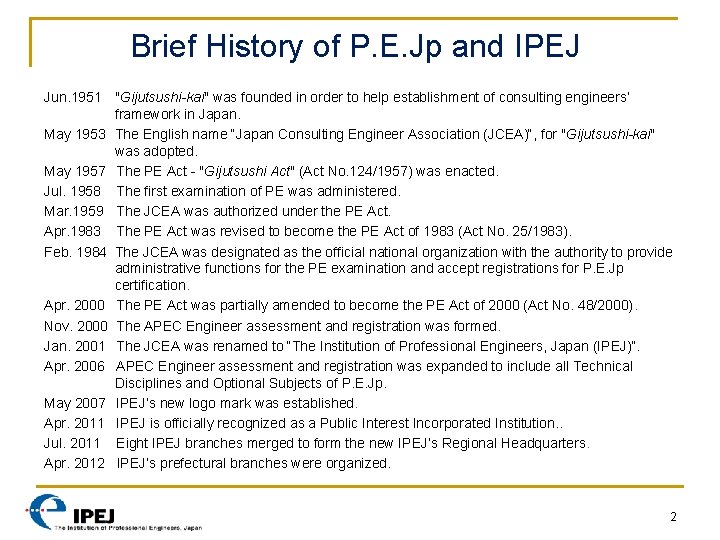
Brief History of P. E. Jp and IPEJ Jun. 1951 "Gijutsushi-kai" was founded in order to help establishment of consulting engineers’ framework in Japan. May 1953 The English name “Japan Consulting Engineer Association (JCEA)“, for "Gijutsushi-kai" was adopted. May 1957 The PE Act - "Gijutsushi Act" (Act No. 124/1957) was enacted. Jul. 1958 The first examination of PE was administered. Mar. 1959 The JCEA was authorized under the PE Act. Apr. 1983 The PE Act was revised to become the PE Act of 1983 (Act No. 25/1983). Feb. 1984 The JCEA was designated as the official national organization with the authority to provide administrative functions for the PE examination and accept registrations for P. E. Jp certification. Apr. 2000 The PE Act was partially amended to become the PE Act of 2000 (Act No. 48/2000). Nov. 2000 The APEC Engineer assessment and registration was formed. Jan. 2001 The JCEA was renamed to “The Institution of Professional Engineers, Japan (IPEJ)”. Apr. 2006 APEC Engineer assessment and registration was expanded to include all Technical Disciplines and Optional Subjects of P. E. Jp. May 2007 IPEJ’s new logo mark was established. Apr. 2011 IPEJ is officially recognized as a Public Interest Incorporated Institution. . Jul. 2011 Eight IPEJ branches merged to form the new IPEJ’s Regional Headquarters. Apr. 2012 IPEJ’s prefectural branches were organized. 2
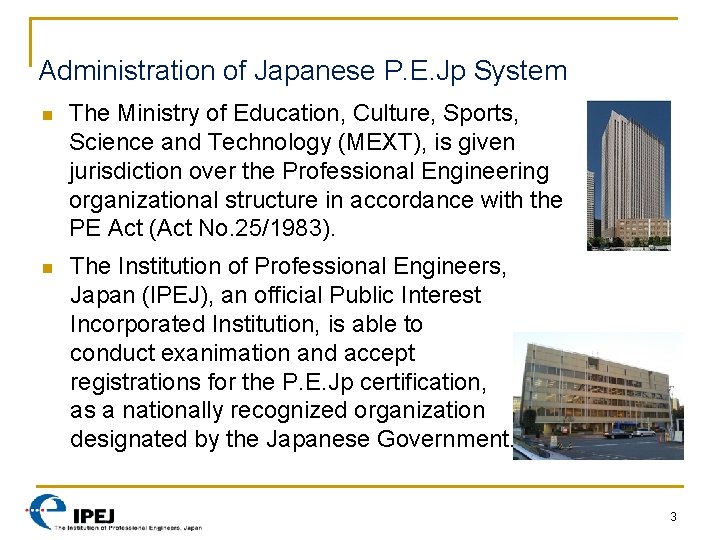
Administration of Japanese P. E. Jp System n The Ministry of Education, Culture, Sports, Science and Technology (MEXT), is given jurisdiction over the Professional Engineering organizational structure in accordance with the PE Act (Act No. 25/1983). n The Institution of Professional Engineers, Japan (l. PEJ), an official Public Interest Incorporated Institution, is able to conduct exanimation and accept registrations for the P. E. Jp certification, as a nationally recognized organization designated by the Japanese Government. 3
Professional Engineer, Japan (P. E. Jp) n Professional Engineer Japan (abbreviated as “P. E. Jp”) is the national certification for engineers recognized by the Professional Engineer Act (hereinafter called “PE Act”) in Japan. n P. E. Jp is defined as an engineer who is engaged in the professional practice of providing services for science and technology fields, involved in planning, research, design, analysis, testing, evaluation, and training. Such services require application of extensive scientific and technical expertise. 4
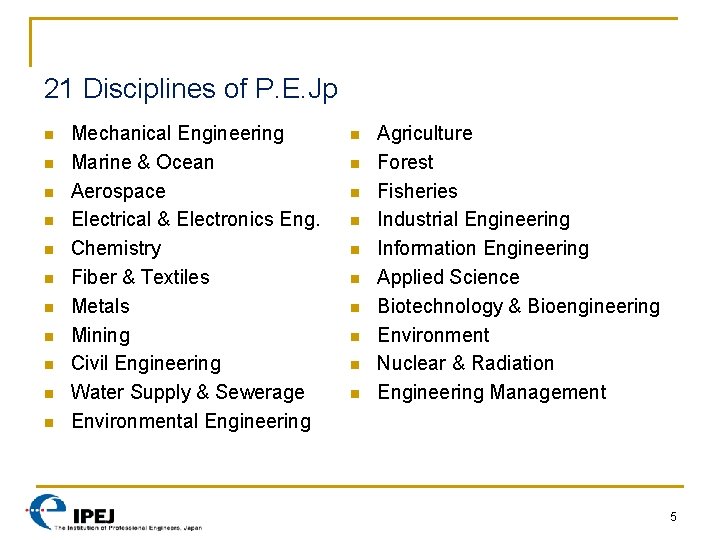
21 Disciplines of P. E. Jp n n n Mechanical Engineering Marine & Ocean Aerospace Electrical & Electronics Eng. Chemistry Fiber & Textiles Metals Mining Civil Engineering Water Supply & Sewerage Environmental Engineering n n n n n Agriculture Forest Fisheries Industrial Engineering Information Engineering Applied Science Biotechnology & Bioengineering Environment Nuclear & Radiation Engineering Management 5
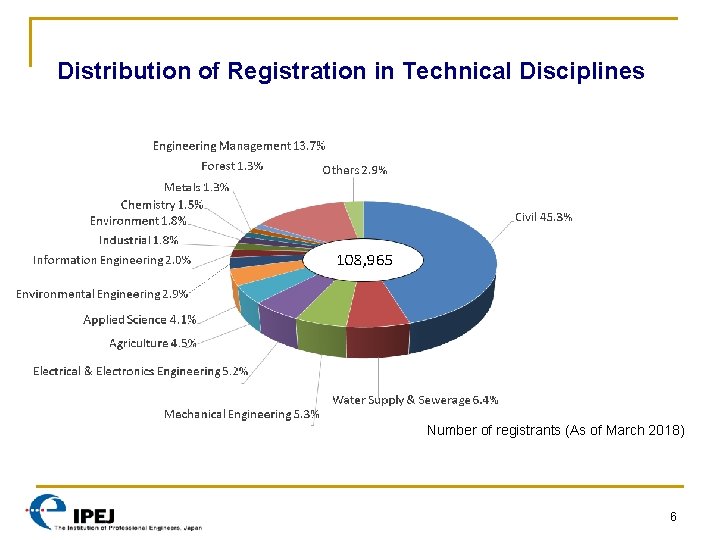
Distribution of Registration in Technical Disciplines Number of registrants (As of March 2018) 6
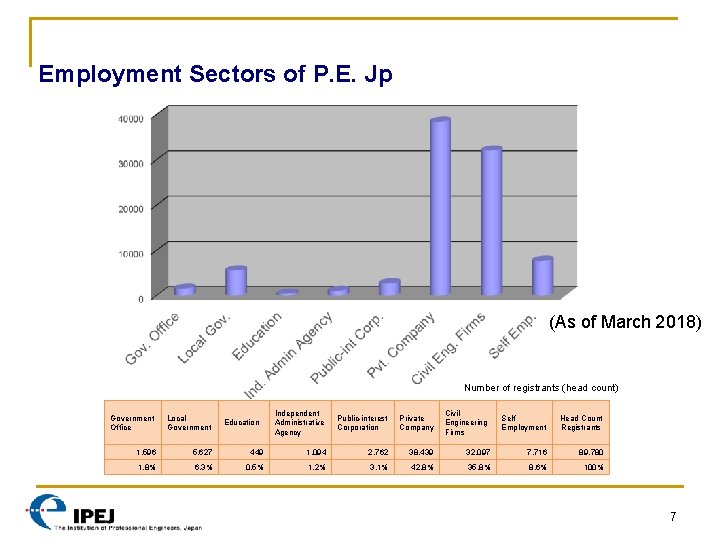
Employment Sectors of P. E. Jp (As of March 2018) Number of registrants (head count) Government Office Local Government Education Independent Public-interest Private Administrative Corporation Company Agency Civil Engineering Firms Self Employment Head Count Registrants 1, 596 5, 627 449 1, 094 2, 762 38, 439 32, 097 7, 716 89, 780 1. 8% 6. 3% 0. 5% 1. 2% 3. 1% 42. 8% 35. 8% 8. 6% 100% 7
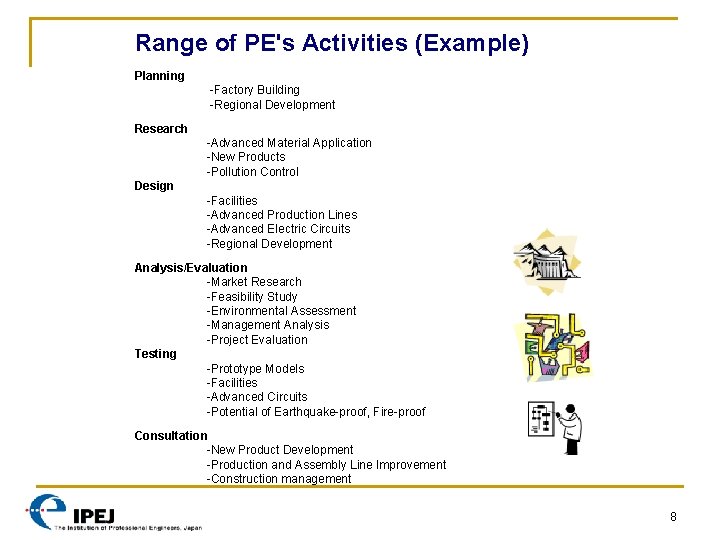
Range of PE's Activities (Example) Planning -Factory Building -Regional Development Research -Advanced Material Application -New Products -Pollution Control Design -Facilities -Advanced Production Lines -Advanced Electric Circuits -Regional Development Analysis/Evaluation -Market Research -Feasibility Study -Environmental Assessment -Management Analysis -Project Evaluation Testing -Prototype Models -Facilities -Advanced Circuits -Potential of Earthquake-proof, Fire-proof Consultation -New Product Development -Production and Assembly Line Improvement -Construction management 8
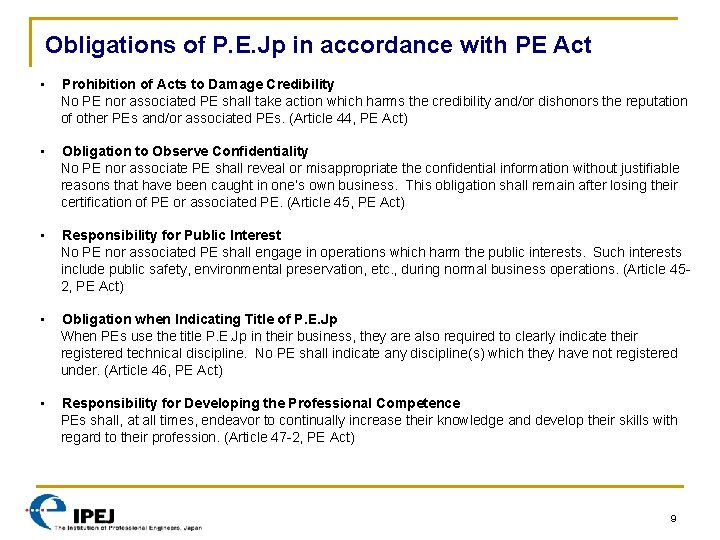
Obligations of P. E. Jp in accordance with PE Act • • • Prohibition of Acts to Damage Credibility No PE nor associated PE shall take action which harms the credibility and/or dishonors the reputation of other PEs and/or associated PEs. (Article 44, PE Act) Obligation to Observe Confidentiality No PE nor associate PE shall reveal or misappropriate the confidential information without justifiable reasons that have been caught in one’s own business. This obligation shall remain after losing their certification of PE or associated PE. (Article 45, PE Act) Responsibility for Public Interest No PE nor associated PE shall engage in operations which harm the public interests. Such interests include public safety, environmental preservation, etc. , during normal business operations. (Article 452, PE Act) Obligation when Indicating Title of P. E. Jp When PEs use the title P. E. Jp in their business, they are also required to clearly indicate their registered technical discipline. No PE shall indicate any discipline(s) which they have not registered under. (Article 46, PE Act) Responsibility for Developing the Professional Competence PEs shall, at all times, endeavor to continually increase their knowledge and develop their skills with regard to their profession. (Article 47 -2, PE Act) 9
10
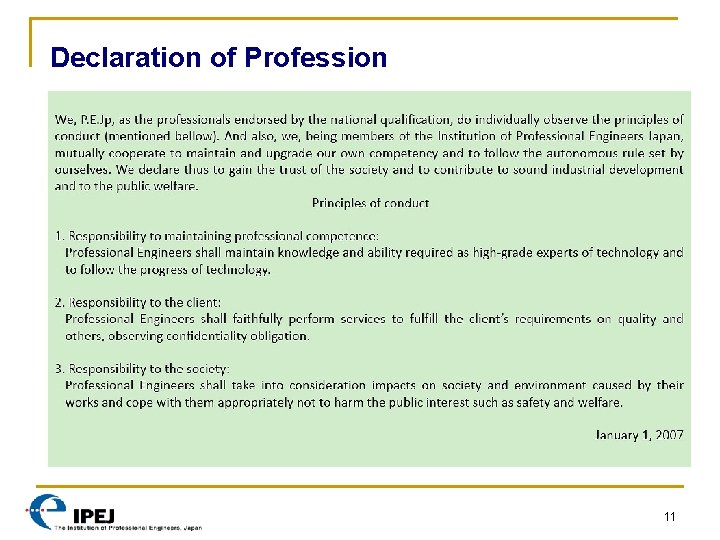
Declaration of Profession 11
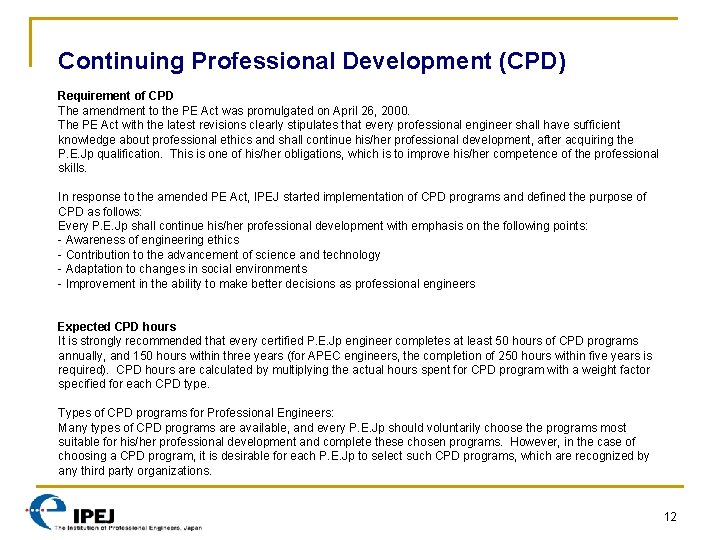
Continuing Professional Development (CPD) Requirement of CPD The amendment to the PE Act was promulgated on April 26, 2000. The PE Act with the latest revisions clearly stipulates that every professional engineer shall have sufficient knowledge about professional ethics and shall continue his/her professional development, after acquiring the P. E. Jp qualification. This is one of his/her obligations, which is to improve his/her competence of the professional skills. In response to the amended PE Act, IPEJ started implementation of CPD programs and defined the purpose of CPD as follows: Every P. E. Jp shall continue his/her professional development with emphasis on the following points: - Awareness of engineering ethics - Contribution to the advancement of science and technology - Adaptation to changes in social environments - Improvement in the ability to make better decisions as professional engineers Expected CPD hours It is strongly recommended that every certified P. E. Jp engineer completes at least 50 hours of CPD programs annually, and 150 hours within three years (for APEC engineers, the completion of 250 hours within five years is required). CPD hours are calculated by multiplying the actual hours spent for CPD program with a weight factor specified for each CPD type. Types of CPD programs for Professional Engineers: Many types of CPD programs are available, and every P. E. Jp should voluntarily choose the programs most suitable for his/her professional development and complete these chosen programs. However, in the case of choosing a CPD program, it is desirable for each P. E. Jp to select such CPD programs, which are recognized by any third party organizations. 12
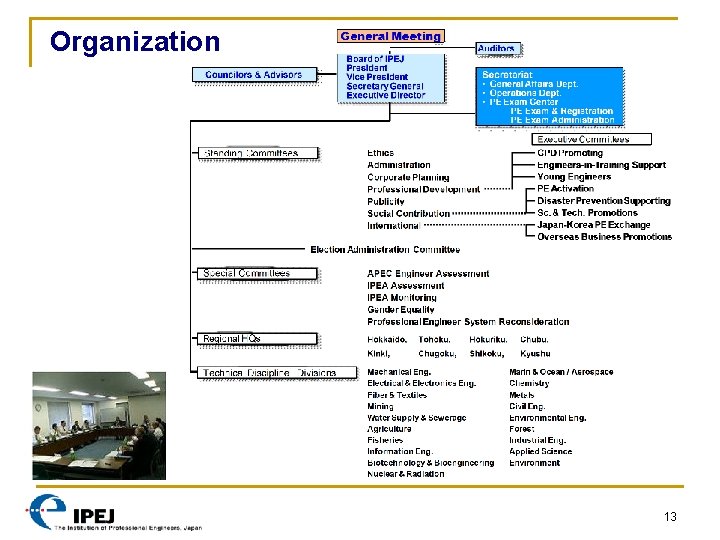
Organization 13
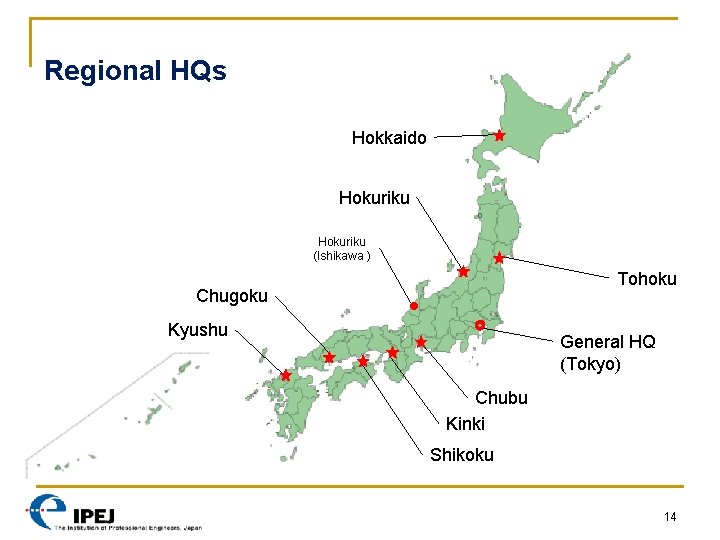
Regional HQs Hokkaido Hokuriku (Ishikawa ) Tohoku Chugoku Kyushu General HQ (Tokyo) Chubu Kinki Shikoku 14
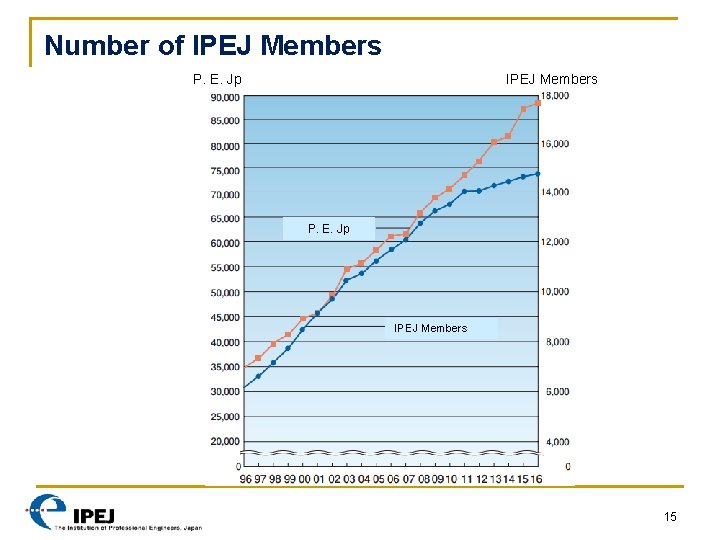
Number of IPEJ Members P. E. Jp IPEJ Members 15
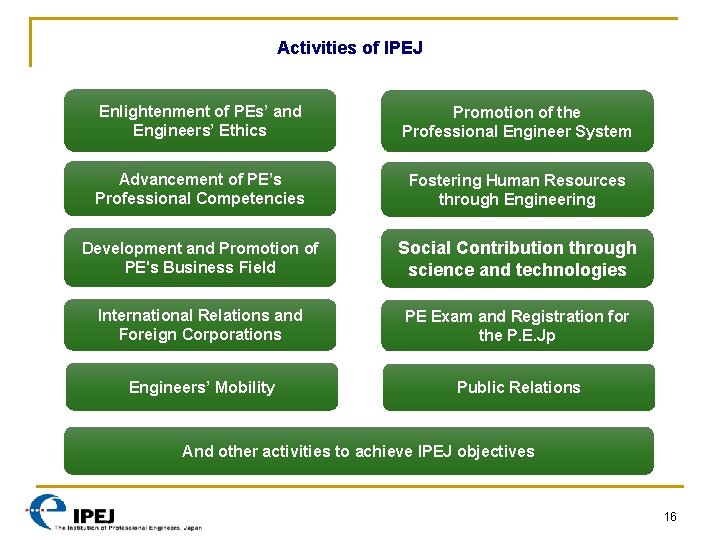
Activities of IPEJ Enlightenment of PEs’ and Engineers’ Ethics Promotion of the Professional Engineer System Advancement of PE’s Professional Competencies Fostering Human Resources through Engineering Development and Promotion of PE's Business Field Social Contribution through science and technologies International Relations and Foreign Corporations PE Exam and Registration for the P. E. Jp Engineers’ Mobility Public Relations And other activities to achieve IPEJ objectives 16
PE Exam 17
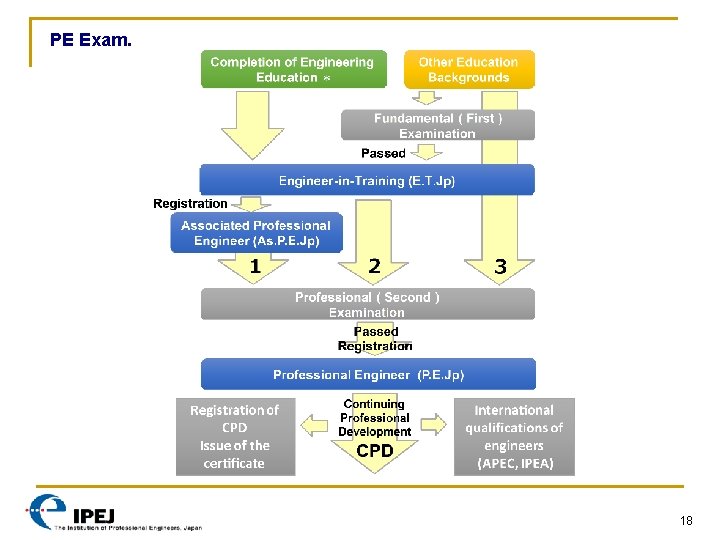
PE Exam. 18
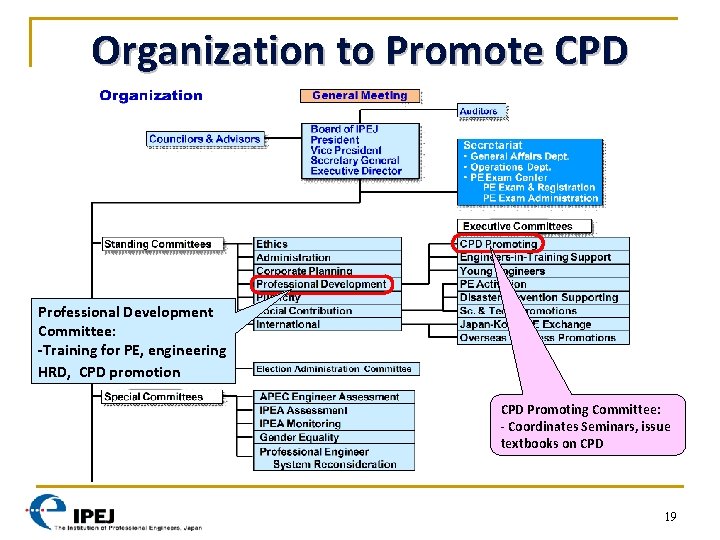
Organization to Promote CPD Professional Development Committee: -Training for PE, engineering HRD, CPD promotion CPD Promoting Committee: - Coordinates Seminars, issue textbooks on CPD 19
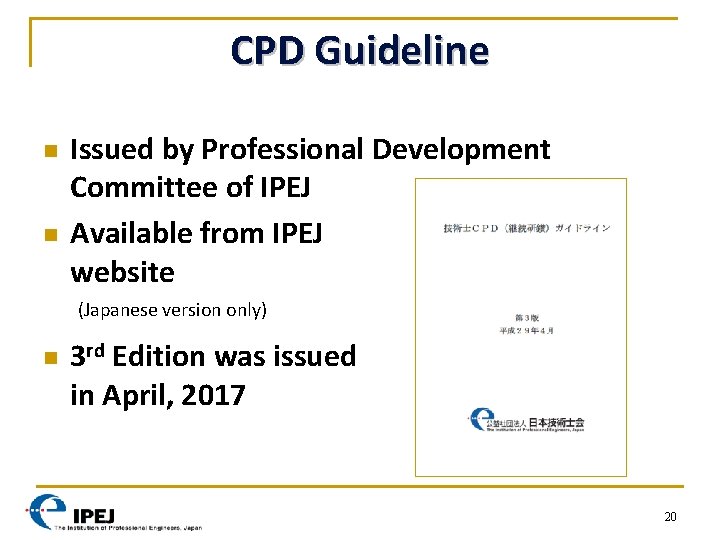
CPD Guideline n n Issued by Professional Development Committee of IPEJ Available from IPEJ website (Japanese version only) n 3 rd Edition was issued in April, 2017 20
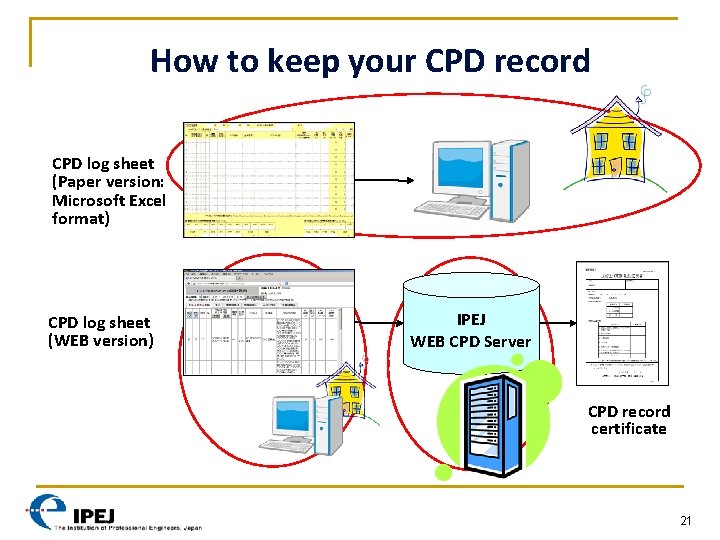
How to keep your CPD record CPD log sheet (Paper version: Microsoft Excel format) CPD log sheet (WEB version) IPEJ WEB CPD Server CPD record certificate 21
CPD Certified Membership IPEJ certifies our member’s continuing professional development to clarify as the IPEJ CPD member for the period of 3 years and renewal application for the clarification is necessary for extension. 22
Seminars 23
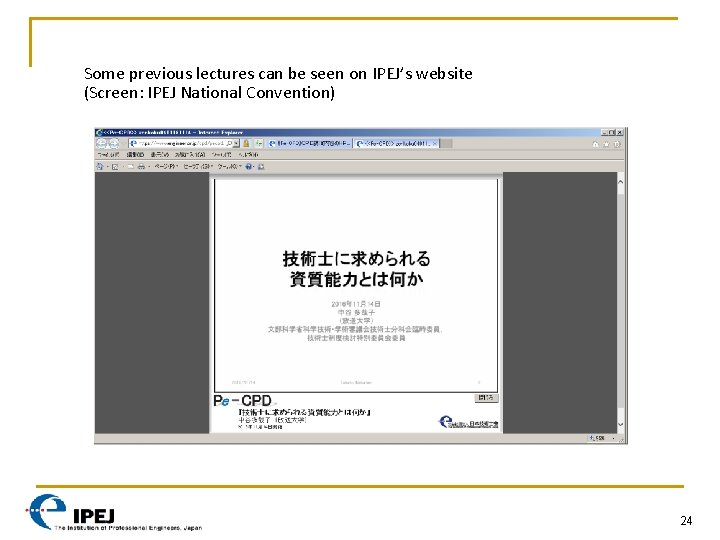
Some previous lectures can be seen on IPEJ’s website (Screen: IPEJ National Convention) 24
Fostering Human Resources with Engineering Background ・ Seminars and exchange opportunities for Engineers-in-Training ・ PE system for college students from Washington Accord accredited programs ・ Career development seminars for Engineers-in-Training ・ Career development seminars for female college students in engineering courses / new female employees in engineering professions (Photo) 25
Development and Promotion of PE's Business • Creation and development of new business models for PEs • Business matching services between potential clients and member PEs Guide book for consulting engineers Promotion of Social Contribution • Technical assistance for national administrative organs and local governments in policy implementations • Support for scientific and technological activities • Approach in reducing natural disasters risks. Brochure for disaster management consultations 26
Publications 27
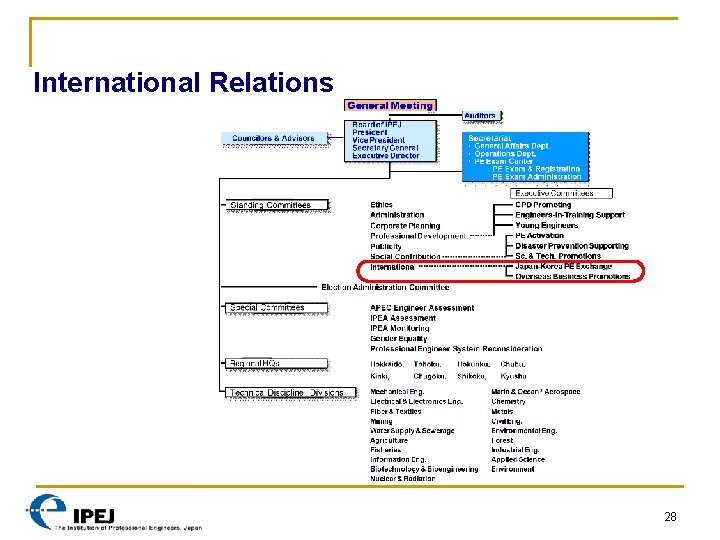
International Relations 28
International Relations 29
APEC Engineer, Int. PE-Jp http: //www. ieagreements. org/ 30
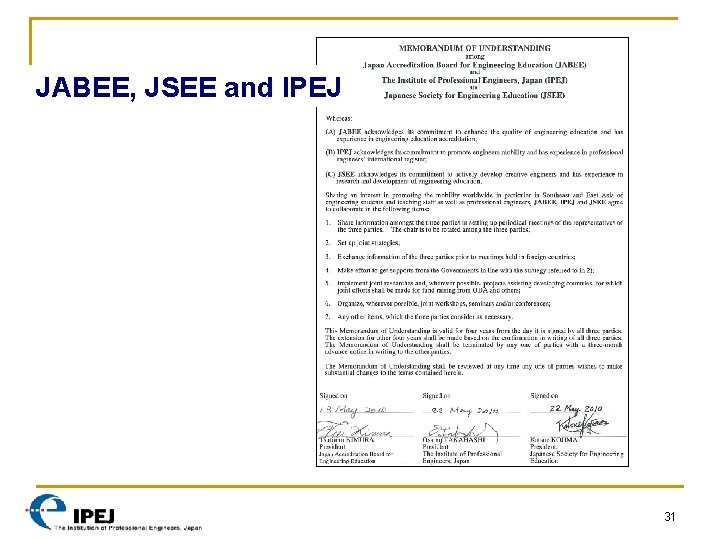
JABEE, JSEE and IPEJ 31
Engineers Australia (EA) and IPEJ September 2015 32