
Japanese Poetry Haiku and Tanka Haiku Poetry Shortest
- Slides: 9
Japanese Poetry Haiku and Tanka
Haiku Poetry Ø Shortest form of poetry developed in Japan Ø Emerged in late 17 th century Ø Very popular today (There are dozens of magazines dedicated to haiku. ) Ø Most educated Japanese can easily write a haiku.
What is haiku? Ø Three line poem consisting of 17 syllables. l l l First line = 5 syllables Second line = 7 syllables Third line = 5 syllables Ø Often includes a reference to nature Ø Written in present tense Ø Not descriptive; it provides a series of images to be connected with reader’s imagination
A Butterfly Ø A falling flower, thought I, Ø Fluttering back to the branch Ø Was a butterfly. l Moritake
The River Ø See the river flow, Ø In a long unbroken line Ø On the field of snow. l Boncho
Tanka Poetry Ø Tanka is perhaps the oldest form of Japanese poetry. Ø It was first used as a form of prayer. Ø It became the standard form of poetry during the Heian Period.
What is tanka? Ø Five line poem consisting of 31 syllables. l l l First line = 5 syllables Second line = 7 syllables Third line = 5 syllables Fourth line = 7 syllables Fifth line = 7 syllables Ø Written to celebrate events or occasions Ø Written in present tense Ø Each line expresses a single idea
Untitled Ø Off in front of me Ø on that distant summit Ø is the setting sun, Ø while in the mountain shadow Ø darkness moves through the pines l Jusammi Chikako
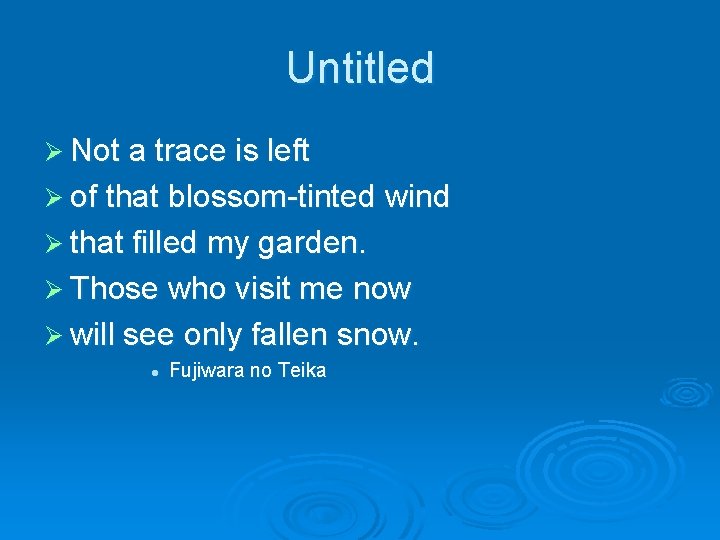
Untitled Ø Not a trace is left Ø of that blossom-tinted wind Ø that filled my garden. Ø Those who visit me now Ø will see only fallen snow. l Fujiwara no Teika