
Japan Stella Theodoulou Japan Second world industrial power
- Slides: 18
Japan Stella Theodoulou
Japan • Second world industrial power (after the US) • Stable but new democracy (after WWII) • Liberal and modern, but Non-Western
Ancient-history • 6 th century: – One clan centralizes power over many (warrior) tribes, and imposes emperor Jimmu. – Confucianism and Buddhism arrive from China, and superimpose to the local Shinto faith-syncreticism. • Development of a traditional feudal society (with lords, samurai—hereditary warriors, continuos wars, serfs). • Aislationism: in the 17 th century, Christianity was forbidden, as well as Japanese ships to leave Japan.
Freeing Trade • In 1853, American Commodore Perry brought to Japan a message from the American President asking the Japanese to open the country to foreign trade. – The Japanese were forced to sign a treaty on trade. . . – And many other treaties from that on (on how to treat foreigners legally, as well as on tariffs)
From Empire to Dictatorship to Liberal Democracy • 1868 -1911 Meiji Period • 1889 Imperial (Meiji) Constitution (the Diet was in place, but the Emperor and the samurai concentrated power and chose the Prime Minister). • (Victorious) wars with China (1894/5) and Russia (1904/5): Japan acquired Taiwan and a part of Manchuria. Korea was incorporated in 1910, and the military gained power and prestige. • 1918: A commoner is elected as the Prime Minister for the first time, representing the Constitutional Party (created since the 1880 s)
From Empire to Dictatorship to Liberal Democracy Taisho Democracy: • 1925, universal (male) suffrage and democratization of the lower house, but. . . Clause confirming the Emperor’s sovereignty. • 1930 s: rise of militarism as a consequence of the economic crisis. Puppet civilian government— Expansionism—WAR (1937 with China) • 1940, Alliance with Italy and Germany • December 7, 1941, Pearl Harbour • August 1945, use of atomic bombs by the US • Japanese surrender and acceptance of Postdam. • US occupation of Japan
From Empire to Dictatorship to Liberal Democracy • 1947 Mc. Arthur Constitution (Gral. Mc. Arthur, head of the occupation forces) • 1940 s Organization of parties (Liberal, Socialist) • Beginning of the economic reorganization of the country. • 1950 s: – 1952 San Francisco Treaty (US military bases on Japan) – Japan was turned into an American ally. – 1955 Beginning of the conservative hegemony (emphasis on economic growth and redistribution) – Strong debates between parties on the right and the left about the role and future of Japan (riots).
The Japanese “miracle. ” • 9% annual economic growth from 1955 to 1973 (and 4 -5% afterwards). • In 1970, Japan was the 3 rd economy in the world. • Secrets: – State planning (“Take off” MITI). – Long term investments (and expected gains)— Technology. – Good conditions for workers/consumers – Skilled workforce
LDP’s Hegemony • From 1945 -55: multi-party system • From 1955 to 1993, the LDP won every general election. One-partydominant-system. • 1970 s Frequent changes in cabinet membership, PM resignation, factions. • End in 1993: coalition of 8 parties (liberal/leftist)
Japan Politics Today • Unstable party system (continous formation and disintegration of parties—TV) • Uncertainty about the international role/s Japan may have to play • Increasing disillusionment from politics • Corruption
The Government • Constitutional monarchy (male Emperor) • Emperor Akihito (1989) Heisei Era (Peace Attained). Years of the eras frame the calendar. • Unitary State (47 prefectures) • Parliamentary democracy (Prime Minister/Cabinet) – (=The United Kingdom? ) (but) • Written Constitution: the Mac. Arthur Constitution consecrates the people as the sovereign.
Art. 9 Japanese Constitution • Japan renounced to use military power (in fact, Japan has a strong military)
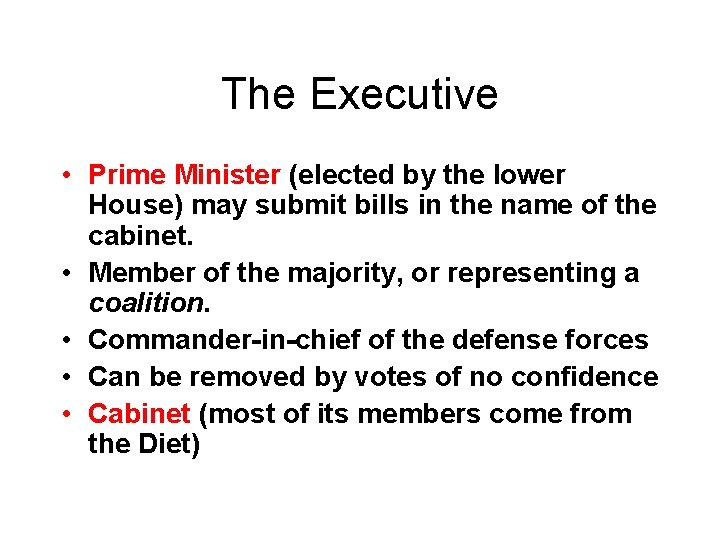
The Executive • Prime Minister (elected by the lower House) may submit bills in the name of the cabinet. • Member of the majority, or representing a coalition. • Commander-in-chief of the defense forces • Can be removed by votes of no confidence • Cabinet (most of its members come from the Diet)
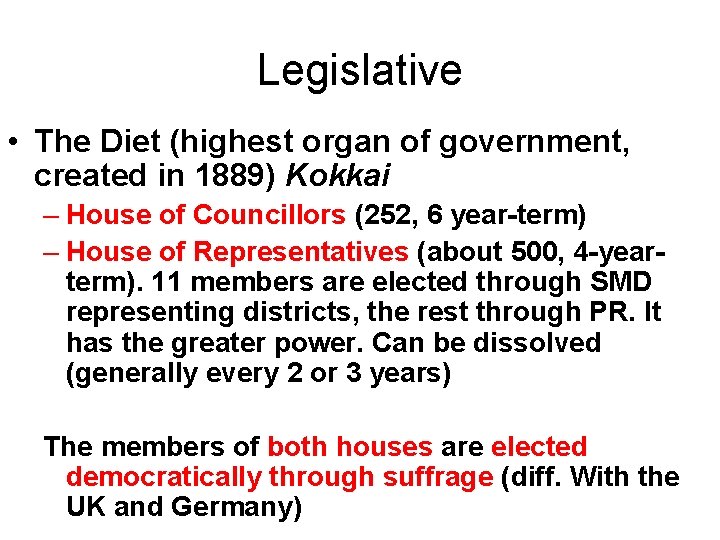
Legislative • The Diet (highest organ of government, created in 1889) Kokkai – House of Councillors (252, 6 year-term) – House of Representatives (about 500, 4 -yearterm). 11 members are elected through SMD representing districts, the rest through PR. It has the greater power. Can be dissolved (generally every 2 or 3 years) The members of both houses are elected democratically through suffrage (diff. With the UK and Germany)
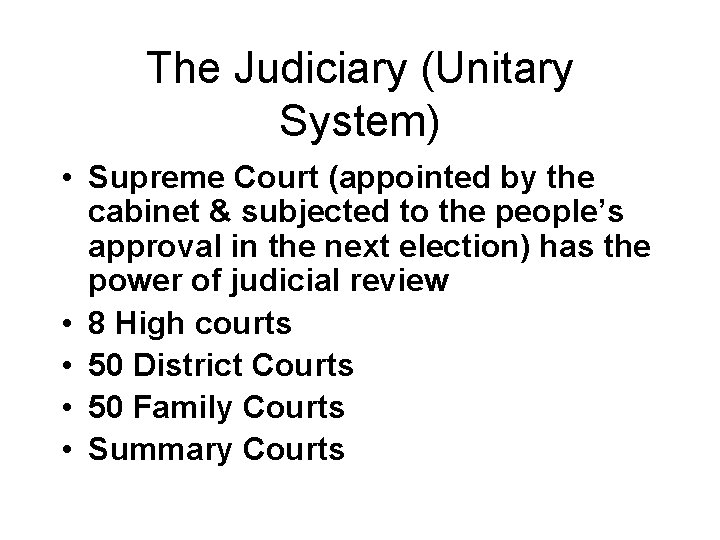
The Judiciary (Unitary System) • Supreme Court (appointed by the cabinet & subjected to the people’s approval in the next election) has the power of judicial review • 8 High courts • 50 District Courts • 50 Family Courts • Summary Courts
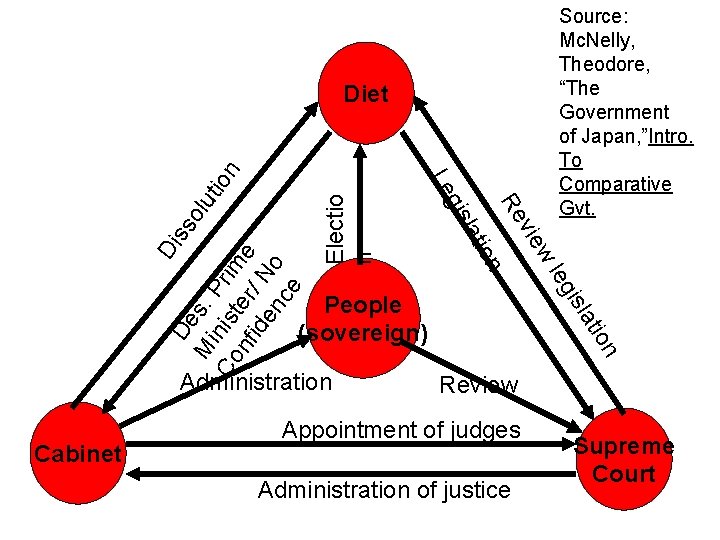
Cabinet n Electio n Administration o ati People (sovereign) isl leg w vie Re n tio isla g Le Di De ss olu M s. tio Co inis Prim n nf ter/ e ide N nc o e Diet Source: Mc. Nelly, Theodore, “The Government of Japan, ”Intro. To Comparative Gvt. Review Appointment of judges Administration of justice Supreme Court
The State Bureaucracy • Prestigious bureaucratic careers (enhanced by the Confucian tradition) • Insulation • Cabinet members tend to be career politicians (and leading politicians frequently come from bureaucratic careers) • Links to corporations
Importance of Consensus • Deliberation councils linked to interest groups within the community informally intervene in the legislative process (prepare bills)