
Japan One Example of Development Japans Geography v
- Slides: 42
Japan One Example of Development
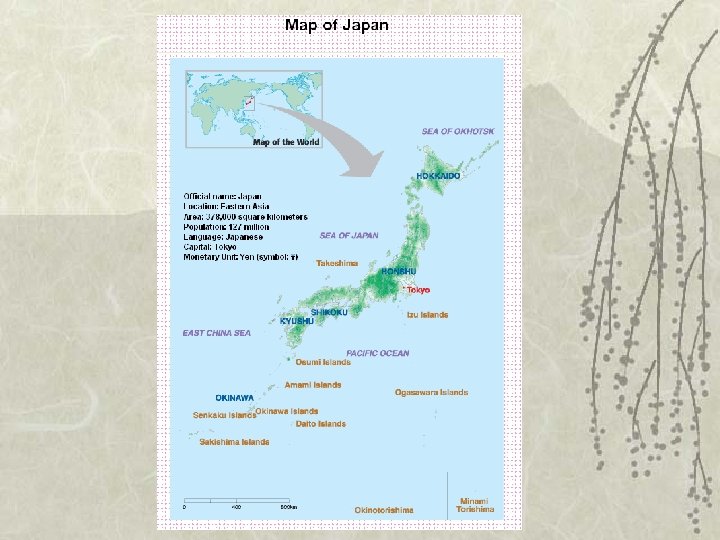
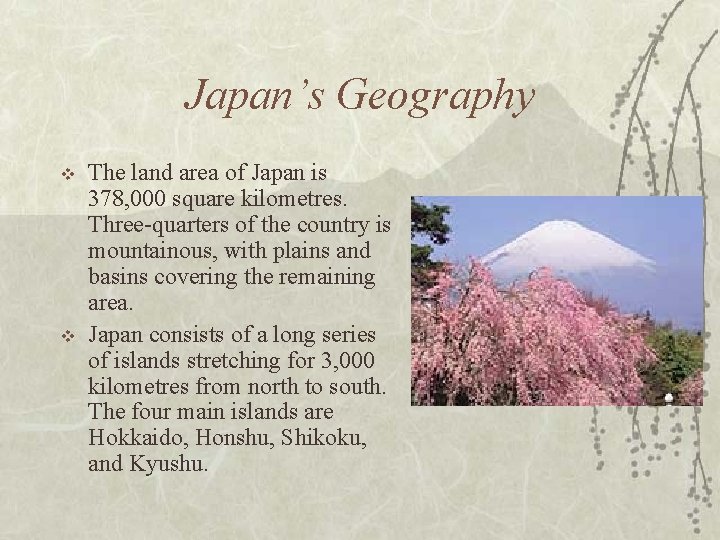
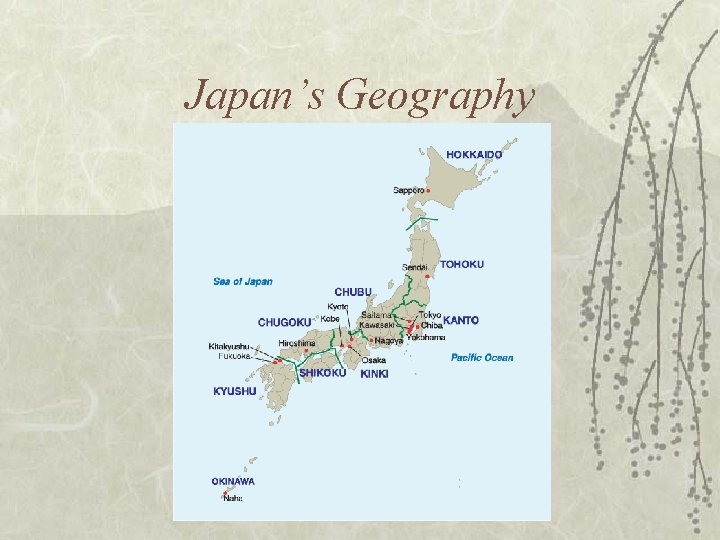
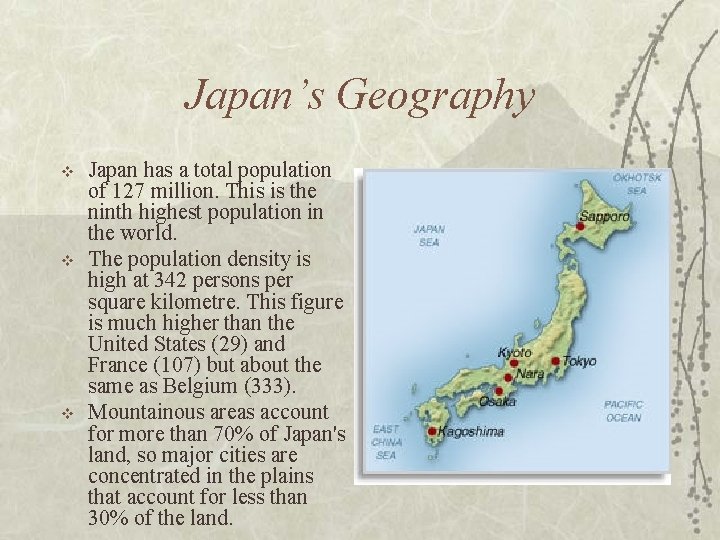
Japan’s Geography v v The land area of Japan is 378, 000 square kilometres. Three-quarters of the country is mountainous, with plains and basins covering the remaining area. Japan consists of a long series of islands stretching for 3, 000 kilometres from north to south. The four main islands are Hokkaido, Honshu, Shikoku, and Kyushu.
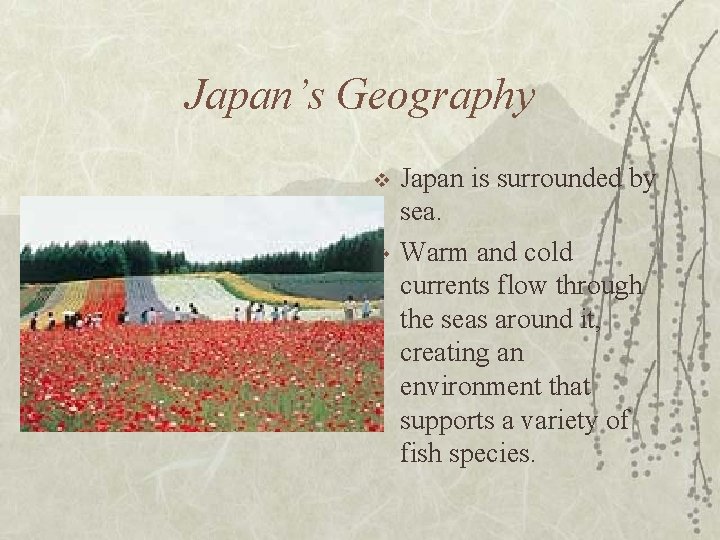
Japan’s Geography v v Japan is surrounded by sea. Warm and cold currents flow through the seas around it, creating an environment that supports a variety of fish species.
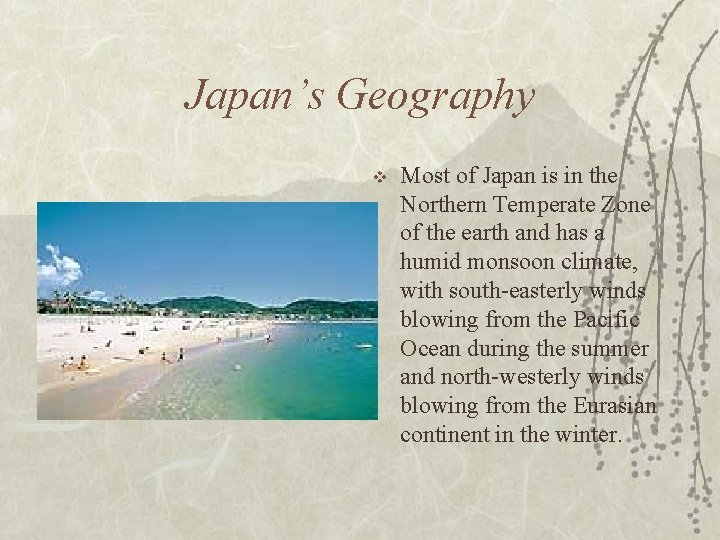
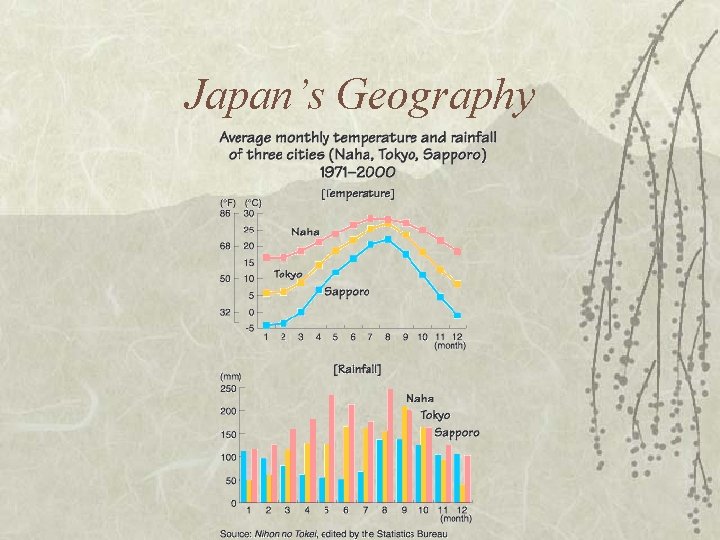
Japan’s Geography v Most of Japan is in the Northern Temperate Zone of the earth and has a humid monsoon climate, with south-easterly winds blowing from the Pacific Ocean during the summer and north-westerly winds blowing from the Eurasian continent in the winter.
Japan’s Geography
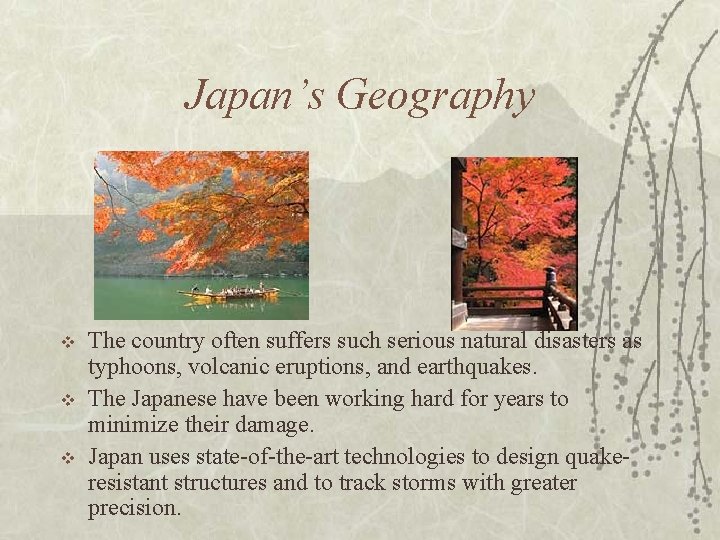
Japan’s Geography v v v The country often suffers such serious natural disasters as typhoons, volcanic eruptions, and earthquakes. The Japanese have been working hard for years to minimize their damage. Japan uses state-of-the-art technologies to design quakeresistant structures and to track storms with greater precision.
Japan’s Geography
Japan’s Geography v v v Japan has a total population of 127 million. This is the ninth highest population in the world. The population density is high at 342 persons per square kilometre. This figure is much higher than the United States (29) and France (107) but about the same as Belgium (333). Mountainous areas account for more than 70% of Japan's land, so major cities are concentrated in the plains that account for less than 30% of the land.
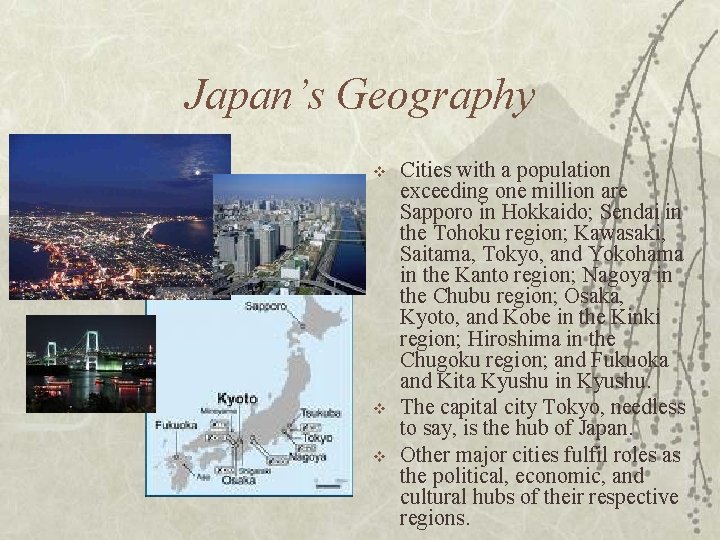
Japan’s Geography v v v Cities with a population exceeding one million are Sapporo in Hokkaido; Sendai in the Tohoku region; Kawasaki, Saitama, Tokyo, and Yokohama in the Kanto region; Nagoya in the Chubu region; Osaka, Kyoto, and Kobe in the Kinki region; Hiroshima in the Chugoku region; and Fukuoka and Kita Kyushu in Kyushu. The capital city Tokyo, needless to say, is the hub of Japan. Other major cities fulfil roles as the political, economic, and cultural hubs of their respective regions.
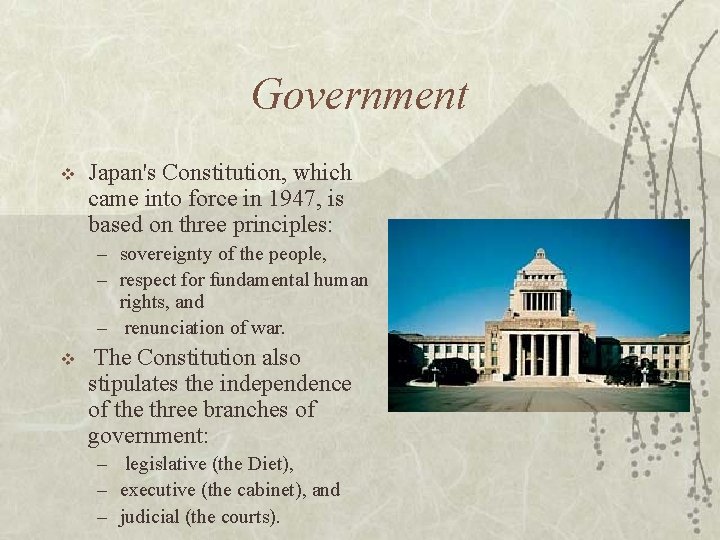
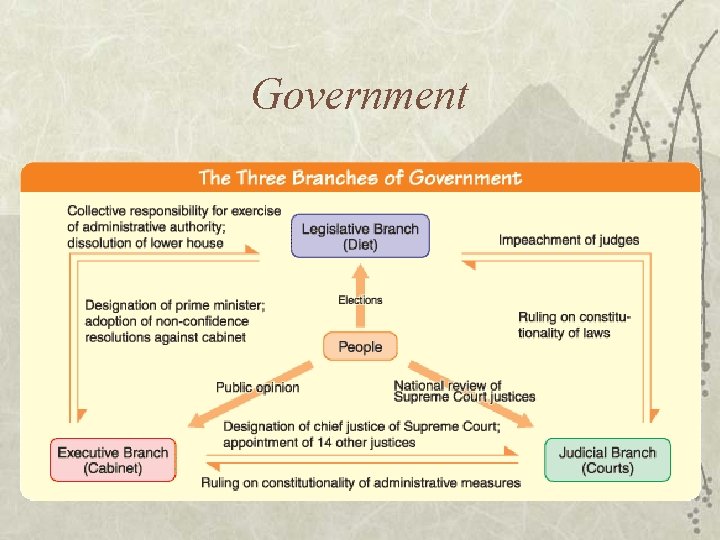
Government v Japan's Constitution, which came into force in 1947, is based on three principles: – sovereignty of the people, – respect for fundamental human rights, and – renunciation of war. v The Constitution also stipulates the independence of the three branches of government: – legislative (the Diet), – executive (the cabinet), and – judicial (the courts).
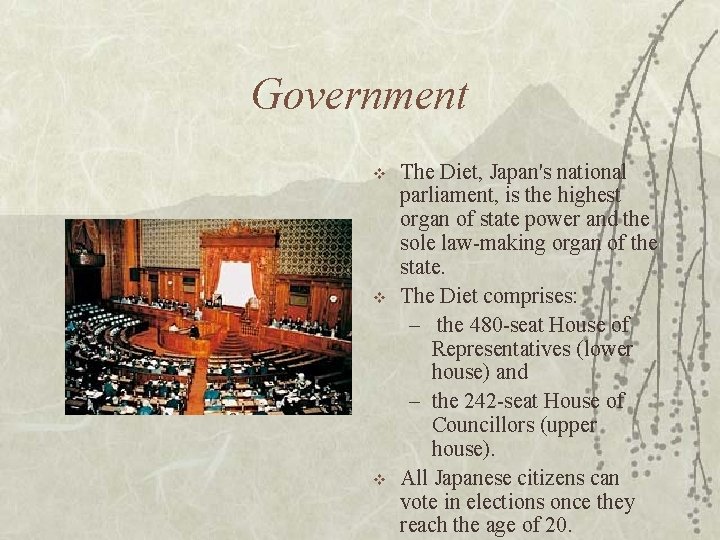
Government v v v The Diet, Japan's national parliament, is the highest organ of state power and the sole law-making organ of the state. The Diet comprises: – the 480 -seat House of Representatives (lower house) and – the 242 -seat House of Councillors (upper house). All Japanese citizens can vote in elections once they reach the age of 20.
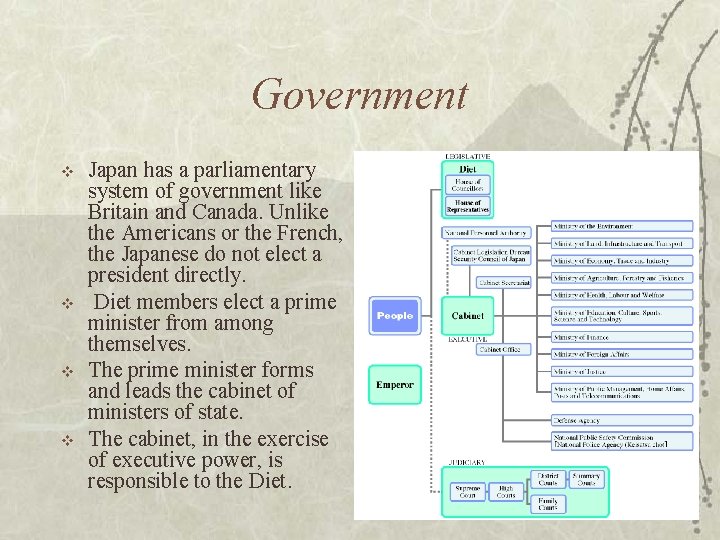
Government v v Japan has a parliamentary system of government like Britain and Canada. Unlike the Americans or the French, the Japanese do not elect a president directly. Diet members elect a prime minister from among themselves. The prime minister forms and leads the cabinet of ministers of state. The cabinet, in the exercise of executive power, is responsible to the Diet.
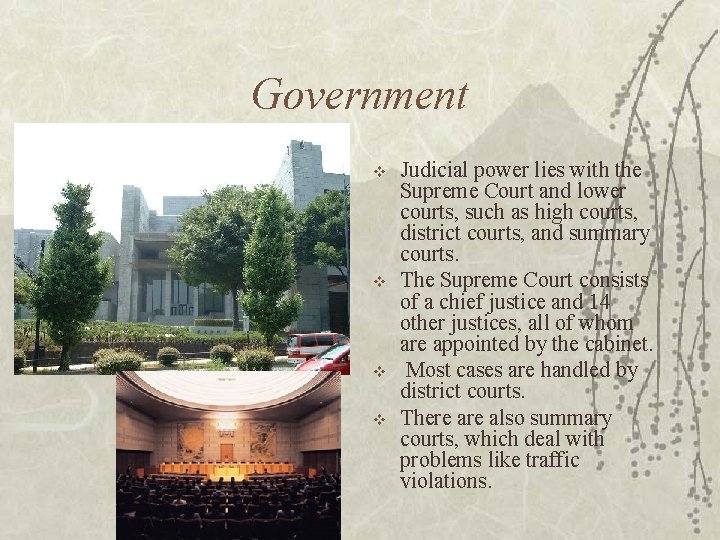
Government v v Judicial power lies with the Supreme Court and lower courts, such as high courts, district courts, and summary courts. The Supreme Court consists of a chief justice and 14 other justices, all of whom are appointed by the cabinet. Most cases are handled by district courts. There also summary courts, which deal with problems like traffic violations.
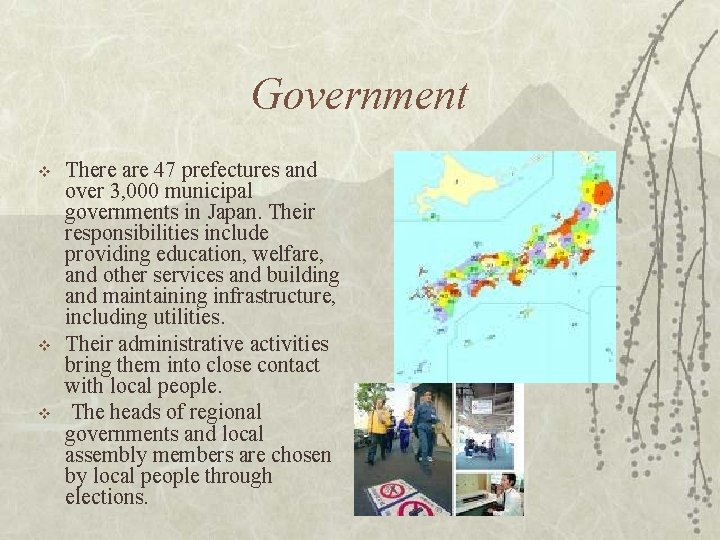
Government v v v There are 47 prefectures and over 3, 000 municipal governments in Japan. Their responsibilities include providing education, welfare, and other services and building and maintaining infrastructure, including utilities. Their administrative activities bring them into close contact with local people. The heads of regional governments and local assembly members are chosen by local people through elections.
Government
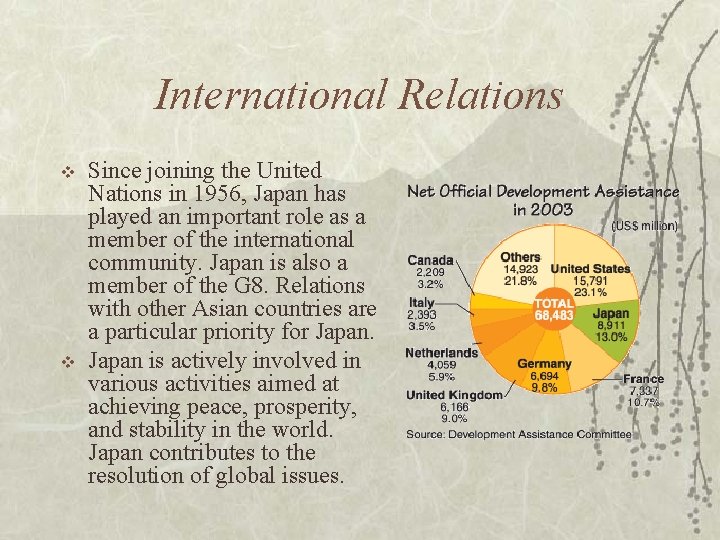
International Relations v v Since joining the United Nations in 1956, Japan has played an important role as a member of the international community. Japan is also a member of the G 8. Relations with other Asian countries are a particular priority for Japan is actively involved in various activities aimed at achieving peace, prosperity, and stability in the world. Japan contributes to the resolution of global issues.
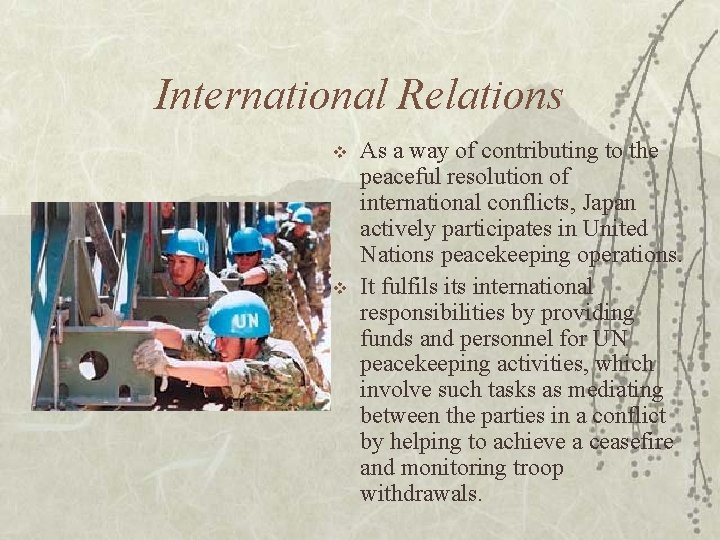
International Relations v v As a way of contributing to the peaceful resolution of international conflicts, Japan actively participates in United Nations peacekeeping operations. It fulfils its international responsibilities by providing funds and personnel for UN peacekeeping activities, which involve such tasks as mediating between the parties in a conflict by helping to achieve a ceasefire and monitoring troop withdrawals.
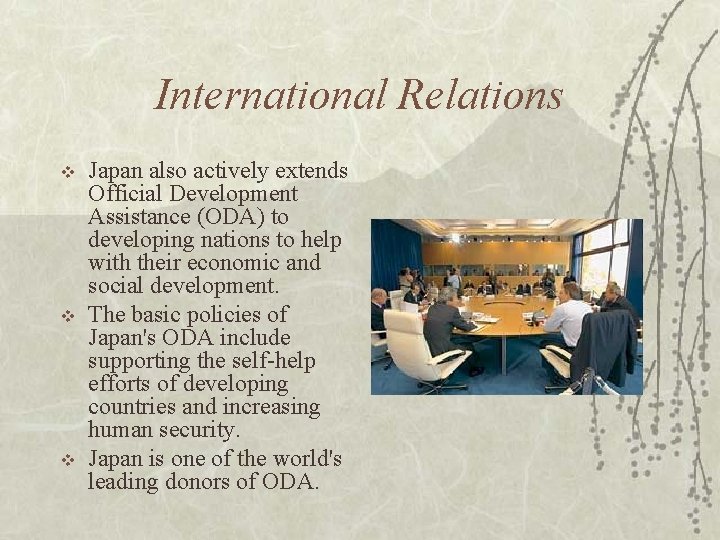
International Relations v v v Japan also actively extends Official Development Assistance (ODA) to developing nations to help with their economic and social development. The basic policies of Japan's ODA include supporting the self-help efforts of developing countries and increasing human security. Japan is one of the world's leading donors of ODA.
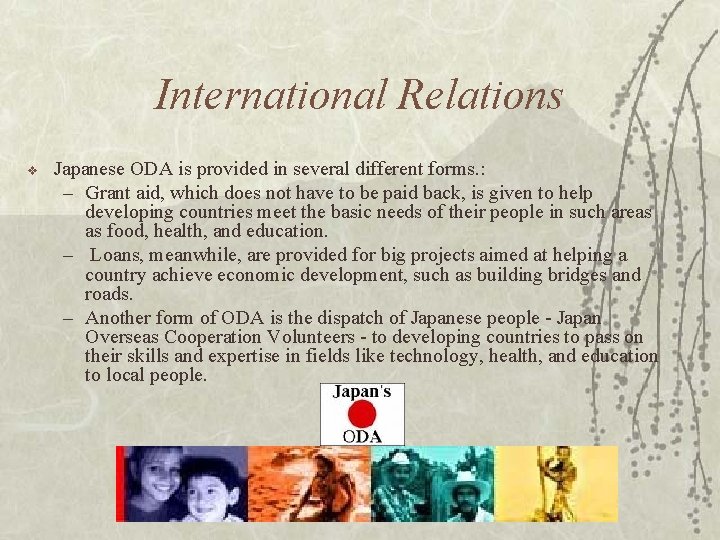
International Relations v Japanese ODA is provided in several different forms. : – Grant aid, which does not have to be paid back, is given to help developing countries meet the basic needs of their people in such areas as food, health, and education. – Loans, meanwhile, are provided for big projects aimed at helping a country achieve economic development, such as building bridges and roads. – Another form of ODA is the dispatch of Japanese people - Japan Overseas Cooperation Volunteers - to developing countries to pass on their skills and expertise in fields like technology, health, and education to local people.
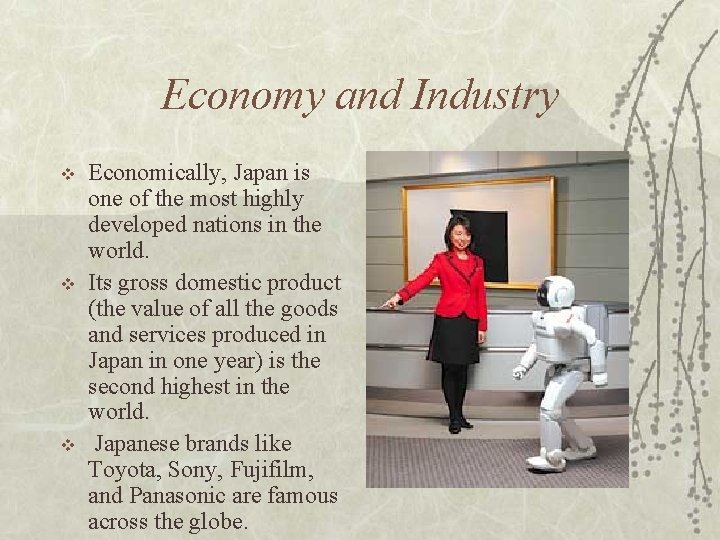
Economy and Industry v v v Economically, Japan is one of the most highly developed nations in the world. Its gross domestic product (the value of all the goods and services produced in Japan in one year) is the second highest in the world. Japanese brands like Toyota, Sony, Fujifilm, and Panasonic are famous across the globe.
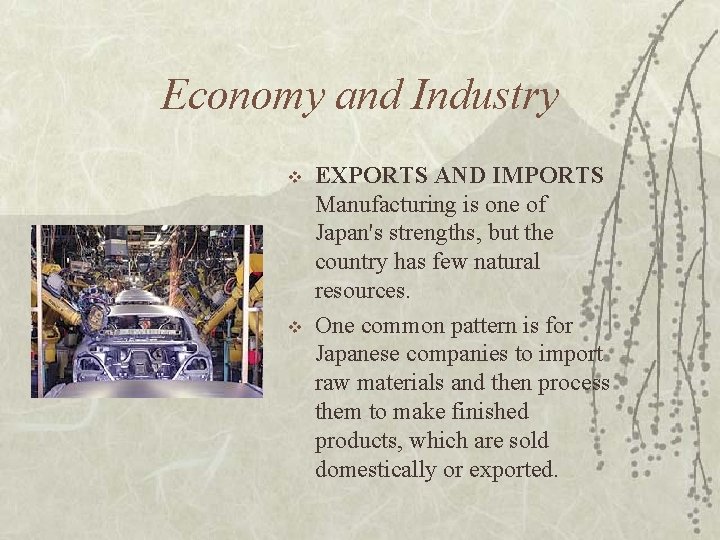
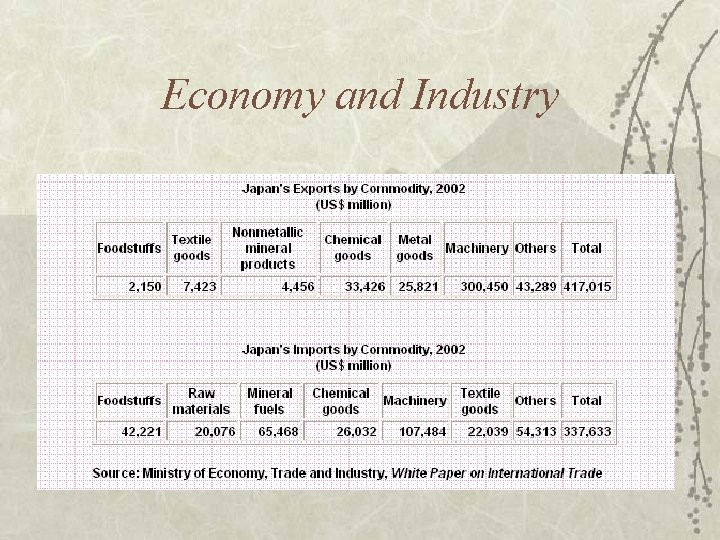
Economy and Industry v v EXPORTS AND IMPORTS Manufacturing is one of Japan's strengths, but the country has few natural resources. One common pattern is for Japanese companies to import raw materials and then process them to make finished products, which are sold domestically or exported.
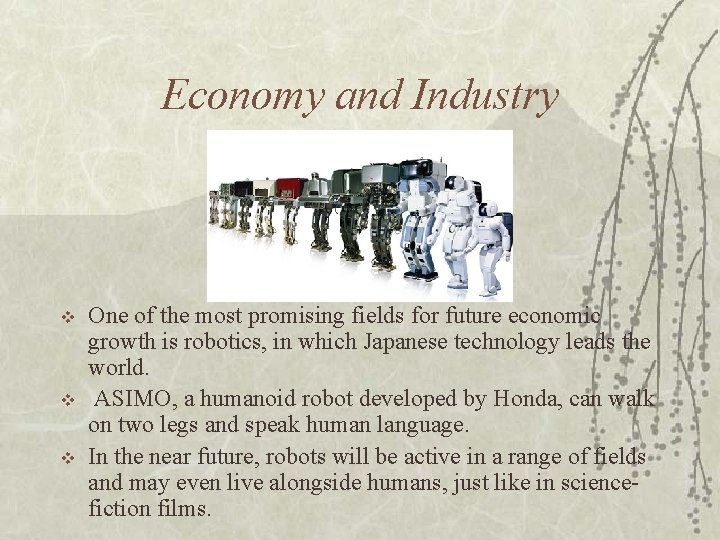
Economy and Industry v v v One of the most promising fields for future economic growth is robotics, in which Japanese technology leads the world. ASIMO, a humanoid robot developed by Honda, can walk on two legs and speak human language. In the near future, robots will be active in a range of fields and may even live alongside humans, just like in sciencefiction films.
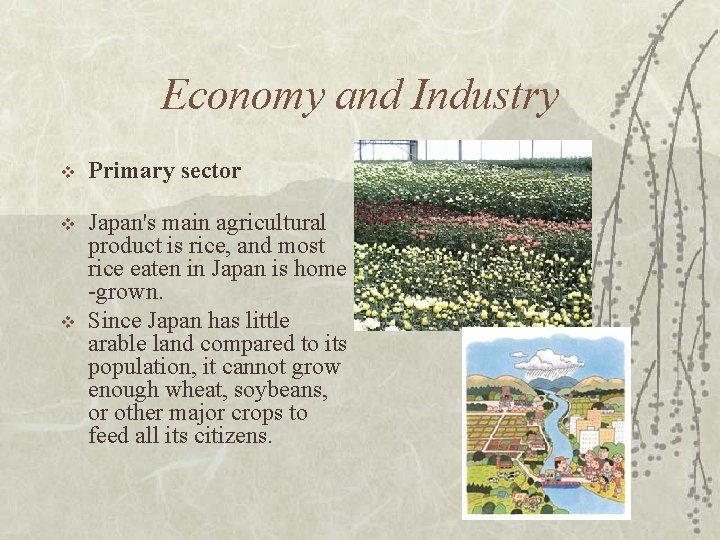
Economy and Industry v Primary sector v Japan's main agricultural product is rice, and most rice eaten in Japan is home -grown. Since Japan has little arable land compared to its population, it cannot grow enough wheat, soybeans, or other major crops to feed all its citizens. v
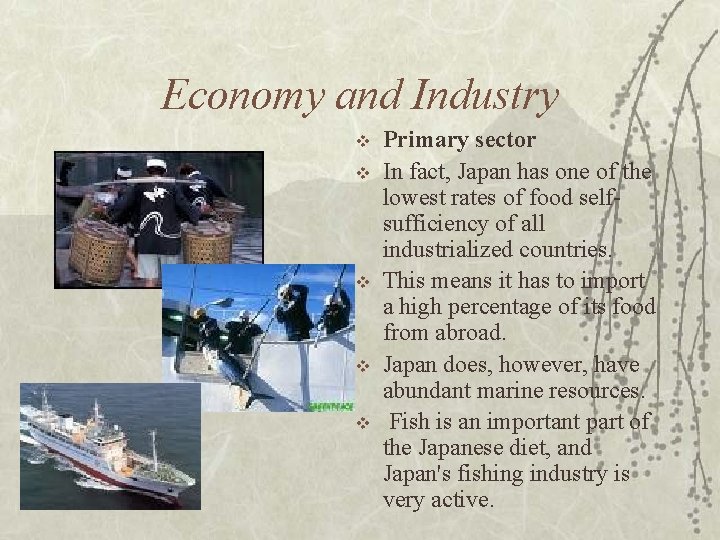
Economy and Industry v v v Primary sector In fact, Japan has one of the lowest rates of food selfsufficiency of all industrialized countries. This means it has to import a high percentage of its food from abroad. Japan does, however, have abundant marine resources. Fish is an important part of the Japanese diet, and Japan's fishing industry is very active.
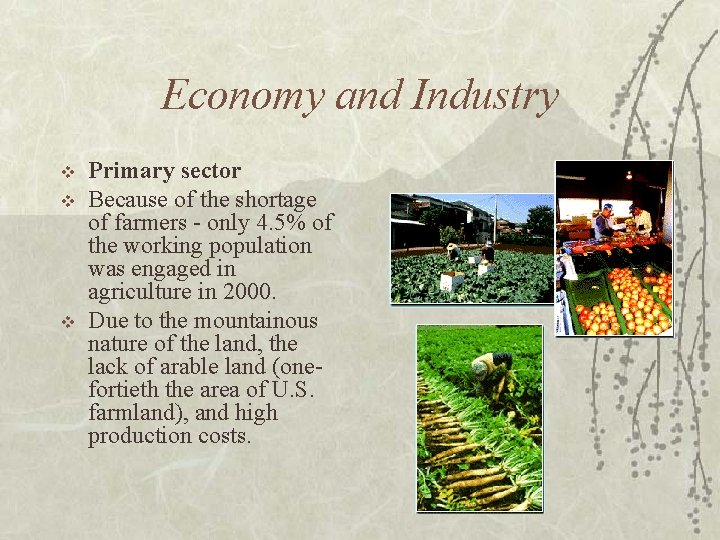
Economy and Industry v v v Primary sector Because of the shortage of farmers - only 4. 5% of the working population was engaged in agriculture in 2000. Due to the mountainous nature of the land, the lack of arable land (onefortieth the area of U. S. farmland), and high production costs.
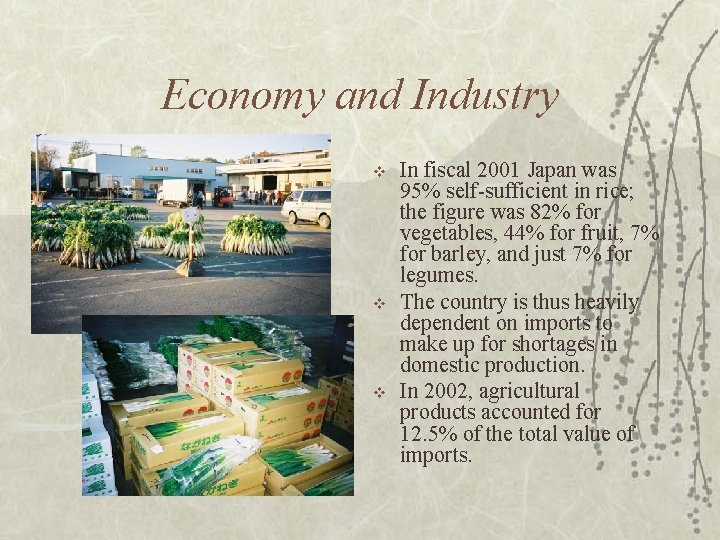
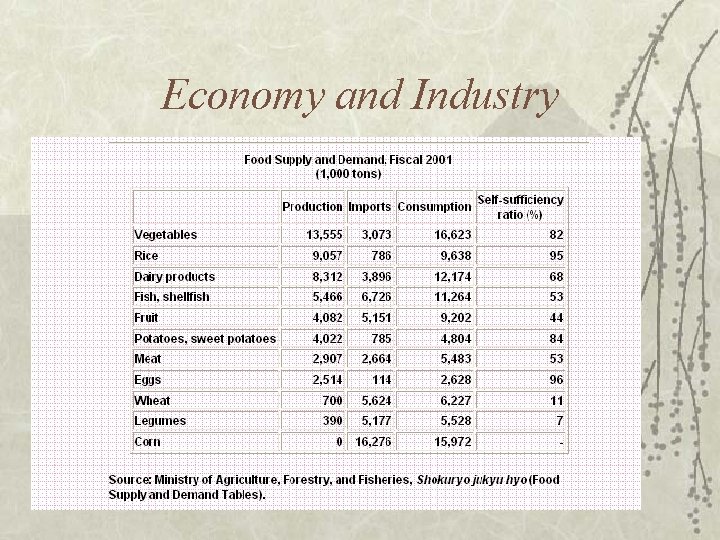
Economy and Industry v v v In fiscal 2001 Japan was 95% self-sufficient in rice; the figure was 82% for vegetables, 44% for fruit, 7% for barley, and just 7% for legumes. The country is thus heavily dependent on imports to make up for shortages in domestic production. In 2002, agricultural products accounted for 12. 5% of the total value of imports.
Economy and Industry
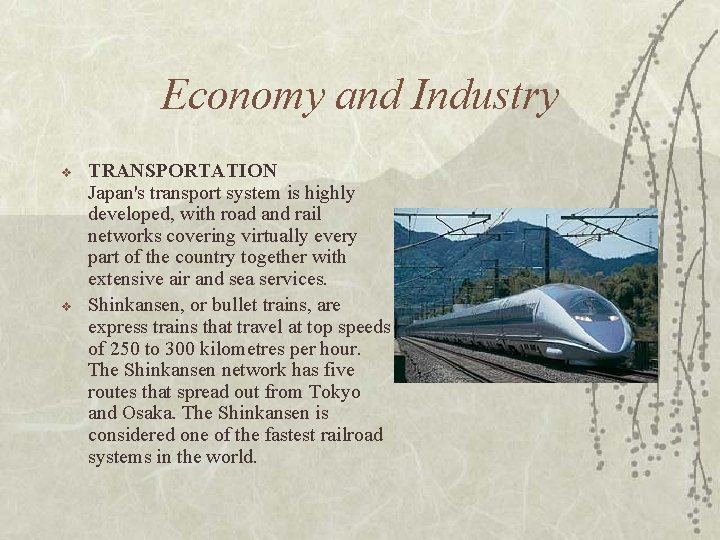
Economy and Industry v v TRANSPORTATION Japan's transport system is highly developed, with road and rail networks covering virtually every part of the country together with extensive air and sea services. Shinkansen, or bullet trains, are express trains that travel at top speeds of 250 to 300 kilometres per hour. The Shinkansen network has five routes that spread out from Tokyo and Osaka. The Shinkansen is considered one of the fastest railroad systems in the world.
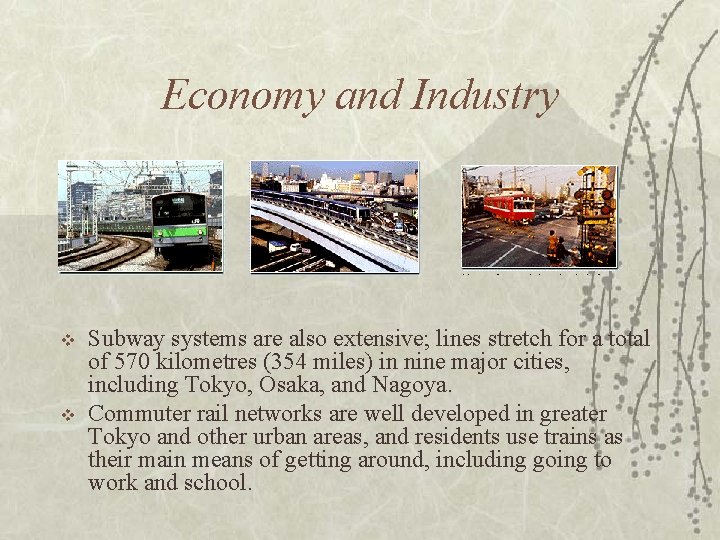
Economy and Industry v v Subway systems are also extensive; lines stretch for a total of 570 kilometres (354 miles) in nine major cities, including Tokyo, Osaka, and Nagoya. Commuter rail networks are well developed in greater Tokyo and other urban areas, and residents use trains as their main means of getting around, including going to work and school.
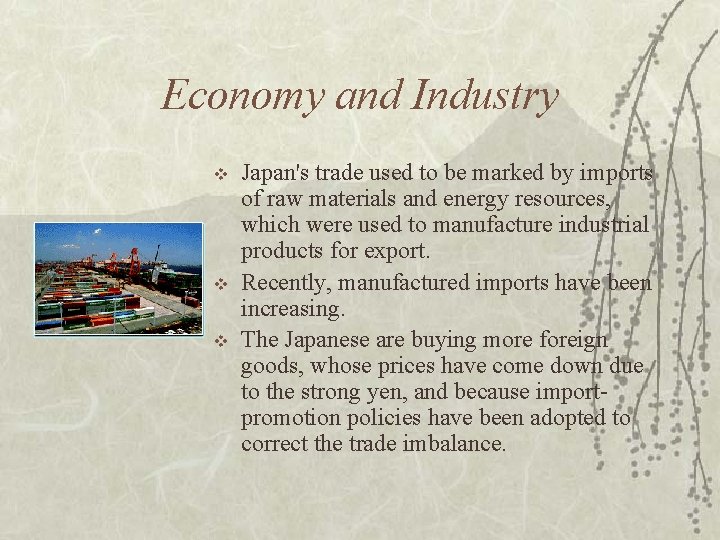
Economy and Industry v v v Japan's trade used to be marked by imports of raw materials and energy resources, which were used to manufacture industrial products for export. Recently, manufactured imports have been increasing. The Japanese are buying more foreign goods, whose prices have come down due to the strong yen, and because importpromotion policies have been adopted to correct the trade imbalance.
Economy and Industry
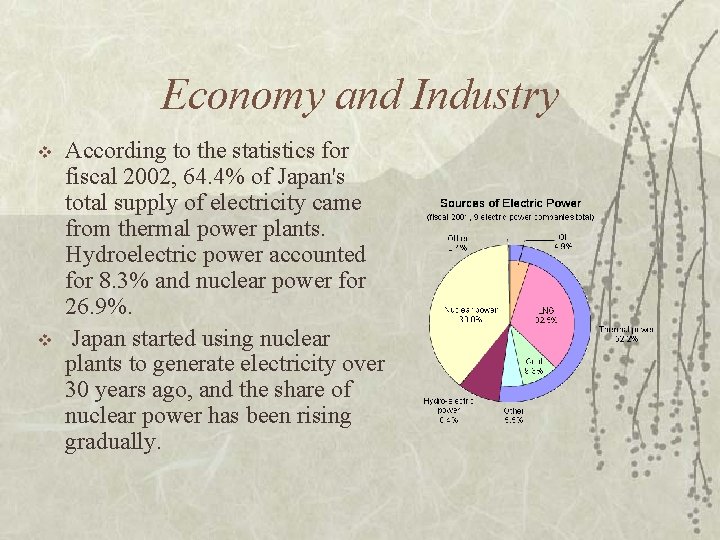
Economy and Industry v v According to the statistics for fiscal 2002, 64. 4% of Japan's total supply of electricity came from thermal power plants. Hydroelectric power accounted for 8. 3% and nuclear power for 26. 9%. Japan started using nuclear plants to generate electricity over 30 years ago, and the share of nuclear power has been rising gradually.
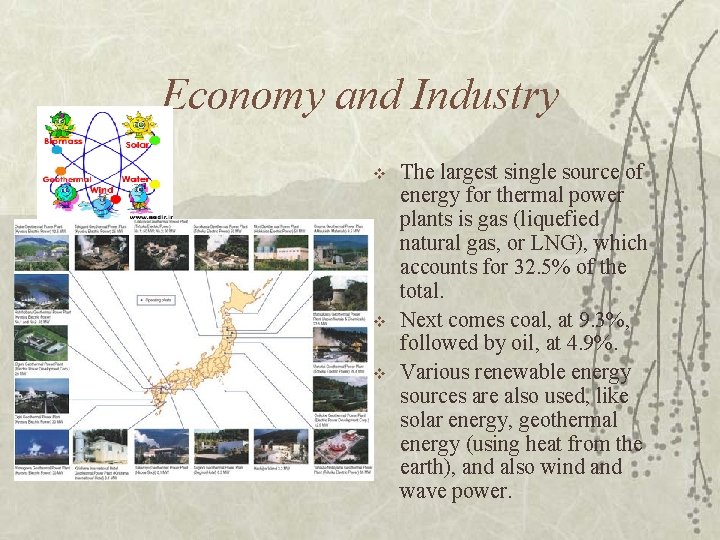
Economy and Industry v v v The largest single source of energy for thermal power plants is gas (liquefied natural gas, or LNG), which accounts for 32. 5% of the total. Next comes coal, at 9. 3%, followed by oil, at 4. 9%. Various renewable energy sources are also used, like solar energy, geothermal energy (using heat from the earth), and also wind and wave power.
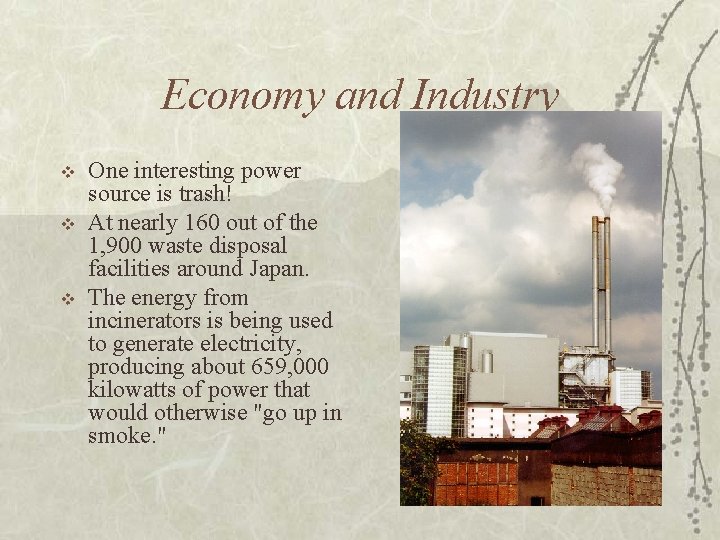
Economy and Industry v v v One interesting power source is trash! At nearly 160 out of the 1, 900 waste disposal facilities around Japan. The energy from incinerators is being used to generate electricity, producing about 659, 000 kilowatts of power that would otherwise "go up in smoke. "
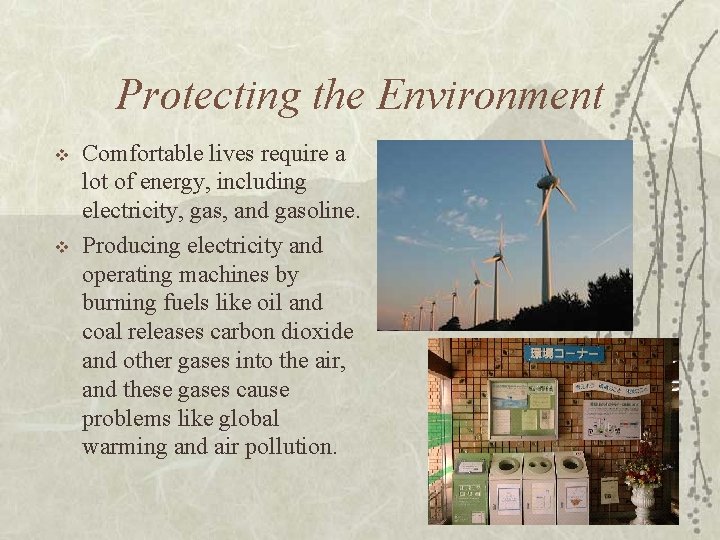
Protecting the Environment v v Comfortable lives require a lot of energy, including electricity, gas, and gasoline. Producing electricity and operating machines by burning fuels like oil and coal releases carbon dioxide and other gases into the air, and these gases cause problems like global warming and air pollution.
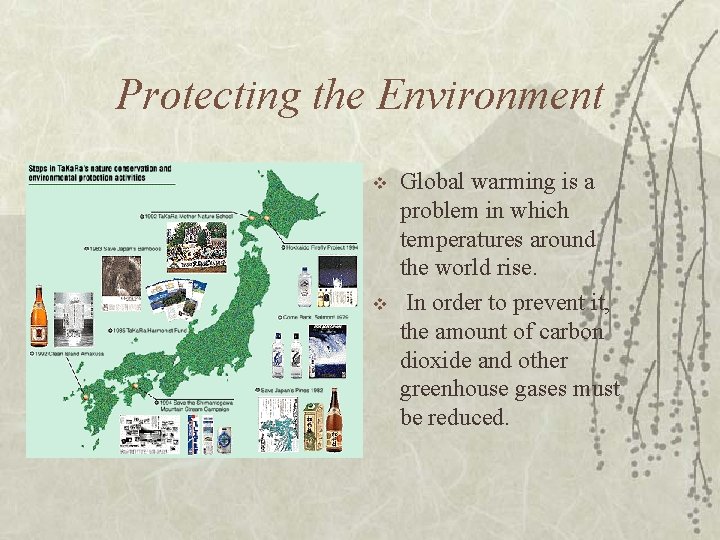
Protecting the Environment v v Global warming is a problem in which temperatures around the world rise. In order to prevent it, the amount of carbon dioxide and other greenhouse gases must be reduced.
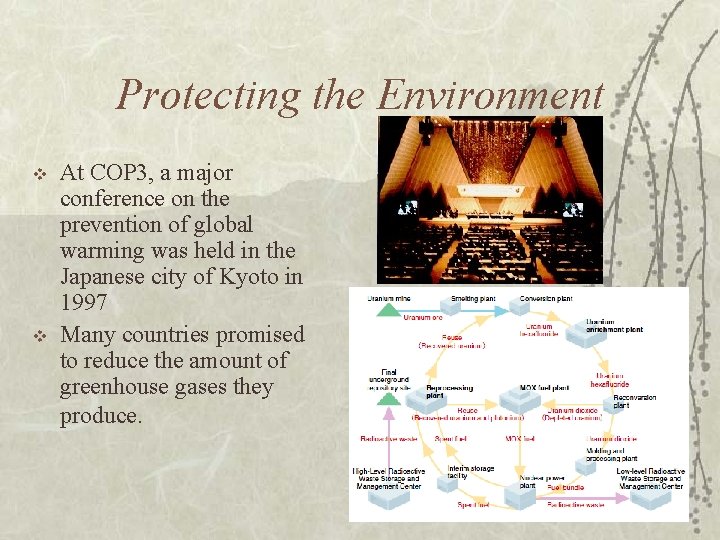
Protecting the Environment v v At COP 3, a major conference on the prevention of global warming was held in the Japanese city of Kyoto in 1997 Many countries promised to reduce the amount of greenhouse gases they produce.
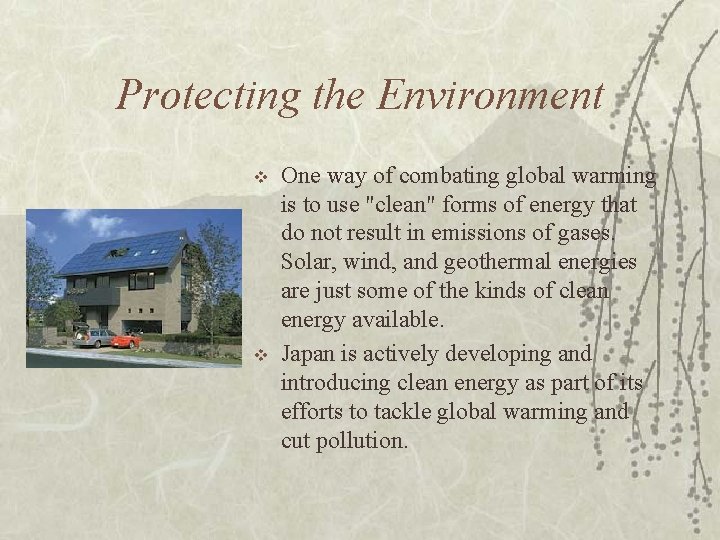
Protecting the Environment v v One way of combating global warming is to use "clean" forms of energy that do not result in emissions of gases. Solar, wind, and geothermal energies are just some of the kinds of clean energy available. Japan is actively developing and introducing clean energy as part of its efforts to tackle global warming and cut pollution.
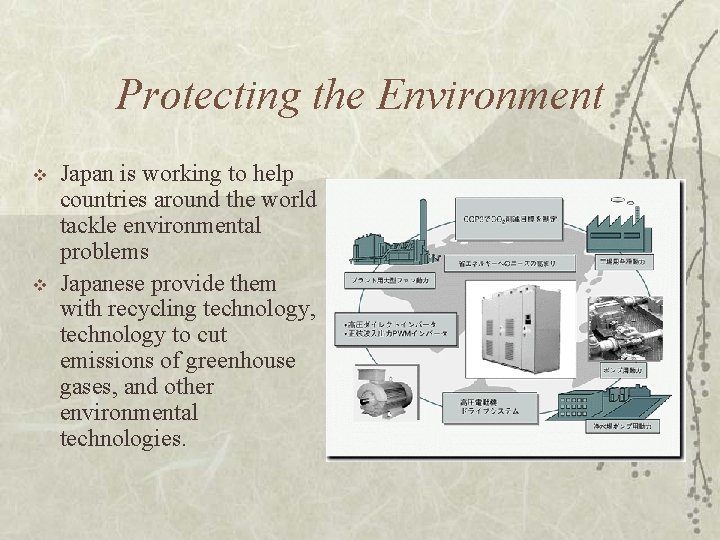
Protecting the Environment v v Japan is working to help countries around the world tackle environmental problems Japanese provide them with recycling technology, technology to cut emissions of greenhouse gases, and other environmental technologies.
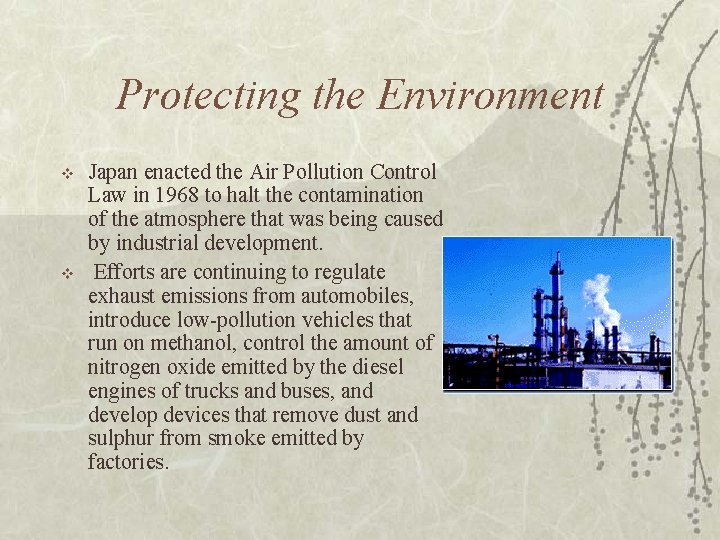
Protecting the Environment v v Japan enacted the Air Pollution Control Law in 1968 to halt the contamination of the atmosphere that was being caused by industrial development. Efforts are continuing to regulate exhaust emissions from automobiles, introduce low-pollution vehicles that run on methanol, control the amount of nitrogen oxide emitted by the diesel engines of trucks and buses, and develop devices that remove dust and sulphur from smoke emitted by factories.
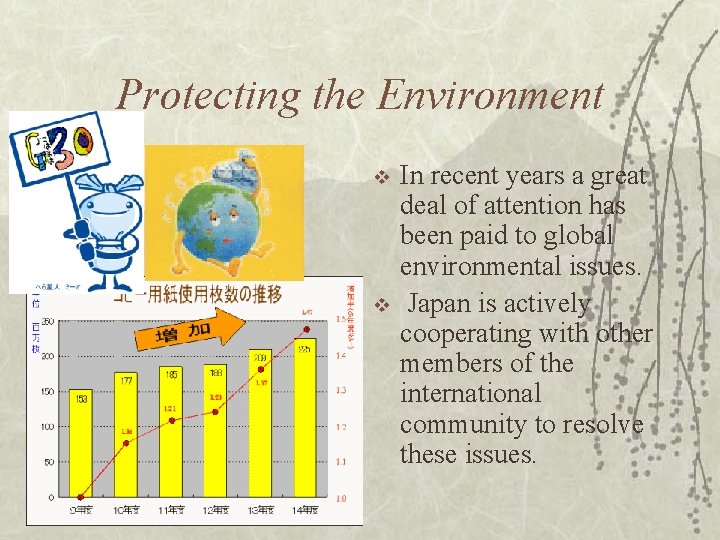
Protecting the Environment v v In recent years a great deal of attention has been paid to global environmental issues. Japan is actively cooperating with other members of the international community to resolve these issues.