
January 22 2019 Maryland Total Cost of Care
- Slides: 24
January 22, 2019 Maryland Total Cost of Care Model: Statewide Alignment and Success Maryland Department of Health, Health Services Cost Review Commission, and Maryland Hospital Association
Agenda 1. 2. Introductions Maryland’s Unique Healthcare Delivery System 1. 2. 3. Goals of the Total Cost of Care Model, 2019 -2028 1. 2. 3. 4. All-Payer Hospital Rate-Setting All-Payer Model, 2014 -2018 Hospital payment program Care Redesign Program (CRP) Population health Maryland Primary Care Program (MDPCP) State Alignment and Collaboration Across Providers 2
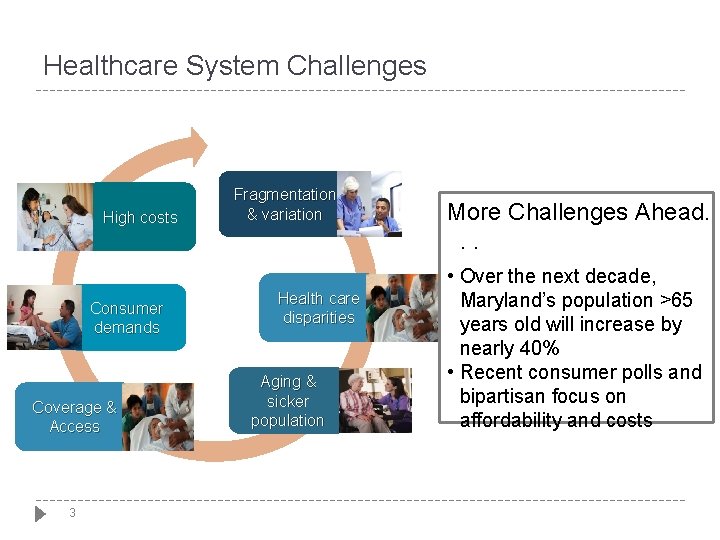
Healthcare System Challenges High costs Consumer demands Coverage & Access 3 Fragmentation & variation Health care disparities Aging & sicker population More Challenges Ahead. . . • Over the next decade, Maryland’s population >65 years old will increase by nearly 40% • Recent consumer polls and bipartisan focus on affordability and costs
Maryland’s Unique Healthcare Delivery System
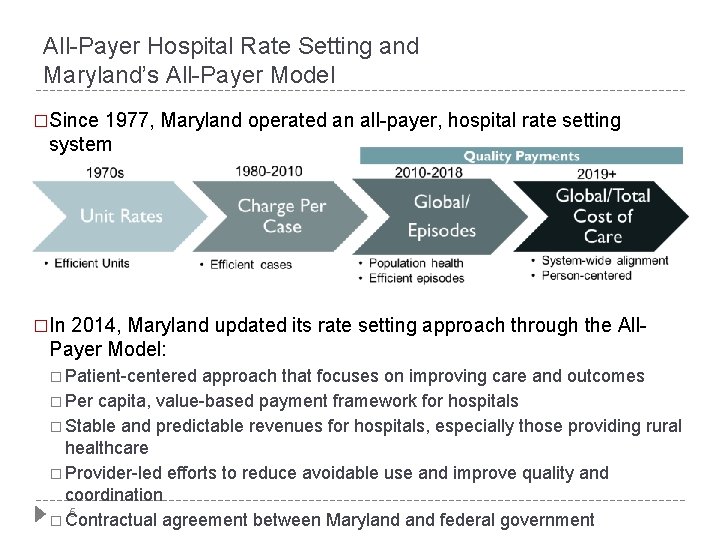
All-Payer Hospital Rate Setting and Maryland’s All-Payer Model � Since 1977, Maryland operated an all-payer, hospital rate setting system � In 2014, Maryland updated its rate setting approach through the All. Payer Model: � Patient-centered approach that focuses on improving care and outcomes � Per capita, value-based payment framework for hospitals � Stable and predictable revenues for hospitals, especially those providing rural healthcare � Provider-led efforts to reduce avoidable use and improve quality and coordination 5 � Contractual agreement between Maryland federal government
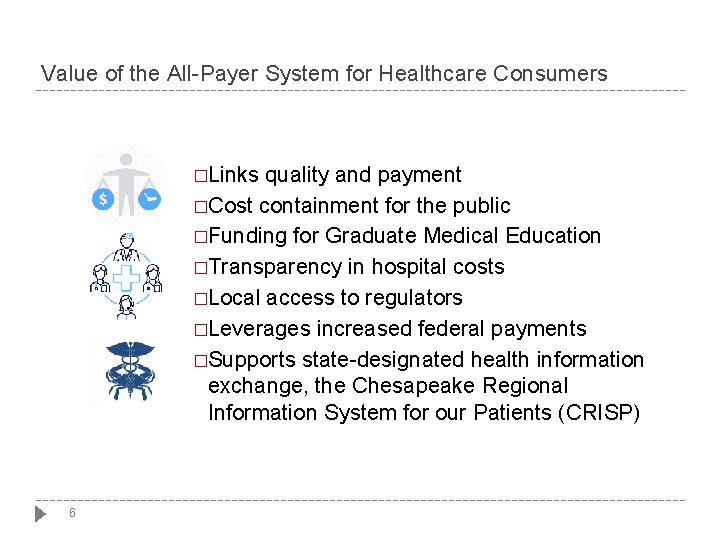
Value of the All-Payer System for Healthcare Consumers �Links quality and payment �Cost containment for the public �Funding for Graduate Medical Education �Transparency in hospital costs �Local access to regulators �Leverages increased federal payments �Supports state-designated health information exchange, the Chesapeake Regional Information System for our Patients (CRISP) 6
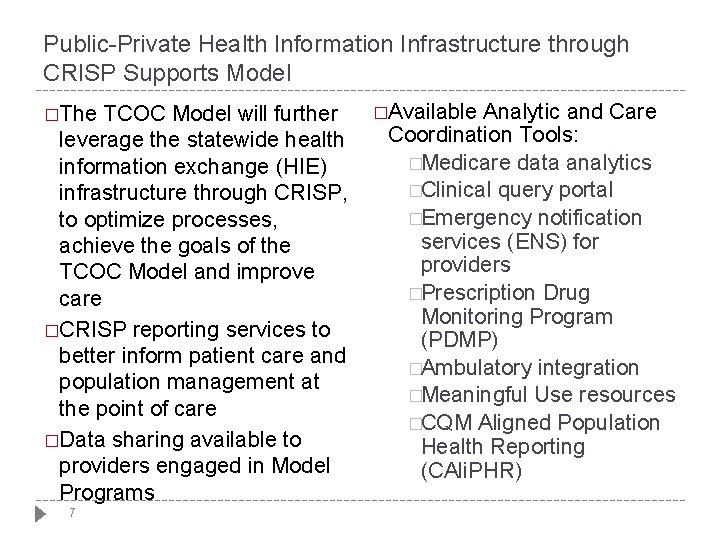
Public-Private Health Information Infrastructure through CRISP Supports Model �The TCOC Model will further leverage the statewide health information exchange (HIE) infrastructure through CRISP, to optimize processes, achieve the goals of the TCOC Model and improve care �CRISP reporting services to better inform patient care and population management at the point of care �Data sharing available to providers engaged in Model Programs 7 �Available Analytic and Care Coordination Tools: �Medicare data analytics �Clinical query portal �Emergency notification services (ENS) for providers �Prescription Drug Monitoring Program (PDMP) �Ambulatory integration �Meaningful Use resources �CQM Aligned Population Health Reporting (CAli. PHR)
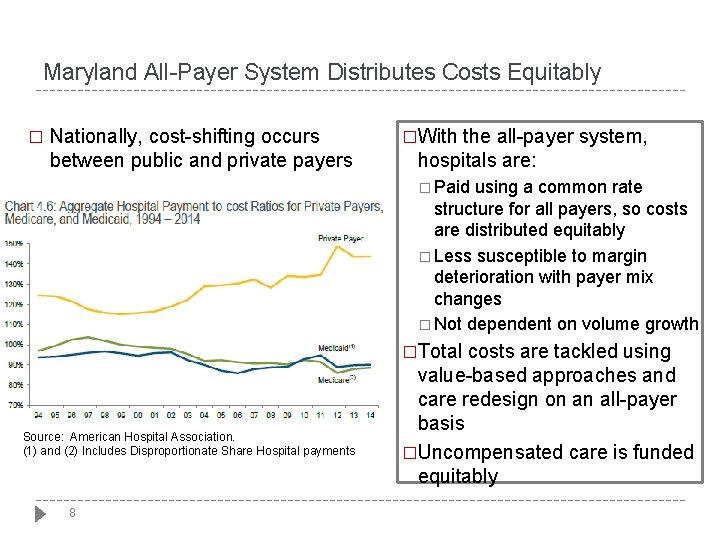
Maryland All-Payer System Distributes Costs Equitably � Nationally, cost-shifting occurs between public and private payers � With the all-payer system, hospitals are: � Paid using a common rate structure for all payers, so costs are distributed equitably � Less susceptible to margin deterioration with payer mix changes � Not dependent on volume growth � Total Source: American Hospital Association. (1) and (2) Includes Disproportionate Share Hospital payments 8 costs are tackled using value-based approaches and care redesign on an all-payer basis � Uncompensated care is funded equitably
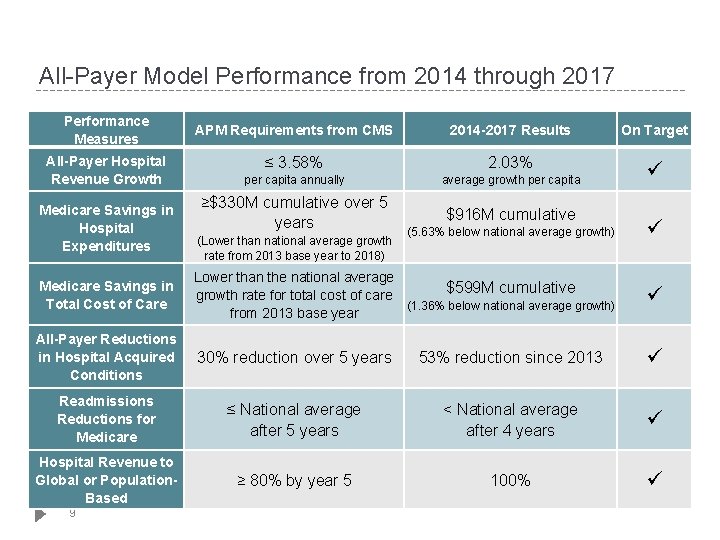
All-Payer Model Performance from 2014 through 2017 Performance Measures All-Payer Hospital Revenue Growth Medicare Savings in Hospital Expenditures APM Requirements from CMS 2014 -2017 Results On Target ≤ 3. 58% 2. 03% per capita annually average growth per capita ≥$330 M cumulative over 5 years $916 M cumulative (5. 63% below national average growth) Medicare Savings in Total Cost of Care Lower than the national average $599 M cumulative growth rate for total cost of care (1. 36% below national average growth) from 2013 base year All-Payer Reductions in Hospital Acquired Conditions 30% reduction over 5 years 53% reduction since 2013 Readmissions Reductions for Medicare ≤ National average after 5 years < National average after 4 years Hospital Revenue to Global or Population. Based ≥ 80% by year 5 100% 9 (Lower than national average growth rate from 2013 base year to 2018)
Maryland Total Cost of Care Model (2019 -2028)
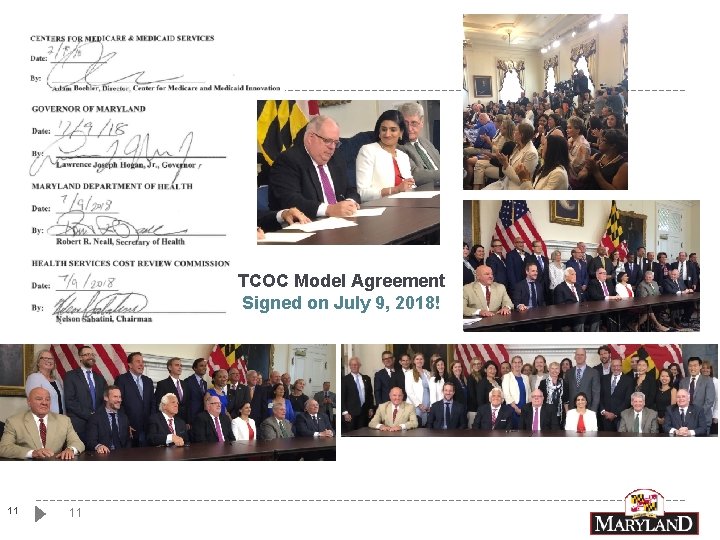
TCOC Model Agreement Signed on July 9, 2018! 11 11
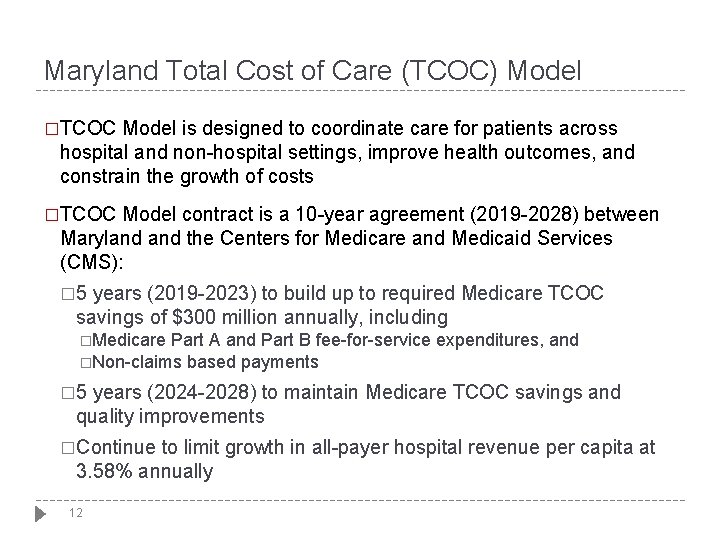
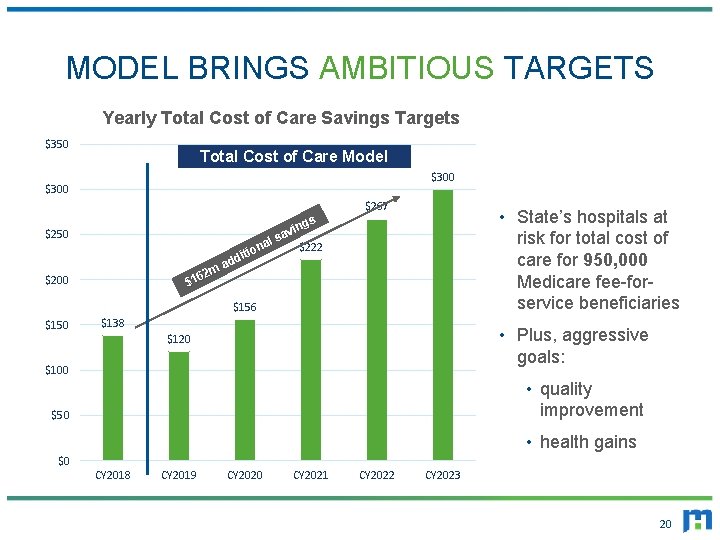
Maryland Total Cost of Care (TCOC) Model � TCOC Model is designed to coordinate care for patients across hospital and non-hospital settings, improve health outcomes, and constrain the growth of costs � TCOC Model contract is a 10 -year agreement (2019 -2028) between Maryland the Centers for Medicare and Medicaid Services (CMS): � 5 years (2019 -2023) to build up to required Medicare TCOC savings of $300 million annually, including �Medicare Part A and Part B fee-for-service expenditures, and �Non-claims based payments � 5 years (2024 -2028) to maintain Medicare TCOC savings and quality improvements � Continue to limit growth in all-payer hospital revenue per capita at 3. 58% annually 12
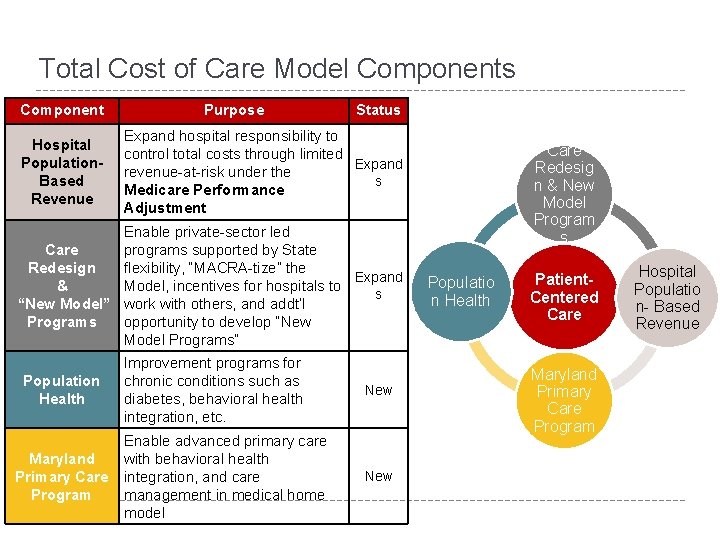
Total Cost of Care Model Components Component Hospital Population. Based Revenue Purpose Status Expand hospital responsibility to control total costs through limited Expand revenue-at-risk under the s Medicare Performance Adjustment Enable private-sector led Care programs supported by State Redesign flexibility, “MACRA-tize” the Expand & Model, incentives for hospitals to s “New Model” work with others, and addt’l Programs opportunity to develop “New Model Programs” Population Health Maryland Primary Care Program 13 Improvement programs for chronic conditions such as diabetes, behavioral health integration, etc. New Enable advanced primary care with behavioral health integration, and care management in medical home model New Care Redesig n & New Model Program s Populatio n Health Patient. Centered Care Maryland Primary Care Program Hospital Populatio n- Based Revenue
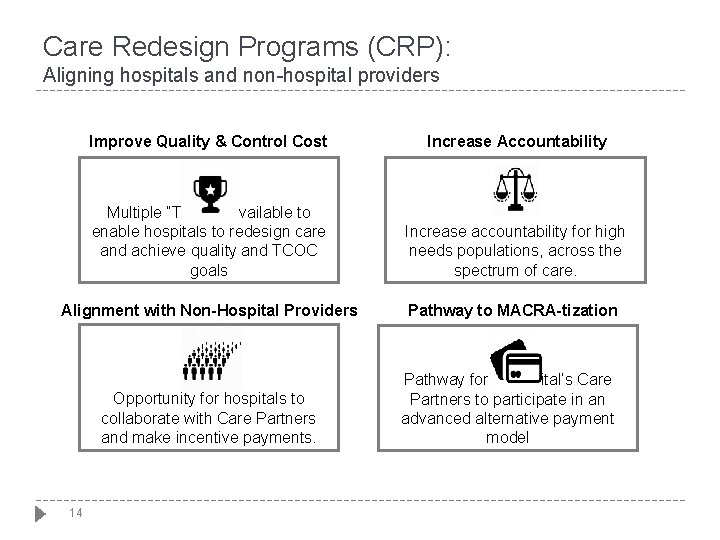
Care Redesign Programs (CRP): Aligning hospitals and non-hospital providers Improve Quality & Control Cost Increase Accountability Multiple “Tracks” available to enable hospitals to redesign care and achieve quality and TCOC goals Increase accountability for high needs populations, across the spectrum of care. Alignment with Non-Hospital Providers Pathway to MACRA-tization Opportunity for hospitals to collaborate with Care Partners and make incentive payments. 14 Pathway for a hospital’s Care Partners to participate in an advanced alternative payment model
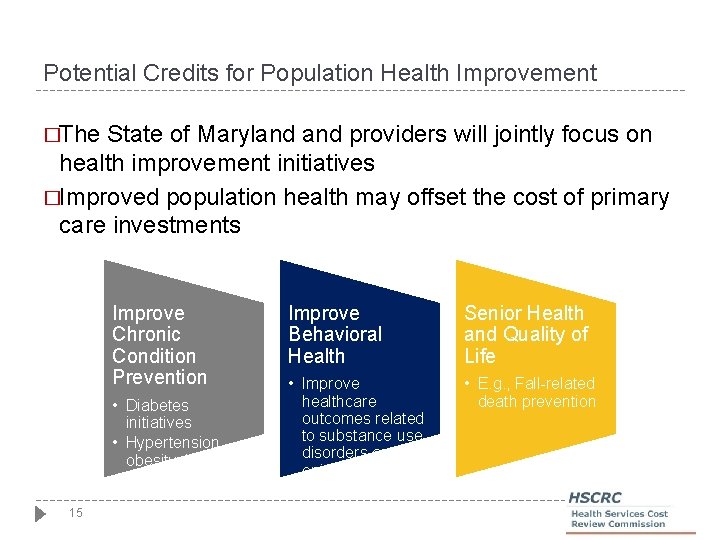
Potential Credits for Population Health Improvement �The State of Maryland providers will jointly focus on health improvement initiatives �Improved population health may offset the cost of primary care investments Improve Chronic Condition Prevention • Diabetes initiatives • Hypertension, obesity, hepatitis C, smoking, and asthma 15 Improve Behavioral Health Senior Health and Quality of Life • Improve healthcare outcomes related to substance use disorders and opioids • E. g. , Fall-related death prevention
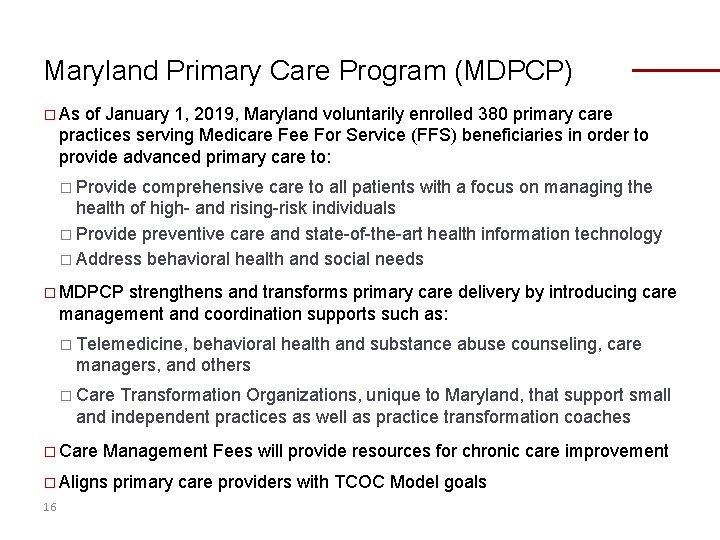
Maryland Primary Care Program (MDPCP) � As of January 1, 2019, Maryland voluntarily enrolled 380 primary care practices serving Medicare Fee For Service (FFS) beneficiaries in order to provide advanced primary care to: � Provide comprehensive care to all patients with a focus on managing the health of high- and rising-risk individuals � Provide preventive care and state-of-the-art health information technology � Address behavioral health and social needs � MDPCP strengthens and transforms primary care delivery by introducing care management and coordination supports such as: � Telemedicine, behavioral health and substance abuse counseling, care managers, and others � Care Transformation Organizations, unique to Maryland, that support small and independent practices as well as practice transformation coaches � Care Management Fees will provide resources for chronic care improvement � Aligns 16 primary care providers with TCOC Model goals
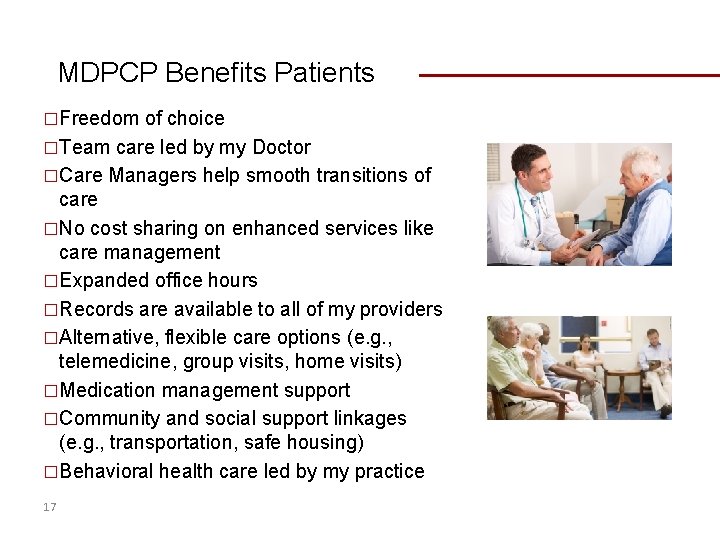
MDPCP Benefits Patients � Freedom of choice � Team care led by my Doctor � Care Managers help smooth transitions of care � No cost sharing on enhanced services like care management � Expanded office hours � Records are available to all of my providers � Alternative, flexible care options (e. g. , telemedicine, group visits, home visits) � Medication management support � Community and social support linkages (e. g. , transportation, safe housing) � Behavioral health care led by my practice 17
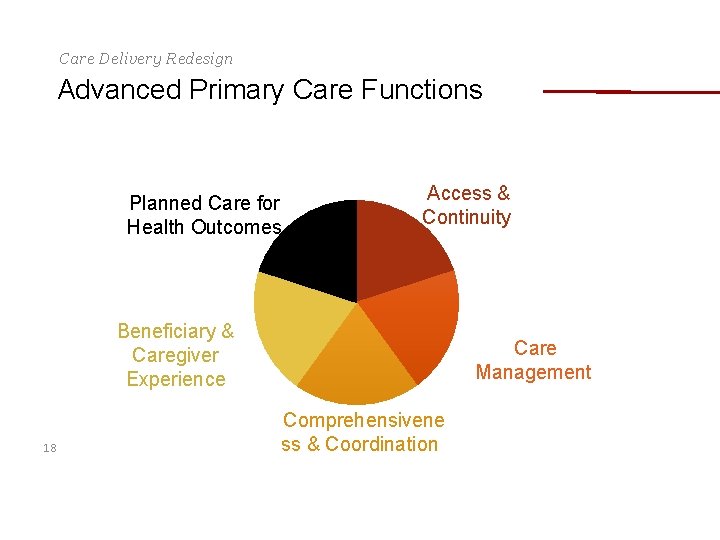
Care Delivery Redesign Advanced Primary Care Functions Planned Care for Health Outcomes Access & Continuity Beneficiary & Caregiver Experience 18 Care Management Comprehensivene ss & Coordination
Hospital Perspective and Opportunities for Alignment across the Healthcare Continuum
MODEL BRINGS AMBITIOUS TARGETS Yearly Total Cost of Care Savings Targets $350 Total Cost of Care Model $300 $267 • State’s hospitals at risk for total cost of care for 950, 000 Medicare fee-forservice beneficiaries gs vin a s al $222 n o iti d ad m 2 6 $1 $250 $200 $156 $150 $138 • Plus, aggressive goals: $120 $100 • quality improvement $50 • health gains $0 CY 2018 CY 2019 CY 2020 CY 2021 CY 2022 CY 2023 20
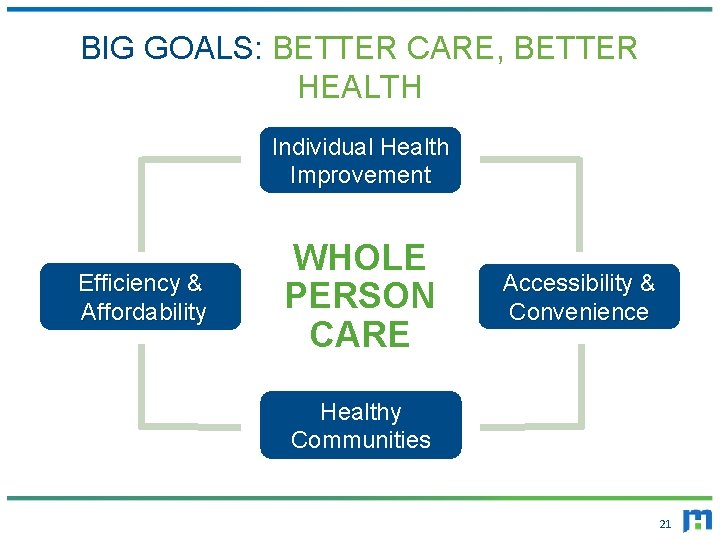
BIG GOALS: BETTER CARE, BETTER HEALTH Individual Health Improvement Efficiency & Affordability WHOLE PERSON CARE Accessibility & Convenience Healthy Communities 21
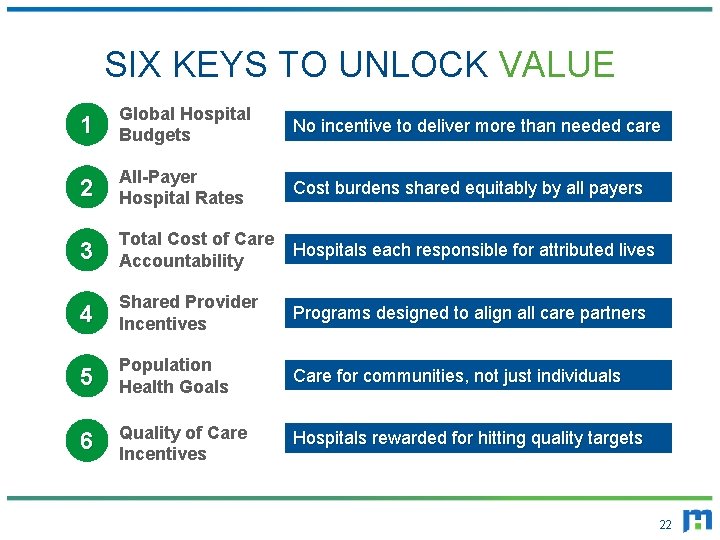
SIX KEYS TO UNLOCK VALUE 1 Global Hospital Budgets No incentive to deliver more than needed care 2 All-Payer Hospital Rates Cost burdens shared equitably by all payers 3 Total Cost of Care Accountability Hospitals each responsible for attributed lives 4 Shared Provider Incentives Programs designed to align all care partners 5 Population Health Goals Care for communities, not just individuals 6 Quality of Care Incentives Hospitals rewarded for hitting quality targets 22
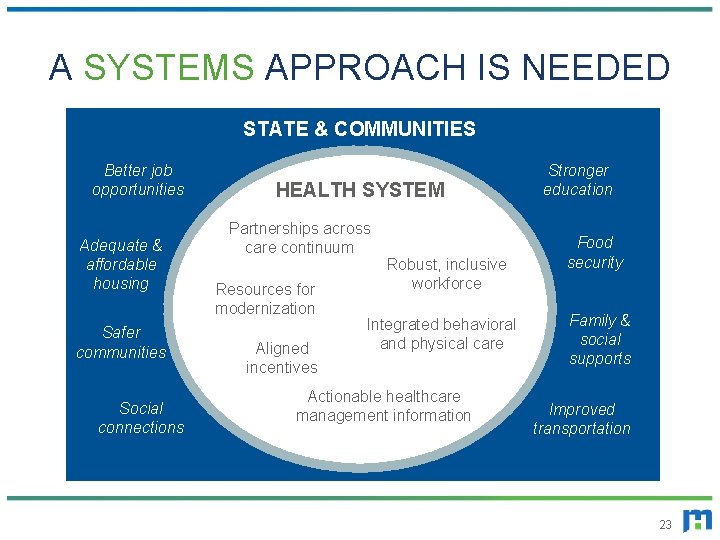
A SYSTEMS APPROACH IS NEEDED STATE & COMMUNITIES Better job opportunities Adequate & affordable housing Safer communities Social connections HEALTH SYSTEM Partnerships across care continuum Resources for modernization Aligned incentives Robust, inclusive workforce Integrated behavioral and physical care Actionable healthcare management information Stronger education Food security Family & social supports Improved transportation 23
Katie Wunderlich, Executive Director, HSCRC Howard Haft, Executive Director, MDPCP Bob Atlas, President & CEO, MHA Thank you!