
Jane Austen 1775 1817 v Born in Hampshire
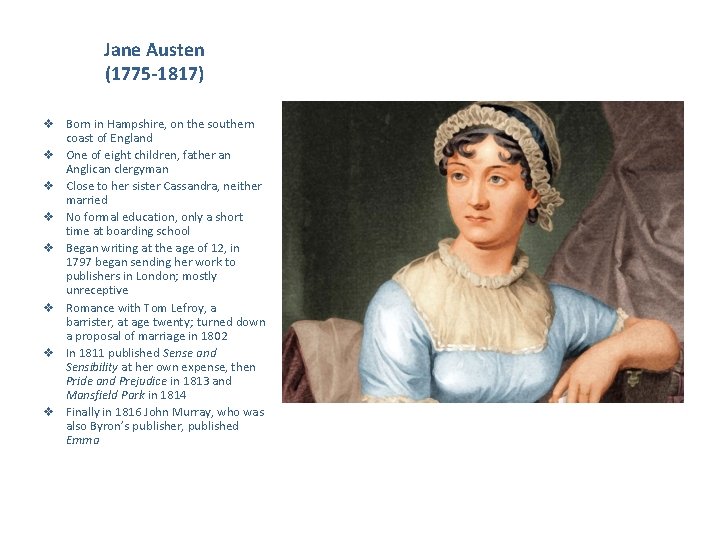
Jane Austen (1775 -1817) v Born in Hampshire, on the southern coast of England v One of eight children, father an Anglican clergyman v Close to her sister Cassandra, neither married v No formal education, only a short time at boarding school v Began writing at the age of 12, in 1797 began sending her work to publishers in London; mostly unreceptive v Romance with Tom Lefroy, a barrister, at age twenty; turned down a proposal of marriage in 1802 v In 1811 published Sense and Sensibility at her own expense, then Pride and Prejudice in 1813 and Mansfield Park in 1814 v Finally in 1816 John Murray, who was also Byron’s publisher, published Emma
"I am almost afraid to tell you how my Irish friend and I behaved. Imagine to yourself everything most profligate and shocking in the way of dancing and sitting down together. ”—from a letter to her sister Cassandra
"The day will come on which I flirt my last with Tom Lefroy and when you receive this it will be all over. My tears flow as I write at this melancholy idea„ from a letter to her sister
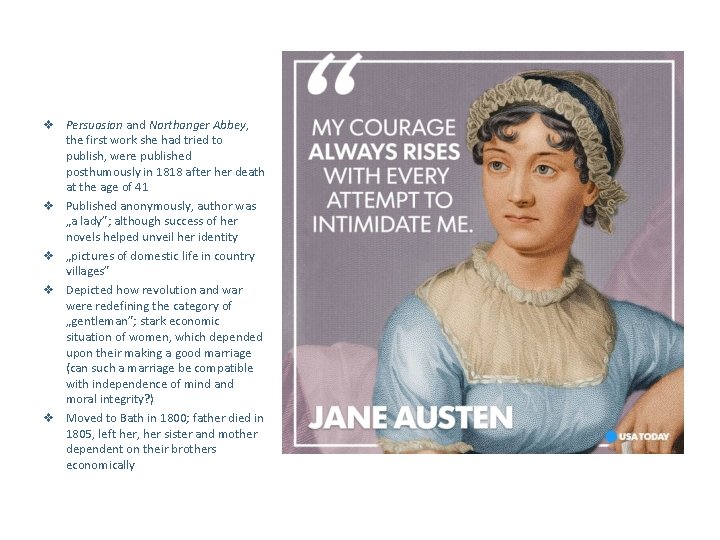
v Persuasion and Northanger Abbey, the first work she had tried to publish, were published posthumously in 1818 after her death at the age of 41 v Published anonymously, author was „a lady”; although success of her novels helped unveil her identity v „pictures of domestic life in country villages” v Depicted how revolution and war were redefining the category of „gentleman”; stark economic situation of women, which depended upon their making a good marriage (can such a marriage be compatible with independence of mind and moral integrity? ) v Moved to Bath in 1800; father died in 1805, left her, her sister and mother dependent on their brothers economically
Austen wrote a letter to her niece, Fanny Knight, who had asked for advice about a serious relationship in 1814: "having written so much on one side of the question, I shall now turn around & entreat you not to commit yourself farther, & not to think of accepting him unless you really do like him. Anything is to be preferred or endured rather than marrying without Affection"
In Sense and Sensibility Elinor Dashwood observes that "the worst and most irremediable of all evils” is „a connection for life" with an unsuitable man
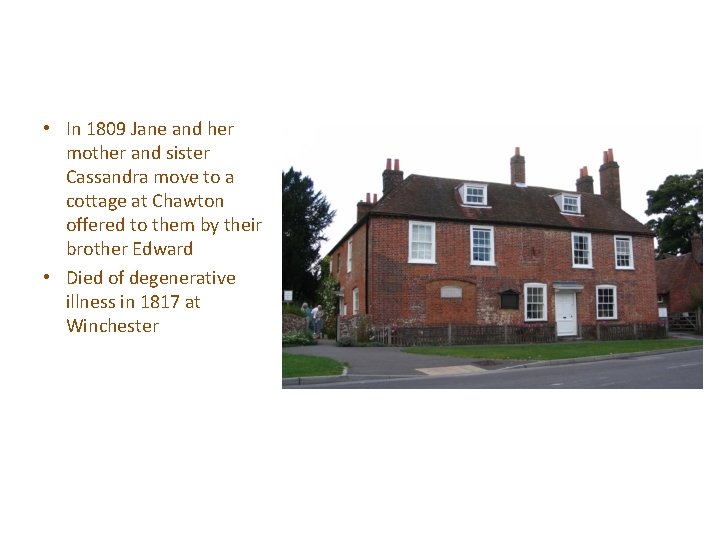
• In 1809 Jane and her mother and sister Cassandra move to a cottage at Chawton offered to them by their brother Edward • Died of degenerative illness in 1817 at Winchester
„It is a truth universally acknowledged, that a single man in possession of a good fortune, must be in want of a wife. ”
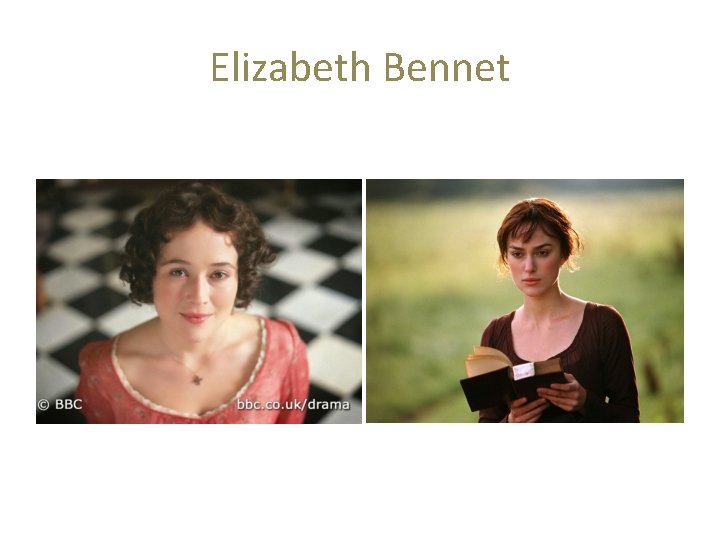
Elizabeth Bennet
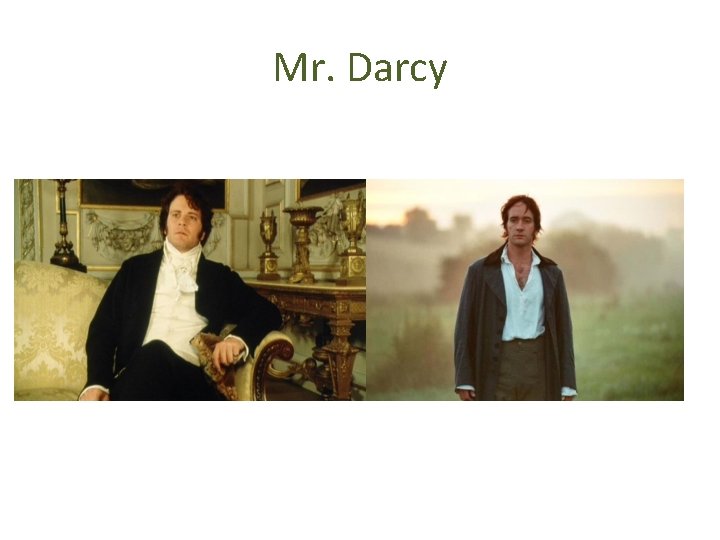
Mr. Darcy
Other characters: Jane Bennet Mr. Bingley Mr. And Mrs. Bennet Mary, Kitty, Lydia Bennet Mr. Collins Charlotte Lucas Lady Catherine De. Bourgh Mr. Wickham
„Oh! You are a great deal too apt you know, to like people in general. You never see a fault in any body. All the world are good and agreeable in your eyes. I never heard you speak ill of a human being in my life. ’ ‚I would wish not to be hasty in censuring any one; but I always speak what I think. ’ ‚I know you do, and it is that which makes the wonder. With your good sense, to be so honestly blind to the follies and nonsense of others! Affectation of candour is common enough; --one meets it every where. But to be candid without ostentation or design—to take the good of every body’s character and make it still better, and say nothing of the bad—belongs to you alone. And so, you like this man’s sisters too, do you? Their manners are not equal to his. ’
‚Certainly not; at first. But they are very pleasing women when you converse with them. Miss Bingley is to live with her brother and keep his house; and I am much mistaken if we shall not find a very charming neighbour in her. ’ Elizabeth listened in silence, but was not convinced; their behaviour at the assembly had not been calculated to please in general; and with more quickness of observation and less pliancy of temper than her sister, and with a judgment too unassailed by any attention to herself, she was very little disposed to approve them. ” –from chapter IV
„He spoke well, but there were feelings besides those of the heart to be detailed, and he was not more eloquent on the subject of tenderness than of pride. His sense of her inferiority—of its being a degradation—of the family obstacles which judgment had always opposed to inclination, were dwelt on with a warmth which seemed due to the consequence he was wounding, but was very unlikely to recommend his suit. ”
„She grew absolutely ashamed of herself. Of neither Darcy nor Wickham could she think, without feeling that she had been blind, partial, prejudiced, absurd. ”
„I have been a selfish being all my life, in practice, though not in principle. As a child I was taught what was right, but left to follow them in pride and conceit…and such I might still have been but for you, dearest, loveliest Elizabeth!”
- Slides: 16